tires INFINITI EX 2012 User Guide
[x] Cancel search | Manufacturer: INFINITI, Model Year: 2012, Model line: EX, Model: INFINITI EX 2012Pages: 506, PDF Size: 7.27 MB
Page 404 of 506

WARNING
.The Anti-lock Braking System (ABS) is a
sophisticated device, but it cannot pre-
vent accidents resulting from careless or
dangerous driving techniques. It can
help maintain vehicle control during
braking on slippery surfaces. Remember
that stopping distances on slippery
surfaces will be longer than on normal
surfaces even with ABS. Stopping dis-
tances may also be longer on rough,
gravel or snow covered roads, or if you
are using tire chains. Always maintain a
safe distance from the vehicle in front of
you. Ultimately, the driver is responsible
for safety.
. Tire type and condition may also affect
braking effectiveness.
—When replacing tires, install the
specified size of tires on all four
wheels.
—When installing a spare tire, make
sure that it is the proper size and
type as specified on the Tire and
Loading Information label. See “Tireand loading information label”
in the
“9. Technical and consumer informa-
tion” section of this manual.
—For detailed information, see
“Wheels and tires” in the“8. Main-
tenance and do-it-yourself” section
of this manual.
The Anti-lock Braking System (ABS) con-
trols the brakes so the wheels do not lock
during hard braking or when braking on
slippery surfaces. The system detects the
rotation speed at each wheel and varies
the brake fluid pressure to prevent each
wheel from locking and sliding. By pre-
venting each wheel from locking, the
system helps the driver maintain steering
control and helps to minimize swerving
and spinning on slippery surfaces.
Using the systemGUID-3868867B-C702-4422-8A3D-5F07812E8BFB
WARNING
Do not pump the brake pedal. Doing so may
result in increased stopping distances.
Self-test featureGUID-8C38208D-BDD0-4E16-BA43-F07BEDECBDAB
Page 406 of 506

WARNING
.The VDC system is designed to help
improve driving stability but does not
prevent accidents due to abrupt steering
operation at high speeds or by careless
or dangerous driving techniques. Reduce
vehicle speed and be especially careful
when driving and cornering on slippery
surfaces and always drive carefully. .
Do not modify the vehicle’s suspension.
If suspension parts such as shock
absorbers, struts, springs, stabilizer
bars, bushings and wheels are not
INFINITI recommended for your vehicle
or are extremely deteriorated, the VDC
system may not operate properly. This
could adversely affect vehicle handling
performance, and the VDC warning light
may illuminate.
. If brake related parts such as brake
pads, rotors and calipers are not INFINITI
recommended or are extremely deterio-
rated, the VDC system may not operate
properly and the VDC warning light
may illuminate.
. If engine control related parts are not
INFINITI recommended or are extremely
deteriorated, the VDC warning light
may illuminate.
. When driving on extremely inclined
surfaces such as higher banked corners,
the VDC system may not operate prop-
erly and the VDC warning light
may
illuminate. Do not drive on these types
of roads.
. When driving on an unstable surface
such as a turntable, ferry, elevator or ramp, the VDC warning light
may
illuminate. This is not a malfunction.
Restart the engine after driving onto a
stable surface.
. If wheels or tires other than the INFINITI
recommended ones are used, the VDC
system may not operate properly and
the VDC warning light
may illumi-
nate.
. The VDC system is not a substitute for
winter tires or tire chains on a snow
covered road.
Starting and driving5-87
Page 412 of 506
WARNING
.Make sure the parking brake is securely
applied and the automatic transmission is in the P (Park) position.
. Never change tires when the vehicle is
on a slope, ice or slippery areas. This is
hazardous.
. Never change tires if oncoming traffic is
close to your vehicle. Wait for profes-
sional road assistance.
In case of emergency6-3
Page 416 of 506

WARNING
.Incorrect wheel nuts or improperly tigh-
tened wheel nuts can cause the wheel to
become loose or come off. This could
cause an accident.
. Do not use oil or grease on the wheel
studs or nuts. This could cause the nuts
to become loose.
. Retighten the wheel nuts when the
vehicle has been driven for 600 miles
(1,000 km) (also in cases of a flat tire,
etc.).
.As soon as possible, tighten the
wheel nuts to the specified torque
with a torque wrench.
Wheel nut tightening torque: 80 ft-lb (108 N·m)
The wheel nuts must be kept tigh-
tened to specification at all times. It is recommended that wheel nuts be
tightened to specifications at each
lubrication interval.
.Adjust tire pressure to the COLD
pressure.
COLD pressure:
After the vehicle has been parked
for three hours or more or driven
less than 1 mile (1.6 km).
COLD tire pressures are shown on
the Tire and Loading Information
label affixed to the driver side center
pillar.
Stowing the damaged tire and toolsGUID-7FB62E67-6127-48F8-A44D-D21F29D6474E
WARNING
. Always make sure that the spare tire and
jacking equipment are properly secured
after use. Such items can become
dangerous projectiles in an accident or
sudden stop. .
The T-type spare tire and small size
spare tire are designed for emergency
use. See specific instructions under the
heading “Wheels and tires” in the“8.
Maintenance and do-it-yourself” section.
If needed, Roadside Assistance is avail-
able. Please see your Warranty Information
Booklet or Roadside Assistance I.D. Card
for the toll-free number to call (U.S.) or
Warranty Information Booklet (Canada).
In case of emergency6-7
Page 423 of 506

6-14In case of emergency
WARNING
.Stand clear of a stuck vehicle.
. Do not spin your tires at high speed. This
could cause them to explode and result
in serious injury. Parts of your vehicle
could also overheat and be damaged.
Pulling a stuck vehicleGUID-F892B344-7115-42FE-AB6E-2CBEBE7F56E6
CAUTION
.Tow chains or cables must be attached
only to the vehicle recovery hooks or
main structural members of the vehicle.
Otherwise, the vehicle body will be
damaged.
. Do not use the vehicle tie downs to free
a vehicle stuck in sand, snow, mud, etc.
. Never tow a vehicle using the vehicle tie
downs or recovery hooks.
. Always pull the cable straight out from
the front of the vehicle. Never pull on the
vehicle at an angle.
. Pulling devices should be routed so they
do not touch any part of the suspension,
steering, brake or cooling systems.
. Pulling devices such as ropes or canvas
straps are not recommended for use in
vehicle towing or recovery.
Rocking a stuck vehicleGUID-CDB08C92-817C-4A2A-AB44-2EEF6FA41988
Page 463 of 506

8-30Maintenance and do-it-yourself
GUID-32E73463-7DBE-43B0-9ABF-D8632B560633
WARNING
.Improperly inflated tires can fail
suddenly and cause an accident.
. The Gross Vehicle Weight rating
(GVWR) is located on the F.M.V.S.
S./C.M.V.S.S. certification label.
The vehicle weight capacity is
indicated on the Tire and Loading
Information label. Do not load
your vehicle beyond this capacity.
Overloading your vehicle may re-
sult in reduced tire life, unsafe
operating conditions due to pre-
mature tire failure, or unfavorable
handling characteristics and could
also lead to a serious accident.
Loading beyond the specified ca-
pacity may also result in failure of
other vehicle components.
WHEELS AND TIRES
Page 465 of 506
8-32Maintenance and do-it-yourself
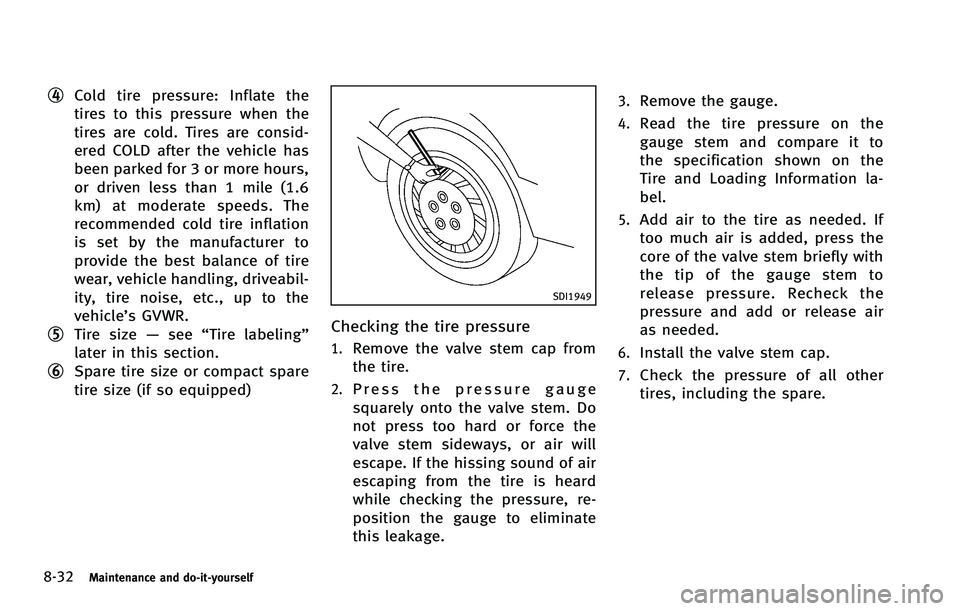
*4Cold tire pressure: Inflate the
tires to this pressure when the
tires are cold. Tires are consid-
ered COLD after the vehicle has
been parked for 3 or more hours,
or driven less than 1 mile (1.6
km) at moderate speeds. The
recommended cold tire inflation
is set by the manufacturer to
provide the best balance of tire
wear, vehicle handling, driveabil-
ity, tire noise, etc., up to the
vehicle’s GVWR.
*5Tire size—see “Tire labeling”
later in this section.
*6Spare tire size or compact spare
tire size (if so equipped)
SDI1949
Checking the tire pressureGUID-0E510B4C-5A57-43DD-B375-2BF4468D6DA6
Page 466 of 506

SIZECOLD TIRE
INFLATION
PRESSURE
FRONT
ORIGINAL TIRE P225/55R18 97V
230 kPa,
33 PSI
P245/45R19 98V 230 kPa,
33 PSI
REAR ORI-
GINAL TIRE P225/55R18 97V
230 kPa,
33 PSI
P245/45R19 98V 230 kPa,
33 PSI
SPARE TIRE T165/80R17
420 kPa,
60 PSI
T165/80D17 420 kPa,
60 PSI
SDI1575
Example
TIRE LABELINGGUID-1315CF90-2235-421A-BA3D-3C92FBA7C3A3
SDI1606
Example*1Tire size (example: P215/60R16
94H)
1.P: The
“P”indicates the tire is
designed for passenger vehicles.
(Not all tires have this informa-
tion.)
2.Three-digit number (215): This
number gives the width in milli-
meters of the tire from sidewall
edge to sidewall edge.
3.Two-digit number (60): This num-
ber, known as the aspect ratio,
Maintenance and do-it-yourself8-33
Page 467 of 506
8-34Maintenance and do-it-yourself
gives the tire’s ratio of height to
width.
4.R: The“R”stands for radial.
5.Two-digit number (16): This num-
ber is the wheel or rim diameter in
inches.
6.Two- or three-digit number (94):
This number is the tire’s load
index. It is a measurement of
how much weight each tire can
support. You may not find this
information on all tires because it
is not required by law.
7.H: Tire speed rating. You should
not drive the vehicle faster than
the tire speed rating.
SDI1607
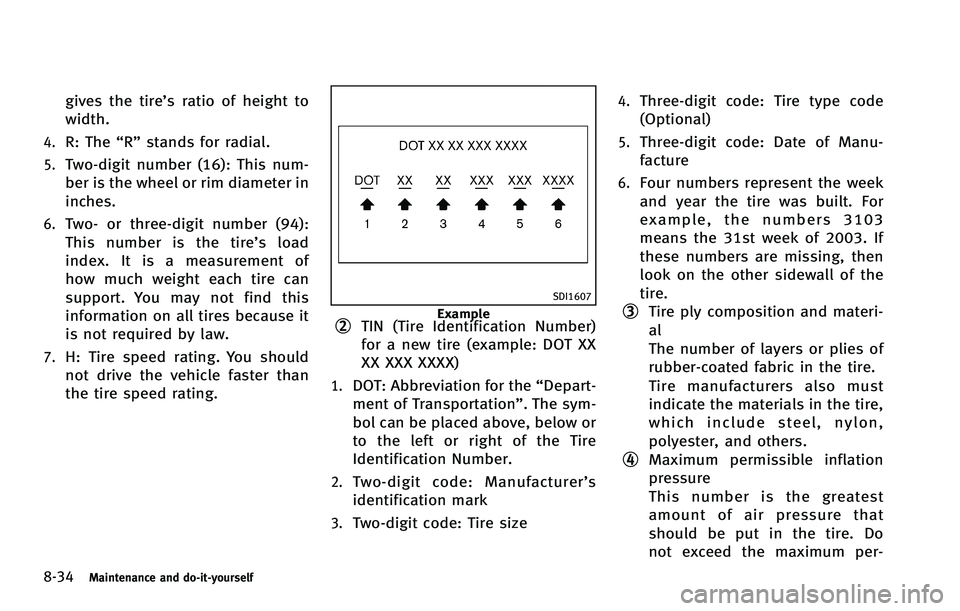
Example*2TIN (Tire Identification Number)
for a new tire (example: DOT XX
XX XXX XXXX)
1.DOT: Abbreviation for the “Depart-
ment of Transportation”. The sym-
bol can be placed above, below or
to the left or right of the Tire
Identification Number.
2.Two-digit code: Manufacturer’s
identification mark
3.Two-digit code: Tire size
4.Three-digit code: Tire type code
(Optional)
5.Three-digit code: Date of Manu-
facture
6.Four numbers represent the week
and year the tire was built. For
example, the numbers 3103
means the 31st week of 2003. If
these numbers are missing, then
look on the other sidewall of the
tire.
*3Tire ply composition and materi-
al
The number of layers or plies of
rubber-coated fabric in the tire.
Tire manufacturers also must
indicate the materials in the tire,
which include steel, nylon,
polyester, and others.
*4Maximum permissible inflation
pressure
This number is the greatest
amount of air pressure that
should be put in the tire. Do
not exceed the maximum per-
Page 468 of 506

WARNING
.When changing or replacing tires, be
sure all four tires are of the same type
(Example: Summer, All Season or Snow)
and construction. An INFINITI retailer
may be able to help you with information
about tire type, size, speed rating and
availability.
. Replacement tires may have a lower
speed rating than the factory equipped
tires, and may not match the potential
maximum vehicle speed. Never exceed
the maximum speed rating of the tire.
. Replacing tires with those not originally specified by INFINITI could affect the
proper operation of the TPMS.
. For additional information regarding
tires, refer to “Important Tire Safety
Information” (US) or“Tire Safety Infor-
mation” (Canada) in the Warranty Infor-
mation Booklet.
All season tiresGUID-9BB582D6-5DCB-4079-89B7-C19D2C973375