brakes INFINITI FX 2012 Owner's Manual
[x] Cancel search | Manufacturer: INFINITI, Model Year: 2012, Model line: FX, Model: INFINITI FX 2012Pages: 522, PDF Size: 3.51 MB
Page 408 of 522

Normal operation
The ABS operates at speeds above 3 to 6
MPH (5 to 10 km/h). The speed varies
according to road conditions.
When the ABS senses that one or more
wheels are close to locking up, the actuator
rapidly applies and releases hydraulic
pressure. This action is similar to pumping
the brakes very quickly. You may feel a
pulsation in the brake pedal and hear a
noise from under the hood or feel a
vibration from the actuator when it is
operating. This is normal and indicates
that the ABS is operating properly. How-
ever, the pulsation may indicate that road
conditions are hazardous and extra care is
required while driving.The Vehicle Dynamic Control (VDC) system
uses various sensors to monitor driver
inputs and vehicle motion. Under certain
driving conditions, the VDC system helps
to perform the following functions.
.
Controls brake pressure to reduce tire
slip on one slipping drive wheel so
power is transferred to a non slipping
drive wheel on the same axle.
. Controls brake pressure and engine
output to reduce drive wheel slip based
on vehicle speed (traction control func-
tion).
. Controls brake pressure at individual
wheels and engine output to help the
driver maintain control of the vehicle in
the following conditions:
— understeer (vehicle tends to not
follow the steered path despite
increased steering input)
— oversteer (vehicle tends to spin due
to certain road or driving condi-
tions).
The VDC system can help the driver to
maintain control of the vehicle, but it
cannot prevent loss of vehicle control in
all driving situations.
When the VDC system operates, the VDC
warning light
in the instrument panel flashes so note the following:
.
The road may be slippery or the system
may determine some action is required
to keep the vehicle on the steered path.
. You may feel a pulsation in the brake
pedal and hear a noise or vibration
from under the hood. This is normal
and indicates that the VDC system is
working properly.
. Adjust your speed and driving to the
road conditions.
See “Vehicle Dynamic Control (VDC) warn-
ing light” (P.2-18) and “Vehicle Dynamic
Control (VDC) off indicator light” (P.2-20).
If a malfunction occurs in the system, the
VDC warning light
illuminates in the
instrument panel. The VDC system auto-
matically turns off.
The VDC OFF switch is used to turn off the
VDC system. The VDC off indicator
illuminates to indicate the VDC system is
off. When the VDC switch is used to turn off
the system, the VDC system still operates
to prevent one drive wheel from slipping by
transferring power to a non slipping drive
wheel. The VDC warning light
flashes if
this occurs. All other VDC functions are off,
and the VDC warning light
will not
flash. The VDC system is automatically
Starting and driving5-83
VEHICLE DYNAMIC CONTROL (VDC) SYSTEM
Page 438 of 522
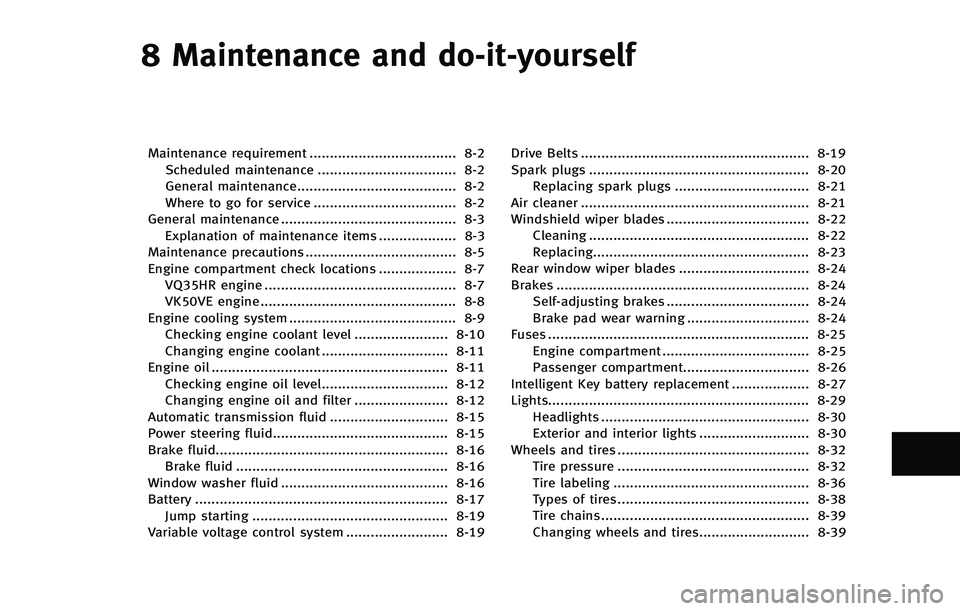
8 Maintenance and do-it-yourself
Maintenance requirement .................................... 8-2Scheduled maintenance .................................. 8-2
General maintenance....................................... 8-2
Where to go for service ................................... 8-2
General maintenance ........................................... 8-3 Explanation of maintenance items ................... 8-3
Maintenance precautions ..................................... 8-5
Engine compartment check locations ................... 8-7 VQ35HR engine ............................................... 8-7
VK50VE engine ................................................ 8-8
Engine cooling system ......................................... 8-9 Checking engine coolant level ....................... 8-10
Changing engine coolant ............................... 8-11
Engine oil .......................................................... 8-11 Checking engine oil level............................... 8-12Changing engine oil and filter ....................... 8-12
Automatic transmission fluid ............................. 8-15
Power steering fluid........................................... 8-15
Brake fluid......................................................... 8-16 Brake fluid .................................................... 8-16
Window washer fluid ......................................... 8-16
Battery .............................................................. 8-17 Jump starting ................................................ 8-19
Variable voltage control system ......................... 8-19 Drive Belts ........................................................ 8-19
Spark plugs ...................................................... 8-20
Replacing spark plugs ................................. 8-21
Air cleaner ........................................................ 8-21
Windshield wiper blades ................................... 8-22 Cleaning ...................................................... 8-22
Replacing..................................................... 8-23
Rear window wiper blades ................................ 8-24
Brakes .............................................................. 8-24 Self-adjusting brakes ................................... 8-24
Brake pad wear warning .............................. 8-24
Fuses ................................................................ 8-25 Engine compartment .................................... 8-25
Passenger compartment............................... 8-26
Intelligent Key battery replacement ................... 8-27
Lights................................................................ 8-29
Headlights ................................................... 8-30
Exterior and interior lights ........................... 8-30
Wheels and tires ............................................... 8-32 Tire pressure ............................................... 8-32
Tire labeling ................................................ 8-36
Types of tires............................................... 8-38
Tire chains ................................................... 8-39
Changing wheels and tires........................... 8-39
Page 441 of 522
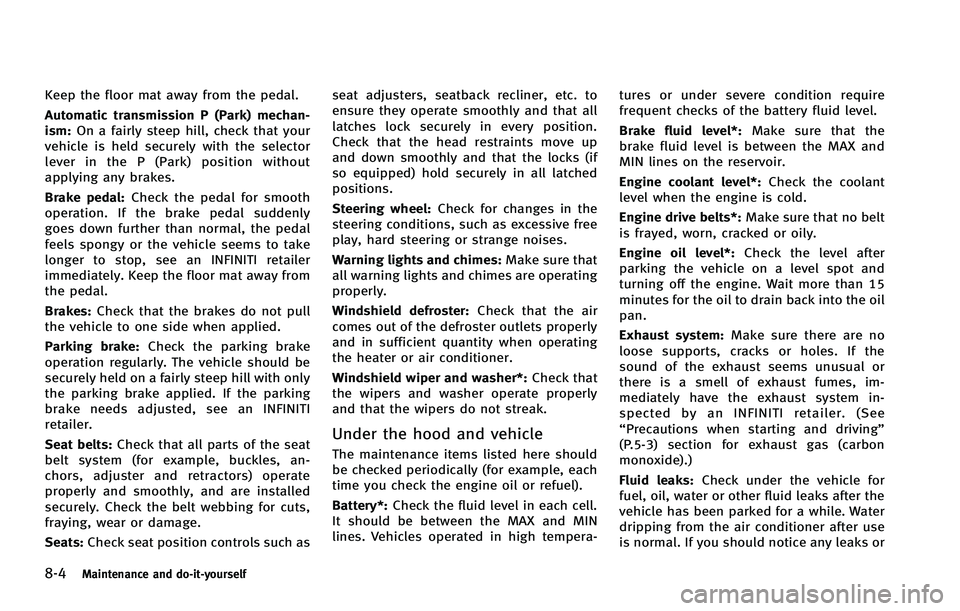
8-4Maintenance and do-it-yourself
Keep the floor mat away from the pedal.
Automatic transmission P (Park) mechan-
ism:On a fairly steep hill, check that your
vehicle is held securely with the selector
lever in the P (Park) position without
applying any brakes.
Brake pedal: Check the pedal for smooth
operation. If the brake pedal suddenly
goes down further than normal, the pedal
feels spongy or the vehicle seems to take
longer to stop, see an INFINITI retailer
immediately. Keep the floor mat away from
the pedal.
Brakes: Check that the brakes do not pull
the vehicle to one side when applied.
Parking brake: Check the parking brake
operation regularly. The vehicle should be
securely held on a fairly steep hill with only
the parking brake applied. If the parking
brake needs adjusted, see an INFINITI
retailer.
Seat belts: Check that all parts of the seat
belt system (for example, buckles, an-
chors, adjuster and retractors) operate
properly and smoothly, and are installed
securely. Check the belt webbing for cuts,
fraying, wear or damage.
Seats: Check seat position controls such as seat adjusters, seatback recliner, etc. to
ensure they operate smoothly and that all
latches lock securely in every position.
Check that the head restraints move up
and down smoothly and that the locks (if
so equipped) hold securely in all latched
positions.
Steering wheel:
Check for changes in the
steering conditions, such as excessive free
play, hard steering or strange noises.
Warning lights and chimes: Make sure that
all warning lights and chimes are operating
properly.
Windshield defroster: Check that the air
comes out of the defroster outlets properly
and in sufficient quantity when operating
the heater or air conditioner.
Windshield wiper and washer*: Check that
the wipers and washer operate properly
and that the wipers do not streak.
Under the hood and vehicle
The maintenance items listed here should
be checked periodically (for example, each
time you check the engine oil or refuel).
Battery*: Check the fluid level in each cell.
It should be between the MAX and MIN
lines. Vehicles operated in high tempera- tures or under severe condition require
frequent checks of the battery fluid level.
Brake fluid level*:
Make sure that the
brake fluid level is between the MAX and
MIN lines on the reservoir.
Engine coolant level*: Check the coolant
level when the engine is cold.
Engine drive belts*: Make sure that no belt
is frayed, worn, cracked or oily.
Engine oil level*: Check the level after
parking the vehicle on a level spot and
turning off the engine. Wait more than 15
minutes for the oil to drain back into the oil
pan.
Exhaust system: Make sure there are no
loose supports, cracks or holes. If the
sound of the exhaust seems unusual or
there is a smell of exhaust fumes, im-
mediately have the exhaust system in-
spected by an INFINITI retailer. (See
“Precautions when starting and driving”
(P.5-3) section for exhaust gas (carbon
monoxide).)
Fluid leaks: Check under the vehicle for
fuel, oil, water or other fluid leaks after the
vehicle has been parked for a while. Water
dripping from the air conditioner after use
is normal. If you should notice any leaks or
Page 461 of 522
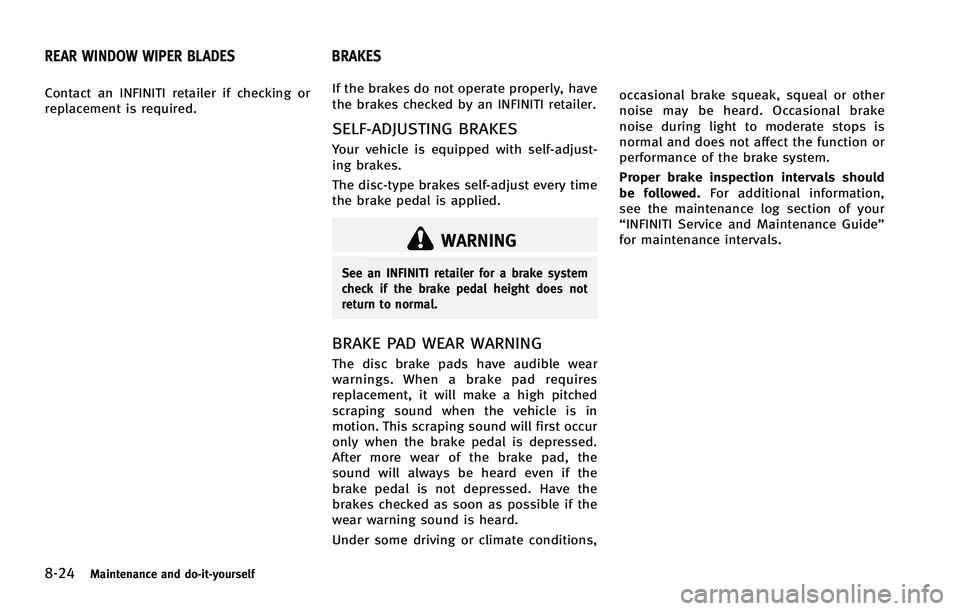
8-24Maintenance and do-it-yourself
Contact an INFINITI retailer if checking or
replacement is required.If the brakes do not operate properly, have
the brakes checked by an INFINITI retailer.
SELF-ADJUSTING BRAKES
Your vehicle is equipped with self-adjust-
ing brakes.
The disc-type brakes self-adjust every time
the brake pedal is applied.
WARNING
See an INFINITI retailer for a brake system
check if the brake pedal height does not
return to normal.
BRAKE PAD WEAR WARNING
The disc brake pads have audible wear
warnings. When a brake pad requires
replacement, it will make a high pitched
scraping sound when the vehicle is in
motion. This scraping sound will first occur
only when the brake pedal is depressed.
After more wear of the brake pad, the
sound will always be heard even if the
brake pedal is not depressed. Have the
brakes checked as soon as possible if the
wear warning sound is heard.
Under some driving or climate conditions,occasional brake squeak, squeal or other
noise may be heard. Occasional brake
noise during light to moderate stops is
normal and does not affect the function or
performance of the brake system.
Proper brake inspection intervals should
be followed.
For additional information,
see the maintenance log section of your
“INFINITI Service and Maintenance Guide”
for maintenance intervals.
REAR WINDOW WIPER BLADES BRAKES
Page 502 of 522
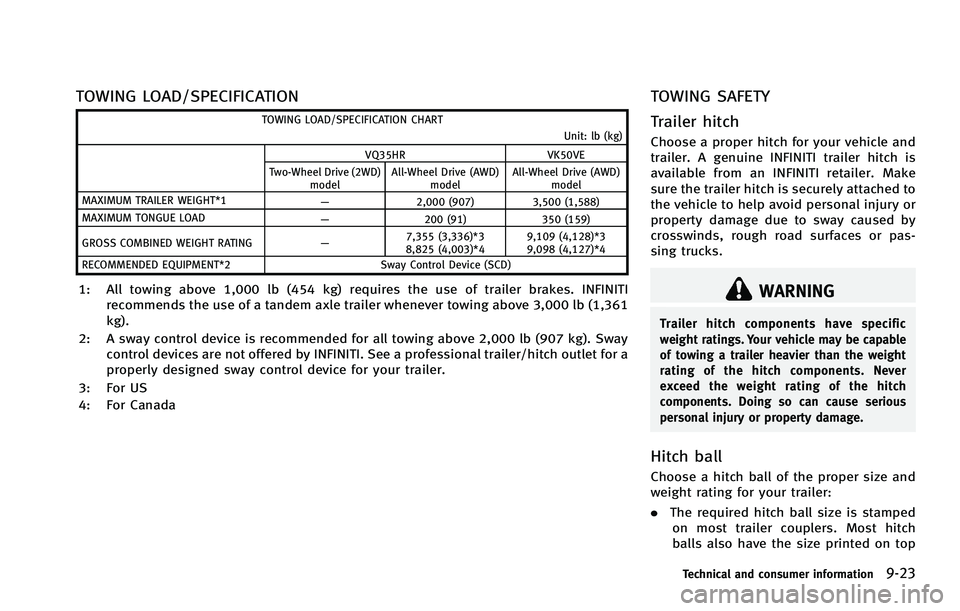
TOWING LOAD/SPECIFICATION
TOWING LOAD/SPECIFICATION CHARTUnit: lb (kg)
VQ35HR VK50VE
Two-Wheel Drive (2WD) model All-Wheel Drive (AWD)
model All-Wheel Drive (AWD)
model
MAXIMUM TRAILER WEIGHT*1 —2,000 (907) 3,500 (1,588)
MAXIMUM TONGUE LOAD —200 (91) 350 (159)
GROSS COMBINED WEIGHT RATING —7,355 (3,336)*3
8,825 (4,003)*4 9,109 (4,128)*3
9,098 (4,127)*4
RECOMMENDED EQUIPMENT*2 Sway Control Device (SCD)
1: All towing above 1,000 lb (454 kg) requires the use of trailer brakes. INFINITI
recommends the use of a tandem axle trailer whenever towing above 3,000 lb (1,361
kg).
2: A sway control device is recommended for all towing above 2,000 lb (907 kg). Sway control devices are not offered by INFINITI. See a professional trailer/hitch outlet for a
properly designed sway control device for your trailer.
3: For US
4: For Canada
TOWING SAFETY
Trailer hitch
Choose a proper hitch for your vehicle and
trailer. A genuine INFINITI trailer hitch is
available from an INFINITI retailer. Make
sure the trailer hitch is securely attached to
the vehicle to help avoid personal injury or
property damage due to sway caused by
crosswinds, rough road surfaces or pas-
sing trucks.
WARNING
Trailer hitch components have specific
weight ratings. Your vehicle may be capable
of towing a trailer heavier than the weight
rating of the hitch components. Never
exceed the weight rating of the hitch
components. Doing so can cause serious
personal injury or property damage.
Hitch ball
Choose a hitch ball of the proper size and
weight rating for your trailer:
. The required hitch ball size is stamped
on most trailer couplers. Most hitch
balls also have the size printed on top
Technical and consumer information9-23
Page 504 of 522
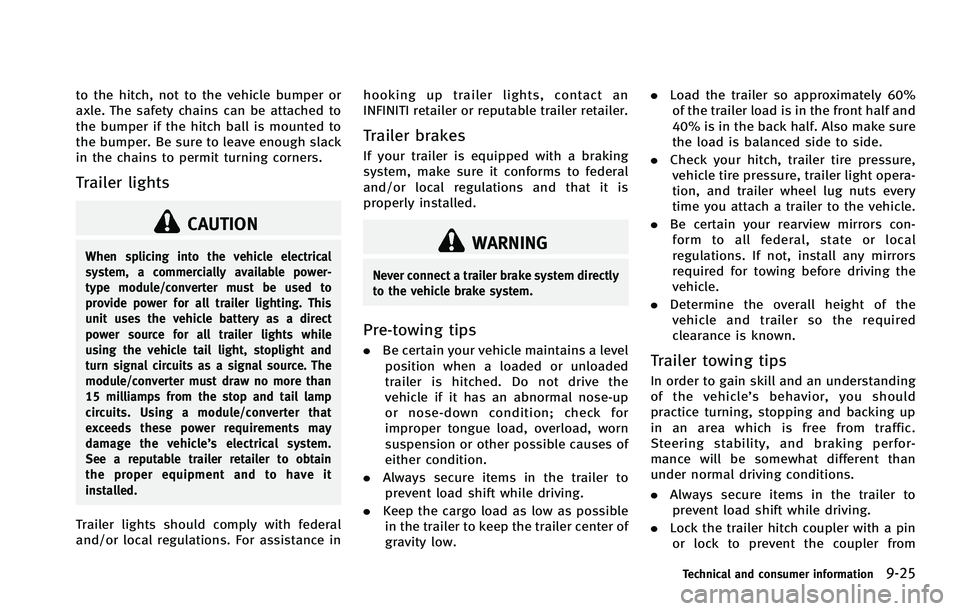
to the hitch, not to the vehicle bumper or
axle. The safety chains can be attached to
the bumper if the hitch ball is mounted to
the bumper. Be sure to leave enough slack
in the chains to permit turning corners.
Trailer lights
CAUTION
When splicing into the vehicle electrical
system, a commercially available power-
type module/converter must be used to
provide power for all trailer lighting. This
unit uses the vehicle battery as a direct
power source for all trailer lights while
using the vehicle tail light, stoplight and
turn signal circuits as a signal source. The
module/converter must draw no more than
15 milliamps from the stop and tail lamp
circuits. Using a module/converter that
exceeds these power requirements may
damage the vehicle’s electrical system.
See a reputable trailer retailer to obtain
the proper equipment and to have it
installed.
Trailer lights should comply with federal
and/or local regulations. For assistance in hooking up trailer lights, contact an
INFINITI retailer or reputable trailer retailer.
Trailer brakes
If your trailer is equipped with a braking
system, make sure it conforms to federal
and/or local regulations and that it is
properly installed.
WARNING
Never connect a trailer brake system directly
to the vehicle brake system.
Pre-towing tips
.
Be certain your vehicle maintains a level
position when a loaded or unloaded
trailer is hitched. Do not drive the
vehicle if it has an abnormal nose-up
or nose-down condition; check for
improper tongue load, overload, worn
suspension or other possible causes of
either condition.
. Always secure items in the trailer to
prevent load shift while driving.
. Keep the cargo load as low as possible
in the trailer to keep the trailer center of
gravity low. .
Load the trailer so approximately 60%
of the trailer load is in the front half and
40% is in the back half. Also make sure
the load is balanced side to side.
. Check your hitch, trailer tire pressure,
vehicle tire pressure, trailer light opera-
tion, and trailer wheel lug nuts every
time you attach a trailer to the vehicle.
. Be certain your rearview mirrors con-
form to all federal, state or local
regulations. If not, install any mirrors
required for towing before driving the
vehicle.
. Determine the overall height of the
vehicle and trailer so the required
clearance is known.Trailer towing tips
In order to gain skill and an understanding
of the vehicle’ s behavior, you should
practice turning, stopping and backing up
in an area which is free from traffic.
Steering stability, and braking perfor-
mance will be somewhat different than
under normal driving conditions.
. Always secure items in the trailer to
prevent load shift while driving.
. Lock the trailer hitch coupler with a pin
or lock to prevent the coupler from
Technical and consumer information9-25
Page 506 of 522
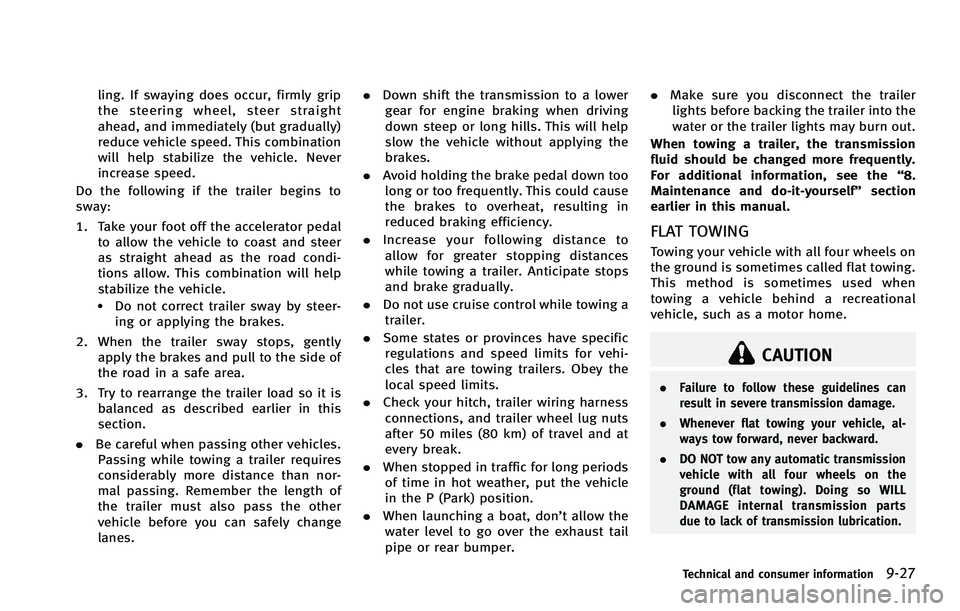
ling. If swaying does occur, firmly grip
the steering wheel, steer straight
ahead, and immediately (but gradually)
reduce vehicle speed. This combination
will help stabilize the vehicle. Never
increase speed.
Do the following if the trailer begins to
sway:
1. Take your foot off the accelerator pedal to allow the vehicle to coast and steer
as straight ahead as the road condi-
tions allow. This combination will help
stabilize the vehicle.
.Do not correct trailer sway by steer-ing or applying the brakes.
2. When the trailer sway stops, gently apply the brakes and pull to the side of
the road in a safe area.
3. Try to rearrange the trailer load so it is balanced as described earlier in this
section.
. Be careful when passing other vehicles.
Passing while towing a trailer requires
considerably more distance than nor-
mal passing. Remember the length of
the trailer must also pass the other
vehicle before you can safely change
lanes. .
Down shift the transmission to a lower
gear for engine braking when driving
down steep or long hills. This will help
slow the vehicle without applying the
brakes.
. Avoid holding the brake pedal down too
long or too frequently. This could cause
the brakes to overheat, resulting in
reduced braking efficiency.
. Increase your following distance to
allow for greater stopping distances
while towing a trailer. Anticipate stops
and brake gradually.
. Do not use cruise control while towing a
trailer.
. Some states or provinces have specific
regulations and speed limits for vehi-
cles that are towing trailers. Obey the
local speed limits.
. Check your hitch, trailer wiring harness
connections, and trailer wheel lug nuts
after 50 miles (80 km) of travel and at
every break.
. When stopped in traffic for long periods
of time in hot weather, put the vehicle
in the P (Park) position.
. When launching a boat, don’t allow the
water level to go over the exhaust tail
pipe or rear bumper. .
Make sure you disconnect the trailer
lights before backing the trailer into the
water or the trailer lights may burn out.
When towing a trailer, the transmission
fluid should be changed more frequently.
For additional information, see the “8.
Maintenance and do-it-yourself” section
earlier in this manual.
FLAT TOWING
Towing your vehicle with all four wheels on
the ground is sometimes called flat towing.
This method is sometimes used when
towing a vehicle behind a recreational
vehicle, such as a motor home.
CAUTION
. Failure to follow these guidelines can
result in severe transmission damage.
. Whenever flat towing your vehicle, al-
ways tow forward, never backward.
. DO NOT tow any automatic transmission
vehicle with all four wheels on the
ground (flat towing). Doing so WILL
DAMAGE internal transmission parts
due to lack of transmission lubrication.
Technical and consumer information9-27