trunk INFINITI FX35 2007 User Guide
[x] Cancel search | Manufacturer: INFINITI, Model Year: 2007, Model line: FX35, Model: INFINITI FX35 2007Pages: 4366, PDF Size: 55.42 MB
Page 3246 of 4366

GW-8
SQUEAK AND RATTLE TROUBLE DIAGNOSES
Revision: 2006 July 2007 FX35/FX45
TRUNK
Trunk noises are often caused by a loose jack or loose items put into the trunk by the owner.
In addition look for:
1. Trunk lid dumpers out of adjustment
2. Trunk lid striker out of adjustment
3. The trunk lid torsion bars knocking together
4. A loose license plate or bracket
Most of these incidents can be repaired by adjusting, securing or insulating the item(s) or component(s) caus-
ing the noise.
SUNROOF/HEADLINING
Noises in the sunroof/headlining area can often be traced to one of the following:
1. Sunroof lid, rail, linkage or seals making a rattle or light knocking noise
2. Sunvisor shaft shaking in the holder
3. Front or rear windshield touching headlining and squeaking
Again, pressing on the components to stop the noise while duplicating the conditions can isolate most of these
incidents. Repairs usually consist of insulating with felt cloth tape.
SEATS
When isolating seat noise it's important to note the position the seat is in and the load placed on the seat when
the noise is present. These conditions should be duplicated when verifying and isolating the cause of the
noise.
Cause of seat noise include:
1. Headrest rods and holder
2. A squeak between the seat pad cushion and frame
3. The rear seatback lock and bracket
These noises can be isolated by moving or pressing on the suspected components while duplicating the con-
ditions under which the noise occurs. Most of these incidents can be repaired by repositioning the component
or applying urethane tape to the contact area.
UNDERHOOD
Some interior noise may be caused by components under the hood or on the engine wall. The noise is then
transmitted into the passenger compartment.
Causes of transmitted underhood noise include:
1. Any component mounted to the engine wall
2. Components that pass through the engine wall
3. Engine wall mounts and connectors
4. Loose radiator mounting pins
5. Hood bumpers out of adjustment
6. Hood striker out of adjustment
These noises can be difficult to isolate since they cannot be reached from the interior of the vehicle. The best
method is to secure, move or insulate one component at a time and test drive the vehicle. Also, engine RPM
or load can be changed to isolate the noise. Repairs can usually be made by moving, adjusting, securing, or
insulating the component causing the noise.
Page 3347 of 4366

IP-1
INSTRUMENT PANEL
I BODY
CONTENTS
C
D E
F
G H
J
K L
M
SECTION
A
B
IP
Revision: 2006 July 2007 FX35/FX45
INSTRUMENT PANEL
PRECAUTIONS .......................................................... 2
Precautions for Supplemental Restraint System
(SRS) “AIR BAG” and “SEAT BELT PRE-TEN-
SIONER” ............................................................. ..... 2
Precautions ......................................................... ..... 2
PREPARATION ...................................................... ..... 3
Special Service Tools .......................................... ..... 3
Commercial Service Tools ................................... ..... 3
SQUEAK AND RATTLE TROUBLE DIAGNOSES ..... 4
Work Flow ........................................................... ..... 4
CUSTOMER INTERVIEW ................................ ..... 4
DUPLICATE THE NOISE AND TEST DRIVE .. ..... 5
CHECK RELATED SERVICE BULLETINS ...... ..... 5
LOCATE THE NOISE AND IDENTIFY THE
ROOT CAUSE ................................................. ..... 5
REPAIR THE CAUSE ...................................... ..... 5
CONFIRM THE REPAIR .................................. ..... 6
Generic Squeak and Rattle Troubleshooting ...... ..... 6 INSTRUMENT PANEL .....................................
..... 6
CENTER CONSOLE ........................................ ..... 6
DOORS ............................................................ ..... 6
TRUNK ............................................................. ..... 7
SUNROOF/HEADLINING ................................ ..... 7
SEATS .............................................................. ..... 7
UNDERHOOD .................................................. ..... 7
Diagnostic Worksheet .......................................... ..... 8
INSTRUMENT PANEL ASSEMBLY ...................... ... 10
Component Parts Drawing .................................. ... 10
Removal and Installation ..................................... ... 11
WORK STEP .................................................... ... 11
REMOVAL ........................................................ ... 12
INSTALLATION ................................................ ... 15
Disassembly and Assembly ................................. ... 16
A/T CONSOLE FINISHER ............................... ... 16
CENTER CONSOLE ........................................ ... 17
INSTRUMENT PASSENGER LOWER PANEL ... 18
Page 3353 of 4366

SQUEAK AND RATTLE TROUBLE DIAGNOSES IP-7
C
D E
F
G H
J
K L
M A
B
IP
Revision: 2006 July 2007 FX35/FX45
TRUNK
Trunk noises are often caused by a loose jack or loose items put into the trunk by the owner.
In addition look for:
1. Trunk lid dumpers out of adjustment
2. Trunk lid striker out of adjustment
3. The trunk lid torsion bars knocking together
4. A loose license plate or bracket
Most of these incidents can be repaired by adjusting, securing or insulating the item(s) or component(s) caus-
ing the noise.
SUNROOF/HEADLINING
Noises in the sunroof/headlining area can often be traced to one of the following:
1. Sunroof lid, rail, linkage or seals making a rattle or light knocking noise
2. Sunvisor shaft shaking in the holder
3. Front or rear windshield touching headlining and squeaking
Again, pressing on the components to stop the noise while duplicating the conditions can isolate most of these
incidents. Repairs usually consist of insulating with felt cloth tape.
SEATS
When isolating seat noise it's important to note the position the seat is in and the load placed on the seat when
the noise is present. These conditions should be duplicated when verifying and isolating the cause of the
noise.
Cause of seat noise include:
1. Headrest rods and holder
2. A squeak between the seat pad cushion and frame
3. The rear seatback lock and bracket
These noises can be isolated by moving or pressing on the suspected components while duplicating the con-
ditions under which the noise occurs. Most of these incidents can be repaired by repositioning the component
or applying urethane tape to the contact area.
UNDERHOOD
Some interior noise may be caused by components under the hood or on the engine wall. The noise is then
transmitted into the passenger compartment.
Causes of transmitted underhood noise include:
1. Any component mounted to the engine wall
2. Components that pass through the engine wall
3. Engine wall mounts and connectors
4. Loose radiator mounting pins
5. Hood bumpers out of adjustment
6. Hood striker out of adjustment
These noises can be difficult to isolate since they cannot be reached from the interior of the vehicle. The best
method is to secure, move or insulate one component at a time and test drive the vehicle. Also, engine RPM
or load can be changed to isolate the noise. Repairs can usually be made by moving, adjusting securing, or
insulating the component causing the noise.
Page 3697 of 4366

GENERAL MAINTENANCE MA-5
C
D E
F
G H
I
J
K
M A
B
MA
Revision: 2006 July 2007 FX35/FX45
OUTSIDE THE VEHICLE
The maintenance items listed here should be performed from time to time, unless otherwise specified.
INSIDE THE VEHICLE
The maintenance items listed here should be checked on a regular basis, such as when performing periodic maintenance, cleaning the
vehicle, etc. Item
Reference page
Tires Check the pressure with a gauge, including the spare, at least once a month
and always prior to a long distance trips. Adjust to the specified pressure if
necessary. Check carefully for damage, cuts or excessive wear. —
Wheel nuts When checking the tires, make sure no nuts are missing, and check for any
loose nuts. Tighten if necessary. —
Windshield Clean the windshield on a regular basis. Check the windshield at least every
six months for cracks or other damage. Repair as necessary. —
Tire rotation Tires should be rotated every 12,000 km (7,500 miles). MA-35
Transmitter compo-
nents in tire pressure
monitoring system
(TPMS) Replace grommet seal, valve core and cap of the transmitter in TPMS every
tire replacement by reaching wear limit of tire. WT-11
Wheel alignment and
balance If the vehicle pulls to either side while driving on a straight and level road, or if
you detect uneven or abnormal tire wear, there may be a need for wheel align-
ment. If the steering wheel or seat vibrates at normal highway speeds, wheel
balancing may be needed. MA-33
,
FSU-6
Windshield wiper
blades Check for cracks or wear if they do not wipe properly. —
Doors and engine
hood Check that all doors and the engine hood operate smoothly as well as the
trunk lid and back hatch. Also make sure that all latches lock securely. Lubri-
cate if necessary. Make sure that the secondary latch keeps the hood from
opening when the primary latch is released.
When driving in areas using road salt or other corrosive materials, check lubri-
cation frequently. MA-38
Lamps
Make sure that the headlamps, stop lamps, tail lamps, turn signal lamps, and
other lamps are all operating properly and installed securely. Also check head-
lamp aim. Clean the headlamps on a regular basis. —
Item
Reference page
Warning lamps and
chimes Make sure that all warning lamps and chimes are operating properly. —
Windshield wiper and
washer Check that the wipers and washer operate properly and that the wipers do not
streak. —
Windshield defroster Check that the air comes out of the defroster outlets properly and in sufficient
quantity when operating the heater or air conditioner. —
Steering wheel Check that it has the specified play. Be sure to check for changes in the steer-
ing condition, such as excessive play, hard steering or strange noises.
Free play: Less than 35 mm (1.38 in) —
Seats Check seat position controls such as seat adjusters, seatback recliner, etc. to
make sure they operate smoothly and that all latches lock securely in every
position. Check that the head restrains move up and down smoothly and that
the locks (if equipped) hold securely in all latched positions. Check that the
latches lock securely for folding-down rear seatbacks. —
Seat belts Check that all parts of the seat belt system (e.g. buckles, anchors, adjusters
and retractors) operate properly and smoothly, and are installed securely.
Check the belt webbing for cuts, fraying, wear or damage. MA-39
Accelerator pedal
Check the pedal for smooth operation and make sure the pedal does not catch
or require uneven effort. Keep the floor mats away from the pedal. —
Brakes Check that the brake does not pull the vehicle to one side when applied. —
Brake pedal and
booster Check the pedal for smooth operation and make sure it has the proper dis-
tance under it when depressed fully. Check the brake booster function. Be
sure to keep the floor mats away from the pedal. BR-6
,
BR-15
Page 3903 of 4366

RF-1
ROOF
I BODY
CONTENTS
C
D E
F
G H
J
K L
M
SECTION
A
B
RF
Revision: 2006 July 2007 FX35/FX45
ROOF
PRECAUTIONS .......................................................... 2
Precautions for Supplemental Restraint System
(SRS) “AIR BAG” and “SEAT BELT PRE-TEN-
SIONER” ............................................................. ..... 2
Precautions ......................................................... ..... 2
PREPARATION ...................................................... ..... 3
Special Service Tools .......................................... ..... 3
Commercial Service Tools ................................... ..... 3
SQUEAK AND RATTLE TROUBLE DIAGNOSES ..... 4
Work Flow ........................................................... ..... 4
CUSTOMER INTERVIEW ................................ ..... 4
DUPLICATE THE NOISE AND TEST DRIVE .. ..... 5
CHECK RELATED SERVICE BULLETINS ...... ..... 5
LOCATE THE NOISE AND IDENTIFY THE
ROOT CAUSE ................................................. ..... 5
REPAIR THE CAUSE ...................................... ..... 5
CONFIRM THE REPAIR .................................. ..... 6
Generic Squeak and Rattle Troubleshooting ...... ..... 6
INSTRUMENT PANEL ..................................... ..... 6
CENTER CONSOLE ........................................ ..... 6
DOORS ............................................................ ..... 6
TRUNK ............................................................. ..... 7
SUNROOF/HEADLINING ................................ ..... 7
SEATS .............................................................. ..... 7
UNDERHOOD .................................................. ..... 7
Diagnostic Worksheet ......................................... ..... 8
SUNROOF ............................................................. ... 10
Component Parts and Harness Connector Location ... 10
System Description ............................................. .... 11
TILT UP / SLIDE CLOSE OPERATION ............ .... 11
TILT DOWN / SLIDE OPEN OPERATION ....... .... 11
AUTO OPERATION ......................................... .... 11
RETAINED POWER OPERATION ................... .... 11 ANTI-PINCH FUNCTION .................................
... 12
MEMORY RESET PROCEDURE .................... ... 12
INITIALIZATION PROCEDURE ....................... ... 12
CAN Communication System Description ........... ... 12
CAN Communication Unit .................................... ... 12
Wiring Diagram — SROOF — ............................. ... 13
Terminals and Reference Value for BCM ............ ... 14
Terminals and Reference Value for Sunroof Motor
Assembly ............................................................. ... 14
Work Flow ............................................................ ... 15
CONSULT-II Function (BCM) .............................. ... 15
CONSULT-II START PROCEDURE ................. ... 15
ACTIVE TEST .................................................. ... 15
WORK SUPPORT ............................................ ... 15
DATA MONITOR .............................................. ... 15
Trouble Diagnosis Chart by Symptom ................. ... 16
Check BCM Power Supply and Ground Circuit ... ... 16
Check Sunroof Motor Assembly Power Supply and
Ground Circuit ..................................................... ... 17
Check Sunroof Switch System ............................ ... 18
Check Door Switch .............................................. ... 20
Wind Deflector Inspection .................................... ... 22
Link and Wire Assembly ...................................... ... 22
Fitting Adjustment ................................................ ... 22
LID WEATHERSTRIP OVERLAP ADJUST-
MENT AND SURFACE MISMATCH ADJUST-
MENT ............................................................... ... 23
Removal and Installation ..................................... ... 23
SUNROOF UNIT ASSEMBLY .......................... ... 25
GLASS LID ....................................................... ... 26
SUNSHADE ..................................................... ... 27
WIND DEFLECTOR ......................................... ... 27
SUNROOF MOTOR ASSEMBLY ..................... ... 27
Page 3909 of 4366

SQUEAK AND RATTLE TROUBLE DIAGNOSES RF-7
C
D E
F
G H
J
K L
M A
B
RF
Revision: 2006 July 2007 FX35/FX45
TRUNK
Trunk noises are often caused by a loose jack or loose items put into the trunk by the owner.
In addition look for:
1. Trunk lid dumpers out of adjustment
2. Trunk lid striker out of adjustment
3. Trunk lid torsion bars knocking together
4. A loose license plate or bracket
Most of these incidents can be repaired by adjusting, securing or insulating the item(s) or component(s) caus-
ing the noise.
SUNROOF/HEADLINING
Noises in the sunroof/headlining area can often be traced to one of the following:
1. Sunroof lid, rail, linkage or seals making a rattle or light knocking noise
2. Sunvisor shaft shaking in the holder
3. Front or rear windshield touching headlining and squeaking
Again, pressing on the components to stop the noise while duplicating the conditions can isolate most of these
incidents. Repairs usually consist of insulating with felt cloth tape.
SEATS
When isolating seat noise it's important to note the position the seat is in and the load placed on the seat when
the noise is present. These conditions should be duplicated when verifying and isolating the cause of the
noise.
Cause of seat noise include:
1. Headrest rods and holder
2. A squeak between the seat pad cushion and frame
3. Rear seatback lock and bracket
These noises can be isolated by moving or pressing on the suspected components while duplicating the con-
ditions under which the noise occurs. Most of these incidents can be repaired by repositioning the component
or applying urethane tape to the contact area.
UNDERHOOD
Some interior noise may be caused by components under the hood or on the engine wall. The noise is then
transmitted into the passenger compartment.
Causes of transmitted underhood noise include:
1. Any component mounted to the engine wall
2. Components that pass through the engine wall
3. Engine wall mounts and connectors
4. Loose radiator mounting pins
5. Hood bumpers out of adjustment
6. Hood striker out of adjustment
These noises can be difficult to isolate since they cannot be reached from the interior of the vehicle. The best
method is to secure, move or insulate one component at a time and test drive the vehicle. Also, engine RPM
or load can be changed to isolate the noise. Repairs can usually be made by moving, adjusting, securing, or
insulating the component causing the noise.
Page 4039 of 4366

SE-1
SEAT
I BODY
CONTENTS
C
D E
F
G H
J
K L
M
SECTION
A
B
SE
Revision: 2006 July 2007 FX35/FX45
SEAT
PRECAUTIONS .......................................................... 3
Precautions for Supplemental Restraint System
(SRS) “AIR BAG” and “SEAT BELT PRE-TEN-
SIONER” ............................................................. ..... 3
Service Notice ..................................................... ..... 3
PREPARATION ...................................................... ..... 4
Special Service Tools .......................................... ..... 4
Commercial Service Tools ................................... ..... 4
SQUEAK AND RATTLE TROUBLE DIAGNOSES ..... 5
Work Flow ........................................................... ..... 5
CUSTOMER INTERVIEW ................................ ..... 5
DUPLICATE THE NOISE AND TEST DRIVE .. ..... 6
CHECK RELATED SERVICE BULLETINS ...... ..... 6
LOCATE THE NOISE AND IDENTIFY THE
ROOT CAUSE ................................................. ..... 6
REPAIR THE CAUSE ...................................... ..... 6
CONFIRM THE REPAIR .................................. ..... 7
Generic Squeak and Rattle Troubleshooting ...... ..... 7
INSTRUMENT PANEL ..................................... ..... 7
CENTER CONSOLE ........................................ ..... 7
DOORS ............................................................ ..... 7
TRUNK ............................................................. ..... 8
SUNROOF/HEADLINING ................................ ..... 8
SEATS .............................................................. ..... 8
UNDERHOOD .................................................. ..... 8
Diagnostic Worksheet ......................................... ..... 9
AUTOMATIC DRIVE POSITIONER ....................... ....11
System Description ............................................. .... 11
MANUAL OPERATION .................................... .... 11
AUTOMATIC OPERATION .............................. .... 11
MEMORY STORING AND KEYFOB INTER-
LOCK STORING .............................................. ... 12
MEMORY SWITCH OPERATION .................... ... 13
ENTRY OPERATION ....................................... ... 13
EXITING OPERATION ..................................... ... 13
KEYFOB INTERLOCK OPERATION ............... ... 14
FAIL- SAFE MODE .......................................... ... 14
CANCEL OF FAIL-SAFE MODE ...................... ... 14
Component Parts and Harness Connector Location ... 15
CAN Communication System Description ........... ... 16 CAN Communication Unit ....................................
... 16
Schematic ............................................................ ... 17
Wiring Diagram — AUT/DP — ............................ ... 19
Terminals and Reference Values for BCM ........... ... 31
Terminals and Reference Values for Automatic
Drive Positioner Control Unit ............................... ... 31
Terminals and Reference Values for Driver Seat
Control Unit .......................................................... ... 33
Work Flow ............................................................ ... 36
Preliminary Check ............................................... ... 36
SETTING CHANGE FUNCTION ...................... ... 36
CHECK POWER SUPPLY AND GROUND ...... ... 37
CONSULT-II Function (AUTO DRIVE POS.) ....... ... 39
CONSULT-II START PROCEDURE ................. ... 39
SELF-DIAGNOSIS RESULTS .......................... ... 39
DATA MONITOR .............................................. ... 40
ACTIVE TEST .................................................. ... 41
Check CAN Communication System ................... ... 42
Symptom Chart .................................................... ... 42
Check Sliding Motor Circuit ................................. ... 43
Check Reclining Motor Circuit ............................. ... 45
Check Front Lifting Motor Circuit ......................... ... 46
Check Rear Lifting Motor Circuit .......................... ... 47
Check Telescopic Motor Circuit ........................... ... 49
Check Tilt Motor Circuit ....................................... ... 50
Check Driver Side Mirror Motor Circuit ................ ... 51
Check Passenger Side Mirror Motor Circuit ........ ... 53
Check Sliding Sensor Circuit ............................... ... 55
Check Reclining Sensor Circuit ........................... ... 56
Check Front Lifting Sensor Circuit ....................... ... 57
Check Rear Lifting Sensor Circuit ....................... ... 58
Check Telescopic Sensor Circuit ......................... ... 59
Check Tilt Sensor Circuit ..................................... ... 60
Check Driver Side Mirror Sensor Circuit .............. ... 61
Check Passenger Side Mirror Sensor Circuit ...... ... 62
Check Steering and Door Mirror Sensor Power Sup-
ply and Ground Circuit ......................................... ... 64
Check Front Door Switch (Driver Side) Circuit .... ... 65
Check Sliding Switch Circuit ................................ ... 67
Check Reclining Switch Circuit ............................ ... 68
Page 4046 of 4366

SE-8
SQUEAK AND RATTLE TROUBLE DIAGNOSES
Revision: 2006 July 2007 FX35/FX45
TRUNK
Trunk noises are often caused by a loose jack or loose items put into the trunk by the owner.
In addition look for:
1. Trunk lid dumpers out of adjustment
2. Trunk lid striker out of adjustment
3. The trunk lid torsion bars knocking together
4. A loose license plate or bracket
Most of these incidents can be repaired by adjusting, securing or insulating the item(s) or component(s) caus-
ing the noise.
SUNROOF/HEADLINING
Noises in the sunroof/headlining area can often be traced to one of the following:
1. Sunroof lid, rail, linkage or seals making a rattle or light knocking noise
2. Sun-visor shaft shaking in the holder
3. Front or rear windshield touching headlining and squeaking
Again, pressing on the components to stop the noise while duplicating the conditions can isolate most of these
incidents. Repairs usually consist of insulating with felt cloth tape.
SEATS
When isolating seat noise it's important to note the position the seat is in and the load placed on the seat when
the noise is present. These conditions should be duplicated when verifying and isolating the cause of the
noise.
Cause of seat noise include:
1. Headrest rods and holder
2. A squeak between the seat pad cushion and frame
3. The rear seatback lock and bracket
These noises can be isolated by moving or pressing on the suspected components while duplicating the con-
ditions under which the noise occurs. Most of these incidents can be repaired by repositioning the component
or applying urethane tape to the contact area.
UNDERHOOD
Some interior noise may be caused by components under the hood or on the engine wall. The noise is then
transmitted into the passenger compartment.
Causes of transmitted under-hood noise include:
1. Any component mounted to the engine wall
2. Components that pass through the engine wall
3. Engine wall mounts and connectors
4. Loose radiator mounting pins
5. Hood bumpers out of adjustment
6. Hood striker out of adjustment
These noises can be difficult to isolate since they cannot be reached from the interior of the vehicle. The best
method is to secure, move or insulate one component at a time and test drive the vehicle. Also, engine RPM
or load can be changed to isolate the noise. Repairs can usually be made by moving, adjusting, securing, or
insulating the component causing the noise.
Page 4143 of 4366

REAR SEAT SE-105
C
D E
F
G H
J
K L
M A
B
SE
Revision: 2006 July 2007 FX35/FX45
REMOVAL
1. Pull the lock at the front bottom of the seat cushion forward (1
for each side), and pull the seat cushion upward to release the
wire from the plastic hook, then pull the seat cushion forward to
remove.
2. Remove the seatback mounting nuts.
3. Remove the seatback mounting bolt and nut. Remove the remote control wire.
INSTALLATION
Install in the reverse order of removal.
NOTE:
After rear wheel house finisher assembly is remove the seatback is installed. Refer to EI-45, "
Removal and
Installation" .
1. Headrest (side) 2. Headrest holder (free) 3. Headrest holder (locked)
4. Seatback trim (RH) 5. Seatback pad (RH) 6. Seatback frame (RH)
7. Nut 8. Seat hinge cover (RH) 9. Screw
10. Reclining lever (RH) 11. Reclining device outer cover (RH) 12. Reclining device inner cover (RH)
13. Bolt 14. Seatback garnish (RH) 15. Trunk net hook
16. Clip (C101) 17. Headrest (center) 18. Seatback trim (LH)
19. Seatback pad (LH) 20. Seatback frame (LH) 21. Seatback garnish (LH)
22. Armrest bracket cover 23. Armrest bracket 24. Armrest
25. Reclining device inner cover (LH) 26. Reclining device outer cover (LH) 27. Reclining lever (LH)
28. Seat hinge cover (LH) 29. Seat cushion trim 30. Seat cushion pad
31. Cup holder bracket 32. Cup holder
PIIA6034E
PIIA6035E
PIIA6036E
Page 4144 of 4366
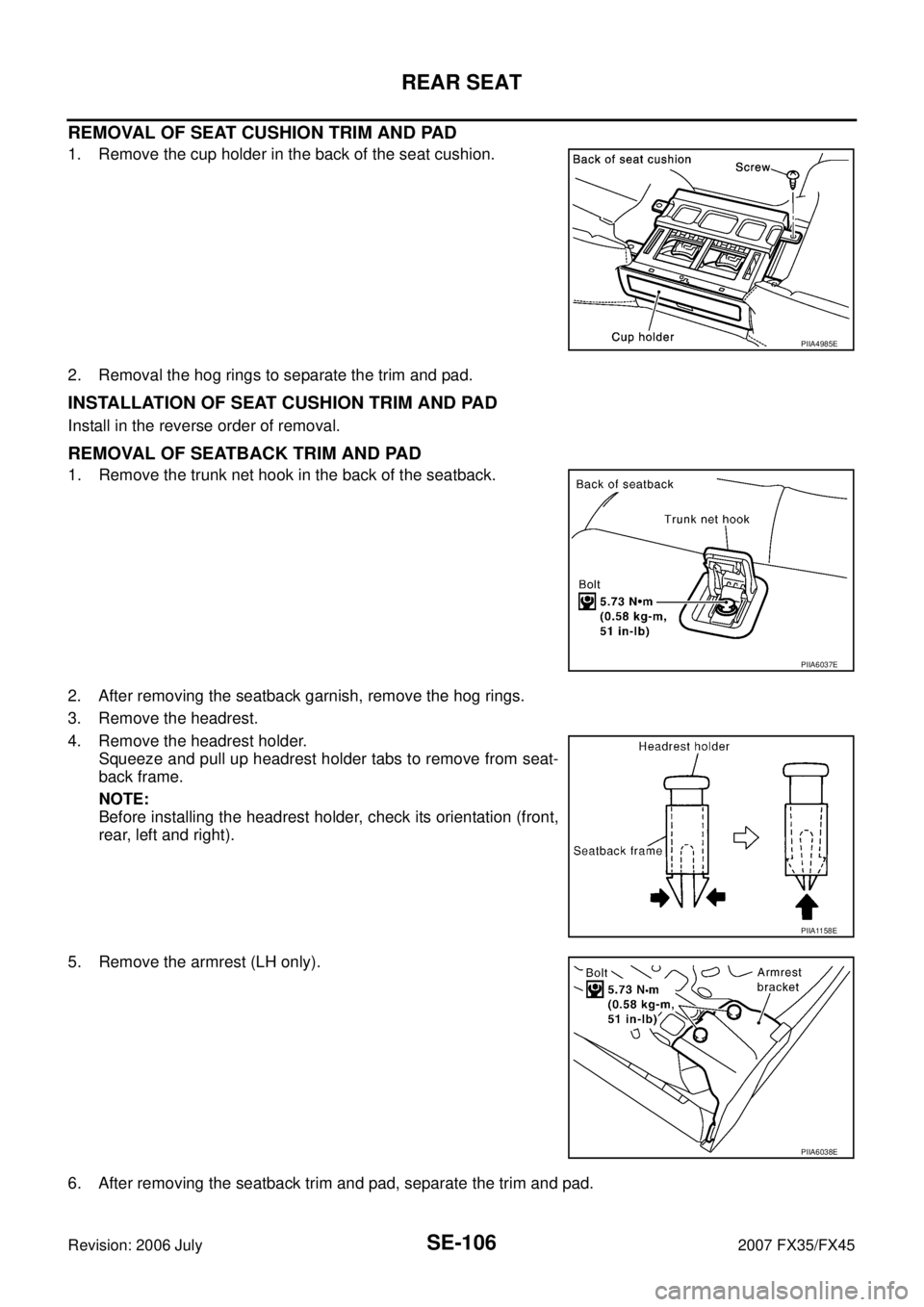
SE-106
REAR SEAT
Revision: 2006 July 2007 FX35/FX45
REMOVAL OF SEAT CUSHION TRIM AND PAD
1. Remove the cup holder in the back of the seat cushion.
2. Removal the hog rings to separate the trim and pad.
INSTALLATION OF SEAT CUSHION TRIM AND PAD
Install in the reverse order of removal.
REMOVAL OF SEATBACK TRIM AND PAD
1. Remove the trunk net hook in the back of the seatback.
2. After removing the seatback garnish, remove the hog rings.
3. Remove the headrest.
4. Remove the headrest holder. Squeeze and pull up headrest holder tabs to remove from seat-
back frame.
NOTE:
Before installing the headrest holder, check its orientation (front,
rear, left and right).
5. Remove the armrest (LH only).
6. After removing the seatback trim and pad, separate the trim and pad.
PIIA4985E
PIIA6037E
PIIA1158E
PIIA6038E