wheel INFINITI G-CONVERTIBLE 2012 Repair Manual
[x] Cancel search | Manufacturer: INFINITI, Model Year: 2012, Model line: G-CONVERTIBLE, Model: INFINITI G-CONVERTIBLE 2012Pages: 474, PDF Size: 3.63 MB
Page 388 of 474

.Never tow a vehicle using the vehicle tie
downs or recovery hooks.
. Always pull the cable straight out from
the front of the vehicle. Never pull on the
vehicle at an angle.
. Pulling devices should be routed so they
do not touch any part of the suspension,
steering, brake or cooling systems.
. Pulling devices such as ropes or canvas
straps are not recommended for use in
vehicle towing or recovery.
Rocking a stuck vehicleGUID-CAB6F3A9-C000-4766-AEE6-0D0457CAACBAIf your vehicle is stuck in sand, snow, mud,
etc., use the following procedure:
1. Turn off the Vehicle Dynamic Control
(VDC) system.
2. Make sure the area in front and behind the vehicle is clear of obstructions.
3. Turn the steering wheel right and left to clear an area around the front tires.
4. Slowly rock the vehicle forward and backward.
.Shift back and forth between R
(Reverse) and D (Drive) (automatic
transmission models) or 1st and R
(Reverse) (manual transmission models).
.Apply the accelerator as little as
possible to maintain the rocking
motion.
.Release the accelerator pedal beforeshifting between R (Reverse) and D
(Drive) (automatic transmission
models) or 1st and R (Reverse)
(manual transmission models).
.Do not spin the tires above 35 MPH(55 km/h).
5. If the vehicle cannot be freed after a few tries, contact a professional towing
service to remove the vehicle.
In case of emergency6-21
Page 390 of 474

7 Appearance and care
Cleaning exterior...
................................................. 7-2
Washing ...
.......................................................... 7-2
Waxing ...
............................................................ 7-3
Removing spots ...
............................................... 7-3
Underbody ...
...................................................... 7-3
Glass ...
............................................................... 7-3
Aluminum alloy wheels ...
................................... 7-3
Chrome parts ...
.................................................. 7-4
Tire dressing ...
................................................... 7-4 Cleaning interior
...
................................................. 7-4
Air fresheners ...
................................................ 7-5
Floor mats ...
..................................................... 7-5
Seat belts ...
...................................................... 7-6
Corrosion protection ...
............................................ 7-7
Most common factors contributing to
vehicle corrosion ...
........................................... 7-7
Environmental factors influence the rate
of corrosion ...
................................................... 7-7
To protect your vehicle from corrosion ...
........... 7-7
Page 391 of 474

7-2Appearance and care
GUID-7AF89F49-0121-4C5A-B2E9-F5570E28289DIn order to maintain the appearance of
your vehicle, it is important to take proper
care of it.
To protect the paint surface, wash your
vehicle as soon as you can:
.after a rainfall to prevent possible
damage from acid rain
. after driving on coastal roads
. when contaminants such as soot, bird
droppings, tree sap, metal particles or
bugs get on the paint surface
. when dust or mud builds up on the
surface
Whenever possible, store or park your
vehicle inside a garage or in a covered
area.
When it is necessary to park outside, park
in a shady area or protect the vehicle with
a body cover.
Be careful not to scratch the paint surface
when putting on or removing the body
cover.WASHINGGUID-C7D39018-743C-40A6-8344-B679CF0A2033Wash dirt off the vehicle with a wet sponge
and plenty of water. Clean the vehicle
thoroughly using a mild soap, a special
vehicle soap or general purpose dishwash-
ing liquid mixed with clean, lukewarm
(never hot) water.
CAUTION
. Do not use car washes that use acid in
the detergent. Some car washes, espe-
cially brushless ones, use some acid for
cleaning. The acid may react with some
plastic vehicle components, causing
them to crack. This could affect their
appearance, and also could cause them
not to function properly. Always check
with your car wash to confirm that acid
is not used.
. Do not wash the vehicle with strong
household soap, strong chemical deter-
gents, gasoline or solvents.
. Do not wash the vehicle in direct sun-
light or while the vehicle body is hot, as
the surface may become water-spotted.
. Avoid using tight-napped or rough
cloths, such as washing mitts. Care must be taken when removing caked-on
dirt or other foreign substances so the
paint surface is not scratched or da-
maged.
. Do not use an automatic car wash or
high pressure car wash. Avoid applying
water continuously to the parts around
the roof and the windows. This may
cause water to leak into the inside of
your vehicle.Rinse the vehicle thoroughly with plenty of
clean water.
Inside flanges, seams and folds on the
doors, hatches and hood are particularly
vulnerable to the effects of road salt.
Therefore, these areas must be regularly
cleaned. Make sure that the drain holes in
the lower edge of the door are open. Spray
water under the body and in the wheel
wells to loosen the dirt and wash away
road salt.
Avoid leaving water spots on the paint
surface by using a damp chamois to dry
the vehicle.
CLEANING EXTERIOR
Page 392 of 474

WAXINGGUID-D7E2A5AF-98DD-4330-B0D0-8D30870A66CFRegular waxing protects the paint surface
and helps retain new vehicle appearance.
Polishing is recommended to remove built-
up wax residue and to avoid a weathered
appearance before reapplying wax.
An INFINITI retailer can assist you in
choosing the proper product.
.Wax your vehicle only after a thorough
washing. Follow the instructions sup-
plied with the wax.
. Do not use a wax containing any
abrasives, cutting compounds or clea-
ners that may damage the vehicle
finish.
Machine compound or aggressive polish-
ing on a base coat/clear coat paint finish
may dull the finish or leave swirl marks.
REMOVING SPOTSGUID-492BA936-565C-451C-ACA3-4011197AA188Remove tar and oil spots, industrial dust,
insects, and tree sap as quickly as possible
from the paint surface to avoid lasting
damage or staining. Special cleaning
products are available at an INFINITI
retailer or any automotive accessory
stores.
UNDERBODYGUID-05FBC2CC-79B8-4C7B-8F1D-03FA002CBA98In areas where road salt is used in winter,
the underbody must be cleaned regularly.
This will prevent dirt and salt from building
up and causing the acceleration of corro-
sion on the underbody and suspension.
Before the winter period and again in the
spring, the underseal must be checked
and, if necessary, re-treated.
GLASSGUID-6C9D9F58-364C-48BB-AC4A-2F08241AF567Use glass cleaner to remove smoke and
dust film from the glass surfaces. It is
normal for glass to become coated with a
film after the vehicle is parked in the hot
sun. Glass cleaner and a soft cloth will
easily remove this film.
CAUTION
When cleaning the inside of the windows,
do not use sharp-edged tools, abrasive
cleaners or chlorine-based disinfectant clea-
ners. They could damage the electrical
conductors, radio antenna elements or rear
window defroster elements.
ALUMINUM ALLOY WHEELSGUID-4D2FB48B-A5E5-4D02-A520-E21B81358ED0Wash regularly with a sponge dampened in
a mild soap solution, especially during
winter months in areas where road salt is
used. Salt could discolor the wheels if not
removed.
CAUTION
Follow the directions below to avoid stain-
ing or discoloring the wheels:
. Do not use a cleaner that uses strong
acid or alkali contents to clean the
wheels.
. Do not apply wheel cleaners to the
wheels when they are hot. The wheel
temperature should be the same as
ambient temperature.
. Rinse the wheel to completely remove
the cleaner within 15 minutes after the
cleaner is applied.
Appearance and care7-3
Page 398 of 474
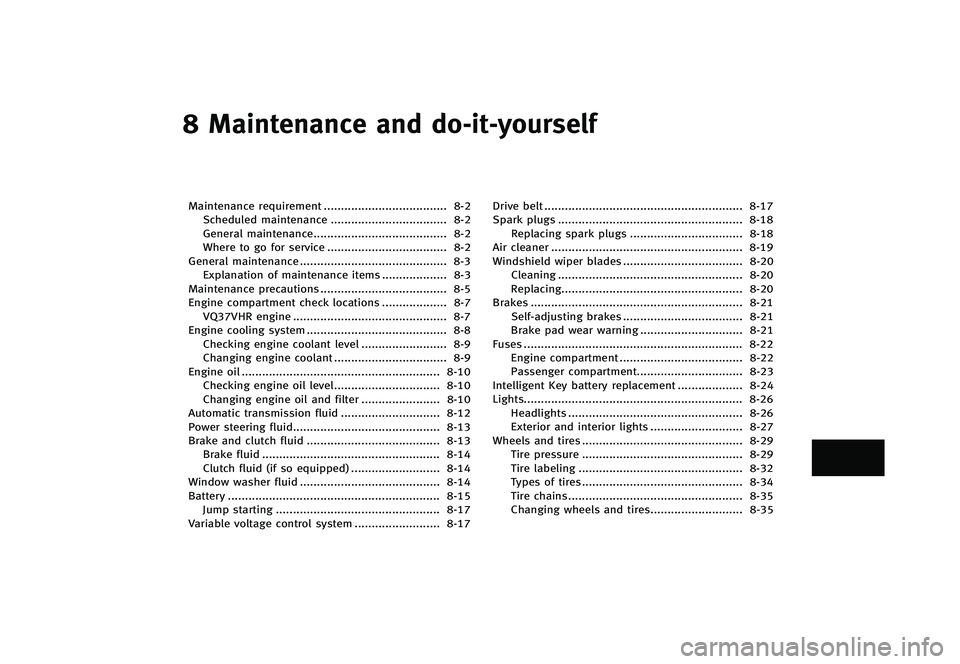
8 Maintenance and do-it-yourself
Maintenance requirement...
.................................... 8-2
Scheduled maintenance ...
.................................. 8-2
General maintenance ...
....................................... 8-2
Where to go for service ...
................................... 8-2
General maintenance ...
........................................... 8-3
Explanation of maintenance items ...
................... 8-3
Maintenance precautions ...
..................................... 8-5
Engine compartment check locations ...
................... 8-7
VQ37VHR engine ...
............................................. 8-7
Engine cooling system ...
......................................... 8-8
Checking engine coolant level ...
......................... 8-9
Changing engine coolant ...
................................. 8-9
Engine oil ...
.......................................................... 8-10
Checking engine oil level ...
............................... 8-10
Changing engine oil and filter ...
....................... 8-10
Automatic transmission fluid ...
............................. 8-12
Power steering fluid ...
........................................... 8-13
Brake and clutch fluid ...
....................................... 8-13
Brake fluid ...
.................................................... 8-14
Clutch fluid (if so equipped) ...
.......................... 8-14
Window washer fluid ...
......................................... 8-14
Battery ...
.............................................................. 8-15
Jump starting ...
................................................ 8-17
Variable voltage control system ...
......................... 8-17 Drive belt
...
.......................................................... 8-17
Spark plugs ...
...................................................... 8-18
Replacing spark plugs ...
................................. 8-18
Air cleaner ...
........................................................ 8-19
Windshield wiper blades ...
................................... 8-20
Cleaning ...
...................................................... 8-20
Replacing ...
..................................................... 8-20
Brakes ...
.............................................................. 8-21
Self-adjusting brakes ...
................................... 8-21
Brake pad wear warning ...
.............................. 8-21
Fuses ...
................................................................ 8-22
Engine compartment ...
.................................... 8-22
Passenger compartment ...
............................... 8-23
Intelligent Key battery replacement ...
................... 8-24
Lights ...
................................................................ 8-26
Headlights ...
................................................... 8-26
Exterior and interior lights ...
........................... 8-27
Wheels and tires ...
............................................... 8-29
Tire pressure ...
............................................... 8-29
Tire labeling ...
................................................ 8-32
Types of tires ...
............................................... 8-34
Tire chains ...
................................................... 8-35
Changing wheels and tires ...
........................... 8-35
Page 400 of 474

GUID-7E681473-8113-4EFB-B5DA-7A7484E2409FDuring the normal day-to-day operation of
the vehicle, general maintenance should
be performed regularly as prescribed in
this section. If you detect any unusual
sounds, vibrations or smell, be sure to
check for the cause or have an INFINITI
retailer do it promptly. In addition, you
should notify an INFINITI retailer if you
think that repairs are required.
When performing any checks or mainte-
nance work, see“Maintenance precau-
tions” (P.8-5).
EXPLANATION OF MAINTENANCE
ITEMS
GUID-4DADA991-350E-4791-AC1F-B7D348E957C5Additional information on the following
items with “*”is found later in this
section.
Outside the vehicleGUID-935F9711-28E8-44B7-926E-055C6CC77282The maintenance items listed here should
be performed from time to time, unless
otherwise specified.
Doors and engine hood: Check that all
doors and the engine hood operate prop-
erly. Also ensure that all latches lock
securely. Lubricate hinges, latches, latch
pins, rollers and links if necessary. Make
sure that the secondary latch keeps the
hood from opening when the primary latch is released.
When driving in areas using road salt or
other corrosive materials, check lubrication
frequently.
Lights*:
Clean the headlights on a regular
basis. Make sure that the headlights, stop
lights, tail lights, turn signal lights, and
other lights are all operating properly and
installed securely. Also check headlight
aim.
Road wheel nuts (lug nuts)*: When check-
ing the tires, make sure no wheel nuts are
missing, and check for any loose wheel
nuts. Tighten if necessary.
Tire rotation*: Tires cannot be rotated, as
front tires are a different size from rear
tires and the direction of wheel rotation is
fixed in each tire.
Tires*: Check the pressure with a gauge
often and always prior to long distance
trips. If necessary, adjust the pressure in
all tires, including the spare, to the
pressure specified. Check carefully for
damage, cuts or excessive wear.
Tire Pressure Monitoring System (TPMS)
transmitter components: Replace the TPMS
transmitter grommet seal, valve core and
cap when the tires are replaced due to wear or age.
Tire, wheel alignment and balance:
If the
vehicle should pull to either side while
driving on a straight and level road, or if
you detect uneven or abnormal tire wear,
there may be a need for wheel alignment.
If the steering wheel or seat vibrates at
normal highway speeds, wheel balancing
may be needed.
For additional information regarding tires,
refer to “Important Tire Safety Information”
(US) or “Tire Safety Information” (Canada)
in the INFINITI Warranty Information Book-
let.
Windshield: Clean the windshield on a
regular basis. Check the windshield at
least every six months for cracks or other
damage. Have a damaged windshield
repaired by a qualified repair facility.
Windshield wiper blades*: Check for
cracks or wear if they do not wipe properly.
Inside the vehicleGUID-AAA8A546-692D-407E-9E98-33BD16F490A2The maintenance items listed here should
be checked on a regular basis, such as
when performing scheduled maintenance,
cleaning the vehicle, etc.
Accelerator pedal: Check the pedal for
Maintenance and do-it-yourself8-3
GENERAL MAINTENANCE
Page 401 of 474

8-4Maintenance and do-it-yourself
smooth operation and make sure the pedal
does not catch or require uneven effort.
Keep the floor mat away from the pedal.
Automatic transmission P (Park) mechan-
ism:On a fairly steep hill, check that the
vehicle is held securely with the selector
lever in the P (Park) position without
applying any brakes.
Brake pedal: Check the pedal for smooth
operation. If the brake pedal suddenly
goes down further than normal, the pedal
feels spongy or the vehicle seems to take
longer to stop, see an INFINITI retailer
immediately. Keep the floor mat away from
the pedal.
Brakes: Check that the brakes do not pull
the vehicle to one side when applied.
Parking brake: Check the parking brake
operation regularly. The vehicle should be
securely held on a fairly steep hill with only
the parking brake applied. If the parking
brake needs adjusted, see an INFINITI
retailer.
Seat belts: Check that all parts of the seat
belt system (for example, buckles, an-
chors, adjusters and retractors) operate
properly and smoothly, and are installed
securely. Check the belt webbing for cuts, fraying, wear or damage.
Seats:
Check seat position controls such as
seat adjusters, seatback recliners, etc. to
ensure they operate smoothly and that all
latches lock securely in every position.
Check that the head restraints move up
and down smoothly and that the locks (if
so equipped) hold securely in all latched
positions.
Steering wheel: Check for changes in the
steering conditions, such as excessive free
play, hard steering or strange noises.
Warning lights and chimes: Make sure that
all warning lights and chimes are operating
properly.
Windshield defroster: Check that the air
comes out of the defroster outlets properly
and in sufficient quantity when operating
the heater or air conditioner.
Windshield wiper and washer*: Check that
the wipers and washers operate properly
and that the wipers do not streak.
Under the hood and vehicleGUID-6687B186-528E-4C5C-A54D-1DCA274537D4The maintenance items listed here should
be checked periodically (for example, each
time you check the engine oil or refuel).
Battery*: Check the fluid level in each cell. It should be between the MAX and MIN
lines. Vehicles operated in high tempera-
tures or under severe condition require
frequent checks of the battery fluid level.
Brake and clutch fluid levels*:
Make sure
that the brake and clutch fluid levels are
between the MAX and MIN lines on the
reservoir.
Engine coolant level*: Check the coolant
level when the engine is cold.
Engine drive belt*: Make sure that the
drive belt is not frayed, worn, cracked or
oily.
Engine oil level*: Check the level after
parking the vehicle on a level surface and
turning off the engine. Wait more than 15
minutes for the oil to drain back into the oil
pan.
Exhaust system: Make sure there are no
loose supports, cracks or holes. If the
sound of the exhaust seems unusual or
there is a smell of exhaust fumes, im-
mediately have the exhaust system in-
spected by an INFINITI retailer. (See
“Precautions when starting and driving”
(P.5-3) for exhaust gas (Carbon monoxide).)
Fluid leaks: Check under the vehicle for
fuel, oil, water or other fluid leaks after the
Page 402 of 474

vehicle has been parked for a while. Water
dripping from the air conditioner after use
is normal. If you should notice any leaks or
if gasoline fumes are evident, check for the
cause and have it corrected immediately.
Power steering fluid level* and lines:
Check the level with the engine off. Check
the lines for proper attachment, leaks,
cracks, etc.
Radiator and hoses:Check the front of the
radiator and clean off any dirt, insects,
leaves, etc., that may have accumulated.
Make sure the hoses have no cracks,
deformation, rot or loose connections.
Underbody: The underbody is frequently
exposed to corrosive substances such as
those used on icy roads or to control dust.
It is very important to remove these
substances, otherwise rust will form on
the floor pan, frame, fuel lines and around
the exhaust system. At the end of winter,
the underbody should be thoroughly
flushed with plain water, being careful to
clean those areas where mud and dirt may
accumulate. For additional information,
see “Cleaning exterior” (P.7-2).
Windshield washer fluid*: Check that there
is adequate fluid in the reservoir.
GUID-10AF39EE-6E4C-416A-9D4D-B725EAC05CA0When performing any inspection or main-
tenance work on your vehicle, always take
care to prevent serious accidental injury to
yourself or damage to the vehicle. The
following are general precautions which
should be closely observed.
WARNING
. Park the vehicle on a level surface, apply
the parking brake securely and block the
wheels to prevent the vehicle from
moving. For manual transmission mod-
els, move the shift lever to N (Neutral).
For automatic transmission models,
move the selector lever to P (Park).
. Be sure the ignition switch is in the OFF
or LOCK position when performing any
parts replacement or repairs.
. Never connect or disconnect the battery
or any transistorized component while
the ignition switch is in the ON position.
. Never leave the engine or automatic
transmission related component har-
nesses disconnected while the ignition
switch is in the ON position.
. If you must work with the engine
running, keep your hands, clothing, hair and tools away from moving fans, belts
and any other moving parts.
. It is advisable to secure or remove any
loose clothing and remove any jewelry,
such as rings, watches, etc. before
working on your vehicle.
. Always wear eye protection whenever
you work on your vehicle.
. If you must run the engine in an
enclosed space such as a garage, be
sure there is proper ventilation for
exhaust gases to escape.
. Never get under the vehicle while it is
supported only by a jack. If it is
necessary to work under the vehicle,
support it with safety stands.
. Keep smoking materials, flame and
sparks away from fuel tank and the
battery.
. Your vehicle is equipped with an auto-
matic engine cooling fan. It may come on
at any time without warning, even if the
ignition key is in the OFF position and
the engine is not running. To avoid
injury, always disconnect the negative
battery cable before working near the
fan.
Maintenance and do-it-yourself8-5
MAINTENANCE PRECAUTIONS
Page 426 of 474

GUID-1FF8645E-BD26-49E1-8ACE-3D93C44CADF6If you have a flat tire, see“Flat tire”(P.6-
2).
TIRE PRESSUREGUID-BDD15B46-98E3-4A60-8D4D-2328B8986E37
Tire Pressure Monitoring System
(TPMS)
GUID-92F1DBE9-C4EF-4679-8E12-AEDD5231258DThis vehicle is equipped with the Tire
Pressure Monitoring System (TPMS). It
monitors tire pressure of all tires except
the spare. When the low tire pressure
warning light is lit and the CHECK TIRE
PRESSURE warning appears on the dot
matrix liquid crystal display, one or more
of your tires is significantly under-inflated.
The TPMS will activate only when the
vehicle is driven at speeds above 16 MPH
(25 km/h). Also, this system may not
detect a sudden drop in tire pressure (for
example a flat tire while driving).
For more details, see “Low tire pressure
warning light” (P.2-12),“Tire Pressure
Monitoring System (TPMS)” (P.5-4) and
“Tire Pressure Monitoring System (TPMS)”
(P.6-2).
Tire inflation pressureGUID-1E5BCB99-CF5B-436E-822C-36E9EA89ED84Check the pressure of the tires
(including the spare) often and al- ways prior to long distance trips. The
recommended tire pressure specifi-
cations are shown on the Tire and
Loading Information label under the
“Cold Tire Pressure”
heading. The
Tire and Loading Information label is
affixed to the driver side center pillar.
Tire pressures should be checked
regularly because:
.Most tires naturally lose air over time.
.Tires can lose air suddenly whendriven over potholes or other
objects or if the vehicle strikes a
curb while parking.
The tire pressures should be checked
when the tires are cold. The tires are
considered COLD after the vehicle
has been parked for 3 or more hours,
or driven less than 1 mile (1.6 km) at
moderate speeds.
Incorrect tire pressure, including
under inflation, may adversely affect
tire life and vehicle handling.
WARNING
. Improperly inflated tires can fail
suddenly and cause an accident.
. The Gross Vehicle Weight rating
(GVWR) is located on the F.M.V.S.
S./C.M.V.S.S. label. The vehicle
weight capacity is indicated on
the Tire and Loading Information
label. Do not load your vehicle
beyond this capacity. Overloading
your vehicle may result in reduced
tire life, unsafe operating condi-
tions due to premature tire failure,
or unfavorable handling character-
istics and could also lead to a
serious accident. Loading beyond
the specified capacity may also
result in failure of other vehicle
components.
. Before taking a long trip, or
whenever you heavily load your
vehicle, use a tire pressure gauge
to ensure that the tire pressures
Maintenance and do-it-yourself8-29
WHEELS AND TIRES
Page 430 of 474

gives the tire’s ratio of height to
width.
4.R: The“R”stands for radial.
5.Two-digit number (16): This num-
ber is the wheel or rim diameter in
inches.
6.Two- or three-digit number (94):
This number is the tire’s load
index. It is a measurement of
how much weight each tire can
support. You may not find this
information on all tires because it
is not required by law.
7.H: Tire speed rating. You should
not drive the vehicle faster than
the tire speed rating.
SDI1607
Example*2TIN (Tire Identification Number)
for a new tire (example: DOT XX XX
XXX XXXX)
1.DOT: Abbreviation for the “Depart-
ment of Transportation”. The sym-
bol can be placed above, below or
to the left or right of the Tire
Identification Number.
2.Two-digit code: Manufacturer’s
identification mark
3.Two-digit code: Tire size
4.Three-digit code: Tire type code
(Optional)
5.Three-digit code: Date of Manu-
facture
6.Four numbers represent the week
and year the tire was built. For
example, the numbers 3103
means the 31st week of 2003. If
these numbers are missing, then
look on the other sidewall of the
tire.
*3Tire ply composition and materi-
al
The number of layers or plies of
rubber-coated fabric in the tire.
Tire manufacturers also must
indicate the materials in the tire,
which include steel, nylon,
polyester, and others.
*4Maximum permissible inflation
pressure
This number is the greatest
amount of air pressure that
should be put in the tire. Do
not exceed the maximum per-
Maintenance and do-it-yourself8-33