REV light INFINITI G35 2006 Owner's Guide
[x] Cancel search | Manufacturer: INFINITI, Model Year: 2006, Model line: G35, Model: INFINITI G35 2006Pages: 344, PDF Size: 6.81 MB
Page 291 of 344
HEADLIGHTS
Replacing the xenon headlight
bulb Xenon headlight bulb:
WARNING HIGH VOLTAGE
When xenon headlights are on, they produce
a high voltage. To prevent an electric shock,
never attempt to modify or disassemble. Al-
ways have your xenon headlights replaced
at an INFINITI dealer. For additional informa-
tion, see ªHeadlight and turn signal switchº
in the ª2. Instruments and controlsº section.
If replacement is required, see an INFINITI
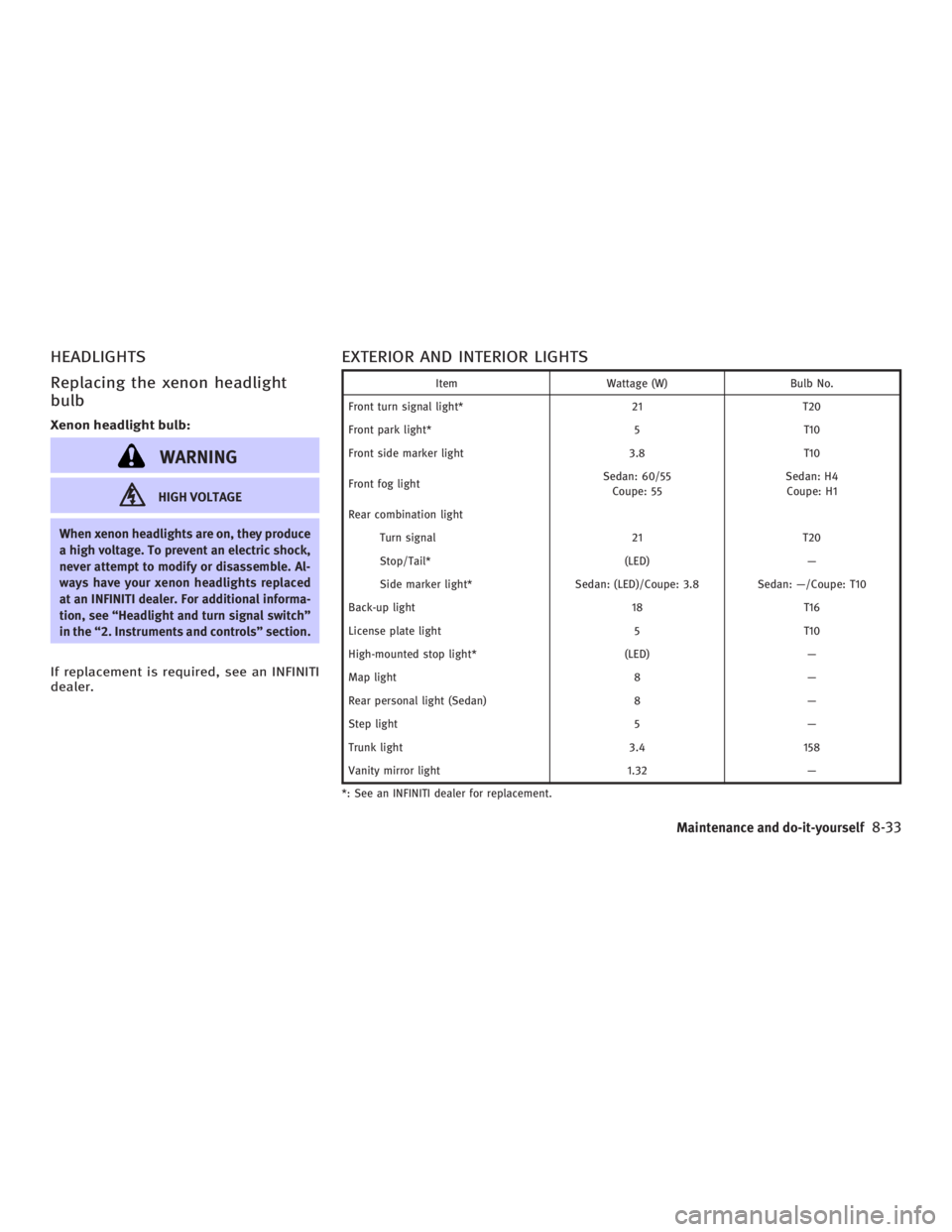
dealer. EXTERIOR AND INTERIOR LIGHTS Item Wattage (W) Bulb No.
Front turn signal light* 21 T20
Front park light* 5 T10
Front side marker light 3.8 T10
Front fog light Sedan: 60/55
Coupe: 55 Sedan: H4
Coupe: H1
Rear combination light
Turn signal 21 T20
Stop/Tail* (LED) Ð
Side marker light* Sedan: (LED)/Coupe: 3.8 Sedan: Ð/Coupe: T10
Back-up light 18 T16
License plate light 5 T10
High-mounted stop light* (LED) Ð
Map light 8 Ð
Rear personal light (Sedan) 8 Ð
Step light 5 Ð
Trunk light 3.4 158
Vanity mirror light 1.32 Ð
*: See an INFINITI dealer for replacement.
Maintenance and do-it-yourself
8-33
w 06.1.4/V35-D/V5.0
X
Page 326 of 344
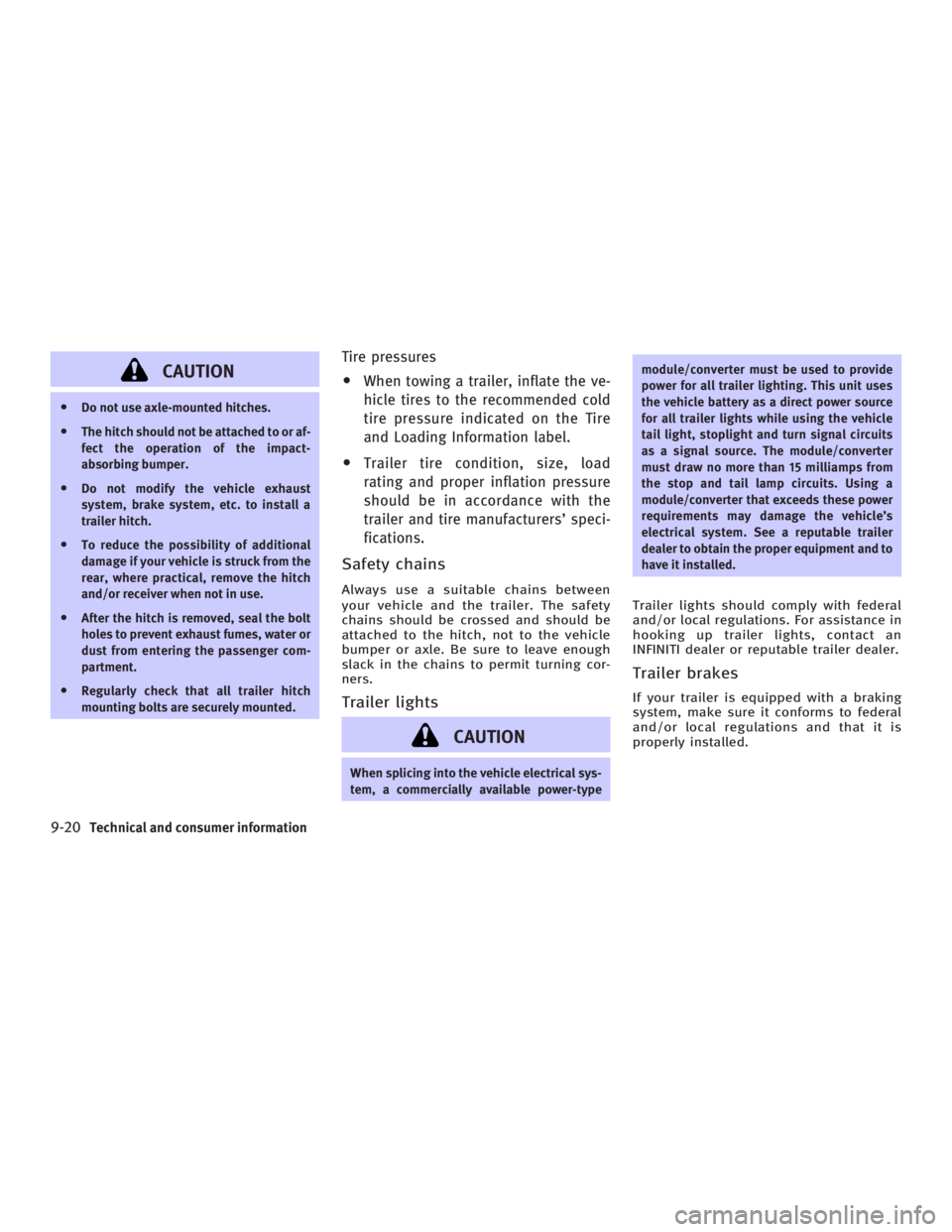
CAUTIONO Do not use axle-mounted hitches.
O The hitch should not be attached to or af-
fect the operation of the impact-
absorbing bumper.
O Do not modify the vehicle exhaust
system, brake system, etc. to install a
trailer hitch.
O To reduce the possibility of additional
damage if your vehicle is struck from the
rear, where practical, remove the hitch
and/or receiver when not in use.
O After the hitch is removed, seal the bolt
holes to prevent exhaust fumes, water or
dust from entering the passenger com-
partment.
O Regularly check that all trailer hitch
mounting bolts are securely mounted. Tire pressures
O When towing a trailer, inflate the ve-
hicle tires to the recommended cold
tire pressure indicated on the Tire
and Loading Information label.
O Trailer tire condition, size, load
rating and proper inflation pressure
should be in accordance with the
trailer and tire manufacturers' speci-
fications.
Safety chains Always use a suitable chains between
your vehicle and the trailer. The safety
chains should be crossed and should be
attached to the hitch, not to the vehicle
bumper or axle. Be sure to leave enough
slack in the chains to permit turning cor-
ners.
Trailer lights
CAUTION When splicing into the vehicle electrical sys-
tem, a commercially available power-type module/converter must be used to provide
power for all trailer lighting. This unit uses
the vehicle battery as a direct power source
for all trailer lights while using the vehicle
tail light, stoplight and turn signal circuits
as a signal source. The module/converter
must draw no more than 15 milliamps from
the stop and tail lamp circuits. Using a
module/converter that exceeds these power
requirements may damage the vehicle's
electrical system. See a reputable trailer
dealer to obtain the proper equipment and to
have it installed.
Trailer lights should comply with federal
and/or local regulations. For assistance in
hooking up trailer lights, contact an
INFINITI dealer or reputable trailer dealer.
Trailer brakes If your trailer is equipped with a braking
system, make sure it conforms to federal
and/or local regulations and that it is
properly installed.
9-20 Technical and consumer information
w 06.1.4/V35-D/V5.0
X
Page 327 of 344
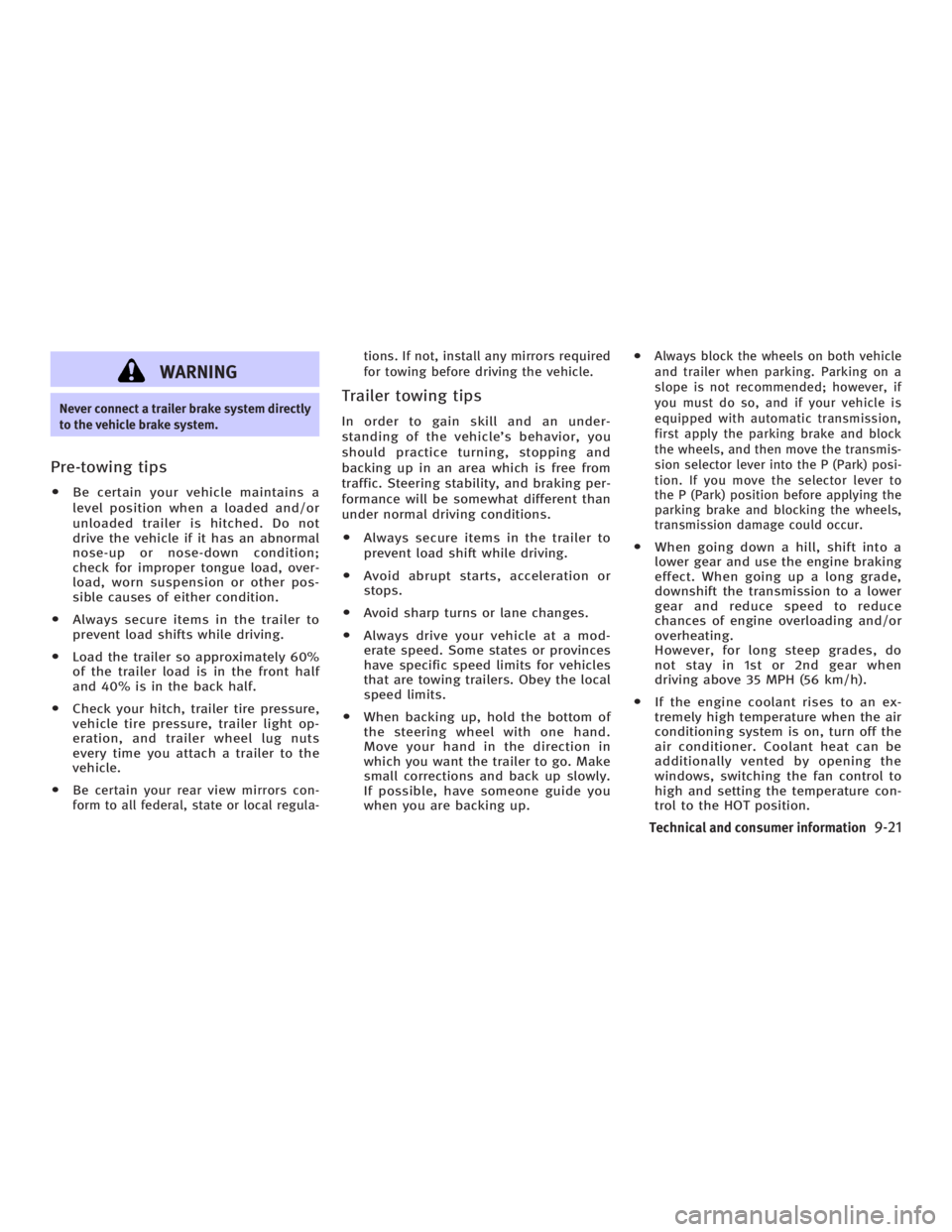
WARNINGNever connect a trailer brake system directly
to the vehicle brake system.
Pre-towing tips O Be certain your vehicle maintains a
level position when a loaded and/or
unloaded trailer is hitched. Do not
drive the vehicle if it has an abnormal
nose-up or nose-down condition;
check for improper tongue load, over-
load, worn suspension or other pos-
sible causes of either condition.
O Always secure items in the trailer to
prevent load shifts while driving.
O Load the trailer so approximately 60%
of the trailer load is in the front half
and 40% is in the back half.
O Check your hitch, trailer tire pressure,
vehicle tire pressure, trailer light op-
eration, and trailer wheel lug nuts
every time you attach a trailer to the
vehicle.
O Be certain your rear view mirrors con-
form to all federal, state or local regula- tions. If not, install any mirrors required
for towing before driving the vehicle.
Trailer towing tips In order to gain skill and an under-
standing of the vehicle's behavior, you
should practice turning, stopping and
backing up in an area which is free from
traffic. Steering stability, and braking per-
formance will be somewhat different than
under normal driving conditions.
O Always secure items in the trailer to
prevent load shift while driving.
O Avoid abrupt starts, acceleration or
stops.
O Avoid sharp turns or lane changes.
O Always drive your vehicle at a mod-
erate speed. Some states or provinces
have specific speed limits for vehicles
that are towing trailers. Obey the local
speed limits.
O When backing up, hold the bottom of
the steering wheel with one hand.
Move your hand in the direction in
which you want the trailer to go. Make
small corrections and back up slowly.
If possible, have someone guide you
when you are backing up. O Always block the wheels on both vehicle
and trailer when parking. Parking on a
slope is not recommended; however, if
you must do so, and if your vehicle is
equipped with automatic transmission,
first apply the parking brake and block
the wheels, and then move the transmis-
sion selector lever into the P (Park) posi-
tion. If you move the selector lever to
the P (Park) position before applying the
parking brake and blocking the wheels,
transmission damage could occur.
O When going down a hill, shift into a
lower gear and use the engine braking
effect. When going up a long grade,
downshift the transmission to a lower
gear and reduce speed to reduce
chances of engine overloading and/or
overheating.
However, for long steep grades, do
not stay in 1st or 2nd gear when
driving above 35 MPH (56 km/h).
O If the engine coolant rises to an ex-
tremely high temperature when the air
conditioning system is on, turn off the
air conditioner. Coolant heat can be
additionally vented by opening the
windows, switching the fan control to
high and setting the temperature con-
trol to the HOT position.
Technical and consumer information
9-21
w 06.1.4/V35-D/V5.0
X