steering INFINITI G35 2006 Service Manual
[x] Cancel search | Manufacturer: INFINITI, Model Year: 2006, Model line: G35, Model: INFINITI G35 2006Pages: 344, PDF Size: 6.81 MB
Page 232 of 344
When accelerating or driving on a slippery
surface, the tires may spin or slide. With
the Vehicle Dynamic Control (VDC)
system, sensors detect these movements
and control the braking and engine
output to help improve vehicle stability.
O When the VDC system is operating,
the ªSLIPº indicator in the instrument
panel blinks.
O When only the Traction Control System
(TCS) portion of the VDC system is op-
erating, the ªSLIPº indicator in the in-
strument panel blinks.
O If the ªSLIPº indicator blinks, the road
conditions are slippery. Be sure to ad-
just your speed and driving to these
conditions. Be sure to drive carefully.
See ªSlip indicator lightº, and ªVe-
hicle Dynamic Control (VDC) off indica-
tor lightº in the ª2. Instruments and
controlsº section.
O Indicator light
If a malfunction occurs in the system,
the ªSLIPº and ªVDC OFFº indicator
lights illuminate in the instrument
panel. As long as these indicators are
illuminated, the VDC system function
is canceled. The VDC system uses an Active Brake Lim-
ited Slip (ABLS) system to improve vehicle
traction. The ABLS system works when
one of the driving wheels is spinning on a
slippery surface. The ABLS system brakes
the spinning wheel which distributes the
driving power to the other driving wheel.
If the vehicle is operated with the VDC
system turned off, all VDC system func-
tions and TCS functions will be turned off.
The ABLS system and ABS will still op-
erate with the VDC system off. When the
ABLS system is activated, the ªSLIPº indi-
cator light will blink and you may hear a
clunk noise and/or feel a pulsation in the
brake pedal. This is normal and is not an
indication of a malfunction.
While the VDC system is operating, you
may feel a pulsation in the brake pedal and
hear a noise or feel a vibration from under
the hood. This is normal and indicates that
the VDC system is working properly.
The VDC system computer has a built in
diagnostic feature that tests the system
each time you start the engine and move
the vehicle forward or backward. When
the self-test occurs, you may hear a clunk
noise and/or feel a pulsation in the brake
pedal. This is normal and is not an indica-
tion of a malfunction. WARNING O The VDC system is designed to help im-
prove driving stability but does not pre-
vent accidents due to abrupt steering op-
eration at high speeds or due to careless
or dangerous driving. Reduce vehicle
speed and be especially careful when
driving and cornering on slippery sur-
faces and always drive carefully.
O If engine related parts such as muffler
are not standard equipment or are ex-
tremely deteriorated, the ªVDC OFFº in-
dicator or ªSLIPº indicator or both indi-
cator lights may illuminate.
O Do not modify the vehicle's suspension.
If suspension parts such as shock ab-
sorbers, struts, springs, stabilizer bars
and bushings are not INFINITI-approved
or are extremely deteriorated, the VDC
system may not operate properly. This
could adversely affect vehicle handling
performance, and the ªVDC OFFº indi-
cator or ªSLIPº indicator or both indi
cator lights may illuminate.VEHICLE DYNAMIC CONTROL (VDC)
SYSTEM
5-28 Starting and driving
w 06.1.4/V35-D/V5.0
X
Page 233 of 344
O If brake related parts such as brake
pads, rotors and calipers are not stan-
dard equipment or are extremely dete-
riorated, the ªVDC OFFº indicator or
ªSLIPº indicator or both indicator lights
may illuminate.
O When driving on extremely inclined sur-
faces such as higher banked corners, the
Vehicle Dynamic Control system may not
operate properly and the ªVDC OFFº indi-
cator or ªSLIPº indicator or both indi-
cator lights may illuminate. Do not drive
on these types of roads.
O When driving on an unstable surface
such as a turntable, ferry, elevator or
ramp, the ªVDC OFFº indicator or ªSLIPº
indicator or both indicator lights may il-
luminate. This is not a malfunction. Re-
start the engine after driving onto a
stable surface.
O If wheels or tires other than those rec-
ommended are used, the VDC system
may not operate properly and the ªVDC
OFFº indicator or ªSLIPº indicator or
both indicator lights may illuminate. O The VDC system is not a substitute for
winter tires or tire chains on a snow cov-
ered road. The Rear Active Steer (RAS) system is an
electronically controlled four-wheel
steering system.
The angle of the rear wheels are adjusted
by the RAS system, depending on the ve-
hicle speed and steering angle. The rear
wheels are designed to turn momentarily
in the opposite direction and then change
to the same direction as the front wheels.
At low speeds, the rear wheels will not
turn and the system functions as a two-
wheel steering system.
If a malfunction occurs in the system, the
RAS function will stop but the ordinary
two-wheel steering system will operate
normally. The ªRASº warning light will il-
luminate.
If the light illuminates while you are driv-
ing, contact an INFINITI dealer for repair.REAR ACTIVE STEER (RAS) SYSTEM (if so
equipped)
Starting and driving
5-29
w 06.1.4/V35-D/V5.0
X
Page 236 of 344
O Allow greater following distances on
slippery roads.
O Watch for slippery spots (glare ice).
These may appear on an otherwise clear
road in shaded areas. If a patch of ice is
seen ahead, brake before reaching it. Try
not to brake while on the ice, and avoid
any sudden steering maneuvers.
O Do not use cruise control on slippery
roads.
O Snow can trap dangerous exhaust gases
under your vehicle. Keep snow clear of
the exhaust pipe and from around your
vehicle.
ENGINE BLOCK HEATER (if so
equipped) An engine block heater to assist extreme
cold temperature starting is available
through an INFINITI dealer. WARNING Do not use your heater with an ungrounded
electrical system or tow-pronged (cheater)
adapters. You can be injured by an electrical
shock if you use an ungrounded connection.
5-32 Starting and driving
w 06.1.4/V35-D/V5.0
X
Page 238 of 344
Every new INFINITI comes with a 4 year,
unlimited mileage Roadside Assistance
plan. In the event of a roadside
emergency, Roadside Assistance Service
is available to you. Please refer to your
Warranty Booklet (U.S.) or Warranty &
Roadside assistance information booklet
(Canada) for details. Both the Warranty
Booklet and Roadside Assistance Calling
Card in your Owner's Literature Portfolio
provide the Toll-Free Number to call for
assistance. Roadside Assistance is
provided 24 hours a day, 365 days a year,
for 4 years from the date sold to give
emergency roadside help, in the event of
mechanical or nonmechanical trouble(s)
such as flat tires, out-of-gas, dead battery,
lost keys, mechanical breakdown,
accident, etc. TIRE PRESSURE MONITORING
SYSTEM (TPMS) This vehicle is equipped with the tire pres-
sure monitoring system (TPMS). It monitors
tire pressure of all tires except the spare.
When the low tire pressure warning light is
lit, or flashing continuously one or more of
your tires is significantly under-inflated. If
the vehicle is being driven with low tire
pressure, the TPMS will activate and warn
you of it by the low tire pressure warning
light. This system will activate only when
the vehicle is driven at speeds above 16
MPH (25 km/h). For more details, refer to
ªWarning/indicator lights and audible re-
mindersº in the ª2. Instruments and con-
trolsº section and ªTire pressure moni-
toring system (TPMS)º in the ª5. Starting
and drivingº section.
WARNING O If the low tire pressure warning light illu-
minates while driving, avoid sudden
steering maneuvers or abrupt braking,
reduce vehicle speed, pull off the road to
a safe location and stop the vehicle as
soon as possible. Serious vehicle damage could occur and may lead to an
accident and could result in serious per-
sonal injury. Check the tire pressure for all
four tires. Adjust the tire pressure to the
recommended COLD tire pressure shown
on the Tire and Loading Information label
to turn the low tire pressure warning light
OFF. If you have a flat tire, replace it with a
spare tire as soon as possible.
O When a spare tire is mounted or a wheel is
replaced, tire pressure will not be indi-
cated, the TPMS will not function and the
low tire pressure warning light will flash.
Contact your INFINITI dealer as soon as
possible for tire replacement and/or
system resetting.
O Replacing tires with those not originally
specified by INFINITI could affect the
proper operation of the TPMS.
O
Do not inject any tire liquid or aerosol tire
sealant into the tires, as this may cause a
malfunction of the tire pressure sensors.
CHANGING A FLAT TIRE If you have a flat tire, follow the instruc-
tions below.ROADSIDE ASSISTANCE PROGRAM FLAT TIRE
6-2 In case of emergency
w 06.1.13/V35-D/V5.0
X
Page 248 of 344
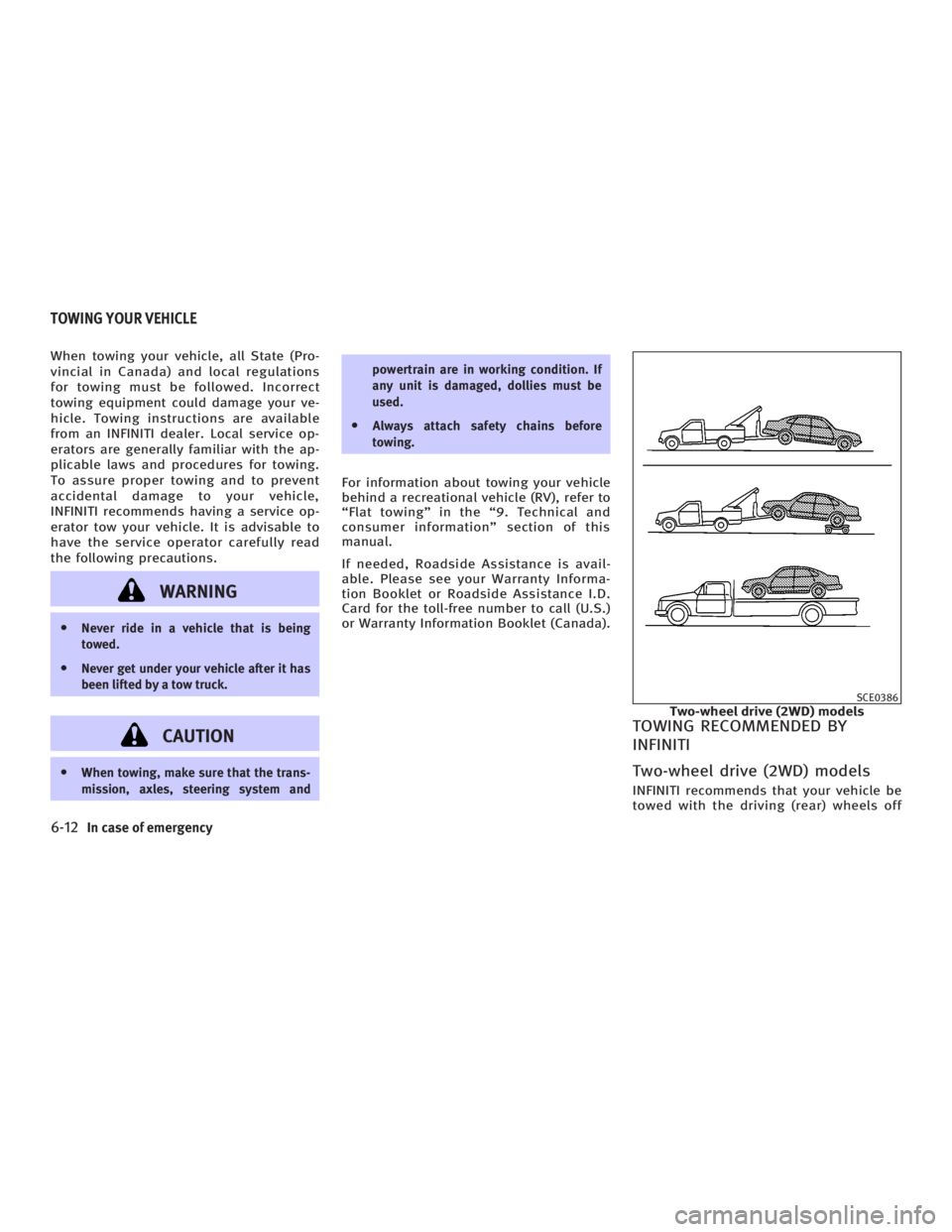
When towing your vehicle, all State (Pro-
vincial in Canada) and local regulations
for towing must be followed. Incorrect
towing equipment could damage your ve-
hicle. Towing instructions are available
from an INFINITI dealer. Local service op-
erators are generally familiar with the ap-
plicable laws and procedures for towing.
To assure proper towing and to prevent
accidental damage to your vehicle,
INFINITI recommends having a service op-
erator tow your vehicle. It is advisable to
have the service operator carefully read
the following precautions.
WARNINGO Never ride in a vehicle that is being
towed.
O Never get under your vehicle after it has
been lifted by a tow truck.
CAUTIONO When towing, make sure that the trans-
mission, axles, steering system and powertrain are in working condition. If
any unit is damaged, dollies must be
used.
O Always attach safety chains before
towing.
For information about towing your vehicle
behind a recreational vehicle (RV), refer to
ªFlat towingº in the ª9. Technical and
consumer informationº section of this
manual.
If needed, Roadside Assistance is avail-
able. Please see your Warranty Informa-
tion Booklet or Roadside Assistance I.D.
Card for the toll-free number to call (U.S.)
or Warranty Information Booklet (Canada).
TOWING RECOMMENDED BY
INFINITI
Two-wheel drive (2WD) models INFINITI recommends that your vehicle be
towed with the driving (rear) wheels off SCE0386
Two-wheel drive (2WD) modelsTOWING YOUR VEHICLE
6-12 In case of emergency
w 06.1.4/V35-D/V5.0
X
Page 249 of 344

the ground or place the vehicle on a flat
bed truck as illustrated.
CAUTION O Never tow automatic transmission
models with the rear wheels on the ground or four wheels on the ground
(forward or backward) as this may cause
serious and expensive damage to the
transmission. If it is necessary to tow the
vehicle with the front wheels raised, al-
ways use towing dollies under the rear
wheels.
O When towing rear wheel drive models
with the front wheels on the ground or
on towing dollies:
Turn the ignition key to the OFF position,
and secure the steering wheel in a
straight ahead position with a rope or
similar device. Never secure the steering
wheel by turning the ignition key to the
LOCK position. This may damage the
steering lock mechanism.
O If you have to tow manual transmission
models with the rear wheels on the
ground or four wheels on the ground (if
you do not use towing dollies):
O Always release the parking brake.
O Move the transmission shift lever to
the N (Neutral) position. SCE0387A
Automatic transmission (AT) models
In case of emergency
6-13
w 06.1.4/V35-D/V5.0
X
Page 251 of 344
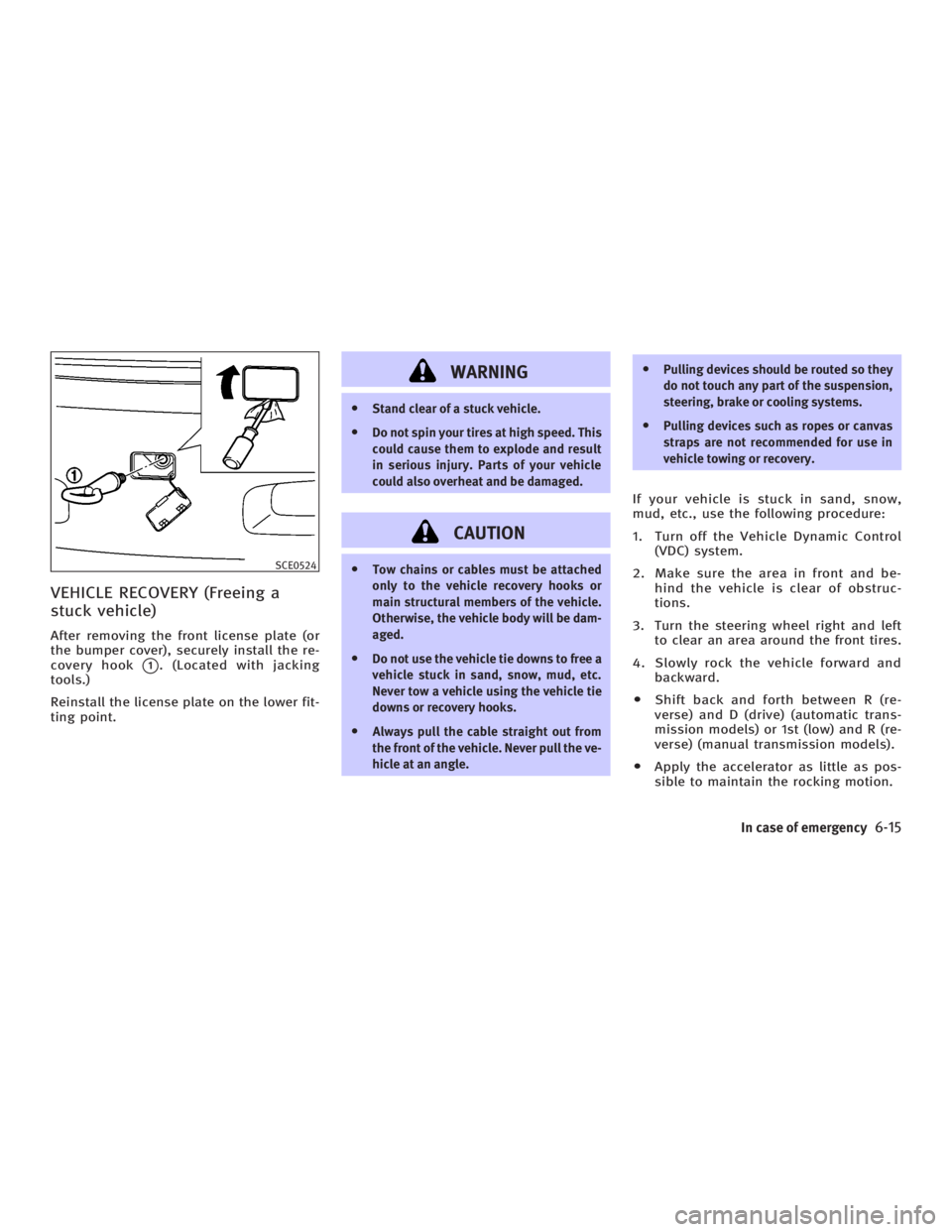
VEHICLE RECOVERY (Freeing a
stuck vehicle) After removing the front license plate (or
the bumper cover), securely install the re-
covery hook
q 1
. (Located with jacking
tools.)
Reinstall the license plate on the lower fit-
ting point. WARNING O Stand clear of a stuck vehicle.
O Do not spin your tires at high speed. This
could cause them to explode and result
in serious injury. Parts of your vehicle
could also overheat and be damaged.
CAUTION O Tow chains or cables must be attached
only to the vehicle recovery hooks or
main structural members of the vehicle.
Otherwise, the vehicle body will be dam-
aged.
O Do not use the vehicle tie downs to free a
vehicle stuck in sand, snow, mud, etc.
Never tow a vehicle using the vehicle tie
downs or recovery hooks.
O Always pull the cable straight out from
the front of the vehicle. Never pull the ve-
hicle at an angle. O Pulling devices should be routed so they
do not touch any part of the suspension,
steering, brake or cooling systems.
O Pulling devices such as ropes or canvas
straps are not recommended for use in
vehicle towing or recovery.
If your vehicle is stuck in sand, snow,
mud, etc., use the following procedure:
1. Turn off the Vehicle Dynamic Control
(VDC) system.
2. Make sure the area in front and be-
hind the vehicle is clear of obstruc-
tions.
3. Turn the steering wheel right and left
to clear an area around the front tires.
4. Slowly rock the vehicle forward and
backward.
O Shift back and forth between R (re-
verse) and D (drive) (automatic trans-
mission models) or 1st (low) and R (re-
verse) (manual transmission models).
O Apply the accelerator as little as pos-
sible to maintain the rocking motion.SCE0524
In case of emergency
6-15
w 06.1.4/V35-D/V5.0
X
Page 259 of 344
8 Maintenance and do-it-yourself Maintenance requirements ............................... 8-2
General maintenance........................................ 8-2
Explanation of general maintenance
items .......................................................... 8-3
Maintenance precautions .................................. 8-5
Engine compartment check locations................ 8-7
Engine cooling system ..................................... 8-8
Checking engine coolant level..................... 8-8
Changing engine coolant............................. 8-9
Engine oil ....................................................... 8-10
Checking engine oil level........................... 8-10
Changing engine oil and filter ................... 8-11
Automatic transmission fluid........................... 8-13
Power steering fluid ........................................ 8-13
Brake and clutch fluid..................................... 8-14
Brake fluid................................................. 8-14
Clutch fluid ............................................... 8-15
Window washer fluid ....................................... 8-15
Battery ............................................................ 8-16
Jump starting ............................................. 8-18
Drive belts ...................................................... 8-19
Spark plugs .................................................... 8-19
Replacing spark plugs ............................... 8-20 Air cleaner...................................................... 8-20
Windshield wiper blades ................................. 8-21
Cleaning .................................................... 8-21
Replacing .................................................. 8-22
Parking brake and brake pedal....................... 8-23
Checking parking brake............................. 8-23
Checking brake pedal................................ 8-23
Brake booster ........................................... 8-24
Fuses .............................................................. 8-25
Engine compartment.................................. 8-25
Passenger compartment ............................ 8-27
Keyfob battery replacement ............................ 8-28
Keyfob (except Intelligent Key) .................. 8-28
Intelligent Key ........................................... 8-29
Lights.............................................................. 8-31
Headlights................................................. 8-33
Exterior and interior lights......................... 8-33
Wheels and tires ............................................ 8-37
Tire pressure ............................................. 8-37
Tire labeling .............................................. 8-41
Types of tires ............................................ 8-43
Tire chains ................................................ 8-44
Changing wheels and tires ........................ 8-45
w 06.1.4/V35-D/V5.0
X
Page 261 of 344
EXPLANATION OF GENERAL
MAINTENANCE ITEMS Additional information on the following
items with ª*º is found later in this sec-
tion.
Outside the vehicle The maintenance items listed here should
be performed from time to time, unless
otherwise specified.
Doors and engine hood: Check that all
doors and the engine hood operate prop-
erly. Also ensure that all latches lock se-
curely. Lubricate hinges and latches if
necessary. Make sure that the secondary
latch keeps the hood from opening when
the primary latch is released.
When driving in areas using road salt or
other corrosive materials, check lubrica-
tion frequently.
Lights*: Clean the headlights on a regular
basis. Make sure that the headlights,
stop lights, tail lights, turn signal lights,
and other lights are all operating properly
and installed securely. Also check head-
light aim.
Road wheel nuts (lug nuts): When
checking the tires, make sure no wheel nuts are missing, and check for any loose
wheel nuts. Tighten if necessary.
Tires*: Check the pressure with a gauge
often and always prior to long distance
trips. If necessary, adjust the pressure in
all tires, including the spare, to the speci-
fied pressure. Check carefully for damage,
cuts or excessive wear.
Tire rotation*:
Sedan: The tires should be rotated every
7,500 miles (12,000 km) to minimize tire
wear variation.
Coupe: The tires cannot be rotated.
Tire, wheel alignment and balance: If the
vehicle should pull to either side while
driving on a straight and level road, or if
you detect uneven or abnormal tire wear,
there may be a need for wheel alignment.
If the steering wheel or seat vibrates at
normal highway speeds, wheel balancing
may be needed.
O For additional information regarding
tires, refer to ªImportant Tire Safety
Informationº (US) or ªTire Safety Infor-
mationº (Canada) in the Warranty In-
formation Booklet. Windshield: Clean the windshield on a
regular basis. Check the windshield at
least every six months for cracks or other
damage. Have a damaged windshield re-
paired by a qualified repair facility.
Windshield wiper blades*: Check for
cracks or wear if they do not wipe prop-
erly.
Maintenance and do-it-yourself
8-3
w 06.1.4/V35-D/V5.0
X
Page 262 of 344
Inside the vehicle The maintenance items listed here should
be checked on a regular basis, such as
when performing periodic maintenance,
cleaning the vehicle, etc.
Accelerator pedal: Check the pedal for
smooth operation and make sure the
pedal does not catch or require uneven
effort. Keep the floor mat away from the
pedal.
Automatic transmission P (Park) mecha-
nism: On a fairly steep hill check that your
vehicle is held securely with the selector
lever in the P (Park) position without ap-
plying any brakes.
Brake pedal*: Check the pedal for smooth
operation and make sure it has the proper
distance under it when depressed fully.
Check the brake booster function. Be sure
to keep the floor mat away from the
pedal.
Brakes: Check that the brakes do not pull
the vehicle to one side when applied.
Parking brake*: Check that the pedal/
lever has the proper travel and confirm
that your vehicle is held securely on a
fairly steep hill with only the parking
brake applied. Seats: Check seat position controls such
as seat adjusters, seatback recliner, etc.
to ensure they operate smoothly and that
all latches lock securely in every position.
Check that the head restraints move up
and down smoothly and that the locks (if
so equipped) hold securely in all latched
positions.
Seat belts: Check that all parts of the seat
belt system (For example, buckles, an-
chors, adjusters and retractors) operate
properly and smoothly, and are installed
securely. Check the belt webbing for cuts,
fraying, wear or damage.
Steering wheel: Check for changes in the
steering conditions, such as excessive
free play, hard steering or strange noises.
Warning lights and chimes: Make sure
that all warning lights and chimes are op-
erating properly.
Windshield defroster: Check that the air
comes out of the defroster outlets prop-
erly and in sufficient quantity when oper-
ating the heater or air conditioner.
Windshield wiper and washer*: Check that
the wipers and washer operate properly
and that the wipers do not streak. Under the hood and the vehicle The maintenance items listed here should
be checked periodically (For example,
each time you check the engine oil or re-
fuel).
Battery*: Check the fluid level in each
cell. It should be between the MAX and
MIN lines. Vehicles operated in high tem-
peratures or under severe conditions re-
quire frequent checks of the battery fluid
level.
Brake and clutch fluid level*: Make sure
that the brake and clutch fluid levels are
between the MAX and MIN lines on the
reservoir.
Engine coolant level*: Check the coolant
level when the engine is cold.
Engine drive belts*: Make sure that no
belt is frayed, worn, cracked or oily.
Engine oil level*: Check the level after
parking the vehicle on a level location
and turning off the engine. (Wait at least
10 minutes for the oil to drain back into
the oil pan.)
Exhaust system: Make sure there are no
loose supports, cracks or holes. If the
sound of the exhaust seems unusual or
8-4 Maintenance and do-it-yourself
w 06.1.4/V35-D/V5.0
X