length INFINITI G35 2006 Owners Manual
[x] Cancel search | Manufacturer: INFINITI, Model Year: 2006, Model line: G35, Model: INFINITI G35 2006Pages: 344, PDF Size: 6.81 MB
Page 35 of 344
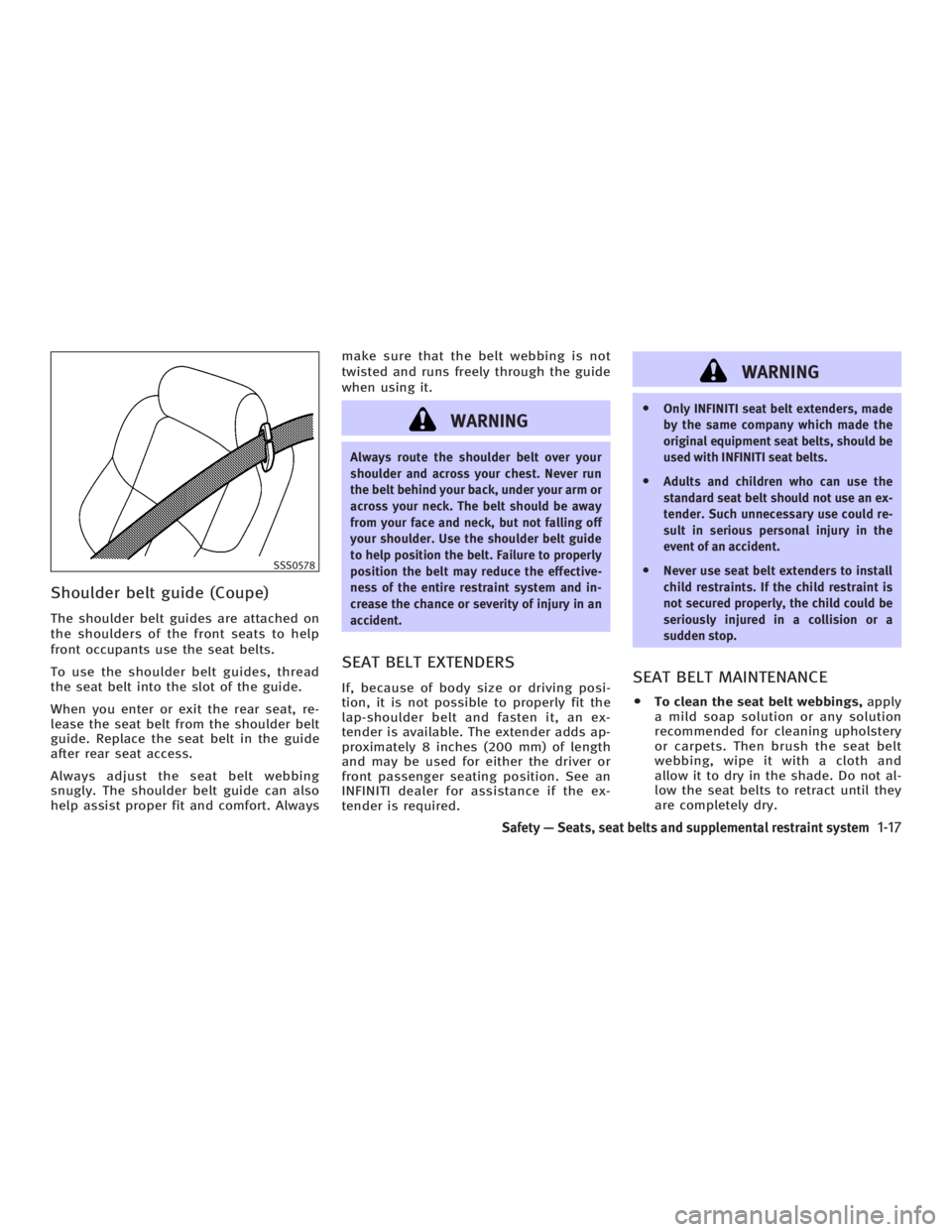
Shoulder belt guide (Coupe) The shoulder belt guides are attached on
the shoulders of the front seats to help
front occupants use the seat belts.
To use the shoulder belt guides, thread
the seat belt into the slot of the guide.
When you enter or exit the rear seat, re-
lease the seat belt from the shoulder belt
guide. Replace the seat belt in the guide
after rear seat access.
Always adjust the seat belt webbing
snugly. The shoulder belt guide can also
help assist proper fit and comfort. Always make sure that the belt webbing is not
twisted and runs freely through the guide
when using it.
WARNING Always route the shoulder belt over your
shoulder and across your chest. Never run
the belt behind your back, under your arm or
across your neck. The belt should be away
from your face and neck, but not falling off
your shoulder. Use the shoulder belt guide
to help position the belt. Failure to properly
position the belt may reduce the effective-
ness of the entire restraint system and in-
crease the chance or severity of injury in an
accident.
SEAT BELT EXTENDERS If, because of body size or driving posi-
tion, it is not possible to properly fit the
lap-shoulder belt and fasten it, an ex-
tender is available. The extender adds ap-
proximately 8 inches (200 mm) of length
and may be used for either the driver or
front passenger seating position. See an
INFINITI dealer for assistance if the ex-
tender is required. WARNING O Only INFINITI seat belt extenders, made
by the same company which made the
original equipment seat belts, should be
used with INFINITI seat belts.
O Adults and children who can use the
standard seat belt should not use an ex-
tender. Such unnecessary use could re-
sult in serious personal injury in the
event of an accident.
O Never use seat belt extenders to install
child restraints. If the child restraint is
not secured properly, the child could be
seriously injured in a collision or a
sudden stop.
SEAT BELT MAINTENANCE O To clean the seat belt webbings, apply
a mild soap solution or any solution
recommended for cleaning upholstery
or carpets. Then brush the seat belt
webbing, wipe it with a cloth and
allow it to dry in the shade. Do not al-
low the seat belts to retract until they
are completely dry.SSS0578
Safety Ð Seats, seat belts and supplemental restraint system
1-17
w 06.1.4/V35-D/V5.0
X
Page 206 of 344
WARNINGO Do not leave children, impaired adults, or
pets alone in your vehicle. They could ac-
cidentally injure themselves or others
through inadvertent operation of the ve-
hicle. Also, on hot, sunny days, tempera-
tures in a closed vehicle could quickly be-
come high enough to cause severe or pos-
sibly fatal injuries to people or animals.
O Closely supervise children when they are
around cars to prevent them from
playing and becoming locked in the
trunk where they could be seriously in-
jured. Keep the car locked, with the rear
seatback and trunk lid securely latched
when not in use, and prevent children's
access to car keys.
EXHAUST GAS (Carbon monoxide)
WARNINGDo not breathe exhaust gases; they contain
colorless and odorless carbon monoxide. Carbon monoxide is dangerous. It can cause
unconsciousness or death.
O If you suspect that exhaust fumes are
entering the vehicle, drive with all win-
dows fully open, and have the vehicle in-
spected immediately.
O Do not run the engine in closed spaces
such as a garage.
O Do not park the vehicle with the engine
running for any extended length of time.
O Keep the trunk lid closed while driving,
otherwise exhaust gases could be drawn
into the passenger compartment. If you
must drive with the trunk lid open, follow
these precautions:
Ð Open all the windows.
Ð Set the air recirculation switch OFF
and the fan control at high to circu-
late the air.
O If electrical wiring or other cable connec-
tions must pass to a trailer through the
seal on the trunk lid or the body, follow
the manufacturer's recommendation to prevent carbon monoxide entry into
the vehicle.
O If a special body, camper, or other equip-
ment is added for recreational or other
usage, follow the manufacturer's recom-
mendation to prevent carbon monoxide
entry into the vehicle. (Some recre-
ational vehicle appliances such as
stoves, refrigerators, heaters, etc. may
also generate carbon monoxide.)
O The exhaust system and body should be
inspected by a qualified mechanic when-
ever:
Ð Your vehicle is raised while being ser-
viced.
Ð You suspect that exhaust fumes are
entering into the passenger compart-
ment.
Ð You notice a change in the sound of
the exhaust system.
Ð You have had an accident involving
damage to the exhaust system, un-
derbody, or rear of the vehicle.PRECAUTIONS WHEN STARTING AND
DRIVING
5-2 Starting and driving
w 06.1.4/V35-D/V5.0
X
Page 315 of 344
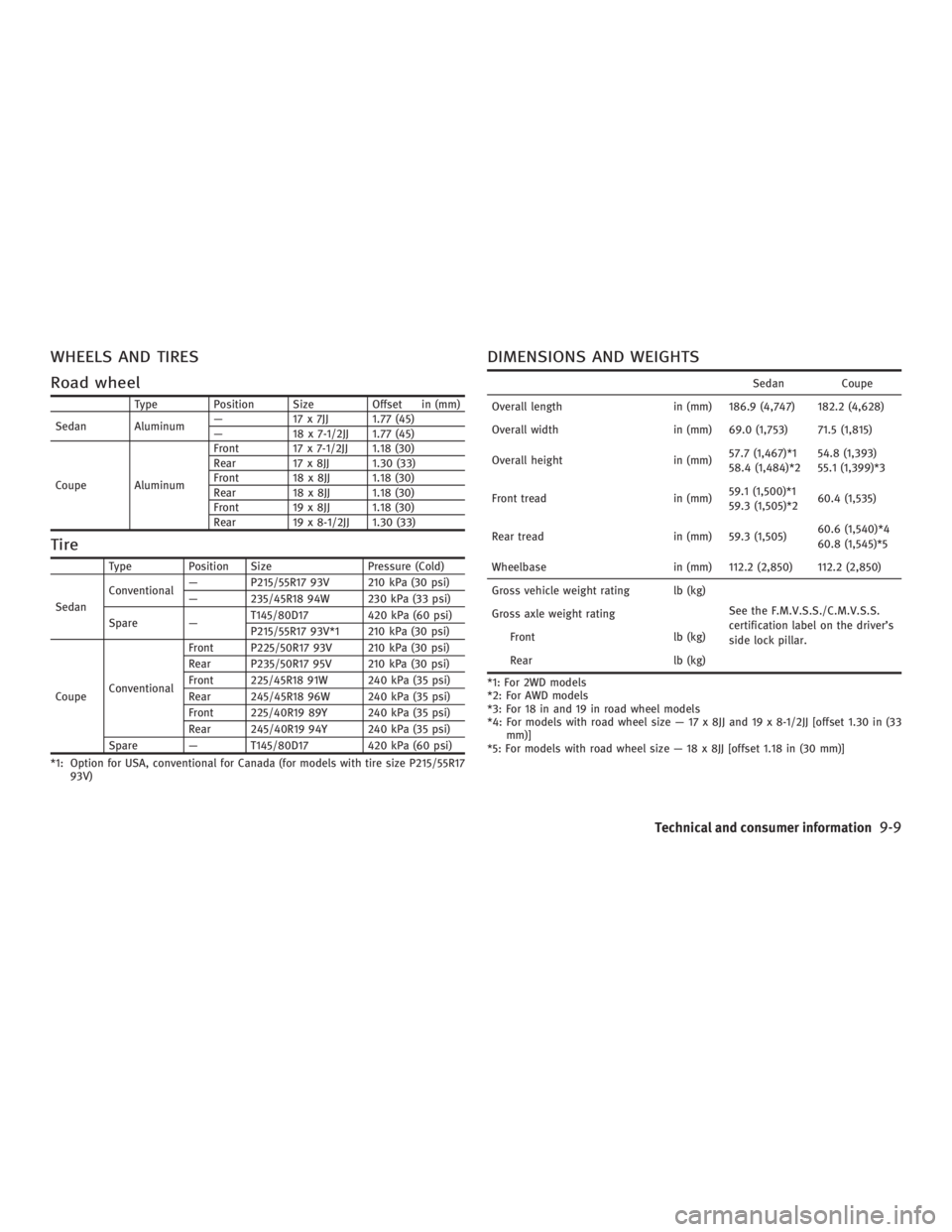
WHEELS AND TIRES
Road wheel Type Position Size Offset in (mm)
Sedan Aluminum Ð 17 x 7JJ 1.77 (45)
Ð 18 x 7-1/2JJ 1.77 (45)
Coupe Aluminum Front 17 x 7-1/2JJ 1.18 (30)
Rear 17 x 8JJ 1.30 (33)
Front 18 x 8JJ 1.18 (30)
Rear 18 x 8JJ 1.18 (30)
Front 19 x 8JJ 1.18 (30)
Rear 19 x 8-1/2JJ 1.30 (33)
Tire Type Position Size Pressure (Cold)
Sedan Conventional Ð P215/55R17 93V 210 kPa (30 psi)
Ð 235/45R18 94W 230 kPa (33 psi)
Spare Ð T145/80D17 420 kPa (60 psi)
P215/55R17 93V*1 210 kPa (30 psi)
Coupe Conventional Front P225/50R17 93V 210 kPa (30 psi)
Rear P235/50R17 95V 210 kPa (30 psi)
Front 225/45R18 91W 240 kPa (35 psi)
Rear 245/45R18 96W 240 kPa (35 psi)
Front 225/40R19 89Y 240 kPa (35 psi)
Rear 245/40R19 94Y 240 kPa (35 psi)
Spare Ð T145/80D17 420 kPa (60 psi)
*1: Option for USA, conventional for Canada (for models with tire size P215/55R17
93V) DIMENSIONS AND WEIGHTS Sedan Coupe
Overall length in (mm) 186.9 (4,747) 182.2 (4,628)
Overall width in (mm) 69.0 (1,753) 71.5 (1,815)
Overall height in (mm) 57.7 (1,467)*1
58.4 (1,484)*2 54.8 (1,393)
55.1 (1,399)*3
Front tread in (mm) 59.1 (1,500)*1
59.3 (1,505)*2 60.4 (1,535)
Rear tread in (mm) 59.3 (1,505) 60.6 (1,540)*4
60.8 (1,545)*5
Wheelbase in (mm) 112.2 (2,850) 112.2 (2,850)
Gross vehicle weight rating lb (kg)
See the F.M.V.S.S./C.M.V.S.S.
certification label on the driver's
side lock pillar.Gross axle weight rating
Front lb (kg)
Rear lb (kg)
*1: For 2WD models
*2: For AWD models
*3: For 18 in and 19 in road wheel models
*4: For models with road wheel size Ð 17 x 8JJ and 19 x 8-1/2JJ [offset 1.30 in (33
mm)]
*5: For models with road wheel size Ð 18 x 8JJ [offset 1.18 in (30 mm)]
Technical and consumer information
9-9
w 06.1.4/V35-D/V5.0
X
Page 328 of 344
O Trailer towing requires more fuel than
normal circumstances.
O Avoid towing a trailer for the first 500
miles (800 km).
O Have your vehicle serviced more often
than at intervals specified in the rec-
ommended maintenance schedule in
the INFINITI Service and Maintenance
Guide.
O When making a turn, your trailer
wheels will be closer to the inside of
the turn than your vehicle wheels. To
compensate for this, make a larger
than normal turning radius during the
turn.
O Crosswinds and rough roads will ad-
versely affect vehicle/trailer handling,
possibly causing vehicle sway. When
being passed by larger vehicles, be
prepared for possible changes in
crosswinds that could affect vehicle
handling. If swaying does occur, firmly
grip the steering wheel, steer straight
ahead, and immediately (but gradu-
ally) reduce vehicle speed. This combi-
nation will help stabilize the vehicle.
Never increase speed. O Be careful when passing other vehicles.
Passing while towing a trailer requires
considerably more distance than normal
passing. Remember the length of the
trailer must also pass the other vehicle
before you can safely change lanes.
O To maintain engine braking efficiency
and electrical charging performance,
do not use sixth gear (manual trans-
mission) or fifth position (automatic
transmission).
O Avoid holding the brake pedal down
too long or too frequently. This could
cause the brakes to overheat, re-
sulting in reduced braking efficiency.
O Increase your following distance to al-
low for greater stopping distances
while towing a trailer. Anticipate stops
and brake gradually.
O Do not use cruise control while towing
a trailer.
O Check your hitch, trailer wiring har-
ness connections, and trailer wheel
lug nuts after 50 miles (80 km) of
travel and at every break.
O When stopped in traffic for long pe-
riods of time in hot weather, put the
vehicle in the P (Park) position. When towing a trailer, transmission
oil/fluid should be changed more fre-
quently.
For additional information, see the ª8.
Maintenance and do-it-yourselfº section
earlier in this manual.
FLAT TOWING Towing your vehicle with all four wheels
on the ground is sometimes called flat
towing. This method is sometimes used
when towing a vehicle behind a recre-
ational vehicle, such as a motor home.
CAUTION O Failure to follow these guidelines can re-
sult in severe transmission damage.
O Whenever flat towing your vehicle, al-
ways tow forward, never backward.
O DO NOT tow any automatic transmission
vehicle with all four wheels on the
ground (flat towing). Doing so WILL
DAMAGE internal transmission parts due
to lack of transmission lubrication.
9-22 Technical and consumer information
w 06.1.4/V35-D/V5.0
X