trailer INFINITI G35 2006 Owners Manual
[x] Cancel search | Manufacturer: INFINITI, Model Year: 2006, Model line: G35, Model: INFINITI G35 2006Pages: 344, PDF Size: 6.81 MB
Page 152 of 344
cause fuel overflow, resulting in fuel-
spray and possibly a fire.
O Use only an original equipment type
fuel-filler cap as a replacement. It has a
built-in safety valve needed for proper
operation of the fuel system and emis-
sion control system. An incorrect cap can
result in a serious malfunction and pos-
sible injury. An incorrect cap could also
cause the
malfunction indicator
lamp to illuminate.
O Do not fill a portable fuel container in the
vehicle or trailer. Static electricity can
cause an explosion of flammable liquid,
vapor or gas in any vehicle or trailer. To
reduce the risk of serious injury or death
when filling portable fuel containers:
Ð Always place the container on the
ground when filling.
Ð Do not use electronic devices when
filling.
Ð Keep the pump nozzle in contact with
the container while you are filling it.
Ð Use only approved portable fuel con-
tainers for flammable liquid.
O Never pour fuel into the throttle body to
attempt to start your vehicle. CAUTION O If fuel is spilled on the vehicle body,
flush it away with water to avoid paint
damage.
O Tighten until the fuel-filler cap clicks.
Failure to tighten the fuel-filler cap prop-
erly may cause the
malfunction in-
dicator lamp (MIL) to illuminate. If the
lamp illuminates because the fuel-
filler cap is loose or missing, tighten or
install the cap and continue to drive the
vehicle. The
lamp should turn off
after a few driving trips. If the
lamp
does not turn off after a few driving trips,
have the vehicle inspected by an INFINITI
dealer.
O For additional information, see the ªMal-
function indicator lamp (MIL)º in the ª2.
Instruments and controlsº section.
MANUAL OPERATION
WARNING Do not adjust the steering wheel while
driving. You could lose control of your ve-
hicle and cause an accident.
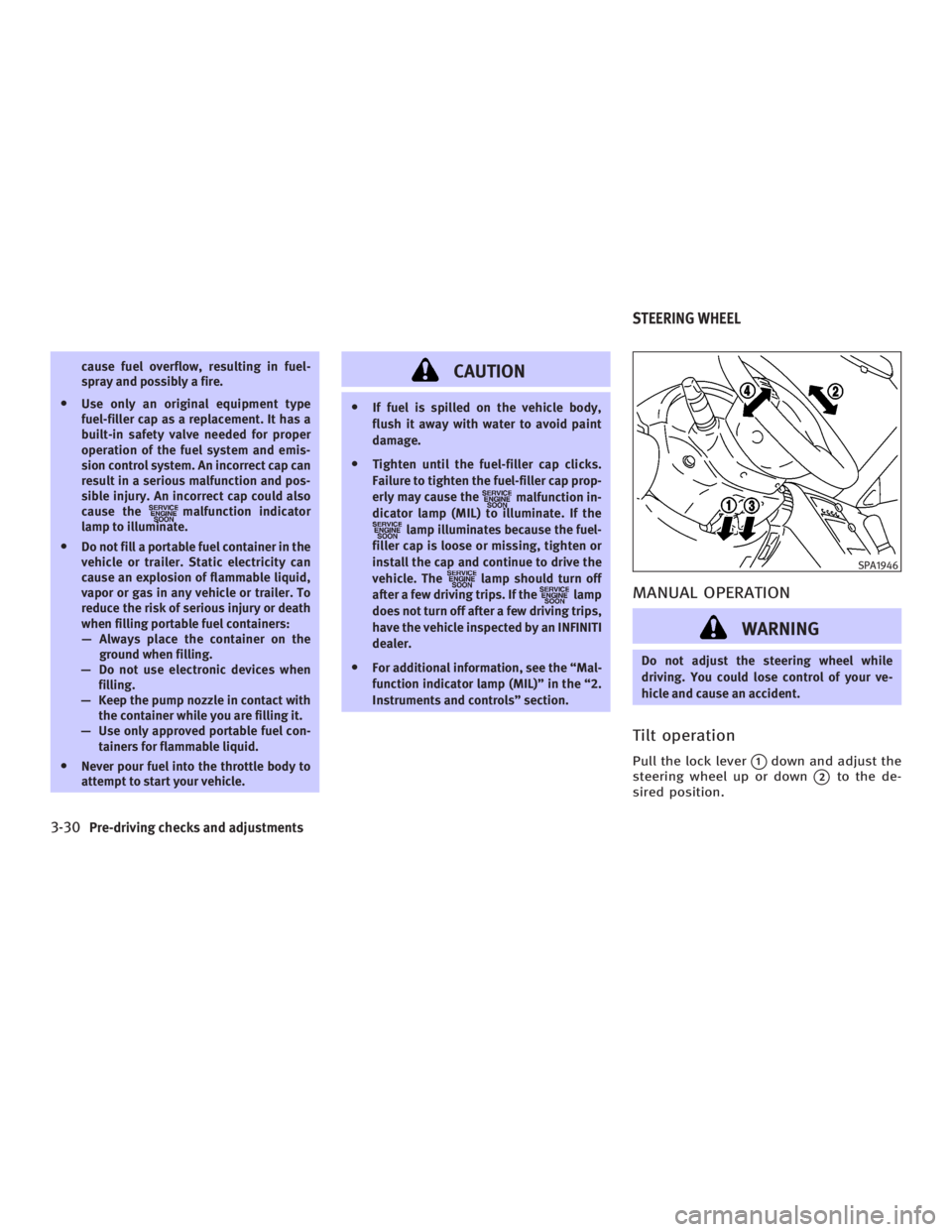
Tilt operation Pull the lock lever
q 1
down and adjust the
steering wheel up or down
q 2
to the de-
sired position. SPA1946
STEERING WHEEL
3-30 Pre-driving checks and adjustments
w 06.1.4/V35-D/V5.0
X
Page 206 of 344
WARNINGO Do not leave children, impaired adults, or
pets alone in your vehicle. They could ac-
cidentally injure themselves or others
through inadvertent operation of the ve-
hicle. Also, on hot, sunny days, tempera-
tures in a closed vehicle could quickly be-
come high enough to cause severe or pos-
sibly fatal injuries to people or animals.
O Closely supervise children when they are
around cars to prevent them from
playing and becoming locked in the
trunk where they could be seriously in-
jured. Keep the car locked, with the rear
seatback and trunk lid securely latched
when not in use, and prevent children's
access to car keys.
EXHAUST GAS (Carbon monoxide)
WARNINGDo not breathe exhaust gases; they contain
colorless and odorless carbon monoxide. Carbon monoxide is dangerous. It can cause
unconsciousness or death.
O If you suspect that exhaust fumes are
entering the vehicle, drive with all win-
dows fully open, and have the vehicle in-
spected immediately.
O Do not run the engine in closed spaces
such as a garage.
O Do not park the vehicle with the engine
running for any extended length of time.
O Keep the trunk lid closed while driving,
otherwise exhaust gases could be drawn
into the passenger compartment. If you
must drive with the trunk lid open, follow
these precautions:
Ð Open all the windows.
Ð Set the air recirculation switch OFF
and the fan control at high to circu-
late the air.
O If electrical wiring or other cable connec-
tions must pass to a trailer through the
seal on the trunk lid or the body, follow
the manufacturer's recommendation to prevent carbon monoxide entry into
the vehicle.
O If a special body, camper, or other equip-
ment is added for recreational or other
usage, follow the manufacturer's recom-
mendation to prevent carbon monoxide
entry into the vehicle. (Some recre-
ational vehicle appliances such as
stoves, refrigerators, heaters, etc. may
also generate carbon monoxide.)
O The exhaust system and body should be
inspected by a qualified mechanic when-
ever:
Ð Your vehicle is raised while being ser-
viced.
Ð You suspect that exhaust fumes are
entering into the passenger compart-
ment.
Ð You notice a change in the sound of
the exhaust system.
Ð You have had an accident involving
damage to the exhaust system, un-
derbody, or rear of the vehicle.PRECAUTIONS WHEN STARTING AND
DRIVING
5-2 Starting and driving
w 06.1.4/V35-D/V5.0
X
Page 226 of 344
CAUTIONDuring the first 1,200 miles (2,000 km),
follow these recommendations to obtain
maximum engine performance and ensure
the future reliability and economy of your
new vehicle. Failure to follow these recom-
mendations may result in shortened engine
life and reduced engine performance.
O Avoid driving for long periods at con-
stant speed, either fast or slow. Do
not run the engine over 4,000 rpm.
O Do not accelerate at full throttle in any
gear.
O Avoid quick starts.
O Avoid hard braking as much as pos-
sible.
O Do not tow a trailer or haul a heavy
load for the first 500 miles (800 km). O Accelerate slowly and smoothly. Main-
tain cruising speeds with a constant
accelerator position.
O Drive at moderate speeds on the high-
way. Driving at high speed will lower
fuel economy.
O Avoid unnecessary stopping and brak-
ing. Maintain a safe distance behind
other vehicles.
O Use a proper gear range which suits
road conditions. On level roads, shift
into high gear as soon as possible.
O Avoid unnecessary engine idling.
O Keep your engine tuned up.
O Follow the recommended periodic
maintenance schedule.
O Keep the tires inflated at the correct
pressure. Low pressure will increase
tire wear and waste fuel.
O Keep the front wheels in correct align-
ment. Improper alignment will cause
not only tire wear but also lower fuel
economy.
O Air conditioner operation lowers fuel
economy. Use the air conditioner only
when necessary. O When cruising at highway speeds, it is
more economical to use the air condi-
tioner and leave the windows closed
to reduce drag.
BREAK-IN SCHEDULE INCREASING FUEL ECONOMY
5-22 Starting and driving
w 06.1.4/V35-D/V5.0
X
Page 306 of 344
O Do not use abrasive cleaners when
washing the wheels.
O Inspect wheel rims regularly for dents or
corrosion. Such damage may cause loss
of pressure or poor seal at the tire bead.
O INFINITI recommends that the road
wheels be waxed to protect against
road salt in areas where it is used
during winter.
Spare tire (TEMPORARY USE ONLY
spare tire (T-type)) Observe the following precautions if the
T-type spare tire must be used, otherwise
your vehicle could be damaged or in-
volved in an accident.
CAUTIONO The T-type spare tire should be used only
for an emergency. It should be replaced by
a standard tire at the first opportunity.
O Drive carefully while the T-type spare tire
is installed.
Avoid sharp turns and abrupt braking
while driving. O Periodically check the T-type spare tire
inflation pressure, and always keep it at
60 psi (420 kPa, 4.2 bar).
O With the T-type spare tire installed, do
not drive your vehicle at speeds faster
than 50 MPH (80 km/h).
O When driving on roads covered with
snow or ice, the T-type spare tire should
be used on the front wheel and the origi-
nal tire used on the rear wheels (drive
wheels). Use tire chains only on the rear
two original tires (Sedan).
O
Tire tread of the T-type spare tire will wear
at a faster rate than the original tire. Re-
place the T-type spare tire as soon as the
tread wear indicators appear.
O Do not use the T-type spare tire on other
vehicles.
O Do not use more than one T-type spare
tire at the same time.
O Do not tow a trailer while the T-type
spare tire is installed. CAUTION O Do not use tire chains on a T-type spare
tire. Tire chains will not fit properly on
the T-type spare tire and may cause
damage to the vehicle.
O Because the T-type spare tire is smaller
than the original tire, ground clearance
is reduced. To avoid damage to the ve-
hicle do not drive over obstacles. Also do
not drive the vehicle through an auto-
matic car wash since it may get caught.
8-48 Maintenance and do-it-yourself
w 06.1.5/V35-D/V5.0
X
Page 307 of 344
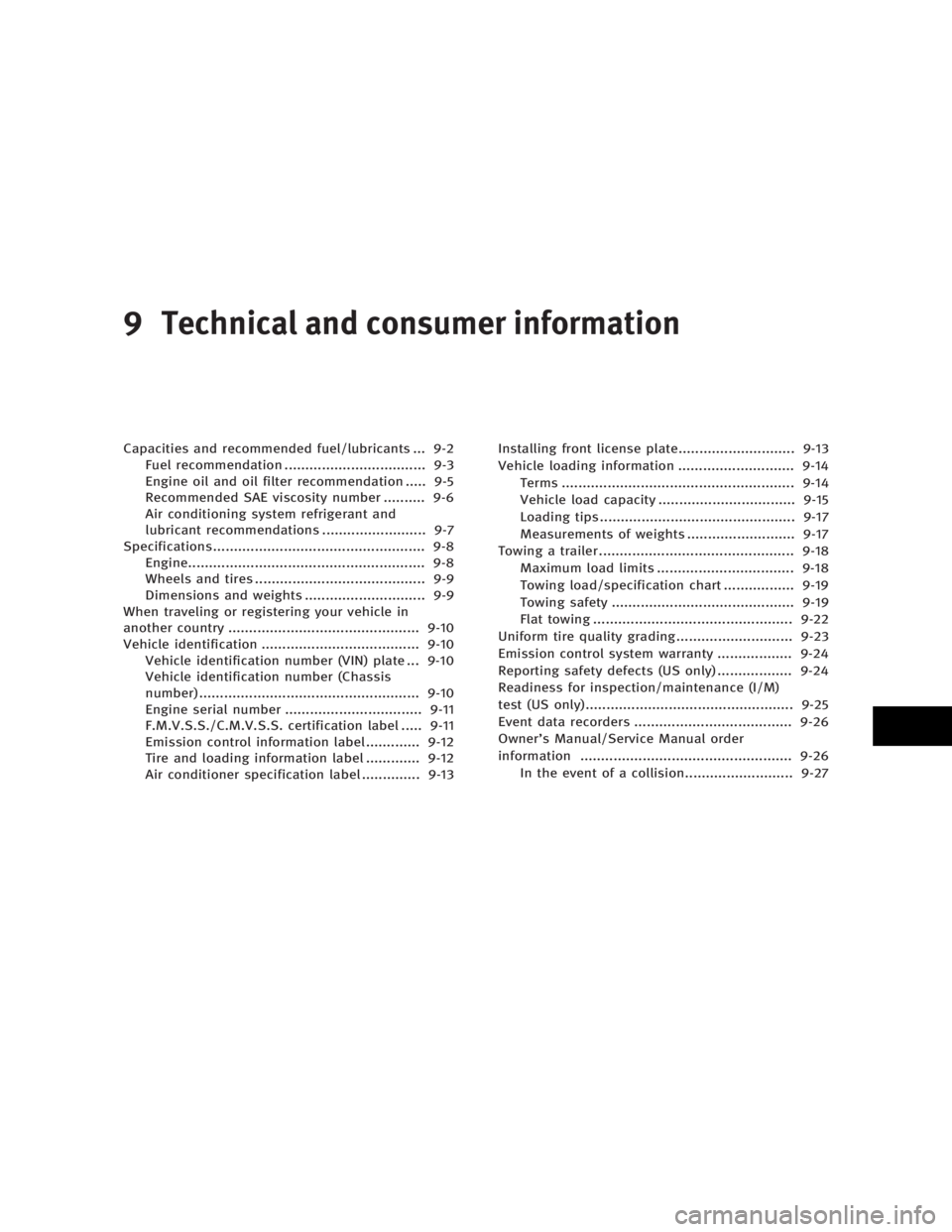
9 Technical and consumer information Capacities and recommended fuel/lubricants ... 9-2
Fuel recommendation .................................. 9-3
Engine oil and oil filter recommendation ..... 9-5
Recommended SAE viscosity number .......... 9-6
Air conditioning system refrigerant and
lubricant recommendations ......................... 9-7
Specifications................................................... 9-8
Engine......................................................... 9-8
Wheels and tires ......................................... 9-9
Dimensions and weights ............................. 9-9
When traveling or registering your vehicle in
another country .............................................. 9-10
Vehicle identification ...................................... 9-10
Vehicle identification number (VIN) plate ... 9-10
Vehicle identification number (Chassis
number) ..................................................... 9-10
Engine serial number ................................. 9-11
F.M.V.S.S./C.M.V.S.S. certification label ..... 9-11
Emission control information label ............. 9-12
Tire and loading information label ............. 9-12
Air conditioner specification label .............. 9-13 Installing front license plate............................ 9-13
Vehicle loading information ............................ 9-14
Terms ........................................................ 9-14
Vehicle load capacity ................................. 9-15
Loading tips ............................................... 9-17
Measurements of weights .......................... 9-17
Towing a trailer ............................................... 9-18
Maximum load limits ................................. 9-18
Towing load/specification chart ................. 9-19
Towing safety ............................................ 9-19
Flat towing ................................................ 9-22
Uniform tire quality grading............................ 9-23
Emission control system warranty .................. 9-24
Reporting safety defects (US only) .................. 9-24
Readiness for inspection/maintenance (I/M)
test (US only).................................................. 9-25
Event data recorders ...................................... 9-26
Owner's Manual/Service Manual order
information ................................................... 9-26
In the event of a collision.......................... 9-27
w 06.1.4/V35-D/V5.0
X
Page 312 of 344
Selecting the correct oil filter Your new vehicle is equipped with a high-
quality genuine NISSAN oil filter. When re-
placing, use the genuine oil filter or its
equivalent for the reason described in
change intervals.
Change intervals The oil and oil filter change intervals for
your engine are based on the use of the
specified quality oils and filters. Oil and
filter other than the specified quality, or
oil and filter change intervals longer than
recommended could reduce engine life.
Damage to engines caused by improper
maintenance or use of incorrect oil and
filter quality and/or viscosity is not cov-
ered by the new INFINITI vehicle limited
warranties.
Your engine was filled with a high quality
engine oil when it was built. You do not
have to change the oil before the first rec-
ommended change interval. Oil and filter
change intervals depend upon how you
use your vehicle. Operation under the fol-
lowing conditions may require more fre-
quent oil and filter changes.
O repeated short distance driving at cold
outside temperatures O driving in dusty conditions
O extensive idling
O towing a trailer
O stop and go commuting
Refer to the ªINFINITI Service and Mainte-
nance Guideº for the maintenance sched-
ule.
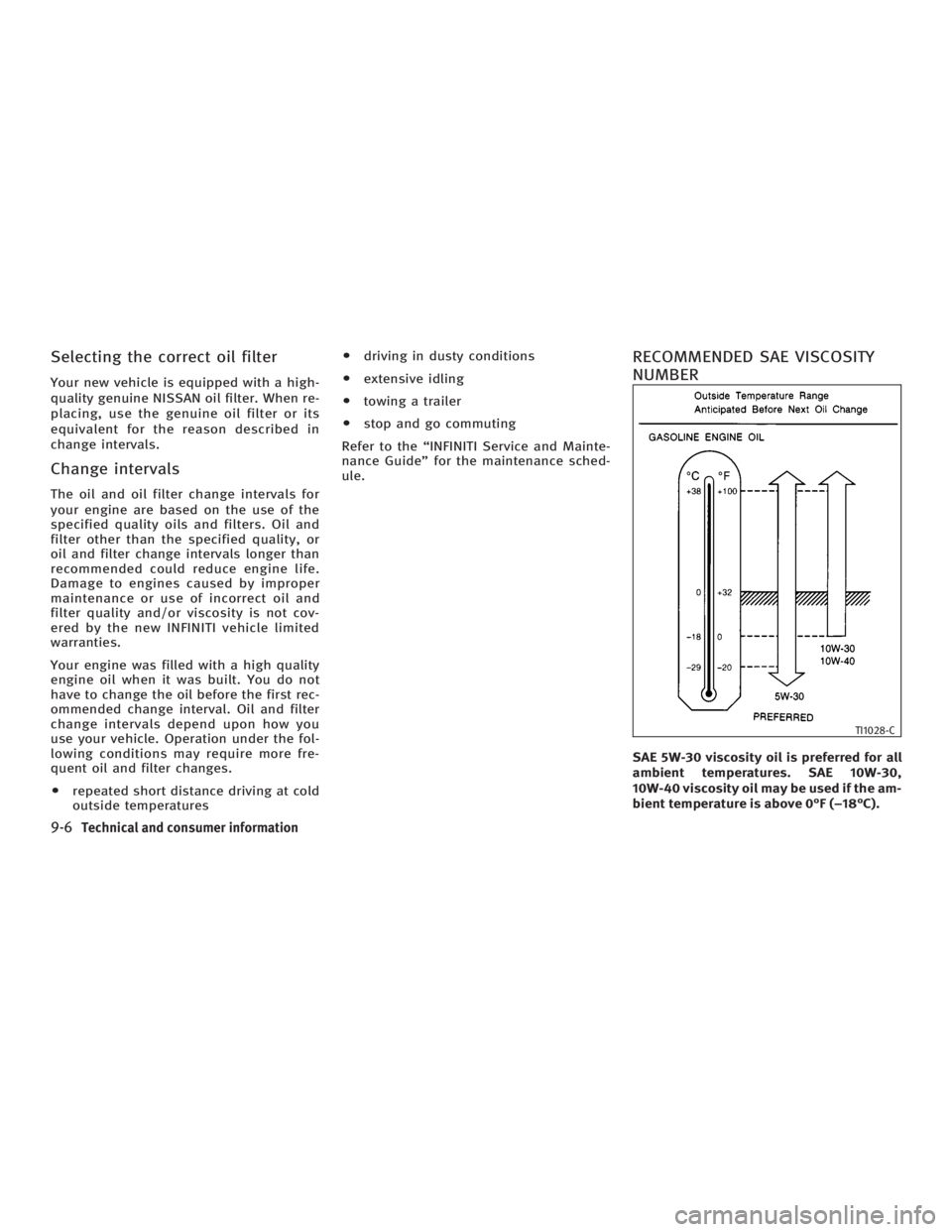
RECOMMENDED SAE VISCOSITY
NUMBER
SAE 5W-30 viscosity oil is preferred for all
ambient temperatures. SAE 10W-30,
10W-40 viscosity oil may be used if the am-
bient temperature is above 0ÉF (þ18ÉC). TI1028-C
9-6 Technical and consumer information
w 06.1.4/V35-D/V5.0
X
Page 321 of 344
tire assembly. This weight does not
include passengers and cargo.
O GVW (Gross Vehicle Weight) - curb
weight plus the combined weight of
passengers and cargo.
O GVWR (Gross Vehicle Weight Rating)
- maximum total combined weight of
the unloaded vehicle, passengers,
luggage, hitch, trailer tongue load
and any other optional equipment.
This information is located on the
F.M.V.S.S./C.M.V.S.S. label.
O GAWR (Gross Axle Weight Rating) -
maximum weight (load) limit speci-
fied for the front or rear axle. This
information is located on the
F.M.V.S.S./C.M.V.S.S. label.
O GCWR (Gross Combined Weight
Rating) - maximum total weight
rating of the vehicle, passengers,
cargo and trailer. O Vehicle Capacity Weight, Load limit,
Total load capacity - maximum total
weight limit specified of the load
(passengers and cargo) for the ve-
hicle. This is the maximum com-
bined weight of occupants and
cargo that can be loaded into the ve-
hicle. If the vehicle is used to tow a
trailer, the trailer tongue weight
must be included as part of the
cargo load. This information is lo-
cated on the Tire and Loading Infor-
mation label.
O Cargo capacity - permissible weight
of cargo, the subtracted weight of
occupants from the load limit. VEHICLE LOAD CAPACITY Do not exceed the load limit of your ve-
hicle shown as ªThe combined weight
of occupants and cargoº on the Tire and
Loading Information label. Do not ex-
ceed the number of occupants shown
as ªSeating Capacityº on the Tire and
Loading Information label.
To get ªthe combined weight of occu-
pants and cargoº, add the weight of all
occupants, then add the total luggage
weight to the value. Examples are
shown in the following illustration.
Technical and consumer information
9-15
w 06.1.4/V35-D/V5.0
X
Page 323 of 344
the vehicle. That weight may not
safely exceed the available cargo
and luggage load capacity calcu-
lated in Step 4.
6. If your vehicle will be towing a
trailer, load from your trailer will be
transferred to your vehicle. Consult
this manual to determine how this
reduces the available cargo and lug-
gage load capacity of your vehicle.
Before driving a loaded vehicle, confirm
that you do not exceed the Gross Ve-
hicle Weight Rating (GVWR) or the
Gross Axle Weight Rating (GAWR) for
your vehicle. See ``Measurement of
Weights'' later in this section.
Also check tires for proper inflation
pressures. See the Tire and Loading In-
formation label.
LOADING TIPS
O The GVW must not exceed GVWR or
GAWR as specified on the F.M.V.S.S./C.M.V.S.S. certification
label.
O Do not load the front and rear axle
to the GAWR. Doing so will exceed
the GVWR.
WARNINGO Properly secure all cargo with
ropes or straps to help prevent it
from sliding or shifting. Do not
place cargo higher than the seat-
backs. In a sudden stop or colli-
sion, unsecured cargo could cause
personal injury.
O Do not load your vehicle any
heavier than the GVWR or the
maximum front and rear GAWRs. If
you do, parts of your vehicle can
break, tire damage could occur, or
it can change the way your vehicle
handles. This could result in loss
of control and cause personal
injury. O Overloading not only can shorten
the life of your vehicle and the tire,
but can also cause unsafe vehicle
handling and longer braking dis-
tances. This may cause a prema-
ture tire failure which could result
in a serious accident and personal
injury. Failures caused by over-
loading are not covered by the ve-
hicle's warranty.
MEASUREMENT OF WEIGHTS
Secure loose items to prevent weight
shifts that could affect the balance of
your vehicle. When the vehicle is
loaded, drive to a scale and weigh the
front and the rear wheels separately to
determine axle loads. Individual axle
loads should not exceed either of the
gross axle weight ratings (GAWR). The
total of the axle loads should not ex-
ceed the gross vehicle weight rating
(GVWR). These ratings are given on the
vehicle certification label. If weight rat-
ings are exceeded, move or remove
items to bring all weights below the rat-
ings. Technical and consumer information
9-17
w 06.1.4/V35-D/V5.0
X
Page 324 of 344
WARNINGOverloading or improper loading of a trailer
and its cargo can adversely affect vehicle
handling, braking and performance and may
lead to accidents.
CAUTIONO Do not tow a trailer or haul a heavy load
for the first 500 miles (800 km). Your engine, axle or other parts could be
damaged.
O For the first 500 miles (800 km) that you
tow a trailer, do not drive over 50 mph
(80 km/h) and do not make starts at full
throttle. This helps the engine and other
parts of your vehicle wear in at the
heavier loads.
Your new vehicle was designed to be
used primarily to carry passengers and
cargo. Remember that towing a trailer will
place additional loads on a vehicle's en-
gine, drive train, steering, braking and
other systems.
An INFINITI Towing Guide (U.S. only) is
available on the website at
www. infiniti.com. This guide includes in-
formation on trailer towing capability and
the special equipment required for proper
towing.
MAXIMUM LOAD LIMITS
Maximum trailer loads Never allow the total trailer load to ex-
ceed the value specified in the Towing
Load/Specification Chart found later in this section. The total trailer load equals
trailer weight plus its cargo weight.
Towing loads greater than specified or us-
ing improper towing equipment could ad-
versely affect vehicle handling, braking
and performance. The ability of a vehicle
to tow a trailer is not only related to the
maximum trailer loads, but also the
places you plan to tow. Tow weights ap-
propriate for level highway driving may
have to be reduced on very steep grades
or in low traction situations (for example,
on slippery boat ramps).
CAUTION Vehicle damage resulting from improper
towing procedures are not covered by
INFINITI warranties.
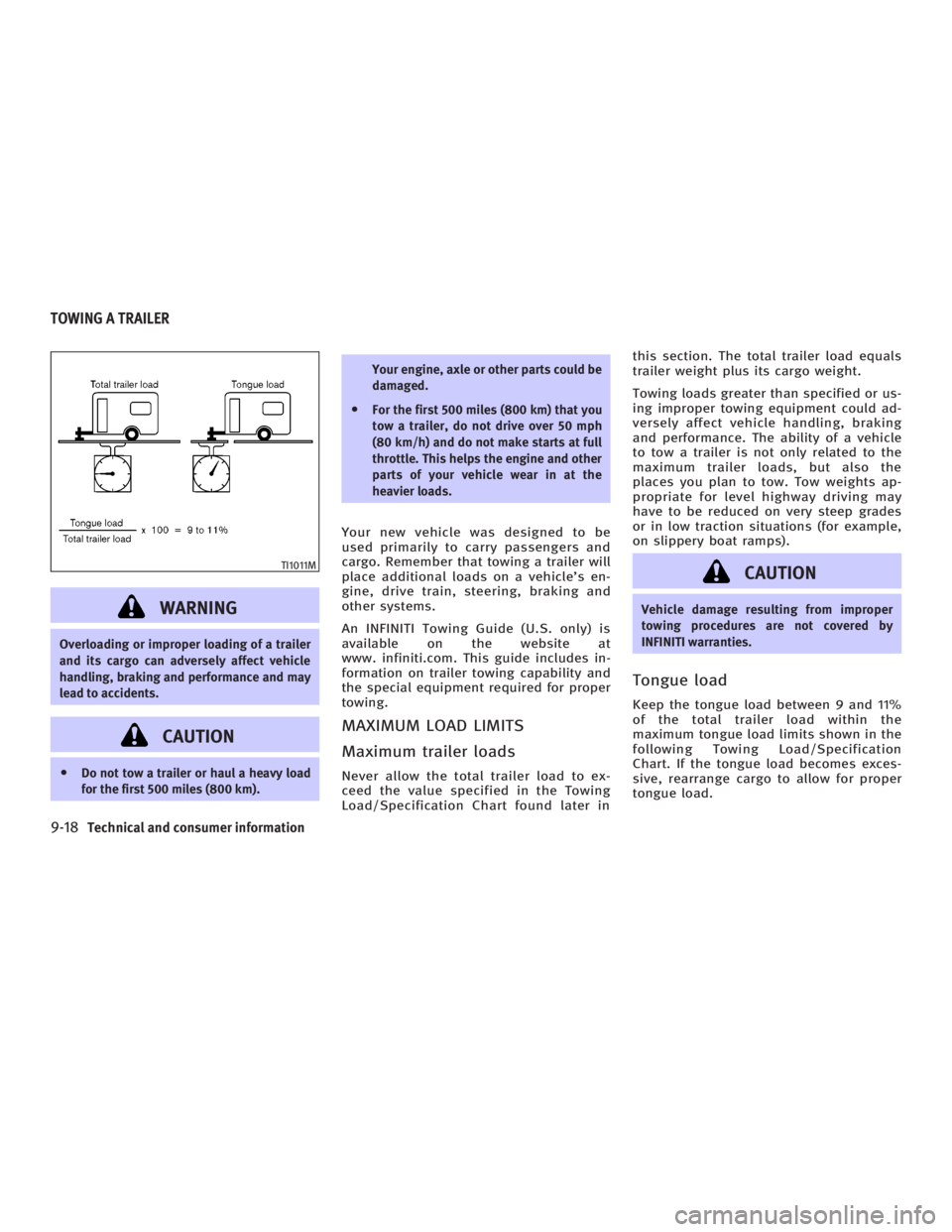
Tongue load Keep the tongue load between 9 and 11%
of the total trailer load within the
maximum tongue load limits shown in the
following Towing Load/Specification
Chart. If the tongue load becomes exces-
sive, rearrange cargo to allow for proper
tongue load.TI1011M
TOWING A TRAILER
9-18 Technical and consumer information
w 06.1.5/V35-D/V5.0
X
Page 325 of 344
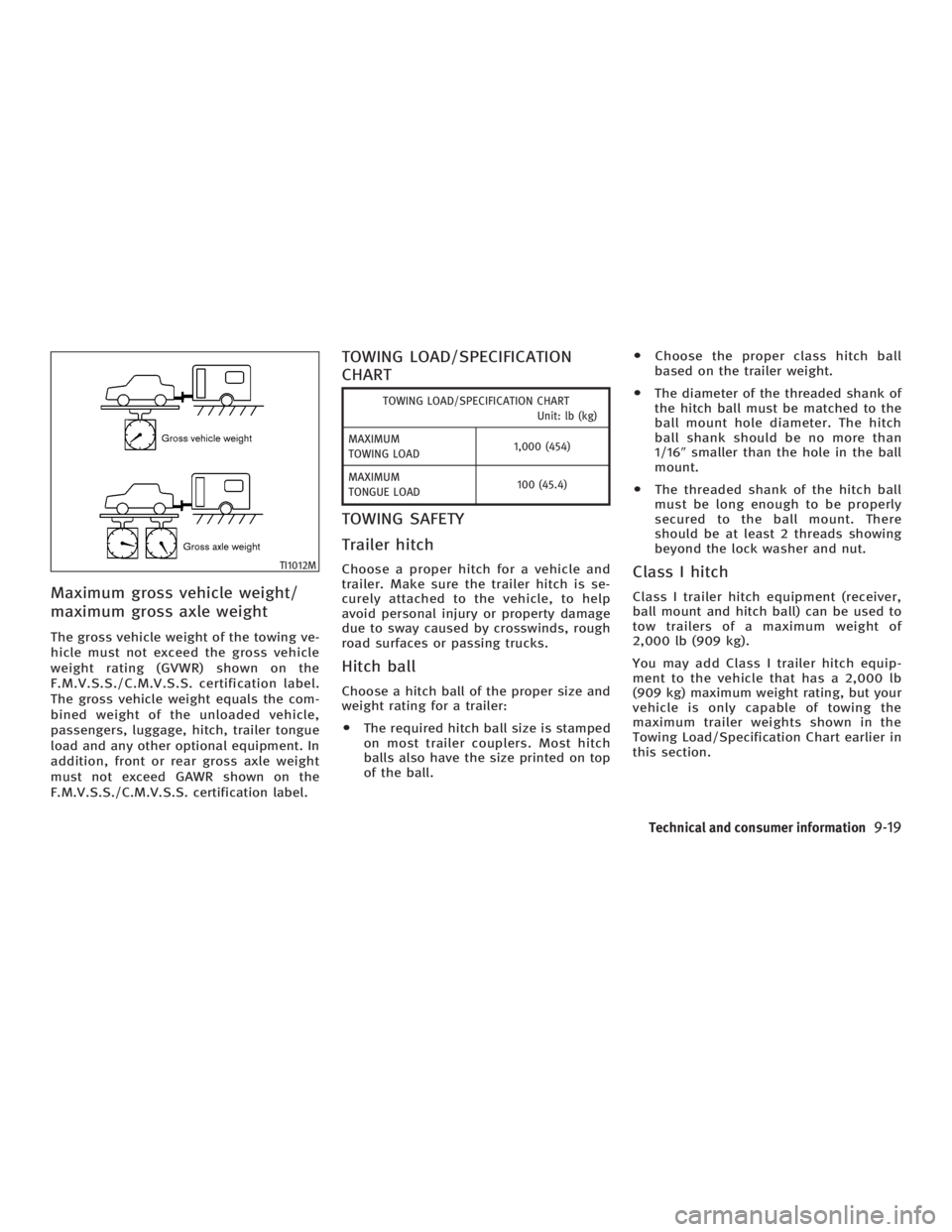
Maximum gross vehicle weight/
maximum gross axle weight The gross vehicle weight of the towing ve-
hicle must not exceed the gross vehicle
weight rating (GVWR) shown on the
F.M.V.S.S./C.M.V.S.S. certification label.
The gross vehicle weight equals the com-
bined weight of the unloaded vehicle,
passengers, luggage, hitch, trailer tongue
load and any other optional equipment. In
addition, front or rear gross axle weight
must not exceed GAWR shown on the
F.M.V.S.S./C.M.V.S.S. certification label. TOWING LOAD/SPECIFICATION
CHART TOWING LOAD/SPECIFICATION CHART
Unit: lb (kg)
MAXIMUM
TOWING LOAD 1,000 (454)
MAXIMUM
TONGUE LOAD 100 (45.4)
TOWING SAFETY
Trailer hitch Choose a proper hitch for a vehicle and
trailer. Make sure the trailer hitch is se-
curely attached to the vehicle, to help
avoid personal injury or property damage
due to sway caused by crosswinds, rough
road surfaces or passing trucks.
Hitch ball Choose a hitch ball of the proper size and
weight rating for a trailer:
O The required hitch ball size is stamped
on most trailer couplers. Most hitch
balls also have the size printed on top
of the ball. O Choose the proper class hitch ball
based on the trailer weight.
O The diameter of the threaded shank of
the hitch ball must be matched to the
ball mount hole diameter. The hitch
ball shank should be no more than
1/16 0 smaller than the hole in the ball
mount.
O The threaded shank of the hitch ball
must be long enough to be properly
secured to the ball mount. There
should be at least 2 threads showing
beyond the lock washer and nut.
Class I hitch Class I trailer hitch equipment (receiver,
ball mount and hitch ball) can be used to
tow trailers of a maximum weight of
2,000 lb (909 kg).
You may add Class I trailer hitch equip-
ment to the vehicle that has a 2,000 lb
(909 kg) maximum weight rating, but your
vehicle is only capable of towing the
maximum trailer weights shown in the
Towing Load/Specification Chart earlier in
this section.TI1012M
Technical and consumer information
9-19
w 06.1.4/V35-D/V5.0
X