brake light INFINITI M 2010 User Guide
[x] Cancel search | Manufacturer: INFINITI, Model Year: 2010, Model line: M, Model: INFINITI M 2010Pages: 445, PDF Size: 6.15 MB
Page 99 of 445

INDICATORS FOR OPERATION
1. Engine start operation indicator
(ignition switch in the LOCK or ACC
position)
This indicator appears when the selector lever
is in the P (Park) position.
This indicator means that the engine will start
by pushing the ignition switch with the brake
pedal depressed.
2. Engine start operation indicator
(ignition switch in the ON position)
This indicator appears when the ignition switch
is in the ON position with the selector lever in
the P (Park) position.
This indicator means that the engine will start
by pushing the ignition switch with the brake
pedal depressed.
3. Steering lock release malfunction
indicator
This indicator appears when the steering wheel
cannot be released from the LOCK position.
If this indicator appears, push the ignition
switch while lightly turning the steering wheel
right and left.
SIC2765
2-22Instruments and controls
wÐ
Ð
05/19/09Ðtbrooks
X
Page 108 of 445

Headlight beam select
s1To select the low beam, put the lever in
the neutral position as shown.
s2To select the high beam, push the lever
forward while the switch is in the
position. Pull it back to select the low
beam.
s3Pulling the lever toward you will flash the headlight high beam even when the
headlight switch is in the OFF position.
Battery saver system
c When the headlight switch is in theor
position while the ignition switch is in the ON position, the lights will automatically
turn off 5 minutes after the ignition switch
has been pushed to the LOCK position.
c When the headlight switch remains in the
orposition after the lights
automatically turn off, the lights will turn on
when the ignition switch is pushed to the ON
position.
CAUTION
c When you turn on the headlight switch again
after the lights automatically turn off, the
lights will not turn off automatically. Be sure
to turn the light switch to the OFF position
when you leave the vehicle for extended pe-
riods of time, otherwise the battery will be
discharged.
c Never leave the light switch on when the
engine is not running for extended periods of
time even if the headlights turn off
automatically.
Daytime running light system
(Canada only)
The daytime running lights automatically illumi-
nate when the engine is started with the park-
ing brake released. The daytime running lights
operate with the headlight switch in the OFF position or in the
position. Turn the
headlight switch to the
position for full
illumination when driving at night.
If the parking brake is applied before the engine
is started, the daytime running lights do not
illuminate. The daytime running lights illumi-
nate once the parking brake is released. The
daytime running lights will remain on until the
ignition switch is pushed to the LOCK position.
WARNING
When the daytime running light system is ac-
tive, tail lights on your vehicle are not on. It is
necessary at dusk to turn on your headlights.
Failure to do so could cause an accident injur-
ing yourself and others.
Adaptive Front lighting System (AFS)
The Adaptive Front lighting System (AFS) will
automatically adjust the headlights (low beam)
toward the turning direction to improve the
driver's view. When the headlight switch is ON
and the driver operates the steering wheel in a
turn, the AFS system will be activated.
The AFS will operate:
c when the headlight switch is ON.
SIC2413
Instruments and controls2-31
wÐ
Ð
05/14/09Ðpattie
X
Page 158 of 445
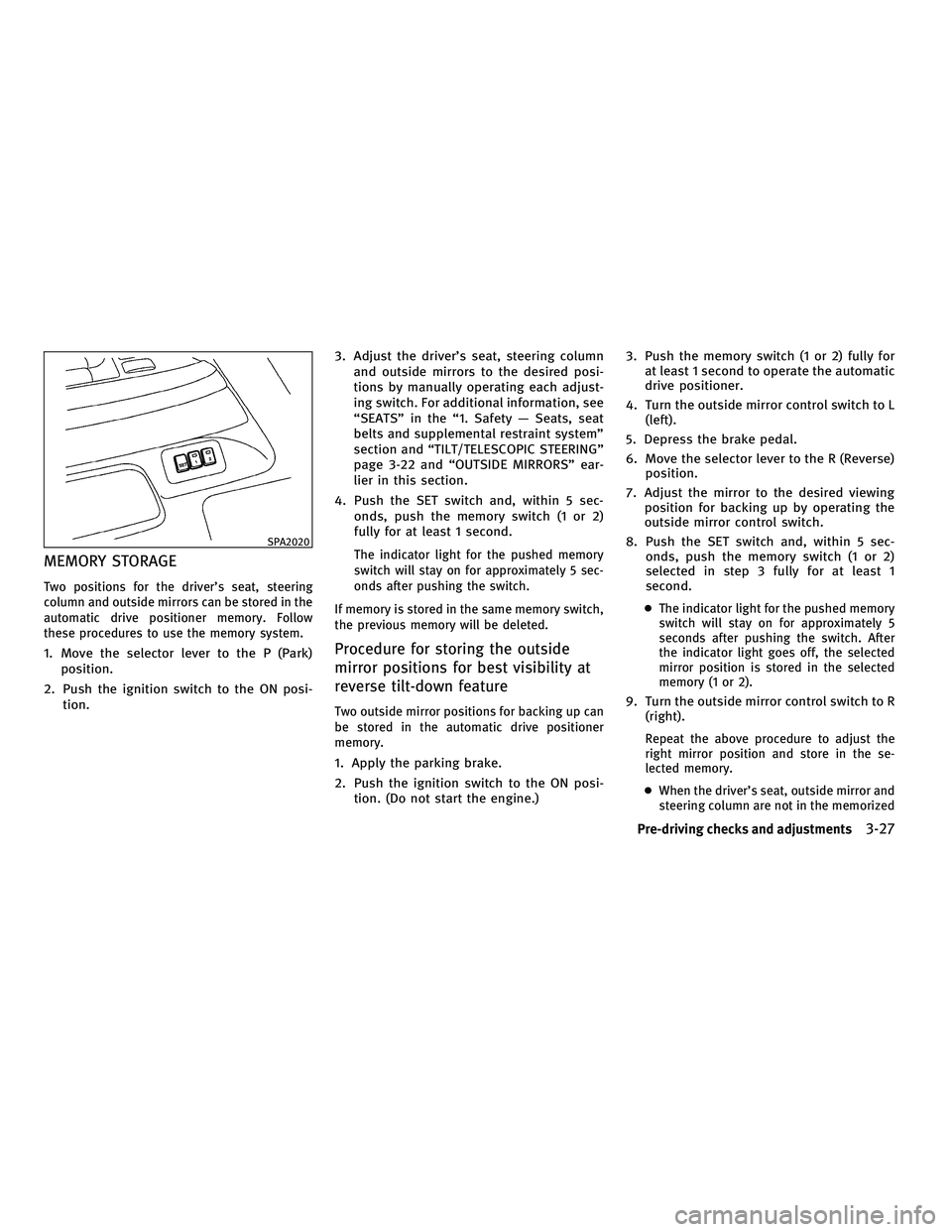
MEMORY STORAGE
Two positions for the driver's seat, steering
column and outside mirrors can be stored in the
automatic drive positioner memory. Follow
these procedures to use the memory system.
1. Move the selector lever to the P (Park)position.
2. Push the ignition switch to the ON posi- tion. 3. Adjust the driver's seat, steering column
and outside mirrors to the desired posi-
tions by manually operating each adjust-
ing switch. For additional information, see
ªSEATSº in the ª1. Safety Ð Seats, seat
belts and supplemental restraint systemº
section and ªTILT/TELESCOPIC STEERINGº
page 3-22 and ªOUTSIDE MIRRORSº ear-
lier in this section.
4. Push the SET switch and, within 5 sec- onds, push the memory switch (1 or 2)
fully for at least 1 second.
The indicator light for the pushed memory
switch will stay on for approximately 5 sec-
onds after pushing the switch.
If memory is stored in the same memory switch,
the previous memory will be deleted.
Procedure for storing the outside
mirror positions for best visibility at
reverse tilt-down feature
Two outside mirror positions for backing up can
be stored in the automatic drive positioner
memory.
1. Apply the parking brake.
2. Push the ignition switch to the ON posi- tion. (Do not start the engine.) 3. Push the memory switch (1 or 2) fully for
at least 1 second to operate the automatic
drive positioner.
4. Turn the outside mirror control switch to L (left).
5. Depress the brake pedal.
6. Move the selector lever to the R (Reverse) position.
7. Adjust the mirror to the desired viewing position for backing up by operating the
outside mirror control switch.
8. Push the SET switch and, within 5 sec- onds, push the memory switch (1 or 2)
selected in step 3 fully for at least 1
second.
cThe indicator light for the pushed memory
switch will stay on for approximately 5
seconds after pushing the switch. After
the indicator light goes off, the selected
mirror position is stored in the selected
memory (1 or 2).
9. Turn the outside mirror control switch to R
(right).
Repeat the above procedure to adjust the
right mirror position and store in the se-
lected memory.
c When the driver's seat, outside mirror and
steering column are not in the memorized
SPA2020
Pre-driving checks and adjustments3-27
wÐ
Ð
05/14/09Ðpattie
X
Page 190 of 445
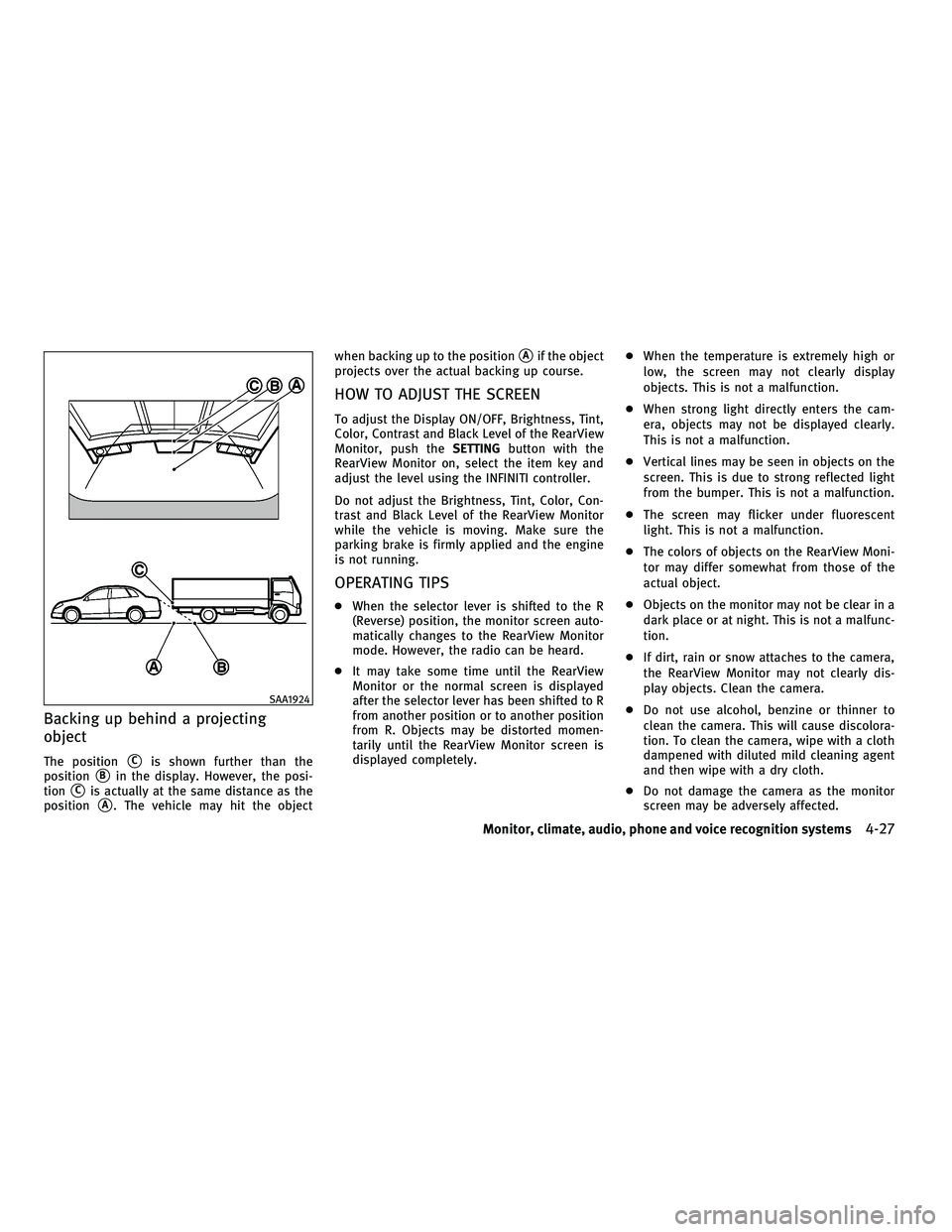
Backing up behind a projecting
object
The positionsCis shown further than the
position
sBin the display. However, the posi-
tion
sCis actually at the same distance as the
position
sA. The vehicle may hit the object when backing up to the position
sAif the object
projects over the actual backing up course.
HOW TO ADJUST THE SCREEN
To adjust the Display ON/OFF, Brightness, Tint,
Color, Contrast and Black Level of the RearView
Monitor, push the SETTINGbutton with the
RearView Monitor on, select the item key and
adjust the level using the INFINITI controller.
Do not adjust the Brightness, Tint, Color, Con-
trast and Black Level of the RearView Monitor
while the vehicle is moving. Make sure the
parking brake is firmly applied and the engine
is not running.
OPERATING TIPS
c When the selector lever is shifted to the R
(Reverse) position, the monitor screen auto-
matically changes to the RearView Monitor
mode. However, the radio can be heard.
c It may take some time until the RearView
Monitor or the normal screen is displayed
after the selector lever has been shifted to R
from another position or to another position
from R. Objects may be distorted momen-
tarily until the RearView Monitor screen is
displayed completely. c
When the temperature is extremely high or
low, the screen may not clearly display
objects. This is not a malfunction.
c When strong light directly enters the cam-
era, objects may not be displayed clearly.
This is not a malfunction.
c Vertical lines may be seen in objects on the
screen. This is due to strong reflected light
from the bumper. This is not a malfunction.
c The screen may flicker under fluorescent
light. This is not a malfunction.
c The colors of objects on the RearView Moni-
tor may differ somewhat from those of the
actual object.
c Objects on the monitor may not be clear in a
dark place or at night. This is not a malfunc-
tion.
c If dirt, rain or snow attaches to the camera,
the RearView Monitor may not clearly dis-
play objects. Clean the camera.
c Do not use alcohol, benzine or thinner to
clean the camera. This will cause discolora-
tion. To clean the camera, wipe with a cloth
dampened with diluted mild cleaning agent
and then wipe with a dry cloth.
c Do not damage the camera as the monitor
screen may be adversely affected.
SAA1924
Monitor, climate, audio, phone and voice recognition systems4-27
wÐ
Ð
05/14/09Ðpattie
X
Page 290 of 445

cReplacing tires with those not originally
specified by INFINITI could affect the proper
operation of the TPMS.
c Do not inject any tire liquid or aerosol tire
sealant into the tires, as this may cause a
malfunction of the tire pressure sensors.
CAUTION
cThe TPMS may not function properly when
the wheels are equipped with tire chains or
the wheels are buried in snow.
c Do not place metalized film or any metal
parts (antenna, etc.) on the windows. This
may cause poor reception of the signals from
the tire pressure sensors, and the TPMS will
not function properly.
Some devices and transmitters may temporarily
interfere with the operation of the TPMS and
cause the low tire pressure warning light to
illuminate. Some examples are:
± Facilities or electric devices using similar radio frequencies are near the vehicle.
± If a transmitter set to similar frequencies is being used in or near the vehicle. ± If a computer (or similar equipment) or a
DC/AC converter is being used in or near the
vehicle.
FCC Notice:
Changes or modifications not expressly ap-
proved by the party responsible for compliance
could void the user's authority to operate the
equipment.
This device complies with Part 15 of the FCC
Rules and RSS-210 of Industry Canada.
Operation is subject to the following two condi-
tions: (1) This device may not cause harmful in-
terference, and (2) this device must accept any
interference received, including interference
that may cause undesired operation of the de-
vice.
AVOIDING COLLISION AND ROLLOVER
WARNING
Failure to operate this vehicle in a safe and
prudent manner may result in loss of control or
an accident.
Be alert and drive defensively at all times. Obey
all traffic regulations. Avoid excessive speed,
high speed cornering, or sudden steering ma-
neuvers, because these driving practices could cause you to lose control of your vehicle.
As
with any vehicle, a loss of control could result in
a collision with other vehicles or objects, or
cause the vehicle to rollover, particularly if the
loss of control causes the vehicle to slide side-
ways. Be attentive at all times, and avoid
driving when tired. Never drive when under the
influence of alcohol or drugs (including pre-
scription or over-the-counter drugs which may
cause drowsiness). Always wear your seat belt
as outlined in the ªSEAT BELTSº in the ª1. Safety
Ð Seats, seat belts and supplemental restraint
systemº section of this manual, and also in-
struct your passengers to do so.
Seat belts help reduce the risk of injury in
collisions and rollovers. In a rollover crash, an
unbelted or improperly belted person is signifi-
cantly more likely to be injured or killed than a
person properly wearing a seat belt.
OFF-ROAD RECOVERY
While driving, the right side or left side wheels
may unintentionally leave the road surface. If
this occurs, maintain control of the vehicle by
following the procedure below. Please note that
this procedure is only a general guide. The
vehicle must be driven as appropriate based on
the conditions of the vehicle, road and traffic.
1. Remain calm and do not overreact.
2. Do not apply the brakes.
Starting and driving5-5
wÐ
Ð
05/15/09Ðpattie
X
Page 291 of 445

3. Maintain a firm grip on the steering wheelwith both hands and try to hold a straight
course.
4. When appropriate, slowly release the ac- celerator pedal to gradually slow the ve-
hicle.
5. If there is nothing in the way, steer the vehicle to follow the road while the ve-
hicle speed is reduced. Do not attempt to
drive the vehicle back onto the road sur-
face until vehicle speed is reduced.
6. When it is safe to do so, gradually turn the steering wheel until both tires return
to the road surface. When all tires are on
the road surface, steer the vehicle to stay
in the appropriate driving lane.
cIf you decide that it is not safe to return the
vehicle to the road surface based on vehicle,
road or traffic conditions, gradually slow the
vehicle to a stop in a safe place off the road.
RAPID AIR PRESSURE LOSS
Rapid air pressure loss or a ªblow-outº can
occur if the tire is punctured or is damaged due
to hitting a curb or pothole. Rapid air pressure
loss can also be caused by driving on under-
inflated tires.
Rapid air pressure loss can affect the handling
and stability of the vehicle, especially at high-
way speeds.
Help prevent rapid air pressure loss by main-
taining the correct air pressure and visually
inspect the tires for wear and damage. See
ªWHEELS AND TIRESº in the ª8. Maintenance
and do-it-yourselfº section of this manual.
If a tire rapidly loses air pressure or ªblows-outº
while driving maintain control of the vehicle by
following the procedure below. Please note that
this procedure is only a general guide. The
vehicle must be driven as appropriate based on
the conditions of the vehicle, road and traffic.
WARNING
The following actions can increase the chance
of losing control of the vehicle if there is a
sudden loss of tire air pressure. Losing control
of the vehicle may cause a collision and result
in personal injury. c
The vehicle generally moves or pulls in the
direction of the flat tire.
c Do not rapidly apply the brakes.
c Do not rapidly release the accelerator pedal.
c Do not rapidly turn the steering wheel.
1. Remain calm and do not overreact.
2. Maintain a firm grip on the steering wheel
with both hands and try to hold a straight
course.
3. When appropriate, slowly release the ac- celerator pedal to gradually slow the ve-
hicle.
4. Gradually steer the vehicle to a safe loca- tion off the road and away from traffic if
possible.
5. Lightly apply the brake pedal to gradually stop the vehicle.
6. Turn on the hazard warning flashers and either contact a roadside emergency ser-
vice to change the tire or see ªCHANGING
A FLAT TIREº in the ª6. In case of emer-
gencyº section of this Owner's Manual.
5-6Starting and driving
wÐ
Ð
05/15/09Ðpattie
X
Page 294 of 445

When the ignition switch cannot be pushed
toward the LOCK position, proceed as follows:
1. Move the selector lever into the P (Park)position.
2. Push the ignition switch. The ignition switch position will change to the ON
position.
3. Push the ignition switch again to the LOCK position.
The selector lever can be moved from the P (Park)
position if the ignition switch is in the ON posi-
tion and the brake pedal is depressed.
In order for the steering wheel to be locked, it
must be turned about 1/8 of a right or left turn
from the straight up position.
To lock the steering wheel, push the ignition
switch to the LOCK position. To unlock the steer-
ing wheel, push the push-button ignition switch
again while lightly turning the steering wheel
right and left.
If the battery of the vehicle is discharged, the
push-button ignition switch cannot be turned
from the LOCK position.
Some indicators and warnings for operation are
displayed on the dot matrix liquid crystal dis-
play in the tachometer. (See ªDOT MATRIX LIQUID CRYSTAL DISPLAYº in the ª2. Instru-
ments and controlsº section.)
PUSH-BUTTON IGNITION SWITCH
POSITIONS
LOCK (Normal parking position)
The ignition switch can only be locked in this
position.
The ignition switch will be unlocked when it is
pushed to the ACC position while carrying the
Intelligent Key or with the Intelligent Key in-
serted in the port.
ACC (Accessories)
This position activates electrical accessories
such as the radio, when the engine is not
running.
ON (Normal operating position)
This position turns on the ignition system and
electrical accessories.
CAUTION
Do not leave the vehicle with the push-button
ignition switch in ACC or ON positions when the
engine is not running for an extended period.
This can discharge the battery.
INTELLIGENT KEY BATTERY DISCHARGE
If the battery of the Intelligent Key is almost
discharged, the guide light
sBof the Intelligent
Key port
sAblinks and the indicator appears on
the dot matrix liquid crystal display. (See ªDOT
MATRIX LIQUID CRYSTAL DISPLAYº in the ª2.
Instruments and controlsº section.)
In this case, inserting the Intelligent Key into
the port
s1allows you to start the engine. Make
sure that the key ring side faces backward as
illustrated. Insert the Intelligent Key in the port
until it is latched and secured.
SSD0512
Starting and driving5-9
wÐ
Ð
05/15/09Ðpattie
X
Page 295 of 445

To remove the Intelligent Key from the port,
push the ignition switch to the LOCK position
and push in the Intelligent Key
s2. Then the
Intelligent Key will be ejected from the port. Pull
the Intelligent Key out.
NOTE:
The Intelligent Key port does not charge the In-
telligent Key battery. If you see the low battery
indicator in the dot matrix liquid crystal display,
replace the battery as soon as possible. (See
ªBATTERY REPLACEMENTº in the ª8. Mainte-
nance and do-it-yourselfº section.)
CAUTION
c Never place anything except the Intelligent
Key in the Intelligent Key port. Doing so may
cause damage to the equipment.
c Make sure the Intelligent Key is in the cor-
rect direction when inserting it to the Intelli-
gent Key port. The engine may not start if it is
in the incorrect direction.
c Remove the Intelligent Key from the Intelli-
gent Key port after the ignition switch is
pushed to the LOCK position.
c Do not pull out the Intelligent Key from the
Intelligent Key port until the Intelligent Key
is ejected to the removal position. c
Make sure the area around the vehicle is
clear.
c Check fluid levels such as engine oil, cool-
ant, brake fluid and window washer fluid as
frequently as possible, or at least whenever
you refuel.
c Check that all windows and lights are clean.
c Visually inspect tires for their appearance
and condition. Also check tires for proper
inflation.
c Lock all doors.
c Position seat and adjust head restraints.
c Adjust inside and outside mirrors.
c Fasten seat belts and ask all passengers to
do likewise.
c Check the operation of warning lights when
the ignition switch is pushed to the ON
position. (See ªWARNING/INDICATOR LIGHTS
AND AUDIBLE REMINDERSº in the ª2. Instru-
ments and controlsº section.)
SSD0513
BEFORE STARTING THE ENGINE
5-10Starting and driving
wÐ
Ð
05/15/09Ðpattie
X
Page 301 of 445

WARNING
cBe sure the parking brake is fully released
before driving. Failure to do so can cause
brake failure and lead to an accident.
c Do not release the parking brake from out-
side the vehicle.
c Do not use the gear shift in place of the
parking brake. When parking, be sure the
parking brake is fully engaged.
c Do not leave children unattended in a ve-
hicle. They could release the parking brake
and cause an accident.
To apply:Fully depress the parking brake pedal
s1.
To release:
1. Firmly apply the foot brakes2.
2. Depress the parking brake pedal
s1and
the parking brake will be released.
3. Before driving, be sure the brake warning light goes out.
The Lane Departure Warning (LDW)
system/Lane Departure Prevention (LDP) sys-
tem will operate when the vehicle is driven at
speeds of approximately 45 MPH (72 km/h) and
above, and when it is traveling close to either
the left or the right of a traveling lane.
Each system functions as follows:
cLane Departure Warning (LDW) system Ð
warns the driver by a warning light and
chime.
c Lane Departure Prevention (LDP) system Ð
warns the driver by a warning light and
chime, and helps assist the driver to return
the vehicle to the center direction of the
traveling lane by applying brake control to
the left or right wheels individually (for a
short period of time).
SPA2331
PARKING BRAKE LANE DEPARTURE WARNING (LDW)
SYSTEM/LANE DEPARTURE PREVENTION
(LDP) SYSTEM (if so equipped)
5-16Starting and driving
wÐ
Ð
05/15/09Ðpattie
X
Page 302 of 445

The LDW and LDP systems monitor the lane
markers on the traveling lane using the camera
unit
s1located inside the front map light cover.
When the camera unit detects that the vehicle is
traveling close to either the left or the right of
the traveling lane, the lane departure warning
light
s2on the instrument panel blinks in
orange and a warning chime sounds. When the
LDP system is on, it will automatically apply the
brakes for a short period of time, using the
function of the Vehicle Dynamic Control (VDC)
system.
To turn on the LDW system, push the LDW
switch
s3. The LDW ON indicator lights4on the
switch will illuminate.
To turn on the LDP system, push the LDP switch
s5. The LDP ON indicator lights2will illumi-
nate in green.
LANE DEPARTURE WARNING (LDW)
SYSTEM
Precautions on LDW system
WARNING
c This system is only a warning device to in-
form the driver of a potential unintended
lane departure. It will not steer the vehicle or
prevent loss of control. It is the driver's re-
sponsibility to stay alert, drive safely, keep
the vehicle in the traveling lane, and be in
control of the vehicle at all times.
c The system will not operate at speeds below
approximately 45 MPH (72 km/h) or if it can-
not detect lane markers.
c If the LDW system malfunctions, it will can-
cel automatically, and the lane departure
warning light (orange) will illuminate.
c If the lane departure warning light (orange)
illuminates, pull off the road to a safe loca-
tion and stop the vehicle. Turn the engine off
and restart the engine. If the lane departure
warning light (orange) continues to illumi-
nate, have the system checked by an INFINITI
retailer.
SSD0670
SSD0674
Starting and driving5-17
wÐ
Ð
05/15/09Ðpattie
X