child lock INFINITI M 2010 Owners Manual
[x] Cancel search | Manufacturer: INFINITI, Model Year: 2010, Model line: M, Model: INFINITI M 2010Pages: 445, PDF Size: 6.15 MB
Page 11 of 445

1. TrunkÐ Trunk lid (P. 3-17)
Ð Intelligent Key system (P. 3-6)
2. High-mounted stop light Ð Bulb replacement (P. 8-30)
3. Rear window defroster (P. 2-28) 4. Satellite radio antenna (if so equipped)
(P. 4-35)
5. Fuel-filler door Ð Operation (P. 3-20)
Ð Fuel recommendation (P. 9-4) 6. Rear view camera (if so equipped)
(P. 4-22)
7. Back-up lights Ð Bulb replacement (P. 8-30)
8. Rear combination lights Ð Bulb replacement (P. 8-30)
9. Child safety rear door locks (P. 3-6)
SSI0370
EXTERIOR REAR
0-4Illustrated table of contents
wÐ
Ð
05/19/09Ðtbrooks
X
Page 23 of 445
WARNING
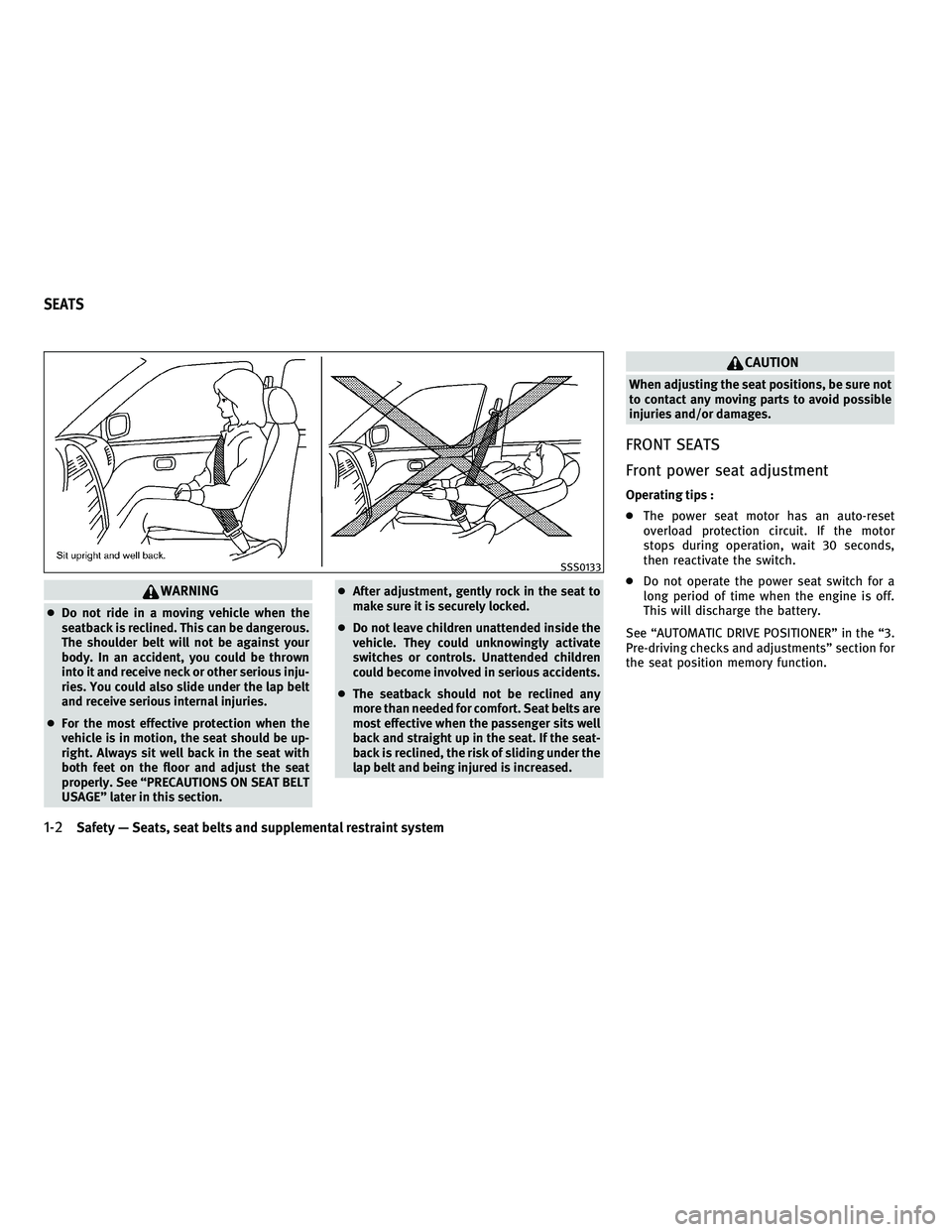
cDo not ride in a moving vehicle when the
seatback is reclined. This can be dangerous.
The shoulder belt will not be against your
body. In an accident, you could be thrown
into it and receive neck or other serious inju-
ries. You could also slide under the lap belt
and receive serious internal injuries.
c For the most effective protection when the
vehicle is in motion, the seat should be up-
right. Always sit well back in the seat with
both feet on the floor and adjust the seat
properly. See ªPRECAUTIONS ON SEAT BELT
USAGEº later in this section. c
After adjustment, gently rock in the seat to
make sure it is securely locked.
c Do not leave children unattended inside the
vehicle. They could unknowingly activate
switches or controls. Unattended children
could become involved in serious accidents.
c The seatback should not be reclined any
more than needed for comfort. Seat belts are
most effective when the passenger sits well
back and straight up in the seat. If the seat-
back is reclined, the risk of sliding under the
lap belt and being injured is increased.
CAUTION
When adjusting the seat positions, be sure not
to contact any moving parts to avoid possible
injuries and/or damages.
FRONT SEATS
Front power seat adjustment
Operating tips :
c The power seat motor has an auto-reset
overload protection circuit. If the motor
stops during operation, wait 30 seconds,
then reactivate the switch.
c Do not operate the power seat switch for a
long period of time when the engine is off.
This will discharge the battery.
See ªAUTOMATIC DRIVE POSITIONERº in the ª3.
Pre-driving checks and adjustmentsº section for
the seat position memory function.
SSS0133
SEATS
1-2Safety Ð Seats, seat belts and supplemental restraint system
wÐ
Ð
05/14/09Ðpattie
X
Page 38 of 445

of movement in the seat. The ELR locks the seat
belt when the vehicle slows down rapidly or
during certain impacts.
The Automatic Locking Retractor (ALR) mode
(child restraint mode) locks the seat belt for
child restraint installation.
When the ALR mode is activated the seat belt
cannot be extended again until the seat belt
tongue is detached from the buckle and fully
retracted. The seat belt returns to the ELR mode
after the seat belt fully retracts. For additional
information, see ªCHILD RESTRAINTSº later in
this section.
The ALR mode should be used only for child
restraint installation. During normal seat belt
use by an occupant, the ALR mode should not be
activated. If it is activated it may cause uncom-
fortable seat belt tension. It can also change the
operation of the front passenger air bag. See
ªFront passenger air bag and status lightº later
in this section.
WARNING
When fastening the seat belts, be certain that
seatbacks are completely secured in the
latched position. If they are not completely se-
cured, passengers may be injured in an acci-
dent or sudden stop.
Unfastening the seat belts
To unfasten the seat belt, push the button on
the buckle. The seat belt automatically retracts.
Checking seat belt operation
Seat belt retractors are designed to lock seat
belt movement by two separate methods:
cWhen the belt is pulled quickly from the
retractor.
c When the vehicle slows down rapidly.
To increase your confidence in the seat belts,
check the operation as follows:
c Grasp the shoulder belt and pull forward
quickly. The retractor should lock and re-
strict further belt movement.
If the retractor does not lock during this check
or if you have any question about seat belt
operation, see an INFINITI retailer.
SSS0326
Safety Ð Seats, seat belts and supplemental restraint system1-17
wÐ
Ð
05/14/09Ðpattie
X
Page 50 of 445
cINFINITI recommends that child restraints be
installed in the rear seat. However, if you
must install a front-facing child restraint in
the front passenger seat, move the passen-
ger seat to the rearmost position. Also, be
sure the front passenger air bag status light
is illuminated to indicate the passenger air
bag is OFF. See ªFront passenger air bag and
status lightº later in this section for details.
c The three-point seat belt in your vehicle is
equipped with an Automatic Locking Retrac-
tor (ALR) which must be used when installing
a child restraint.
c Failure to use the ALR mode will result in the
child restraint not being properly secured.
The restraint could tip over or otherwise be
unsecured and cause injury to the child in a
sudden stop or collision. Also, it can change
the operation of the front passenger air bag.
See ªFront passenger air bag and status
lightº later in this section.
c A child restraint with a top tether strap
should not be used in the front passenger
seat.
The instructions in this section apply to child
restraint installation using the vehicle seat
belts in the rear seat or the front passenger
seat.Front-facing
Follow these steps to install a front-facing child
restraint using the vehicle seat belt in the rear
seat or in the front passenger seat:
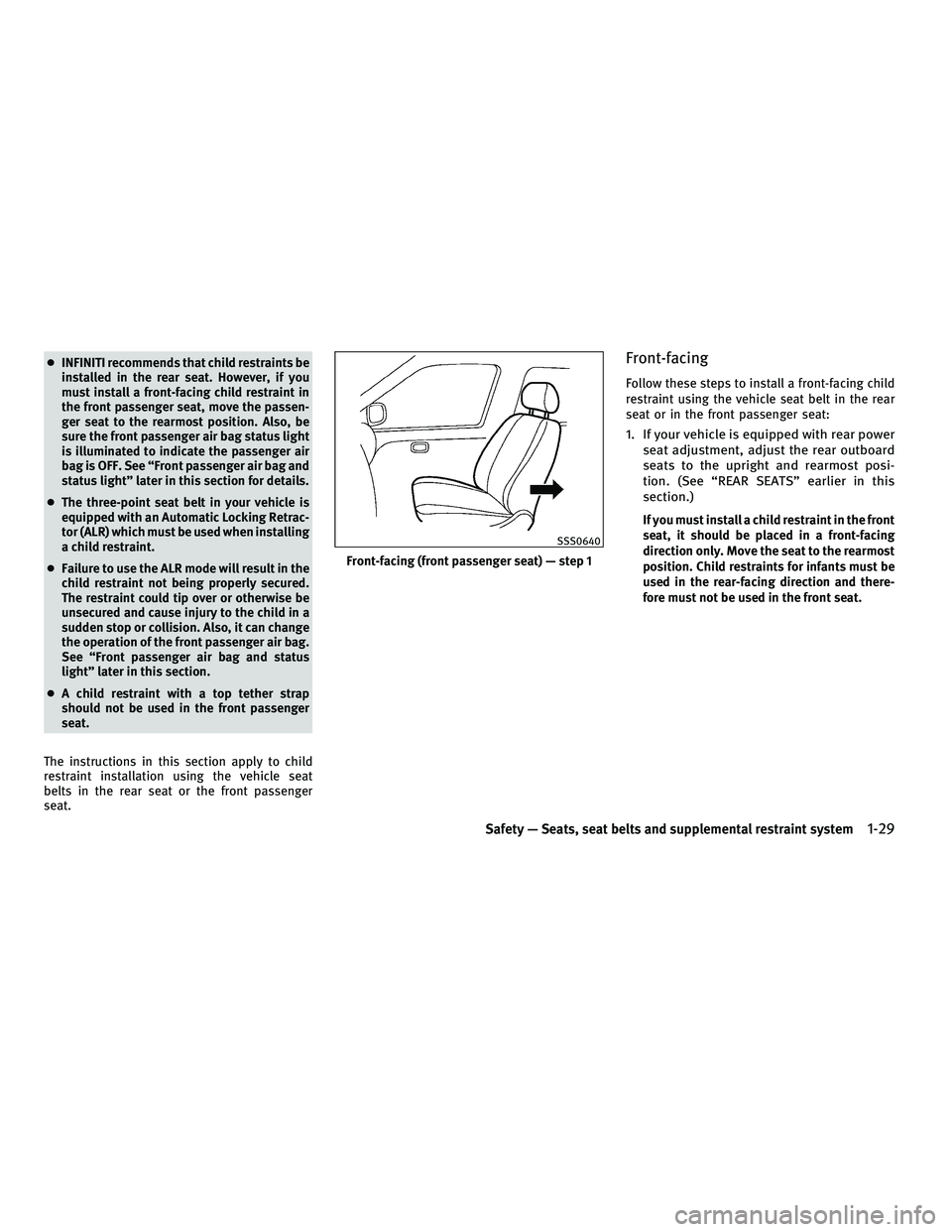
1. If your vehicle is equipped with rear power seat adjustment, adjust the rear outboard
seats to the upright and rearmost posi-
tion. (See ªREAR SEATSº earlier in this
section.)
If you must install a child restraint in the front
seat, it should be placed in a front-facing
direction only. Move the seat to the rearmost
position. Child restraints for infants must be
used in the rear-facing direction and there-
fore must not be used in the front seat.
Front-facing (front passenger seat) Ð step 1
SSS0640
Safety Ð Seats, seat belts and supplemental restraint system1-29
wÐ
Ð
05/14/09Ðpattie
X
Page 51 of 445

2. Position the child restraint on the seat.Always follow the child restraint manufac-
turer's instructions.
The back of the child restraint should be
secured against the seatback. If necessary,
adjust or remove the head restraint to ob-
tain the correct child restraint fit. (See
ªHEAD RESTRAINTSº earlier in this section.)
If the head restraint is removed, store it in a
secure place. Be sure to reinstall the head
restraint when the child restraint is re-
moved.
If the seating position does not have an
adjustable head restraint and it is interfer-
ing with the proper child restraint fit, try
another seating position or a different child
restraint.
3. Route the seat belt tongue through thechild restraint and insert it into the buckle
until you hear and feel the latch engage.
Be sure to follow the child restraint manu-
facturer's instructions for belt routing. 4. Pull the shoulder belt until the belt is fully
extended. At this time, the seat belt re-
tractor is in the Automatic Locking Retrac-
tor (ALR) mode (child restraint mode). It
reverts to the Emergency Locking Retrac-
tor (ELR) mode when the seat belt is fully
retracted.
Front-facing Ð step 3
SSS0360B
Front-facing Ð step 4
SSS0651
1-30Safety Ð Seats, seat belts and supplemental restraint system
wÐ
Ð
05/14/09Ðpattie
X
Page 53 of 445

8. After attaching the child restraint, test itbefore you place the child in it. Push it
from side to side while holding the seat
near the seat belt path. The child restraint
should not move more than 1 inch (25
mm) from side to side. Try to tug it
forward and check to see if the belt holds
the restraint in place. If the restraint is
not secure, tighten the belt as necessary,
or put the restraint in another seat and
test it again. You may need to try a
different child restraint. Not all child re-
straints fit in all types of vehicles. 9. Check that the retractor is in the ALR
mode by trying to pull more seat belt out
of the retractor. If you cannot pull any
more belt webbing out of the retractor,
the retractor is in the ALR mode.
10. Check to make sure the child restraint is properly secured prior to each use. If the
seat belt is not locked, repeat steps 3
through 9.
11. If the child restraint is installed in thefront passenger seat, push the ignition
switch to the ON position. The front pas-
senger air bag status light
should
illuminate. If this light is not illuminated,
see ªFront passenger air bag and status
lightº later in this section. Move the child
restraint to another seating position .
Have the system checked by an INFINITI
retailer.
After the child restraint is removed and the seat
belt is fully retracted, the ALR mode (child
restraint mode) is canceled.
Front-facing Ð step 8
SSS0641
Front-facing Ð step 11
SSS0481
1-32Safety Ð Seats, seat belts and supplemental restraint system
wÐ
Ð
05/14/09Ðpattie
X
Page 54 of 445

Rear-facing
Follow these steps to install a rear-facing child
restraint using the vehicle seat belt in the rear
seat:
1.Child restraints for infants must be used in
the rear-facing direction and therefore
must not be used in the front seat.
If your vehicle is equipped with rear power
seat adjustment, adjust the rear outboard
seats to the upright and rearmost position.
(See ªREAR SEATSº earlier in this section.)
2. Position the child restraint on the seat.
Always follow the restraint manufacturer's
instructions. 3. Route the seat belt tongue through the
child restraint and insert it into the buckle
until you hear and feel the latch engage.
Be sure to follow the child restraint manu-
facturer's instructions for belt routing. 4. Pull the shoulder belt until the belt is fully
extended. At this time, the seat belt re-
tractor is in the Automatic Locking Retrac-
tor (ALR) mode (child restraint mode). It
reverts to the Emergency Locking Retrac-
tor (ELR) mode when the seat belt is fully
retracted.
SSS0100
Rear-facing Ð step 3
SSS0654
Rear-facing Ð step 4
SSS0655
Safety Ð Seats, seat belts and supplemental restraint system1-33
wÐ
Ð
05/14/09Ðpattie
X
Page 56 of 445
8. Check that the retractor is in the ALRmode by trying to pull more seat belt out
of the retractor. If you cannot pull any
more seat belt webbing out of the retrac-
tor, the retractor is in the ALR mode.
9. Check to make sure that the child re- straint is properly secured prior to each
use. If the seat belt is not locked, repeat
steps 3 through 8.
After the child restraint is removed and the seat
belt fully retracted, the ALR mode (child re-
straint mode) is canceled.
PRECAUTIONS ON BOOSTER SEATS
WARNING
cInfants and small children should always be
placed in an appropriate child restraint
while riding in the vehicle. Failure to use a
child restraint or booster seat can result in
serious injury or death.
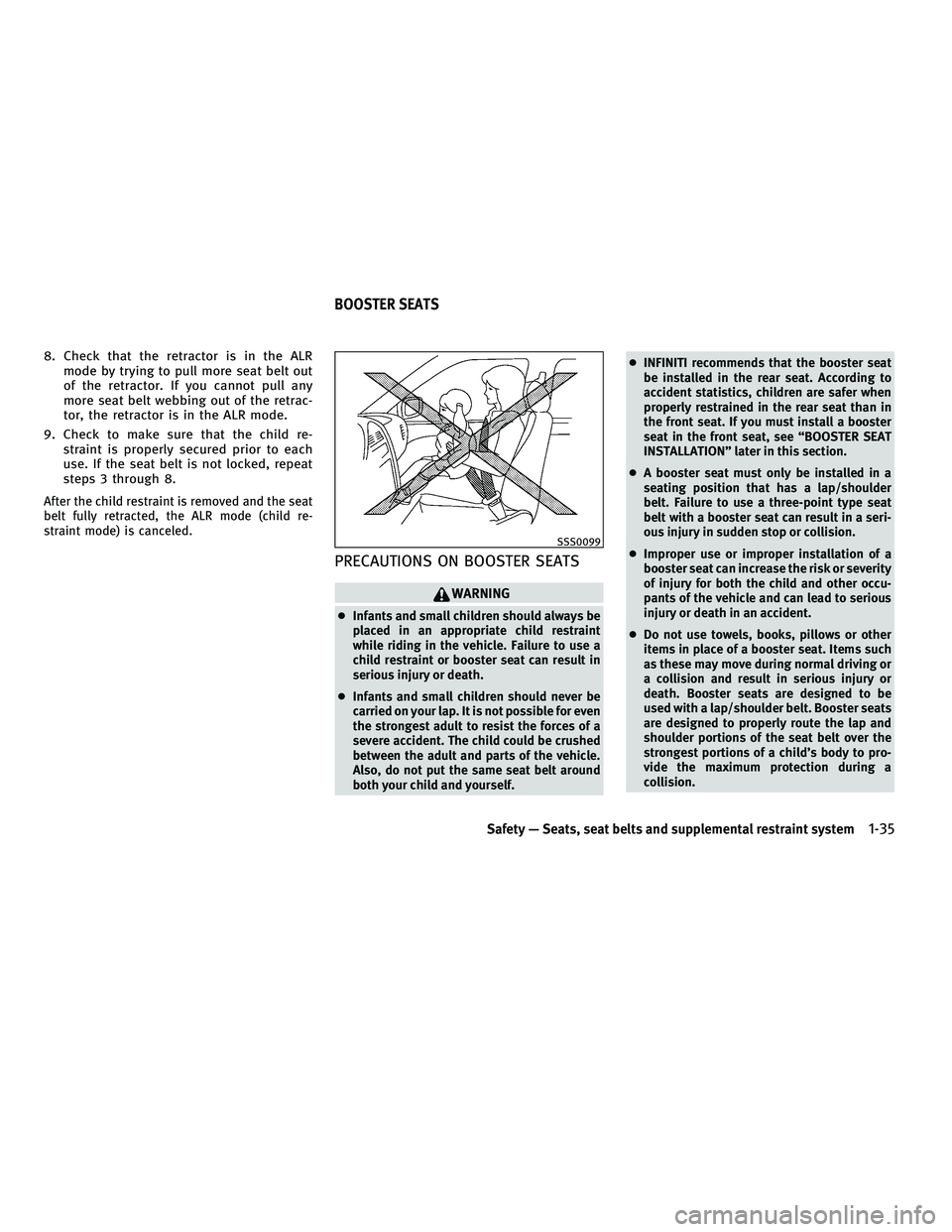
c Infants and small children should never be
carried on your lap. It is not possible for even
the strongest adult to resist the forces of a
severe accident. The child could be crushed
between the adult and parts of the vehicle.
Also, do not put the same seat belt around
both your child and yourself. c
INFINITI recommends that the booster seat
be installed in the rear seat. According to
accident statistics, children are safer when
properly restrained in the rear seat than in
the front seat. If you must install a booster
seat in the front seat, see ªBOOSTER SEAT
INSTALLATIONº later in this section.
c A booster seat must only be installed in a
seating position that has a lap/shoulder
belt. Failure to use a three-point type seat
belt with a booster seat can result in a seri-
ous injury in sudden stop or collision.
c Improper use or improper installation of a
booster seat can increase the risk or severity
of injury for both the child and other occu-
pants of the vehicle and can lead to serious
injury or death in an accident.
c Do not use towels, books, pillows or other
items in place of a booster seat. Items such
as these may move during normal driving or
a collision and result in serious injury or
death. Booster seats are designed to be
used with a lap/shoulder belt. Booster seats
are designed to properly route the lap and
shoulder portions of the seat belt over the
strongest portions of a child's body to pro-
vide the maximum protection during a
collision.
SSS0099
BOOSTER SEATS
Safety Ð Seats, seat belts and supplemental restraint system1-35
wÐ
Ð
05/14/09Ðpattie
X
Page 58 of 445
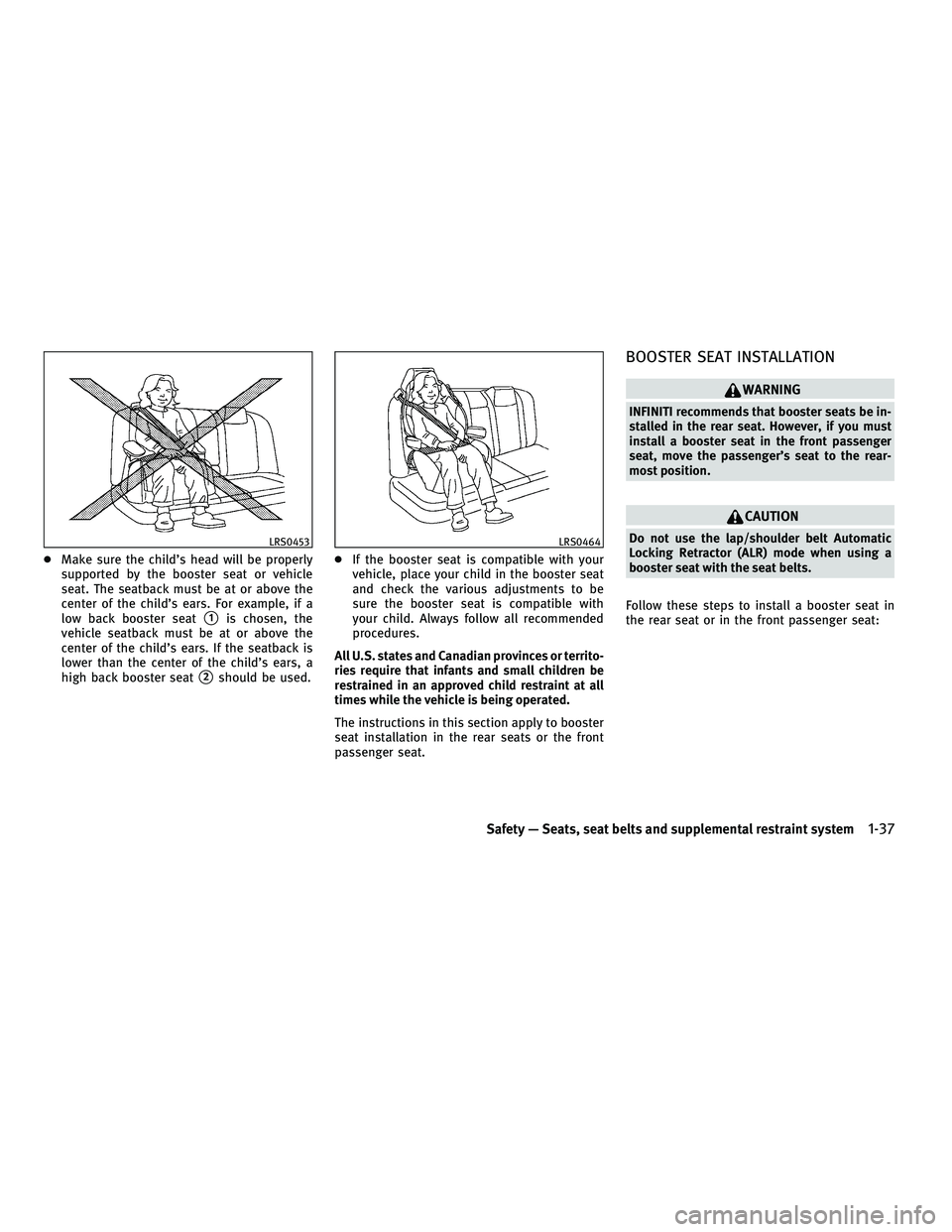
cMake sure the child's head will be properly
supported by the booster seat or vehicle
seat. The seatback must be at or above the
center of the child's ears. For example, if a
low back booster seat
s1is chosen, the
vehicle seatback must be at or above the
center of the child's ears. If the seatback is
lower than the center of the child's ears, a
high back booster seat
s2should be used. c
If the booster seat is compatible with your
vehicle, place your child in the booster seat
and check the various adjustments to be
sure the booster seat is compatible with
your child. Always follow all recommended
procedures.
All U.S. states and Canadian provinces or territo-
ries require that infants and small children be
restrained in an approved child restraint at all
times while the vehicle is being operated.
The instructions in this section apply to booster
seat installation in the rear seats or the front
passenger seat.
BOOSTER SEAT INSTALLATION
WARNING
INFINITI recommends that booster seats be in-
stalled in the rear seat. However, if you must
install a booster seat in the front passenger
seat, move the passenger's seat to the rear-
most position.
CAUTION
Do not use the lap/shoulder belt Automatic
Locking Retractor (ALR) mode when using a
booster seat with the seat belts.
Follow these steps to install a booster seat in
the rear seat or in the front passenger seat:LRS0453LRS0464
Safety Ð Seats, seat belts and supplemental restraint system1-37
wÐ
Ð
05/14/09Ðpattie
X
Page 68 of 445

Front passenger air bag and status
light
WARNING
The front passenger air bag is designed to au-
tomatically turn OFF under some conditions.
Read this section carefully to learn how it oper-
ates. Proper use of the seat, seat belt and child
restraints is necessary for most effective pro-
tection. Failure to follow all instructions in this
manual concerning the use of seats, seat belts
and child restraints can increase the risk or
severity of injury in an accident.Status light :
The front passenger air bag status light
is located on the overhead console. The light
operates as follows:
c
Unoccupied passenger seat: The
light
is OFF and the front passenger air bag is OFF
and will not inflate in a crash.
c Passenger seat occupied by a small adult,
child or child restraint as outlined in this
section: The
light illuminates to indi-
cate that the front passenger air bag is OFF
and will not inflate in a crash.
c Occupied passenger seat and the passenger
meets the conditions outlined in this sec-
tion: The
light is OFF to indicate that
the front passenger air bag is operational.
Front passenger air bag :
The front passenger air bag is designed to
automatically turn OFF when the vehicle is
operated under some conditions as described
below as permitted by U.S. regulations. If the
front passenger air bag is OFF, it will not inflate
in a crash. The driver air bag and other air bags
in your vehicle are not part of this system.
The purpose of the regulation is to help reduce
the risk of injury or death from an inflating air
bag to certain front passenger seat occupants, such as children, by requiring the air bag to be
automatically turned OFF. Certain sensors are
used to meet the requirements.
One sensor used is the occupant classification
sensor (pressure sensor). It is in the bottom of
the front passenger seat cushion and is de-
signed to detect an occupant and objects on the
seat by weight. It works together with seat belt
sensors described later. For example, if a child
is in the front passenger seat, the Advanced Air
Bag System is designed to turn the passenger
air bag OFF in accordance with the regulations.
Also, if a child restraint of the type specified in
the regulations is on the seat, its weight and
the child's weight can be detected and cause
the air bag to turn OFF. The occupant classifi-
cation sensor operation can vary depending on
the front passenger seat belt sensors.
The front passenger seat belt sensors are de-
signed to detect if the seat belt is buckled and
the amount of tension on the seat belt, such as
when it is in the Automatic Locking Retractor
(ALR) mode (child restraint mode). Based on the
weight on the seat detected by the occupant
classification sensor and the belt tension de-
tected on the seat belt, the Advanced Air Bag
System determines whether the front passen-
ger air bag should be automatically turned OFF
as required by the regulations.
Front passenger air bag status light
SSS0481
Safety Ð Seats, seat belts and supplemental restraint system1-47
wÐ
Ð
05/14/09Ðpattie
X