seat adjustment INFINITI M 2012 User Guide
[x] Cancel search | Manufacturer: INFINITI, Model Year: 2012, Model line: M, Model: INFINITI M 2012Pages: 522, PDF Size: 3.8 MB
Page 41 of 522
1-22Safety—Seats, seat belts and supplemental restraint system
restraint while in the vehicle.
. When the child restraint is not in use,
keep it secured with the LATCH system
or a seat belt. In a sudden stop or
collision, loose objects can injure occu-
pants or damage the vehicle.
CAUTION
A child restraint in a closed vehicle can
become very hot. Check the seating surface
and buckles before placing a child in the
child restraint.
This vehicle is equipped with a universal
child restraint anchor system, referred to
as the LATCH (Lower Anchors and Tethers
for CHildren) system. Some child restraints
include rigid or webbing-mounted attach-
ments that can be connected to these
anchors.
For details, see “Lower Anchors and
Tethers for CHildren System (LATCH) ”later
in this section.
If you do not have a LATCH compatible
child restraint, the vehicle seat belts can
be used. Several manufacturers offer child restraints
for infants and small children of various
sizes. When selecting any child restraint,
keep the following points in mind:
.
Choose only a restraint with a label
certifying that it complies with Federal
Motor Vehicle Safety Standard 213 or
Canadian Motor Vehicle Safety Stan-
dard 213.
. Check the child restraint in your vehicle
to be sure it is compatible with the
vehicle ’s seat and seat belt system.
. If the child restraint is compatible with
your vehicle, place your child in the
child restraint and check the various
adjustments to be sure the child
restraint is compatible with your child.
Choose a child restraint that is de-
signed for your child ’s height and
weight. Always follow all recommended
procedures.
All U.S. states and Canadian provinces or
territories require that infants and small
children be restrained in an approved child
restraint at all times while the vehicle is
being operated. Canadian law requires the
top tether strap on forward-facing child
restraints be secured to the designated
anchor point on the vehicle.
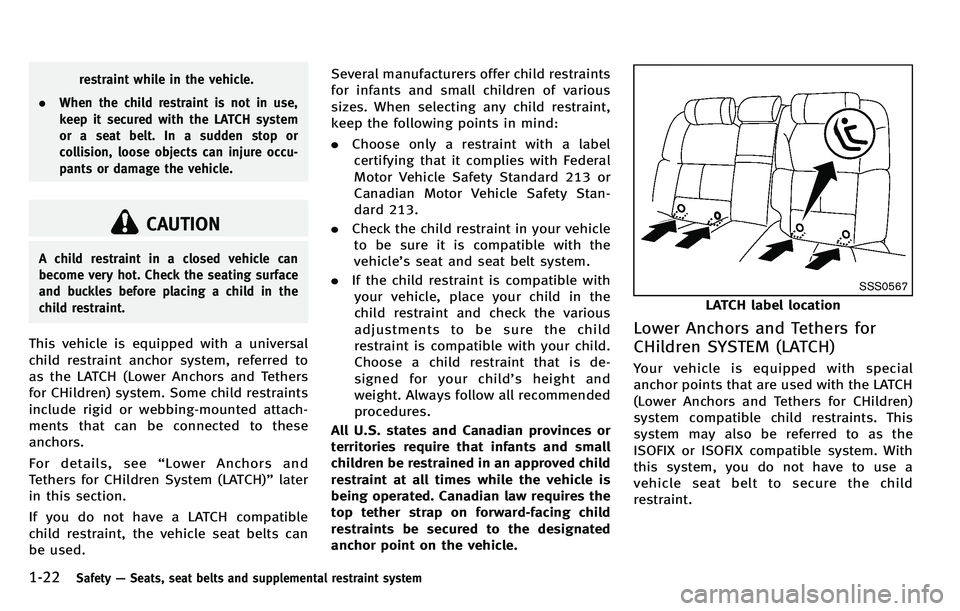
SSS0567
LATCH label location
Lower Anchors and Tethers for
CHildren SYSTEM (LATCH)
Your vehicle is equipped with special
anchor points that are used with the LATCH
(Lower Anchors and Tethers for CHildren)
system compatible child restraints. This
system may also be referred to as the
ISOFIX or ISOFIX compatible system. With
this system, you do not have to use a
vehicle seat belt to secure the child
restraint.
Page 49 of 522

1-30Safety—Seats, seat belts and supplemental restraint system
SSS0646
Forward-facing rigid-mounted —step 3
3. The back of the child restraint should
be secured against the vehicle seat-
back.
If necessary, adjust or remove the
headrest to obtain the correct child
restraint fit. If the headrest is removed,
store it in a secure place. Be sure to
reinstall the headrest when the child
restraint is removed. See“Adjustable
headrests” earlier in this sectio-
n “Adjustable headrest ”in this section
for headrest adjustment information.
If the seating position does not have an
adjustable headrest and it is interfering with the proper child restraint fit, try
another seating position or a different
child restraint.
SSS0647
Forward-facing
—step 4
4. For child restraints that are equipped
with webbing-mounted attachments,
remove any additional slack from the
anchor attachments. Press downward
and rearward firmly in the center of the
child restraint with your knee to com-
press the vehicle seat cushion and
seatback while tightening the webbing
of the anchor attachments.
5. Tighten the tether strap according to the manufacturer ’s instructions to re-
move any slack.
Page 51 of 522

1-32Safety—Seats, seat belts and supplemental restraint system
must not be used in the front seat.
2. Position the child restraint on the seat. Always follow the child restraint man-
ufacturer ’s instructions.
The back of the child restraint should
be secured against the vehicle seat-
back.
If necessary, adjust or remove the head
restraint or headrest to obtain the
correct child restraint fit. If the head
restraint or headrest is removed, store
it in a secure place. Be sure to reinstall
the head restraint or headrest when
the child restraint is removed. See
“ Head restraints” earlier in this section
or “Adjustable headrests ”earlier in this
section for head restraint or headrest
adjustment, removal and installation
information.
If the seating position does not have an
adjustable head restraint or headrest
and it is interfering with the proper
child restraint fit, try another seating
position or a different child restraint.
SSS0360B
Forward-facing —step 3
3. Route the seat belt tongue through the
child restraint and insert it into the
buckle until you hear and feel the latch
engage. Be sure to follow the child
restraint manufacturer ’s instructions
for belt routing.
If the child restraint is equipped with a
top tether strap, route the top tether
strap and secure the tether strap to the
tether anchor point (rear seat installa-
tion only). See “Installing top tether
strap ”later in this section. Do not
install child restraints that require the
use of a top tether strap in seating positions that do not have a top tether
anchor.
Page 54 of 522

SSS0791
INSTALLING TOP TETHER STRAP
First, secure the child restraint with the
LATCH lower anchors (rear outboard seat
positions only) or the seat belt, as applic-
able.
1. Flip up the anchor cover from theanchor point which is located directly
behind the child seat.
2. If necessary, raise or remove the head- rest to position the top tether strap
over the top of the seatback. If the
headrest is removed, store it in a
secure place. Be sure to reinstall the
headrest when the child restraint is removed.
See
“Adjustable headrests” earlier in
this section for headrest adjustment,
removal and installation information.
Position the top tether strap over the
top of the seatback.
3. Secure the tether strap to the tether anchor point on the rear parcel shelf.
4. Refer to the appropriate child restraint installation procedure steps in this
section before tightening the tether
strap.
If you have any questions when installing
a top tether strap, consult your INFINITI
retailer for details.
BOOSTER SEATS
Precautions on booster seats
WARNING
If a booster seat and seat belt are not used
properly, the risk of a child being injured in
a sudden stop or collision greatly increases:
. Make sure the shoulder portion of the
belt is away from the child ’s face and
neck and the lap portion of the belt does
not cross the stomach.
. Make sure the shoulder belt is not
behind the child or under the child ’s
arm.
. A booster seat must only be installed in
a seating position that has a lap/
shoulder belt.
Safety —Seats, seat belts and supplemental restraint system1-35
Page 55 of 522
1-36Safety—Seats, seat belts and supplemental restraint system
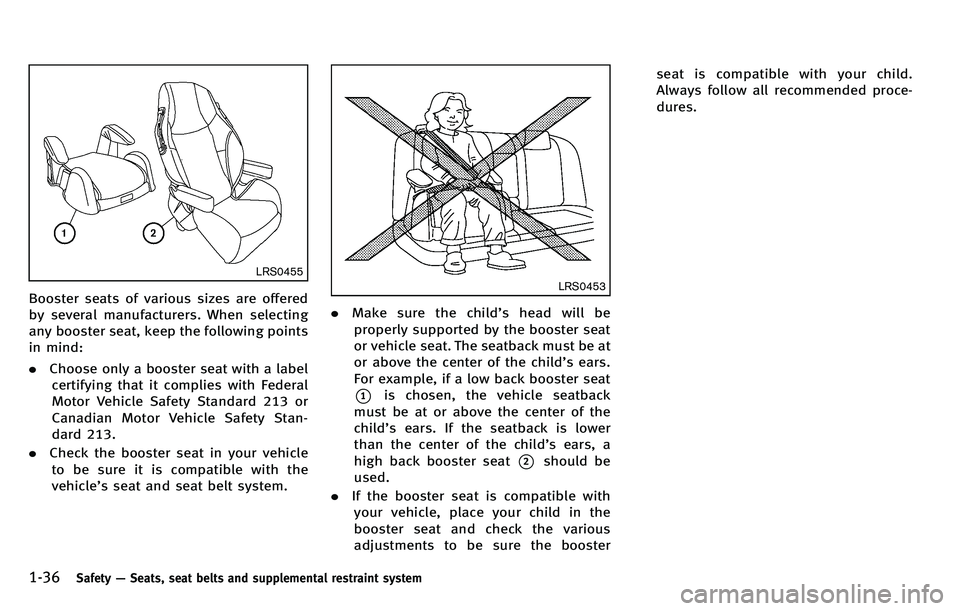
LRS0455
Booster seats of various sizes are offered
by several manufacturers. When selecting
any booster seat, keep the following points
in mind:
. Choose only a booster seat with a label
certifying that it complies with Federal
Motor Vehicle Safety Standard 213 or
Canadian Motor Vehicle Safety Stan-
dard 213.
. Check the booster seat in your vehicle
to be sure it is compatible with the
vehicle ’s seat and seat belt system.LRS0453
. Make sure the child ’s head will be
properly supported by the booster seat
or vehicle seat. The seatback must be at
or above the center of the child’ s ears.
For example, if a low back booster seat
*1is chosen, the vehicle seatback
must be at or above the center of the
child’ s ears. If the seatback is lower
than the center of the child ’s ears, a
high back booster seat
*2should be
used.
. If the booster seat is compatible with
your vehicle, place your child in the
booster seat and check the various
adjustments to be sure the booster seat is compatible with your child.
Always follow all recommended proce-
dures.
Page 57 of 522
1-38Safety—Seats, seat belts and supplemental restraint system
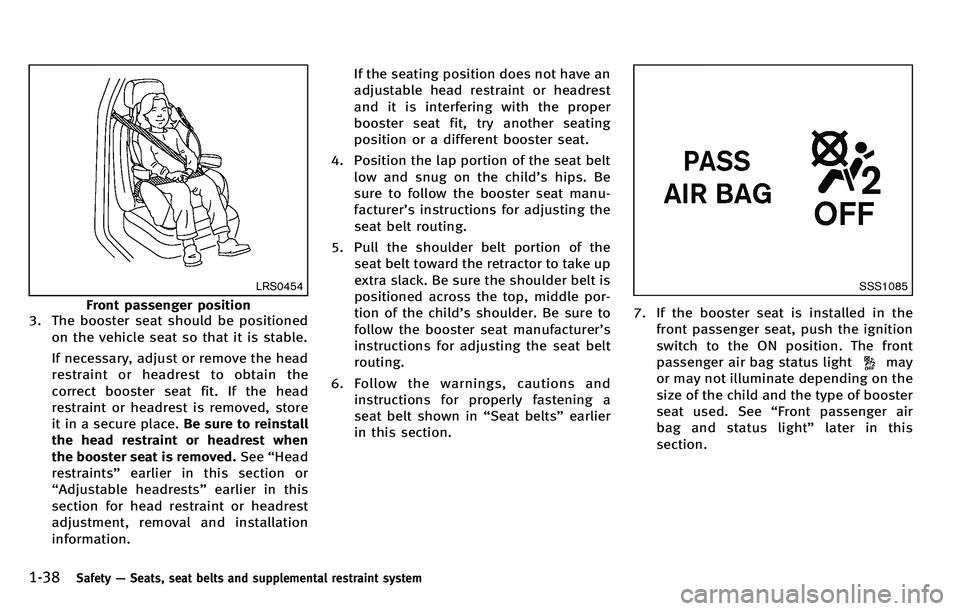
LRS0454
Front passenger position
3. The booster seat should be positioned
on the vehicle seat so that it is stable.
If necessary, adjust or remove the head
restraint or headrest to obtain the
correct booster seat fit. If the head
restraint or headrest is removed, store
it in a secure place. Be sure to reinstall
the head restraint or headrest when
the booster seat is removed. See“Head
restraints” earlier in this section or
“ Adjustable headrests ”earlier in this
section for head restraint or headrest
adjustment, removal and installation
information. If the seating position does not have an
adjustable head restraint or headrest
and it is interfering with the proper
booster seat fit, try another seating
position or a different booster seat.
4. Position the lap portion of the seat belt low and snug on the child’ s hips. Be
sure to follow the booster seat manu-
facturer ’s instructions for adjusting the
seat belt routing.
5. Pull the shoulder belt portion of the seat belt toward the retractor to take up
extra slack. Be sure the shoulder belt is
positioned across the top, middle por-
tion of the child ’s shoulder. Be sure to
follow the booster seat manufacturer ’s
instructions for adjusting the seat belt
routing.
6. Follow the warnings, cautions and instructions for properly fastening a
seat belt shown in “Seat belts ”earlier
in this section.
SSS1085
7. If the booster seat is installed in the
front passenger seat, push the ignition
switch to the ON position. The front
passenger air bag status light
may
or may not illuminate depending on the
size of the child and the type of booster
seat used. See “Front passenger air
bag and status light ”later in this
section.
Page 140 of 522
3 Pre-driving checks and adjustments
Keys .................................................................... 3-2Intelligent Key ................................................. 3-2
Valet hand-off.................................................. 3-3
Doors .................................................................. 3-4 Locking with mechanical key ........................... 3-4
Opening and closing windows with the
mechanical key................................................ 3-5
Locking with inside lock knob ......................... 3-5
Locking with power door lock switch ............... 3-5
Automatic door locks....................................... 3-6
Child safety rear door lock .............................. 3-6
Intelligent Key system ......................................... 3-7 Intelligent Key operating range........................ 3-8
Door locks/unlocks precaution ....................... 3-9
Intelligent Key operation ............................... 3-10
Battery saver system ..................................... 3-11
Warning signals............................................. 3-12
Troubleshooting guide ................................... 3-13
Remote keyless entry system............................. 3-14 How to use remote keyless entry system....... 3-14
Hood ................................................................. 3-18 Trunk lid ........................................................... 3-18
Trunk lid release switch ............................... 3-19
Trunk open request switch ........................... 3-19
Opening with key......................................... 3-19
Trunk open button ....................................... 3-19
Trunk release power cancel switch ............... 3-20
Interior trunk lid release .............................. 3-20
Fuel-filler door................................................... 3-21 Opening the fuel-filler door.......................... 3-21
Fuel-filler cap............................................... 3-21
Tilt/telescopic steering ...................................... 3-23 Electric operation ......................................... 3-24
Sun visors......................................................... 3-24
Mirrors .............................................................. 3-25 Inside mirror................................................ 3-25
Outside mirrors............................................ 3-26
Vanity mirror................................................ 3-27
Automatic drive positioner ................................ 3-28 Entry/exit function ....................................... 3-28
Seat synchronization function ..................... 3-29
Memory storage........................................... 3-29
Setting memory function.............................. 3-30
System operation......................................... 3-31
Page 142 of 522

ceed 1408F (60 8C).
— Do not change or modify the
Intelligent Key.
— Do not use a magnet key holder.
— Do not place the Intelligent Key
near an electric appliance such
as a television set or personal
computer.
— Do not allow the Intelligent Key
to come into contact with water
or salt water, and do not wash it
in a washing machine. This
could affect the system function.
. If an Intelligent Key is lost or stolen,
INFINITI recommends erasing the ID code
of that Intelligent Key. This will prevent
the Intelligent Key from unauthorized
use to unlock the vehicle. For informa-
tion regarding the erasing procedure,
please contact an INFINITI retailer.
SPA2033
Mechanical key
To remove the mechanical key, release the
lock knob at the back of the Intelligent Key.
To install the mechanical key, firmly insert
it into the Intelligent Key until the lock
knob returns to the lock position.
Use the mechanical key to lock or unlock
the doors, glove box and trunk pass-
through lid, if they are equipped with a
key cylinder.
See “Doors ”later in this section and
“ Trunk lid” later in this section, “Storage ”
in the “2. Instruments and controls ”
section and “Seats ”in the “1. Safety —Seats, seat belts and supplemental re-
straint system”
section.
CAUTION
Always carry the mechanical key installed in
the key.
VALET HAND-OFF
When you have to leave a key with a valet,
give them the Intelligent Key itself and
keep the mechanical key with you to
protect your belongings.
To prevent the glove box and the trunk
from being opened during valet hand-off,
follow the procedures below.
1. Push the trunk release power cancel
switch to the CANCEL side.
2. Remove the mechanical key from the Intelligent Key.
3. Lock the glove box and the trunk pass- through with the mechanical key.
4. Hand the Intelligent Key to the valet, keeping the mechanical key in your
pocket or bag for insertion into the
Intelligent Key when you retrieve your
vehicle.
Pre-driving checks and adjustments3-3
Page 143 of 522
3-4Pre-driving checks and adjustments
See“Trunk lid ”later in this section,
“ Storage ”in the “2. Instruments and
controls ”section and “Seats ”in the “1.
Safety —Seats, seat belts and supple-
mental restraint system” section.
WARNING
.Always have the doors locked while
driving. Along with the use of seat belts,
this provides greater safety in the event
of an accident by helping to prevent
persons from being thrown from the
vehicle. This also helps keep children
and others from unintentionally opening
the doors, and will help keep out
intruders.
. Before opening any door, always look for
and avoid oncoming traffic.
. Do not leave children unattended inside
the vehicle. They could unknowingly
activate switches or controls. Unat-
tended children could become involved
in serious accidents.
SPA2527
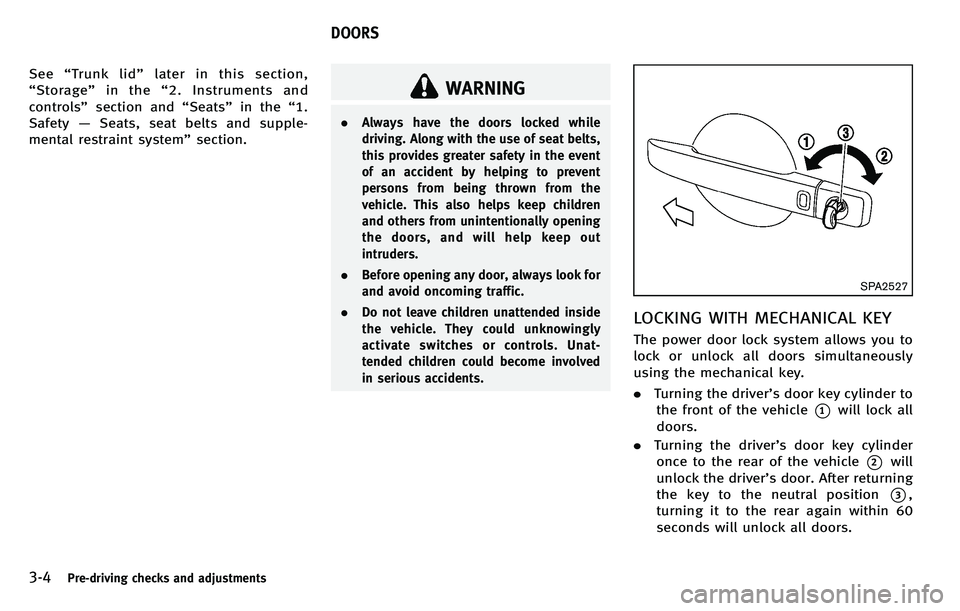
LOCKING WITH MECHANICAL KEY
The power door lock system allows you to
lock or unlock all doors simultaneously
using the mechanical key.
.Turning the driver ’s door key cylinder to
the front of the vehicle
*1will lock all
doors.
. Turning the driver ’s door key cylinder
once to the rear of the vehicle
*2will
unlock the driver ’s door. After returning
the key to the neutral position
*3,
turning it to the rear again within 60
seconds will unlock all doors.
DOORS
Page 160 of 522

that people become locked inside the trunk
or in the event of the loss of electrical
power such as a discharged battery.
Releasing inside the trunk
To open the trunk lid from the inside, pull
the release handle
*1until the lock
releases and push up on the trunk lid.
The release lever is made of a material that
glows in the dark after a brief exposure to
ambient light.
The handle is located on the back of the
trunk lid as illustrated.
Releasing from the rear seat
You can access the release handle through
the trunk pass-through (rear seat armrest).
(See “Armrest ”in the “1. Safety —Seats,
seat belts and supplemental restraint
system” section.)
To open the trunk lid from the rear seat,
pull the release handle towards front of
vehicle until the lock releases.
SPA2735
OPENING THE FUEL-FILLER DOOR
To open the fuel-filler door, unlock the fuel-
filler door by using one of the following
operations, then push the upper left side
of the door.
. Push the door handle request switch
with the Intelligent Key carried with
you.
. Push the UNLOCK button on the Intelli-
gent Key.
. Insert the mechanical key into the door
lock cylinder and turn it to the rear of
the vehicle. .
Push the power door lock switch to the
UNLOCK position.
To lock, close the fuel-filler door securely
and lock all doors by operating the door
handle request switch, the LOCK button on
the Intelligent Key, the mechanical key or
the power door lock switch.
FUEL-FILLER CAP
WARNING
. Gasoline is extremely flammable and
highly explosive under certain condi-
tions. You could be burned or seriously
injured if it is misused or mishandled.
Always stop engine and do not smoke or
allow open flames or sparks near the
vehicle when refueling.
. Do not attempt to top off the fuel tank
after the fuel pump nozzle shuts off
automatically. Continued refueling may
cause fuel overflow, resulting in fuel
spray and possibly a fire.
. Use only an original equipment type
fuel-filler cap as a replacement. It has a
built-in safety valve needed for proper
operation of the fuel system and emis-
sion control system. An incorrect cap can
Pre-driving checks and adjustments3-21
FUEL-FILLER DOOR