warning INFINITI Q50 2014 Owner's Manual
[x] Cancel search | Manufacturer: INFINITI, Model Year: 2014, Model line: Q50, Model: INFINITI Q50 2014Pages: 394, PDF Size: 1.99 MB
Page 346 of 394

SDI2330
Step light
SDI1258A
Trunk lightIf you have a flat tire, see
“Flat tire”(P.6-
3).
TIRE PRESSURE
Tire Pressure Monitoring System
(TPMS)
This vehicle is equipped with the Tire
Pressure Monitoring System (TPMS). It
monitors tire pressure of all tires except
the spare. When the low tire pressure
warning light is lit and the “Tire Pressure
Low - Add Air” warning appears in the
vehicle information display, one or more of
your tires is significantly under-inflated.
The TPMS will activate only when the
vehicle is driven at speeds above 16 MPH
(25 km/h). Also, this system may not
detect a sudden drop in tire pressure (for
example a flat tire while driving).
For more details, see “Low tire pressure
warning light” (P.2-14),“Tire Pressure Mon-
itoring System (TPMS)” (P.5-4) and“Tire
Pressure Monitoring System (TPMS)” (P.6-
3).
Tire inflation pressure
Check the pressure of the tires
(including the spare) often and al- ways prior to long distance trips. The
recommended tire pressure specifi-
cations are shown on the Tire and
Loading Information label under the
“Cold Tire Pressure”
heading. The
Tire and Loading Information label is
affixed to the driver side center pillar.
Tire pressures should be checked
regularly because:
.Most tires naturally lose air over time.
.Tires can lose air suddenly whendriven over potholes or other
objects or if the vehicle strikes a
curb while parking.
The tire pressures should be checked
when the tires are cold. The tires are
considered COLD after the vehicle
has been parked for 3 or more hours,
or driven less than 1 mile (1.6 km) at
moderate speeds.
TPMS with Tire Inflation Indicator
provides visual and audible signals
outside the vehicle for inflating the
tires to the recommended COLD tire
Maintenance and do-it-yourself8-29
WHEELS AND TIRES
Page 347 of 394
8-30Maintenance and do-it-yourself
pressure. (See“TPMS with Tire Infla-
tion Indicator” (P.5-7) about the
TPMS with Tire Inflation Indicator.)
Incorrect tire pressure, including
under inflation, may adversely affect
tire life and vehicle handling.
WARNING
. Improperly inflated tires can fail
suddenly and cause an accident.
. The Gross Vehicle Weight rating
(GVWR) is located on the F.M.V.S.
S./C.M.V.S.S. label. The vehicle
weight capacity is indicated on
the Tire and Loading Information
label. Do not load your vehicle
beyond this capacity. Overloading
your vehicle may result in reduced
tire life, unsafe operating condi-
tions due to premature tire failure,
or unfavorable handling character-
istics and could also lead to a
serious accident. Loading beyond
the specified capacity may also result in failure of other vehicle
components.
. Before taking a long trip, or
whenever you heavily load your
vehicle, use a tire pressure gauge
to ensure that the tire pressures
are at the specified level.
. For additional information regard-
ing tires, refer to “Important Tire
Safety Information ”(US) or “Tire
Safety Information ”(Canada) in
the Warranty Information Booklet.
Page 352 of 394
Intended Outboard Sidewall is (1) the
sidewall that contains a whitewall,
bears white lettering or bears manu-
facturer, brand and/or model name
molding that is higher or deeper than
the same molding on the other side-
wall of the tire, or (2) the outward
facing sidewall of an asymmetrical
tire that has a particular side that
must always face outward when
mounted on a vehicle.
TYPES OF TIRES
WARNING
.When changing or replacing tires, be
sure all four tires are of the same type
(Example: Summer, All Season or Snow)
and construction. An INFINITI retailer
may be able to help you with information
about tire type, size, speed rating and
availability.
. Replacement tires may have a lower
speed rating than the factory equipped
tires, and may not match the potential
maximum vehicle speed. Never exceed the maximum speed rating of the tire.
. Replacing tires with those not originally
specified by INFINITI could affect the
proper operation of the TPMS.
. For additional information regarding
tires, refer to “Important Tire Safety
Information” (US) or“Tire Safety Infor-
mation” (Canada) in the Warranty Infor-
mation Booklet.
All season tires
INFINITI specifies all season tires on some
models to provide good performance all
year, including snowy and icy road condi-
tions. All Season tires are identified by ALL
SEASON and/or M&S (Mud and Snow) on
the tire sidewall. Snow tires have better
snow traction than All Season tires and
may be more appropriate in some areas.
Summer tires
INFINITI specifies summer tires on some
models to provide superior performance on
dry roads. Summer tire performance is
substantially reduced in snow and ice.
Summer tires do not have the tire traction
rating M&S on the tire sidewall.
If you plan to operate your vehicle in snowy or icy conditions, INFINITI recommends the
use of SNOW tires or ALL SEASON tires on
all four wheels.
Snow tires
If snow tires are needed, it is necessary to
select tires equivalent in size and load
rating to the original equipment tires. If
you do not, it can adversely affect the
safety and handling of your vehicle.
Generally, snow tires will have lower speed
ratings than factory equipped tires and
may not match the potential maximum
vehicle speed. Never exceed the maximum
speed rating of the tire.
If you install snow tires, they must be the
same size, brand, construction and tread
pattern on all four wheels.
For additional traction on icy roads,
studded tires may be used. However, some
U.S. states and Canadian provinces prohi-
bit their use. Check local, state and
provincial laws before installing studded
tires. Skid and traction capabilities of
studded snow tires, on wet or dry surfaces,
may be poorer than that of non-studded
snow tires.
Maintenance and do-it-yourself8-35
Page 353 of 394

8-36Maintenance and do-it-yourself
Run-flat tires
Your vehicle is equipped with run-flat tires.
You can continue driving to a safe location
even if they are punctured. Always use run-
flat tires of the specified size on all four
wheels. Mixing tire sizes or construction
may reduce vehicle handling stability. If
necessary, contact an INFINITI retailer for
assistance.
Frequently check the tire pressure and
adjust pressure of each tire properly. The
tire pressure can be also checked in the
vehicle information display.
It can be difficult to tell if a run-flat tire is
under-inflated or flat. Check the tire
pressures as described earlier in this
section. If the tire becomes under-inflated
while driving, the low tire pressure warning
light will illuminate. If the tire becomes flat
while driving, the low tire pressure warning
light and the“Flat Tire - Visit dealer”
warning will appear.
Low tire pressure:
If the vehicle is being driven with low tire
pressure, the low tire pressure warning
light will illuminate. Flat tire:
If the vehicle is being driven with one or
more flat tires, the low tire pressure
warning light will illuminate continuously
and a chime will sound for 10 seconds. A
“ Flat Tire - Visit dealer” warning also
appears in the vehicle information display.
The chime will only sound at the first
indication of a flat tire and the warning
light will illuminate continuously. When the
flat tire warning is activated, have the
system reset and the tire checked and
replaced if necessary by an INFINITI retai-
ler. Even if the tire is inflated to the
specified COLD tire pressure, the warning
light will continue to illuminate until the
system is reset by an INFINITI retailer.
If the low tire pressure warning light
illuminates continuously and the “Flat Tire
- Visit dealer” warning appears in the
vehicle information display:
. Do not exceed 50 MPH (80 km/h).
. Increase your following distance to
allow for increased stopping distances.
. Avoid sudden maneuvers, hard corner-
ing and hard braking.WARNING
. Although you can continue driving with a
punctured run-flat tire, remember that
vehicle handling stability is reduced,
which could lead to an accident and
personal injury. Also, driving a long
distance at high speeds may damage
the tire.
. Do not drive at speeds above 50 MPH
(80 km/h) and do not drive more than
approximately 93 miles (150 km) with a
punctured run-flat tire. The actual dis-
tance the vehicle can be driven on a flat
tire depends on outside temperature,
vehicle load, road conditions and other
factors.
. Drive safely at reduced speeds. Avoid
hard cornering or braking, which may
cause you to lose control of the vehicle.
. If you detect any unusual sounds or
vibrations while driving with a punctured
run-flat tire, pull off the road to a safe
location and stop the vehicle as soon as
possible. The tire may be seriously
damaged and need to be replaced.
Page 355 of 394
8-38Maintenance and do-it-yourself
SDI1662
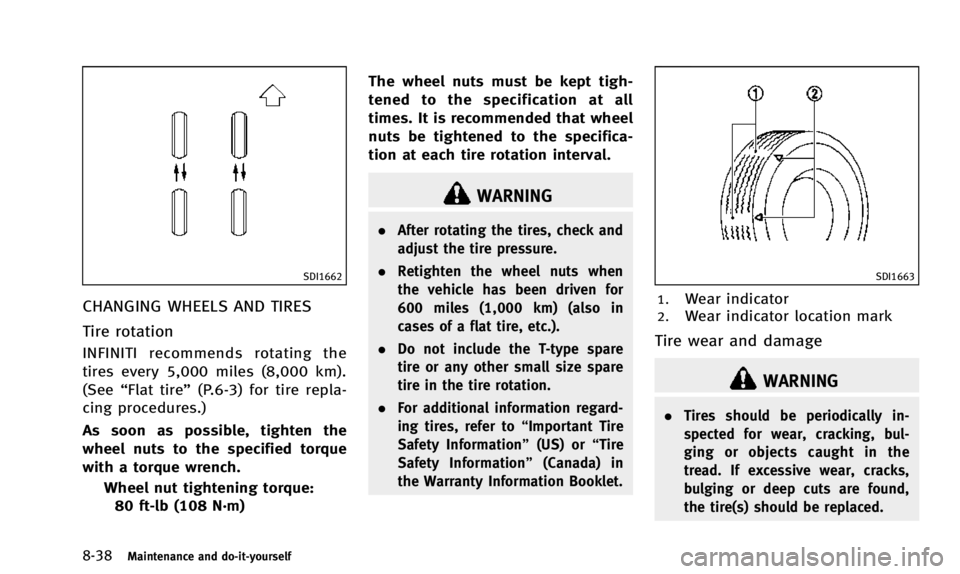
CHANGING WHEELS AND TIRES
Tire rotation
INFINITI recommends rotating the
tires every 5,000 miles (8,000 km).
(See“Flat tire” (P.6-3) for tire repla-
cing procedures.)
As soon as possible, tighten the
wheel nuts to the specified torque
with a torque wrench.
Wheel nut tightening torque:80 ft-lb (108 N·m) The wheel nuts must be kept tigh-
tened to the specification at all
times. It is recommended that wheel
nuts be tightened to the specifica-
tion at each tire rotation interval.
WARNING
.
After rotating the tires, check and
adjust the tire pressure.
. Retighten the wheel nuts when
the vehicle has been driven for
600 miles (1,000 km) (also in
cases of a flat tire, etc.).
. Do not include the T-type spare
tire or any other small size spare
tire in the tire rotation.
. For additional information regard-
ing tires, refer to “Important Tire
Safety Information ”(US) or “Tire
Safety Information ”(Canada) in
the Warranty Information Booklet.
SDI1663
1.Wear indicator
2.Wear indicator location mark
Tire wear and damage
WARNING
. Tires should be periodically in-
spected for wear, cracking, bul-
ging or objects caught in the
tread. If excessive wear, cracks,
bulging or deep cuts are found,
the tire(s) should be replaced.
Page 356 of 394
.The original tires have built-in
tread wear indicators. When wear
indicators are visible, the tire(s)
should be replaced.
. Tires degrade with age and use.
Have tires, including the spare,
over 6 years old checked by a
qualified technician, because
some tire damage may not be
obvious. Replace the tires as
necessary to prevent tire failure
and possible personal injury.
. Improper service of the spare tire
may result in serious personal
injury. If it is necessary to repair
the spare tire, contact an INFINITI
retailer.
. For additional information regard-
ing tires, refer to “Important Tire
Safety Information ”(US) or “Tire
Safety Information ”(Canada) in
the Warranty Information Booklet.Replacing wheels and tires
When replacing a tire, use the same size,
tread design, speed rating and load carry-
ing capacity as originally equipped. (See
“Specifications” (P.9-8) for recommended
types and sizes of tires and wheels.)
WARNING
. The use of tires other than those
recommended or the mixed use of tires
of different brands, construction (bias,
bias-belted, radial or run-flat), or tread
patterns can adversely affect the ride,
braking, handling, ground clearance,
body-to-tire clearance, tire chain clear-
ance, speedometer calibration, head-
light aim and bumper height. Some of
these effects may lead to accidents and
could result in serious personal injury.
. For Two-Wheel Drive (2WD) models, if
your vehicle was originally equipped
with 4 tires that were the same size
and you are only replacing 2 of the 4
tires, install the new tires on the rear
axle. Placing new tires on the front axle
may cause loss of vehicle control in
some driving conditions and cause an accident and personal injury.
. If the wheels are changed for any
reason, always replace with wheels
which have the same off-set dimension.
Wheels of a different off-set could cause
premature tire wear, degrade vehicle
handling characteristics and/or interfer-
ence with the brake discs/drums. Such
interference can lead to decreased brak-
ing efficiency and/or early brake pad/
shoe wear. See “Wheels and tires” (P.9-
9) of this manual for wheel off-set
dimensions.
. When a spare tire is mounted or a wheel
is replaced, the TPMS will not function
and the low tire pressure warning light
will flash for approximately 1 minute.
The light will remain on after 1 minute.
Contact your INFINITI retailer as soon as
possible for tire replacement and/or
system resetting.
. Replacing tires with those not originally
specified by INFINITI could affect the
proper operation of the TPMS.
. Do not install a damaged or deformed
wheel or tire even if it has been repaired.
Such wheels or tires could have struc-
tural damage and could fail without
Maintenance and do-it-yourself8-39
Page 357 of 394
8-40Maintenance and do-it-yourself
warning.
. The use of retread tire is not recom-
mended.
. For additional information regarding
tires, refer to “Important Tire Safety
Information” (US) or“Tire Safety Infor-
mation” (Canada) in the Warranty Infor-
mation Booklet.
Intelligent All-Wheel Drive (AWD)
models
CAUTION
. Always use tires of the same type, size,
brand, construction (bias, bias-belted or
radial), and tread pattern on all four
wheels. Failure to do so may result in a
circumference difference between tires
on the front and rear axles which will
cause excessive tire wear and may
damage the transmission, transfer case
and differential gears.
. ONLY use spare tires specified for the
Intelligent AWD model.
If excessive tire wear is found, it is recommended that all four tires be re-
placed with tires of the same size, brand,
construction and tread pattern. The tire
pressure and wheel alignment should also
be checked and corrected as necessary.
Contact an INFINITI retailer.
Wheel balance
Unbalanced wheels may affect vehicle
handling and tire life. Even with regular
use, wheels can get out of balance. There-
fore, they should be balanced as required.
Wheel balance service should be per-
formed with the wheels off the vehicle.
Spin balancing the wheels on the vehicle
could lead to mechanical damage.
For additional information regarding tires,
refer to
“Important Tire Safety Information”
(US) or “Tire Safety Information” (Canada)
in the INFINITI Warranty Information Book-
let.
Care of wheels
See “Cleaning exterior” (P.7-2) for details
about care of the wheels.
Spare tire (TEMPORARY USE ONLY
(T-type) spare tire) (if so equipped)
When a spare tire is mounted (TEMPORARY
USE ONLY), the Tire Pressure Monitoring
System (TPMS) will not function.
Observe the following precautions if the
TEMPORARY USE ONLY spare tire must be
used, otherwise your vehicle could be
damaged or involved in an accident.
WARNING
. The TEMPORARY USE ONLY spare tire
should be used for emergency use. It
should be replaced with the standard
tire at the first opportunity to avoid
possible tire or differential damage.
. Drive carefully while the TEMPORARY
USE ONLY spare tire is installed. Avoid
sharp turns and abrupt braking while
driving.
. Periodically check spare tire inflation
pressure. Always keep the pressure of
the TEMPORARY USE ONLY spare tire at
60 psi (420 kPa, 4.2 bar). Always keep
the pressure of the full size spare tire (if
so equipped) at the recommended pres-
sure for standard tires, as indicated on
Page 375 of 394
9-16Technical and consumer information
WARNING
.It is extremely dangerous to ride
in a cargo area inside the vehicle.
In a collision, people riding in
these areas are more likely to be
seriously injured or killed.
.Do not allow people to ride in any
area of vehicle that is not
equipped with seats and seat
belts.
.Be sure everyone in your vehicle is
in a seat and using a seat belt
properly.
TERMS
It is important to familiarize yourself
with the following terms before
loading your vehicle:
.Curb Weight (actual weight of yourvehicle) - vehicle weight includ-
ing: standard and optional equip-
ment, fluids, emergency tools,
and spare tire assembly. This weight
does not include passen-
gers and cargo.
.GVW (Gross Vehicle Weight) - curb weight plus the combined weight
of passengers and cargo.
.GVWR (Gross Vehicle Weight Rat-ing) - maximum total combined
weight of the unloaded vehicle,
passengers, luggage, hitch, trailer
tongue load and any other op-
tional equipment. This informa-
tion is located on the F.M.V.S.S./
C.M.V.S.S. label.
.GAWR (Gross Axle Weight Rating) -maximum weight (load) limit spe-
cified for the front or rear axle.
This information is located on the
F.M.V.S.S./C.M.V.S.S. label.
.GCWR (Gross Combined WeightRating) - The maximum total
weight rating of the vehicle, pas-
sengers, cargo, and trailer.
.Vehicle Capacity Weight, Loadlimit, Total load capacity - max-
imum total weight limit specified of the load (passengers and car-
go) for the vehicle. This is the
maximum combined weight of
occupants and cargo that can be
loaded into the vehicle. If the
vehicle is used to tow a trailer,
the trailer tongue weight must be
included as part of the cargo load.
This information is located on the
Tire and Loading Information la-
bel.
.Cargo capacity - permissible
weight of cargo, the weight of
total occupants weight subtracted
from the load limit.
VEHICLE LOADING INFORMATION
Page 377 of 394
9-18Technical and consumer information
cargo and luggage load capacity
of your vehicle.
Before driving a loaded vehicle,
confirm that you do not exceed the
Gross Vehicle Weight Rating (GVWR)
or the Gross Axle Weight Rating
(GAWR) for your vehicle. (See “Mea-
surement of weights” (P.9-18).)
Also check tires for proper inflation
pressures. See the Tire and Loading
Information label.
LOADING TIPS
.The GVW must not exceed GVWR or GAWR as specified on the F.M.V.
S.S./C.M.V.S.S. certification label.
.Do not load the front and rear axle
to the GAWR. Doing so will exceed
the GVWR.
WARNING
.Properly secure all cargo to help
prevent it from sliding or shifting.
Do not place cargo higher than the seatbacks. In a sudden stop or
collision, unsecured cargo could
cause personal injury.
.Do not load your vehicle any
heavier than the GVWR or the
maximum front and rear GAWRs.
If you do, parts of your vehicle can
break, tire damage could occur, or
it can change the way your vehicle
handles. This could result in loss
of control and cause personal
injury.
.Overloading could not only short-
en the life of your vehicle and the
tires, but also could lead to
hazardous vehicle handling and
long braking distance. This may
cause a premature tire malfunc-
tion, which could result in a
serious accident and personal in-
jury. Failures caused by overload-
ing are not covered by the
vehicle’s warranty.
MEASUREMENT OF WEIGHTS
Secure loose items to prevent weight
shifts that could affect the balance of
your vehicle. When the vehicle is
loaded, drive to a scale and weigh
the front and the rear wheels sepa-
rately to determine axle loads. In-
dividual axle loads should not
exceed either of the gross axle
weight ratings (GAWR). The total of
the axle loads should not exceed the
gross vehicle weight rating (GVWR).
These ratings are given on the
vehicle certification label. If weight
ratings are exceeded, move or re-
move items to bring all weights
below the ratings.
Page 379 of 394

9-20Technical and consumer information
TRACTION AA, A, B AND C
The traction grades, from highest to low-
est, are AA, A, B and C. Those grades
represent the tire’s ability to stop on wet
pavement as measured under controlled
conditions on specified government test
surfaces of asphalt and concrete. A tire
marked C may have poor traction perfor-
mance.
WARNING
The traction grade assigned to this tire is
based on straight-ahead braking traction
tests, and does not include acceleration,
cornering, hydroplaning, or peak traction
characteristics.
TEMPERATURE A, B AND C
The temperature grades A (the highest), B,
and C, representing the tire’s resistance to
the generation of heat and its ability to
dissipate heat when tested under con-
trolled conditions on a specified indoor
laboratory test wheel. Sustained high
temperature can cause the material of the
tire to degenerate and reduce tire life, and
excessive temperature can lead to suddentire failure. The grade C corresponds to a
level of performance which all passenger
car tires must meet under the Federal
Motor Vehicle Safety Standard No. 109.
Grades B and A represent higher levels of
performance on the laboratory test wheel
than the minimum required by law.
WARNING
The temperature grade for this tire is
established for a tire that is properly
inflated and not overloaded. Excessive
speed, under-inflation, or excessive loading,
either separately or in combination, can
cause heat build-up and possible tire failure.
Your INFINITI is covered by the following
emission warranties.
For USA:
.
Emission Defects Warranty
. Emissions Performance Warranty
Details of these warranties may be found
with other vehicle warranties in your
Warranty Information Booklet that comes
with your INFINITI. If you did not receive a
Warranty Information Booklet, or it has
become lost, you may obtain a replace-
ment by writing to:
. INFINITI Division
Nissan North America, Inc.
Consumer Affairs Department
P.O. Box 685003
Franklin, TN 37068-5003
EMISSION CONTROL SYSTEM WARRANTY