wheel well INFINITI Q50 2014 Owner's Manual
[x] Cancel search | Manufacturer: INFINITI, Model Year: 2014, Model line: Q50, Model: INFINITI Q50 2014Pages: 394, PDF Size: 1.99 MB
Page 62 of 394
SSS0131B
SSS0132B
WARNING
.The front air bags ordinarily will not
inflate in the event of a side impact, rear
impact, rollover, or lower severity frontal
collision. Always wear your seat belts to
help reduce the risk or severity of injury
in various kinds of accidents.
. The front passenger air bag will not
inflate if the passenger air bag status
light is lit or if the front passenger seat
is unoccupied. See “Front passenger air
bag and status light” (P.1-49).
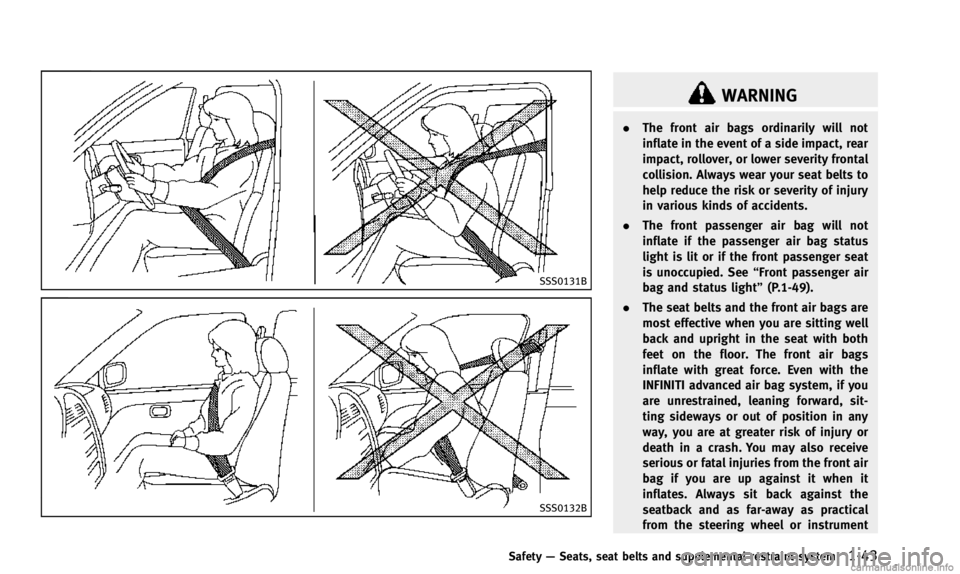
. The seat belts and the front air bags are
most effective when you are sitting well
back and upright in the seat with both
feet on the floor. The front air bags
inflate with great force. Even with the
INFINITI advanced air bag system, if you
are unrestrained, leaning forward, sit-
ting sideways or out of position in any
way, you are at greater risk of injury or
death in a crash. You may also receive
serious or fatal injuries from the front air
bag if you are up against it when it
inflates. Always sit back against the
seatback and as far-away as practical
from the steering wheel or instrument
Safety —Seats, seat belts and supplemental restraint system1-43
Page 201 of 394
5-26Starting and driving
PRECAUTIONS ON ACTIVE LANE
CONTROL
WARNING
.Active Lane Control will not always steer
the vehicle to keep it in the lane. It is not
designed to prevent loss of control. It is
the driver’s responsibility to stay alert,
drive safely, keep the vehicle in the
traveling lane, and be in control of
vehicle at all times.
. Active Lane Control is primarily intended
for use on well-developed freeways or
highways. It may not detect the lane
markers for certain roads, weather or
driving conditions.
. Using Active Lane Control under some
conditions of road, lane marker or
weather, or if you attempt to change
lanes without using the lane change
signal could lead to an unexpected
system operation. In such conditions,
you need to correct the vehicle’s direc-
tion with your steering operation to
avoid accidents.
. When Active Lane Control is operating,
avoid excessive or sudden steering maneuvers. Otherwise, you could lose
control of the vehicle.
. Active Lane Control will not operate at
speeds below approximately 45 MPH (70
km/h) or if it cannot detect lane markers.
. Active Lane Control may not operate
properly under the following conditions,
and do not use Active Lane Control:
—During bad weather (rain, fog, snow,
wind, etc.).
—When driving on slippery roads,such as on ice or snow, etc.
—When driving on winding or uneven roads.
—When there is a lane closure due toroad repairs.
—When driving in a makeshift lane.
—When driving on roads where the
lane width is too narrow.
—When driving with a tire that is notwithin normal tire conditions (for
example, tire wear, low tire pressure,
installation of spare tire, tire chains,
non-standard wheels).
—When the vehicle is equipped withnon-original steering parts or sus- pension parts.
. If Active Lane Control malfunctions, it
will cancel automatically. The chassis
control warning will appear in the
vehicle information display.
. If the chassis control warning appears,
pull off the road to a safe location and
stop the vehicle. Turn the engine off and
restart the engine. If the chassis control
warning continues to illuminate, have
Active Lane Control checked by an
INFINITI retailer.
The functions of Active Lane Control may or
may not operate properly under the follow-
ing conditions:
.On roads where there are multiple
parallel lane markers; lane markers
that are faded or not painted clearly;
yellow painted lane markers; non-stan-
dard lane markers; lane markers cov-
ered with water, dirt, snow, etc.
. On roads where discontinued lane
markers are still detectable.
. On roads where there are sharp curves.
. On roads where there are sharply
contrasting objects, such as shadows,
snow, water, wheel ruts, seams or lines
Page 208 of 394
LANE DEPARTURE PREVENTION
(LDP) SYSTEM
Precautions on LDP system
WARNING
.The LDP system will not always steer the
vehicle to keep it in the lane. It is not
designed to prevent loss of control. It is
the driver’s responsibility to stay alert,
drive safely, keep the vehicle in the
traveling lane, and be in control of
vehicle at all times.
. The LDP system is primarily intended for
use on well-developed freeways or high-
ways. It may not detect the lane markers
in certain roads, weather or driving
conditions.
. Using the LDP system under some
conditions of road, lane marker or
weather, or when you change lanes
without using the lane change signal
could lead to an unexpected system
operation. In such conditions, you need
to correct the vehicle’s direction with
your steering operation to avoid acci-
dents. .
When the LDP system is operating, avoid
excessive or sudden steering maneu-
vers. Otherwise, you could lose control
of the vehicle.
. The LDP system will not operate at
speeds below approximately 45 MPH
(70 km/h) or if it cannot detect lane
markers.
. The LDP system may not function
properly under the following conditions,
and do not use the LDP system:
—During bad weather (rain, fog, snow,
wind, etc.).
—When driving on slippery roads,
such as on ice or snow, etc.
—When driving on winding or uneven roads.
—When there is a lane closure due to
road repairs.
—When driving in a makeshift lane.
—When driving on roads where thelane width is too narrow.
—When driving with a tire that is notwithin normal tire conditions (for
example, tire wear, low tire pressure,
installation of spare tire, tire chains, non-standard wheels).
—When the vehicle is equipped with
non-original steering parts or sus-
pension parts.
. If the LDP system malfunctions, it will
cancel automatically. The LDP “malfunc-
tion” message will appear in the vehicle
information display.
. If the “malfunction” message appears,
pull off the road to a safe location and
stop the vehicle. Turn the engine off and
restart the engine. If the “malfunction”
message continues to appear, have the
LDP system checked by an INFINITI
retailer.
. Excessive noise will interfere with the
warning chime sound, and the chime
may not be heard.
The functions of the LDP system (warning
and steering control assist) may or may not
operate properly under the following con-
ditions:
.On roads where there are multiple
parallel lane markers; lane markers
that are faded or not painted clearly;
yellow painted lane markers; non-stan-
dard lane markers; lane markers cov-
Starting and driving5-33
Page 265 of 394

5-90Starting and driving
JVS0312X
1. Driver assist system forward indicator
2. Vehicle ahead detection indicator
SYSTEM OPERATION
The forward emergency braking system will
function when your vehicle is driven at
speeds above approximately 3 MPH (5
km/h).
If a risk of a forward collision is detected,
the forward emergency braking system will
provide the first warning to the driver by
flashing the driver assist system forward
indicator (orange) and the vehicle ahead
detection indicator (orange), and providing
an audible warning. In addition, theforward emergency braking system pushes
the accelerator pedal up. If the driver
releases the accelerator pedal, then the
system applies partial braking.
If the driver applies the brakes quickly and
forcefully after the warning, and the
forward emergency braking system detects
that there is still the possibility of a
forward collision, the system will automa-
tically increase the braking force.
If a forward collision is imminent and the
driver does not take action, the forward
emergency braking system issues the
second visual (red) and audible warning
and automatically applies harder braking.NOTE:
The vehicle’s stop lights come on when
braking is performed by the forward
emergency braking system.
Depending on vehicle speed and distance
to the vehicle ahead, as well as driving and
roadway conditions, the system may help
the driver avoid a forward collision or may
help mitigate the consequences if a colli-
sion should one be unavoidable.
If the driver is handling the steering wheel,
accelerating or braking, the forward emer-
gency braking system will function later or
will not function.
The automatic braking will cease under the
following conditions:
.
When the steering wheel is turned as
far as necessary to avoid a collision.
. When the accelerator pedal is de-
pressed.
. When there is no longer a vehicle
detected ahead.
If the forward emergency braking system
has stopped the vehicle, the vehicle will
remain at a standstill for approximately 2
seconds before the brakes are released.
Page 311 of 394
7-2Appearance and care
In order to maintain the appearance of
your vehicle, it is important to take proper
care of it.
To protect the paint surface, wash your
vehicle as soon as you can:
.after a rainfall to prevent possible
damage from acid rain
. after driving on coastal roads
. when contaminants such as soot, bird
droppings, tree sap, metal particles or
bugs get on the paint surface
. when dust or mud builds up on the
surface
Whenever possible, store or park your
vehicle inside a garage or in a covered
area.
When it is necessary to park outside, park
in a shady area or protect the vehicle with
a body cover.
Be careful not to scratch the paint surface
when putting on or removing the body
cover.WASHING
Wash dirt off the vehicle with a wet sponge
and plenty of water. Clean the vehicle
thoroughly using a mild soap, a special
vehicle soap or general purpose dishwash-
ing liquid mixed with clean, lukewarm
(never hot) water.
CAUTION
. Do not use car washes that use acid in
the detergent. Some car washes, espe-
cially brushless ones, use some acid for
cleaning. The acid may react with some
plastic vehicle components, causing
them to crack. This could affect their
appearance, and also could cause them
not to function properly. Always check
with your car wash to confirm that acid
is not used.
. Do not wash the vehicle with strong
household soap, strong chemical deter-
gents, gasoline or solvents.
. Do not wash the vehicle in direct sun-
light or while the vehicle body is hot, as
the surface may become water-spotted.
. Avoid using tight-napped or rough
cloths, such as washing mitts. Care must be taken when removing caked-on
dirt or other foreign substances so the
paint surface is not scratched or da-
maged.
Rinse the vehicle again with plenty of clean
water.
Inside flanges, seams and folds on the
doors, hatches and hood are particularly
vulnerable to the effects of road salt.
Therefore, these areas must be regularly
cleaned. Make sure that the drain holes in
the lower edge of the door are open. Spray
water under the body and in the wheel
wells to loosen the dirt and wash away
road salt.
Avoid leaving water spots on the paint
surface by using a damp chamois to dry
the vehicle.
WAXING
Regular waxing protects the paint surface
and helps retain new vehicle appearance.
Polishing is recommended to remove built-
up wax residue and to avoid a weathered
appearance before reapplying wax.
An INFINITI retailer can assist you in
choosing the proper product.
CLEANING EXTERIOR
Page 378 of 394
Do not tow a trailer with your
vehicle.
FLAT TOWING
Towing your vehicle with all four wheels on
the ground is sometimes called flat towing.
This method is sometimes used when
towing a vehicle behind a recreational
vehicle, such as a motor home.
CAUTION
.Failure to follow these guidelines can
result in severe transmission damage.
. Whenever flat towing your vehicle, al-
ways tow forward, never backward.
. DO NOT tow any Automatic Transmission
(AT) vehicle with all four wheels on the
ground (flat towing). Doing so WILL
DAMAGE internal transmission parts
due to lack of transmission lubrication.
. DO NOT tow any All-Wheel Drive (AWD)
vehicle with any of the wheels on the
ground. Doing so may cause serious and
expensive damage to the powertrain.
. For emergency towing procedures refer
to“Towing recommended by INFINITI”
(P.6-14).
Automatic Transmission
All-Wheel Drive (AWD) models:
Do not tow an AWD vehicle with any of the
wheels on the ground.
Two-Wheel Drive (2WD) models:
To tow a vehicle equipped with an auto-
matic transmission, an appropriate vehicle
dolly MUST be placed under the towed
vehicle’s drive wheels. Alwaysfollow the
dolly manufacturer’ s recommendations
when using their product. DOT (Department Of Transportation) Qual-
ity Grades: All passenger car tires must
conform to federal safety requirements in
addition to these grades.
Quality grades can be found where applic-
able on the tire sidewall between tread
shoulder and maximum section width. For
example:
Treadwear 200 Traction AA Temperature A
TREADWEAR
The treadwear grade is a comparative
rating based on the wear rate of the tire
when tested under controlled conditions
on a specified government test course. For
example, a tire graded 150 would wear one
and one-half (1 1/2) times as well on the
government course as a tire graded 100.
The relative performance of tires depends
upon actual conditions of their use, how-
ever, and may depart significantly from the
norm due to variations in driving habits,
service practices and differences in road
characteristics and climate.
Technical and consumer information9-19
TOWING A TRAILER
UNIFORM TIRE QUALITY GRADING