weight INFINITI Q50 2014 User Guide
[x] Cancel search | Manufacturer: INFINITI, Model Year: 2014, Model line: Q50, Model: INFINITI Q50 2014Pages: 394, PDF Size: 1.99 MB
Page 360 of 394

9 Technical and consumer information
Capacities and recommended fuel/lubricants....... 9-2Fuel information .............................................. 9-4
Engine oil and oil filter recommendation ......... 9-6
Air conditioning system refrigerant and
lubricant recommendations ............................. 9-7
Specifications ...................................................... 9-8
Engine............................................................. 9-8
Wheels and tires ............................................. 9-9
Dimensions ................................................... 9-10
When traveling or registering your vehicle in
another country ................................................. 9-11
Vehicle identification ......................................... 9-11 Vehicle Identification Number (VIN) plate ....... 9-11
Vehicle identification number
(chassis number) ........................................... 9-11
Engine serial number .................................... 9-12
F.M.V.S.S./C.M.V.S.S. certification label .......... 9-12
Emission control information label ................ 9-12
Tire and loading information label ................. 9-13
Air conditioner specification label.................. 9-13 Installing front license plate .............................. 9-14
Removing air deflectors..................................... 9-15
Vehicle loading information............................... 9-16
Terms .......................................................... 9-16
Vehicle load capacity ................................... 9-17
Loading tips................................................. 9-18
Measurement of weights.............................. 9-18
Towing a trailer ................................................. 9-19 Flat towing................................................... 9-19
Uniform tire quality grading .............................. 9-19
Treadwear .................................................... 9-19
Traction AA, A, B and C................................ 9-20
Temperature A, B and C ............................... 9-20
Emission control system warranty ..................... 9-20
Reporting safety defects.................................... 9-21
Readiness for Inspection/Maintenance (I/M) test
(US only)........................................................... 9-22
Event Data Recorders (EDR) ............................... 9-23
Owner’s Manual/Service Manual
order information .............................................. 9-23
Page 371 of 394
9-12Technical and consumer information
STI0509
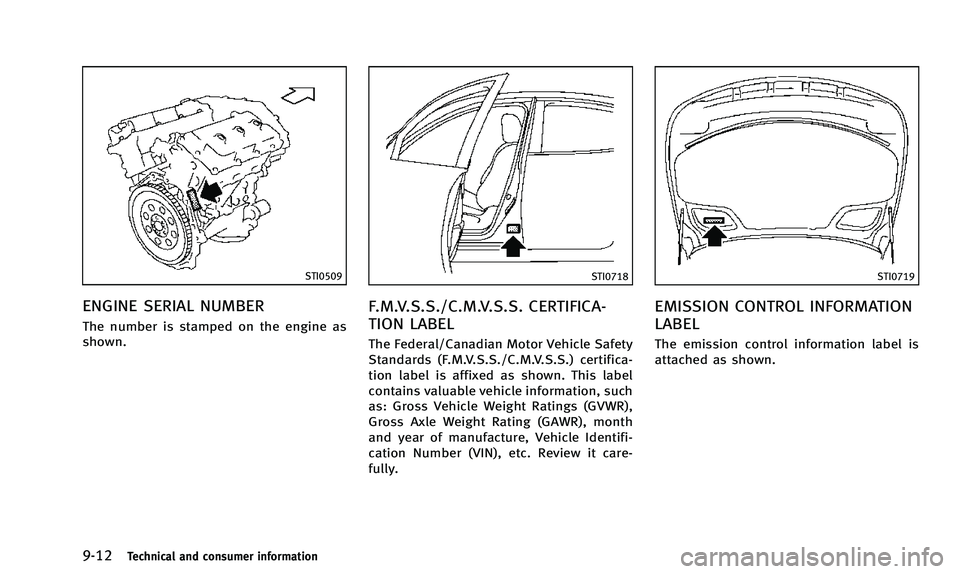
ENGINE SERIAL NUMBER
The number is stamped on the engine as
shown.
STI0718
F.M.V.S.S./C.M.V.S.S. CERTIFICA-
TION LABEL
The Federal/Canadian Motor Vehicle Safety
Standards (F.M.V.S.S./C.M.V.S.S.) certifica-
tion label is affixed as shown. This label
contains valuable vehicle information, such
as: Gross Vehicle Weight Ratings (GVWR),
Gross Axle Weight Rating (GAWR), month
and year of manufacture, Vehicle Identifi-
cation Number (VIN), etc. Review it care-
fully.
STI0719
EMISSION CONTROL INFORMATION
LABEL
The emission control information label is
attached as shown.
Page 375 of 394
9-16Technical and consumer information
WARNING
.It is extremely dangerous to ride
in a cargo area inside the vehicle.
In a collision, people riding in
these areas are more likely to be
seriously injured or killed.
.Do not allow people to ride in any
area of vehicle that is not
equipped with seats and seat
belts.
.Be sure everyone in your vehicle is
in a seat and using a seat belt
properly.
TERMS
It is important to familiarize yourself
with the following terms before
loading your vehicle:
.Curb Weight (actual weight of yourvehicle) - vehicle weight includ-
ing: standard and optional equip-
ment, fluids, emergency tools,
and spare tire assembly. This weight
does not include passen-
gers and cargo.
.GVW (Gross Vehicle Weight) - curb weight plus the combined weight
of passengers and cargo.
.GVWR (Gross Vehicle Weight Rat-ing) - maximum total combined
weight of the unloaded vehicle,
passengers, luggage, hitch, trailer
tongue load and any other op-
tional equipment. This informa-
tion is located on the F.M.V.S.S./
C.M.V.S.S. label.
.GAWR (Gross Axle Weight Rating) -maximum weight (load) limit spe-
cified for the front or rear axle.
This information is located on the
F.M.V.S.S./C.M.V.S.S. label.
.GCWR (Gross Combined WeightRating) - The maximum total
weight rating of the vehicle, pas-
sengers, cargo, and trailer.
.Vehicle Capacity Weight, Loadlimit, Total load capacity - max-
imum total weight limit specified of the load (passengers and car-
go) for the vehicle. This is the
maximum combined weight of
occupants and cargo that can be
loaded into the vehicle. If the
vehicle is used to tow a trailer,
the trailer tongue weight must be
included as part of the cargo load.
This information is located on the
Tire and Loading Information la-
bel.
.Cargo capacity - permissible
weight of cargo, the weight of
total occupants weight subtracted
from the load limit.
VEHICLE LOADING INFORMATION
Page 376 of 394
STI0365
VEHICLE LOAD CAPACITY
Do not exceed the load limit of your
vehicle shown as“The combined
weight of occupants and cargo” on
the Tire and Loading Information
label. Do not exceed the number of
occupants shown as “Seating Capa-
city” on the Tire and Loading In-
formation label.
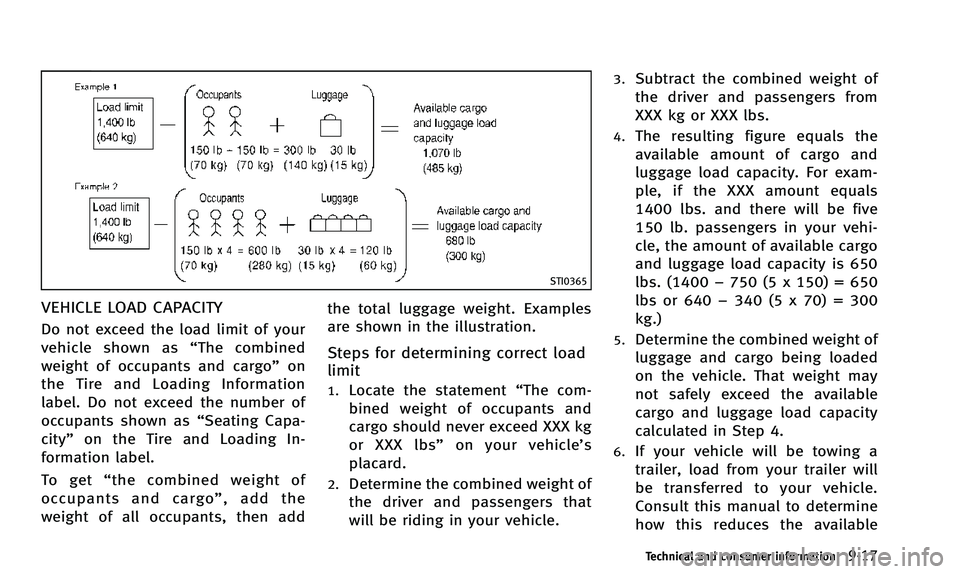
To get “the combined weight of
occupants and cargo” , add the
weight of all occupants, then add the total luggage weight. Examples
are shown in the illustration.
Steps for determining correct load
limit
1.Locate the statement
“The com-
bined weight of occupants and
cargo should never exceed XXX kg
or XXX lbs” on your vehicle’ s
placard.
2.Determine the combined weight of
the driver and passengers that
will be riding in your vehicle.
3.Subtract the combined weight of
the driver and passengers from
XXX kg or XXX lbs.
4.The resulting figure equals the
available amount of cargo and
luggage load capacity. For exam-
ple, if the XXX amount equals
1400 lbs. and there will be five
150 lb. passengers in your vehi-
cle, the amount of available cargo
and luggage load capacity is 650
lbs. (1400 −750 (5 x 150) = 650
lbs or 640 −340 (5 x 70) = 300
kg.)
5.Determine the combined weight of
luggage and cargo being loaded
on the vehicle. That weight may
not safely exceed the available
cargo and luggage load capacity
calculated in Step 4.
6.If your vehicle will be towing a
trailer, load from your trailer will
be transferred to your vehicle.
Consult this manual to determine
how this reduces the available
Technical and consumer information9-17
Page 377 of 394
9-18Technical and consumer information
cargo and luggage load capacity
of your vehicle.
Before driving a loaded vehicle,
confirm that you do not exceed the
Gross Vehicle Weight Rating (GVWR)
or the Gross Axle Weight Rating
(GAWR) for your vehicle. (See “Mea-
surement of weights” (P.9-18).)
Also check tires for proper inflation
pressures. See the Tire and Loading
Information label.
LOADING TIPS
.The GVW must not exceed GVWR or GAWR as specified on the F.M.V.
S.S./C.M.V.S.S. certification label.
.Do not load the front and rear axle
to the GAWR. Doing so will exceed
the GVWR.
WARNING
.Properly secure all cargo to help
prevent it from sliding or shifting.
Do not place cargo higher than the seatbacks. In a sudden stop or
collision, unsecured cargo could
cause personal injury.
.Do not load your vehicle any
heavier than the GVWR or the
maximum front and rear GAWRs.
If you do, parts of your vehicle can
break, tire damage could occur, or
it can change the way your vehicle
handles. This could result in loss
of control and cause personal
injury.
.Overloading could not only short-
en the life of your vehicle and the
tires, but also could lead to
hazardous vehicle handling and
long braking distance. This may
cause a premature tire malfunc-
tion, which could result in a
serious accident and personal in-
jury. Failures caused by overload-
ing are not covered by the
vehicle’s warranty.
MEASUREMENT OF WEIGHTS
Secure loose items to prevent weight
shifts that could affect the balance of
your vehicle. When the vehicle is
loaded, drive to a scale and weigh
the front and the rear wheels sepa-
rately to determine axle loads. In-
dividual axle loads should not
exceed either of the gross axle
weight ratings (GAWR). The total of
the axle loads should not exceed the
gross vehicle weight rating (GVWR).
These ratings are given on the
vehicle certification label. If weight
ratings are exceeded, move or re-
move items to bring all weights
below the ratings.