engine oil INFINITI Q50 2018 User Guide
[x] Cancel search | Manufacturer: INFINITI, Model Year: 2018, Model line: Q50, Model: INFINITI Q50 2018Pages: 458, PDF Size: 2.13 MB
Page 356 of 458

8 Do-it-yourself
Maintenance precautions ................................................ 8-3
Engine compartment check locations .......................... 8-4VR30DDTT engine....................................................... 8-4
2.0L turbo gasoline engine........................................ 8-5
Engine cooling system (for VR30DDTT
engine models).................................................................... 8-6
Checking engine coolant level ................................. 8-7
Changing engine coolant............................................ 8-7
Engine cooling system (for 2.0L turbo gasoline
engine models).................................................................... 8-8
Checking engine coolant level................................... 8-8
Changing engine coolant............................................ 8-9
Intercooler cooling system (for VR30DDTT
engine models).................................................................... 8-9 Checking intercooler coolant level........................ 8-10
Changing intercooler coolant................................. 8-10
Engine oil.....................................................................\
...... 8-10 Checking engine oil level .......................................... 8-11
Changing engine oil and filter................................. 8-11
Automatic Transmission Fluid (ATF).......................... 8-13
Power steering fluid (models with hydraulic pump
electric power steering).................................................. 8-14
Brake fluid...................................................................\
....... 8-14
Window washer fluid...................................................... 8-15 Battery........................................................................\
........ 8-16
Main battery location.............................................. 8-16
Auxiliary battery location (for 2.0L turbo
gasoline engine models).......................................... 8-17
Checking battery fluid level................................... 8-17
Jump starting............................................................. 8-18
Variable voltage control system ................................. 8-19
Drive belts ........................................................................\
. 8-19
Spark plugs....................................................................... 8-20 Replacing spark plugs............................................. 8-20
Air cleaner........................................................................\
.. 8-21
Windshield wiper blades ............................................... 8-21 Cleaning....................................................................... 8-21
Replacing..................................................................... 8-22
Brakes..................................................................\
............... 8-22 Self-adjusting brakes............................................... 8-22
Brake pad wear warning........................................ 8-22
Fuses...................................................................\
................ 8-23 Engine compartment.............................................. 8-24
Passenger compartment ........................................ 8-25
Intelligent Key battery replacement........................... 8-26
Lights........................................................................\
......... 8-28 Headlights................................................................... 8-29
Exterior and interior lights..................................... 8-29
Page 358 of 458
When performing any inspection or main-
tenance work on your vehicle, always take
care to prevent serious accidental injury to
yourself or damage to the vehicle. The
following are general precautions which
should be closely observed.
WARNING
.Park the vehicle on a level surface,
apply the parking brake securely and
block the wheels to prevent the
vehicle from moving. Move the shift
lever to P (Park).
. Be sure the ignition switch is in the
OFF or LOCK position when per-
forming any parts replacement or
repairs.
. Never connect or disconnect the
battery or any transistorized compo-
nent while the ignition switch is in the
ON position.
. Never leave the engine or automatic
transmission related component har-
nesses disconnected while the igni-
tion switch is in the ON position.
. If you must work with the engine
running, keep your hands, clothing,
hair and tools away from moving
fans, belts and any other moving parts.
. It is advisable to secure or remove
any loose clothing and remove any
jewelry, such as rings, watches, etc.
before working on your vehicle.
. Always wear eye protection when-
ever you work on your vehicle.
. If you must run the engine in an
enclosed space such as a garage, be
sure there is proper ventilation for
exhaust gases to escape.
. Never get under the vehicle while it is
supported only by a jack. If it is
necessary to work under the vehicle,
support it with safety stands.
. Keep smoking materials, flame and
sparks away from fuel tank and the
battery.
. Your vehicle is equipped with an
automatic engine cooling fan. It may
come on at any time without warn-
ing, even if the ignition key is in the
OFF position and the engine is not
running. To avoid injury, always dis-
connect the negative battery cable
before working near the fan.
. Because the fuel lines are under high
pressure even when the engine is off,
it is recommended you visit an
INFINITI retailer for service of the fuel filter or fuel lines.
CAUTION
.
Do not work under the hood while the
engine is hot. Turn the engine off and
wait until it cools down.
. Avoid direct contact with used en-
gine oil and coolant. Improperly dis-
posed engine oil, coolant, and/or
other vehicle fluids can damage the
environment. Always conform to lo-
cal regulations for disposal of vehicle
fluid.
This “8. Do-it-yourself” section gives in-
structions regarding only those items which
are relatively easy for an owner to perform.
A genuine INFINITI Service Manual is also
available. (See “Owner’s Manual/Service
Manual order information” (P.10-26).)
You should be aware that incomplete or
improper servicing may result in operating
difficulties or excessive emissions, and could
affect your warranty coverage. If in doubt
about any servicing, it is recommended you
have it done by an INFINITI retailer.
Do-it-yourself8-3
MAINTENANCE PRECAUTIONS
Page 359 of 458

8-4Do-it-yourself
JVC0968X
VR30DDTT ENGINE
1. Battery
2. Engine oil dipstick
3. Engine oil filler cap
4. Brake fluid reservoir
5. Fuse/fusible link holder6. Air cleaner
7. Engine drive belt location
8. Radiator filler cap
9 Intercooler cooling reservoir
10. Engine coolant reservoir
11. Window washer fluid reservoir
ENGINE COMPARTMENT CHECK
LOCATIONS
Page 360 of 458

JVC0646X
2.0L TURBO GASOLINE ENGINE
1. Fuse and fusible link holder
2. Main battery*
3. Engine oil filler cap
4. Brake fluid reservoir
5. Engine coolant reservoir6. Fuse and fusible link holder
7. Engine oil dipstick
8. Engine drive belt location
9. Power steering fluid reservoir (if so
equipped)
10. Window washer fluid reservoir *: The auxiliary battery is located in the
trunk. (See “Auxiliary battery location
(for 2.0L turbo gasoline engine mod-
els)” (P.8-17).)
Do-it-yourself8-5
Page 365 of 458
8-10Do-it-yourself
JVM0653X
CHECKING INTERCOOLER
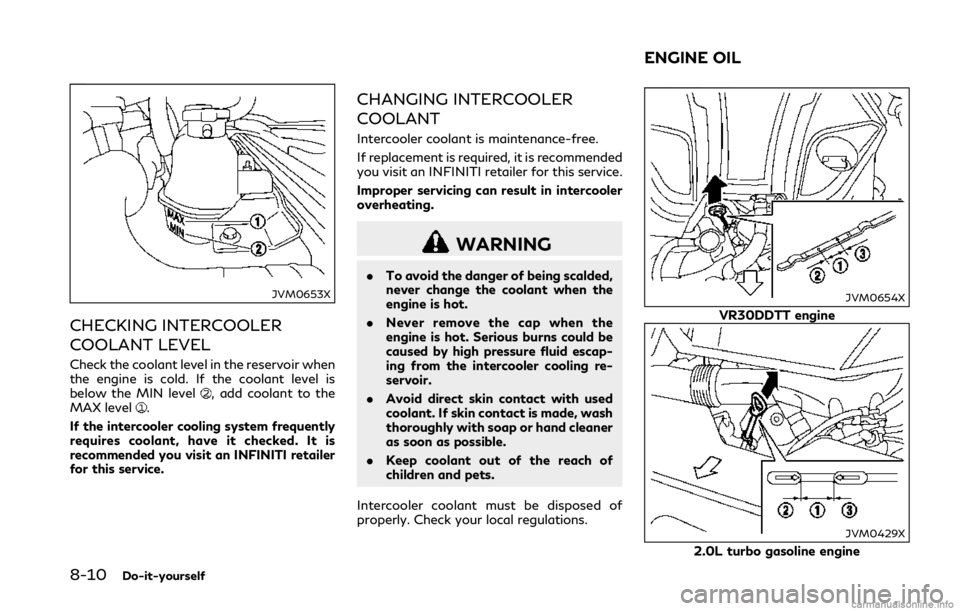
COOLANT LEVEL
Check the coolant level in the reservoir when
the engine is cold. If the coolant level is
below the MIN level
, add coolant to the
MAX level.
If the intercooler cooling system frequently
requires coolant, have it checked. It is
recommended you visit an INFINITI retailer
for this service.
CHANGING INTERCOOLER
COOLANT
Intercooler coolant is maintenance-free.
If replacement is required, it is recommended
you visit an INFINITI retailer for this service.
Improper servicing can result in intercooler
overheating.
WARNING
. To avoid the danger of being scalded,
never change the coolant when the
engine is hot.
. Never remove the cap when the
engine is hot. Serious burns could be
caused by high pressure fluid escap-
ing from the intercooler cooling re-
servoir.
. Avoid direct skin contact with used
coolant. If skin contact is made, wash
thoroughly with soap or hand cleaner
as soon as possible.
. Keep coolant out of the reach of
children and pets.
Intercooler coolant must be disposed of
properly. Check your local regulations.
JVM0654X
VR30DDTT engine
JVM0429X
2.0L turbo gasoline engine
ENGINE OIL
Page 366 of 458
CHECKING ENGINE OIL LEVEL
1. Park the vehicle on a level surface andapply the parking brake.
2. Run the engine until it reaches operating temperature.
3. Turn off the engine. Wait more than 15
minutes for the oil to drain back into the
oil pan.
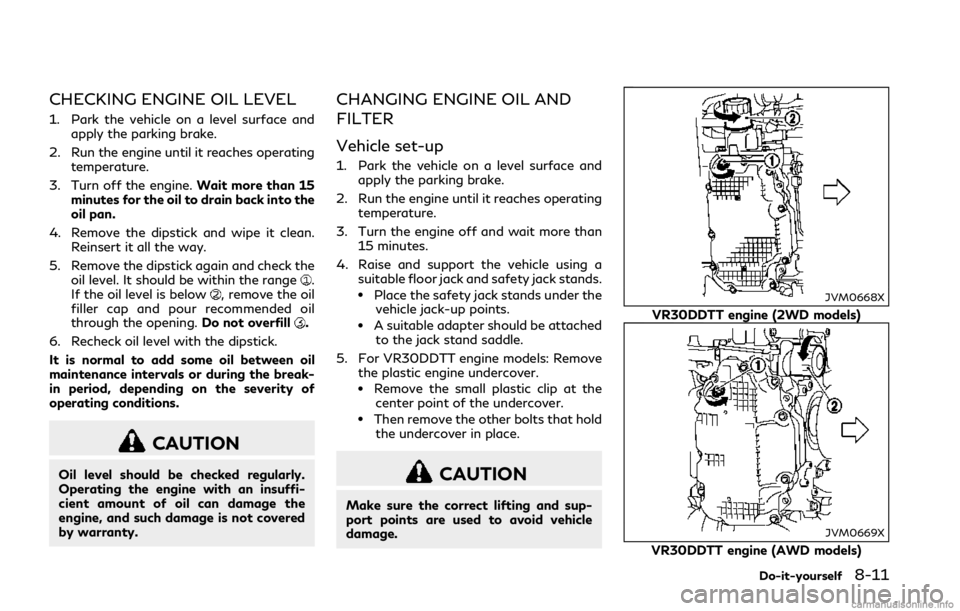
4. Remove the dipstick and wipe it clean. Reinsert it all the way.
5. Remove the dipstick again and check the oil level. It should be within the range
.
If the oil level is below, remove the oil
filler cap and pour recommended oil
through the opening. Do not overfill
.
6. Recheck oil level with the dipstick.
It is normal to add some oil between oil
maintenance intervals or during the break-
in period, depending on the severity of
operating conditions.
CAUTION
Oil level should be checked regularly.
Operating the engine with an insuffi-
cient amount of oil can damage the
engine, and such damage is not covered
by warranty.
CHANGING ENGINE OIL AND
FILTER
Vehicle set-up
1. Park the vehicle on a level surface and apply the parking brake.
2. Run the engine until it reaches operating temperature.
3. Turn the engine off and wait more than 15 minutes.
4. Raise and support the vehicle using a suitable floor jack and safety jack stands.
.Place the safety jack stands under thevehicle jack-up points.
.A suitable adapter should be attachedto the jack stand saddle.
5. For VR30DDTT engine models: Remove the plastic engine undercover.
.Remove the small plastic clip at thecenter point of the undercover.
.Then remove the other bolts that hold
the undercover in place.
CAUTION
Make sure the correct lifting and sup-
port points are used to avoid vehicle
damage.
JVM0668X
VR30DDTT engine (2WD models)
JVM0669X
VR30DDTT engine (AWD models)
Do-it-yourself8-11
Page 367 of 458
8-12Do-it-yourself
JVM0667X
2.0L turbo gasoline engine
JVM0428X
2.0L turbo gasoline engine
Engine oil and filter
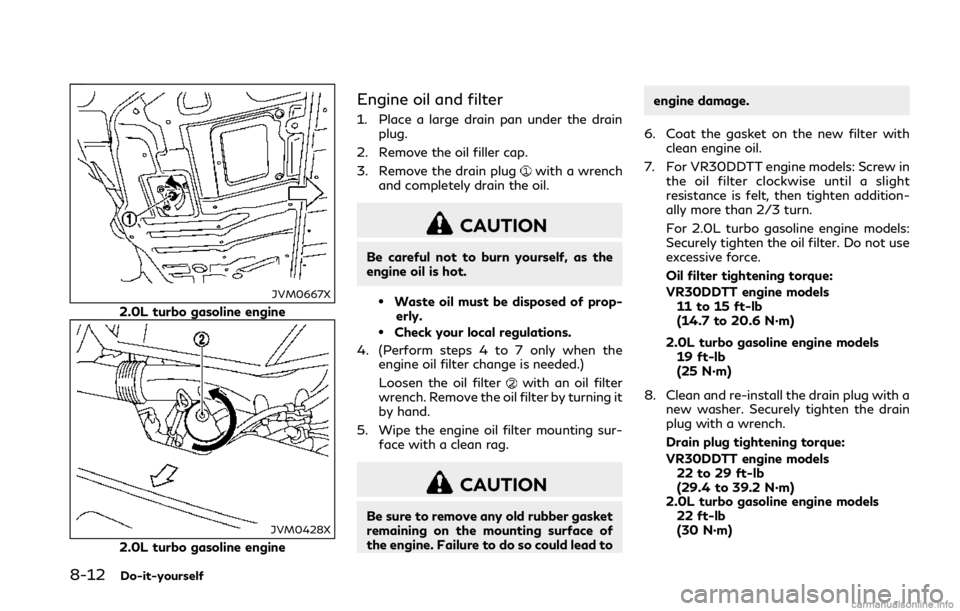
1. Place a large drain pan under the drainplug.
2. Remove the oil filler cap.
3. Remove the drain plug
with a wrench
and completely drain the oil.
CAUTION
Be careful not to burn yourself, as the
engine oil is hot.
.Waste oil must be disposed of prop-
erly.
.Check your local regulations.
4. (Perform steps 4 to 7 only when the engine oil filter change is needed.)
Loosen the oil filter
with an oil filter
wrench. Remove the oil filter by turning it
by hand.
5. Wipe the engine oil filter mounting sur- face with a clean rag.
CAUTION
Be sure to remove any old rubber gasket
remaining on the mounting surface of
the engine. Failure to do so could lead to engine damage.
6. Coat the gasket on the new filter with clean engine oil.
7. For VR30DDTT engine models: Screw in the oil filter clockwise until a slight
resistance is felt, then tighten addition-
ally more than 2/3 turn.
For 2.0L turbo gasoline engine models:
Securely tighten the oil filter. Do not use
excessive force.
Oil filter tightening torque:
VR30DDTT engine models
11 to 15 ft-lb
(14.7 to 20.6 N·m)
2.0L turbo gasoline engine models 19 ft-lb
(25 N·m)
8. Clean and re-install the drain plug with a new washer. Securely tighten the drain
plug with a wrench.
Drain plug tightening torque:
VR30DDTT engine models22 to 29 ft-lb
(29.4 to 39.2 N·m)
2.0L turbo gasoline engine models 22 ft-lb
(30 N·m)
Page 368 of 458
Do not use excessive force.
9. Refill engine with recommended oil and install the oil filler cap securely.
See “Capacities and recommended
fluids/lubricants” (P.10-2) for drain and
refill capacity. The drain and refill capa-
city depends on the oil temperature and
drain time. Use these specifications for
reference only. Always use the dipstick
to determine the proper amount of oil in
the engine.
10. Start the engine and check for leakage around the drain plug and the oil filter.
Correct as required.
11. Turn the engine off and wait more than 15 minutes. Check the oil level with the
dipstick. Add engine oil if necessary.
After the operation
1. Install the engine undercover into posi-tion as the following steps.
a. Pull the center of the small plastic clip
out.
b. Hold the engine undercover into posi- tion.
c. Insert the clip through the undercover into the hole in the frame, then push
the center of the clip in to lock the clip
in place. d. Install the other bolts that hold the
undercover in place. Be careful not to
strip the bolts or over-tighten them.
2. Lower the vehicle carefully to the ground.
3. Dispose of waste oil and filter properly.
WARNING
. Prolonged and repeated contact with
used engine oil may cause skin cancer.
. Try to avoid direct skin contact with
used oil. If skin contact is made, wash
thoroughly with soap or hand cleaner
as soon as possible.
. Keep used engine oil out of reach of
children. When checking or replacement is required,
we recommend an INFINITI retailer for
servicing.
CAUTION
.
It is recommended that you use only
Genuine NISSAN Matic S ATF. Do
not mix with other fluids.
. Using automatic transmission fluid
other than Genuine NISSAN Matic S
ATF may cause deterioration in dri-
veability and automatic transmission
durability, and may damage the
automatic transmission. Damage
caused by the use of fluid other than
as recommended is not covered by
the INFINITI new vehicle limited
warranty.
Do-it-yourself8-13
AUTOMATIC TRANSMISSION
FLUID (ATF)
Page 402 of 458

9 Maintenance and schedules
Maintenance requirement................................................ 9-2General maintenance................................................... 9-2
Scheduled maintenance.............................................. 9-2
Where to go for service.............................................. 9-2
General maintenance ........................................................ 9-2 Explanation of general maintenance items........... 9-2
Explanation of scheduled maintenance items ........... 9-5 Emission control system maintenance ................... 9-5
Chassis and body maintenance................................ 9-6
Maintenance schedules.................................................... 9-6
Additional maintenance items for severe
operating conditions.................................................... 9-6 Oil control system (for VR30DDTT
engine models).............................................................. 9-7
Standard maintenance...................................................... 9-7
Emission control system maintenance
(for VR30DDTT engine)........................................... 9-8
Emission control system maintenance
(for 2.0L turbo gasoline engine) .......................... 9-11
Chassis and body maintenance............................ 9-13
Maintenance under severe driving conditions ........ 9-16
Maintenance log.............................................................. 9-17
Page 405 of 458

9-4Maintenance and schedules
Warning lights and chimes:Make sure that
all warning lights and chimes are operating
properly.
Windshield defroster: Check that the air
comes out of the defroster outlets properly
and in sufficient quantity when operating
the heater or air conditioner.
Windshield wiper and washer*: Check that
the wipers and washer operate properly and
that the wipers do not streak.
Under the hood and vehicle
The maintenance items listed here should be
checked periodically (for example, each time
you check the engine oil or refuel).
Battery*: Check the fluid level in each cell. It
should be between the MAX and MIN lines.
Vehicles operated in high temperatures or
under severe condition require frequent
checks of the battery fluid level.
NOTE:
Care should be taken to avoid situations
that can lead to potential battery discharge
and potential no-start conditions such as:
1. Installation or extended use of electro-
nic accessories that consume battery
power when the engine is not running
(Phone chargers, GPS, DVD players,
etc.) 2.
Vehicle is not driven regularly and/or
only driven short distances.
In these cases, the battery may need to be
charged to maintain battery health.
Brake fluid level*: Make sure that the brake
fluid level is between the MAX and MIN lines
on the reservoir.
Engine coolant level*: Check the coolant
level when the engine is cold.
Intercooler coolant level*: Check the coolant
level when the engine is cold.
Engine drive belts*: Make sure that no belt is
frayed, worn, cracked or oily.
Engine oil level*: Check the level after
parking the vehicle on a level spot and
turning off the engine. Wait more than 15
minutes for the oil to drain back into the oil
pan.
Exhaust system: Make sure there are no
loose supports, cracks or holes. If the sound
of the exhaust seems unusual or there is a
smell of exhaust fumes, immediately have
the exhaust system inspected. It is recom-
mended you visit an INFINITI retailer for this
service. (See “Precautions when starting and
driving” (P.5-4).)
Fluid leaks: Check under the vehicle for fuel,
oil, water or other fluid leaks after the
vehicle has been parked for a while. Water
dripping from the air conditioner after use is normal. If you should notice any leaks or if
gasoline fumes are evident, check for the
cause and have it corrected immediately.
Power steering fluid level* and lines:
Check
the level when the fluid is cold, with the
engine off. Check the lines for proper
attachment, leaks, cracks, etc.
Radiator and hoses: Check the front of the
radiator and clean off any dirt, insects,
leaves, etc., that may have accumulated.
Make sure the hoses have no cracks, defor-
mation, rot or loose connections.
Underbody: The underbody is frequently
exposed to corrosive substances such as
those used on icy roads or to control dust. It
is very important to remove these sub-
stances, otherwise rust will form on the
floor pan, frame, fuel lines and around the
exhaust system. At the end of winter, the
underbody should be thoroughly flushed
with plain water, being careful to clean
those areas where mud and dirt may accu-
mulate. For additional information, see
“Cleaning exterior” (P.7-2).
Windshield washer fluid*: Check that there
is adequate fluid in the reservoir.