power steering INFINITI Q50 2019 Owner's Guide
[x] Cancel search | Manufacturer: INFINITI, Model Year: 2019, Model line: Q50, Model: INFINITI Q50 2019Pages: 468, PDF Size: 2.16 MB
Page 323 of 468

NOTE:
It may take some time until the Idling Stop
System activates under the following con-
ditions:
.when the battery is discharged.
. when the outside temperature is low or
high.
. when the battery is replaced or the
battery terminal is disconnected for
extended periods and then reconnected.
NOTE:
When the Idling Stop System indicator light
illuminates, the engine starts running auto-
matically under at least one of the following
conditions:
. The brake pedal is released with the shift
lever in the D (Drive) or N (Neutral)
position.
. The shift lever is placed in the D (Drive)
or R (Reverse) position from the N
(Neutral) or P (Park) position.
. The driver’s seat belt is unfastened, or
the driver’s door is open.
. The battery voltage becomes low (due to
electrical load from other vehicle sys-
tems like headlights, heaters, etc., or
auxiliary devices connected to the 12
volt socket inside the vehicle).
. The vehicle speed is above about 1 MPH
(2 km/h). .
The front defroster is operated.
. The rear window defroster is operated.
. When the temperature inside the vehicle
is lower than approximately 68°F
(20°C).
. When the temperature inside the vehicle
is higher than approximately 86°F
(30°C). (When the air conditioner is
off, the Idling Stop System will operate.)
. When the front defroster is turned on.
(The engine may not starts depending
on the outside temperature.)
. When more than 3 minutes have elapsed
since the Idling Stop System was active.
. When the accelerator pedal is depressed.
. When the steering wheel is operated.
(The steering wheel operation may be-
come heavy, but this is not a malfunc-
tion.)
. When the battery capacity is low.
. When the power consumption is high.
. When the shift lever is placed in the R
(Reverse) position.
NOTE:
The following condition will prevent the
Idling Stop System from automatically re-
starting the engine. Starting the engine
with the ignition switch operation is then
necessary: .
The hood is open.
Use this system while waiting at stoplight,
etc. When the vehicle is stopped for long
periods of time, turn off the engine.
When the engine is stopped by the Idling
Stop System, heating, cooling and dehumi-
difying functions will be deactivated. To
avoid the air conditioning functions from
being deactivated, turn off the Idling Stop
mode by pushing the Idling Stop OFF switch.
RETROGRADE MOVEMENT
CONTROL FUNCTION
This system is designed to reduce the retro-
grade movement that occurs while the
driver’s foot changes from depressing the
brake pedal to the accelerator pedal when
moving the vehicle while the Idling Stop
System is active on a hilly road.
IDLING STOP SYSTEM DISPLAY
The status of the Idling Stop System can be
checked in the vehicle information display.
Starting and driving5-139
Page 347 of 468
fan can start at any time.
7. After the engine cools down, check the coolant level in the reservoir tank with
the engine running. Add coolant to the
reservoir tank if necessary. Have your
vehicle repaired. It is recommended you
visit an INFINITI retailer for this service. When towing your vehicle, all State (Pro-
vincial in Canada) and local regulations for
towing must be followed. Incorrect towing
equipment could damage your vehicle. Tow-
ing instructions are available from an
INFINITI retailer. Local service operators
are familiar with the applicable laws and
procedures for towing. To assure proper
towing and to prevent accidental damage to
your vehicle, INFINITI recommends that you
have a service operator tow your vehicle. It is
advisable to have the service operator care-
fully read the following precautions.
WARNING
.
Never ride in a vehicle that is being
towed.
. Never get under your vehicle after it
has been lifted by a tow truck.
CAUTION
.When towing, make sure that the
transmission, axles, steering system
and powertrain are in working con-
dition. If any unit is damaged, dollies
must be used. .
Always attach safety chains before
towing.
For information about towing your vehicle
behind a recreational vehicle (RV), see “Flat
towing” (P.10-22) of this manual.
In case of emergency6-17
TOWING YOUR VEHICLE
Page 359 of 468

8 Do-it-yourself
Maintenance precautions ............................................... 8-3
Engine compartment check locations ......................... 8-4VR30DDTT engine ..................................................... 8-4
2.0L turbo gasoline engine ...................................... 8-5
Engine cooling system (for VR30DDTT
engine models) ................................................................... 8-6
Checking engine coolant level ................................ 8-7
Changing engine coolant .......................................... 8-7
Engine cooling system (for 2.0L turbo gasoline
engine models) ................................................................... 8-8
Checking engine coolant level ................................. 8-8
Changing engine coolant .......................................... 8-9
Intercooler cooling system (for VR30DDTT
engine models) ................................................................... 8-9 Checking intercooler coolant level ...................... 8-10
Changing intercooler coolant ............................... 8-10
Engine oil ........................................................................\
.. 8-10 Checking engine oil level ......................................... 8-11
Changing engine oil and filter ................................ 8-11
Automatic Transmission Fluid (ATF) ........................ 8-14
Power steering fluid (models with hydraulic pump
electric power steering) ................................................ 8-14
Brake fluid ........................................................................\
. 8-15
Window washer fluid .................................................... 8-15 Battery ........................................................................\
...... 8-16
Main battery location ............................................ 8-17
Auxiliary battery location (for 2.0L turbo
gasoline engine models) ........................................ 8-17
Checking battery fluid level .................................. 8-18
Jump starting ........................................................... 8-19
Variable voltage control system ................................ 8-19
Drive belts ........................................................................\
8-19
Spark plugs ..................................................................... 8-20 Replacing spark plugs ............................................ 8-21
Air cleaner ........................................................................\
8-21
Windshield wiper blades .............................................. 8-22 Cleaning ..................................................................... 8-22
Replacing ................................................................... 8-22
Brakes ........................................................................\
........ 8-23 Self-adjusting brakes ............................................. 8-23
Brake pad wear warning ....................................... 8-23
Fuses ........................................................................\
.......... 8-23 Engine compartment ............................................. 8-24
Passenger compartment ....................................... 8-25
Intelligent Key battery replacement ......................... 8-26
Lights ........................................................................\
......... 8-29 Headlights ................................................................. 8-29
Exterior and interior lights ................................... 8-30
Page 363 of 468

JVC0646X
2.0L TURBO GASOLINE ENGINE
1. Fuse and fusible link holder
2. Main battery*
3. Engine oil filler cap
4. Brake fluid reservoir
5. Engine coolant reservoir6. Fuse and fusible link holder
7. Engine oil dipstick
8. Engine drive belt location
9. Power steering fluid reservoir (if so
equipped)
10. Window washer fluid reservoir *: The auxiliary battery is located in the
trunk. (See “Auxiliary battery location
(for 2.0L turbo gasoline engine mod-
els)” (P.8-17).)
Do-it-yourself8-5
Page 372 of 468
8-14Do-it-yourself
When checking or replacement is required,
we recommend an INFINITI retailer for
servicing.
CAUTION
.It is recommended that you use only
Genuine NISSAN Matic S ATF. Do
not mix with other fluids.
. Using automatic transmission fluid
other than Genuine NISSAN Matic S
ATF may cause deterioration in dri-
veability and automatic transmission
durability, and may damage the
automatic transmission. Damage
caused by the use of fluid other than
as recommended is not covered by
the INFINITI new vehicle limited
warranty.
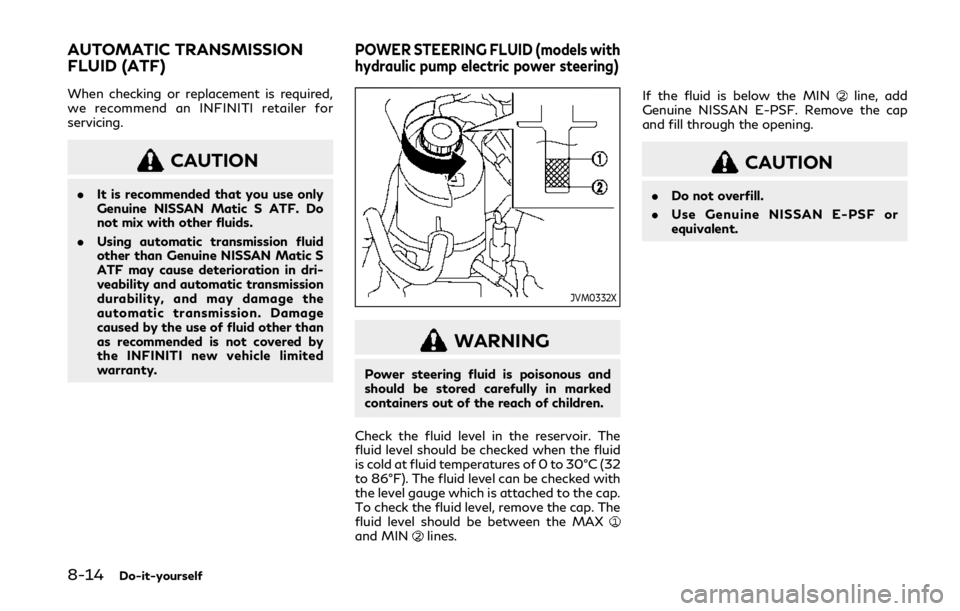
JVM0332X
WARNING
Power steering fluid is poisonous and
should be stored carefully in marked
containers out of the reach of children.
Check the fluid level in the reservoir. The
fluid level should be checked when the fluid
is cold at fluid temperatures of 0 to 30°C (32
to 86°F). The fluid level can be checked with
the level gauge which is attached to the cap.
To check the fluid level, remove the cap. The
fluid level should be between the MAX
and MINlines. If the fluid is below the MIN
line, add
Genuine NISSAN E-PSF. Remove the cap
and fill through the opening.
CAUTION
. Do not overfill.
. Use Genuine NISSAN E-PSF or
equivalent.
AUTOMATIC TRANSMISSION
FLUID (ATF)POWER STEERING FLUID (models with
hydraulic pump electric power steering)
Page 408 of 468

9-4Maintenance and schedules
Warning lights and chimes:Make sure that
all warning lights and chimes are operating
properly.
Windshield defroster: Check that the air
comes out of the defroster outlets properly
and in sufficient quantity when operating
the heater or air conditioner.
Windshield wiper and washer*: Check that
the wipers and washer operate properly and
that the wipers do not streak.
Under the hood and vehicle
The maintenance items listed here should be
checked periodically (for example, each time
you check the engine oil or refuel).
Battery*: Check the fluid level in each cell. It
should be between the MAX and MIN lines.
Vehicles operated in high temperatures or
under severe condition require frequent
checks of the battery fluid level.
NOTE:
Care should be taken to avoid situations
that can lead to potential battery discharge
and potential no-start conditions such as:
1. Installation or extended use of electro-
nic accessories that consume battery
power when the engine is not running
(Phone chargers, GPS, DVD players,
etc.) 2.
Vehicle is not driven regularly and/or
only driven short distances.
In these cases, the battery may need to be
charged to maintain battery health.
Brake fluid level*: Make sure that the brake
fluid level is between the MAX and MIN lines
on the reservoir.
Engine coolant level*: Check the coolant
level when the engine is cold.
Intercooler coolant level*: Check the coolant
level when the engine is cold.
Engine drive belts*: Make sure that no belt is
frayed, worn, cracked or oily.
Engine oil level*: Check the level after
parking the vehicle on a level spot and
turning off the engine. Wait more than 15
minutes for the oil to drain back into the oil
pan.
Exhaust system: Make sure there are no
loose supports, cracks or holes. If the sound
of the exhaust seems unusual or there is a
smell of exhaust fumes, immediately have
the exhaust system inspected. It is recom-
mended you visit an INFINITI retailer for this
service. (See “Precautions when starting and
driving” (P.5-4).)
Fluid leaks: Check under the vehicle for fuel,
oil, water or other fluid leaks after the
vehicle has been parked for a while. Water
dripping from the air conditioner after use is normal. If you should notice any leaks or if
gasoline fumes are evident, check for the
cause and have it corrected immediately.
Power steering fluid level* and lines:
Check
the level when the fluid is cold, with the
engine off. Check the lines for proper
attachment, leaks, cracks, etc.
Radiator and hoses: Check the front of the
radiator and clean off any dirt, insects,
leaves, etc., that may have accumulated.
Make sure the hoses have no cracks, defor-
mation, rot or loose connections.
Underbody: The underbody is frequently
exposed to corrosive substances such as
those used on icy roads or to control dust. It
is very important to remove these sub-
stances, otherwise rust will form on the
floor pan, frame, fuel lines and around the
exhaust system. At the end of winter, the
underbody should be thoroughly flushed
with plain water, being careful to clean
those areas where mud and dirt may accu-
mulate. For additional information, see
“Cleaning exterior” (P.7-2).
Windshield washer fluid*: Check that there
is adequate fluid in the reservoir.
Page 427 of 468

Fluid typeCapacity (approximate)
Recommended Fluids/Lubricants
Metric
Measure US
Measure Imperial
Measure
Automatic Transmission Fluid (ATF)
———Â
Genuine NISSAN Matic S ATF
 INFINITI recommends using Genuine NISSAN Matic S ATF ONLY
in INFINITI automatic transmissions. Do not mix with other fluids.
Using fluids that are not equivalent to Genuine NISSAN Matic S
ATF may damage the automatic transmission. Damage caused by
the use of fluids other than as recommended is not covered under
the INFINITI’s new vehicle limited warranty.
Differential gear oil Front ———Â
Genuine NISSAN Differential Oil Hypoid Super GL-5 80W-90 or
equivalent conventional (non-synthetic) oil.
Rear ———ÂGenuine NISSAN HYPOID FLUID·S1 GL-5 75W-80 or equivalent
Transfer fluid
———Â
Genuine NISSAN Matic J ATF
 INFINITI recommends using Genuine NISSAN Matic J ATF ONLY in
INFINITI transfers. Do not mix with other fluids. Using fluids that
are not equivalent to Genuine NISSAN Matic J ATF may damage
the transfer. Damage caused by the use of fluids other than as
recommended is not covered under the INFINITI’s new vehicle
limited warranty.
Brake fluid
Refill to the proper oil level according to the
instructions in the “8. Do-it-yourself” section. Â
Genuine NISSAN Super Heavy Duty Brake Fluid
*2or equivalent
DOT 3*2: Available in mainland U.S.A. through an INFINITI retailer.
Power steering fluid ÂGenuine NISSAN E-PSF or equivalent
 Use of a power steering fluid other than Genuine NISSAN E-PSF
may prevent the power steering system from operating properly.
Multi-purpose grease — — — ÂNLGI No. 2 (Lithium soap base)
Air conditioning system refrigerant ———Â
HFC-134a (R-134a)
For additional information, see “Vehicle identification” (P.10-14)
for air conditioner specification label.
Air conditioning system lubricants — — — ÂNISSAN A/C System Oil PAG or exact equivalent
Window washer fluid ———Â
Genuine NISSAN Windshield Washer Concentrate Cleaner &
Antifreeze or equivalent
Technical and consumer information10-3
Page 455 of 468

Floor mat installation ............................................ 7-6
FluidAutomatic Transmission Fluid (ATF) ....... 8-14
Brake fluid ....................................................... 8-15
Capacities and
recommended fluids/lubricants ................. 10-2
Engine coolant .................................................. 8-6
Engine oil ........................................................ 8-10
Power steering fluid ..................................... 8-14
Window washer fluid ................................... 8-15
Fog light switch ................................................... 2-42
Forward Emergency Braking (FEB) ............ 5-106
Forward Emergency Braking (FEB) system
warning light .......................................................... 2-11
Front passenger air bag and status light ..... 1-50
Front power seat adjustment ............................. 1-3
Front seat Front seat adjustment .................................... 1-3
Fuel
Capacities and
recommended fluids/lubricants ................. 10-2
Fuel economy .............................................. 5-124
Fuel information ............................... 10-4, 10-6
Fuel octane rating ............................ 10-4, 10-6
Fuel-filler cap .................................................. 3-26
Fuel-filler door ............................................... 3-26
Gauge .................................................................. 2-9
Fuel Efficient Driving Tips .............................. 5-123
Fuses ....................................................................... 8-23
Fusible links ........................................................... 8-25G
Garage door opener
HomeLink®Universal Transceiver ............ 2-58
Gas cap ................................................................... 3-26
Gauge ........................................................................\
. 2-6
Engine coolant temperature gauge ............ 2-8
Fuel gauge ......................................................... 2-9
Odometer ............................................................ 2-7
Speedometer ...................................................... 2-7
Tachometer ....................................................... 2-8
Trip computer ................................................. 2-27
General maintenance ............................................. 9-2
Glove box ............................................................... 2-48
H
Hazard warning flasher switch ........................... 6-2
Head restraints/headrests .................................. 1-8
Headlights Aiming control (See Adaptive Front
lighting System (AFS)) ................................ 2-40
Headlight switch ............................................ 2-36
Heated seats ......................................................... 2-43
Heated steering wheel ....................................... 2-45
Heater Engine block heater ................................... 5-143
High beam assist ................................................. 2-37
Hill start assist system ..................................... 5-137
HomeLink
®Universal Transceiver .................. 2-58
Hood release ......................................................... 3-23 Hook
Coat hooks ..................................................... 2-50
Trunk hooks ................................................... 2-50
Horn ........................................................................\
. 2-42
Hydraulic pump electric power steering ..... 5-128
I
Idling Stop System ............................................ 5-138
Idling Stop System indicator light .................. 2-16
Idling Stop System reminder buzzer .............. 2-18
Ignition switch
(Push-button) ................................................. 5-11
Automatic transmission models ................ 5-16
Immobilizer system .............................................. 2-31
Indicator
Lights ................................................................ 2-16
Vehicle information display ........................ 2-19
Indicator lights ...................................................... 2-16
Indicators for operation (vehicle
information display) ............................................ 2-21
INFINITI Drive Mode Selector ......................... 5-22
INFINITI InTouch Owner’s Manual .................. 4-2
INFINITI Vehicle Immobilizer System ............ 2-31 Engine start ..................................................... 2-31
Inside mirror .......................................................... 3-30
Inspection/maintenance (I/M) test ............. 10-25
Instrument brightness control ......................... 2-41
Instrument panel ..................................................... 2-5
Intelligent All-Wheel Drive (AWD) ............... 5-125
Intelligent Cruise Control (ICC) ....................... 5-74
11-3
Page 457 of 468

Under the hood and vehicle ......................... 9-4
Maintenance schedules ........................................ 9-6
Malfunction indicator light (MIL) ..................... 2-17
Map lights .............................................................. 2-55
Master warning light .......................................... 2-14
Mechanical key (Intelligent Key system) .......... 3-3
Memory storage Automatic drive positioner ......................... 3-34
Meter Trip computer ................................................. 2-27
Meters and gauges ................................................ 2-6 Instrument brightness control ................... 2-41
Mirror
Inside mirror ................................................... 3-30
Outside mirrors .............................................. 3-31
Vanity mirror ................................................... 3-33
Moonroof ............................................................... 2-53
N
NAVI Shift Control .............................................. 5-20
New vehicle break-in ........................................ 5-123
O
Odometer .................................................................. 2-7
Off-road recovery .................................................. 5-9
Oil Capacities and
recommended fluids/lubricants ................. 10-2
Changing engine oil and filter .................... 8-11
Checking engine oil level ............................. 8-11 Engine oil ........................................................ 8-10
One touch unlock sensor (See Intelligent
Key system) ........................................................... 3-10
Operation Indicators for operation ............................... 2-21
Outside air temperature .................................... 2-29
Outside mirrors .................................................... 3-31
Overheat, If your vehicle overheats ............... 6-16
Owner’s Manual/Service Manual
order information ............................................. 10-26
P
Panic alarm ............................................................ 3-18
Parking Parking brake operation .............................. 5-21
Parking on hills ............................................. 5-127
Parking brake break-in .................................... 5-131
Personal lights ...................................................... 2-56
PERSONAL mode ............................................... 5-25
Phone Car phone or CB radio ................................... 4-4
Power Power door lock ............................................... 3-4
Power outlet ................................................... 2-45
Power steering fluid ..................................... 8-14
Power steering system ............................. 5-128
Power windows ............................................. 2-51
Power moonroof ................................................. 2-53
Power steering warning light ........................... 2-14
Precautions Braking precautions .................................... 5-131 Child restraints ............................................... 1-24
Cruise control ................................................. 5-72
Maintenance ..................................................... 8-3
Seat belt usage .............................................. 1-12
Supplemental restraint system .................. 1-42
When starting and driving ............................ 5-4
Pre-crash seat belts with
comfort function .................................................. 1-14
Predictive Forward Collision
Warning (PFCW) ............................................... 5-114
Push starting ......................................................... 6-16
Push-button ignition switch .............................. 5-11R
Radio
Car phone or CB radio ................................... 4-4
Rain-sensing auto wiper system ..................... 2-34
Rapid air pressure loss .......................................... 5-9
Readiness for inspection/maintenance
(I/M) test (US only) .......................................... 10-25
Rear door lock
Child safety rear door lock ........................... 3-6
Rear seats ................................................................. 1-5
Rear window and outside mirror
defroster switch ................................................... 2-35
Recorders Event data .................................................... 10-26
Registering your vehicle in
another country ................................................ 10-14
Remote engine start ........................................... 3-20
Remote keyless entry system .......................... 3-16
11-5
Page 458 of 468

11-6
Reporting safety defects ................................ 10-24
Request switch (See Intelligent
Key system) ........................................................... 3-10
Roadside assistance program ............................. 6-2
Rollover ..................................................................... 5-9
RoofMoonroof ......................................................... 2-54
Run-flat tires .......................................................... 6-4
S
Safety Child seat belts ............................................... 1-21
Reporting safety defects .......................... 10-24
Seat adjustment
Front power seat adjustment ....................... 1-3
Front seats ......................................................... 1-3
Seat belt(s)
Child safety ..................................................... 1-21
Infants ............................................................... 1-22
Injured persons ............................................... 1-14
Larger children ............................................... 1-22
Precautions on seat belt usage ................. 1-12
Pre-crash seat belts with
comfort function ............................................ 1-14
Pregnant women ........................................... 1-14
Seat belt cleaning ............................................. 7-7
Seat belt extenders ....................................... 1-20
Seat belt maintenance ................................. 1-20
Seat belt warning light and chime ............ 2-15
Seat belts ......................................................... 1-12
Seat belts with pretensioners .................... 1-59 Shoulder belt height adjustment ............... 1-20
Small children .................................................. 1-22
Three-point type ............................................ 1-15
Seat(s)
Driver-side memory ...................................... 3-33
Heated seats ................................................... 2-43
Seats .................................................................... 1-2
Security system Vehicle security system ............................... 2-30
Security system (INFINITI Vehicle
Immobilizer System) Engine start ..................................................... 2-31
Shift lever
Shift lock release ........................................... 5-19
Shift lock release, Transmission ...................... 5-19
Shifting
Automatic transmission ............................... 5-16
Shoulder belt height adjustment ..................... 1-20
SNOW mode ......................................................... 5-23
Spare tire ............................................................. 10-12
Spark plugs ............................................................ 8-20
Speedometer ............................................................ 2-7
SPORT mode ........................................................ 5-23
SPORT+ mode ...................................................... 5-23
Standard maintenance .......................................... 9-7
STANDARD mode ............................................... 5-22
Starting
Before starting the engine .......................... 5-14
Jump starting .................................................. 8-19
Precautions when starting and driving ..... 5-4
Push starting ................................................... 6-16 Starting the engine ....................................... 5-15
Status light, Front passenger air bag ............ 1-50
Steering Direct Adaptive Steering ........................... 5-129
Heated steering wheel ................................. 2-45
Power steering fluid ..................................... 8-14
Power steering system ............................. 5-128
Tilt/telescopic steering ................................ 3-28
Storage ................................................................... 2-46
Storage box ........................................................... 2-49
Sun visors ............................................................... 3-30
Sunglasses holder ................................................ 2-48
Supplemental air bag warning labels ............. 1-60
Supplemental air bag warning light ... 1-60, 2-15
Supplemental restraint system ........................ 1-42 Precautions on supplemental
restraint system ............................................. 1-42
Switch Autolight switch ............................................. 2-36
Fog light switch ............................................. 2-42
Hazard warning flasher switch .................... 6-2
Headlight switch ............................................ 2-36
Ignition switch ................................................ 5-16
Power door lock switch ................................. 3-5
Rear window and outside mirror
defroster switch ............................................. 2-35
Turn signal switch ......................................... 2-41
Vehicle Dynamic Control (VDC)
off switch ......................................................... 2-43