tires INFINITI Q50 2020 Service Manual
[x] Cancel search | Manufacturer: INFINITI, Model Year: 2020, Model line: Q50, Model: INFINITI Q50 2020Pages: 468, PDF Size: 2.17 MB
Page 412 of 468

8-36Do-it-yourself
rectly be displayed.
SDI1663
: Wear indicator
: Wear indicator location mark. The
locations are shown by “”, “TWI”,
etc. depending on tire types.
Tire wear and damage
WARNING
. Tires should be periodically in-
spected for wear, cracking, bul-
ging or objects caught in the
tread. If excessive wear, cracks,
bulging or deep cuts are found,
the tire(s) should be replaced. .
The original tires have built-in
tread wear indicators. When
wear indicators are visible, the
tire(s) should be replaced.
. Tires degrade with age and use.
Have tires, including the spare,
over 6 years old checked by a
qualified technician, because
some tire damage may not be
obvious. Replace the tires as
necessary to prevent tire failure
and possible personal injury.
. Improper service of the spare
tire may result in serious perso-
nal injury. If it is necessary to
repair the spare tire, it is re-
commended you visit an
INFINITI retailer for this ser-
vice.
. For additional information re-
garding tires, refer to “Impor-
tant Tire Safety Information”
(US) or “Tire Safety Informa-
tion” (Canada) in the Warranty
Information Booklet.
Page 413 of 468

Replacing wheels and tires
When replacing a tire, use the same size,
tread design, speed rating and load carrying
capacity as originally equipped. (See “Speci-
fications” (P.10-8) for recommended types
and sizes of tires and wheels.)
After the ignition switch is placed in the ON
position, it may take a period of time for the
tire pressure to be displayed in the vehicle
information display while the vehicle is
driven. Depending on the radio wave circum-
stance, tire pressure may not correctly be
displayed.
WARNING
.The use of tires other than those
recommended or the mixed use of
tires of different brands, construc-
tion (bias, bias-belted, radial or run-
flat), or tread patterns can adversely
affect the ride, braking, handling,
ground clearance, body-to-tire clear-
ance, tire chain clearance, speed-
ometer calibration, headlight aim
and bumper height. Some of these
effects may lead to accidents and
could result in serious personal injury.
. For Two-Wheel Drive (2WD) models,
if your vehicle was originally equipped with 4 tires that were the
same size and you are only replacing
2 of the 4 tires, install the new tires
on the rear axle. Placing new tires on
the front axle may cause loss of
vehicle control in some driving condi-
tions and cause an accident and
personal injury.
. If the wheels are changed for any
reason, always replace with wheels
which have the same off-set dimen-
sion. Wheels of a different off-set
could cause premature tire wear,
degrade vehicle handling character-
istics and/or interference with the
brake discs/drums. Such interference
can lead to decreased braking effi-
ciency and/or early brake pad/shoe
wear. See “Wheels and tires” (P.10-
9) of this manual for wheel off-set
dimensions.
. Since the spare tire is not equipped
with the TPMS, when a spare tire is
mounted or a wheel is replaced, the
TPMS will not function and the low
tire pressure warning light will flash
for approximately 1 minute. The light
will remain on after 1 minute. Have
your tires replaced and/or TPMS
system reset as soon as possible. It
is recommended you visit an INFINITI
retailer for these services. .
Replacing tires with those not origin-
ally specified by INFINITI could affect
the proper operation of the TPMS.
. The TPMS sensor may be damaged if
it is not handled correctly. Be careful
when handling the TPMS sensor.
. When replacing the TPMS sensor, the
ID registration may be required. It is
recommended you contact an
INFINITI retailer for ID registration.
. Do not use a valve stem cap that is
not specified by INFINITI. The valve
stem cap may become stuck.
. Be sure that the valve stem caps are
correctly fitted. Otherwise the valve
may be clogged up with dirt and
cause a malfunction or loss of pres-
sure.
. Do not install a damaged or deformed
wheel or tire even if it has been
repaired. Such wheels or tires could
have structural damage and could fail
without warning.
. The use of retread tire is not recom-
mended.
. For additional information regarding
tires, refer to “Important Tire Safety
Information” (US) or “Tire Safety
Information” (Canada) in the War-
Do-it-yourself8-37
Page 414 of 468

8-38Do-it-yourself
ranty Information Booklet.
Intelligent All-Wheel Drive (AWD)
models
CAUTION
.Always use tires of the same type,
size, brand, construction (bias, bias-
belted or radial), and tread pattern
on all four wheels. Failure to do so
may result in a circumference differ-
ence between tires on the front and
rear axles which will cause excessive
tire wear and may damage the trans-
mission, transfer case and differential
gears.
. ONLY use spare tires specified for
the Intelligent AWD model.
If excessive tire wear is found, it is recom-
mended that all four tires be replaced with
tires of the same size, brand, construction
and tread pattern. The tire pressure and
wheel alignment should also be checked and
corrected as necessary. It is recommended
you visit an INFINITI retailer for this service.
Wheel balance
Unbalanced wheels may affect vehicle hand-
ling and tire life. Even with regular use,
wheels can get out of balance. Therefore,
they should be balanced as required.
Wheel balance service should be performed
with the wheels off the vehicle. Spin
balancing the wheels on the vehicle could
lead to mechanical damage.
For additional information regarding tires,
refer to “Important Tire Safety Information”
(US) or “Tire Safety Information” (Canada) in
the INFINITI Warranty Information Booklet.
Care of wheels
See “Cleaning exterior” (P.7-2) for details
about care of the wheels.
JACKING UP THE VEHICLE AND
REPLACING TIRES
Your vehicle is equipped with run-flat tires
and you can continue driving to a safe
location even if they are punctured. (See
“Run-flat tires” (P.6-4) and “Run-flat tires”
(P.8-32).)
This section contains the information about
the vehicle jack-up procedures and the tire
replacement. NOTE:
Jacking tools are not equipped as standard
with this vehicle. It is recommended you
contact an INFINITI retailer about acquiring
the tools.
WARNING
.
Make sure the parking brake is
securely applied and the transmission
into the P (Park) position.
. Never change tires when the vehicle
is on a slope, ice or slippery areas.
This is hazardous.
. Never change tires if oncoming traf-
fic is close to your vehicle. Wait for
professional road assistance.
Page 421 of 468

other corrosive materials, check lubrication
frequently.
Lights*:Clean the headlights on a regular
basis. Make sure that the headlights, stop
lights, tail lights, turn signal lights, and other
lights are all operating properly and installed
securely. Also check headlight aim.
Road wheel nuts (lug nuts)*: When checking
the tires, make sure no wheel nuts are
missing, and check for any loose wheel nuts.
Tighten if necessary.
Tire rotation*: Tires should be rotated every
5,000 miles (8,000 km). If your vehicle is
equipped with different sized tires in the
front and rear, tires cannot be rotated.
Tires*: Check the pressure with a gauge
often and always prior to long distance trips.
If necessary, adjust the pressure in all tires,
including the spare, to the pressure speci-
fied. Check carefully for damage, cuts or
excessive wear.
Tire Pressure Monitoring System (TPMS)
transmitter components: Replace the TPMS
transmitter grommet seal, valve core and
cap when the tires are replaced due to wear
or age.
Wheel alignment and balance: If the vehicle
should pull to either side while driving on a
straight and level road, or if you detect
uneven or abnormal tire wear, there may be
a need for wheel alignment. If the steering wheel or seat vibrates at
normal highway speeds, wheel balancing
may be needed.
For additional information regarding tires,
refer to “Important Tire Safety Information”
(US) or “Tire Safety Information” (Canada) in
the INFINITI Warranty Information Booklet.
Windshield:
Clean the windshield on a
regular basis. Check the windshield at least
every six months for cracks or other damage.
Have a damaged windshield repaired by a
qualified repair facility. It is recommended
that you have a damaged windshield re-
paired by an INFINITI retailer, or an INFINITI
Certified Collision Center. To locate a colli-
sion center in your area, refer to http://
collision.infinitiusa.com.
Windshield wiper blades*: Check for cracks
or wear if they do not wipe properly.
Inside the vehicle
The maintenance items listed here should be
checked on a regular basis, such as when
performing scheduled maintenance, cleaning
the vehicle, etc.
Accelerator pedal: Check the pedal for
smooth operation and make sure the pedal
does not catch or require uneven effort.
Keep the floor mat away from the pedal.
Automatic transmission P (Park) mechan-
ism: On a fairly steep hill, check that your vehicle is held securely with the shift lever in
the P (Park) position without applying any
brakes.
Brake pedal:
Check the pedal for smooth
operation. If the brake pedal suddenly goes
down further than normal, the pedal feels
spongy or the vehicle seems to take longer to
stop, have your vehicle checked immediately.
It is recommended you visit an INFINITI
retailer for this service. Keep the floor mat
away from the pedal.
Brakes: Check that the brakes do not pull the
vehicle to one side when applied.
Parking brake: Check the parking brake
operation regularly. The vehicle should be
securely held on a fairly steep hill with only
the parking brake applied. If the parking
brake needs adjusted, it is recommended you
visit an INFINITI retailer for this service.
Seats: Check seat position controls such as
seat adjusters, seatback recliner, etc. to
ensure they operate smoothly and that all
latches lock securely in every position. Check
that the head restraints move up and down
smoothly and that the locks (if so equipped)
hold securely in all latched positions.
Seat belts: Check that all parts of the seat
belt system (for example, buckles, anchors,
adjuster and retractors) operate properly
and smoothly, and are installed securely.
Check the belt webbing for cuts, fraying,
Maintenance and schedules9-3
Page 424 of 468

9-6Maintenance and schedules
Brake pads, rotors, drums and linings:
Check for wear, deterioration and fluid
leaks. Replace any deteriorated or damaged
parts immediately.
Exhaust system:
Visually inspect the exhaust pipes, muffler
and hangers for leaks, cracks, deterioration,
and damage. Tighten connections or replace
parts as necessary.
In-cabin microfilter:
Replace at specified intervals. When driving
for prolonged periods in dusty conditions,
replace the filter more frequently.
Propeller shaft(s):
Check for damage, looseness, and grease
leakage. (4WD/AWD/RWD)
Steering gear and linkage, axle and suspen-
sion parts, drive shaft boots:
Check for damage, looseness, and leakage
of oil or grease. Under severe driving condi-
tions, inspect more frequently.
Tire rotation:
Tires should be rotated every 5,000 miles
(8,000 km) according to the instructions
under “Explanation of general maintenance
items” (P.9-2). When rotating tires, check for
damage and uneven wear. Replace if neces-
sary.Transmission fluid/oil, differential oil and
transfer case oil:
Visually inspect for signs of leakage at
specified intervals.
To help ensure smooth, safe and economical
driving, INFINITI provides two maintenance
schedules that may be used, depending upon
the conditions in which you usually drive.
These schedules contain both distance and
time intervals, up to 120,000 miles
(192,000 km)/144 months. For most peo-
ple, the odometer reading will indicate when
service is needed. However, if you drive very
little, your vehicle should be serviced at the
regular time intervals shown in the schedule.
After 120,000 miles (192,000 km)/144
months, continue maintenance at the same
mileage/time intervals.
ADDITIONAL MAINTENANCE
ITEMS FOR SEVERE OPERATING
CONDITIONS
Additional maintenance items for severe
operating conditions;
should be performed
on vehicles that are driven under especially
demanding conditions. Additional mainte-
nance items should be performed if you
primarily operate your vehicle under the
following conditions:
. Repeated short trips of less than 5 miles
(8 km).
. Repeated short trips of less than 10 miles
(16 km) with outside temperatures re-
maining below freezing.
MAINTENANCE SCHEDULES
Page 433 of 468
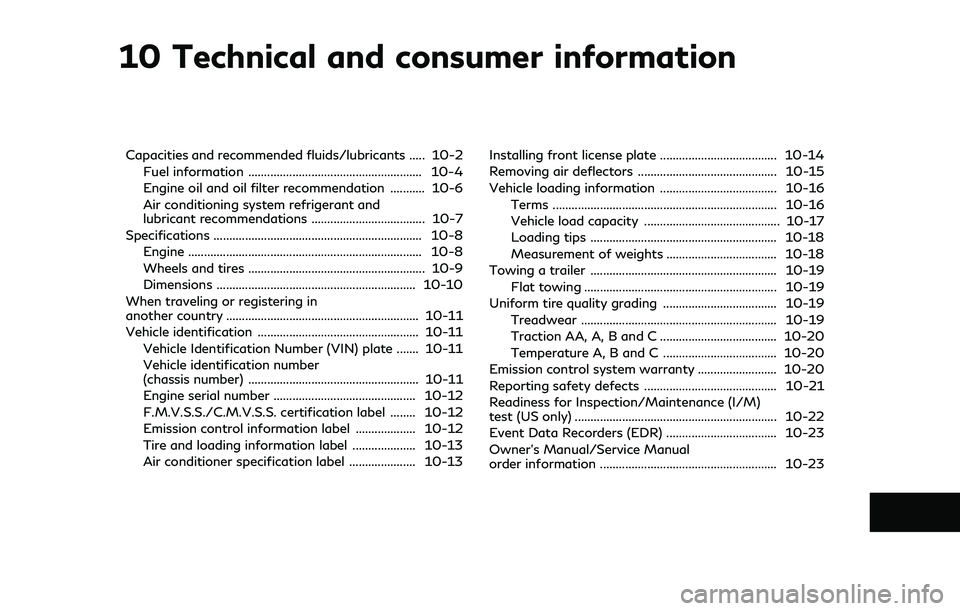
10 Technical and consumer information
Capacities and recommended fluids/lubricants ..... 10-2Fuel information ....................................................... 10-4
Engine oil and oil filter recommendation ........... 10-6
Air conditioning system refrigerant and
lubricant recommendations .................................... 10-7
Specifications .................................................................. 10-8
Engine ........................................................................\
.. 10-8
Wheels and tires ........................................................ 10-9
Dimensions ............................................................... 10-10
When traveling or registering in
another country ............................................................. 10-11
Vehicle identification ................................................... 10-11 Vehicle Identification Number (VIN) plate ....... 10-11
Vehicle identification number
(chassis number) ...................................................... 10-11
Engine serial number ............................................. 10-12
F.M.V.S.S./C.M.V.S.S. certification label ........ 10-12
Emission control information label ................... 10-12
Tire and loading information label .................... 10-13
Air conditioner specification label ..................... 10-13 Installing front license plate ..................................... 10-14
Removing air deflectors ............................................ 10-15
Vehicle loading information ..................................... 10-16
Terms ....................................................................... 10-16
Vehicle load capacity ........................................... 10-17
Loading tips ........................................................... 10-18
Measurement of weights ................................... 10-18
Towing a trailer ........................................................... 10-19 Flat towing ............................................................. 10-19
Uniform tire quality grading .................................... 10-19
Treadwear .............................................................. 10-19
Traction AA, A, B and C ..................................... 10-20
Temperature A, B and C .................................... 10-20
Emission control system warranty ......................... 10-20
Reporting safety defects .......................................... 10-21
Readiness for Inspection/Maintenance (I/M)
test (US only) ................................................................ 10-22
Event Data Recorders (EDR) ................................... 10-23
Owner’s Manual/Service Manual
order information ........................................................ 10-23
Page 441 of 468

WHEELS AND TIRES
Road wheel
TypeSize Offset in (mm)
Conventional 17 × 7.5J
1.77 (45)
18 × 7.5J 1.77 (45)
19 × 8.5J 1.97 (50)
19 × 9J 1.85 (47)
19 × 9.5J 1.97 (50)
Tire
TypeSize Pressure PSI (kPa) [Cold]
Conventional P225/55RF17 95V
35 (240)
P225/50RF18 94V
P245/40RF19 94V
245/40RF19 94W
Front: 245/40RF19 94W
Rear: 265/35RF19 94W
Technical and consumer information10-9
Page 450 of 468

10-18Technical and consumer information
for your vehicle. (See “Measurement
of weights” (P.10-18).)
Also check tires for proper inflation
pressures. See the Tire and Loading
Information label.
LOADING TIPS
.The GVW must not exceed GVWRor GAWR as specified on the F.M.
V.S.S./C.M.V.S.S. certification la-
bel.
.Do not load the front and rear axleto the GAWR. Doing so will exceed
the GVWR.
WARNING
.Properly secure all cargo to help
prevent it from sliding or shift-
ing. Do not place cargo higher
than the seatbacks. In a sudden
stop or collision, unsecured car-
go could cause personal injury.
.Do not load your vehicle any
heavier than the GVWR or the
maximum front and rear
GAWRs. If you do, parts of your vehicle can break, tire
damage could occur, or it can
change the way your vehicle
handles. This could result in loss
of control and cause personal
injury.
.Overloading could not only
shorten the life of your vehicle
and the tires, but also could
lead to hazardous vehicle hand-
ling and long braking distance.
This may cause a premature tire
malfunction, which could result
in a serious accident and perso-
nal injury. Failures caused by
overloading are not covered by
the vehicle’s warranty.
MEASUREMENT OF WEIGHTS
Secure loose items to prevent weight
shifts that could affect the balance of
your vehicle. When the vehicle is
loaded, drive to a scale and weigh
the front and the rear wheels sepa-
rately to determine axle loads. Indivi-
dual axle loads should not exceed
either of the gross axle weight ratings(GAWR). The total of the axle loads
should not exceed the gross vehicle
weight rating (GVWR). These ratings
are given on the vehicle certification
label. If weight ratings are exceeded,
move or remove items to bring all
weights below the ratings.
Page 451 of 468

Do not tow a trailer with your
vehicle.
FLAT TOWING
Towing your vehicle with all four wheels on
the ground is sometimes called flat towing.
This method is sometimes used when towing
a vehicle behind a recreational vehicle, such
as a motor home.
CAUTION
.Failure to follow these guidelines can
result in severe transmission damage.
. Whenever flat towing your vehicle,
always tow forward, never back-
ward.
. DO NOT tow any Automatic Trans-
mission (AT) vehicle with all four
wheels on the ground (flat towing).
Doing so WILL DAMAGE internal
transmission parts due to lack of
transmission lubrication.
. DO NOT tow any All-Wheel Drive
(AWD) vehicle with any of the wheels
on the ground. Doing so may cause
serious and expensive damage to the
powertrain.
. For emergency towing procedures
refer to “Towing recommended by INFINITI” (P.6-9).
Automatic Transmission
All-Wheel Drive (AWD) models:
Do not tow an AWD vehicle with any of the
wheels on the ground.
Two-Wheel Drive (2WD) models:
To tow a vehicle equipped with an automatic
transmission, an appropriate vehicle dolly
MUST
be placed under the towed vehicle’s
drive wheels. Alwaysfollow the dolly man-
ufacturer’s recommendations when using
their product. DOT (Department Of Transportation) Qual-
ity Grades: All passenger car tires must
conform to federal safety requirements in
addition to these grades.
Quality grades can be found where applic-
able on the tire sidewall between tread
shoulder and maximum section width. For
example:
Treadwear 200 Traction AA Temperature A
TREADWEAR
The treadwear grade is a comparative rating
based on the wear rate of the tire when
tested under controlled conditions on a
specified government test course. For ex-
ample, a tire graded 150 would wear one
and one-half (1 1/2) times as well on the
government course as a tire graded 100.
The relative performance of tires depends
upon actual conditions of their use, however,
and may depart significantly from the norm
due to variations in driving habits, service
practices and differences in road character-
istics and climate.
Technical and consumer information10-19
TOWING A TRAILERUNIFORM TIRE QUALITY GRADING
Page 452 of 468

10-20Technical and consumer information
TRACTION AA, A, B AND C
The traction grades, from highest to lowest,
are AA, A, B and C. Those grades represent
the tire’s ability to stop on wet pavement as
measured under controlled conditions on
specified government test surfaces of as-
phalt and concrete. A tire marked C may
have poor traction performance.
WARNING
The traction grade assigned to this tire is
based on straight-ahead braking trac-
tion tests, and does not include accel-
eration, cornering, hydroplaning, or peak
traction characteristics.
TEMPERATURE A, B AND C
The temperature grades A (the highest), B,
and C, representing the tire’s resistance to
the generation of heat and its ability to
dissipate heat when tested under controlled
conditions on a specified indoor laboratory
test wheel. Sustained high temperature can
cause the material of the tire to degenerate
and reduce tire life, and excessive tempera-
ture can lead to sudden tire failure. The
grade C corresponds to a level of perfor-
mance which all passenger car tires must
meet under the Federal Motor VehicleSafety Standard No. 109. Grades B and A
represent higher levels of performance on
the laboratory test wheel than the minimum
required by law.
WARNING
The temperature grade for this tire is
established for a tire that is properly
inflated and not overloaded. Excessive
speed, under-inflation, or excessive
loading, either separately or in combina-
tion, can cause heat build-up and possi-
ble tire failure.
Your INFINITI is covered by the following
emission warranties.
For USA:
.
Emission Defects Warranty
. Emissions Performance Warranty
Details of these warranties may be found
with other vehicle warranties in your War-
ranty Information Booklet that comes with
your INFINITI. If you did not receive a
Warranty Information Booklet, or it has
become lost, you may obtain a replacement
by writing to:
. INFINITI Division
Nissan North America, Inc.
Consumer Affairs Department
P.O. Box 685003
Franklin, TN 37068-5003
For Canada:
Emission Control System Warranty
Details of these warranties may be found
with other vehicle warranties in your War-
ranty and Roadside Assistance Information
that comes with your INFINITI. If you did not
receive a Warranty and Roadside Assistance
Information, or it has become lost, you may
obtain a replacement by writing to:
. Nissan Canada Inc.
5290 Orbitor Drive
Mississauga, Ontario,
EMISSION CONTROL SYSTEM
WARRANTY