tire pressure INFINITI Q50 2021 Owner's Guide
[x] Cancel search | Manufacturer: INFINITI, Model Year: 2021, Model line: Q50, Model: INFINITI Q50 2021Pages: 484, PDF Size: 1.86 MB
Page 409 of 484
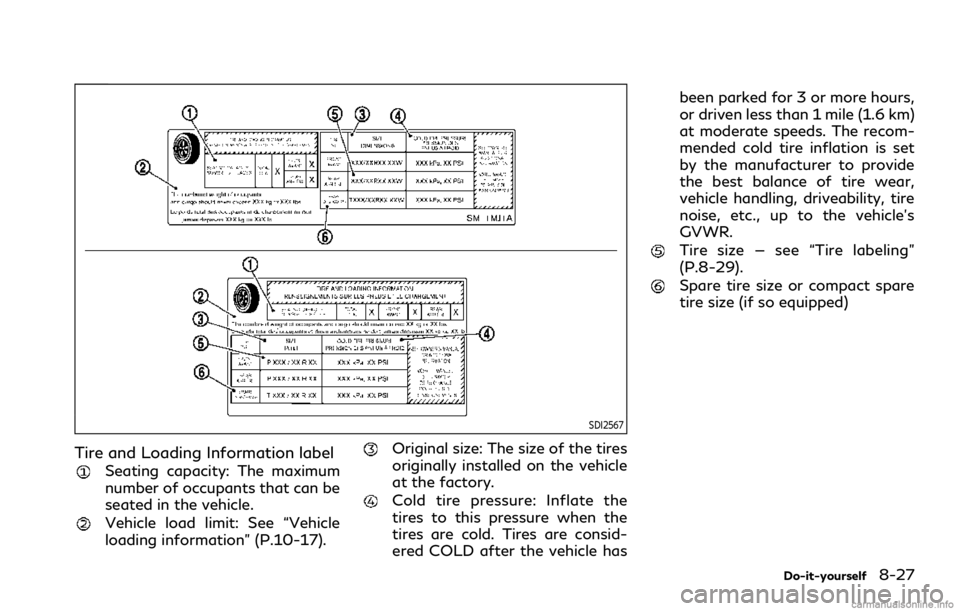
SDI2567
Tire and Loading Information label
Seating capacity: The maximum
number of occupants that can be
seated in the vehicle.
Vehicle load limit: See “Vehicle
loading information” (P.10-17).
Original size: The size of the tires
originally installed on the vehicle
at the factory.
Cold tire pressure: Inflate the
tires to this pressure when the
tires are cold. Tires are consid-
ered COLD after the vehicle hasbeen parked for 3 or more hours,
or driven less than 1 mile (1.6 km)
at moderate speeds. The recom-
mended cold tire inflation is set
by the manufacturer to provide
the best balance of tire wear,
vehicle handling, driveability, tire
noise, etc., up to the vehicle’s
GVWR.
Tire size — see “Tire labeling”
(P.8-29).
Spare tire size or compact spare
tire size (if so equipped)
Do-it-yourself8-27
Page 410 of 484

8-28Do-it-yourself
SDI1949
Checking the tire pressure
1. Remove the valve stem cap fromthe tire.
2. Press the pressure gauge squarely onto the valve stem. Do not press
too hard or force the valve stem
sideways, or air will escape. If the
hissing sound of air escaping from
the tire is heard while checking the
pressure, reposition the gauge to
eliminate this leakage.
3. Remove the gauge. 4. Read the tire pressure on the
gauge stem and compare it to the
specification shown on the Tire
and Loading Information label.
5. Add air to the tire as needed. If too much air is added, press the core of
the valve stem briefly with the tip
of the gauge stem to release
pressure. Recheck the pressure
and add or release air as needed.
6. Install the valve stem cap.
7. Check the pressure of all other tires, including the spare.
8. Check the pressure when driving the vehicle at speeds of 100 MPH
(160 km/h) or higher where it is
legal to do so.
WARNING
.Driving at high speeds, 100
MPH (160 km/h) or higher
sustained where it is legal to
do so, can cause tires to have
excessive heat build up, which
may result in a tire failure causing loss of control, crash,
injuries or even death. Some
high-speed rated tires require
inflation pressure adjustment
for high-speed operation.
When speed limits and road
conditions allow vehicle driving
at high speeds, make sure tires
are rated to support high speed
operation, tires are in optimal
conditions and pressure is ad-
justed to correct cold inflation
pressure for high speed opera-
tion.
. Tires require adjustment to the
inflation pressure when driving
the vehicle at speeds of 100
MPH (160 km/h) or higher
where it is legal to do so. See
recommended tire inflation
chart for correct operating
pressure.
. After vehicle high speed opera-
tion has ended, readjust the tire
pressure to the recommended
cold inflation pressure. (See
“Checking the tire pressure”
Page 411 of 484
(P.8-28).)
SizeCold Tire In-
flation Pres- sure
Front Original Tire:
P225/55RF17 95V 35 psi, 240
kPa
Front Original Tire:
P225/50RF18 94V 35 psi, 240
kPa
Front Original Tire:
P245/40RF19 94V 35 psi, 240
kPa
Front Original Tire:
245/40RF19 94W 35 psi, 240
kPa
Rear Original Tire:
P225/55RF17 95V 35 psi, 240
kPa
Rear Original Tire:
P225/50RF18 94V 35 psi, 240
kPa
Rear Original Tire:
P245/40RF19 94V 35 psi, 240
kPa
Rear Original Tire:
245/40RF19 94W 35 psi, 240
kPa
Rear Original Tire:
265/35RF19 94W 35 psi, 240
kPa
Recommended tire inflation pressures
at speeds of 100 MPH (160 km/h) or
higher where it is legal to do so.
SizeCold Tire In-
flation Pres- sure
Front Original Tire:
P225/55RF17 95V 38 psi, 260
kPa
Front Original Tire:
P225/50RF18 94V 41 psi, 280
kPa
Front Original Tire:
P245/40RF19 94V 42 psi, 290
kPa
Front Original Tire:
245/40RF19 94W 42 psi, 290
kPa
Rear Original Tire:
P225/55RF17 95V 38 psi, 260
kPa
Rear Original Tire:
P225/50RF18 94V 41 psi, 280
kPa
Rear Original Tire:
P245/40RF19 94V 42 psi, 290
kPa
Rear Original Tire:
245/40RF19 94W 42 psi, 290
kPa
Rear Original Tire:
265/35RF19 94W 42 psi, 290
kPa
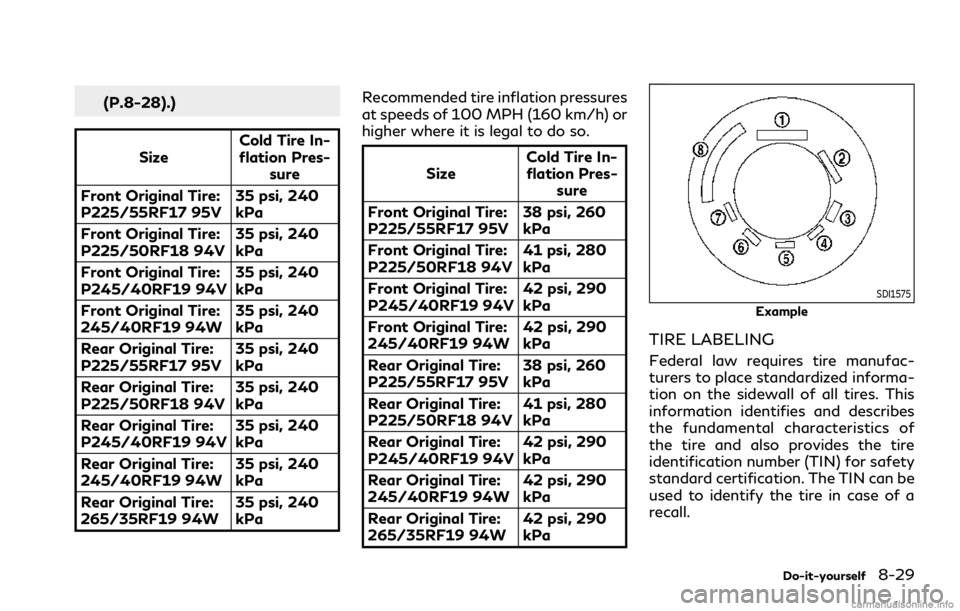
SDI1575
Example
TIRE LABELING
Federal law requires tire manufac-
turers to place standardized informa-
tion on the sidewall of all tires. This
information identifies and describes
the fundamental characteristics of
the tire and also provides the tire
identification number (TIN) for safety
standard certification. The TIN can be
used to identify the tire in case of a
recall.
Do-it-yourself8-29
Page 413 of 484
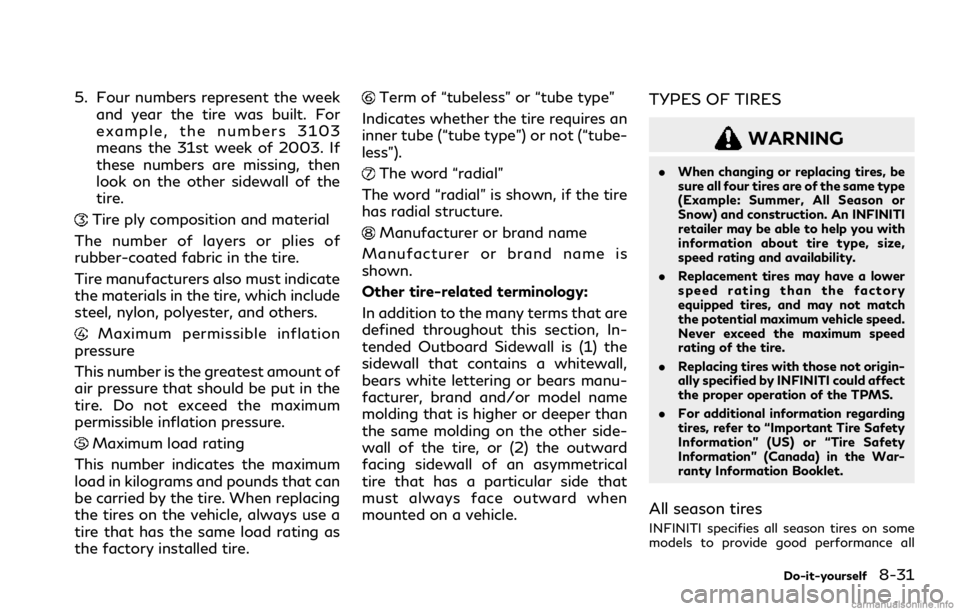
5. Four numbers represent the weekand year the tire was built. For
example, the numbers 3103
means the 31st week of 2003. If
these numbers are missing, then
look on the other sidewall of the
tire.
Tire ply composition and material
The number of layers or plies of
rubber-coated fabric in the tire.
Tire manufacturers also must indicate
the materials in the tire, which include
steel, nylon, polyester, and others.
Maximum permissible inflation
pressure
This number is the greatest amount of
air pressure that should be put in the
tire. Do not exceed the maximum
permissible inflation pressure.
Maximum load rating
This number indicates the maximum
load in kilograms and pounds that can
be carried by the tire. When replacing
the tires on the vehicle, always use a
tire that has the same load rating as
the factory installed tire.
Term of “tubeless” or “tube type”
Indicates whether the tire requires an
inner tube (“tube type”) or not (“tube-
less”).
The word “radial”
The word “radial” is shown, if the tire
has radial structure.
Manufacturer or brand name
Manufacturer or brand name is
shown.
Other tire-related terminology:
In addition to the many terms that are
defined throughout this section, In-
tended Outboard Sidewall is (1) the
sidewall that contains a whitewall,
bears white lettering or bears manu-
facturer, brand and/or model name
molding that is higher or deeper than
the same molding on the other side-
wall of the tire, or (2) the outward
facing sidewall of an asymmetrical
tire that has a particular side that
must always face outward when
mounted on a vehicle.
TYPES OF TIRES
WARNING
. When changing or replacing tires, be
sure all four tires are of the same type
(Example: Summer, All Season or
Snow) and construction. An INFINITI
retailer may be able to help you with
information about tire type, size,
speed rating and availability.
. Replacement tires may have a lower
speed rating than the factory
equipped tires, and may not match
the potential maximum vehicle speed.
Never exceed the maximum speed
rating of the tire.
. Replacing tires with those not origin-
ally specified by INFINITI could affect
the proper operation of the TPMS.
. For additional information regarding
tires, refer to “Important Tire Safety
Information” (US) or “Tire Safety
Information” (Canada) in the War-
ranty Information Booklet.
All season tires
INFINITI specifies all season tires on some
models to provide good performance all
Do-it-yourself8-31
Page 414 of 484

8-32Do-it-yourself
year, including snowy and icy road condi-
tions. All Season tires are identified by ALL
SEASON and/or M&S (Mud and Snow) on
the tire sidewall. Snow tires have better
snow traction than All Season tires and may
be more appropriate in some areas.
Summer tires
INFINITI specifies summer tires on some
models to provide superior performance on
dry roads. Summer tire performance is
substantially reduced in snow and ice. Sum-
mer tires do not have the tire traction rating
M&S on the tire sidewall.
If you plan to operate your vehicle in snowy
or icy conditions, INFINITI recommends the
use of SNOW tires or ALL SEASON tires on
all four wheels.
Snow tires
If snow tires are needed, it is necessary to
select tires equivalent in size and load rating
to the original equipment tires. If you do not,
it can adversely affect the safety and
handling of your vehicle.
Generally, snow tires will have lower speed
ratings than factory equipped tires and may
not match the potential maximum vehicle
speed. Never exceed the maximum speed
rating of the tire.
If you install snow tires, they must be thesame size, brand, construction and tread
pattern on all four wheels.
For additional traction on icy roads, studded
tires may be used. However, some U.S.
states and Canadian provinces prohibit their
use. Check local, state and provincial laws
before installing studded tires. Skid and
traction capabilities of studded snow tires,
on wet or dry surfaces, may be poorer than
that of non-studded snow tires.
Run-flat tires (if so equipped)
Your vehicle is equipped with run-flat tires.
You can continue driving to a safe location
even if they are punctured. Always use run-
flat tires of the specified size on all four
wheels. Mixing tire sizes or construction may
reduce vehicle handling stability. If neces-
sary, contact an INFINITI retailer for assis-
tance.
Frequently check the tire pressure and adjust
pressure of each tire properly. The tire
pressure can be also checked in the vehicle
information display.
It can be difficult to tell if a run-flat tire is
under-inflated or flat. Check the tire pres-
sures as described earlier in this section. If
the tire becomes under-inflated while driv-
ing, the low tire pressure warning light will
illuminate. If the tire becomes flat while
driving, the low tire pressure warning light
and the “Flat Tire - Visit dealer” warning will
appear.
Low tire pressure:
If the vehicle is being driven with low tire
pressure, the low tire pressure warning light
will illuminate.
Flat tire:
If the vehicle is being driven with one or more
flat tires, the low tire pressure warning light
will illuminate continuously and a chime will
sound for 10 seconds. A “Flat Tire - Visit
dealer” warning also appears in the vehicle
information display.
The chime will only sound at the first
indication of a flat tire and the warning light
will illuminate continuously. When the flat
tire warning is activated, have the system
reset and the tire checked, and replaced if
necessary. It is recommended you visit an
INFINITI retailer for these services. Even if
the tire is inflated to the specified COLD tire
pressure, the warning light will continue to
illuminate until the system is reset by an
INFINITI retailer.
If the low tire pressure warning light illumi-
nates continuously and the “Flat Tire - Visit
dealer” warning appears in the vehicle
information display:
. Do not exceed 50 MPH (80 km/h).
Page 416 of 484
8-34Do-it-yourself
the tire chain must be secured or removed to
prevent the possibility of whipping action
damage to the fenders or underbody. If
possible, avoid fully loading your vehicle
when using tire chains. In addition, drive at
a reduced speed. Otherwise, your vehicle
may be damaged and/or vehicle handling
and performance may be adversely affected.
Tire chains must be installed only on the
rear wheels and not on the front wheels.
Never install tire chains on a TEMPORARY
USE ONLY spare tire (if so equipped). Never
install tire chains on a punctured run-flat tire
(if so equipped), as this could damage your
vehicle.
Do not use tire chains on dry roads. Driving
with tire chains in such conditions can cause
damage to the various mechanisms of the
vehicle due to some overstress.
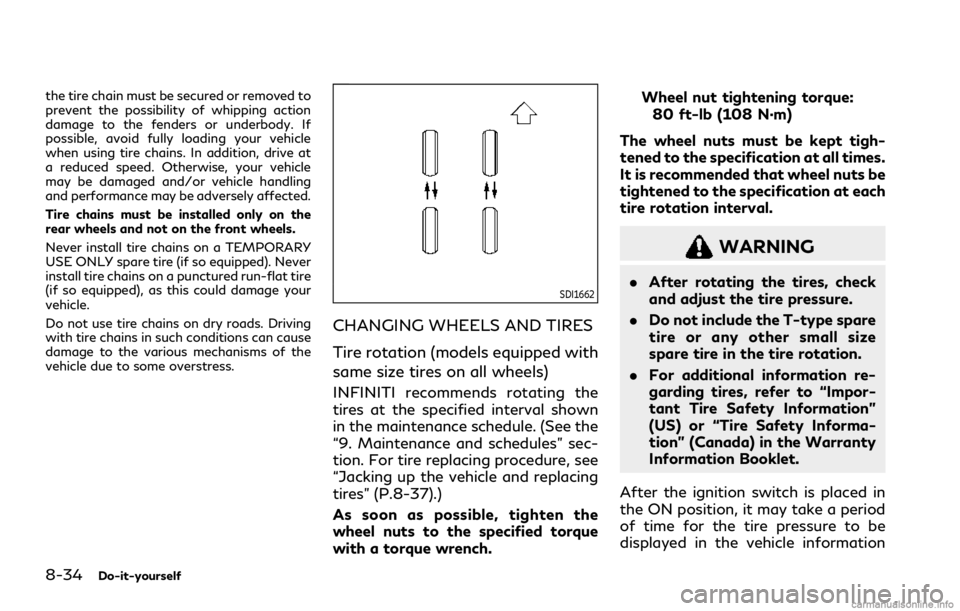
SDI1662
CHANGING WHEELS AND TIRES
Tire rotation (models equipped with
same size tires on all wheels)
INFINITI recommends rotating the
tires at the specified interval shown
in the maintenance schedule. (See the
“9. Maintenance and schedules” sec-
tion. For tire replacing procedure, see
“Jacking up the vehicle and replacing
tires” (P.8-37).)
As soon as possible, tighten the
wheel nuts to the specified torque
with a torque wrench.Wheel nut tightening torque:
80 ft-lb (108 N·m)
The wheel nuts must be kept tigh-
tened to the specification at all times.
It is recommended that wheel nuts be
tightened to the specification at each
tire rotation interval.
WARNING
. After rotating the tires, check
and adjust the tire pressure.
. Do not include the T-type spare
tire or any other small size
spare tire in the tire rotation.
. For additional information re-
garding tires, refer to “Impor-
tant Tire Safety Information”
(US) or “Tire Safety Informa-
tion” (Canada) in the Warranty
Information Booklet.
After the ignition switch is placed in
the ON position, it may take a period
of time for the tire pressure to be
displayed in the vehicle information
Page 417 of 484
display while the vehicle is driven.
Depending on the radio wave circum-
stance, tire pressure may not cor-
rectly be displayed.
Tire rotation (models equipped with
different size tires on front and rear)
Tires cannot be rotated on this vehi-
cle, as front tires are a different size
from rear tires.
A pin is on the front brake rotor to
prevent the rear wheels from being
installed in place of the front wheels.
The spare tire can be installed in place
of the front and rear wheels. When
installing the spare tire in the front
wheel, the hole in the spare tire wheel
must be aligned with the pin on the
brake rotor.
WARNING
.If your vehicle is equipped with
different size front and rear
tires, never install the rear
tire/wheel on the front of the
vehicle. Doing so can damage the vehicle or tire. Damage to
the tire may result in a sudden
loss of air pressure which may
cause loss of vehicle control in
some driving conditions and
cause a collision and personal
injury.
. For additional information re-
garding tires, refer to “Impor-
tant Tire Safety Information”
(US) or “Tire Safety Informa-
tion” (Canada) in the Warranty
Information Booklet.
After the ignition switch is placed in
the ON position, it may take a period
of time for the tire pressure to be
displayed in the vehicle information
display while the vehicle is driven.
Depending on the radio wave circum-
stance, tire pressure may not cor-
rectly be displayed.
SDI1663
: Wear indicator
: Wear indicator location mark. The
locations are shown by “”, “TWI”,
etc. depending on tire types.
Tire wear and damage
WARNING
. Tires should be periodically in-
spected for wear, cracking, bul-
ging or objects caught in the
tread. If excessive wear, cracks,
bulging or deep cuts are found,
the tire(s) should be replaced.
Do-it-yourself8-35
Page 418 of 484
8-36Do-it-yourself
.The original tires have built-in
tread wear indicators. When
wear indicators are visible, the
tire(s) should be replaced.
. Tires degrade with age and use.
Have tires, including the spare,
over 6 years old checked by a
qualified technician, because
some tire damage may not be
obvious. Replace the tires as
necessary to prevent tire failure
and possible personal injury.
. Improper service of the spare
tire may result in serious perso-
nal injury. If it is necessary to
repair the spare tire, it is re-
commended you visit an
INFINITI retailer for this ser-
vice.
. For additional information re-
garding tires, refer to “Impor-
tant Tire Safety Information”
(US) or “Tire Safety Informa-
tion” (Canada) in the Warranty
Information Booklet.Replacing wheels and tires
When replacing a tire, use the same size,
tread design, speed rating and load carrying
capacity as originally equipped. (See “Speci-
fications” (P.10-8) for recommended types
and sizes of tires and wheels.)
After the ignition switch is placed in the ON
position, it may take a period of time for the
tire pressure to be displayed in the vehicle
information display while the vehicle is
driven. Depending on the radio wave circum-
stance, tire pressure may not correctly be
displayed.
WARNING
. The use of tires other than those
recommended or the mixed use of
tires of different brands, construc-
tion (bias, bias-belted, radial or run-
flat), or tread patterns can adversely
affect the ride, braking, handling,
ground clearance, body-to-tire clear-
ance, tire chain clearance, speed-
ometer calibration, headlight aim
and bumper height. Some of these
effects may lead to accidents and
could result in serious personal injury.
. For Two-Wheel Drive (2WD) models,
if your vehicle was originally equipped with 4 tires that were the
same size and you are only replacing
2 of the 4 tires, install the new tires
on the rear axle. Placing new tires on
the front axle may cause loss of
vehicle control in some driving condi-
tions and cause an accident and
personal injury.
. If the wheels are changed for any
reason, always replace with wheels
which have the same off-set dimen-
sion. Wheels of a different off-set
could cause premature tire wear,
degrade vehicle handling character-
istics and/or interference with the
brake discs/drums. Such interference
can lead to decreased braking effi-
ciency and/or early brake pad/shoe
wear. See “Wheels and tires” (P.10-
9) of this manual for wheel off-set
dimensions.
. Since the spare tire is not equipped
with the TPMS, when a spare tire is
mounted or a wheel is replaced, the
TPMS will not function and the low
tire pressure warning light will flash
for approximately 1 minute. The light
will remain on after 1 minute. Have
your tires replaced and/or TPMS
system reset as soon as possible. It
is recommended you visit an INFINITI
retailer for these services.
Page 419 of 484
.Replacing tires with those not origin-
ally specified by INFINITI could affect
the proper operation of the TPMS.
. The TPMS sensor may be damaged if
it is not handled correctly. Be careful
when handling the TPMS sensor.
. When replacing the TPMS sensor, the
ID registration may be required. It is
recommended you contact an
INFINITI retailer for ID registration.
. Do not use a valve stem cap that is
not specified by INFINITI. The valve
stem cap may become stuck.
. Be sure that the valve stem caps are
correctly fitted. Otherwise the valve
may be clogged up with dirt and
cause a malfunction or loss of pres-
sure.
. Do not install a damaged or deformed
wheel or tire even if it has been
repaired. Such wheels or tires could
have structural damage and could fail
without warning.
. The use of retread tire is not recom-
mended.
. For additional information regarding
tires, refer to “Important Tire Safety
Information” (US) or “Tire Safety
Information” (Canada) in the War- ranty Information Booklet.
Intelligent All-Wheel Drive (AWD)
models
CAUTION
.
Always use tires of the same type,
size, brand, construction (bias, bias-
belted or radial), and tread pattern
on all four wheels. Failure to do so
may result in a circumference differ-
ence between tires on the front and
rear axles which will cause excessive
tire wear and may damage the trans-
mission, transfer case and differential
gears.
. ONLY use spare tires specified for
the Intelligent AWD model.
If excessive tire wear is found, it is recom-
mended that all four tires be replaced with
tires of the same size, brand, construction
and tread pattern. The tire pressure and
wheel alignment should also be checked and
corrected as necessary. It is recommended
you visit an INFINITI retailer for this service.
Wheel balance
Unbalanced wheels may affect vehicle hand-
ling and tire life. Even with regular use,
wheels can get out of balance. Therefore,
they should be balanced as required.
Wheel balance service should be performed
with the wheels off the vehicle. Spin
balancing the wheels on the vehicle could
lead to mechanical damage.
For additional information regarding tires,
refer to “Important Tire Safety Information”
(US) or “Tire Safety Information” (Canada) in
the INFINITI Warranty Information Booklet.
Care of wheels
See “Cleaning exterior” (P.7-2) for details
about care of the wheels.
JACKING UP THE VEHICLE AND
REPLACING TIRES
Your vehicle is equipped with run-flat tires
and you can continue driving to a safe
location even if they are punctured. (See
“Run-flat tires” (P.6-4) and “Run-flat tires”
(P.8-32).)
This section contains the information about
the vehicle jack-up procedures and the tire
replacement.
Do-it-yourself8-37
Page 422 of 484
8-40Do-it-yourself
This could cause an accident.
. Do not use oil or grease on the wheel
studs or nuts. This could cause the
nuts to become loose.
.As soon as possible, tighten the wheel
nuts to the specified torque with a
torque wrench.
Wheel nut tightening torque: 80 ft-lb (108 N·m)
The wheel nuts must be kept tigh-
tened to specification at all times. It
is recommended that wheel nuts be
tightened to specifications at each
lubrication interval.
.Adjust tire pressure to the COLD pressure.
COLD pressure:
After the vehicle has been parked for
three hours or more or driven less
than 1 mile (1.6 km).
COLD tire pressures are shown on
the Tire and Loading Information
label affixed to the driver side center
pillar.
Securely store the jacking tools in the
vehicle.