change time INFINITI Q60 2018 Owner's Manual
[x] Cancel search | Manufacturer: INFINITI, Model Year: 2018, Model line: Q60, Model: INFINITI Q60 2018Pages: 466, PDF Size: 2.47 MB
Page 271 of 466
5-92Starting and driving
system completely off.
When the ignition switch is placed in the
OFF position, the system is also automati-
cally turned off.
To use the ICC system again, quickly push
and release the MAIN switch (vehicle-to-
vehicle distance control mode) or push and
hold it (conventional cruise control mode)
again to turn it on.
When the Distance Control Assist (DCA)
system is on, the conventional (fixed speed)
cruise control mode cannot be turned on
even though the MAIN switch is pushed and
held.
To turn on the conventional (fixed speed)
cruise control mode, turn off the DCA
system. See “Distance Control Assist
(DCA)” (P.5-94).
CAUTION
To avoid accidentally engaging cruise
control, make sure to turn the MAIN
switch off when not using the ICC
system.
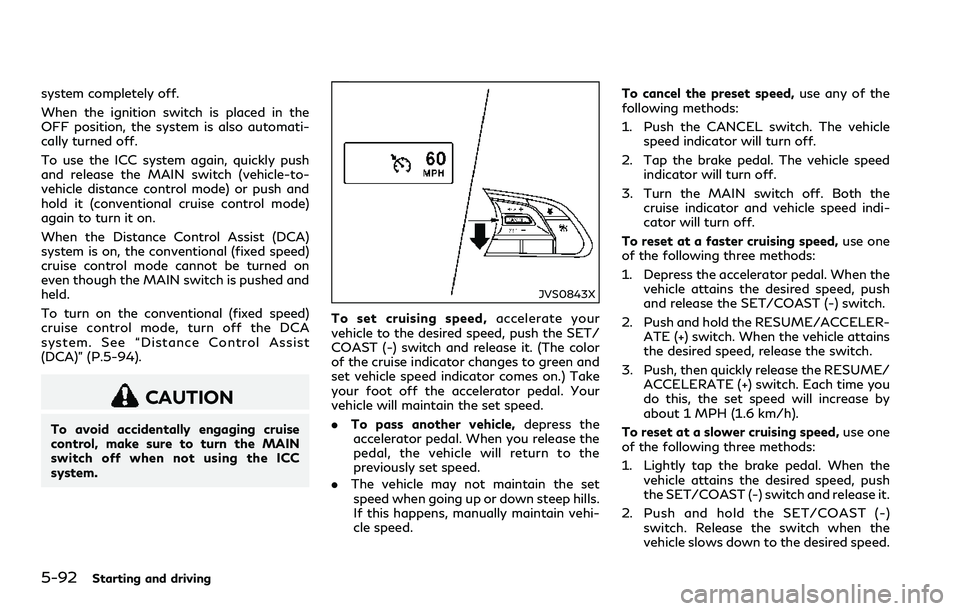
JVS0843X
To set cruising speed,accelerate your
vehicle to the desired speed, push the SET/
COAST (-) switch and release it. (The color
of the cruise indicator changes to green and
set vehicle speed indicator comes on.) Take
your foot off the accelerator pedal. Your
vehicle will maintain the set speed.
.To pass another vehicle,depress the
accelerator pedal. When you release the
pedal, the vehicle will return to the
previously set speed.
.The vehicle may not maintain the set
speed when going up or down steep hills.
If this happens, manually maintain vehi-
cle speed.To cancel the preset speed,use any of the
following methods:
1. Push the CANCEL switch. The vehicle
speed indicator will turn off.
2. Tap the brake pedal. The vehicle speed
indicator will turn off.
3. Turn the MAIN switch off. Both the
cruise indicator and vehicle speed indi-
cator will turn off.
To reset at a faster cruising speed,use one
of the following three methods:
1. Depress the accelerator pedal. When the
vehicle attains the desired speed, push
and release the SET/COAST (-) switch.
2. Push and hold the RESUME/ACCELER-
ATE (+) switch. When the vehicle attains
the desired speed, release the switch.
3. Push, then quickly release the RESUME/
ACCELERATE (+) switch. Each time you
do this, the set speed will increase by
about 1 MPH (1.6 km/h).
To reset at a slower cruising speed,use one
of the following three methods:
1. Lightly tap the brake pedal. When the
vehicle attains the desired speed, push
the SET/COAST (-) switch and release it.
2. Push and hold the SET/COAST (-)
switch. Release the switch when the
vehicle slows down to the desired speed.
Page 272 of 466
3. Push, then quickly release the SET/
COAST (-) switch. Each time you do this,
the set speed will decrease by about 1
MPH (1.6 km/h).
To resume the preset speed,push and
release the RESUME/ACCELERATE (+)
switch. The vehicle will resume the last set
cruising speed when the vehicle speed is over
25 MPH (40 km/h).
System temporarily unavailable
A chime sounds under the following condi-
tions and the control is automatically can-
celed.
.When the vehicle slows down more than
8 MPH (13 km/h) below the set speed
.When the shift lever is not in the D (Drive)
or manual shift mode
.When the parking brake is applied.
.When the VDC operates (including the
traction control system)
.When a wheel slips
JVS0306X
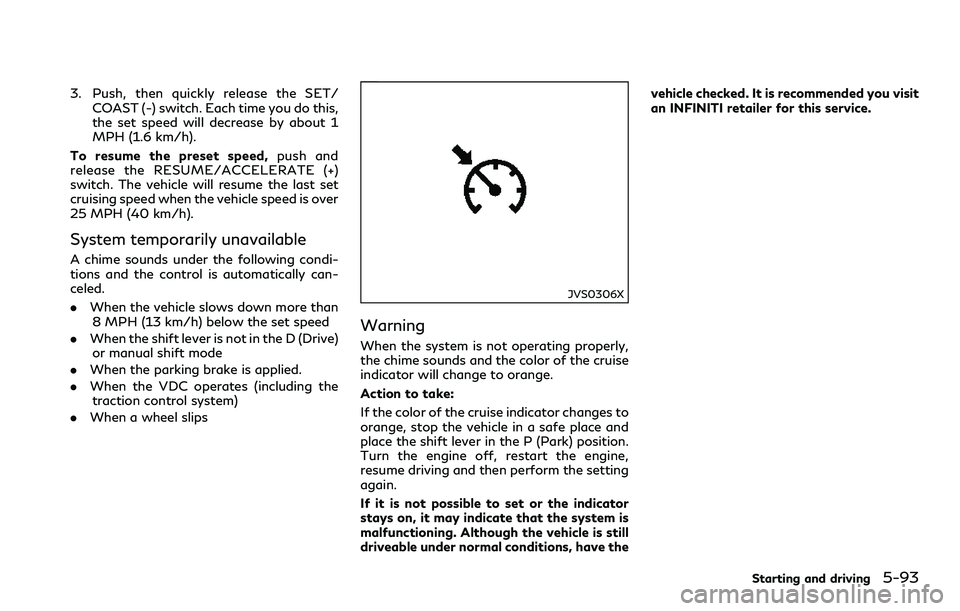
Warning
When the system is not operating properly,
the chime sounds and the color of the cruise
indicator will change to orange.
Action to take:
If the color of the cruise indicator changes to
orange, stop the vehicle in a safe place and
place the shift lever in the P (Park) position.
Turn the engine off, restart the engine,
resume driving and then perform the setting
again.
If it is not possible to set or the indicator
stays on, it may indicate that the system is
malfunctioning. Although the vehicle is still
driveable under normal conditions, have thevehicle checked. It is recommended you visit
an INFINITI retailer for this service.
Starting and driving5-93
Page 304 of 466
Follow these easy-to-use Fuel Efficient
Driving Tips to help you achieve the most
fuel economy from your vehicle.
1. Use smooth accelerator and brake pedal
application.
.Avoid rapid starts and stops..Use smooth, gentle accelerator and
brake application whenever possible.
.Maintain constant speed while com-
muting and coast whenever possible.
2. Maintain constant speed.
.Look ahead to try and anticipate and
minimize stops.
.Synchronizing your speed with traffic
lights allows you to reduce your
number of stops.
.Maintaining a steady speed can mini-
mize red light stops and improve fuel
efficiency.
3. Use air conditioning (A/C) at higher
vehicle speeds.
.Below 40 MPH (64 km/h), it is more
efficient to open windows to cool the
vehicle due to reduced engine load.
.Above 40 MPH (64 km/h), it is more
efficient to use A/C to cool the
vehicle due to increased aerodynamic
drag.
.Recirculating the cool air in the cabin
when the A/C is on reduces cooling
load.4. Drive at economical speeds and dis-
tances.
.Observing the speed limit and not
exceeding 60 MPH (97 km/h) (where
legally allowed) can improve fuel
efficiency due to reduced aerody-
namic drag.
.Maintaining a safe following distance
behind other vehicles reduces unne-
cessary braking.
.Safely monitoring traffic to anticipate
changes in speed permits reduced
braking and smooth acceleration
changes.
.Select a gear range suitable to road
conditions.
5. Use cruise control.
.Using cruise control during highway
driving helps maintain a steady speed.
.Cruise control is particularly effective
in providing fuel savings when driving
on flat terrains.
6. Plan for the shortest route.
.Utilize a map or navigation system to
determine the best route to save time.
7. Avoid idling.
.Shutting off your engine when safe
for stops exceeding 30-60 seconds
saves fuel and reduces emissions.8. Buy an automated pass for toll roads.
.Automated passes permit drivers to
use special lanes to maintain cruising
speed through the toll and avoid
stopping and starting.
9. Winter warm up.
.Limit idling time to minimize impact to
fuel economy.
.Vehicles typically need no more than
30 seconds of idling at start-up to
effectively circulate the engine oil
before driving.
.Your vehicle will reach its ideal oper-
ating temperature more quickly while
driving versus idling.
10. Keeping your vehicle cool.
.Park your vehicle in a covered parking
area or in the shade whenever possi-
ble.
.When entering a hot vehicle, opening
the windows will help to reduce the
inside temperature faster, resulting in
reduced demand on your A/C system.
Starting and driving5-125
FUEL EFFICIENT DRIVING TIPS
Page 319 of 466
5-140Starting and driving
NOTE:
It may take some time until the Idling Stop
System activates under the following con-
ditions:
.when the battery is discharged.
.when the outside temperature is low or
high.
.when the battery is replaced or the
battery terminal is disconnected for
extended periods and then reconnected.
NOTE:
When the Idling Stop System indicator light
illuminates, the engine starts running auto-
matically under at least one of the following
conditions:
.The brake pedal is released with the shift
lever in the D (Drive) or N (Neutral)
position.
.The shift lever is placed in the D (Drive)
or R (Reverse) position from the N
(Neutral) or P (Park) position.
.The driver’s seat belt is unfastened, or
the driver’s door is open.
.The battery voltage becomes low (due to
electrical load from other vehicle sys-
tems like headlights, heaters, etc., or
auxiliary devices connected to the 12
volt socket inside the vehicle).
.The vehicle speed is above about 1 MPH
(2 km/h)..The front defroster is operated.
.The rear window defroster is operated.
.When the temperature inside the vehicle
is lower than approximately 68°F
(20°C).
.When the temperature inside the vehicle
is higher than approximately 86°F
(30°C). (When the air conditioner is
off, the Idling Stop System will operate.)
.When the front defroster is turned on.
(The engine may not starts depending
on the outside temperature.)
.When more than 3 minutes have elapsed
since the Idling Stop System was active.
.When the accelerator pedal is depressed.
.When the steering wheel is operated.
(The steering wheel operation may be-
come heavy, but this is not a malfunc-
tion.)
.When the battery capacity is low.
.When the power consumption is high.
.When the shift lever is placed in the R
(Reverse) position.
NOTE:
The following condition will prevent the
Idling Stop System from automatically re-
starting the engine. Starting the engine
with the ignition switch operation is then
necessary:.The hood is open.
Use this system while waiting at stoplight,
etc. When the vehicle is stopped for long
periods of time, turn off the engine.
When the engine is stopped by the Idling
Stop System, heating, cooling and dehumi-
difying functions will be deactivated. To
avoid the air conditioning functions from
being deactivated, turn off the Idling Stop
mode by pushing the Idling Stop OFF switch.
RETROGRADE MOVEMENT
CONTROL FUNCTION
This system is designed to reduce the retro-
grade movement that occurs while the
driver’s foot changes from depressing the
brake pedal to the accelerator pedal when
moving the vehicle while the Idling Stop
System is active on a hilly road.
IDLING STOP SYSTEM DISPLAY
The status of the Idling Stop System can be
checked in the vehicle information display.
Page 402 of 466

.The original tires have built-in
tread wear indicators. When
wear indicators are visible, the
tire(s) should be replaced.
.Tires degrade with age and use.
Have tires, including the spare,
over 6 years old checked by a
qualified technician, because
some tire damage may not be
obvious. Replace the tires as
necessary to prevent tire failure
and possible personal injury.
.Improper service of the spare
tire may result in serious perso-
nal injury. If it is necessary to
repair the spare tire, it is re-
commended you visit an
INFINITI retailer for this ser-
vice.
.For additional information re-
garding tires, refer to “Impor-
tant Tire Safety Information”
(US) or “Tire Safety Informa-
tion” (Canada) in the Warranty
Information Booklet.Replacing wheels and tires
When replacing a tire, use the same size,
tread design, speed rating and load carrying
capacity as originally equipped. (See “Speci-
fications” (P.10-11) for recommended types
and sizes of tires and wheels.)
After the ignition switch is placed in the ON
position, it may take a period of time for the
tire pressure to be displayed while the
vehicle is driven. Depending on the radio
wave circumstance, tire pressure may not
correctly be displayed.
WARNING
.The use of tires other than those
recommended or the mixed use of
tires of different brands, construc-
tion (bias, bias-belted, radial or run-
flat), or tread patterns can adversely
affect the ride, braking, handling,
ground clearance, body-to-tire clear-
ance, tire chain clearance, speed-
ometer calibration, headlight aim
and bumper height. Some of these
effects may lead to accidents and
could result in serious personal injury.
.For Two-Wheel Drive (2WD) models,
if your vehicle was originally
equipped with 4 tires that were thesame size and you are only replacing
2 of the 4 tires, install the new tires
on the rear axle. Placing new tires on
the front axle may cause loss of
vehicle control in some driving condi-
tions and cause an accident and
personal injury.
.If the wheels are changed for any
reason, always replace with wheels
which have the same off-set dimen-
sion. Wheels of a different off-set
could cause premature tire wear,
degrade vehicle handling character-
istics and/or interference with the
brake discs/drums. Such interference
can lead to decreased braking effi-
ciency and/or early brake pad/shoe
wear. See “Wheels and tires” (P.10-
12) of this manual for wheel off-set
dimensions.
.Since the spare tire is not equipped
with the TPMS, when a spare tire is
mounted or a wheel is replaced, the
TPMS will not function and the low
tire pressure warning light will flash
for approximately 1 minute. The light
will remain on after 1 minute. Have
your tires replaced and/or TPMS
system reset as soon as possible. It
is recommended you visit an INFINITI
retailer for these services.
Do-it-yourself8-43
Page 412 of 466
.Operating in hot weather in stop-and-go
“rush hour” traffic.
.Extensive idling and/or low speed driving
for long distances, such as police, taxi or
door-to-door delivery use.
.Driving in dusty conditions.
.Driving on rough, muddy or salt spread
roads.
.Using a car-top carrier.
NOTE:
For vehicles operated in Canada, both
standard and severe maintenance items
should be performed at every interval.
OIL CONTROL SYSTEM (for
VR30DDTT engine models)
Your vehicle is equipped with oil control
system. It calculates engine oil and filter
change interval based on driving conditions.
Driving in severe conditions will shorten the
engine oil and filter change interval. When
the oil replacement indicator appears in the
vehicle information display, the engine oil
and filter need to be replaced.The following tables show the standard
maintenance schedule. Depending upon
weather and atmospheric conditions, vary-
ing road surfaces, individual driving habits
and vehicle usage, additional or more fre-
quent maintenance may be required.
After 120,000 miles (192,000 km)/144
months, continue maintenance at the same
mileage/time intervals.
Maintenance and schedules9-7
STANDARD MAINTENANCE
Page 430 of 466

use in INFINITI vehicles.
If any undesirable driveability problems such
as engine stalling or hard hot starting are
experienced after using oxygenate-blend
fuels, immediately change to a non-oxyge-
nate fuel or a fuel with a low blend of MTBE.
Take care not to spill gasoline during
refueling. Gasoline containing oxygenates
can cause paint damage.
E-15 fuel
E-15 fuel is a mixture of approximately 15%
fuel ethanol and 85% unleaded gasoline. E-
15 can only be used in vehicles designed to
run on E-15 fuel. U.S. government regula-
tions require fuel ethanol dispensing pumps
to be identified with small, square, orange
and black label with the common abbrevia-
tion or the appropriate percentage for that
region.
E-85 fuel
E-85 fuel is a mixture of approximately 85%
fuel ethanol and 15% unleaded gasoline. E-
85 can only be used in a Flexible Fuel Vehicle
(FFV). Do not use E-85 fuel in your vehicle.
U.S. government regulations require fuel
ethanol dispensing pumps to be identified
by a small, square, orange and black label
with the common abbreviation or the appro-
priate percentage for that region.
Fuel containing MMT
MMT, or methylcyclopentadienyl manga-
nese tricarbonyl, is an octane boosting
additive. INFINITI does not recommend the
use of fuel containing MMT. Such fuel may
adversely affect vehicle performance, in-
cluding the emissions control system. Note
that while some fuel pumps label MMT
content, not all do, so you may have to
consult your gasoline retailer for more de-
tails.
Aftermarket fuel additives
INFINITI does not recommend the use of any
aftermarket fuel additives (Example: fuel
injector cleaner, octane booster, intake valve
deposit removers, etc.) which are sold com-
mercially. Many of these additives intended
for gum, varnish or deposit removal may
contain active solvent or similar ingredients
that can be harmful to the fuel system and
engine.
Octane rating tips
Using unleaded gasoline with an octane
rating lower than recommended above can
cause persistent, heavy spark knock. (Spark
knock is a metallic rapping noise.) If severe,
this can lead to engine damage. If you
detect a persistent heavy spark knock even
when using gasoline of the stated octanerating, or if you hear steady spark knock
while holding a steady speed on level roads,
it is recommended you have an INFINITI
retailer correct the condition. Failure to
correct the condition is misuse of the
vehicle, for which INFINITI is not respon-
sible.
Incorrect ignition timing will result in knock-
ing, after-run or overheating. This in turn
may cause excessive fuel consumption or
damage to the engine. If any of the above
symptoms are encountered, have your ve-
hicle checked. It is recommended you visit an
INFINITI retailer for servicing.
However, now and then you may notice
light spark knock for a short time while
accelerating or driving up hills. This is no
cause for concern, because you get the
greatest fuel benefit when there is light
spark knock for a short time under heavy
engine load.
FUEL INFORMATION (for 2.0L
turbo gasoline engine model)
Use unleaded premium gasoline with an
octane rating of at least 91 AKI (Anti-Knock
Index) number (Research octane number 96).
If unleaded premium gasoline is not avail-
able, unleaded regular gasoline with an
octane rating of at least 87 AKI number
(Research octane number 91) may be tem-
Technical and consumer information10-5
Page 432 of 466
affect the emission control devices and
systems of the vehicle and should not be
used. Damage caused by such fuel is not
covered by the INFINITI new vehicle
limited warranty.
.If a methanol blend is used, it should
contain no more than 5% methanol
(methyl alcohol, wood alcohol). It should
also contain a suitable amount of ap-
propriate cosolvents and corrosion in-
hibitors. If not properly formulated with
appropriate cosolvents and corrosion
inhibitors, such methanol blends may
cause fuel system damage and/or vehi-
cle performance problems. At this time,
sufficient data is not available to ensure
that all methanol blends are suitable for
use in INFINITI vehicles.
If any undesirable driveability problems such
as engine stalling or hard hot starting are
experienced after using oxygenate-blend
fuels, immediately change to a non-oxyge-
nate fuel or a fuel with a low blend of MTBE.
Take care not to spill gasoline during
refueling. Gasoline containing oxygenates
can cause paint damage.
E-15 fuel
E-15 fuel is a mixture of approximately 15%
fuel ethanol and 85% unleaded gasoline. E-
15 can only be used in vehicles designed to
run on E-15 fuel. Do not use E-15 in yourvehicle. U.S. government regulations require
fuel ethanol dispensing pumps to be identi-
fied with small, square, orange and black
label with the common abbreviation or the
appropriate percentage for that region.
E-85 fuel
E-85 fuel is a mixture of approximately 85%
fuel ethanol and 15% unleaded gasoline. E-
85 can only be used in a Flexible Fuel Vehicle
(FFV). Do not use E-85 fuel in your vehicle.
U.S. government regulations require fuel
ethanol dispensing pumps to be identified
by a small, square, orange and black label
with the common abbreviation or the appro-
priate percentage for that region.
Fuel containing MMT
MMT, or methylcyclopentadienyl manga-
nese tricarbonyl, is an octane boosting
additive. INFINITI does not recommend the
use of fuel containing MMT. Such fuel may
adversely affect vehicle performance, in-
cluding the emissions control system. Note
that while some fuel pumps label MMT
content, not all do, so you may have to
consult your gasoline retailer for more de-
tails.
Aftermarket fuel additives
INFINITI does not recommend the use of any
aftermarket fuel additives (Example: fuel
injector cleaner, octane booster, intake valve
deposit removers, etc.) which are sold com-
mercially. Many of these additives intended
for gum, varnish or deposit removal may
contain active solvent or similar ingredients
that can be harmful to the fuel system and
engine.
Octane rating tips
Using unleaded gasoline with an octane
rating lower than recommended above can
cause persistent, heavy spark knock. (Spark
knock is a metallic rapping noise.) If severe,
this can lead to engine damage. If you
detect a persistent heavy spark knock even
when using gasoline of the stated octane
rating, or if you hear steady spark knock
while holding a steady speed on level roads,
it is recommended you have an INFINITI
retailer correct the condition. Failure to
correct the condition is misuse of the
vehicle, for which INFINITI is not respon-
sible.
Incorrect ignition timing will result in knock-
ing, after-run or overheating. This in turn
may cause excessive fuel consumption or
damage to the engine. If any of the above
symptoms are encountered, have your ve-
Technical and consumer information10-7