weight INFINITI Q60 2018 Owner's Manual
[x] Cancel search | Manufacturer: INFINITI, Model Year: 2018, Model line: Q60, Model: INFINITI Q60 2018Pages: 466, PDF Size: 2.47 MB
Page 443 of 466

10-18Technical and consumer information
3. Perform the same procedure to remove
the right-side air deflector.
4. Store the two air deflectors and six
screws to reinstall in the reverse order.
5. When reinstalling, make sure all eight
screws are firmly tightened on both air
deflectors.
Tightening torque:
4 to 6 ft-lb
(5.6 to 8.4 N·m)
WARNING
.It is extremely dangerous to
ride in a cargo area inside the
vehicle. In a collision, people
riding in these areas are more
likely to be seriously injured or
killed.
.Do not allow people to ride in
any area of vehicle that is not
equipped with seats and seat
belts.
.Be sure everyone in your vehicle
is in a seat and using a seat belt
properly.
TERMS
It is important to familiarize yourself
with the following terms before load-
ing your vehicle:
.Curb Weight (actual weight of
your vehicle) - vehicle weight in-
cluding: standard and optional
equipment, fluids, emergency
tools, and spare tire assembly. This
weightdoes notinclude passen-gers and cargo.
.GVW (Gross Vehicle Weight) -
curb weight plus the combined
weight of passengers and cargo.
.GVWR (Gross Vehicle Weight Rat-
ing) - maximum total combined
weight of the unloaded vehicle,
passengers, luggage, hitch, trailer
tongue load and any other op-
tional equipment. This information
is located on the F.M.V.S.S./C.M.
V.S.S. label.
.GAWR (Gross Axle Weight Rating)
- maximum weight (load) limit
specified for the front or rear axle.
This information is located on the
F.M.V.S.S./C.M.V.S.S. label.
.GCWR (Gross Combined Weight
Rating) - The maximum total
weight rating of the vehicle, pas-
sengers, cargo, and trailer.
.Vehicle Capacity Weight, Load
limit, Total load capacity - max-
imum total weight limit specified
of the load (passengers and cargo)
for the vehicle. This is the max-
imum combined weight of occu-
VEHICLE LOADING INFORMATION
Page 444 of 466

pants and cargo that can be
loaded into the vehicle. If the
vehicle is used to tow a trailer,
the trailer tongue weight must be
included as part of the cargo load.
This information is located on the
Tire and Loading Information la-
bel.
.Cargo capacity - permissible
weight of cargo, the weight of
total occupants weight subtracted
from the load limit.
STI0365
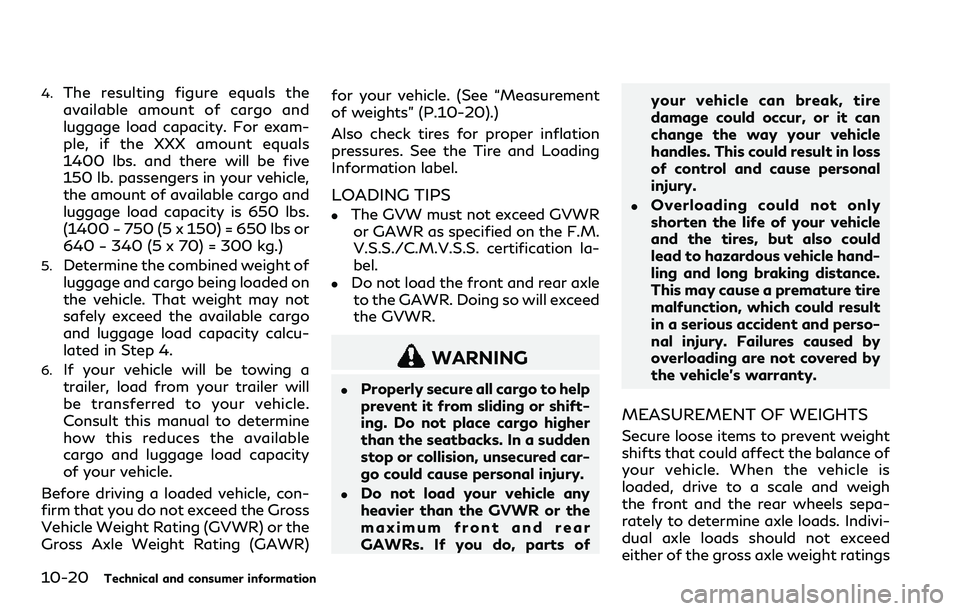
VEHICLE LOAD CAPACITY
Do not exceed the load limit of your
vehicle shown as “The combined
weight of occupants and cargo” on
the Tire and Loading Information
label. Do not exceed the number of
occupants shown as “Seating Capa-
city” on the Tire and Loading Infor-
mation label.
To get “the combined weight of
occupants and cargo”, add the weight
of all occupants, then add the total
luggage weight. Examples are shown
in the illustration.
Steps for determining correct load
limit
1.Locate the statement “The com-
bined weight of occupants and
cargo should never exceed XXX
kg or XXX lbs” on your vehicle’s
placard.
2.Determine the combined weight of
the driver and passengers that will
be riding in your vehicle.
3.Subtract the combined weight of
the driver and passengers from
XXX kg or XXX lbs.
Technical and consumer information10-19
Page 445 of 466
10-20Technical and consumer information
4.The resulting figure equals the
available amount of cargo and
luggage load capacity. For exam-
ple, if the XXX amount equals
1400 lbs. and there will be five
150 lb. passengers in your vehicle,
the amount of available cargo and
luggage load capacity is 650 lbs.
(1400 − 750 (5 x 150) = 650 lbs or
640 − 340 (5 x 70) = 300 kg.)
5.Determine the combined weight of
luggage and cargo being loaded on
the vehicle. That weight may not
safely exceed the available cargo
and luggage load capacity calcu-
lated in Step 4.
6.If your vehicle will be towing a
trailer, load from your trailer will
be transferred to your vehicle.
Consult this manual to determine
how this reduces the available
cargo and luggage load capacity
of your vehicle.
Before driving a loaded vehicle, con-
firm that you do not exceed the Gross
Vehicle Weight Rating (GVWR) or the
Gross Axle Weight Rating (GAWR)for your vehicle. (See “Measurement
of weights” (P.10-20).)
Also check tires for proper inflation
pressures. See the Tire and Loading
Information label.
LOADING TIPS
.The GVW must not exceed GVWR
or GAWR as specified on the F.M.
V.S.S./C.M.V.S.S. certification la-
bel.
.Do not load the front and rear axle
to the GAWR. Doing so will exceed
the GVWR.
WARNING
.Properly secure all cargo to help
prevent it from sliding or shift-
ing. Do not place cargo higher
than the seatbacks. In a sudden
stop or collision, unsecured car-
go could cause personal injury.
.Do not load your vehicle any
heavier than the GVWR or the
maximum front and rear
GAWRs. If you do, parts ofyour vehicle can break, tire
damage could occur, or it can
change the way your vehicle
handles. This could result in loss
of control and cause personal
injury.
.Overloading could not only
shorten the life of your vehicle
and the tires, but also could
lead to hazardous vehicle hand-
ling and long braking distance.
This may cause a premature tire
malfunction, which could result
in a serious accident and perso-
nal injury. Failures caused by
overloading are not covered by
the vehicle’s warranty.
MEASUREMENT OF WEIGHTS
Secure loose items to prevent weight
shifts that could affect the balance of
your vehicle. When the vehicle is
loaded, drive to a scale and weigh
the front and the rear wheels sepa-
rately to determine axle loads. Indivi-
dual axle loads should not exceed
either of the gross axle weight ratings
Page 446 of 466

(GAWR). The total of the axle loads
should not exceed the gross vehicle
weight rating (GVWR). These ratings
are given on the vehicle certification
label. If weight ratings are exceeded,
move or remove items to bring all
weights below the ratings.Do not tow a trailer with your
vehicle.
FLAT TOWING
Towing your vehicle with all four wheels on
the ground is sometimes called flat towing.
This method is sometimes used when towing
a vehicle behind a recreational vehicle, such
as a motor home.
CAUTION
.Failure to follow these guidelines can
result in severe transmission damage.
.Whenever flat towing your vehicle,
always tow forward, never back-
ward.
.DO NOT tow any Automatic Trans-
mission (AT) vehicle with all four
wheels on the ground (flat towing).
Doing so WILL DAMAGE internal
transmission parts due to lack of
transmission lubrication.
.DO NOT tow any All-Wheel Drive
(AWD) vehicle with any of the wheels
on the ground. Doing so may cause
serious and expensive damage to the
powertrain.
.For emergency towing procedures
refer to “Towing recommended byINFINITI” (P.6-23).
Automatic Transmission
All-Wheel Drive (AWD) models:
Do not tow an AWD vehicle with any of the
wheels on the ground.
Two-Wheel Drive (2WD) models:
To tow a vehicle equipped with an automatic
transmission, an appropriate vehicle dolly
MUSTbe placed under the towed vehicle’s
drive wheels.Alwaysfollow the dolly man-
ufacturer’s recommendations when using
their product.
Technical and consumer information10-21
TOWING A TRAILER