service INFINITI Q60 2018 Workshop Manual
[x] Cancel search | Manufacturer: INFINITI, Model Year: 2018, Model line: Q60, Model: INFINITI Q60 2018Pages: 466, PDF Size: 2.47 MB
Page 312 of 466
an INFINITI retailer for this service.BRAKE ASSIST
When the force applied to the brake pedal
exceeds a certain level, the Brake Assist is
activated generating greater braking force
than a conventional brake booster even with
light pedal force.
WARNING
The Brake Assist is only an aid to assist
braking operation and is not a collision
warning or avoidance device. It is the
driver’s responsibility to stay alert, drive
safely and be in control of the vehicle at
all times.
ANTI-LOCK BRAKING SYSTEM
(ABS)
WARNING
.The Anti-lock Braking System (ABS)
is a sophisticated device, but it
cannot prevent accidents resulting
from careless or dangerous driving
techniques. It can help maintain ve-
hicle control during braking on slip-
pery surfaces. Remember that
stopping distances on slippery sur-faces will be longer than on normal
surfaces even with ABS. Stopping
distances may also be longer on
rough, gravel or snow covered roads,
or if you are using tire chains. Always
maintain a safe distance from the
vehicle in front of you. Ultimately,
the driver is responsible for safety.
.Tire type and condition may also
affect braking effectiveness.
— When replacing tires, install the
specified size of tires on all four
wheels.
— When installing a spare tire, make
sure that it is the proper size and
type as specified on the Tire and
Loading Information label. See
“Tire and loading information la-
bel” (P.10-16) of this manual.
— For detailed information, see
“Wheels and tires” (P.8-32) of
this manual.
The Anti-lock Braking System (ABS) controls
the brakes so the wheels do not lock during
hard braking or when braking on slippery
surfaces. The system detects the rotation
speed at each wheel and varies the brake
fluid pressure to prevent each wheel from
locking and sliding. By preventing each
Starting and driving5-133
BRAKE ASSIST
Page 313 of 466
5-134Starting and driving
wheel from locking, the system helps the
driver maintain steering control and helps to
minimize swerving and spinning on slippery
surfaces.
Using the system
Depress the brake pedal and hold it down.
Depress the brake pedal with firm steady
pressure, but do not pump the brakes. The
ABS will operate to prevent the wheels from
locking up. Steer the vehicle to avoid
obstacles.
WARNING
Do not pump the brake pedal. Doing so
may result in increased stopping dis-
tances.
Self-test feature
The ABS includes electronic sensors, electric
pumps, hydraulic solenoids and a computer.
The computer has a built-in diagnostic
feature that tests the system each time you
start the engine and move the vehicle at a
low speed in forward or reverse. When the
self-test occurs, you may hear a “clunk”
noise and/or feel a pulsation in the brake
pedal. This is normal and does not indicate a
malfunction. If the computer senses a mal-function, it switches the ABS off and
illuminates the ABS warning light on the
instrument panel. The brake system then
operates normally, but without anti-lock
assistance.
If the ABS warning light illuminates during
the self-test or while driving, have the
vehicle checked. It is recommended you visit
an INFINITI retailer for this service.
Normal operation
The ABS operates at speeds above 3 to 6
MPH (5 to 10 km/h).
When the ABS senses that one or more
wheels are close to locking up, the actuator
rapidly applies and releases hydraulic pres-
sure. This action is similar to pumping the
brakes very quickly. You may feel a pulsation
in the brake pedal and hear a noise from
under the hood or feel a vibration from the
actuator when it is operating. This is normal
and indicates that the ABS is operating
properly. However, the pulsation may indi-
cate that road conditions are hazardous and
extra care is required while driving.The Vehicle Dynamic Control (VDC) system
uses various sensors to monitor driver inputs
and vehicle motion. Under certain driving
conditions, the VDC system helps to perform
the following functions.
.Controls brake pressure to reduce wheel
slip on one slipping drive wheel so power
is transferred to a non slipping drive
wheel on the same axle.
.Controls brake pressure and engine out-
put to reduce drive wheel slip based on
vehicle speed (traction control function).
.Controls brake pressure at individual
wheels and engine output to help the
driver maintain control of the vehicle in
the following conditions:
— understeer (vehicle tends to not follow
the steered path despite increased
steering input)
— oversteer (vehicle tends to spin due to
certain road or driving conditions).
The VDC system can help the driver to
maintain control of the vehicle, but it cannot
prevent loss of vehicle control in all driving
situations.
When the VDC system operates, the VDC
warning light
in the instrument panel
flashes so note the following:
.The road may be slippery or the system
may determine some action is required to
help keep the vehicle on the steered path.
VEHICLE DYNAMIC CONTROL
(VDC) SYSTEM
Page 327 of 466
6-2In case of emergency
SIC2574
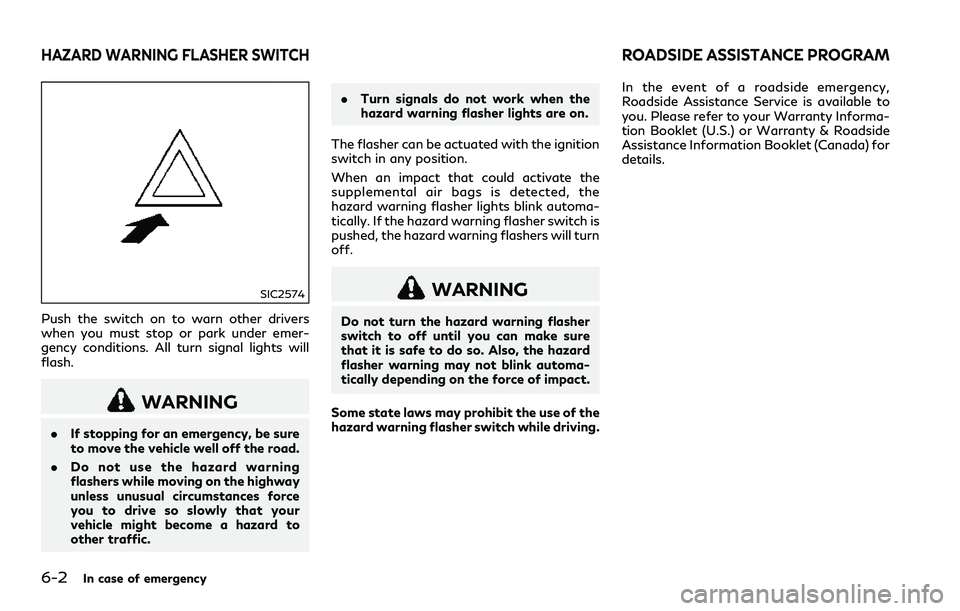
Push the switch on to warn other drivers
when you must stop or park under emer-
gency conditions. All turn signal lights will
flash.
WARNING
.If stopping for an emergency, be sure
to move the vehicle well off the road.
.Do not use the hazard warning
flashers while moving on the highway
unless unusual circumstances force
you to drive so slowly that your
vehicle might become a hazard to
other traffic..Turn signals do not work when the
hazard warning flasher lights are on.
The flasher can be actuated with the ignition
switch in any position.
When an impact that could activate the
supplemental air bags is detected, the
hazard warning flasher lights blink automa-
tically. If the hazard warning flasher switch is
pushed, the hazard warning flashers will turn
off.
WARNING
Do not turn the hazard warning flasher
switch to off until you can make sure
that it is safe to do so. Also, the hazard
flasher warning may not blink automa-
tically depending on the force of impact.
Some state laws may prohibit the use of the
hazard warning flasher switch while driving.In the event of a roadside emergency,
Roadside Assistance Service is available to
you. Please refer to your Warranty Informa-
tion Booklet (U.S.) or Warranty & Roadside
Assistance Information Booklet (Canada) for
details.
HAZARD WARNING FLASHER SWITCHROADSIDE ASSISTANCE PROGRAM
Page 329 of 466

6-4In case of emergency
tire pressure warning light will flash
for approximately 1 minute. The light
will remain on after 1 minute. Have
your tires replaced and/or TPMS
system reset as soon as possible. It
is recommended you visit an INFINITI
retailer for these services.
.Replacing tires with those not origin-
ally specified by INFINITI could affect
the proper operation of the TPMS.
.Do not inject any tire liquid or aerosol
tire sealant into the tires, as this may
cause a malfunction of the tire pres-
sure sensors.
.INFINITI recommends using only
Genuine NISSAN Emergency Tire
Sealant provided with your vehicle.
Other tire sealants may damage the
valve stem seal which can cause the
tire to lose air pressure. It is recom-
mended you visit an INFINITI retailer
as soon as possible after using tire
repair sealant (for models equipped
with the emergency tire puncture
repair kit).RUN-FLAT TIRES
Run-flat tires are those tires that can be
used temporarily if they are punctured. See
“Run-flat tires” (P.8-39).
Also, refer to “Important Tire Safety Infor-
mation” (US) or “Tire Safety Information”
(Canada) in the INFINITI Warranty Informa-
tion Booklet.
WARNING
.Although you can continue driving
with a punctured run-flat tire, re-
member that vehicle handling stabi-
lity is reduced, which could lead to an
accident and personal injury. Also,
driving a long distance at high speeds
may damage the tires.
.Do not drive at speeds above 50
MPH (80 km/h) and do not drive
more than approximately 93 miles
(150 km) with a punctured run-flat
tire. The actual distance the vehicle
can be driven on a flat tire depends on
outside temperature, vehicle load,
road conditions and other factors.
.Drive safely at reduced speeds. Avoid
hard cornering or braking, which may
cause you to lose control of the
vehicle..If you detect any unusual sounds or
vibrations while driving with a punc-
tured run-flat tire, pull off the road
to a safe location and stop the vehicle
as soon as possible. The tire may be
seriously damaged and need to be
replaced.
CAUTION
.Never install tire chains on a punctu-
red run-flat tire, as this could damage
your vehicle.
.Avoid driving over any projection or
pothole, as the clearance between
the vehicle and the ground is smaller
than normal.
.Do not enter an automated car wash
with a punctured run-flat tire.
.It is recommended you have the
punctured tire inspected by an
INFINITI retailer or other authorized
repair shop. Replace the tire as soon
as possible if the tire is seriously
damaged.
Page 334 of 466
3. With the wheel nut wrench, tighten
wheel nuts alternately and evenly in the
sequence illustrated (
,,,,) until
they are tight.
4. Lower the vehicle slowly until the tire
touches the ground. Then, with the
wheel nut wrench, tighten the wheel
nuts securely in the sequence as illu-
strated. Lower the vehicle completely.
WARNING
.Incorrect wheel nuts or improperly
tightened wheel nuts can cause the
wheel to become loose or come off.
This could cause an accident.
.Do not use oil or grease on the wheel
studs or nuts. This could cause the
nuts to become loose.
.Retighten the wheel nuts when the
vehicle has been driven for 600 miles
(1,000 km) (also in cases of a flat tire,
etc.).
.As soon as possible, tighten the wheel
nuts to the specified torque with a
torque wrench.
Wheel nut tightening torque:
80 ft-lb (108 N·m)The wheel nuts must be kept tigh-
tened to specification at all times. It
is recommended that wheel nuts be
tightened to specifications at each
lubrication interval.
.Adjust tire pressure to the COLD
pressure.
COLD pressure:
After the vehicle has been parked for
three hours or more or driven less
than 1 mile (1.6 km).
COLD tire pressures are shown on
the Tire and Loading Information
label affixed to the driver side center
pillar.
5. Securely store the flat tire and jacking
equipment in the vehicle.
6. Place the spare tire cover (if so equipped)
and the trunk floor carpeting over the
damaged tire.
7. Close the trunk.
WARNING
.Always make sure that the spare tire
(if so equipped) and jacking equip-
ment are properly secured after use.
Such items can become dangerous
projectiles in an accident or sudden
stop..The T-type spare tire and small size
spare tire (if so equipped) are de-
signed for emergency use. See spe-
cific instructions under the heading
“Wheels and tires” (P.8-32).
REPAIRING A FLAT TIRE (for
models with emergency tire punc-
ture repair kit)
WARNING
.After using Emergency Tire Sealant
to repair a minor tire puncture, do not
drive the vehicle at speeds faster
than 50 MPH (80 km/h).
.Immediately after using the Emer-
gency Tire Sealant to repair a minor
tire puncture, take your vehicle to
inspect, and repair or replace the tire.
It is recommended you visit an
INFINITI retailer for this service. The
Emergency Tire Sealant cannot per-
manently seal a punctured tire. Con-
tinuing operation of the vehicle
without a permanent tire repair can
lead to a crash.
.INFINITI recommends using only
Genuine NISSAN Emergency Tire
In case of emergency6-9
Page 339 of 466
6-14In case of emergency
puncture repair kit.It is recommended
you visit an INFINITI retailer for servi-
cing.
7. When the tire pressure is at the specified
amount, turn the air compressor off. If
the pressure cannot be inflated to the
specified amount, the air compressor can
be turned off at the minimum of 26 psi
(180 kPa). Remove the power plug from
the power outlet and quickly remove the
hose from the tire valve. Attach the
protective cap and valve cap. Properly
stow the emergency tire puncture repair
kit in the trunk.
CAUTION
To avoid serious personal injury when
stowing the emergency tire puncture
repair kit:
.Keep the sealant bottle screwed into
the compressor. Failure to do so can
cause the sealant to spray into the air
and get into your eyes or on the skin.
8. Immediately drive the vehicle for 10
minutes or 2 miles (3 km) at a speed of
50 MPH (80 km/h) or less.
9. After driving, make sure that the air
compressor switch is in the OFF (*)position, then screw the hose securely
onto the tire valve. Check the tire
pressure with the pressure gauge. The
temporary repair is completed if the tire
pressure does not drop.
Make sure the pressure is adjusted to the
pressure that is specified on the tire and
loading information label before driving.
10. If the tire pressure drops, repeat the
steps from 5 to 9. If the pressure drops
again or under 19 psi (130 kPa),the tire
cannot be repaired with this tire punc-
ture repair kit.It is recommended you
visit an INFINITI retailer for this servi-
cing.
The sealant bottle and hose cannot be
reused to repair another punctured tire.
It is recommended you visit an INFINITI
retailer to purchase replacements.
After repairing tire
It is recommended you visit an INFINITI
retailer for tire repair/replacement as soon
as possible.
WARNING
.After using Emergency Tire Sealant
to repair a minor tire puncture, do not
drive the vehicle at speeds fasterthan 50 MPH (80 km/h).
.Immediately after using Emergency
Tire Sealant to repair a minor tire
puncture, take your vehicle to in-
spect, and repair or replace the tire.
It is recommended you visit an
INFINITI retailer for this service. The
Emergency Tire Sealant cannot per-
manently seal a punctured tire. Con-
tinuing operation of the vehicle
without a permanent tire repair can
lead to a crash.
.INFINITI recommends using only
Genuine NISSAN Emergency Tire
Sealant provided with your vehicle.
Other tire sealants may damage the
valve stem seal which can cause the
tire to lose air pressure. It is recom-
mended you visit an INFINITI retailer
as soon as possible after using tire
repair sealant.
Page 347 of 466
6-22In case of emergency
at a fast idle (approximately 1,500 rpm)
until the temperature gauge indication
returns to normal.
4. Get out of the vehicle. Look and listen for
steam or coolant escaping from the
radiator before opening the hood. (If
steam or coolant is escaping, turn off the
engine.) Do not open the hood further
until no steam or coolant can be seen.
5. Open the engine hood.
WARNING
If steam or water is coming from the
engine, stand clear to prevent getting
burned.
6. Visually check drive belts for damage or
looseness. Also check if the cooling fan is
running. The radiator hoses and radiator
should not leak water. If coolant is
leaking or the cooling fan does not run,
stop the engine.
WARNING
Be careful not to allow your hands, hair,
jewelry or clothing to come into contact
with, or get caught in, engine belts or the
engine cooling fan. The engine coolingfan can start at any time.
7. After the engine cools down, check the
coolant level in the reservoir tank with
the engine running. Add coolant to the
reservoir tank if necessary. Have your
vehicle repaired. It is recommended you
visit an INFINITI retailer for this service.When towing your vehicle, all State (Pro-
vincial in Canada) and local regulations for
towing must be followed. Incorrect towing
equipment could damage your vehicle. Tow-
ing instructions are available from an
INFINITI retailer. Local service operators
are familiar with the applicable laws and
procedures for towing. To assure proper
towing and to prevent accidental damage to
your vehicle, INFINITI recommends that you
have a service operator tow your vehicle. It is
advisable to have the service operator care-
fully read the following precautions.
WARNING
.Never ride in a vehicle that is being
towed.
.Never get under your vehicle after it
has been lifted by a tow truck.
CAUTION
.When towing, make sure that the
transmission, axles, steering system
and powertrain are in working con-
dition. If any unit is damaged, dollies
must be used.
.Always attach safety chains before
TOWING YOUR VEHICLE
Page 350 of 466
designed specifically for vehicle recovery.
Always follow the manufacturer’s instruc-
tions for the recovery device.
Rocking a stuck vehicle
If your vehicle is stuck in sand, snow, mud,
etc., use the following procedure:
1. Turn off the Vehicle Dynamic Control
(VDC) system.
2. Make sure the area in front and behind
the vehicle is clear of obstructions.
3. Turn the steering wheel right and left to
clear an area around the front tires.
4. Slowly rock the vehicle forward and
backward.
.Shift back and forth between R (Re-
verse) and D (Drive).
.Apply the accelerator as little as
possible to maintain the rocking mo-
tion.
.Release the accelerator pedal before
shifting between R and D.
.Do not spin the tires above 35 MPH
(55 km/h).
5. If the vehicle cannot be freed after a few
tries, contact a professional towing
service to remove the vehicle.
WARNING
.Stand clear of a stuck vehicle.
.Do not spin your tires at high speed.
This could cause them to explode and
result in serious injury. Parts of your
vehicle could also overheat and be
damaged.
In case of emergency6-25
Page 362 of 466
When performing any inspection or main-
tenance work on your vehicle, always take
care to prevent serious accidental injury to
yourself or damage to the vehicle. The
following are general precautions which
should be closely observed.
WARNING
.Park the vehicle on a level surface,
apply the parking brake securely and
block the wheels to prevent the
vehicle from moving. Move the shift
lever to P (Park).
.Be sure the ignition switch is in the
OFF or LOCK position when per-
forming any parts replacement or
repairs.
.Never connect or disconnect the
battery or any transistorized compo-
nent while the ignition switch is in the
ON position.
.Never leave the engine or automatic
transmission related component har-
nesses disconnected while the igni-
tion switch is in the ON position.
.If you must work with the engine
running, keep your hands, clothing,
hair and tools away from moving
fans, belts and any other movingparts.
.It is advisable to secure or remove
any loose clothing and remove any
jewelry, such as rings, watches, etc.
before working on your vehicle.
.Always wear eye protection when-
ever you work on your vehicle.
.If you must run the engine in an
enclosed space such as a garage, be
sure there is proper ventilation for
exhaust gases to escape.
.Never get under the vehicle while it is
supported only by a jack. If it is
necessary to work under the vehicle,
support it with safety stands.
.Keep smoking materials, flame and
sparks away from fuel tank and the
battery.
.Your vehicle is equipped with an
automatic engine cooling fan. It may
come on at any time without warn-
ing, even if the ignition key is in the
OFF position and the engine is not
running. To avoid injury, always dis-
connect the negative battery cable
before working near the fan.
.Because the fuel lines are under high
pressure even when the engine is off,
it is recommended you visit an
INFINITI retailer for service of thefuel filter or fuel lines.
CAUTION
.Do not work under the hood while the
engine is hot. Turn the engine off and
wait until it cools down.
.Avoid direct contact with used en-
gine oil and coolant. Improperly dis-
posed engine oil, coolant, and/or
other vehicle fluids can damage the
environment. Always conform to lo-
cal regulations for disposal of vehicle
fluid.
This “8. Do-it-yourself” section gives in-
structions regarding only those items which
are relatively easy for an owner to perform.
A genuine INFINITI Service Manual is also
available. (See “Owner’s Manual/Service
Manual order information” (P.10-25).)
You should be aware that incomplete or
improper servicing may result in operating
difficulties or excessive emissions, and could
affect your warranty coverage.If in doubt
about any servicing, it is recommended you
have it done by an INFINITI retailer.
Do-it-yourself8-3
MAINTENANCE PRECAUTIONS
Page 366 of 466
JVM0652X
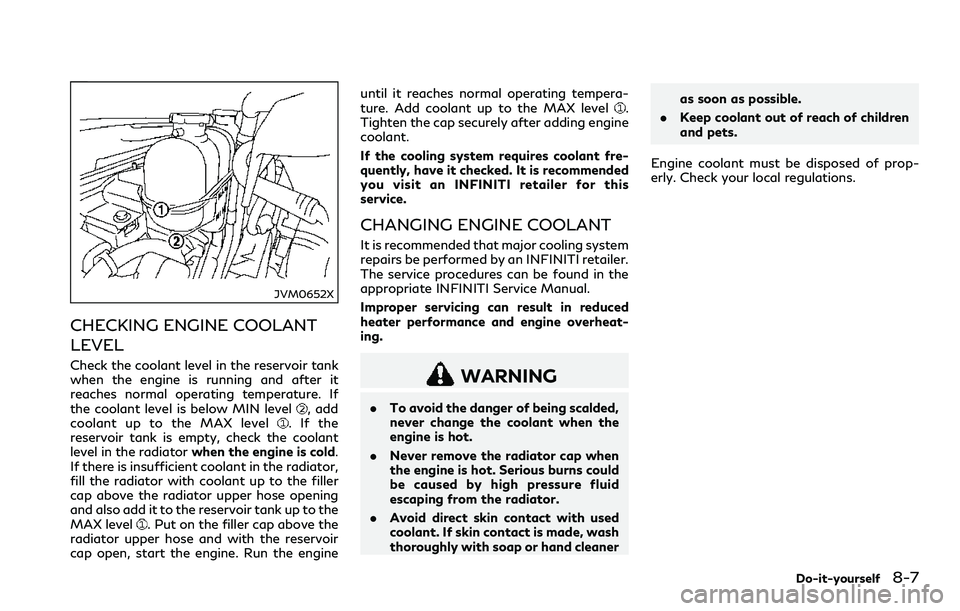
CHECKING ENGINE COOLANT
LEVEL
Check the coolant level in the reservoir tank
when the engine is running and after it
reaches normal operating temperature. If
the coolant level is below MIN level
, add
coolant up to the MAX level. If the
reservoir tank is empty, check the coolant
level in the radiatorwhen the engine is cold.
If there is insufficient coolant in the radiator,
fill the radiator with coolant up to the filler
cap above the radiator upper hose opening
and also add it to the reservoir tank up to the
MAX level
. Put on the filler cap above the
radiator upper hose and with the reservoir
cap open, start the engine. Run the engineuntil it reaches normal operating tempera-
ture. Add coolant up to the MAX level
.
Tighten the cap securely after adding engine
coolant.
If the cooling system requires coolant fre-
quently, have it checked. It is recommended
you visit an INFINITI retailer for this
service.
CHANGING ENGINE COOLANT
It is recommended that major cooling system
repairs be performed by an INFINITI retailer.
The service procedures can be found in the
appropriate INFINITI Service Manual.
Improper servicing can result in reduced
heater performance and engine overheat-
ing.
WARNING
.To avoid the danger of being scalded,
never change the coolant when the
engine is hot.
.Never remove the radiator cap when
the engine is hot. Serious burns could
be caused by high pressure fluid
escaping from the radiator.
.Avoid direct skin contact with used
coolant. If skin contact is made, wash
thoroughly with soap or hand cleaneras soon as possible.
.Keep coolant out of reach of children
and pets.
Engine coolant must be disposed of prop-
erly. Check your local regulations.
Do-it-yourself8-7