set INFINITI Q60 CONVERTIBLE 2015 Towing Guide
[x] Cancel search | Manufacturer: INFINITI, Model Year: 2015, Model line: Q60 CONVERTIBLE, Model: INFINITI Q60 CONVERTIBLE 2015Pages: 25, PDF Size: 0.42 MB
Page 2 of 25
2015 Infiniti Towing Guide
1
SAFETY IS PRIORITY ONE
Obviously, your first concern should be safety. Your vehicle was designed to be used primarily to
carry passengers and cargo. Always remember that towing a trailer places additional loads on your
vehicle’s engine, drivetrain, suspension, steering, braking, and other systems. Therefore, be certain
that your vehicle can meet the demands of the towing application you have in mind.
Rent or purchase only the highest-quality towing and safety equipment you can find. Reinforced tow
hitches designed especially for certain Infiniti vehicles are available from your Infiniti retailer.
Hitches for other Infiniti models — if Infiniti recommends towing with that vehicle — should be
bought from and installed by a professional supplier of towing equipment. Carefully review all
information and literature provided with any hitch you purchase for safety and proper use
information. Finally, it is important to follow the towing capacity limit set for your specific vehicle
and to ensure that your vehicle is in top mechanical condition, especially the tires, brakes,
suspension, and engine cooling system. See your vehicle owner’s manual for details.
NEVER EXCEED THE ESTABLISHED TOWING CAPACITY
Towing capacities vary from vehicle to vehicle. See the towing information in your vehicle owner’s
manual to confirm whether your 2015 Infiniti vehicle can be used for towing and if so it’s towing
capacity . Use this data to help select the proper Infiniti vehicle to meet your anticipated towing
needs, and refer to it when towing, renting a trailer or other piece of towing equipment.
EQUIP YOUR INFINITI FOR TOWING
The frequency and type of towing dictate the manner in which you equip your vehicle. If you plan to
tow often, either for recreation or work, select the engine size, transmission type, suspension, and
towing capacity that are best suited to your requirements. This guide can help you select the proper
equipment.
READ THIS GUIDE BEFORE YOU TOW
This guide was designed to provide an overview of safe towing practices. Here, you will find
information on towing equipment, safety, proper loading and driving techniques, towing tips, and
much more.
It is also a good idea to discuss your towing requirements with either your Infiniti retailer or a
professional supplier of towing equipment before you equip your Infiniti vehicle for towing.
Finally, there are state and local laws on towing that you should review to ensure compliance with
all regulations.
CAUTION: Infiniti recommends you do not use your new vehicle to tow a trailer or haul a heavy
load for the first 500 miles (800 km) of use. Your engine, axle or other parts could be damaged.
For the first 500 miles that you tow a trailer, do not drive over 50 mph and do not make starts at
full throttle. This helps your engine and other parts of your vehicle wear in at heavier loads.
INTRODUCTION
Page 13 of 25
2015 Infiniti Towing Guide
12 The GCW you come up with must not exceed the Gross Combined Weight Rating (GCWR) for your
vehicle. Refer to your vehicle owner’s manual to view the maximum GCWR specification listed for
your vehicle.
TRAILER TONGUE LOAD
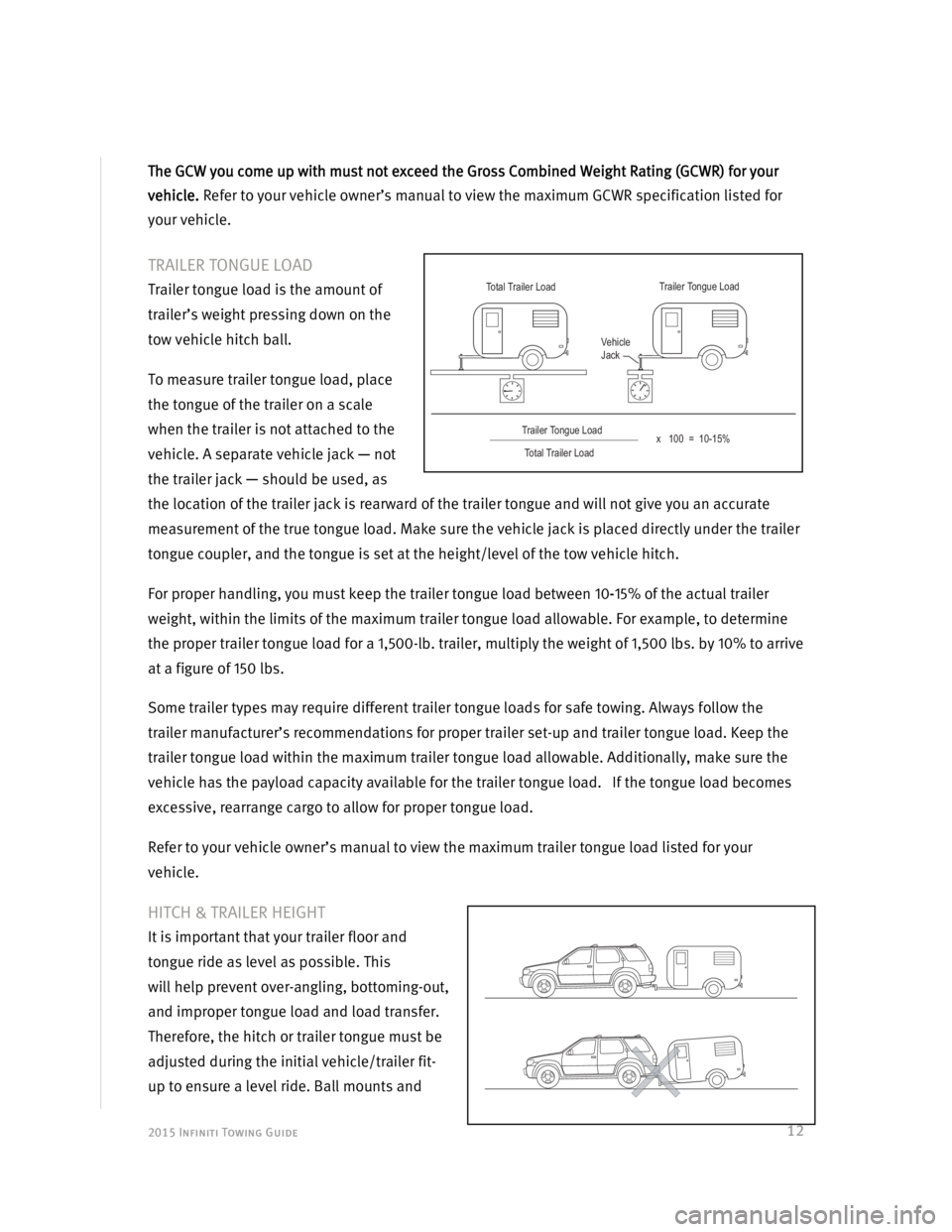
Trailer tongue load is the amount of
trailer’s weight pressing down on the
tow vehicle hitch ball.
To measure trailer tongue load, place
the tongue of the trailer on a scale
when the trailer is not attached to the
vehicle. A separate vehicle jack — not
the trailer jack — should be used, as
the location of the trailer jack is rearward of the trailer tongue and will not give you an accurate
measurement of the true tongue load. Make sure the vehicle jack is placed directly under the trailer
tongue coupler, and the tongue is set at the height/level of the tow vehicle hitch.
For proper handling, you must keep the trailer tongue load between 10-15% of the actual trailer
weight, within the limits of the maximum trailer tongue load allowable. For example, to determine
the proper trailer tongue load for a 1,500-lb. trailer, multiply the weight of 1,500 lbs. by 10% to arrive
at a figure of 150 lbs.
Some trailer types may require different trailer tongue loads for safe towing. Always follow the
trailer manufacturer’s recommendations for proper trailer set-up and trailer tongue load. Keep the
trailer tongue load within the maximum trailer tongue load allowable. Additionally, make sure the
vehicle has the payload capacity available for the trailer tongue load. If the tongue load becomes
excessive, rearrange cargo to allow for proper tongue load.
Refer to your vehicle owner’s manual to view the maximum trailer tongue load listed for your
vehicle.
HITCH & TRAILER HEIGHT
It is important that your trailer floor and
tongue ride as level as possible. This
will help prevent over-angling, bottoming-out,
and improper tongue load and load transfer.
Therefore, the hitch or trailer tongue must be
adjusted during the initial vehicle/trailer fit-
up to ensure a level ride. Ball mounts and
Trailer Tongue Load
Total Trailer Loadx 100 = 10-15%
Vehicle
Jack
Trailer Tongue Load
Total Trailer Load
Page 14 of 25
2015 Infiniti Towing Guide
13
weight distribution hitches are available in different configurations to adjust the tongue load and
load transfer and hitch ball height.
WARNING - Towing can significantly alter the handling and performance characteristics of your
vehicle. Moreover, it puts increased strain on the engine and drivetrain. Therefore, it is always a
good idea to approach towing from the standpoint of safety — whether you are purchasing
equipment or actually pulling the trailer.
WARNING- Always make sure your vehicle’s towing capacity is adequate for the trailer you
intend to tow. Be certain that you have all of the proper equipment needed for safe towing, such
as safety chains/cables, electric trailer brakes, electric trailer brake controller, breakaway switch,
and extended rear view mirrors. Make certain your equipment conforms to all federal, state or local
regulations to help ensure against the possibility of a serious accident and personal injury or death.
You should follow a more frequent maintenance schedule and check fluid levels, pressures, tire
condition, etc., more often when on the road. See your vehicle owner’s manual for details.
LOADING YOUR TRAILER
WARNING- Taking the time to load and balance your trailer properly will improve overall
handling and minimize the strain on your tow vehicle. Incorrectly, loaded trailers tend to sway or
swing from side to side, upsetting vehicle handling which could result in a serious accident,
personal injury or death. Careful loading and balancing, and a weight distribution hitch and sway-
control device can help eliminate these problems.
As mentioned earlier, conventional trailer tongue load must fall between 10-15% of the total trailer
weight, or within the limits of the maximum trailer tongue load specified by the trailer
manufacturer.
WARNING- Excessive trailer tongue load can actually push down the tow vehicle in back, lifting
the front wheels to a point where traction, steering response, and braking may be severely reduced.
which could result in an accident, personal injury or death. Too little trailer tongue load or negative
load can lift the trailer tongue upwards on the trailer ball causing instability, which may lead to
swaying, “tail wagging,” or jackknifing which could result in an accident, personal injury or death.
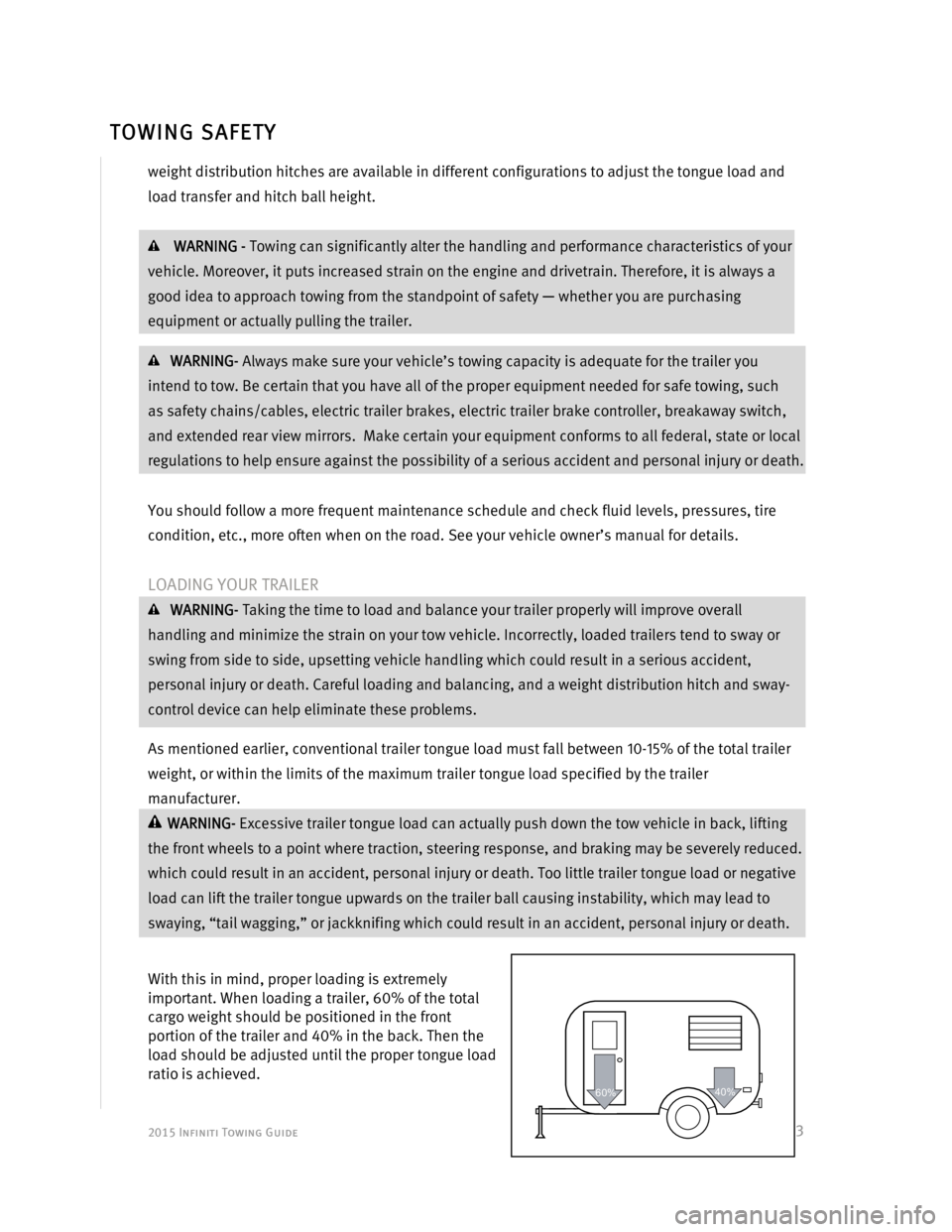
With this in mind, proper loading is extremely
important. When loading a trailer, 60% of the total
cargo weight should be positioned in the front
portion of the trailer and 40% in the back. Then the
load should be adjusted until the proper tongue load
ratio is achieved.
60%40%
TOWING SAFETY