radiator INFINITI Q70-HYBRID 2018 Owners Manual
[x] Cancel search | Manufacturer: INFINITI, Model Year: 2018, Model line: Q70-HYBRID, Model: INFINITI Q70-HYBRID 2018Pages: 458, PDF Size: 2.22 MB
Page 31 of 458
0-10Illustrated table of contents
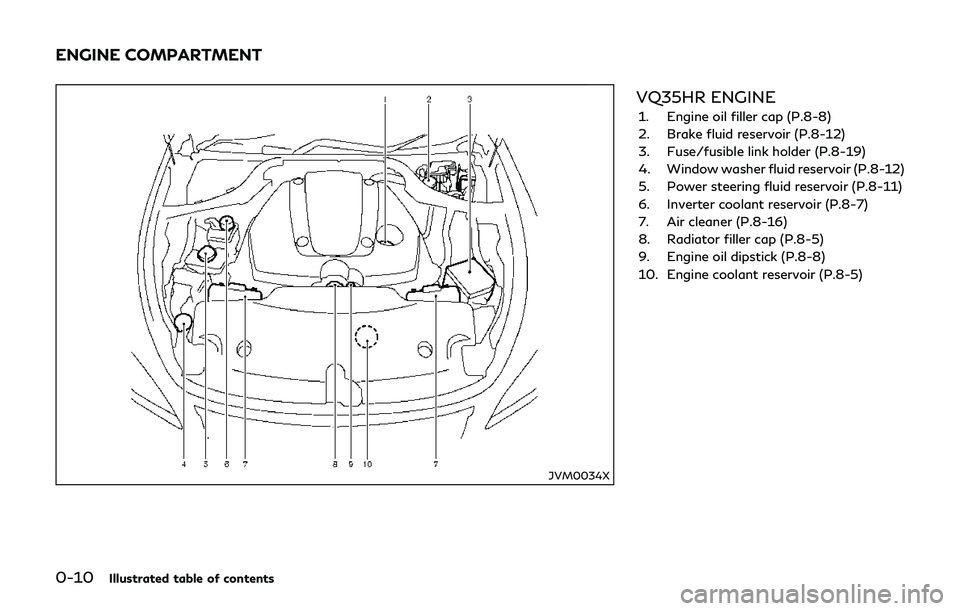
JVM0034X
VQ35HR ENGINE
1. Engine oil filler cap (P.8-8)
2. Brake fluid reservoir (P.8-12)
3. Fuse/fusible link holder (P.8-19)
4. Window washer fluid reservoir (P.8-12)
5. Power steering fluid reservoir (P.8-11)
6. Inverter coolant reservoir (P.8-7)
7. Air cleaner (P.8-16)
8. Radiator filler cap (P.8-5)
9. Engine oil dipstick (P.8-8)
10. Engine coolant reservoir (P.8-5)
ENGINE COMPARTMENT
Page 118 of 458

time.)
7. Distance to empty (dte — mls or
km)
The distance to empty (dte) mode provides
you with an estimation of the distance that
can be driven before refueling. The dte is
constantly being calculated, based on the
amount of fuel in the fuel tank and the actual
fuel consumption.
The display is updated every 30 seconds.
The dte mode includes a low range warning
feature. If the fuel level is low, the warning is
displayed on the screen.
When the fuel level drops even lower, the
dte display will change to “——”.
.If the amount of fuel added is small, the
display just before the ignition switch is
pushed to the OFF position may con-
tinue to be displayed.
. When driving uphill or rounding curves,
the fuel in the tank shifts, which may
momentarily change the display.
8. Engine coolant temperature
gauge
The gauge indicates the engine coolant
temperature.
This displays the temperature of the engine
coolant. The range of coolant overheat is indicated by the horizontal line of the upper
part of the H mark.
The engine coolant temperature varies with
the outside air temperature and driving
conditions.
CAUTION
If the engine is overheated, continued
operation of the vehicle may seriously
damage the engine. See “If your vehicle
overheats” (P.6-12) for immediate ac-
tion required.
9. Outside air temperature (ICY — °F
or °C)
The outside air temperature is displayed in °F
or °C in the range of −22 to 140°F (−30 to
60°C).
The outside air temperature mode includes a
low temperature warning feature. If the
outside air temperature is below 37°F
(3°C), the warning is displayed on the screen.
The outside temperature sensor is located in
front of the radiator. The sensor may be
affected by road or engine heat, wind
directions and other driving conditions. The
display may differ from the actual outside
temperature or the temperature displayed
on various signs or billboards.
10. Setting
Setting is available while the hybrid system
is running.
Setting cannot be made while driving. A
message “Setting can only be operated
when stopped” is also displayed on the
vehicle information display.
The
switchandswitchare used
in the setting mode to select and decide a
menu.
SKIP:
Push the
switchto move to the
warning check mode.
Push the
switchto select other
menus.
ALERT:
There are the following submenus under the
alert menu.
. BACK
Select this submenu to return to the top
page of the setting mode.
. TIMER
Select this submenu to specify when the
“TIMER” indicator activates.
. ICY
Select this submenu to display the low
outside temperature warning.
Instruments and controls2-31
Page 361 of 458
6-12In case of emergency
NOTE:
If it is not possible to turn the hybrid system
ON by following this procedure, it is
recommended that you contact an INFINITI
retailer immediately.Do not attempt to start the engine by
pushing.
CAUTION
.
Automatic transmission models can-
not be push-started or tow-started.
Attempting to do so may cause
transmission damage.
. Three way catalyst equipped models
should not be started by pushing
since the three way catalyst may be
damaged.
. Never try to start the vehicle by
towing it; when the engine starts,
the forward surge could cause the
vehicle to collide with the tow vehi-
cle.
. Hybrid models cannot be push-
started or tow-started. Attempting
to do so may cause electrical or
transmission damage.
CAUTION
.Do not continue to drive if your
vehicle overheats. Doing so could
cause engine damage or a vehicle fire.
. To avoid the danger of being scalded,
never remove the radiator cap while
the engine is still hot. When the
radiator cap is removed, pressurized
hot water will spurt out, possibly
causing serious injury.
. Do not open the hood if steam is
coming out.
If your vehicle is overheating (indicated by an
extremely high temperature gauge reading),
or if you feel a lack of engine power, detect
abnormal noise, etc., take the following
steps:
1. Move the vehicle safely off the road, apply the parking brake and move the
shift lever to the P (Park) position.
Do not turn the INFINITI Direct Re-
sponse Hybrid
®System off.
2. Turn off the climate control. Open all the windows, move the heater or air condi-
tioner temperature control to maximum
hot and fan control to high speed.
PUSH STARTING IF YOUR VEHICLE OVERHEATS
Page 362 of 458

3. If engine overheating is caused by climb-ing a long hill on a hot day, run the engine
at a fast idle (approximately 1,500 rpm)
until the temperature gauge indication
returns to normal.
4. Get out of the vehicle. Look and listen for steam or coolant escaping from the
radiator before opening the hood. (If
steam or coolant is escaping, turn off the
hybrid system.) Do not open the hood
further until no steam or coolant can be
seen.
5. Open the engine hood.
WARNING
If steam or water is coming from the
engine, stand clear to prevent getting
burned.
6. Also check if the cooling fan is running. The radiator hoses and radiator should
not leak water. If coolant is leaking or the
cooling fan does not run, stop the hybrid
system.
WARNING
Be careful not to allow your hands, hair,
jewelry or clothing to come into contact
with, or get caught in, engine belts or the
engine cooling fan. The engine cooling
fan can start at any time.
7. After the engine cools down, check the coolant level in the reservoir tank with
the engine running. Add coolant to the
reservoir tank if necessary. Have your
vehicle repaired. It is recommended you
visit an INFINITI retailer for this service. When towing your vehicle, all State (Pro-
vincial in Canada) and local regulations for
towing must be followed. Incorrect towing
equipment could damage your vehicle. Tow-
ing instructions are available from an
INFINITI retailer. Local service operators
are familiar with the applicable laws and
procedures for towing. To assure proper
towing and to prevent accidental damage to
your vehicle, INFINITI recommends that you
have a service operator tow your vehicle. It is
advisable to have the service operator care-
fully read the following precautions.
WARNING
.
Never ride in a vehicle that is being
towed.
. Never get under your vehicle after it
has been lifted by a tow truck.
CAUTION
.When towing, make sure that the
transmission, axles, steering system
and powertrain are in working con-
dition. If any unit is damaged, dollies
must be used.
. Always attach safety chains before
In case of emergency6-13
TOWING YOUR VEHICLE
Page 377 of 458

8-4Do-it-yourself
JVM0034X
1. Engine oil filler cap
2. Brake fluid reservoir
3. Fuse/fusible link holder
4. Window washer fluid reservoir
5. Power steering fluid reservoir
6. Inverter coolant reservoir
7. Air cleaner
8. Radiator filler cap
9. Engine oil dipstick
10. Engine coolant reservoir
Page 378 of 458

The engine cooling system is filled at the
factory with a pre-diluted mixture of 50%
Genuine NISSAN Long Life Antifreeze/
Coolant (blue) and 50% water to provide
year-round anti-freeze and coolant protec-
tion. The anti-freeze solution contains rust
and corrosion inhibitors. Additional engine
cooling system additives are not necessary.
WARNING
.Never remove the radiator or coolant
reservoir cap when the engine is hot.
Wait until the engine and radiator
cool down. Serious burns could be
caused by high pressure fluid escap-
ing from the radiator. See precau-
tions in “If your vehicle overheats”
(P.6-12).
. The radiator is equipped with a
pressure type radiator cap. To pre-
vent engine damage, use only a
genuine NISSAN radiator cap.
CAUTION
.Never use any cooling system addi-
tives such as radiator sealer. Addi-
tives may clog the cooling system and
cause damage to the engine, trans- mission and/or cooling system.
. When adding or replacing coolant, be
sure to use only Genuine NISSAN
Long Life Antifreeze/Coolant (blue)
or equivalent. Genuine NISSAN Long
Life Antifreeze/Coolant (blue) is pre-
diluted to provide antifreeze protec-
tion to −34°F (−37°C). If additional
freeze protection is needed due to
weather where you operate your
vehicle, add Genuine NISSAN Long
Life Antifreeze/Coolant (blue) con-
centrate following the directions on
the container. If an equivalent cool-
ant other than Genuine NISSAN Long
Life Antifreeze/Coolant (blue) is
used, follow the coolant manufac-
ture’s instructions to maintain mini-
mum antifreeze protection to −34°F
(−37°C). The use of other types of
coolant solutions other than Genuine
NISSAN Long Life Antifreeze/Cool-
ant (blue) or equivalent may damage
the engine cooling system.
. The life expectancy of the factory-fill
coolant is 105,000 miles (168,000
km) or 7 years. Mixing any other type
of coolant other than Genuine
NISSAN Long Life Antifreeze/Cool-
ant (blue) , including Genuine NISSAN
Long Life Antifreeze/Coolant
(green), or the use of nondistilled water will reduce the life expectancy
of the factory-fill coolant. Refer to
the “9. Maintenance and schedules”
section of this manual for more de-
tails.
Do-it-yourself8-5
ENGINE COOLING SYSTEM
Page 379 of 458

8-6Do-it-yourself
SDI2043
CHECKING ENGINE COOLANT
LEVEL
Check the coolant levelin the reservoir
when the engine is cold. If the coolant level
is below MIN
, open the reservoir tank cap
and add coolant up to the MAXlevel. If the
reservoir tank is empty, check the coolant
level in the radiator when the engine is cold.
If there is insufficient coolant in the radiator,
fill the radiator with coolant up to the filler
opening and also add it to the reservoir tank
up to the MAX level
.
Tighten the cap securely after adding engine
coolant. If the cooling system requires coolant fre-
quently, have it checked. It is recommended
you visit an INFINITI retailer for this
service.
CHANGING ENGINE COOLANT
It is recommended that major cooling system
repairs be performed by an INFINITI retailer.
The service procedures can be found in the
appropriate INFINITI Service Manual.
Improper servicing can result in reduced
heater performance and engine overheat-
ing.
WARNING
.
To avoid the danger of being scalded,
never change the coolant when the
engine is hot.
. Never remove the radiator cap when
the engine is hot. Serious burns could
be caused by high pressure fluid
escaping from the radiator.
. Avoid direct skin contact with used
coolant. If skin contact is made, wash
thoroughly with soap or hand cleaner
as soon as possible.
. Keep coolant out of reach of children
and pets. Engine coolant must be disposed of prop-
erly. Check your local regulations.
Page 380 of 458

The inverter cooling system is filled at the
factory with a pre-diluted mixture of 50%
Genuine NISSAN Long Life Antifreeze/
Coolant (blue) and 50% water to provide
year-round anti-freeze and coolant protec-
tion. The antifreeze solution contains rust
and corrosion inhibitors. Additional inverter
cooling system additives are not necessary.
WARNING
.Never remove the coolant reservoir
cap when the engine and inverter are
hot. Wait until the engine and in-
verter cool down. Serious burns could
be caused by high pressure fluid
escaping from the radiator.
. The inverter reservoir is equipped
with a pressure type cap. To prevent
engine and inverter damage, use only
a genuine NISSAN inverter reservoir
cap.
CAUTION
.When adding or replacing coolant, be
sure to use only Genuine NISSAN
Long Life Antifreeze/Coolant (blue)
or equivalent. Genuine NISSAN Long
Life Antifreeze/Coolant (blue) is pre- diluted to provide antifreeze protec-
tion to −34°F(−37°C). If additional
freeze protection is needed due to
weather where you operate your
vehicle, add Genuine NISSAN Long
Life Antifreeze/Coolant (blue) con-
centrate following the directions on
the container. If an equivalent cool-
ant other than Genuine NISSAN Long
Life Antifreeze/Coolant (blue) is
used, follow the coolant manufatur-
urer’s instructions to maintain mini-
mum antifreeze protection to −34°F
(−37°C). The use of other types of
coolant solutions other than Genuine
NISSAN Long Life Antifreeze/Cool-
ant (blue) or equivalent may damage
the inverter cooling system.
. The life expectancy of the factory-fill
coolant is 125,000 miles (200,000
km) or 15 years. Mixing any other
type of coolant other than Genuine
NISSAN Long Life Antifreeze/Cool-
ant (blue), including Genuine NISSAN
Long Life Antifreeze/Coolant
(green), or the use of non-distilled
water will reduce the life expectancy
of the factory-fill coolant. Refer to
the “9. Maintenance and schedules”
section of this manual for more de-
tails. .
Never use any additives in the cool-
ant such as radiator sealer in the
cooling system. This may cause da-
mage to electrical equipment such as
the motor and inverter, and also to
engine and transmission.
Do-it-yourself8-7
INVERTER COOLING SYSTEM
Page 413 of 458

9-4Maintenance and schedules
properly.
Windshield defroster:Check that the air
comes out of the defroster outlets properly
and in sufficient quantity when operating
the heater or air conditioner.
Windshield wiper and washer*: Check that
the wipers and washer operate properly and
that the wipers do not streak.
Under the hood and vehicle
The maintenance items listed here should be
checked periodically (for example, each time
you check the engine oil or refuel).
12-volt battery*: Check the fluid level in
each cell. It should be between the MAX and
MIN lines. Vehicles operated in high tem-
peratures or under severe condition require
frequent checks of the battery fluid level.
NOTE:
Care should be taken to avoid situations
that can lead to potential 12-volt battery
discharge and potential no-start conditions
such as:
1. Installation or extended use of electro-
nic accessories that consume 12-volt
battery power when the engine is not
running (Phone chargers, GPS, DVD
players, etc.)
2. Vehicle is not driven regularly and/or
only driven short distances. In these cases, the 12-volt battery may
need to be charged to maintain 12-volt
battery health.
Brake fluid level*:
Make sure that the brake
fluid level is between the MAX and MIN lines
on the reservoir.
Engine coolant level*: Check the coolant
level when the engine is cold.
Engine oil level*: Check the level after
parking the vehicle on a level spot and
turning off the INFINITI Direct Response
Hybrid®System. Wait more than 15 minutes
for the oil to drain back into the oil pan.
Exhaust system: Make sure there are no
loose supports, cracks or holes. If the sound
of the exhaust seems unusual or there is a
smell of exhaust fumes, immediately have
the exhaust system inspected. It is recom-
mended you visit an INFINITI retailer for this
service. (See “Precautions when starting and
driving” (P.5-4) for exhaust gas (Carbon
monoxide).)
Fluid leaks: Check under the vehicle for fuel,
oil, water or other fluid leaks after the
vehicle has been parked for a while. Water
dripping from the air conditioner after use is
normal. If you should notice any leaks or if
gasoline fumes are evident, check for the
cause and have it corrected immediately.
Inverter coolant level: Check the coolant
level when the inverter is cold. Power steering fluid level* and lines:
Check
the level when the fluid is cold, with the
hybrid system off. Check the lines for proper
attachment, leaks, cracks, etc.
Radiator and hoses: Check the front of the
radiator and clean off any dirt, insects,
leaves, etc., that may have accumulated.
Make sure the hoses have no cracks, defor-
mation, rot or loose connections.
Underbody: The underbody is frequently
exposed to corrosive substances such as
those used on icy roads or to control dust. It
is very important to remove these sub-
stances, otherwise rust will form on the
floor pan, frame, fuel lines and around the
exhaust system. At the end of winter, the
underbody should be thoroughly flushed
with plain water, being careful to clean
those areas where mud and dirt may accu-
mulate. For additional information, see
“Cleaning exterior” (P.7-2).
Windshield washer fluid*: Check that there
is adequate fluid in the reservoir.