towing INFINITI QX30 2018 User Guide
[x] Cancel search | Manufacturer: INFINITI, Model Year: 2018, Model line: QX30, Model: INFINITI QX30 2018Pages: 538, PDF Size: 3.79 MB
Page 444 of 538

Two-Wheel Drive (FWD) models
CAUTION
NEVER tow automatic transmission (DCT)
models with the front wheels on the
ground or with all four wheels on the
ground (forwards or backwards), as this
may cause serious and expensive damage
to the transmission. If it is necessary to tow
the vehicle with the rear wheels raised, al-
ways use towing dollies under the front
wheels.
Four-Wheel Drive (4WD) models
INFINITI recommends that towing dollies be
used under the front or rear wheels when
towing your vehicle or the vehicle be placed
on a flatbed tow truck as illustrated.
CAUTION
Never tow 4WD models with any of the
wheels on the ground. Doing so will cause
serious and expensive damage to the
drivetrain.
Vehicle recovery (freeing a stuck
vehicle)
WARNING
To avoid vehicle damage, serious personal
injury or death when recovering a stuck ve-
hicle:
•Contact a professional towing service to
recover the vehicle if you have any ques-
tions regarding the recovery procedure.
•Tow chains or cables must be attached
only to main structural members of the
vehicle.
•Do not use the vehicle tie downs to tow
or free a stuck vehicle.
•Only use devices specifically designed
for vehicle recovery and follow the
manufacturer's instructions.
•Always pull the recovery device straight
out from the front of the vehicle. Never
pull at an angle.
•Route recovery devices so they do not
touch any part of the vehicle except the
attachment point.
•On vehicles with a push button ignition
switch: you must remove the start/stop
NCE450
4WD models
In case of emergency6-15
Page 445 of 538

button and use the key (see " Push-
button ignition switch (if equipped)" in
the "5. Starting and driving" section).
Otherwise the automatic transmission
may shift to position P (Park) when the
driver's or front passenger door are
opened, which could lead to damage to
the transmission.
If your vehicle is stuck in sand, snow, mud,
etc., use a tow strap or other device designed
specifically for vehicle recovery. Always fol-
low the manufacturer’s instructions for the
recovery device.
Rocking a stuck vehicle
WARNING
•To avoid potential injury, stand clear of
a stuck vehicle.
•Do not spin your tires at high speed. This
could cause them to explode and result
in serious injury. Parts of your vehicle
could also overheat and be damaged. If your vehicle is stuck in sand, snow, mud,
etc., use the following procedure:
1. Turn off the Vehicle Dynamic Control
(VDC) system.
2. Make sure the area in front and behind the vehicle is clear of obstructions.
3. Turn the steering wheel right and left to clear an area around the front tires.
4. Slowly rock the vehicle forward and back- ward.
•Shift back and forth between R (Reverse)
and D (Drive).
•Apply the accelerator as little as possible
to maintain the rocking motion.
•Release the accelerator pedal before shift-
ing between R (Reverse) and D (Drive).
•Do not spin the tires above 35 MPH (55
km/h).
5. If the vehicle cannot be freed after a few tries, contact a professional towing ser-
vice to remove the vehicle.
6-16In case of emergency
Page 496 of 538

Propeller shaft(s):
Check for damage, looseness, and grease
leakage. (4WD/AWD).
Steering gear and linkage, axle and suspen-
sion parts, drive shaft boots:
Check for damage, looseness, and leakage of
oil or grease. Under severe driving conditions,
inspect more frequently
Tire rotation:
Tires should be rotated every 5,000 miles
(8,000 km) according to the instructions un-
der "Tire rotation*" earlier in this section.
When rotating tires, check for damage and
uneven wear. Replace if necessary.
Transmission fluid/oil, differential oil,
transfer case oil:
Visually inspect for signs of leakage at speci-
fied intervals.To ensure smooth, trouble-free, safe and
economical driving, INFINITI provides two
maintenance schedules that may be used,
depending upon the conditions in which you
usually drive. These schedules contain both
distance and time intervals, up to 120,000
miles (192,000 km)/144 months. For most
people, the odometer reading will indicate
when service is needed. However, if you drive
very little, your vehicle should be serviced at
the regular time intervals shown in the sched-
ule.
After 120,000 miles (192,000 km)/144
months, continue maintenance at the same
mileage/time intervals.
ADDITIONAL MAINTENANCE
ITEMS FOR SEVERE OPERATING
SYSTEMS
Additional maintenance items for severe op-
erating conditions; should be performed on
vehicles that are driven under especially de-
manding conditions. Additional maintenance
items should be performed if you primarily
operate your vehicle under the following con-
ditions:
•Repeated short trips of less than 5 miles in
normal temperatures or less than 10 miles
in freezing temperatures.
•Stop-and-go traffic in hot weather or low
speed driving for long distances.
•Driving in dusty conditions or on rough,
muddy or salt-spread roads.
•Towing a trailer, or using a camper or car-
top carrier.
OIL CHANGE MONITOR
This vehicle is equipped with oil change moni-
tor. It calculates engine oil and filter change
interval base on driving conditions. Driving in
severe conditions will shorten the engine oil
and filter change interval. When the Engine
Oil – Service Due Now warning appears in
the vehicle information display, the engine oil
and filter need to be replaced.
NOTE
For vehicles operated in Canada, both stan-
dard and severe maintenance items should
be performed at every interval.
MAINTENANCE SERVICE
MESSAGES
The maintenance service interval display in-
forms you of the next service due date.
NOTE
The maintenance service interval display
does not show any information on the engine
oil level.
MAINTENANCE SCHEDULES
Maintenance and Schedules9-7
Page 508 of 538

10 Technical information
Recommended fluids/lubricants and capacities . .10-2Fuel recommendation ............... .10-3
Engine oil and oil filter recommendations . . . .10-5
Air conditioner system refrigerant and oil
recommendations .................. .10-6
Engine specifications .................. .10-7
Wheels and Tires .................... .10-8
Dimensions ........................ .10-9
When traveling or registering in another
country ......................... .10-10
Vehicle identification ................. .10-10
Vehicle identification number (VIN) plate . . .10-10
Vehicle identification number (chassis
number) ....................... .10-11
Engine serial number ............... .10-11
F.M.V.S.S./C.M.V.S.S. Certification label. . . .10-11
Emission control information label .......10-12
Tire and loading information label ........10-12
Air conditioner specification label ........10-12Installing front license plate
..............10-13
Vehicle loading information ..............10-14
TERMS ....................... .10-14
Vehicle load capacity ............... .10-15
Loading tips .................... .10-16
Measurement of weights .............10-16
Trailer towing ..................... .10-16
Uniform tire quality grading ..............10-17
Treadwear ..................... .10-17
Traction AA, A, B and C ..............10-17
Temperature A, B and C ..............10-17
Emission control system warranty .........10-18
Reporting safety defects ...............10-18
Readiness for inspection/maintenance (I/M)
test ............................ .10-19
Event data recorders (EDR) (if so equipped) . . .10-20
Owner's manual/service manual order
information ....................... .10-20
Page 522 of 538
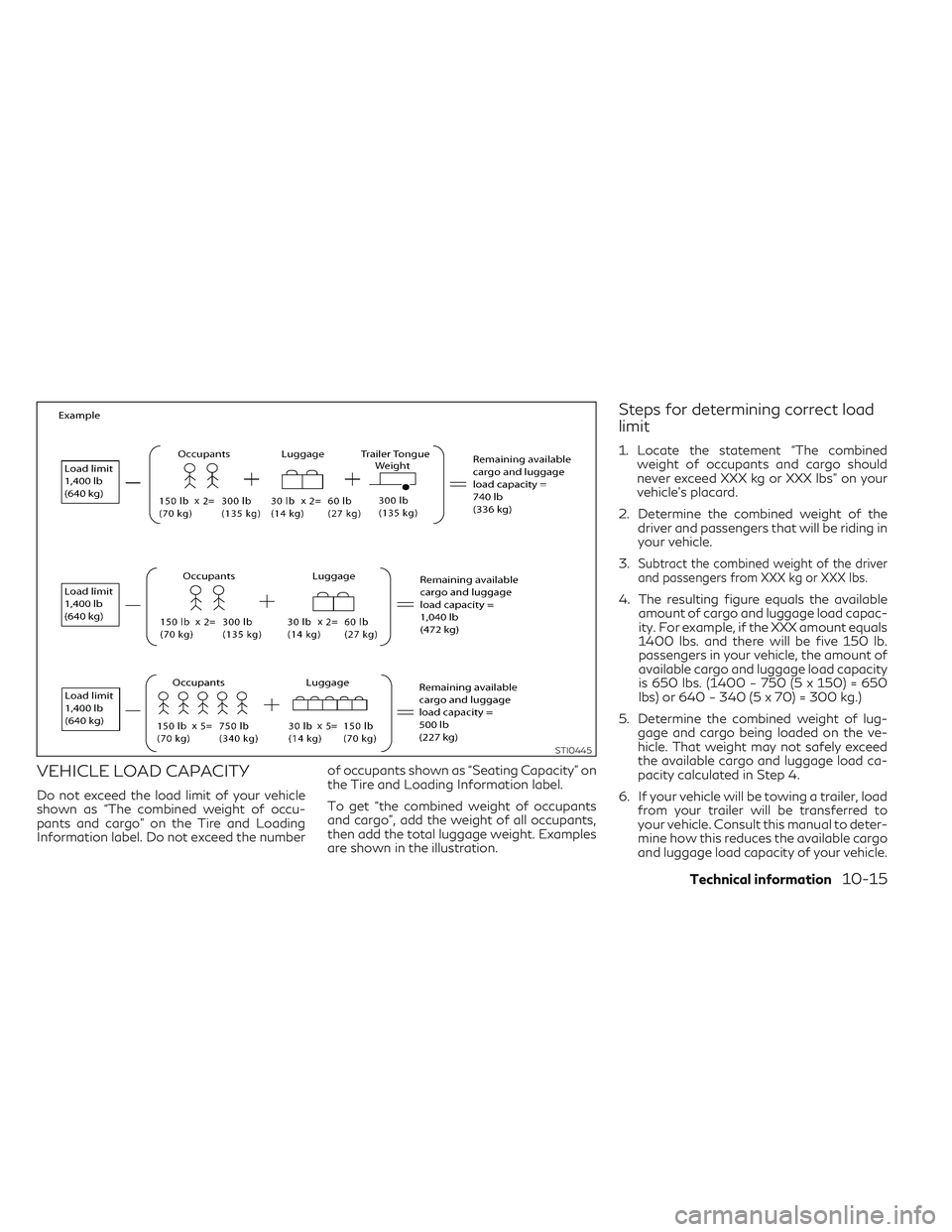
VEHICLE LOAD CAPACITY
Do not exceed the load limit of your vehicle
shown as “The combined weight of occu-
pants and cargo” on the Tire and Loading
Information label. Do not exceed the numberof occupants shown as “Seating Capacity” on
the Tire and Loading Information label.
To get “the combined weight of occupants
and cargo”, add the weight of all occupants,
then add the total luggage weight. Examples
are shown in the illustration.
Steps for determining correct load
limit
1. Locate the statement “The combined
weight of occupants and cargo should
never exceed XXX kg or XXX lbs” on your
vehicle’s placard.
2. Determine the combined weight of the driver and passengers that will be riding in
your vehicle.
3.
Subtract the combined weight of the driver
and passengers from XXX kg or XXX lbs.
4. The resulting figure equals the available amount of cargo and luggage load capac-
ity. For example, if the XXX amount equals
1400 lbs. and there will be five 150 lb.
passengers in your vehicle, the amount of
available cargo and luggage load capacity
is 650 lbs. (1400 − 750 (5 x 150) = 650
lbs) or 640 − 340 (5 x 70) = 300 kg.)
5. Determine the combined weight of lug- gage and cargo being loaded on the ve-
hicle. That weight may not safely exceed
the available cargo and luggage load ca-
pacity calculated in Step 4.
6. If your vehicle will be towing a trailer, load from your trailer will be transferred to
your vehicle. Consult this manual to deter-
mine how this reduces the available cargo
and luggage load capacity of your vehicle.
STI0445
Technical information10-15
Page 523 of 538

Before driving a loaded vehicle, confirm that
you do not exceed the Gross Vehicle Weight
Rating (GVWR) or the Gross Axle Weight
Rating (GAWR) for your vehicle. (See "Mea-
surement of weights" later in this section.)
Also check tires for proper inflation pres-
sures. See the Tire and Loading Information
label.
LOADING TIPS
•The GVW must not exceed GVWR or
GAWR as specified on the F.M.V. S.S./
C.M.V.S.S. certification label.
•Do not load the front and rear axle to the
GAWR. Doing so will exceed the GVWR.
WARNING
•Properly secure all cargo to help prevent
it from sliding or shifting. Do not place
cargo higher than the seatbacks. In a
sudden stop or collision, unsecured
cargo could cause personal injury.
•Do not load your vehicle any heavier
than the GVWR or the maximum front
and rear GAWRs. If you do, parts of your
vehicle can break, tire damage could oc-
cur, or it can change the way your ve-
hicle handles. This could result in loss of
control and cause personal injury.
•Overloading could not only shorten the
life of your vehicle and the tires, but also
could cause unsafe vehicle handling and
longer braking distances. This may
cause a premature tire failure which
could result in a serious accident and
personal injury. Failures caused by over-
loading are not covered by the vehicle's
warranty.
MEASUREMENT OF WEIGHTS
Secure loose items to prevent weight shifts
that could affect the balance of your vehicle.
When the vehicle is loaded, drive to a scale
and weigh the front and the rear wheels
separately to determine axle loads. Individual
axle loads should not exceed either of the
gross axle weight ratings (GAWR). The total
of the axle loads should not exceed the gross
vehicle weight rating (GVWR). These ratings
are given on the vehicle certification label. If
weight ratings are exceeded, move or remove
items to bring all weights below the ratings. Your vehicle was designed to be used to carry
passengers and luggage
CAUTION
Do not tow a trailer with your vehicle.
TRAILER TOWING
10-16Technical information
Page 534 of 538

Supplemental Restraint System (SRS)....0-2
Air bags ....................0-2
Switches ....................2-70 Brightness..................2-70
Defroster ..................2-63
Foglights..................2-70
Front passenger air bag ..........1-46
Hazardwarningflasher...........6-2
Headlight ..................2-64
Ignition ....................5-15
Ignition positions ..............5-15
Parking brake ................5-27
Parking sensor system ...........5-82
Power door lock ...............3-6
Push-button ignition ............5-16
Seat ......................3-21
Seat adjustment ...............1-3
Sonar function ...............5-82
Turn signal ..................2-66
Windshieldde-icer.............2-63
Wiperandwasher.............2-60
T
Tachometer ...................2-6
Three-waycatalyst...............5-4 Precautions ..................5-4
Tire chains ...................8-32 Tires.......................8-34
Changing ..................8-34
Cold weather ................5-97
Equipment ..................5-97
Flat tire ....................6-2
Inflationpressure..............8-27
Placard...................10-12
Quality grading ..............10-17
Sizes.....................10-8
tire chains ..................8-32
Wear and damage .............8-33
Wheel balance ...............8-35
Wheels and tires ..........8-27,10-8
Touch panel ...................4-4
Operation ...................4-4
Towing .....................6-14
Recommendations .............6-14
Your vehicle .................6-14
Trailer .....................10-16 Towing ...................10-16
Transferring registration to another
country ....................10-10
Transmission ..................5-20
Automatic Transmission (AT)
operation ..................5-20
Automatic transmission fluid (ATF) ....8-7
Traveling ...................10-10
Turn signal ...................8-22
Bulbinformation..............8-22
Operation ..................8-22
U
USB connection .................4-4
V
Vanity mirror..................3-18
Lights..................... 2-87
Vehicle .....................4-102
Apps Manager ..............4-102
Vehicle Dynamic Control (VDC) .......5-93
Vehicle identification ............10-10
Air conditioner label ...........10-12
Engine serial number ...........10-11
Number (VIN) (chassis number) .....10-11
Number (VIN) plate ...........10-10
Tire and loading information label . . .10-12
Vehicle Immobilizer system ..........5-14
Vehicle information display ..........2-15
Warningsandindicators ......... 2-29
Vehicle loading information ........10-14
Ventilators ...................4-42
Voice Recognition system .........4-105
Command list ...............4-109
Giving voice commands .........4-106
Settings...................4-116
Voice recognition system ..........4-136
Troubleshooting .............4-136
Voice Recognition system .........4-107
Voice command screen .........4-107
Index11-7
Page 537 of 538

•In case of emergency ... 6-2
(Flat tire, engine will not start, overheat-
ing, towing)
•How to start the engine ... 5-18
•How to read the meters and gauges ... 2-4
•Maintenance and do-it-yourself ... 8-2
•Technical information ... 9-2
QUICK REFERENCE