flat tire INFINITI QX50 2019 Owners Manual
[x] Cancel search | Manufacturer: INFINITI, Model Year: 2019, Model line: QX50, Model: INFINITI QX50 2019Pages: 564, PDF Size: 7.25 MB
Page 11 of 564
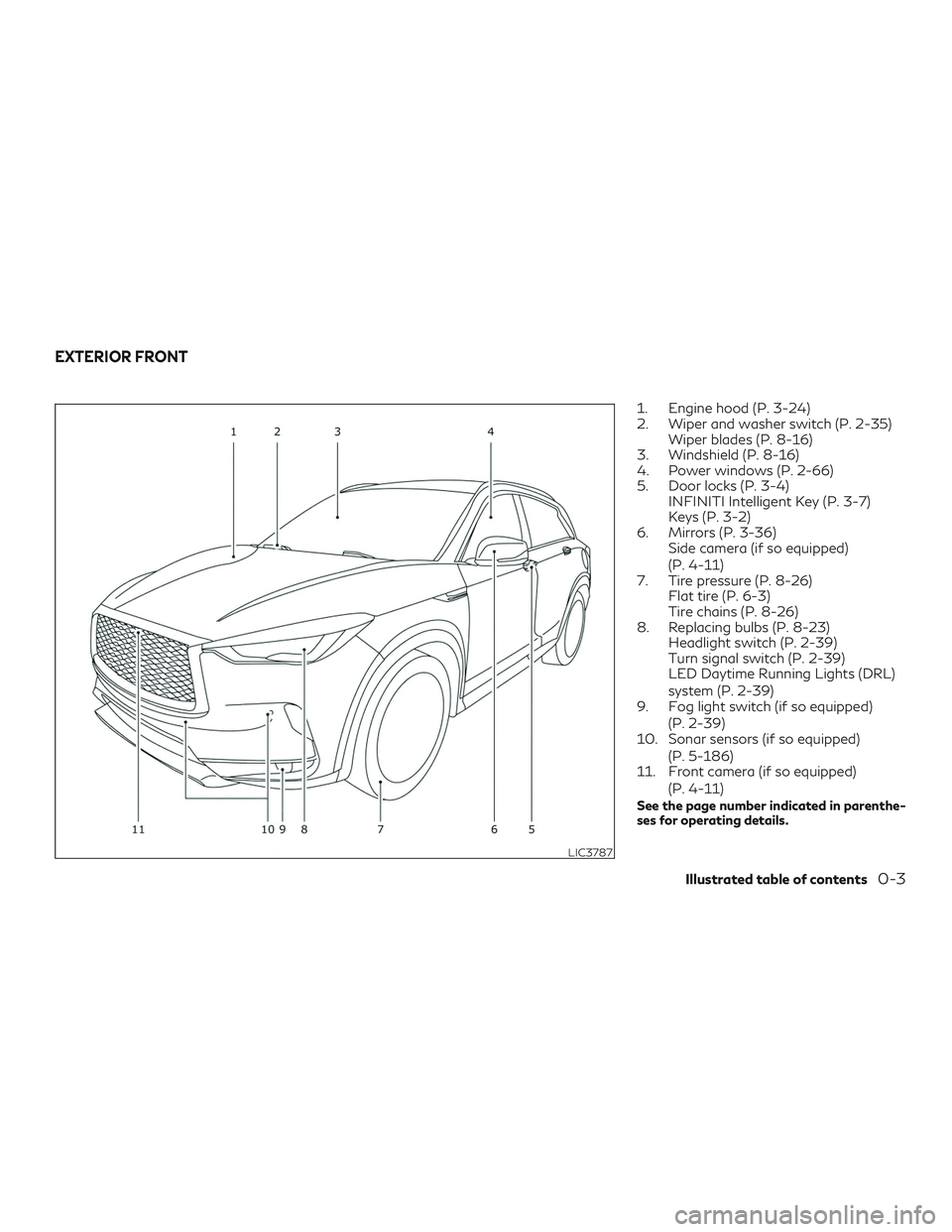
1. Engine hood (P. 3-24)
2. Wiper and washer switch (P. 2-35)Wiper blades (P. 8-16)
3. Windshield (P. 8-16)
4. Power windows (P. 2-66)
5. Door locks (P. 3-4) INFINITI Intelligent Key (P. 3-7)
Keys (P. 3-2)
6. Mirrors (P. 3-36) Side camera (if so equipped)
(P. 4-11)
7. Tire pressure (P. 8-26) Flat tire (P. 6-3)
Tire chains (P. 8-26)
8. Replacing bulbs (P. 8-23) Headlight switch (P. 2-39)
Turn signal switch (P. 2-39)
LED Daytime Running Lights (DRL)
system (P. 2-39)
9. Fog light switch (if so equipped)
(P. 2-39)
10. Sonar sensors (if so equipped)
(P. 5-186)
11. Front camera (if so equipped)
(P. 4-11)
See the page number indicated in parenthe-
ses for operating details.
LIC3787
EXTERIOR FRONT
Illustrated table of contents0-3
Page 96 of 564
If the light illuminates when the FEB with
Pedestrian Detection system is on, it may
indicate that the system is unavailable. For
additional information, refer to “Forward
Emergency Braking (FEB) with Pedestrian
Detection” and “Predictive Forward Collision
Warning (PFCW)” in the “Starting and driv-
ing” section of this manual.
Low tire pressure warninglight
Your vehicle is equipped with a Tire Pressure
Monitoring System (TPMS) that monitors the
tire pressure of all tires except the spare.
The low tire pressure warning light warns of
low tire pressure or indicates that the TPMS
is not functioning properly.
After the ignition switch is placed in the ON
position, this light illuminates for about 1 sec-
ond and turns off.
Low tire pressure warning
If the vehicle is being driven with low tire
pressure, the warning light will illuminate. A
“Tire Pressure Low - Add Air” warning also
appears in the vehicle information display. When the low tire pressure warning light il-
luminates, you should stop and adjust the
tire pressure of all four tires to the recom-
mended COLD tire pressure shown on the
Tire and Loading Information label located in
the driver’s door opening. The low tire pres-
sure warning light does not automatically
turn off when the tire pressure is adjusted.
After the tire is inflated to the recommended
pressure, the vehicle must be driven at
speeds above 16 mph (25 km/h) to activate
the TPMS and turn off the low tire pressure
warning light. Use a tire pressure gauge to
check the tire pressure.
The “Tire Pressure Low - Add Air” warning
appears each time the ignition switch is
placed in the ON position as long as the low
tire pressure warning light remains illumi-
nated.
For additional information, refer to “Vehicle
information display” in the “Instruments and
controls” section and “Tire Pressure Monitor-
ing System (TPMS)” in the “Starting and driv-
ing” section and in the “In case of emergency”
section of this manual.
TPMS malfunction
If the TPMS is not functioning properly, the
low tire pressure warning light will flash for
approximately 1 minute when the ignition
switch is placed in the ON position. The light
will remain on after 1 minute. Have the sys-
tem checked. It is recommended that you visit
an INFINITI retailer for this service. The "Tire
Pressure Low — Add Air" warning does not
appear if the low tire pressure warning light
illuminates to indicate a TPMS malfunction.
For additional information, refer to “Tire
Pressure Monitoring System (TPMS)” in the
“Starting and driving” section and “Tire pres-
sure” in the “Do-it-yourself” section of this
manual.
WARNING
∙ Radio waves could adversely affect elec-
tric medical equipment. Those who use a
pacemaker should contact the electric
medical equipment manufacturer for the
possible influences before use.
∙ If the light does not illuminate with the ignition switch placed in the ON position,
have the vehicle checked as soon as pos-
sible. It is recommended that you visit an
INFINITI retailer for this service.
2-12Instruments and controls
Page 97 of 564
∙ If the light illuminates while driving,avoid sudden steering maneuvers or
abrupt braking, reduce vehicle speed, pull
off the road to a safe location and stop
the vehicle as soon as possible. Driving
with under-inflated tires may perma-
nently damage the tires and increase the
likelihood of tire failure. Serious vehicle
damage could occur and may lead to an
accident and could result in serious per-
sonal injury or death. Check the tire pres-
sure for all four tires. Adjust the tire pres-
sure to the recommended COLD tire
pressure show on the Tire and Loading
Information label located in the driver’s
door opening to turn the low tire pressure
warning light OFF. If the light still illumi-
nates while driving after adjusting the
tire pressure, a tire may be flat or the
TPMS may be malfunctioning. If you
have a flat tire, replace it with a replace-
ment tire as soon as possible. If no tire is
flat and all tires are properly inflated,
have the vehicle checked. It is recom-
mended that you visit an INFINITI re-
tailer for this service. ∙ When replacing a wheel without the
TPMS such as the spare tire, the TPMS
will not function and the low tire pressure
warning light will flash for approximately
1 minute. The light will remain on after
1 minute. Have your tires replaced
and/or TPMS system reset as soon as
possible. It is recommended that you visit
an INFINITI retailer for these services.
∙ Replacing tires with those not originally specified by INFINITI could affect the
proper operation of the TPMS.
CAUTION
∙ The TPMS is not a substitute for theregular tire pressure check. Be sure to
check the tire pressure regularly.
∙ If the vehicle is being driven at speeds of less than 16 mph (25 km/h), the TPMS
may not operate correctly.
∙ Be sure to install the specified size of tires to the four wheels correctly.
Master warning light
When the ignition switch is in the ON posi-
tion, the master warning light illuminates if
any of the following (if so equipped) are dis-
played on the vehicle information display: ∙ No key warning
∙ I-Key system warning
∙ Low fuel warning
∙ Low washer fluid warning
∙ Parking brake warning
∙ Door/ liftgate open warning
∙ Loose fuel cap warning
∙ Low tire pressure warning
∙ Flat tire warning
∙ Transmission system warning
∙ Headlight warning
∙ Driver Attention Support system warning
∙ Shift position warning
∙ Low battery warning
∙ Shipping mode warning
∙ Low oil pressure warning
∙ All Wheel Drive (AWD) system warning
∙ Adaptive Front lighting System (AFS)
warning
∙ Handle Release warning
∙ Driving Aids malfunction warning
∙ Chassis Control system warning
Instruments and controls2-13
Page 108 of 564
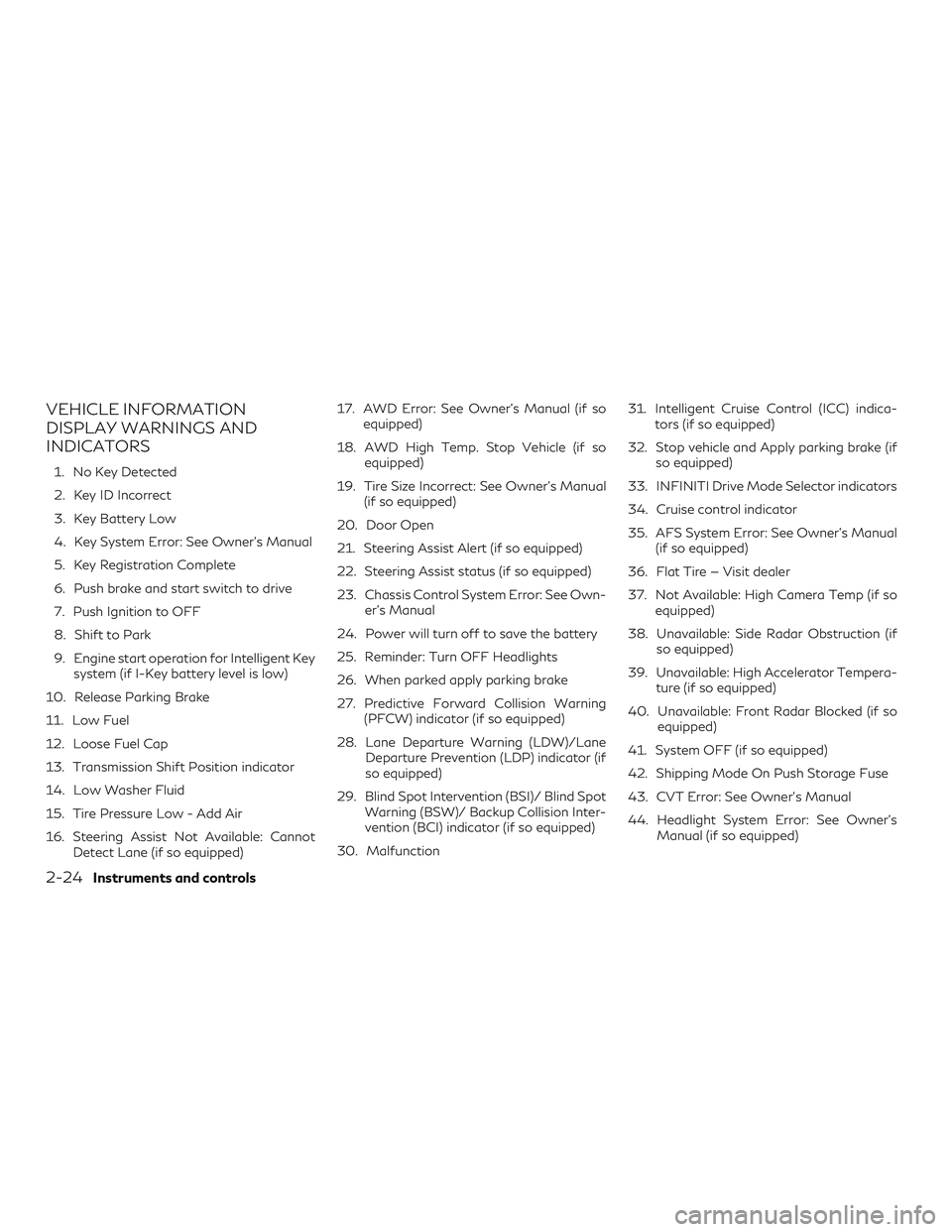
VEHICLE INFORMATION
DISPLAY WARNINGS AND
INDICATORS
1. No Key Detected
2. Key ID Incorrect
3. Key Battery Low
4. Key System Error: See Owner’s Manual
5. Key Registration Complete
6. Push brake and start switch to drive
7. Push Ignition to OFF
8. Shift to Park
9. Engine start operation for Intelligent Keysystem (if I-Key battery level is low)
10. Release Parking Brake
11. Low Fuel
12. Loose Fuel Cap
13. Transmission Shift Position indicator
14. Low Washer Fluid
15. Tire Pressure Low - Add Air
16. Steering Assist Not Available: Cannot Detect Lane (if so equipped) 17. AWD Error: See Owner’s Manual (if so
equipped)
18. AWD High Temp. Stop Vehicle (if so equipped)
19. Tire Size Incorrect: See Owner’s Manual (if so equipped)
20. Door Open
21. Steering Assist Alert (if so equipped)
22. Steering Assist status (if so equipped)
23. Chassis Control System Error: See Own- er’s Manual
24. Power will turn off to save the battery
25. Reminder: Turn OFF Headlights
26. When parked apply parking brake
27. Predictive Forward Collision Warning (PFCW) indicator (if so equipped)
28. Lane Departure Warning (LDW)/Lane Departure Prevention (LDP) indicator (if
so equipped)
29. Blind Spot Intervention (BSI)/ Blind Spot Warning (BSW)/ Backup Collision Inter-
vention (BCI) indicator (if so equipped)
30. Malfunction 31. Intelligent Cruise Control (ICC) indica-
tors (if so equipped)
32. Stop vehicle and Apply parking brake (if so equipped)
33. INFINITI Drive Mode Selector indicators
34. Cruise control indicator
35. AFS System Error: See Owner’s Manual (if so equipped)
36. Flat Tire — Visit dealer
37. Not Available: High Camera Temp (if so equipped)
38. Unavailable: Side Radar Obstruction (if so equipped)
39. Unavailable: High Accelerator Tempera- ture (if so equipped)
40. Unavailable: Front Radar Blocked (if so equipped)
41. System OFF (if so equipped)
42. Shipping Mode On Push Storage Fuse
43. CVT Error: See Owner’s Manual
44. Headlight System Error: See Owner’s Manual (if so equipped)
2-24Instruments and controls
Page 113 of 564
the speed the cruise control was set at. If you
accelerate past the set speed, the speed will
blink until you either cancel cruise control or
go back to the set speed. If cruise control is on
and canceled, the speed will be displayed to
show the speed the vehicle will return to if the
resume button is activated.
AFS system error: See Owner’s Manual (if
so equipped)
This message may appear when the Adaptive
Front lighting System (AFS) encounters an
error.
For additional information, see Adaptive
Front lighting System (AFS) in this section.
Flat Tire — Visit dealer
This warning appears when the low tire pres-
sure warning light in the meter illuminates
and one or more flat tires are detected while
driving. For additional information, refer to
“Flat tire” in the “In case of emergency” sec-
tion and “Types of tires” in the “Do-it-
yourself” section of this manual.
Not Available: High Camera Temp (if so
equipped)
This message appears when the camera de-
tects an interior temperature of more than
104°F (40°C). For additional information, re-fer to “Distance Control Assist (DCA)”, “Lane
Departure Prevention (LDW)”, “Lane Depar-
ture Prevention (LDP)” or “Blind Spot Inter-
vention® (BSI)” in the “Starting and driving”
section of this manual.
Unavailable: Side Radar Obstruction (if so
equipped)
This message appears when the Blind Spot
Warning (BSW), Rear Cross Traffic Alert
(RCTA), Blind Spot Intervention® (BSI), or
Backup Collision Intervention (BCI) systems
become unavailable because a radar block-
age is detected. For additional information,
refer to “Blind Spot Warning (BSW),” “Rear
Cross Traffic Alert (RCTA),” “Blind Spot Inter-
vention® (BSI),” or “Backup Collision Inter-
vention (BCI)” in the “Starting and driving”
section of this manual.
Unavailable: High Accelerator Temperature
(if so equipped)
This message appears when the Backup Col-
lision Intervention (BCI) system becomes un-
available because of an interior temperature
greater than approximately 104°F (40°C).
For additional information, refer to “Backup
Collision Intervention (BCI)” in the “Starting
and driving” section of this manual.
Unavailable: Front Radar Blocked (if so
equipped)
This message appears when the Intelligent
Cruise Control (ICC), Distance Control Assist
(DCA), Forward Emergency Braking (FEB)
with Pedestrian Detection, or Predictive For-
ward Collision Warning (PFCW) systems be-
come unavailable because the front radar is
obstructed. For additional information, refer
to “Intelligent Cruise Control (ICC)”, “Distance
Control Assist (DCA)”, “Forward Emergency
Braking (FEB) with Pedestrian Detection”, or
“Predictive Forward Collision Warning
(PFCW)” in the “Starting and driving” section
of this manual.
System OFF (if so equipped)
This message appears when the Backup Col-
lision Intervention (BCI) system is turned off
using the lower display. For additional infor-
mation, refer to “Backup Collision Interven-
tion (BCI)” in the “Starting and driving” section
of this manual.
Shipping Mode On Push Storage Fuse
This warning may appear if the extended
storage switch is not pushed in. When this
warning appears, push in the extended stor-
age switch to turn off the warning. For addi-
Instruments and controls2-29
Page 255 of 564
CAUTION
∙ Do not use leaded gasoline. Depositsfrom leaded gasoline will seriously reduce
the three-way catalyst’s ability to help
reduce exhaust pollutants.
∙ Keep your engine tuned up. Malfunctions in the ignition, fuel injection, or electrical
systems can cause over rich fuel flow into
the three-way catalyst, causing it to
overheat. Do not keep driving if the en-
gine misfires, or if noticeable loss of per-
formance or other unusual operating
conditions are detected. Have the vehicle
inspected promptly. It is recommended
that you visit an INFINITI retailer for this
service.
∙ Avoid driving with an extremely low fuel level. Running out of fuel could cause the
engine to misfire, damaging the three-
way catalyst.
∙ Do not race the engine while warming it up.
∙ Do not push or tow your vehicle to start the engine.
TIRE PRESSURE MONITORING
SYSTEM (TPMS)
Each tire, including the spare (if provided),
should be checked monthly when cold and
inflated to the inflation pressure recom-
mended by the vehicle manufacturer on the
vehicle placard or tire inflation pressure label.
(If your vehicle has tires of a different size
than the size indicated on the vehicle placard
or tire inflation pressure label, you should
determine the proper tire inflation pressure
for those tires.)
As an added safety feature, your vehicle has
been equipped with a Tire Pressure Monitor-
ing System (TPMS) that illuminates a low tire
pressure telltale when one or more of your
tires is significantly under-inflated. Accord-
ingly, when the low tire pressure telltale illu-
minates, you should stop and check all your
tires as soon as possible, and inflate them to
the proper pressure. Driving on a significantly
under-inflated tire causes the tire to overheat
and can lead to tire failure. Under-inflation
also reduces fuel efficiency and tire tread life,
and may affect the vehicle’s handling and
stopping ability. Please note that the TPMS is not a substitute
for proper tire maintenance, and it is the driv-
er’s responsibility to maintain correct tire
pressure, even if under-inflation has not
reached the level to trigger illumination of the
TPMS low tire pressure telltale.
Your vehicle has also been equipped with a
TPMS malfunction indicator to indicate
when the system is not operating properly.
The TPMS malfunction indicator is combined
with the low tire pressure telltale. When the
system detects a malfunction, the telltale will
flash for approximately one minute and then
remain continuously illuminated. This se-
quence will continue upon subsequent vehicle
start-ups as long as the malfunction exists.
When the malfunction indicator is illumi-
nated, the system may not be able to detect
or signal low tire pressure as intended. TPMS
malfunctions may occur for a variety of rea-
sons, including the installation of replace-
ment or alternate tires or wheels on the ve-
hicle that prevent the TPMS from functioning
properly. Always check the TPMS malfunc-
tion telltale after replacing one or more tires
or wheels on your vehicle to ensure that the
replacement or alternate tires and wheels al-
low the TPMS to continue to function prop-
erly.
Starting and driving5-5
Page 256 of 564
Additional information:∙ When replacing a wheel without the TPMS such as the spare tire, the TPMS
does not monitor the tire pressure of the
spare tire.
∙ The TPMS will activate only when the vehicle is driven at speeds above 16 mph
(25 km/h). Also, this system may not de-
tect a sudden drop in tire pressure (for
example, a flat tire while driving).
∙ The low tire pressure warning light does not automatically turn off when the tire
pressure is adjusted. After the tire is in-
flated to the recommended pressure, the
vehicle must be driven at speeds above
16 mph (25 km/h) to activate the TPMS
and turn off the low tire pressure warning
light. Use a tire pressure gauge to check
the tire pressure.
∙ The “Tire Pressure Low — Add Air” warn- ing appears in the vehicle information
display when the low tire pressure warn-
ing light is illuminated and low tire pres-
sure is detected. The “Tire Pressure Low -
Add Air” warning turns off when the low
tire pressure warning light turns off. ∙ The “Tire Pressure Low — Add Air” warn-
ing appears each time the ignition switch
is in the ON position as long as the low
tire pressure warning light remains illumi-
nated.
∙ The “Tire Pressure Low — Add Air” warn- ing does not appear if the low tire pres-
sure warning light illuminates to indicate
a TPMS malfunction.
∙ Tire pressure rises and falls depending on the heat caused by the vehicle’s opera-
tion and the outside temperature. Do not
reduce the tire pressure after driving be-
cause the tire pressure rises after driving.
Low outside temperature can lower the
temperature of the air inside the tire
which can cause a lower tire inflation
pressure. This may cause the low tire
pressure warning light to illuminate. If the
warning light illuminates, check the tire
pressure for all four tires.
∙ The Tire and Loading Information label is located in the driver’s door opening.
∙ You can also check the pressure of all tires (except the spare tire) on the vehicle
information display screen. The order of
the tire pressure figures displayed on the
screen corresponds with the actual order
of the tire position. For additional information, refer to “Low tire
pressure warning light” and “Tire Pressure
Low — Add Air” in the “Instruments and con-
trols” section and “Tire Pressure Monitoring
System (TPMS)” in the “In case of emergency”
section of this manual.
WARNING
∙ Radio waves could adversely affect elec-
tric medical equipment. Those who use a
pacemaker should contact the electric
medical equipment manufacturer for the
possible influences before use.
5-6Starting and driving
Page 257 of 564
∙ If the low tire pressure warning light illu-minates while driving, avoid sudden
steering maneuvers or abrupt braking,
reduce vehicle speed, pull off the road to
a safe location and stop the vehicle as
soon as possible. Driving with under-
inflated tires may permanently damage
the tires and increase the likelihood of
tire failure. Serious vehicle damage could
occur and may lead to an accident and
could result in serious personal injury.
Check the tire pressure for all four tires.
Adjust the tire pressure to the recom-
mended COLD tire pressure shown on
the Tire and Loading Information label to
turn the low tire pressure warning light
off. If you have a flat tire, replace it with a
replacement tire as soon as possible. (For
additional information, refer to “Flat
tire” in the “In case of emergency” section
for changing a flat tire.) ∙ When replacing a wheel without the
TPMS such as the spare tire, when a
spare tire is mounted or a wheel is re-
placed, tire pressure will not be indicated,
the TPMS will not function and the low
tire pressure warning light will flash for
approximately 1 minute. The light will re-
main on after 1 minute. Have your tires
replaced and/or TPMS system reset as
soon as possible. It is recommended that
you visit an INFINITI retailer for this
service.
∙ Replacing tires with those not originally specified by INFINITI could affect the
proper operation of the TPMS.
∙ Do not inject any tire liquid or aerosol tire sealant into the tires, as this may cause a
malfunction of the tire pressure sensors.
CAUTION
∙ The TPMS may not function properlywhen the wheels are equipped with tire
chains or the wheels are buried in snow.
∙ Do not place metalized film or any metal parts (antenna, etc.) on the windows.
This may cause poor reception of the sig-
nals from the tire pressure sensors, and
the TPMS will not function properly. Some devices and transmitters may tempo-
rarily interfere with the operation of the
TPMS and cause the low tire pressure warn-
ing light to illuminate.
Some examples are:
∙ Facilities or electric devices using similar radio frequencies are near the vehicle.
∙ If a transmitter set to similar frequencies is being used in or near the vehicle.
∙ If a computer (or similar equipment) or a DC/AC converter is being used in or near
the vehicle.
The low tire pressure warning light may illu-
minate in the following cases: ∙ If the vehicle is equipped with a wheel and tire without TPMS.
∙ If the TPMS has been replaced and the ID has not been registered.
∙ If the wheel is not originally specified by INFINITI.
Starting and driving5-7
Page 258 of 564
FCC Notice:
For USA:
This device complies with Part 15 of the FCC
Rules. Operation is subject to the following
two conditions: (1) This device may not
cause harmful interference, and (2) this de-
vice must accept any interference received,
including interference that may cause unde-
sired operation.
Note: Changes or modifications not ex-
pressly approved by the party responsible
for compliance could void the user’s author-
ity to operate the equipment.
For Canada:
This device complies with Industry Canada
licence-exempt RSS standard(s). Operation
is subject to the following two conditions: (1)
this device may not cause interference, and
(2) this device must accept any interference,
including interference that may cause unde-
sired operation of the device
TPMS with Tire Inflation Indicator
When adding air to an under-inflated tire, the
TPMS with Tire Inflation Indicator provides
visual and audible signals outside the vehicle
to help you inflate the tires to the recom-
mended COLD tire pressure.Vehicle set-up:
1. Park the vehicle in a safe and level place.
2. Apply the parking brake and place the shift lever in the P (Park) position.
3. Place the ignition switch in the ON posi- tion. Do not start the engine.
Operation: 1. Add air to the tire.
2. After a few seconds, the hazard indica- tors will start flashing.
3. When the designated pressure is reached, the horn beeps once and the
hazard indicators stop flashing.
4. Perform the above steps for each tire. ∙ If the tire is over-inflated more thanapproximately 4 psi (30 kPa), the horn
beeps and the hazard indicators flash
three times. To correct the pressure,
push the core of the valve stem on the
tire briefly to release pressure. When
the pressure reaches the designated
pressure, the horn beeps once.
∙ If the hazard indicator does not flash within approximately 15 seconds after
starting to inflate the tire, it indicates that the TPMS with Tire Inflation Indi-
cator is not operating.
∙ The TPMS will not activate the TPMS with Tire Inflation Indicator under the
following conditions:
– If there is interference from an exter- nal device or transmitter.
– The air pressure from the inflation de- vice is not sufficient to inflate the tire.
– There is a malfunction in the TPMS system.
– There is a malfunction in the horn or hazard indicators.
– The identification code of the tire pressure sensor is not registered to
the system.
– The battery of the tire pressure sensor is low.
∙ If the TPMS with Tire Inflation Indica- tor does not operate due to TPMS
interference, move the vehicle about
3 ft (1 m) backward or forward and try
again.
If the TPMS with Tire Inflation Indicator is
not working, use a tire pressure gauge.
5-8Starting and driving
Page 260 of 564
6. When it is safe to do so, gradually turnthe steering wheel until both tires return
to the road surface. When all tires are on
the road surface, steer the vehicle to stay
in the appropriate driving lane.
∙ If you decide that it is not safe to return the vehicle to the road surface based
on vehicle, road or traffic conditions,
gradually slow the vehicle to a stop in a
safe place off the road.
RAPID AIR PRESSURE LOSS
Rapid air pressure loss or a “blow-out” can
occur if the tire is punctured or is damaged
due to hitting a curb or pothole. Rapid air
pressure loss can also be caused by driving on
under-inflated tires.
Rapid air pressure loss can affect the han-
dling and stability of the vehicle, especially at
highway speeds.
Help prevent rapid air pressure loss by main-
taining the correct air pressure and visually
inspecting the tires for wear and damage. For
additional information, refer to “Wheels and
tires” in the “Do-it-yourself” section of this
manual. If a tire rapidly loses air pressure or
“blows-out” while driving, maintain control of
the vehicle by following the procedure below.
Please note that this procedure is only a gen- eral guide. The vehicle must be driven as ap-
propriate based on the conditions of the ve-
hicle, road and traffic.
WARNING
The following actions can increase the
chance of losing control of the vehicle if
there is a sudden loss of tire air pressure.
Losing control of the vehicle may cause a
collision and result in personal injury.
∙ The vehicle generally moves or pulls in the
direction of the flat tire.
∙ Do not rapidly apply the brakes.
∙ Do not rapidly release the accelerator pedal.
∙ Do not rapidly turn the steering wheel.
1. Remain calm and do not overreact.
2. Maintain a firm grip on the steering wheel with both hands and try to hold a
straight course.
3. When appropriate, slowly release the accelerator pedal to gradually slow the
vehicle.
4. Gradually steer the vehicle to a safe lo- cation off the road and away from traf-
fic if possible. 5. Lightly apply the brake pedal to gradu-
ally stop the vehicle.
6. Turn on the hazard warning flashers and contact a roadside emergency service to
change the tire. For additional informa-
tion, refer to “Flat tire” in the “In case of
emergency section of this manual.
DRINKING ALCOHOL/DRUGS
AND DRIVING
WARNING
Never drive under the influence of alcohol
or drugs. Alcohol in the bloodstream re-
duces coordination, delays reaction time
and impairs judgement. Driving after drink-
ing alcohol increases the likelihood of being
involved in an accident injuring yourself and
others. Additionally, if you are injured in an
accident, alcohol can increase the severity
of the injury.
5-10Starting and driving