overheating INFINITI QX55 2023 Owners Manual
[x] Cancel search | Manufacturer: INFINITI, Model Year: 2023, Model line: QX55, Model: INFINITI QX55 2023Pages: 526, PDF Size: 5.75 MB
Page 272 of 526

• While the electronic parking brake is ap-plied or released, an operating sound is
heard from the lower side of the rear seat.
This is normal and does not indicate a
malfunction.
•
When the electronic parking brake is fre-
quently applied and released in a short pe-
riod of time, the parking brake may not op-
erate in order to prevent the parking brake
system from overheating. If this occurs, op-
erate the electronic parking brake switch
again after waiting approximately 1 minute.
• If the electronic parking brake must be ap- plied while driving in an emergency, pull up
and hold the parking brake switch. When
you release the parking brake switch, the
parking brake will be released.
•
While pulling up the electronic parking brake
switch during driving, the parking brake is ap-
plied and a chime sounds. The electronic park-
ing brake indicator light (red) in the meter and
in the parking brake switch illuminates. This
does not indicate a malfunction. The elec-
tronic parking brake indicator light (red) in
the meter and in the parking brake switch
turns off when the parking brake is released.
• When pulling the electronic parking brake switch up with the ignition switch in the
OFF or AUTO ACC position, the parking
brake switch indicator light will continue
to illuminate for a short period of time. The automatic brake hold function maintains
the braking force without the driver having to
depress the brake pedal when the vehicle is
stopped at a traffic light or intersection. As
soon as the driver depresses the accelerator
pedal again, the automatic brake hold func-
tion is deactivated and the braking force is
released. The operating status of the auto-
matic brake hold can be displayed.
To use the automatic brake hold function, the
following conditions need to be met:
• The driver’s seat belt is fastened.
• The electronic parking brake is released.
• The vehicle is not in the P (Park) position.
• The vehicle is not parked on a steep hill.
WARNING
• The automatic brake hold function is not
designed to hold the vehicle on a steep
hill or slippery road. Never use the auto-
matic brake hold when the vehicle is
stopped on a steep hill or slippery road.
Failure to do so may cause the vehicle to
move.
• The automatic brake hold warning may
appear to request that the driver retake
control by depressing the brake pedal. •
When the automatic brake hold function
is activated but fails to maintain the ve-
hicle at a standstill, depress the brake
pedal to stop the vehicle. If the vehicle
unexpectedly moves due to outside con-
ditions, the chime may sound and auto-
matic brake hold warning may
illuminate.
• Be sure to deactivate the automatic
brake hold function when using a car
wash or towing your vehicle.
• Make sure to place the shift position in
the P (Park) position and apply the park-
ing brake when parking your vehicle, en-
tering or exiting the vehicle, or loading
luggage. Failure to do so could cause the
vehicle to move or roll away unexpect-
edly and result in serious personal injury
or property damage.
AUTOMATIC BRAKE HOLD
5-26Starting and driving
Page 336 of 526

•Always pay attention to the operation of
the vehicle and be ready to manually
control the proper following distance.
The ICC system may not be able to main-
tain the selected distance between ve-
hicles (following distance) or selected
vehicle speed under some circumstances.
• The system may not detect the vehicle in
front of you in certain road or weather
conditions. To avoid accidents, never use
the ICC system under the following con-
ditions:
– On roads with heavy, high-speed
traffic or sharp curves
– On slippery road surfaces such as on
ice or snow, etc.
– During bad weather (rain, fog, snow,
etc.)
– When rain, snow or dirt adhere to the
bumper around the distance sensor
– On steep downhill roads (the vehicle
may go beyond the set vehicle speed
and frequent braking may result in
overheating the brakes)
– On repeated uphill and downhill roads –
When traffic conditions make it diffi-
cult to keep a proper distance be-
tween vehicles because of frequent
acceleration or deceleration
– Interference by other radar sources.
• In some road or traffic conditions, a ve-
hicle or object can unexpectedly come
into the sensor detection zone and cause
automatic braking. Always stay alert
and avoid using the ICC system where
not recommended in this warning
section.
The ICC system will not detect the following
objects:
• Stationary or slow moving vehicles
• Pedestrians or objects in the roadway
• Oncoming vehicles in the same lane
• Motorcycles traveling offset in the travel lane
The following are some conditions in which
the radar sensor cannot properly detect a
vehicle ahead and the system may not oper-
ate properly:
• When the sensor detection is reduced (con- ditions such as rain, snow, fog, dust storms,
sandstorms, and road spray from other
vehicles) • Driving on a steep downhill slope or roads
with sharp curves
• Driving on a bumpy road surface, such as an uneven dirt road
• If dirt, ice, snow or other material is cover- ing the radar sensor area
• A complicated-shaped vehicle such as a car carrier trailer or flatbed truck/trailer is near
the vehicle ahead.
• Interference by other radar sources
• When excessively heavy baggage is loaded in the rear seat or cargo area of your
vehicle.
The ICC system is designed to automatically
check the radar sensor’s operation within the
limitations of the system.
The detection zone of the radar sensor is
limited. A vehicle ahead must be in the detec-
tion zone for the ICC system to maintain the
selected distance from the vehicle ahead. A
vehicle ahead may move outside of the de-
tection zone due to its position within the
same lane of travel. Motorcycles may not be
detected in the same lane ahead if they are
traveling offset from the center line of the
lane. A vehicle that is entering the lane ahead
may not be detected until the vehicle has
completely moved into the lane.
5-90Starting and driving
Page 382 of 526

•To help avoid risk of injury or death
through unintended operation of the ve-
hicle and/or its systems, do not leave
children, people who require the assis-
tance of others or pets unattended in
your vehicle. Additionally, the tempera-
ture inside a closed vehicle on a warm day
can quickly become high enough to cause
a significant risk of injury or death to
people and pets.
1. Apply the electronic parking brake.
2. Press the Park button to place the vehicle in the P (Park) position.
3. To help prevent the vehicle from rolling into traffic when parked on an incline, it is
a good practice to turn the wheels as
illustrated.
• HEADED DOWNHILL WITH CURB
OA:
Turn the wheels into the curb and move
the vehicle forward until the curb side
wheel gently touches the curb.
• HEADED UPHILL WITH CURB
OB:
Turn the wheels away from the curb and
move the vehicle back until the curb side
wheel gently touches the curb. • HEADED UPHILL OR DOWNHILL,
NO CURB
OC:
Turn the wheels toward the side of the
road so the vehicle will move away from
the center of the road if it moves.
4. Place the ignition switch in the LOCK position.ELECTRIC POWER STEERING
TYPE
WARNING
• If the engine is not running or is turned
off while driving, the power assist for the
steering will not work. Steering will be
harder to operate.
• When the power steering warning light
illuminates with the engine running,
there will be no power assist for the
steering. You will still have control of the
vehicle, but the steering will be harder to
operate. Have the power steering sys-
tem checked. It is recommended that you
visit an INFINITI retailer for this service.
The power steering system is designed to
provide power assist while driving to operate
the steering wheel with light force.
When the steering wheel is operated repeat-
edly or continuously while parking or driving
at a very low speed, the power assist for the
steering wheel will be reduced. This is to pre-
vent overheating of the power steering sys-
tem and protect it from getting damaged.
While the power assist is reduced, steering
wheel operation will become heavy. When
the temperature of the power steering sys-
tem goes down, the power assist level will
POWER STEERING
5-136Starting and driving
Page 385 of 526

You may hear a noise under the following
conditions. However, this is not a malfunc-
tion.
• When the engine is started or stopped.
• When the steering wheel is turned in the fulllock position. The brake system has two separate hydraulic
circuits. If one circuit malfunctions, you will
still have braking at two wheels.
BRAKE PRECAUTIONS
Vacuum assisted brakes
The brake booster aids braking by using en-
gine vacuum. If the engine stops, you can
stop the vehicle by depressing the brake
pedal. However, greater foot pressure on the
brake pedal will be required to stop the ve-
hicle and stopping distance will be longer.
Using the brakes
Avoid resting your foot on the brake pedal
while driving. This will overheat the brakes,
wear out the brake pads faster, and reduce
gas mileage.
To help reduce brake wear and to prevent the
brakes from overheating, reduce speed and
downshift to a lower gear before going down
a slope or long grade. Overheated brakes
may reduce braking performance and could
result in loss of vehicle control.
WARNING
• While driving on a slippery surface, be
careful when braking, accelerating or
downshifting. Abrupt braking or accel-
erating could cause the wheels to skid
and result in an accident.
• If the engine is not running or is turned
off while driving, the power assist for the
brakes will not work. Braking will be
harder.
Wet brakes
When the vehicle is washed or driven through
water, the brakes may get wet. As a result,
your braking distance will be longer and the
vehicle may pull to one side during braking.
To dry the brakes, drive the vehicle at a safe
speed while lightly pressing the brake pedal
to heat up the brakes. Do this until the brakes
return to normal. Avoid driving the vehicle at
high speeds until the brakes function
correctly.
BRAKE SYSTEM
Starting and driving5-139
Page 409 of 526
CAUTION
• Continuously Variable Transmission
(CVT) models cannot be push-started or
tow-started. Attempting to do so may
cause transmission damage.
• Do not push start this vehicle. The three-
way catalyst may be damaged.WARNING
• Do not continue to drive if your vehicle
overheats. Doing so could cause engine
damage or a vehicle fire.
• To avoid the danger of being scalded,
never remove the coolant reservoir cap
while the engine is still hot. When the
coolant reservoir cap is removed, pres-
surized hot water will spurt out, possibly
causing serious injury.
• Do not open the hood if steam is coming
out.
If your vehicle is overheating (indicated by an
extremely high temperature gauge reading),
or if you feel a lack of engine power, detect
abnormal noise, etc. take the following steps.
1. Move the vehicle safely off the road, apply the parking brake and engage the P (Park)
position.
Do not stop the engine.
2. Turn off the air conditioner. Open all the windows, move the heater or air condi-
tioner temperature control to maximum
hot and fan control to high speed. 3. Get out of the vehicle. Look and listen for
steam or coolant escaping from the radia-
tor before opening the hood. (If steam or
coolant is escaping, turn off the engine.)
Do not open the hood further until no
steam or coolant can be seen.
4. Open the engine hood.
WARNING
If steam or water is coming from the en-
gine, stand clear to prevent getting
burned.
5. Visually check drive belts for damage or looseness. Also check if the cooling fan is
running. The radiator hoses and radiator
should not leak water. If coolant is leaking,
the water pump belt is missing or loose, or
the cooling fan does not run, stop the
engine.
WARNING
Be careful not to allow your hands, hair,
jewelry or clothing to come into contact
with, or get caught in, engine belts or the
engine cooling fan. The engine cooling fan
can start at any time.
PUSH STARTING IF YOUR VEHICLE OVERHEATS
In case of emergency6-7
Page 425 of 526
CHECKING ENGINE COOLANT
LEVEL
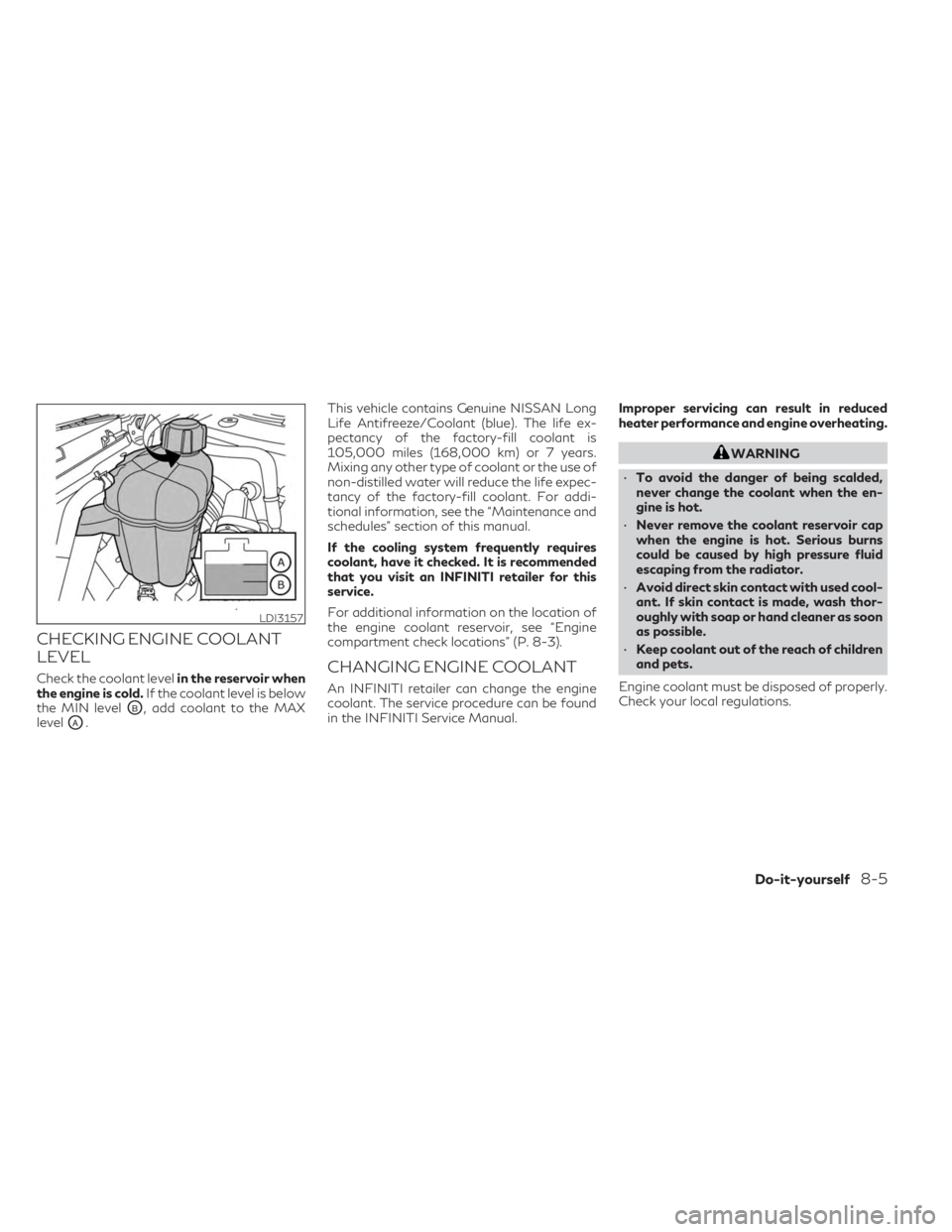
Check the coolant levelin the reservoir when
the engine is cold. If the coolant level is below
the MIN level
OB, add coolant to the MAX
level
OA. This vehicle contains Genuine NISSAN Long
Life Antifreeze/Coolant (blue). The life ex-
pectancy of the factory-fill coolant is
105,000 miles (168,000 km) or 7 years.
Mixing any other type of coolant or the use of
non-distilled water will reduce the life expec-
tancy of the factory-fill coolant. For addi-
tional information, see the “Maintenance and
schedules” section of this manual.
If the cooling system frequently requires
coolant, have it checked. It is recommended
that you visit an INFINITI retailer for this
service.
For additional information on the location of
the engine coolant reservoir, see “Engine
compartment check locations” (P. 8-3).
CHANGING ENGINE COOLANT
An INFINITI retailer can change the engine
coolant. The service procedure can be found
in the INFINITI Service Manual.
Improper servicing can result in reduced
heater performance and engine overheating.
WARNING
• To avoid the danger of being scalded,
never change the coolant when the en-
gine is hot.
• Never remove the coolant reservoir cap
when the engine is hot. Serious burns
could be caused by high pressure fluid
escaping from the radiator.
• Avoid direct skin contact with used cool-
ant. If skin contact is made, wash thor-
oughly with soap or hand cleaner as soon
as possible.
• Keep coolant out of the reach of children
and pets.
Engine coolant must be disposed of properly.
Check your local regulations.
LDI3157
Do-it-yourself8-5
Page 491 of 526

E–15 fuel
E-15 fuel is a mixture of approximately 15%
fuel ethanol and 85% unleaded gasoline.
E-15 can only be used in vehicles designed to
run on E-15 fuel. U.S. government regula-
tions require fuel ethanol dispensing pumps
to be identified with small, square, orange
and black label with the common abbrevia-
tion or the appropriate percentage for that
region.
E–85 fuel
E-85 fuel is a mixture of approximately 85%
fuel ethanol and 15% unleaded gasoline.
E-85 can only be used in a Flexible Fuel Ve-
hicle (FFV). Do not use E-85 in your vehicle.
U.S. government regulations require fuel
ethanol dispensing pumps to be identified by
a small, square, orange and black label with
the common abbreviation or the appropriate
percentage for that region.
Fuel containing MMT
MMT, or methylcyclopentadienyl manganese
tricarbonyl, is an octane boosting additive.
INFINITI does not recommend the use of fuel
containing MMT. Such fuel may adversely
affect vehicle performance, including the
emissions control system. Note that while
some fuel pumps label MMT content, not all
do, so you may have to consult your gasoline
retailer for more details.
Aftermarket fuel additives
INFINITI does not recommend the use of any
aftermarket fuel additives (for example, fuel
injector cleaner, octane booster, intake valve
deposit removers, etc.) which are sold com-
mercially. Many of these additives intended
for gum, varnish or deposit removal may con-
tain active solvents or similar ingredients that
can be harmful to the fuel system and engine.
Octane rating tips
Using unleaded gasoline with an octane rat-
ing lower than recommended can cause per-
sistent, heavy “spark knock.” (“Spark knock”
is a metallic rapping noise.) If severe, this can
lead to engine damage. If you detect a per-
sistent heavy spark knock even when using
gasoline of the stated octane rating, or if you
hear steady spark knock while holding a
steady speed on level roads, it is recom-
mended that you have an INFINITI retailer
correct the condition. Failure to correct the
condition is misuse of the vehicle, for which
INFINITI is not responsible.
Incorrect ignition timing may result in spark
knock, after-run and/or overheating, which
may cause excessive fuel consumption or en-
gine damage. If any of the above symptoms
are encountered, have your vehicle checked.
It is recommended that you visit an INFINITI
retailer.
However, now and then you may notice light
spark knock for a short time while accelerat-
ing or driving up hills. This is not a cause for
concern, because you get the greatest fuel
benefit when there is light spark knock for a
short time under heavy engine load.
Technical and consumer information10-5