Control arm INFINITI QX60 2018 Owner's Guide
[x] Cancel search | Manufacturer: INFINITI, Model Year: 2018, Model line: QX60, Model: INFINITI QX60 2018Pages: 532, PDF Size: 6.22 MB
Page 374 of 532
∙ Do not cover or attach stickers, or installany accessory near the sensors. This
could block sensor signals, and/or cause
failure or malfunction.
∙ Do not attach metallic objects near the radar sensor (brush guard, etc.). This
could cause failure or malfunction.
∙ Do not place reflective materials, such as white paper or a mirror, on the instrument
panel. The reflection of sunlight may ad-
versely affect the camera unit’s detection
capability.
∙ Do not alter, remove or paint the front bumper. Before customizing or restoring
the front bumper, it is recommended that
you visit an INFINITI retailer.
Radio frequency statement
For USA
FCC ID: OAYARS3–B
This device complies with part 15 of the FCC
Rules. Operation is subject to the following
two conditions: (1) This device may not cause
harmful interference, and (2) this device must
accept any interference received, including
interference that may cause undesired op-
eration. FCC Warning
Changes or modifications not expressly ap-
proved by the party responsible for compli-
ance could void the user’s authority to oper-
ate the equipment.
For Canada
IC: 4135A-ARS3B
This device complies with Industry Canada
licence-exempt RSS standard(s). Operation is
subject to the following two conditions: (1)
This device may not cause interference, and
(2) this device must accept any interference,
including interference that may cause unde-
sired operation of the device.
Droit applicable : Canada 310
Le présent appareil est conforme aux CNR
d’Industrie Canada applicables aux appareils
radio exempts de licence. L’exploitation est
autorisée aux deux conditions suivantes: (1)
L’appareil ne doit pas produire de brouillage,
et (2) l’utilisateur de l’appareil doit accepter
tout brouillage radioélectrique subi, même si
le brouillage est susceptible d’en comprom-
ettre le fonctionnement.
WARNING
Failure to follow the warnings and instruc-
tions for proper use of the PFCW system
could result in serious injury or death.
∙ The PFCW system can help warn the
driver before a collision occurs but will
not avoid a collision. It is the driver’s re-
sponsibility to stay alert, drive safely and
be in control of the vehicle at all times.
The PFCW system can help alert the driver
when there is a sudden braking of a second
vehicle traveling in front of the vehicle ahead
in the same lane.
PREDICTIVE FORWARD COLLISION
WARNING (PFCW) (if so equipped)
Starting and driving5-117
Page 386 of 532
Follow these easy-to-use Fuel Efficient Driv-
ing Tips to help you achieve the most fuel
economy from your vehicle.1. Use Smooth Accelerator and Brake
Pedal Application
∙ Avoid rapid starts and stops.
∙ Use smooth, gentle accelerator and brake application whenever possible.
∙ Maintain constant speed while com- muting and coast whenever possible.
2. Maintain Constant Speed
∙ Look ahead to try and anticipate and minimize stops.
∙ Synchronizing your speed with traffic lights allows you to reduce your num-
ber of stops.
∙ Maintaining a steady speed can mini- mize red light stops and improve fuel
efficiency.
3. Use Air Conditioning (A/C) at Higher
Vehicle Speeds
∙ Below 40 mph (64 km/h), it is more efficient to open windows to cool the
vehicle due to reduced engine load. ∙ Above 40 mph (64 km/h), it is more
efficient to use A/C to cool the vehicle
due to increased aerodynamic drag.
∙ Recirculating the cool air in the cabin when the A/C is on reduces cooling
load.
4. Drive at Economical Speeds and Dis-
tances
∙ Observing the speed limit and not ex- ceeding 60 mph (97 km/h) (where le-
gally allowed) can improve fuel effi-
ciency due to reduced aerodynamic
drag.
∙ Maintaining a safe following distance behind other vehicles reduces unnec-
essary braking.
∙ Safely monitoring traffic to anticipate changes in speed permits reduced
braking and smooth acceleration
changes.
∙ Select a gear range suitable to road conditions.
5. Use Cruise Control
∙ Using cruise control during highway driving helps maintain a steady speed. ∙ Cruise control is particularly effective
in providing fuel savings when driving
on flat terrains.
6. Plan for the Shortest Route
∙ Utilize a map or navigation system to determine the best route to save time.
7. Avoid Idling
∙ Shutting off your engine when safe for stops exceeding 30–60 seconds saves
fuel and reduces emissions.
8. Buy an Automated Pass for Toll Roads
∙ Automated passes permit drivers to use special lanes to maintain cruising
speed through the toll and avoid stop-
ping and starting.
9. Winter Warm Up
∙ Limit idling time to minimize impact to fuel economy.
∙ Vehicles typically need no more than 30 seconds of idling at start-up to ef-
fectively circulate the engine oil before
driving.
∙ Your vehicle will reach its ideal operat- ing temperature more quickly while
driving versus idling.
FUEL EFFICIENT DRIVING TIPS
Starting and driving5-129
Page 490 of 532
E–15 fuel
E-15 fuel is a mixture of approximately 15%
fuel ethanol and 85% unleaded gasoline.
E-15 can only be used in vehicles designed to
run on E-15 fuel. U.S. government regula-
tions require fuel ethanol dispensing pumps
to be identified with small, square, orange
and black label with the common abbrevia-
tion or the appropriate percentage for that
region.
E–85 fuel
E-85 fuel is a mixture of approximately 85%
fuel ethanol and 15% unleaded gasoline.
E-85 can only be used in a Flexible Fuel Ve-
hicle (FFV). Do not use E-85 in your vehicle.
U.S. government regulations require fuel
ethanol dispensing pumps to be identified by
a small, square, orange and black label with
the common abbreviation or the appropriate
percentage for that region.
Fuel containing MMT
MMT, or methylcyclopentadienyl manganese
tricarbonyl, is an octane boosting additive.
INFINITI does not recommend the use of fuel
containing MMT. Such fuel may adversely
affect vehicle performance, including the
emissions control system. Note that while
some fuel pumps label MMT content, not alldo, so you may have to consult your gasoline
retailer for more details.
Aftermarket fuel additives
INFINITI does not recommend the use of any
aftermarket fuel additives (for example, fuel
injector cleaner, octane booster, intake valve
deposit removers, etc.) which are sold com-
mercially. Many of these additives intended
for gum, varnish or deposit removal may con-
tain active solvents or similar ingredients that
can be harmful to the fuel system and engine.
Octane rating tips
Using unleaded gasoline with an octane rat-
ing lower than recommended can cause per-
sistent, heavy “spark knock.” (“Spark knock”
is a metallic rapping noise.) If severe, this can
lead to engine damage. If you detect a per-
sistent heavy spark knock even when using
gasoline of the stated octane rating, or if you
hear steady spark knock while holding a
steady speed on level roads, it is recom-
mended that you have an INFINITI retailer
correct the condition. Failure to correct the
condition is misuse of the vehicle, for which
INFINITI is not responsible.
Incorrect ignition timing may result in spark
knock, after-run and/or overheating, which
may cause excessive fuel consumption or en-
gine damage. If any of the above symptoms
are encountered, have your vehicle checked.
It is recommended that you visit an INFINITI
retailer.
However, now and then you may notice light
spark knock for a short time while accelerat-
ing or driving up hills. This is not a cause for
concern, because you get the greatest fuel
benefit when there is light spark knock for a
short time under heavy engine load.
Technical and consumer information10-5
Page 510 of 532
Have a professional supplier of towing
equipment make sure the trailer brakes are
properly installed and demonstrate proper
brake function testing.
WARNING
Never connect a trailer brake system di-
rectly to the vehicle brake system.
Electric trailer brake controller
Trailers equipped with electric brakes may
require the installation of an aftermarket
trailer brake controller.
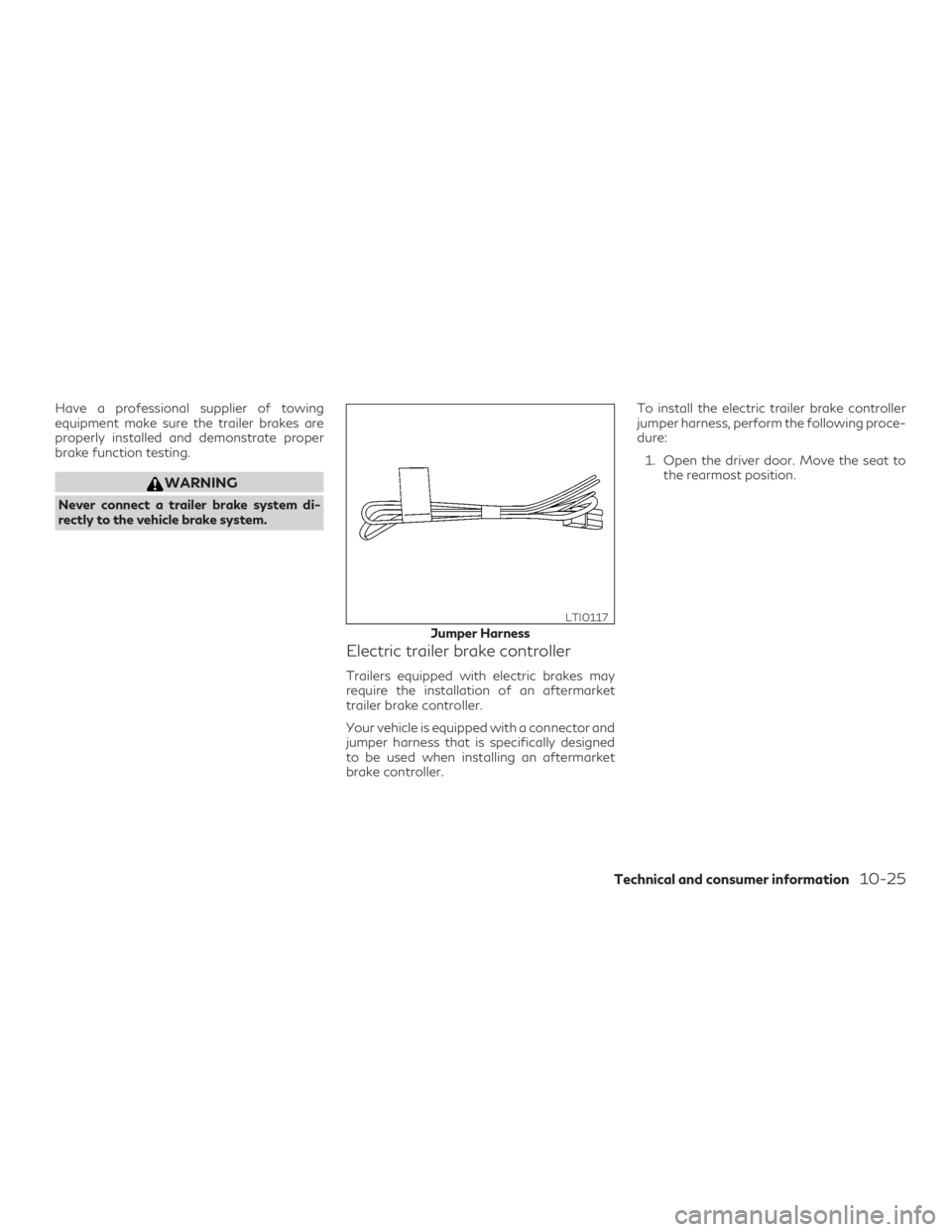
Your vehicle is equipped with a connector and
jumper harness that is specifically designed
to be used when installing an aftermarket
brake controller.To install the electric trailer brake controller
jumper harness, perform the following proce-
dure:
1. Open the driver door. Move the seat to the rearmost position.
Jumper Harness
LTI0117
Technical and consumer information10-25
Page 520 of 532
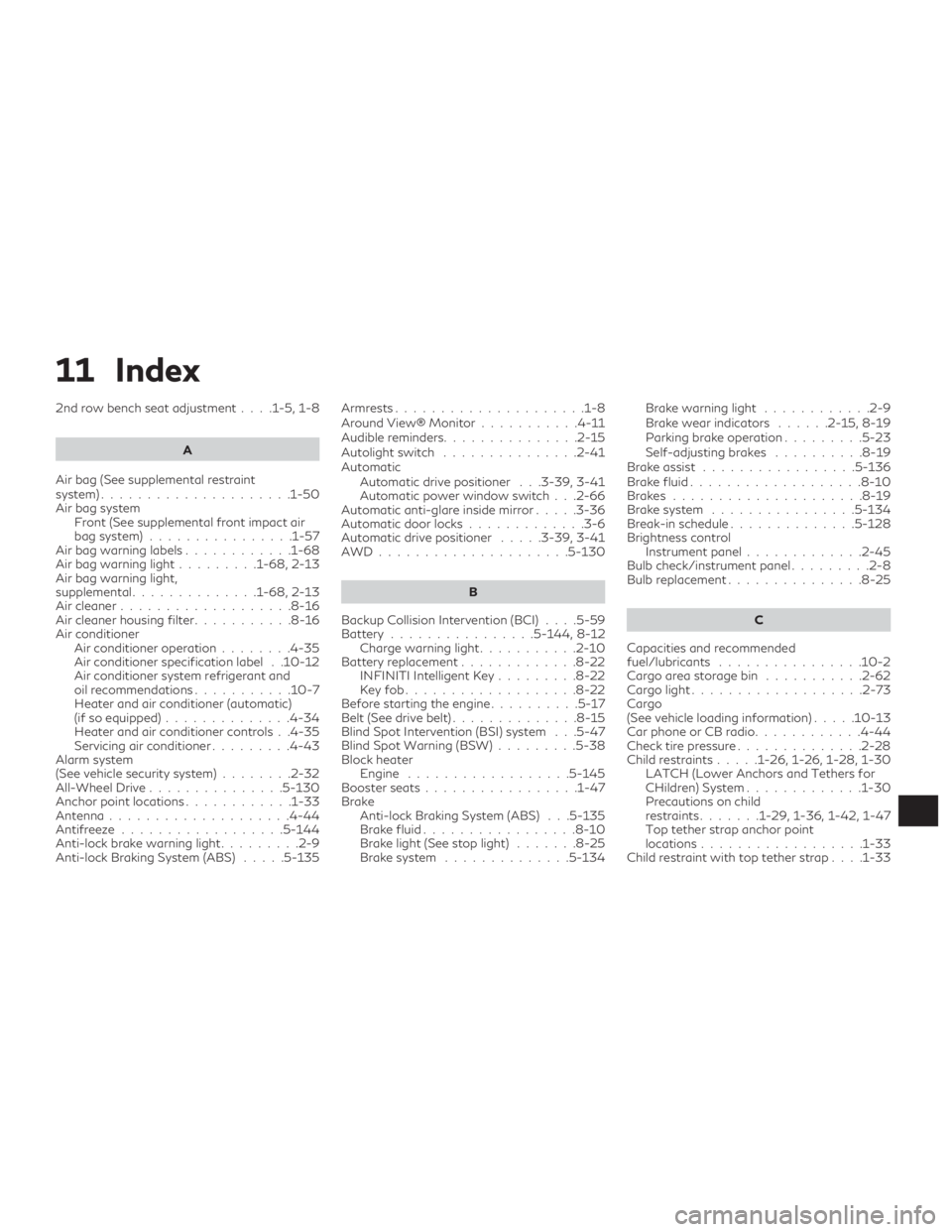
11 Index
2nd row bench seat adjustment....1-5,1-8
A
Air bag (See supplemental restraint
system).....................1-50
Air bag system Front (See supplemental front impact air
bag system) ................1-57
Air bag warning labels ............1-68
Airbagwarninglight.........1-68,2-13
Air bag warning light,
supplemental ..............1-68,2-13
Air cleaner ...................8-16
Air cleaner housing filter ...........8-16
Air conditioner Air conditioner operation ........4-35
Air conditioner specification label . .10-12
Air conditioner system refrigerant and
oil recommendations ...........10-7
Heater and air conditioner (automatic)
(if so equipped) ..............4-34
Heater and air conditioner controls . .4-35
Servicing air conditioner .........4-43
Alarm system
(See vehicle security system) ........2-32
All-Wheel Drive ...............5-130
Anchor point locations ............1-33
Antenna ....................4-44
Antifreeze ..................5-144
Anti-lock brake warning light .........2-9
Anti-lock Braking System (ABS) .....5-135Armrests.....................1-8
Around View® Monitor
...........4-11
Audible reminders ...............2-15
Autolight switch ...............2-41
Automatic Automatic drive positioner . . .3-39, 3-41
Automatic power window switch . . .2-66
Automatic anti-glare inside mirror .....3-36
Automatic door locks .............3-6
Automatic drive positioner .....3-39,3-41
AWD.....................5-130
B
Backup Collision Intervention (BCI) ....5-59
Battery................5- 144, 8-12
Charge warning light ...........2-10
Battery replacement .............8-22
INFINITI Intelligent Key .........8-22
Keyfob...................8-22
Before starting the engine ..........5-17
Belt (See drive belt) ..............8-15
Blind Spot Intervention (BSI) system . . .5-47
Blind Spot Warning (BSW) .........5-38
Block heater Engine ..................5-145
Boosterseats.................1-47
Brake Anti-lock Braking System (ABS) . . .5-135
Brakefluid.................8-10
Brakelight(Seestoplight) .......8-25
Brake system ..............5-134 Brakewarninglight ............2-9
Brake wear indicators
......2-15,8-19
Parking brake operation .........5-23
Self-adjusting brakes ..........8-19
Brakeassist .................5-136
Brakefluid...................8-10
Brakes .....................8-19
Brake system ................5-134
Break-in schedule ..............5-128
Brightness control Instrument panel .............2-45
Bulb check/instrument panel .........2-8
Bulb replacement ............... 8-25
C
C
apacities and recommended
fuel/lubricants ................10-2
Cargoareastoragebin ...........2-62
Cargolight................... 2-73
Cargo
(See vehicle loading information) .....10-13
Car phone or CB radio ............4-44
Check tire pressure ..............2-28
Child restraints .....1-26,1-26,1 -28, 1-30
LATCH (Lower Anchors and Tethers for
CHildren) System .............1-30
Precautions on child
restraints .......1-29,1-36,1 -42, 1-47
Top tether strap anchor point
locations..................1-33
Child restraint with top tether strap . . . .1-33