warning INFINITI QX60 2019 Owners Manual
[x] Cancel search | Manufacturer: INFINITI, Model Year: 2019, Model line: QX60, Model: INFINITI QX60 2019Pages: 540, PDF Size: 6.41 MB
Page 510 of 540
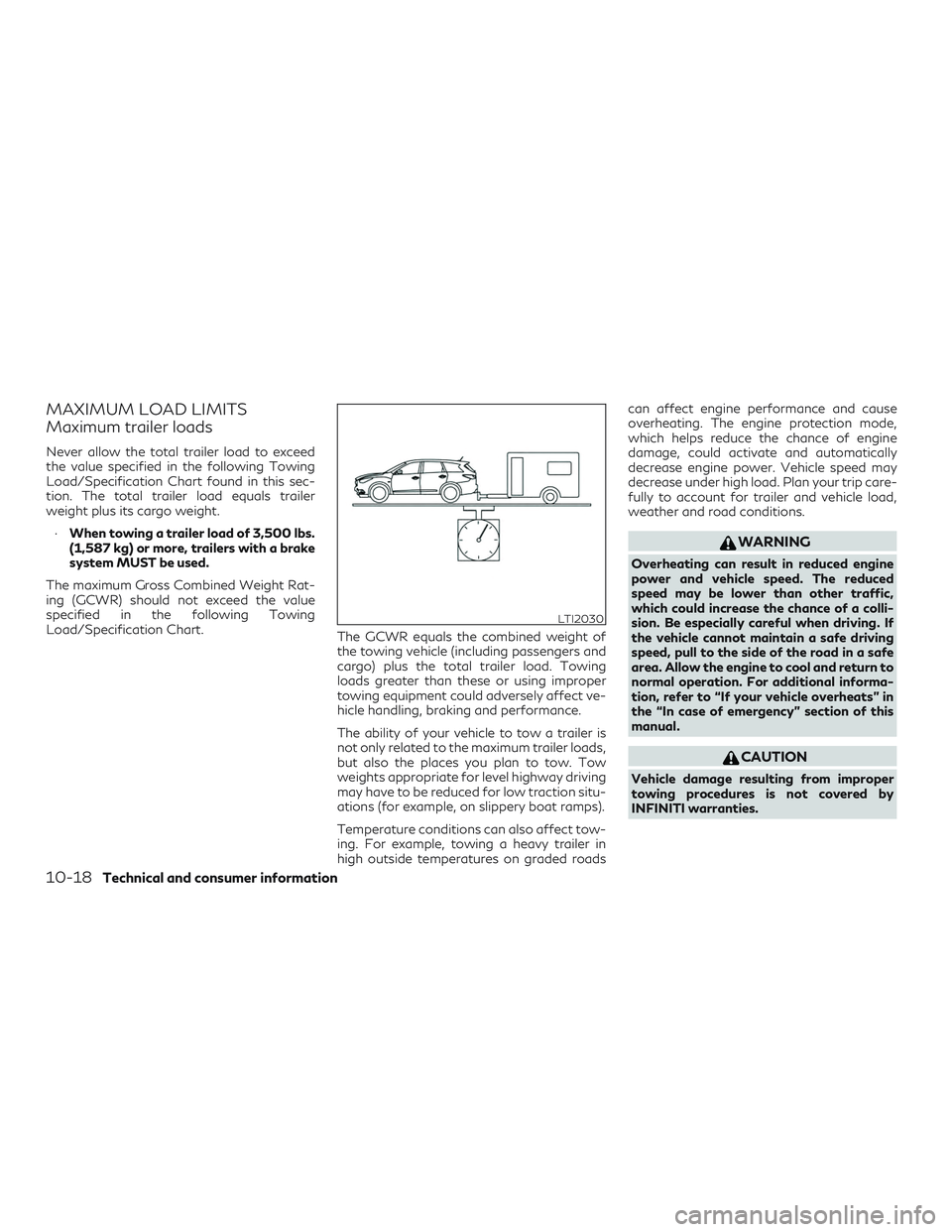
MAXIMUM LOAD LIMITS
Maximum trailer loads
Never allow the total trailer load to exceed
the value specified in the following Towing
Load/Specification Chart found in this sec-
tion. The total trailer load equals trailer
weight plus its cargo weight.∙ When towing a trailer load of 3,500 lbs.
(1,587 kg) or more, trailers with a brake
system MUST be used.
The maximum Gross Combined Weight Rat-
ing (GCWR) should not exceed the value
specified in the following Towing
Load/Specification Chart. The GCWR equals the combined weight of
the towing vehicle (including passengers and
cargo) plus the total trailer load. Towing
loads greater than these or using improper
towing equipment could adversely affect ve-
hicle handling, braking and performance.
The ability of your vehicle to tow a trailer is
not only related to the maximum trailer loads,
but also the places you plan to tow. Tow
weights appropriate for level highway driving
may have to be reduced for low traction situ-
ations (for example, on slippery boat ramps).
Temperature conditions can also affect tow-
ing. For example, towing a heavy trailer in
high outside temperatures on graded roadscan affect engine performance and cause
overheating. The engine protection mode,
which helps reduce the chance of engine
damage, could activate and automatically
decrease engine power. Vehicle speed may
decrease under high load. Plan your trip care-
fully to account for trailer and vehicle load,
weather and road conditions.
WARNING
Overheating can result in reduced engine
power and vehicle speed. The reduced
speed may be lower than other traffic,
which could increase the chance of a colli-
sion. Be especially careful when driving. If
the vehicle cannot maintain a safe driving
speed, pull to the side of the road in a safe
area. Allow the engine to cool and return to
normal operation. For additional informa-
tion, refer to “If your vehicle overheats” in
the “In case of emergency” section of this
manual.
CAUTION
Vehicle damage resulting from improper
towing procedures is not covered by
INFINITI warranties.
LTI2030
10-18Technical and consumer information
Page 513 of 540
Do not exceed the maximum tongue weight
specification shown in the “Towing
Load/Specification” chart even if the calcu-
lated available tongue weight is greater than
15%. If the calculated tongue weight is less
than 10%, reduce the total trailer weight to
match the available tongue weight.
Always verify that available capacities are
within the required ratings.
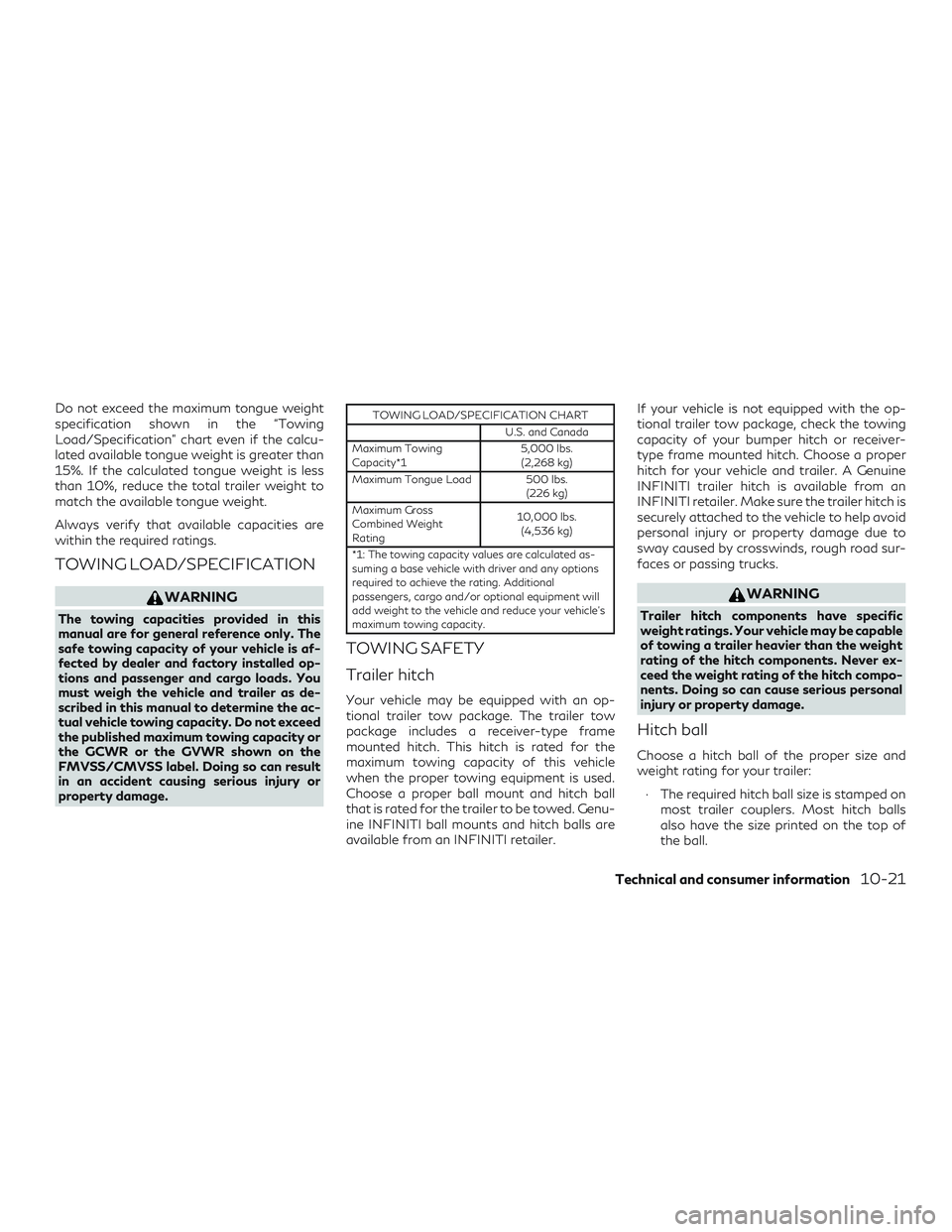
TOWING LOAD/SPECIFICATION
WARNING
The towing capacities provided in this
manual are for general reference only. The
safe towing capacity of your vehicle is af-
fected by dealer and factory installed op-
tions and passenger and cargo loads. You
must weigh the vehicle and trailer as de-
scribed in this manual to determine the ac-
tual vehicle towing capacity. Do not exceed
the published maximum towing capacity or
the GCWR or the GVWR shown on the
FMVSS/CMVSS label. Doing so can result
in an accident causing serious injury or
property damage.
TOWING LOAD/SPECIFICATION CHARTU.S. and Canada
Maximum Towing
Capacity*1 5,000 lbs.
(2,268 kg)
Maximum Tongue Load 500 lbs.
(226 kg)
Maximum Gross
Combined Weight
Rating 10,000 lbs.
(4,536 kg)
*1: The towing capacity values are calculated as-
suming a base vehicle with driver and any options
required to achieve the rating. Additional
passengers, cargo and/or optional equipment will
add weight to the vehicle and reduce your vehicle’s
maximum towing capacity.
TOWING SAFETY
Trailer hitch
Your vehicle may be equipped with an op-
tional trailer tow package. The trailer tow
package includes a receiver-type frame
mounted hitch. This hitch is rated for the
maximum towing capacity of this vehicle
when the proper towing equipment is used.
Choose a proper ball mount and hitch ball
that is rated for the trailer to be towed. Genu-
ine INFINITI ball mounts and hitch balls are
available from an INFINITI retailer. If your vehicle is not equipped with the op-
tional trailer tow package, check the towing
capacity of your bumper hitch or receiver-
type frame mounted hitch. Choose a proper
hitch for your vehicle and trailer. A Genuine
INFINITI trailer hitch is available from an
INFINITI retailer. Make sure the trailer hitch is
securely attached to the vehicle to help avoid
personal injury or property damage due to
sway caused by crosswinds, rough road sur-
faces or passing trucks.
WARNING
Trailer hitch components have specific
weight ratings. Your vehicle may be capable
of towing a trailer heavier than the weight
rating of the hitch components. Never ex-
ceed the weight rating of the hitch compo-
nents. Doing so can cause serious personal
injury or property damage.
Hitch ball
Choose a hitch ball of the proper size and
weight rating for your trailer:
∙ The required hitch ball size is stamped on most trailer couplers. Most hitch balls
also have the size printed on the top of
the ball.
Technical and consumer information10-21
Page 514 of 540

∙ Choose the proper class hitch ball basedon the trailer weight.
∙ The diameter of the threaded shank of the hitch ball must be matched to the ball
mount hole diameter. The hitch ball shank
should be no more than 1/16” smaller
than the hole in the ball mount.
∙ The threaded shank of the hitch ball must be long enough to be properly secured to
the ball mount. There should be at least 2
threads showing beyond the lock washer
and nut.
Ball mount
The hitch ball is attached to the ball mount
and the ball mount is inserted into the hitch
receiver. Choose a proper class ball mount
based on the trailer weight. Additionally, the
ball mount should be chosen to keep the
trailer tongue level with the ground.
Weight carrying hitches
A weight carrying or “dead weight” ball
mount is one that is designed to carry the
whole amount of tongue weight and gross
weight directly on the ball mount and on the
receiver.
Weight distribution hitch
This type of hitch is also called a “load-leveling”
or “equalizing” hitch. A set of bars attach to the
ball mount and to the trailer to distribute the
tongue weight (hitch weight) of your trailer.
Many vehicles can’t carry the full tongue
weight of a given trailer, and need some of the
tongue weight transferred through the frame
and pushing down on the front wheels. This
gives stability to the tow vehicle.
A weight-distributing hitch system (Class IV)
is recommended if you plan to tow trailers
with a maximum weight over 5,000 lbs.
(2,268 kg). Check with the trailer and towing
equipment manufacturers to determine if
they recommend the use of a weight-
distributing hitch system.
NOTE:
A weight-distributing hitch system may af-
fect the operation of trailer surge brakes. If
you are considering use of a weight-
distributing hitch system with a surge
brake-equipped trailer, check with the surge
brake, hitch or trailer manufacturer to de-
termine if and how this can be done.
Follow the instructions provided by the
manufacturer for installing and using the
weight-distributing hitch system. General set-up instructions are as follows:
1. Park unloaded vehicle on a level surface. With the ignition on and the doors
closed, allow the vehicle to stand for
several minutes so that it can level.
2. Measure the height of a reference point on the front and rear bumpers at the
center of the vehicle.
3. Attach the trailer to the vehicle and ad- just the hitch equalizers so that the front
bumper height is within0-.5inches (0 –
13 mm) of the reference height mea-
sured in step 2. The rear bumper should
be no higher than the reference height
measured in step 2.
WARNING
Properly adjust the weight distributing
hitch so the rear of the bumper is no higher
than the measured reference height when
the trailer is attached. If the rear bumper is
higher than the measured reference height
when loaded, the vehicle may handle unpre-
dictably which could cause a loss of vehicle
control and cause serious personal injury or
property damage.
10-22Technical and consumer information
Page 516 of 540
Trailer brakes
When towing a trailer load of 3,500 lbs.
(1,587 kg) or more, trailers with a brake sys-
tem MUST be used.However, most states
require a separate braking system on trailers
with a loaded weight above a specific
amount. Make sure the trailer meets the local
regulations and the regulations where you
plan to tow.
Several types of braking systems are avail-
able.
Surge Brakes - The surge brake actuator is
mounted on the trailer tongue with a hydrau-
lic line running to each trailer wheel. Surge
brakes are activated by the trailer pushing
against the hitch ball when the tow vehicle is
braking. Hydraulic surge brakes are common
on rental trailers and some boat trailers. In
this type of system, there is no hydraulic or
electric connection for brake operation be-
tween the tow vehicle and the trailer. Electric Trailer Brakes -
Electric braking sys-
tems are activated by an electronic signal
sent from a trailer brake controller (special
brake-sensing module). For additional infor-
mation, refer to “Electric trailer brake control-
ler” in this section.
Have a professional supplier of towing
equipment make sure the trailer brakes are
properly installed and demonstrate proper
brake function testing.
WARNING
Never connect a trailer brake system di-
rectly to the vehicle brake system.
Electric trailer brake controller
(if so equipped)
Trailers equipped with electric brakes may
require the installation of an aftermarket
trailer brake controller.
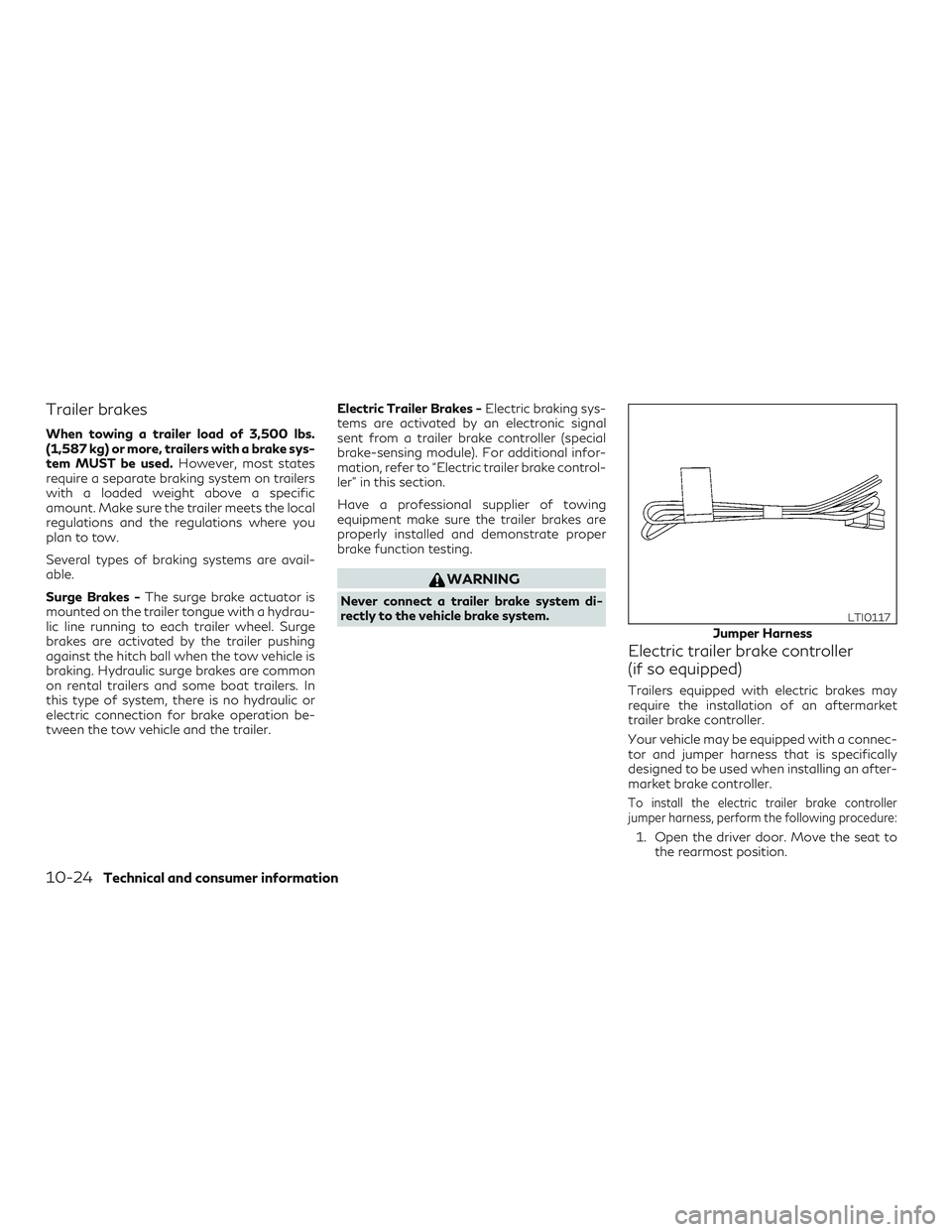
Your vehicle may be equipped with a connec-
tor and jumper harness that is specifically
designed to be used when installing an after-
market brake controller.
To install the electric trailer brake controller
jumper harness, perform the following procedure:
1. Open the driver door. Move the seat to the rearmost position.
Jumper Harness
LTI0117
10-24Technical and consumer information
Page 521 of 540
Continuously Variable Transmission
To tow a vehicle equipped with a continu-
ously variable transmission, an appropriate
vehicle dollyMUSTbe placed under the
towed vehicle’s drive wheels. Alwaysfollow
the dolly manufacturer’s recommendations
when using their product. DOT (Department of Transportation) Quality
Grades: All passenger car tires must conform
to federal safety requirements in addition to
these grades.
Quality grades can be found where appli-
cable on the tire sidewall between tread
shoulder and maximum section width. For
example:
Treadwear 200 Traction AA Temperature A
Treadwear
The treadwear grade is a comparative rating
based on the wear rate of the tire when
tested under controlled conditions on a
specified government test course. For ex-
ample, a tire graded 150 would wear one and
one-half (1 1/2) times as well on the govern-
ment course as a tire graded 100. The rela-
tive performance of tires depends upon the
actual conditions of their use, however, and
may depart significantly from the norm due
to variations in driving habits, service prac-
tices and differences in road characteristics
and climate.
Traction AA, A, B and C
The traction grades, from highest to lowest,
are AA, A, B, and C. Those grades represent
the tire’s ability to stop on wet pavement as
measured under controlled conditions onspecified government test surfaces of as-
phalt and concrete. A tire marked C may have
poor traction performance.
WARNING
The traction grade assigned to this tire is
based on straight-ahead braking traction
tests, and does not include acceleration,
cornering, hydroplaning, or peak traction
characteristics.
Temperature A, B and C
The temperature grades are A (the highest),
B, and C, representing the tire’s resistance to
the generation of heat, and its ability to dis-
sipate heat when tested under controlled
conditions on a specified indoor laboratory
test wheel. Sustained high temperature can
cause the material of the tire to degenerate
and reduce tire life, and excessive tempera-
ture can lead to sudden tire failure. The grade
C corresponds to a level of performance
which all passenger car tires must meet under
the Federal Motor Vehicle Safety Standard
No. 109. Grades B and A represent higher
levels of performance on the laboratory test
wheel than the minimum required by law.
UNIFORM TIRE QUALITY GRADING
Technical and consumer information10-29
Page 522 of 540
WARNING
The temperature grade for this tire is es-
tablished for a tire that is properly inflated
and not overloaded. Excessive speed,
under-inflation, or excessive loading, either
separately or in combination, can cause
heat build-up and possible tire failure.Your INFINITI is covered by the following
emission warranties:
For USA
1. Emission Defects Warranty
2. Emissions Performance Warranty
Details of these warranties may be found
with other vehicle warranties in your War-
ranty Information Booklet which comes with
your INFINITI. If you did not receive a War-
ranty Information Booklet, or it is lost, you
may obtain a replacement by writing to: ∙ INFINITI Division Nissan North America, Inc.
Consumer Affairs Department
P.O. Box 685003
Franklin, TN 37068-5003 For Canada
Emission Control System Warranty
Details of these warranties may be found
with other vehicle warranties in your War-
ranty Information Booklet which comes with
your INFINITI. If you did not receive a War-
ranty Information Booklet, or it is lost, you
may obtain a replacement by writing to:
∙ Nissan Canada Inc. 5290 Orbitor Drive
Mississauga, Ontario, L4W 4Z5
EMISSION CONTROL SYSTEM
WARRANTY
10-30Technical and consumer information
Page 524 of 540

WARNING
A vehicle equipped with All-Wheel Drive
(AWD) should never be tested using a two
wheel dynamometer (such as the dyna-
mometers used by some states for emis-
sions testing), or similar equipment. Make
sure you inform the test facility personnel
that your vehicle is equipped with AWD be-
fore it is placed on a dynamometer. Using
the wrong test equipment may result in
transmission damage or unexpected vehicle
movement which could result in serious ve-
hicle damage or personal injury.
Due to legal requirements in some states and
Canadian Provinces, your vehicle may be re-
quired to be in what is called the “ready con-
dition” for an Inspection/Maintenance (I/M)
test of the emission control system.
The vehicle is set to the “ready condition”
when it is driven through certain driving pat-
terns. Usually, the ready condition can be
obtained by ordinary usage of the vehicle. If a powertrain system component is repaired
or the battery is disconnected, the vehicle
may be reset to a “not ready” condition. Be-
fore taking the I/M test, check the vehicle’s
inspection/maintenance test readiness con-
dition. Place the ignition switch in the ON
position without starting the engine. If the
Malfunction Indicator Light (MIL) comes on
steady for 20 seconds and then blinks for
10 seconds , the I/M test condition is “not
ready”. If the MIL does not blink after 20 sec-
onds, the I/M test condition is “ready”. It is
recommended that you visit an INFINITI re-
tailer to set the “ready condition” or to pre-
pare the vehicle for testing.
This vehicle is equipped with an EDR. The
main purpose of an EDR is to record, in cer-
tain collision or near collision-like situations,
such as an air bag deployment or hitting a
road obstacle, data that will assist in under-
standing how a vehicle’s systems performed.
The EDR is designed to record data related to
vehicle dynamics and safety systems for a
short period of time, typically 30 seconds or
less. The EDR in this vehicle is designed to
record such data as:
∙ How various systems in your vehicle were operating;
∙ Whether or not the driver and passenger safety belts were buckled/fastened;
∙ How far (if at all) the driver was depress- ing the accelerator and/or brake pedal;
and,
∙ How fast the vehicle was traveling.
∙ Sounds are not recorded.
These data can help provide a better under-
standing of the circumstances in which colli-
sions and injuries occur. NOTE: EDR data are
recorded by your vehicle only if a nontrivial
collision situation occurs; no data are re-
corded by the EDR under normal driving con-
ditions and no personal data (e.g. name, gen-
der, age and collision location) are recorded.
READINESS FOR INSPECTION/
MAINTENANCE (I/M) TEST EVENT DATA RECORDERS (EDR)
10-32Technical and consumer information
Page 527 of 540

11 Index
2nd row bench seat adjustment.......1-8
A
Air bag (See supplemental restraint
system).....................1-50
Air bag system Front (See supplemental front impact
airbagsystem) ..............1-57
Air bag warning labels ............1-68
Airbagwarninglight.........1-69,2-12
Air bag warning light,
supplemental ..............1-69,2-12
Air cleaner ...................8-16
Air cleaner housing filter ...........8-16
Air conditioner Air conditioner operation ....4-35,4-44
Air conditioner specification label . .10-12
Air conditioner system refrigerant and
oil recommendations ...........10-7
Heater and air conditioner (automatic)
(if so equipped) ..........4-34,4-43
Heater and air conditioner
controls ..............4-35,4-44
Servicing air conditioner .........4-53
Alarm system (See
vehicle security system) ...........2-32
Anchor point locations ............1-33
Antenna ....................4-54
Antifreeze ..................5-144
Anti-lock brake warning light .........2-9
Anti-lock Braking System (ABS) .....5-135Armrests.....................1-8
Around View® Monitor
...........4-11
Audible reminders ...............2-15
Autolight switch ...............2-40
Automatic Automatic drive positioner . . .3-37, 3-39
Automatic power window switch . . .2-65
Automatic anti-glare inside mirror .....3-34
Automatic door locks .............3-7
Automatic drive positioner .....3-37,3-39
B
Backup Collision Intervention (BCI) ....5-60
Battery................5- 144, 8-12
Charge warning light ...........2-9
Battery replacement .............8-22
INFINITI Intelligent Key .........8-22
Keyfob...................8-22
Before starting the engine ..........5-17
Belt (See drive belt) ..............8-15
Blind Spot Intervention® (BSI) .......5-48
Blind Spot Warning (BSW) .........5-38
Boosterseats.................1-47
Brake Anti-lock Braking System (ABS) . . .5-135
Brakefluid.................8-10
Brakelight(Seestoplight) .......8-25
Brake system ..............5-134
Brakewarninglight ............2-9
Brakewearindicators ......2-15,8-19
Parking brake operation .........5-23 Self-adjusting brakes
..........8-19
Brake Assist ................. 5-136
Brakefluid...................8-10
Brakes .....................8-19
Brake system ................5-134
Break-in schedule ..............5-128
Brightness control Instrument panel .............2-44
Bulb check/instrument panel .........2-8
Bulb replacement ............... 8-25
C
Camera Aiding Sonar (parking sensor) . .4-24
Capacities and recommended
fuel/lubricants ................10-2
Cargoareastoragebin ...........2-61
Cargolight...................2-72
Cargo (See
vehicle loading information) ........10-13
Car phone or CB radio ............4-54
Check tire pressure ..............
2
-28
Child restraints .....1-26,1-27,1 -28, 1-30
LATCH (Lower Anchors and Tethers
for CHildren) System ...........1-30
Precautions on child
restraints .......1-28, 1-35, 1-41, 1-47
Top tether strap anchor point
locations..................1-33
Child restraint with top tether strap ....1-32
Child safety rear door lock ..........3-7
Chimes, audible reminders ..........2-15
Page 528 of 540

Cleaning exterior and interior......7-2,7-4
C.M.V.S.S. certification label ........10-11
Cold weather driving ............5-144
Console box ..................2-58
Console light ..................2-71
Continuously Variable
Transmission (CVT) ..............5-18
Continuously Variable Transmission
(CVT) fluid ..................8-9
Driving with Continuously Variable
Transmission (CVT) ............5-18
Controls Heater and air conditioner
controls...............4-35,4-44
Coolant Capacities and recommended
fuel/lubricants...............10-2
Changing engine coolant ..........8-5
Checking engine coolant level .......8-5
Engine coolant temperature gauge ....2-6
Corrosion protection ..............7-7
Cruisecontrol..............5-76,5-77
Cupholders...................2-60
D
Defroster switch Rear window and outside mirror
defroster switch ..............2-39
Dimensionsandweights...........10-9
Dimmer switch for instrument panel ....2-44
Distance Control Assist (DCA) ........5-98
Door locks ....................3-5
Drivebelt....................8-15
Drive positioner, Automatic .....3-37,3-39Driving
Cold weather driving ..........5-144
Driving with Continuously Variable
Transmission (CVT) ............5-18
Precautions when starting
and driving ..............5-4,5-10
Driving the vehicle ...............5-18
Dual panel moonroof .............2-67
Dual power moonroof ............2-67
E
E-CALL (SOS) SWITCH ...........2-53
Economy - fuel ................5-130
Emergency engine shutoff .......5-15,6-3
Emission control information label ....10-11
Emission control system warranty ....10-30
Engine Before starting the engine ........5-17
Block heater ................5-146
Capacities and recommended
fuel/lubricants...............10-2
Changing engine coolant ..........8-5
Changing engine oil .............8-7
Changing engine oil filter .........8-8
Checking engine coolant level .......8-5
Checking engine oil level ..........8-6
Engine compartment check locations . .8-3
Engine coolant temperature gauge ....2-6
Engine cooling system ...........8-4
Engine oil ...................8-6
Engine oil and oil filter
recommendation ..............10-6
Engine oil viscosity ............10-6
Engine serial number ..........10-11 Engine specifications
...........10-8
Starting the engine ............5-17
Engine coolant temperature gauge ......2-6
Event Data recorders ............10-32
Exhaust gas (Carbon monoxide) .......5-4
Explanation of
maintenance items ......9-2
Explanation of scheduled maintenance
items........................9-5
Extended storage switch ...........2-55
F
Flashers (See
hazard warning flasher switch) ........6-2
Flat tire ......................6-3
Floor mat positioning aid ............7-5
Fluid Brakefluid .................8-10
Capacities and recommended
fuel/lubricants............... 10-2
Continuously Variable Transmission
(CVT) fluid ..................8-9
Engine coolant ................8-4
Engine oil ...................8-6
Power steering fluid ............8-9
Windshield-washerfluid.........8-11
F.M.V.S.S. certification label ........10-11
Fog light switch ................ 2-45
Forward Emergency Braking (FEB) with
Pedestrian Detection system ....2-10,5-109
Front air bag system (See
supplemental restraint system) .......1-57
Front and rear sonar system ........5-141
Front-door pocket ...............2-56
Front power seat adjustment .........1-3
11-2
Page 529 of 540
Frontseats....................1-2
FuelCapacities and recommended
fuel/lubricants...............10-2
Fuel economy ...............5-130
Fuel-filler door and cap ..........3-29
Fuel gauge ..................2-7
Fueloctanerating.............10-5
Fuel recommendation ...........10-3
Loose fuel cap warning ..........2-28
Fuel efficient driving tips ..........5-128
Fuel-filler door .................3-28
Fuel gauge ....................2-7
Fuses......................8-20
Fusiblelinks...................8-21
G
Garage door opener, HomeLink® Universal
Transceiver....2-73,2-74,2-75,2-76,2-76, 2-77
Gascap.....................3-29
Gauge Engine coolant temperature gauge ....2-6
Fuel gauge ..................2-7
Odometer ...................2-5
Speedometer .................2-5
Tachometer .................2-6
Trip odometer ................2-5
General maintenance ..............9-2
Glovebox....................2-58
Gloveboxlock.................2-58 H
Hazard warning flasher switch ........6-2
Headlight and turn signal switch ......2-39
Headlight control switch ...........2-40
Headlights ...................8-24
Head restraints .................1-12
Heated 2nd row seat switches .......2-48
Heated seats ..................2-46
Heated seat switches .............2-47
Heated steering wheel ............2-49
Heater Heater and air conditioner (automatic)
(if so equipped) ...........4-34,4-43
Heater and air conditioner
controls...............4-35,4-44
Heater operation ..........4-36,4-45
Heater and air conditioner
(automatic) ...............4-34,4-43
Hill start assist system ............5-139
HomeLink® Universal Transceiver .2-73, 2-74, 2-75, 2-76, 2-76, 2-77
Hood .......................3-22
Hook Luggage hook ...............2-62
Horn.......................2-46
I
Ignition switch Push-button ignition switch .......5-13
Immobilizer system ..............5-16
Important vehicle information label ....10-11
In-cabin microfilter ..............8-17 Increasing fuel economy
..........5-130
Indicator lights and audible reminders
(See warning/indicator lights and
audiblereminders)......... 2-8, 2-9, 2-13
INFINITI Drive Mode Selector ........5-24
INFINITI Intelligent Key System .....3-2, 3-7
INFINITI InTouch™ Owner's Manual .....4-2
INFINITI Vehicle Immobilizer
System ............... 2-34, 3-4, 5-16
Inside automatic anti-glare mirror .....3-34
Instrument brightness
control ........2-44
Instrument panel .............0-6,2-2
Instrument panel dimmer switch ......2-44
Intelligent All-Wheel Drive (AWD) .....5-130
Intelligent Cruise Control (ICC) .......5-78
Intelligent Key system Key operating range ............3-9
Keyoperation ...............3-10
Mechanical key ...............3-3
Remote keyless entry operation .....3-13
Troubleshooting guide ..........3-17
Warningsignals ..............3-17
Interiorlight...................2-71
ISOFIX child restraints ............1-30
J
Jump starting ..............6-11,8-15
K
Key.........................3-2
Key fob battery replacement ........8-22
11-3