light INFINITI QX60 2023 Owners Manual
[x] Cancel search | Manufacturer: INFINITI, Model Year: 2023, Model line: QX60, Model: INFINITI QX60 2023Pages: 636, PDF Size: 7.28 MB
Page 590 of 636
Octane rating tips
Using unleaded gasoline with an octane rat-
ing lower than recommended can cause per-
sistent, heavy “spark knock.” (“Spark knock”
is a metallic rapping noise.) If severe, this can
lead to engine damage. If you detect a per-
sistent heavy spark knock even when using
gasoline of the stated octane rating, or if you
hear steady spark knock while holding a
steady speed on level roads, it is recom-
mended that you have an INFINITI retailer
correct the condition. Failure to correct the
condition is misuse of the vehicle, for which
INFINITI is not responsible.
Incorrect ignition timing may result in spark
knock, after-run and/or overheating, which
may cause excessive fuel consumption or en-
gine damage. If any of the above symptoms
are encountered, have your vehicle checked.
It is recommended that you visit an INFINITI
retailer.
However, now and then you may notice light
spark knock for a short time while accelerat-
ing or driving up hills. This is not a cause for
concern, because you get the greatest fuel
benefit when there is light spark knock for a
short time under heavy engine load.
ENGINE OIL AND OIL FILTER
RECOMMENDATIONS
Selecting the correct oil
It is essential to choose the correct grade,
quality and viscosity engine oil to ensure sat-
isfactory engine life and performance. For
additional information, see "Recommended
fluids/lubricants and capacities" (P. 10-2).
INFINITI recommends the use of an energy
conserving oil in order to improve fuel
economy.Select only engine oils that meet the Ameri-
can Petroleum Institute (API) certification or
International Lubricant Standardization and
Approval Committee (ILSAC) certification
and SAE viscosity standard. These oils have
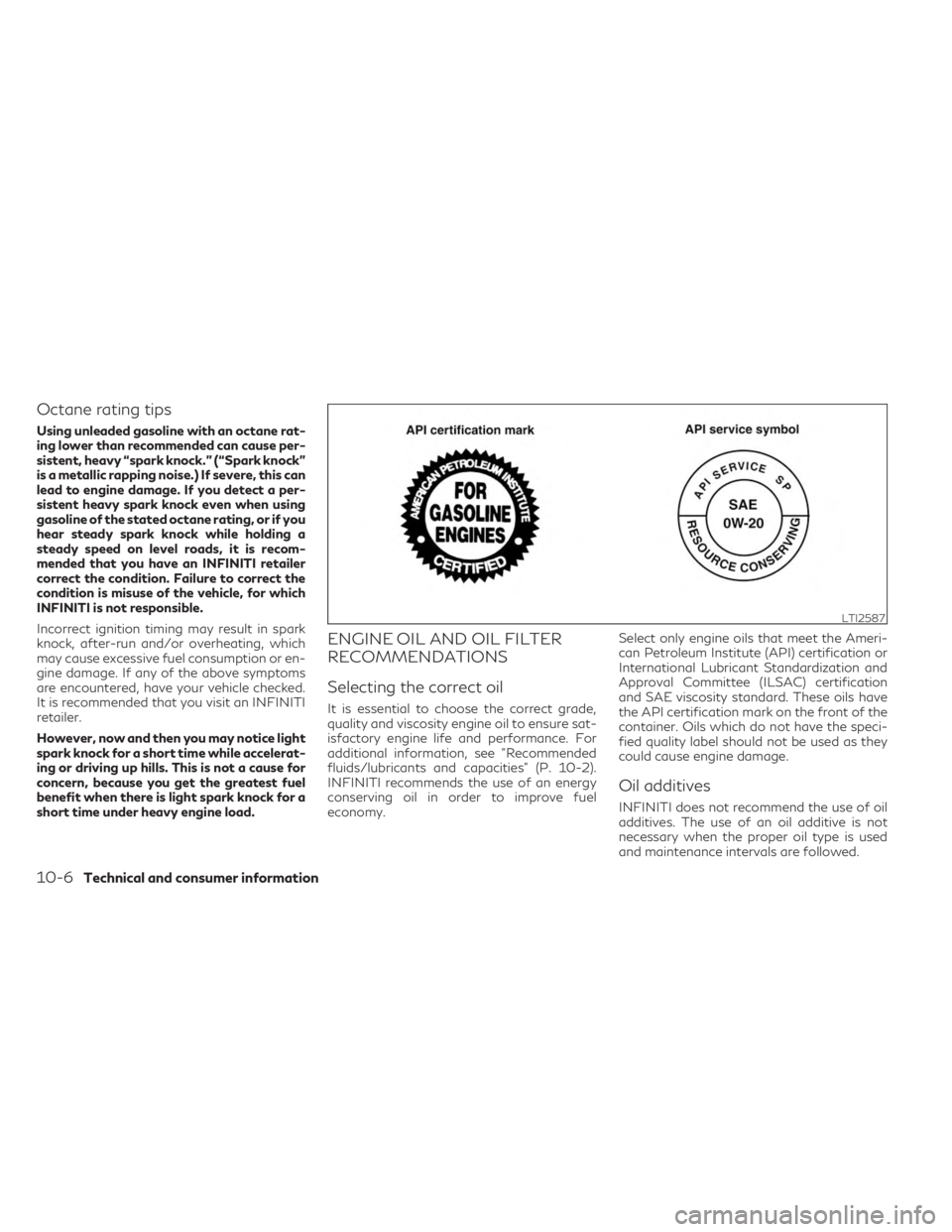
the API certification mark on the front of the
container. Oils which do not have the speci-
fied quality label should not be used as they
could cause engine damage.
Oil additives
INFINITI does not recommend the use of oil
additives. The use of an oil additive is not
necessary when the proper oil type is used
and maintenance intervals are followed.
LTI2587
10-6Technical and consumer information
Page 610 of 636
Safety chains
Always use suitable safety chains between
your vehicle and the trailer. The safety chains
should be crossed and should be attached to
the hitch, not to the vehicle bumper or axle.
The safety chains can be attached to the
bumper if the hitch ball is mounted to the
bumper. Be sure to leave enough slack in the
chains to permit turning corners.
Trailer lights
CAUTION
When splicing into the vehicle electrical
system, a commercially available power-
type module/converter must be used to
provide power for all trailer lighting. This
unit uses the vehicle battery as a direct
power source for all trailer lights while us-
ing the vehicle tail light, stop light and turn
signal circuits as a signal source. The
module/converter must draw no more
than 15 milliamps from the stop and tail
lamp circuits. Using a module/converter
that exceeds these power requirements
may damage the vehicle's electrical sys-
tem. See a reputable trailer retailer to ob-
tain the proper equipment and to have it
installed. Trailer lights should comply with federal
and/or local regulations. For assistance in
hooking up trailer lights, contact an INFINITI
retailer or reputable trailer retailer. Vehicles
equipped with the optional trailer tow pack-
age are equipped with a 7-pin trailer harness
connector. If your trailer is equipped with a
flat 4-pin connector, an adapter will be
needed to connect the trailer lights to the
vehicle. Adapters are available at auto parts
stores and hitch retailers.Trailer brakes
When towing a trailer load of 3,500 lbs.
(1,587 kg) or more, trailers with a brake sys-
tem MUST be used.
However, most states
require a separate braking system on trailers
with a loaded weight above a specific
amount. Make sure the trailer meets the local
regulations and the regulations where you
plan to tow.
Several types of braking systems are
available. Surge Brakes -
The surge brake actuator is
mounted on the trailer tongue with a hydrau-
lic line running to each trailer wheel. Surge
brakes are activated by the trailer pushing
against the hitch ball when the tow vehicle is
braking. Hydraulic surge brakes are common
on rental trailers and some boat trailers. In
this type of system, there is no hydraulic or
electric connection for brake operation be-
tween the tow vehicle and the trailer.
Electric Trailer Brakes - Electric braking sys-
tems are activated by an electronic signal
sent from a trailer brake controller (special
brake-sensing module). For additional infor-
mation, see “Electric trailer brake controller”
(P. 10-27).
Have a professional supplier of towing
equipment make sure the trailer brakes are
properly installed and demonstrate proper
brake function testing.
WARNING
Never connect a trailer brake system di-
rectly to the vehicle brake system.
10-26Technical and consumer information
Page 612 of 636

2. Locate the jumper harness connector un-der the lower portion of the instrument
panel. The connector is taped to the wir-
ing harness
O1as indicated.
• The connector is marked with a white tag with “elec brake conn”.
If you have trouble locating the wiring har-
ness, it is recommended that you visit an
INFINITI retailer for assistance.
Wire color designation for electric trailer
brake controller jumper harness.
WIRE COLOR NOTE
WHITE Vehicle stop lamp switch
to trailer brake controller.
BLACK Brake controller ground
(-).
WHITE Trailer brake controller
switched output.
RED/BLUE Not used
GREEN Fused trailer brake con-
troller battery feed (B+).
3. Peel off the tape and connect the jumper harness to the connector.
4. Release the parking brake.
5. Install the aftermarket electric trailer brake controller according to the manu-
facturer's instructions.
Pre-towing tips
• Be certain your vehicle maintains a levelposition when a loaded and/or unloaded
trailer is hitched. Do not drive the vehicle if
it has an abnormal nose-up or nose-down
condition; check for improper tongue load,
overload, worn suspension or other pos-
sible causes of either condition.
• Always secure items in the trailer to prevent load shift while driving. • Keep the cargo load as low as possible in
the trailer to keep the trailer center of grav-
ity low.
• Load the trailer so approximately 60% of the trailer load is in the front half and 40%
is in the back half. Also make sure the load is
balanced side to side.
• Check your hitch, trailer tire pressure, ve- hicle tire pressure, trailer light operation,
and trailer wheel lug nuts every time you
attach a trailer to the vehicle.
• Be certain your rearview mirrors conform to all federal, state or local regulations. If
not, install any mirrors required for towing
before driving the vehicle.
• Determine the overall height of the vehicle and trailer so the required clearance is
known.Trailer towing tips
In order to gain skill and an understanding of
the vehicle's behavior, you should practice
turning, stopping and backing up in an area
which is free from traffic. Steering stability and
braking performance will be somewhat differ-
ent than under normal driving conditions.
• Always secure items in the trailer to preventload shift while driving.
LTI2046
Connector
10-28Technical and consumer information
Page 614 of 636

• Crosswinds and rough roads will adverselyaffect vehicle/trailer handling, possibly
causing vehicle sway. When being passed
by larger vehicles, be prepared for possible
changes in crosswinds that could affect
vehicle handling.
Do the following if the trailer begins to sway:
1. Take your foot off the accelerator pedal to allow the vehicle to coast and steer as
straight ahead as the road conditions al-
low. This combination will help stabilize
the vehicle.
– Do not correct trailer sway by steering or applying the brakes.
2. When the trailer sway stops, gently apply the brakes and pull to the side of the road
in a safe area.
3. Try to rearrange the trailer load so it is balanced. For additional information, see
“Pre-towing tips” (P. 10-28).
• Be careful when passing other vehicles. Passing while towing a trailer requires con-
siderably more distance than normal pass-
ing. Remember, the length of the trailer
must also pass the other vehicle before you
can safely change lanes. • Downshift the transmission to a lower gear
for engine braking when driving down
steep or long hills. This will help slow the
vehicle without applying the brakes.
• Avoid holding the brake pedal down too long or too frequently. This could cause the
brakes to overheat, resulting in reduced
braking efficiency.
• Increase your following distance to allow for greater stopping distances while tow-
ing a trailer. Anticipate stops and brake
gradually.
• INFINITI recommends that the cruise con- trol not be used while towing a trailer.
• Some states or provinces have specific regulations and speed limits for vehicles
that are towing trailers. Obey the local
speed limits.
• Check your hitch, trailer wiring harness connections, and trailer wheel lug nuts af-
ter 50 miles (80 km) of travel and at every
break.
• When launching a boat, don't allow the water level to go over the exhaust tail pipe
or rear bumper.
• Make sure you disconnect the trailer lights before backing the trailer into the water or
the trailer lights may burn out. When towing a trailer, differential gear oil,
transfer fluid and transmission oil/fluid
should be changed more frequently. For ad-
ditional information, see the “Maintenance
and schedules” section of this manual.
FLAT TOWING FOR ALL–WHEEL
DRIVE VEHICLE (if so equipped)
Towing your vehicle with all four wheels on
the ground is sometimes called flat towing.
This method is sometimes used when towing
a vehicle behind a recreational vehicle, such
as a motor home.
CAUTION
• Failure to follow these guidelines can re-
sult in severe transmission damage.
• Never flat tow your All-wheel drive
(AWD) vehicle.
• DO NOT tow your All-wheel drive
(AWD) vehicle with any wheels on the
ground. Doing so may cause serious and
expensive damage to the powertrain.
• For emergency towing procedures, see
“Towing recommended by INFINITI”
(P. 6-16).
10-30Technical and consumer information
Page 618 of 636
WARNING
A vehicle equipped with All-Wheel Drive
(AWD) should never be tested using a two
wheel dynamometer (such as the dyna-
mometers used by some states for emis-
sions testing), or similar equipment. Make
sure you inform the test facility personnel
that your vehicle is equipped with AWD
before it is placed on a dynamometer. Us-
ing the wrong test equipment may result in
transmission damage or unexpected ve-
hicle movement which could result in seri-
ous vehicle damage or personal injury.
Due to legal requirements in some states and
Canadian Provinces, your vehicle may be re-
quired to be in what is called the “ready con-
dition” for an Inspection/Maintenance (I/M)
test of the emission control system.
The vehicle is set to the “ready condition”
when it is driven through certain driving pat-
terns. Usually, the ready condition can be
obtained by ordinary usage of the vehicle. If a powertrain system component is repaired
or the battery is disconnected, the vehicle
may be reset to a “not ready” condition. Be-
fore taking the I/M test, check the vehicle's
inspection/maintenance test readiness con-
dition. Place the ignition switch in the ON
position without starting the engine. If the
Malfunction Indicator Light (MIL) comes on
steady for 20 seconds and then blinks for
10 seconds , the I/M test condition is “not
ready”. If the MIL does not blink after 20
seconds, the I/M test condition is “ready”. It is
recommended that you visit an INFINITI re-
tailer to set the “ready condition” or to pre-
pare the vehicle for testing.
This vehicle is equipped with an Event Data
Recorder (EDR). The main purpose of an EDR
is to record, in certain crash or near crash-like
situations, such as an air bag deployment or
hitting a road obstacle, data that will assist in
understanding how a vehicle's systems per-
formed. The EDR is designed to record data
related to vehicle dynamics and safety sys-
tems for a short period of time, typically 30
seconds or less. The EDR in this vehicle is
designed to record such data as:
• How various systems in your vehicle were
operating;
• Whether or not the driver and passenger safety belts were buckled/fastened;
• How far (if at all) the driver was depressing the accelerator and/or brake pedal; and,
• How fast the vehicle was traveling.
• Sounds are not recorded.
These data can help provide a better under-
standing of the circumstances in which
crashes and injuries occur. NOTE: EDR data
are recorded by your vehicle only if a non-
trivial crash situation occurs; no data are re-
corded by the EDR under normal driving con-
ditions and no personal data (e.g., name,
gender, age, and crash location) are recorded.
However, other parties, such as law enforce-
ment, could combine the EDR data with the
READINESS FOR INSPECTION/
MAINTENANCE (I/M) TEST EVENT DATA RECORDERS (EDR)
10-34Technical and consumer information
Page 623 of 636

11 Index
A
Active Brake Limited Slip (ABLS)
system....................5-167Active Ride Control.............5-171Active Trace Control............5-170Aiming control, headlights.........2-82Air bag (See supplemental restraint
system).................... .1-54Air bag system
Front (See supplemental front impact air
bag system)
............... .1-62Air bag warning labels............1-74Air bag warning light.........1-75, 2-16Air bag warning light,
supplemental............ .1-75, 2-16Air cleaner.................. .8-17Air cleaner housing filter..........8-17Air conditioner
Air conditioner operation........4-30Air conditioner specification label. .10-12Air conditioner system refrigerant
recommendations............ .10-7Air conditioner system refrigerant and oil
recommendations.............10-7Heater and air conditioner (automatic)
(if so equipped)............. .4-29Heater and air conditioner controls. .4-30Servicing air conditioner.........4-36Alarm system (See vehicle security
system).................... .2-71
Anchor point locations...........1-36Antenna................... .4-36Anti-lock brake warning light........2-17Anti-lock Braking System (ABS).....5-166Antifreeze..................5-184Armrests.................... .1-8Around View® Monitor...........4-10Autolight switch.............. .2-78Automatic
Automatic power window switch. .2-110Driving with automatic transmission. .5-18Automatic anti-glare inside
mirror................ .3-33, 3-34Automatic brake hold............5-27Automatic door locks............ .3-6
B
Battery............... .5-184, 8-13Charge warning light...........2-15Battery replacement............ .8-24INFINITI Intelligent Key.........8-24Key fob.................. .8-24Before starting the engine.........5-16Belt (See drive belt).............8-15Blind Spot Intervention® (BSI).......5-61Blind Spot Warning (BSW).........5-49Booster seats................ .1-51Brake
Anti-lock Braking System (ABS). . .5-166
Brake fluid................ .8-11Brake light (See stop light).......8-26Brake system...............5-165Brake warning light............2-14Brake wear indicators......2-22, 8-20Parking brake operation.........5-25Self-adjusting brakes..........8-20Brake Assist................ .5-167Brake fluid.................. .8-11Brake system................5-165Brakes.................... .8-20Break-in schedule..............5-159Brightness control
Instrument panel............ .2-83Bulb check/instrument panel........2-14Bulb replacement............. .8-26
C
C.M.V.S.S. certification label.......10-11Capacities and recommended
fuel/lubricants............... .10-2Car phone or CB radio...........4-37Cargo (See vehicle loading
information)................ .10-15Cargo area storage bin..........2-106Cargo light................. .2-115Chassis control...............5-170Check tire pressure..........2-41, 2-67Child restraint with top tether strap. . . .1-35
Page 624 of 636

Child restraints.....1-25, 1-26, 1-28, 1-30LATCH (Lower Anchors and Tethers for
CHildren) System.............1-30Precautions on child
restraints...........1-39, 1-45, 1-51Top tether strap anchor point
locations.................. .1-36Child safety rear door lock...........3-6Cleaning exterior and interior......7-2, 7-4Climate-controlled seat switches......2-84Cold weather driving........... .5-184Console box................ .2-102Console light.................2-114Controls
Heater and air conditioner controls. . .4-30CoolantCapacities and recommended
fuel/lubricants
.............. .10-2Changing engine coolant..........8-5Checking engine coolant level.......8-5Engine coolant temperature gauge. . . .2-9Corrosion protection..............7-7Cruise control................ .5-83Cup holders.................2-104
D
Defroster switch
Rear window and outside mirror defroster
switch
................... .2-77Dimensions and weights...........10-9Dimmer switch for instrument panel. . . .2-83Door locks................... .3-4
Drive belt....................8-15Driver Attention Alert............5-156Driving
Cold weather driving..........5-184Driving with automatic transmission. .5-18Precautions when starting and
driving................ .5-4, 5-10Driving the vehicle...............5-18Dual panel moonroof............2-111
E
E-call (SOS) Button............. .2-92Eco Drive Report.............. .5-33Economy - fuel............... .5-161Emergency engine shutoff.......5-14, 6-3Emission control information label. . . .10-12Emission control system warranty. . . .10-32Engine
Before starting the engine........5-16Capacities and recommended
fuel/lubricants.............. .10-2Changing engine coolant..........8-5Changing engine oil.............8-6Changing engine oil filter..........8-6Checking engine coolant level.......8-5Checking engine oil level..........8-6Engine coolant temperature gauge. . . .2-9Engine cooling system...........8-4Engine oil.................. .8-6Engine oil and oil filter
recommendation..............10-6Engine oil pressure warning light. . . .2-15
Engine oil viscosity.............10-7Engine serial number...........10-11Engine specifications...........10-8Starting the engine............ .5-16Engine coolant temperature gauge. . . . .2-9Event Data recorders.......10-34, 10-35Exhaust gas (Carbon monoxide).......5-4Explanation of maintenance items......9-2Explanation of scheduled maintenance
items...................... .9-5Extended storage switch...........2-99
F
F.M.V.S.S. certification label........10-11Flashers (See hazard warning flasher
switch)..................... .6-2Flat tire...................6-3, 6-4Floor mat positioning aid...........7-6Fluid
Brake fluid................. .8-11Capacities and recommended
fuel/lubricants...............10-2Engine coolant............... .8-4Engine oil.................. .8-6Windshield-washer fluid.........8-11Forward Emergency Braking (FEB) with
Pedestrian Detection system. . .2-17, 5-128Front air bag system
(See supplemental restraint system). . . .1-62Front and rear sonar system........5-172Front power seat adjustment.........1-3Front seats................... .1-2
11-2
Page 625 of 636

Front-door pocket.............2-100Fuel
Capacities and recommended
fuel/lubricants
.............. .10-2Fuel economy...............5-161Fuel gauge................ .2-10Fuel octane rating.............10-6Fuel recommendation...........10-4Fuel efficient driving tips..........5-160Fuel gauge.................. .2-10Fuel-filler door.................3-27Fuses..................... .8-20Fusible links..................8-21
G
Garage door opener, HomeLink® Universal
Transceiver. . . .2-116, 2-120, 2-121, 2-122Gauge
Engine coolant temperature gauge. . . .2-9Fuel gauge................ .2-10Odometer.................. .2-8Speedometer..............2-6, 2-7Tachometer................. .2-8Trip odometer................2-8General maintenance..............9-2Glove box.................. .2-101Glove box lock................2-101
H
Hazard warning flasher switch........6-2Head restraints................ .1-12
Head Up Display (HUD)...........2-89Headlight aiming control...........2-82Headlight and turn signal switch......2-77Headlight control switch...........2-77Headlights.................. .8-26Headlights, aiming control..........2-82Heated 2nd row seat switches.......2-86Heated mirrors................3-42Heated seat switches............2-85Heated seats................. .2-84Heated steering wheel switch........2-87Heater
Heater and air conditioner (automatic)
(if so equipped)
.............. .4-29Heater and air conditioner controls. . .4-30Heater operation..............4-31Heater and air conditioner (automatic). .4-29Hill start assist system...........5-171HomeLink® Universal
Transceiver. . . .2-116, 2-120, 2-121, 2-122Hood..................... .3-21Hook
Luggage hook............. .2-106Horn...................... .2-84
I
Idling Stop System..............5-178Ignition switch
Push-button ignition switch.......5-13Immobilizer system............. .5-15Important vehicle information label. . . .10-11In-cabin microfilter..............8-17
Increasing fuel economy..........5-161Indicator lights and audible reminders
(See warning/indicator lights and audible
reminders)
.................. .2-12INFINITI Drive Mode Selector.......5-29INFINITI Intelligent Key
System..............3-2, 3-6, 10-36INFINITI InTouch™ Owner's Manual. . . .4-2INFINITI Vehicle Immobilizer
System..............2-72, 3-3, 5-15Inside automatic anti-glare
mirror................. .3-33, 3-34Instrument brightness control........2-83Instrument panel.............0-6, 2-4Instrument panel dimmer switch......2-83Intelligent All-Wheel Drive (AWD).....5-161Intelligent Cruise Control (ICC)
(for vehicles with ProPILOT Assist). . . .5-97Intelligent Key system
Key operating range............ .3-8Key operation............... .3-9Mechanical key................3-3Remote keyless entry operation.....3-14Troubleshooting guide..........3-16Warning signals..............3-16Interior light................. .2-114ISOFIX child restraints............1-30
J
Jump starting............ .6-12, 8-14
11-3
Page 626 of 636

K
Key........................3-2Key fob battery replacement........8-24Keyless entry
With Intelligent Key system
(See Intelligent Key system)
.......3-14
L
LabelTire and Loading Information label. .10-12LabelsAir conditioner specification label. . .10-12C.M.V.S.S. certification label......10-11Emission control information label. .10-12Engine serial number.......... .10-11F.M.V.S.S. certification label......10-11Tire and Loading Information label. .10-12Vehicle identification number (VIN). .10-10Vehicle identification number (VIN)
plate................... .10-10Warning labels (for SRS).........1-74Lane Departure Prevention (LDP).....5-43Lane Departure Warning (LDW)......5-36LATCH (Lower Anchors and Tethers for
CHildren) System...............1-30LED Daytime Running Lights (DRL)
system.................... .2-82License plate
Installing the license plate........10-13Liftgate.................... .3-21Liftgate release................3-25
Light
Air bag warning light........1-75, 2-16Brake light (See stop light)........8-26Bulb check/instrument panel.......2-14Bulb replacement............ .8-26Charge warning light...........2-15Console light.............. .2-114Exterior and Interior lights........8-26Headlight and turn signal switch.....2-77Headlight control switch.........2-77Headlights................ .8-26Interior light................2-114Light bulbs................ .8-26Low tire pressure warning light.....2-18Low windshield-washer fluid warning
light.................2-39, 2-62Personal lights..............2-115Warning/indicator lights and audible
reminders................. .2-12Lights..................... .8-26Map lights.................2-115Lock
Child safety rear door lock.........3-6Door locks................. .3-4Glove box lock..............2-101Liftgate release..............3-25Power door locks..............3-5Low fuel warning light........2-38, 2-62Low tire pressure warning light.......2-18Low windshield-washer fluid warning
light.................. .2-39, 2-62Luggage (See vehicle loading
information).................10-15Luggage hook................2-106
Luggage rack (see roof rack).......2-107
M
Maintenance
General maintenance........... .9-2Inside the vehicle.............. .9-3Maintenance precautions.........8-2Outside the vehicle.............9-2Seat belt maintenance...........1-25Under the hood and vehicle........9-4Maintenance requirements..........9-2Maintenance schedules........... .9-7Malfunction indicator light..........2-19Map lights.................. .2-115Memory seat.............3-43, 3-44Meters and gauges.............. .2-6Instrument brightness control......2-83Mirror
Automatic anti-glare inside
mirror
............... .3-33, 3-34Heated mirrors...............3-42Outside mirrors...............3-41Vanity mirror............... .3-33Mirror defroster................2-77Mirrors.................... .3-33Moonroof................2-112, 7-5Moving Object Detection (MOD)......4-23
O
Octane rating (See fuel octane rating). . .10-6Odometer................... .2-8
11-4
Page 627 of 636

OilCapacities and recommended
fuel/lubricants
.............. .10-2Changing engine oil.............8-6Changing engine oil filter..........8-6Checking engine oil level..........8-6Engine oil.................. .8-6Engine oil and oil filter
recommendation..............10-6Engine oil viscosity.............10-7Outside mirrors............... .3-41Overhead sunglasses holder........2-103Overheat
If your vehicle overheats.........6-14Owner's manual order form........10-36Owner's manual/service manual order
information................. .10-36
P
Parking
Parking brake operation.........5-25Parking/parking on hills.........5-163Parking brake......2-15, 2-17, 2-21, 5-25Personal lights............... .2-115Power
Power door locks............. .3-5Power outlet............2-94, 2-95Power rear windows..........2-109Power steering system.........5-164Power windows............ .2-108Rear power windows..........2-109Power outlet............. .2-94, 2-95
Power steering............... .5-164Precautions
Maintenance precautions.........8-2On-pavement and off-road driving
precautions................. .5-8Precautions on booster
seats.............1-39, 1-45, 1-51Precautions on child
restraints...........1-39, 1-45, 1-51Precautions on seat belt usage......1-17Precautions on supplemental restraint
system................... .1-54Precautions when starting and
driving.................5-4, 5-10Predictive Forward Collision Warning
(PFCW)................... .5-140ProPILOT Assist...............5-84Push starting................. .6-14
R
Radio
Car phone or CB radio..........4-37Rain sensor.................. .2-75Readiness for inspection maintenance (I/M)
test..................... .10-34Rear Automatic Braking (RAB).......5-121Rear Cross Traffic Alert (RCTA).......5-72Rear Door Alert........2-38, 2-61, 2-92Rear power sunshade............2-111Rear power windows............2-109Rear window and outside mirror defroster
switch..................... .2-77
Rear window wiper and washer
switches....................2-76RearView Monitor...............4-3Recommended Fluids.............10-2Recorders
Event Data.......... .10-34, 10-35Refrigerant recommendation........10-7Registering a vehicle in another
country................... .10-10Remote Engine Start.........3-18, 5-17Reporting safety defects (US only). . . .10-33Roadside assistance program.........6-2Roof rack...................2-107
S
Safety
Child safety rear door lock.........3-6Child seat belts. . .1-28, 1-39, 1-45, 1-51Reporting safety defects (US only). .10-33SeatMemory seat........... .3-43, 3-44Seat adjustment
2nd row seat adjustment..........1-53rd row seat adjustment..........1-7Front power seat adjustment.......1-3Seat beltChild safety................ .1-25Infants and small children.........1-26Injured person...............1-20Larger children...............1-27Precautions on seat belt usage......1-17Pregnant women.............1-20
11-5