towing INFINITI QX60-HYBRID 2016 Owner's Manual
[x] Cancel search | Manufacturer: INFINITI, Model Year: 2016, Model line: QX60-HYBRID, Model: INFINITI QX60-HYBRID 2016Pages: 623, PDF Size: 12.97 MB
Page 603 of 623
Trailer lights
CAUTION
When splicing into the vehicle electrical
system, a commercially available power-
type module/converter must be used to
provide power for all trailer lighting. This
unit uses the vehicle battery as a direct
power source for all trailer lights while
using the vehicle tail light, stoplight and
turn signal circuits as a signal source. The
module/converter must draw no more that
15 milliamps from the stop and tail lamp
circuits. Using a module/converter that
exceeds these power requirements may
damage the vehicle’s electrical system.
See a reputable trailer retailer to obtain
the proper equipment and to have it
installed.
Trailer lights should comply with federal and/or
local regulations. For assistance in hooking up
trailer lights, it is recommended that you contact
an INFINITI retailer or reputable trailer retailer.
Vehicles equipped with the optional trailer tow
package are equipped with a 7-pin trailer har-
ness connector. If your trailer is equipped with a
flat 4-pin connector, an adapter will be needed to
connect the trailer lights to the vehicle. Adapters
are available at auto parts stores and hitch retail-
ers.
Trailer brakes
When towing a trailer load of 3,500 lbs.
(1,587 kg) or more, trailers with a brake
system MUST be used. However, most states
require a separate braking system on trailers with
a loaded weight above a specific amount. Make
sure the trailer meets the local regulations and
the regulations where you plan to tow.
Several types of braking systems are available.
Surge Brakes - The surge brake actuator is
mounted on the trailer tongue with a hydraulic line
running to each trailer wheel. Surge brakes are
activated by the trailer pushing against the hitch
ball when the tow vehicle is braking. Hydraulic
surge brakes are common on rental trailers and
some boat trailers. In this type of system, there is
no hydraulic or electric connection for brake op-
eration between the tow vehicle and the trailer.
Electric Trailer Brakes - Electric braking sys-
tems are activated by an electronic signal sent
from a trailer brake controller (special brake-
sensing module) . For additional information, refer
to “Electric trailer brake controller” in this section.
Have a professional supplier of towing equip-
ment make sure the trailer brakes are properly
installed and demonstrate proper brake function
testing.
WARNING
Never connect a trailer brake system di-
rectly to the vehicle brake system.
9-24Technical and consumer information
Page 605 of 623
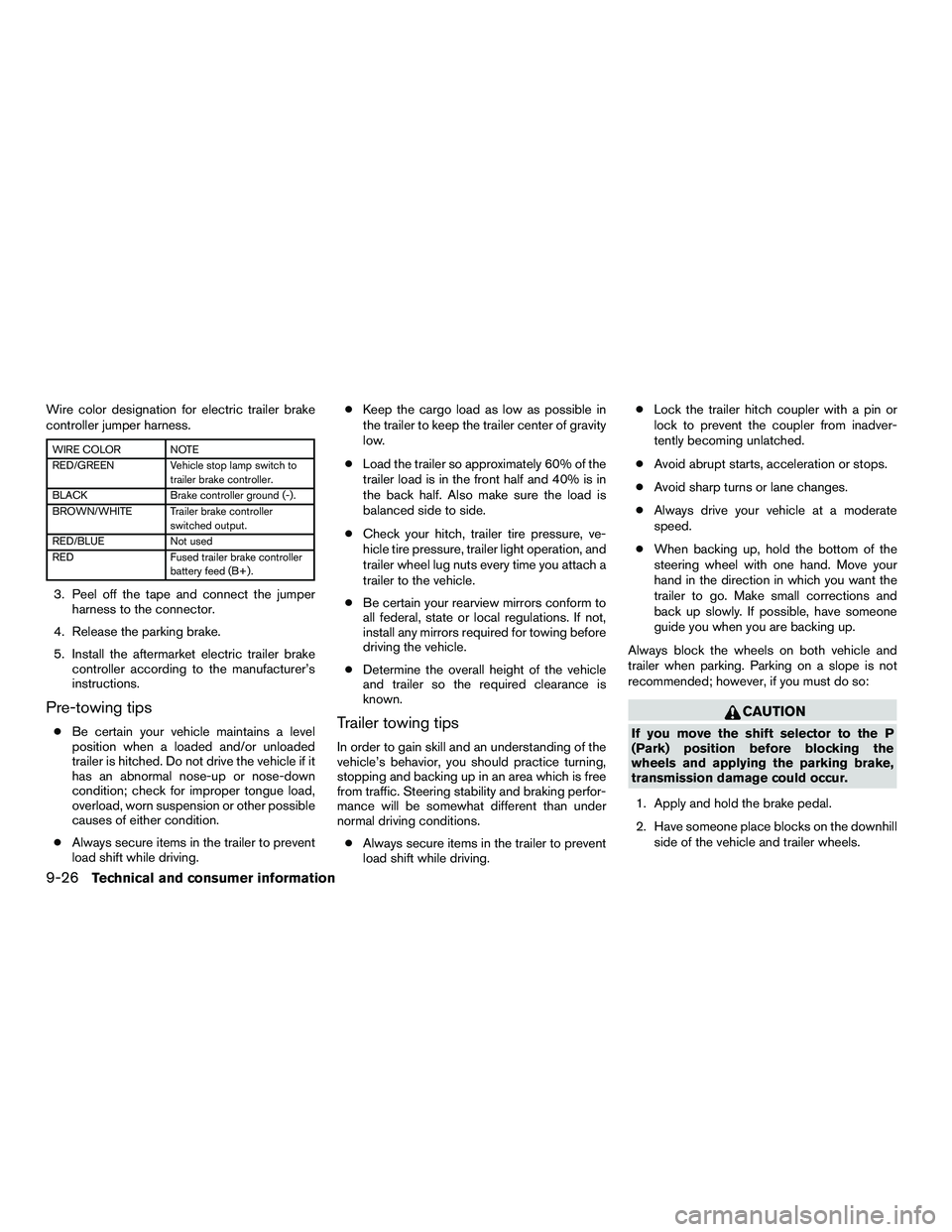
Wire color designation for electric trailer brake
controller jumper harness.
WIRE COLOR NOTE
RED/GREENVehicle stop lamp switch to
trailer brake controller.
BLACK Brake controller ground (-) .
BROWN/WHITE Trailer brake controller switched output.
RED/BLUE Not used
RED Fused trailer brake controller
battery feed (B+) .
3. Peel off the tape and connect the jumper
harness to the connector.
4. Release the parking brake.
5. Install the aftermarket electric trailer brake controller according to the manufacturer’s
instructions.
Pre-towing tips
●Be certain your vehicle maintains a level
position when a loaded and/or unloaded
trailer is hitched. Do not drive the vehicle if it
has an abnormal nose-up or nose-down
condition; check for improper tongue load,
overload, worn suspension or other possible
causes of either condition.
● Always secure items in the trailer to prevent
load shift while driving. ●
Keep the cargo load as low as possible in
the trailer to keep the trailer center of gravity
low.
● Load the trailer so approximately 60% of the
trailer load is in the front half and 40% is in
the back half. Also make sure the load is
balanced side to side.
● Check your hitch, trailer tire pressure, ve-
hicle tire pressure, trailer light operation, and
trailer wheel lug nuts every time you attach a
trailer to the vehicle.
● Be certain your rearview mirrors conform to
all federal, state or local regulations. If not,
install any mirrors required for towing before
driving the vehicle.
● Determine the overall height of the vehicle
and trailer so the required clearance is
known.Trailer towing tips
In order to gain skill and an understanding of the
vehicle’s behavior, you should practice turning,
stopping and backing up in an area which is free
from traffic. Steering stability and braking perfor-
mance will be somewhat different than under
normal driving conditions.
● Always secure items in the trailer to prevent
load shift while driving. ●
Lock the trailer hitch coupler with a pin or
lock to prevent the coupler from inadver-
tently becoming unlatched.
● Avoid abrupt starts, acceleration or stops.
● Avoid sharp turns or lane changes.
● Always drive your vehicle at a moderate
speed.
● When backing up, hold the bottom of the
steering wheel with one hand. Move your
hand in the direction in which you want the
trailer to go. Make small corrections and
back up slowly. If possible, have someone
guide you when you are backing up.
Always block the wheels on both vehicle and
trailer when parking. Parking on a slope is not
recommended; however, if you must do so:
CAUTION
If you move the shift selector to the P
(Park) position before blocking the
wheels and applying the parking brake,
transmission damage could occur.
1. Apply and hold the brake pedal.
2. Have someone place blocks on the downhill side of the vehicle and trailer wheels.
9-26Technical and consumer information
Page 606 of 623
3. After the wheel blocks are in place, slowlyrelease the brake pedal until the blocks ab-
sorb the vehicle load.
4. Apply the parking brake.
5. Shift the transmission into P (Park) .
6. Turn off the engine.
To drive away: 1. Start the vehicle.
2. Apply and hold the brake pedal.
3. Shift the transmission into gear.
4. Release the parking brake.
5. Drive slowly until the vehicle and trailer are clear from the blocks.
6. Apply and hold the brake pedal.
7. Have someone retrieve and store the blocks. ●
While going downhill, the weight of the trailer
pushing on the tow vehicle may decrease
overall stability. Therefore, to maintain ad-
equate control, reduce your speed and shift to
a lower gear. Avoid long or repeated use of the
brakes when descending a hill, as this re-
duces their effectiveness and could cause
overheating. Shifting to a lower gear instead
provides “engine braking” and reduces the
need to brake as frequently.
● If the engine coolant temperature rises to a
high temperature, refer to “If your vehicle
overheats” in the “In case of emergency”
section of this owner’s manual.
● Trailer towing requires more fuel than normal
circumstances.
● Avoid towing a trailer for your vehicle’s first
500 miles (805 km) .
● For the first 500 miles (805 km) that you do
tow, do not drive over 50 mph (80 km/h).
● Have your vehicle serviced more often than
at intervals specified in the recommended
Maintenance Schedule in the “INFINITI Ser-
vice and Maintenance Guide”.
● When making a turn, your trailer wheels will
be closer to the inside of the turn than your
vehicle wheels. To compensate for this,
make a larger than normal turning radius
during the turn.
● Crosswinds and rough roads will adversely
affect vehicle/trailer handling, possibly caus-
ing vehicle sway. When being passed by
larger vehicles, be prepared for possible
changes in crosswinds that could affect ve-
hicle handling. Do the following if the trailer begins to sway:
1. Take your foot off the accelerator pedal to allow the vehicle to coast and steer as
straight ahead as the road conditions allow.
This combination will help stabilize the ve-
hicle
– Do not correct trailer sway by steering or applying the brakes.
2. When the trailer sway stops, gently apply the brakes and pull to the side of the road in a
safe area.
3. Try to rearrange the trailer load so it is bal- anced as described in this section.
● Be careful when passing other vehicles.
Passing while towing a trailer requires con-
siderably more distance than normal pass-
ing. Remember, the length of the trailer must
also pass the other vehicle before you can
safely change lanes.
● Downshift the transmission to a lower gear
for engine braking when driving down steep
or long hills. This will help slow the vehicle
without applying the brakes.
● Avoid holding the brake pedal down too long
or too frequently. This could cause the
brakes to overheat, resulting in reduced
braking efficiency.
Technical and consumer information9-27
Page 607 of 623
●Increase your following distance to allow for
greater stopping distances while towing a
trailer. Anticipate stops and brake gradually.
● INFINITI recommends that the cruise control
not be used while towing a trailer.
● Some states or provinces have specific
regulations and speed limits for vehicles that
are towing trailers. Obey the local speed
limits.
● Check your hitch, trailer wiring harness con-
nections, and trailer wheel lug nuts after
50 miles (80 km) of travel and at every break.
● When launching a boat, don’t allow the wa-
ter level to go over the exhaust tail pipe or
rear bumper.
● Make sure you disconnect the trailer lights
before backing the trailer into the water or
the trailer lights may burn out.
When towing a trailer, final drive gear oil
should be replaced and transmission
oil/fluid should be changed more fre-
quently. For additional information, refer to
the “Maintenance and do-it-yourself” sec-
tion in this manual.FLAT TOWING FOR ALL–WHEEL
DRIVE VEHICLE (if so equipped)
Towing your vehicle with all four wheels on the
ground is sometimes called flat towing. This
method is sometimes used when towing a vehicle
behind a recreational vehicle, such as a motor
home.
CAUTION
● Failure to follow these guidelines can
result in severe transmission damage.
● Never flat tow your All-wheel drive
(AWD) vehicle.
● DO NOT tow your All-wheel drive (AWD)
vehicle with any wheels on the ground.
Doing so may cause serious and expen-
sive damage to the powertrain.
● For emergency towing procedures refer
to “Towing recommended by INFINITI”
in the “In case of emergency” section of
this manual.
FLAT TOWING FOR FRONT WHEEL
DRIVE VEHICLE (if so equipped)
Towing your vehicle with all four wheels on the
ground is sometimes called flat towing. This
method is sometimes used when towing a vehicle
behind a recreational vehicle, such as a motor
home.
CAUTION
●Failure to follow these guidelines can
result in severe transmission damage.
● Whenever flat towing your vehicle, al-
ways tow forward, never backward.
● Never tow your front wheel drive vehicle
with the front tires on the ground. Doing
so may cause serious and expensive
damage to the powertrain.
● DO NOT tow your front wheel drive con-
tinuously variable transmission vehicle
with all four wheels on the ground (flat
towing) . Doing so WILL DAMAGE inter-
nal transmission parts due to lack of
transmission lubrication.
● For emergency towing procedures refer
to “Towing recommended by INFINITI”
in the “In case of emergency” section of
this manual.
9-28Technical and consumer information
Page 620 of 623
Types of tires.................8-35
Uniform tire quality grading .........9-29
Wheels and tires ...............8-29
Wheel/tire size .................9-9
Tire pressure ...................8-29
Low tire pressure warning light .......2-10
Tire Pressure Monitoring System (TPMS) . . . .5-5
Top tether strap child restraint .........1-31
Towing Flat towing ..................9-28
Towing load/specification ..........9-22
Tow truck towing ...............6-14
Trailer towing .................9-18
Towing a trailer ..................9-18
Transceiver HomeLink® Universal
Transceiver .......2-68, 2-69, 2-71, 2-72
Transmission Continuously Variable Transmission (CVT)
fluid ......................8-14
Driving with Continuously Variable
Transmission (CVT) .............5-17
Travel (See registering a vehicle in another
country) ......................9-10
Trip odometer ...................2-5
Turn signal switch ................2-42
U
Uniform tire quality grading ...........9-29
USB interface Audio file operation ..........4-84, 4-85
Video file operation .............4-87
USB (Universal Serial Bus) Connection Port
(models with Navigation System) ........4-85USB (Universal Serial Bus) Connection Port
(models without Navigation System)
......4-83
V
Vanity mirror ...................3-31
Vehicle dimensions and weights .........9-9
Vehicle does not start ..............6-10
Vehicle dynamic control (VDC) off switch . . .2-47
Vehicle dynamic control (VDC) system . . . .5-137
Vehicle Dynamic Control (VDC) system . . .5-137
Vehicle identification ...............9-10
Vehicle identification number (VIN) .......9-10
Vehicle identification number (VIN)
(Chassis number) ................9-10
Vehicle identification number (VIN) plate . . . .9-10
Vehicle immobilizer system ...........5-16
V ehicle
Information Display ...........2-16
Vehicle loading information ...........9-14
Vehicle recovery ..............6-16, 6-17
Vehicle security system .............2-32
(INFINITI vehicle immobilizer system) ,
engine start ...........2-34, 3-4, 5-16
Vents .......................4-48
Visors .......................3-31
Voice Prompt Interrupt ........4-115, 4-128
Voice recognition system ...........4-138
W
Warning Air bag warning light .........1-66, 2-12
Anti-lock brake warning light .........2-8
Battery charge warning light .........2-8Blind Spot Intervention (BSI) warning
light
......................5-45
Blind Spot Warning (BSW) warning
light ......................5-36
Brake warning light ...........2-8, 2-9
Distance Control Assist (DCA) .......5-95
Hazard warning flasher switch ........6-2
Lane Departure Prevention . .5-25, 5-30, 5-33
Lane Departure Warning
light ...............5-25, 5-30, 5-33
Loose fuel cap warning ...........2-30
Low fuel warning light ......2-9, 2-11, 2-28
Low tire pressure warning light .......2-10
Low windshield-washer fluid warning
light ......................2-29
Passenger air bag and status light .....1-57
Seat belt warning light ........1-18, 2-12
Supplemental air bag warning
light ..................1-66, 2-12
Vehicle security system ...........2-32
Warning/indicator lights and audible
reminders .................2-7, 2-8
Warning labels (for SRS) ..........1-65
Warning/indicator lights and audible
reminders ...................2-7, 2-8
Audible reminders ............2-7, 2-8
Indicator lights ..............2-7, 2-8
Warning lights ..............2-7, 2-8
W arning
lights ................2-7, 2-8
Warning systems switch ............2-48
Washer switch Rear window wiper and washer
switches ...................2-37
Weights (See dimensions and weights) .....9-9
Wheels and tires .................8-29
Wheel/tire size ...................9-9
10-7