Schedule INFINITI QX80 2019 Owner's Manual
[x] Cancel search | Manufacturer: INFINITI, Model Year: 2019, Model line: QX80, Model: INFINITI QX80 2019Pages: 524, PDF Size: 2.44 MB
Page 467 of 524

MAINTENANCE OP-
ERATION
Perform at of miles, kilo-
meters or months,
whichever comes first.Miles × 1,000
(km × 1,000) Months MAINTENANCE INTERVAL
65
(104) 78 70
(112) 84 75
(120) 90 80
(128) 96 85
(136) 102 90
(144) 108 95
(152) 114 100
(160) 120 105
(168) 126 110
(176) 132 115
(184) 138 120
(192) 144
Brake lines & cables IIII I I
Brake pads & rotors$ IIII I I
Brake fluid$ RR R
Automatic transmission
fluid See NOTE (1)
Transfer fluid & differen-
tial gear oil See NOTE (2)
IIII I I
Steering gear & linkage,
axle & suspension parts$ II I
Tire rotation See NOTE (3)
Propeller shaft & drive
shaft boots (4WD mod-
els)$ IIII I I
Propeller shaft grease
(4WD models) LLLL L L
Exhaust system$ II I
In-cabin microfilter RRR R
Intelligent Key battery RRR R
Maintenance and schedules9-11
Page 468 of 524

9-12Maintenance and schedules
NOTE:
Maintenance items with “$” should be
performed more frequently according to
“Maintenance under severe driving condi-
tions” (P.9-13).
(1) Periodic maintenance is not required.
(2) If towing trailer, using a camper or car-
top carrier, or driving on rough or muddy
roads, change (not just inspect) oil at every
20,000 miles (32,000 km) or 24 months.
(3) Refer to “Tire rotation” under “General
maintenance” (P.9-2).
Page 469 of 524

The maintenance intervals shown on the
preceding pages are for normal operating
conditions. If the vehicle is mainly operated
under severe driving conditions as shown
below, more frequent maintenance must be
performed on the following items as shown
in the table.
Severe driving conditions
.Repeated short trips of less than 5 miles
(8 km).
. Repeated short trips of less than 10 miles
(16 km) with outside temperatures re-
maining below freezing.
. Operating in hot weather in stop-and-go
“rush hour” traffic.
. Extensive idling and/or low speed driving
for long distances, such as police, taxi or
door-to-door delivery use.
. Driving in dusty conditions.
. Driving on rough, muddy, or salt spread
roads.
. Towing a trailer, using a camper or car-
top carrier.
Maintenance operation: Inspect = Inspect
and correct or replace as necessary.Maintenance item Maintenance operation Maintenance interval
Brake fluid ReplaceEvery 10,000 miles (16,000 km) or 12
months
Brake pads & rotors InspectEvery 5,000 miles (8,000 km) or 6
months
Steering gear & linkage, axle &
suspension parts Inspect
Every 5,000 miles (8,000 km) or 6
months
Propeller shaft & drive shaft
boots (4WD models) Inspect
Every 5,000 miles (8,000 km) or 6
months
Exhaust system InspectEvery 5,000 miles (8,000 km) or 6
months
Maintenance and schedules9-13
MAINTENANCE UNDER SEVERE
DRIVING CONDITIONS
Page 470 of 524

9-14Maintenance and schedules
5,000 Miles (8,000 km) or 6 Months
Retailer Name:
Date:
Mileage:
Retailer
Stamp:10,000 Miles (16,000 km) or 12 Months
Retailer Name:
Date:
Mileage:
Retailer
Stamp:15,000 Miles (24,000 km) or 18 Months
Retailer Name:
Date:
Mileage:
Retailer
Stamp:
20,000 Miles (32,000 km) or 24 Months
Retailer Name:
Date:
Mileage:
Retailer
Stamp: 25,000 Miles (40,000 km) or 30 Months
Retailer Name:
Date:
Mileage:
Retailer
Stamp:30,000 Miles (48,000 km) or 36 Months
Retailer Name:
Date:
Mileage:
Retailer
Stamp:
35,000 Miles (56,000 km) or 42 Months
Retailer Name:
Date:
Mileage:
Retailer
Stamp: 40,000 Miles (64,000 km) or 48 Months
Retailer Name:
Date:
Mileage:
Retailer
Stamp:45,000 Miles (72,000 km) or 54 Months
Retailer Name:
Date:
Mileage:
Retailer
Stamp:
MAINTENANCE LOG
Page 471 of 524
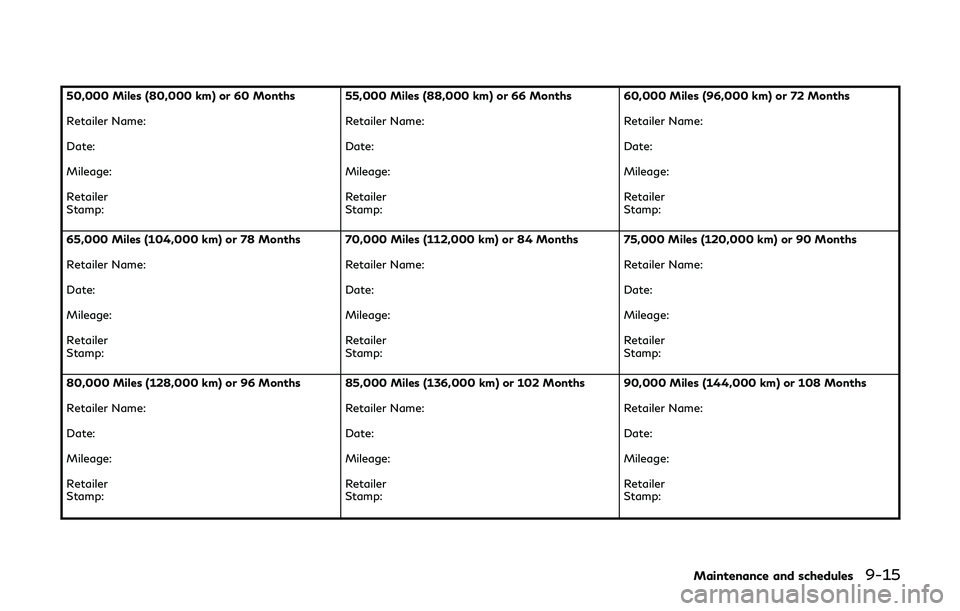
50,000 Miles (80,000 km) or 60 Months
Retailer Name:
Date:
Mileage:
Retailer
Stamp:55,000 Miles (88,000 km) or 66 Months
Retailer Name:
Date:
Mileage:
Retailer
Stamp:60,000 Miles (96,000 km) or 72 Months
Retailer Name:
Date:
Mileage:
Retailer
Stamp:
65,000 Miles (104,000 km) or 78 Months
Retailer Name:
Date:
Mileage:
Retailer
Stamp: 70,000 Miles (112,000 km) or 84 Months
Retailer Name:
Date:
Mileage:
Retailer
Stamp:75,000 Miles (120,000 km) or 90 Months
Retailer Name:
Date:
Mileage:
Retailer
Stamp:
80,000 Miles (128,000 km) or 96 Months
Retailer Name:
Date:
Mileage:
Retailer
Stamp: 85,000 Miles (136,000 km) or 102 Months
Retailer Name:
Date:
Mileage:
Retailer
Stamp:90,000 Miles (144,000 km) or 108 Months
Retailer Name:
Date:
Mileage:
Retailer
Stamp:
Maintenance and schedules9-15
Page 472 of 524
9-16Maintenance and schedules
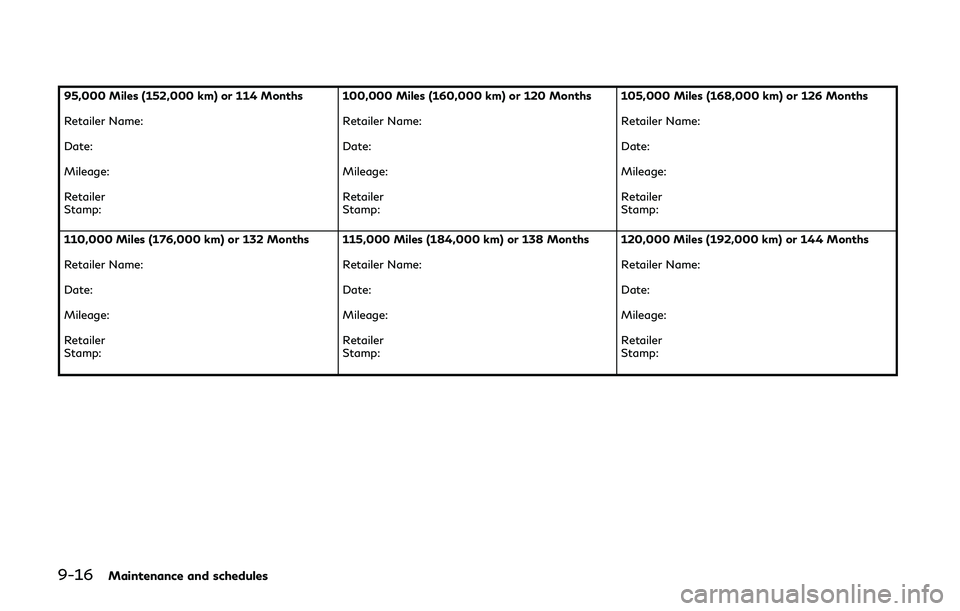
95,000 Miles (152,000 km) or 114 Months
Retailer Name:
Date:
Mileage:
Retailer
Stamp:100,000 Miles (160,000 km) or 120 Months
Retailer Name:
Date:
Mileage:
Retailer
Stamp:105,000 Miles (168,000 km) or 126 Months
Retailer Name:
Date:
Mileage:
Retailer
Stamp:
110,000 Miles (176,000 km) or 132 Months
Retailer Name:
Date:
Mileage:
Retailer
Stamp: 115,000 Miles (184,000 km) or 138 Months
Retailer Name:
Date:
Mileage:
Retailer
Stamp:120,000 Miles (192,000 km) or 144 Months
Retailer Name:
Date:
Mileage:
Retailer
Stamp:
Page 500 of 524

10-28Technical and consumer information
4. Release the parking brake.
5. Drive slowly until the vehicle and trailerare clear from the blocks.
6. Apply and hold the brake pedal.
7. Have someone retrieve and store the blocks.
. While going downhill, the weight of the
trailer pushing on the tow vehicle may
decrease overall stability. Therefore, to
maintain adequate control, reduce your
speed and shift to a lower gear. Avoid
long or repeated use of the brakes when
descending a hill, as this reduces their
effectiveness and could cause overheat-
ing. Shifting to a lower gear instead
provides “engine braking” and reduces
the need to brake as frequently.
. If the engine coolant temperature rises to
a high temperature, see “If your vehicle
overheats” (P.6-14).
. Trailer towing requires more fuel than
normal circumstances.
. Avoid towing a trailer for your vehicle’s
first 500 miles (800 km).
. Have your vehicle serviced more often
than at intervals specified in the recom-
mended maintenance schedule shown in
the “9. Maintenance and schedules”
section. .
When making a turn, your trailer wheels
will be closer to the inside of the turn
than your vehicle wheels. To compensate
for this, make a larger than normal
turning radius during the turn.
. Crosswinds and rough roads will ad-
versely affect vehicle/trailer handling,
possibly causing vehicle sway. When
being passed by larger vehicles, be pre-
pared for possible changes in crosswinds
that could affect vehicle handling.
Do the following if the trailer begins to sway:
1. Take your foot off the accelerator pedal to allow the vehicle to coast and steer as
straight ahead as the road conditions
allow. This combination will help stabilize
the vehicle.
.Do not correct trailer sway by steering
or applying the brakes.
2. When the trailer sway stops, gently apply the brakes and pull to the side of
the road in a safe area.
3. Try to rearrange the trailer load so it is balanced as described earlier in this
section.
. Be careful when passing other vehicles.
Passing while towing a trailer requires
considerably more distance than normal
passing. Remember the length of the
trailer must also pass the other vehicle
before you can safely change lanes. .
Use the TOW mode or downshift the
transmission to a lower gear for engine
braking when driving down steep or long
hills. This will help slow the vehicle
without applying the brakes.
. Avoid holding the brake pedal down too
long or too frequently. This could cause
the brakes to overheat, resulting in
reduced braking efficiency.
. Increase your following distance to allow
for greater stopping distances while
towing a trailer. Anticipate stops and
brake gradually.
. INFINITI recommends that the cruise
control not be used while towing a
trailer.
. While towing a trailer, do not use the
following systems (if so equipped):
— the Lane Departure Warning (LDW) system
— the Lane Departure Prevention (LDP) system
— the Blind Spot Warning (BSW) system
— the Blind Spot Intervention
®(BSI)
system
— the Back-up Collision Intervention (BCI) system
— the Intelligent Cruise Control (ICC) system
— the Distance Control Assist (DCA) system
Page 501 of 524

— the Forward Emergency Braking(FEB) with pedestrian detection sys-
tem
— the Predictive Forward Collision Warning (PFCW) system
. Some states or provinces have specific
regulations and speed limits for vehicles
that are towing trailers. Obey the local
speed limits.
. Check your hitch, trailer wiring harness
connections, and trailer wheel lug nuts
after 50 miles (80 km) of travel and at
every break.
. When launching a boat, do not allow the
water level to go over the exhaust tail
pipe or rear bumper.
. Make sure you disconnect the trailer
lights before backing the trailer into the
water or the trailer lights may burn out.
When towing a trailer, the transmission
fluid should be changed more frequently.
For additional information, see “9. Main-
tenance and schedules” section.
TOW mode
Using TOW mode is recommended when
pulling a heavy trailer or hauling a heavy
load. Push the TOW mode switch to activate
TOW mode. The TOW mode indicator light
in the meter illuminates when TOW mode is
selected. Push the TOW mode switch again to turn TOW mode off. TOW mode is
automatically cancelled when the ignition
switch is placed in the OFF position.
TOW mode includes the following features:
.
Grade logic — Adjusts transmission shifts
when pulling a trailer or hauling a load up
a grade.
. Downhill Speed Control (DSC) — auto-
matically downshifts when driving down
a grade with a trailer or heavy load to
help control vehicle speed.
Driving the vehicle in the TOW mode with no
trailer/load or light trailer/light load will not
cause any damage. However, fuel economy
may be reduced and the transmission/
engine driving characteristics may feel unu-
sual.
When towing a trailer, the transmission
fluid should be changed more frequently.
For additional information, see “9. Main-
tenance and schedules” section.
Trailer Sway Control
To minimize trailer sway, your vehicle may
apply braking to individual wheels based on
input from your vehicle sensors and vehicle
speed. Trailer Sway Control is a function of
the Vehicle Dynamic Control (VDC) system
and is active when the VDC function is
enabled.
CAUTION
If the VDC OFF switch is on (meaning
VDC system OFF), the Trailer Sway
Control is also disabled.
When Trailer Sway Control is in operation,
the VDC warning light blinks. When vehicle
control is regained, VDC warning light will
turn OFF.
For additional information about the VDC
system, see “Vehicle Dynamic Control (VDC)
system” (P.5-133).
If Trailer Sway Control activates:
1. Take your foot off the accelerator pedal to allow the vehicle to coast and steer as
straight ahead as the road conditions
allow. This combination will help stabilize
the vehicle.
CAUTION
Do not try to correct trailer sway by
steering or applying the brakes.
2. When the trailer sway stops, gently apply the brakes and pull to the side of
the road in a safe area.
Technical and consumer information10-29
Page 509 of 524

11 Index
A
ABS (Anti-lock Braking System) ................... 5-132
Adaptive front lighting system (AFS) ............ 2-42
Advanced air bag system .................................. 1-58
Aiming controlAdaptive front lighting system (AFS) ...... 2-42
Headlights ........................................................ 2-41
Air bag system
Advanced air bag system ............................ 1-58
Front passenger air bag and
status light ....................................................... 1-60
Front-seat mounted side-impact
supplemental air bag system ..................... 1-65
Roof-mounted curtain side-impact and
rollover supplemental air bag system ...... 1-65
Air bag warning labels ....................................... 1-68
Air bag warning light ............................... 1-69, 2-17
Air cleaner housing filter ................................... 8-15
Air conditioner Advanced Climate Control System ......... 4-29
Air conditioner service ................................. 4-35
Air conditioner specification label ......... 10-13
Air conditioning system refrigerant and
lubricant recommendations ............ 4-35, 10-7
Automatic climate control ............. 4-26, 4-28
In-cabin microfilter ........................................ 4-35
Alarm, How to stop alarm (see vehicle
security system) ................................................... 2-32
Alcohol, drugs and driving ................................ 5-10 Antenna .................................................................. 4-36
Anti-lock Braking System (ABS) ................... 5-132
Anti-lock braking system (ABS)
warning light ......................................................... 2-12
Appearance care
Exterior appearance care ............................... 7-2
Interior appearance care ................................ 7-5
Armrest ................................................................... 1-10
Around View
®Monitor ........................................ 4-3
Audible reminders ................................................ 2-21
Auto closure .......................................................... 3-25
Autolight system .................................................. 2-37
Automatic
Automatic Transmission Fluid (ATF) ......... 8-8
Climate control .................................. 4-26, 4-28
Door locks .......................................................... 3-6
Drive positioner .............................................. 3-39
Driving with automatic transmission ....... 5-18
Seat positioner ............................................... 3-39
Average fuel consumption and speed ........... 2-29
Avoiding collision and rollover ........................... 5-8
B
Back door (See liftgate) ..................................... 3-22
Back-up Collision Intervention
(BCI) system .......................................................... 5-55
Battery .................................................................... 8-11 Battery saver system ........................ 2-41, 2-66
Intelligent Key ................................................. 8-21 Variable voltage control system ............... 8-13
Before starting the engine ................................ 5-15
Belts (See drive belts) ......................................... 8-13
Blind Spot Intervention (BSI) ON
indicator light ........................................................ 2-18
Blind Spot Intervention
®(BSI) system .......... 5-42
Blind Spot Warning (BSW) system ................ 5-32
Blind Spot Warning (BSW)/Blind Spot
Intervention (BSI) system warning light ....... 2-13
Booster seats ........................................................ 1-48
Brake
Anti-lock Braking System (ABS) ............. 5-132
Brake booster ................................................. 8-17
Brake fluid ............................................. 8-9, 8-10
Brake system ................................................ 5-131
Parking brake operation .............................. 5-22
Warning light .................................................. 2-13
Break-in schedule .............................................. 5-119
Brightness control Instrument panel ............................................ 2-43
Bulb check/instrument panel ........................... 2-12
Bulb replacement ................................................. 8-23
C
Cabin air filter ....................................................... 4-35
Camera aiding sonar function ......................... 4-16
Capacities and
recommended fluids/lubricants ....................... 10-2
Car phone or CB radio ....................................... 4-36
Page 510 of 524

11-2
Cargo floor box .................................................... 2-60
Cargo light ............................................................. 2-68
Catalytic converter, Three way catalyst ......... 5-4
Center ventilators ................................................ 4-25
Chassis and body maintenance ....................... 9-10
Child restraints ...................................................... 1-31Booster seats .................................................. 1-48
LATCH system ............................................... 1-33
Precautions on child restraints .................. 1-31
Top tether strap ............................................. 1-36
Child safety ........................................................... 1-29
Child safety rear door lock .................................. 3-6
Chimes Audible reminders .......................................... 2-21
Seat belt warning light and chime ............ 2-17
Circuit breaker, Fusible link .............................. 8-19
Cleaning exterior and interior .................... 7-2, 7-5
Climate control Automatic climate control ............. 4-26, 4-28
Clock ........................................................................\
2-51
Coat hooks ............................................................ 2-59
Cockpit ...................................................................... 2-3
Cold weather driving ........................................ 5-136
Console box ........................................................... 2-57
Console light ......................................................... 2-67
Coolant Capacities and
recommended fluids/lubricants ................. 10-2
Changing engine coolant ............................... 8-5
Checking engine coolant level ...................... 8-5
Corrosion protection ............................................. 7-8 Cruise control ....................................................... 5-65
Fixed speed cruise control (on
ICC system) .................................................... 5-84
Intelligent cruise control (ICC) system .... 5-66
Cup holders ........................................................... 2-54
D
Daytime running light system .......................... 2-42
Dimensions ......................................................... 10-10
Distance Control Assist (DCA) system .......... 5-87
Distance Control Assist (DCA) system
warning light ......................................................... 2-14
Drive belts .............................................................. 8-13
Drive positioner .................................................... 3-39
Driving Cold weather driving ................................. 5-136
Driving with automatic transmission ....... 5-18
On-pavement and off-road driving ........... 5-8
Precautions when starting and driving ..... 5-4
Safety precautions ........................................ 5-10
E
Economy, Fuel ................................................... 5-120
Elapsed time ......................................................... 2-29
Emission control information label ............... 10-12
Emission control system maintenance ............ 9-8
Emission control system warranty ............... 10-31
EngineBefore starting the engine .......................... 5-15
Break-in schedule ........................................ 5-119 Capacities and
recommended fluids/lubricants ................. 10-2
Changing engine coolant ............................... 8-5
Changing engine oil and filter ...................... 8-6
Checking engine coolant level ...................... 8-5
Checking engine oil level ............................... 8-6
Coolant temperature gauge ......................... 2-8
Emergency engine shut off ......................... 5-14
Engine block heater .................................... 5-137
Engine compartment check locations ........ 8-3
Engine cooling system ................................... 8-4
Engine oil ........................................................... 8-6
Engine oil and oil
filter recommendation .................................. 10-6
Engine oil replacement indicator ............... 2-27
Engine oil viscosity ........................................ 10-7
Engine serial number ................................. 10-12
Engine specifications ................................... 10-8
Engine start operation indicator ............... 2-24
If your vehicle overheats ............................. 6-14
Oil pressure gauge .......................................... 2-9
Protection mode ............................................ 5-17
Remote engine start
operation indicator ........................................ 2-24
Starting the engine ....................................... 5-15
Entry/exit function, Automatic
drive positioner .................................................... 3-39
Event Data Recorders (EDR) ........................ 10-34
Exhaust gas (carbon monoxide) ........................ 5-4
Explanation of scheduled
maintenance items ................................................. 9-5