wheel alignment ISUZU AXIOM 2002 Service Owner's Guide
[x] Cancel search | Manufacturer: ISUZU, Model Year: 2002, Model line: AXIOM, Model: ISUZU AXIOM 2002Pages: 2100, PDF Size: 19.35 MB
Page 747 of 2100

5C±67 POWER±ASSISTED BRAKE SYSTEM
General Diagnosis
ConditionPossible causeCorrection
Brake PullTire inflation pressure is unequal.Adjust
Front wheel alignment is incorrect.Adjust
Unmatched tires on same axle.Tires with approx. the same amount
of tread should be used on the same
axle.
Restricted brake pipes or hoses.Check for soft hoses and damaged
lines. Replace with new hoses and
new double walled steel brake
piping.
Water or oil on the brake pads.Clean or replace.
Brake pads hardened.Replace
Brake pads worn excessively.Replace
Brake rotor worn or scored.Grind or replace.
Disc brake caliper malfunctioning.Clean or replace.
Front hub bearing preload incorrect.Adjust or replace.
Loose suspension parts.Check all suspension mountings.
Loose calipers.Check and tighten the bolts to
specifications.
Brake Roughness or Chatter
(Pulsates)Excessive lateral runout.Check per instructions. If not within
specifications, replace or machine
the rotor.
Parallelism not within specifications.Check per instructions. If not within
specifications, replace or machine
the rotor.
Pad reversed (steel against iron).Replace the brake pad and machine
rotor to within specifications.
Excessive Pedal EffortMalfunctioning vacuum booster.Check the vacuum booster operation
and repair, if necessary.
Partial system failure.Check the front and rear brake
system for failure and repair. Also,
check the brake warning light. If a
failed system is found, the light
should indicate failure.
Excessively worn pad.Check and replace pads in sets.
Piston in caliper stuck or sluggish.Remove caliper and rebuild.
Fading brakes due to incorrect pad.Remove and replace with original
equipment pad or equivalent.
Vacuum leak to vacuum booster.Check for ruptured or loose hose.
Check the direction of check valve
within vacuum hose.Correct vacuum hose direction.
Grease on the brake pads.Replace or clean.
Excessive Brake Pedal TravelAir in hydraulic circuit.Bleed the hydraulic circuit.
Level of brake fluid in the reservoir
too low.Replenish brake fluid reservoir to
specified level and bleed hydraulic
circuit as necessary.
Master cylinder push rod clearance
excessive.Adjust
Leakage in hydraulic system.Correct or replace defective parts.
Page 856 of 2100
6A±46
ENGINE MECHANICAL (6VE1 3.5L)
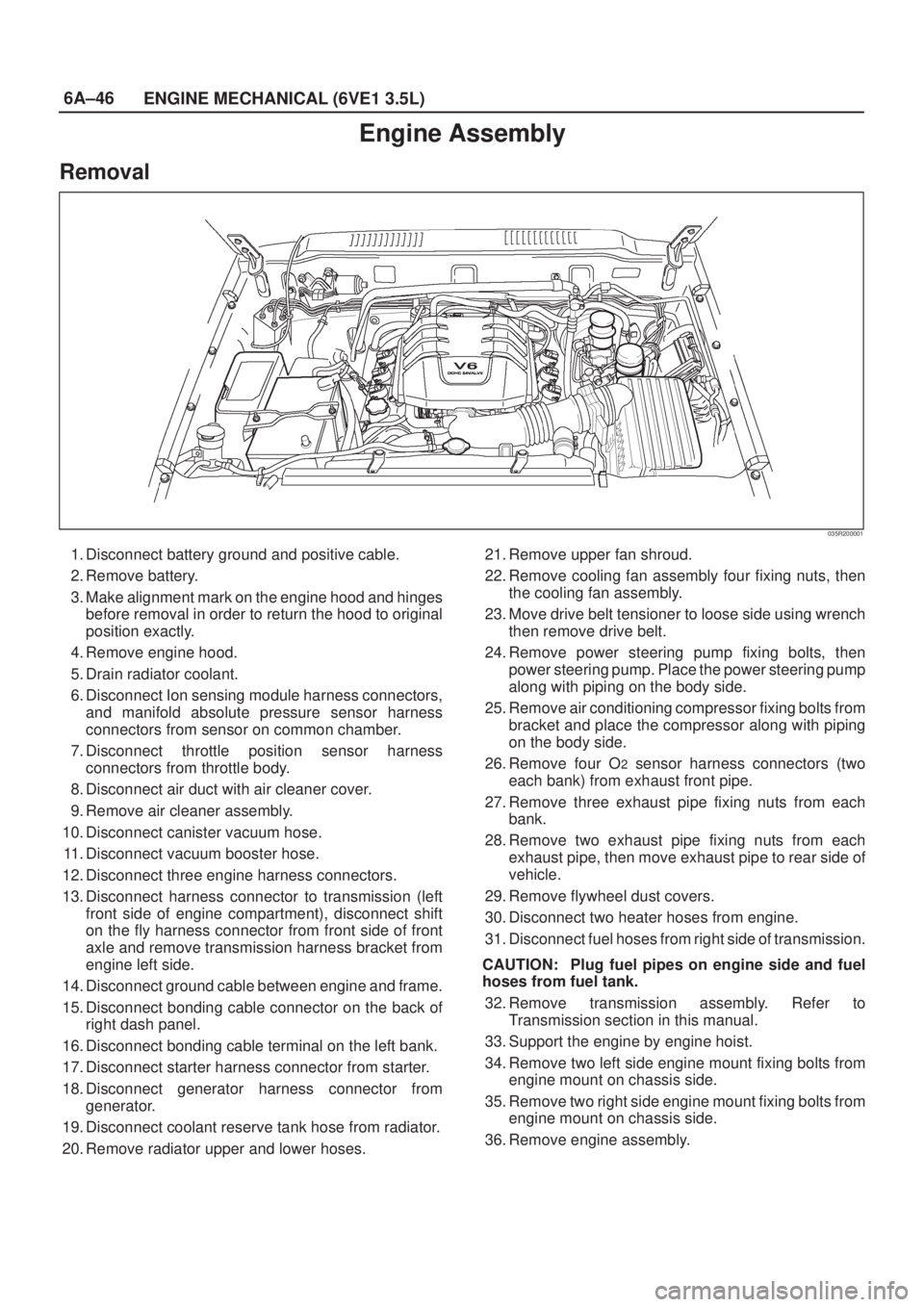
Engine Assembly
Removal
035R200001
1. Disconnect battery ground and positive cable.
2. Remove battery.
3. Make alignment mark on the engine hood and hinges
before removal in order to return the hood to original
position exactly.
4. Remove engine hood.
5. Drain radiator coolant.
6. Disconnect Ion sensing module harness connectors,
and manifold absolute pressure sensor harness
connectors from sensor on common chamber.
7. Disconnect throttle position sensor harness
connectors from throttle body.
8. Disconnect air duct with air cleaner cover.
9. Remove air cleaner assembly.
10. Disconnect canister vacuum hose.
11. Disconnect vacuum booster hose.
12. Disconnect three engine harness connectors.
13. Disconnect harness connector to transmission (left
front side of engine compartment), disconnect shift
on the fly harness connector from front side of front
axle and remove transmission harness bracket from
engine left side.
14. Disconnect ground cable between engine and frame.
15. Disconnect bonding cable connector on the back of
right dash panel.
16. Disconnect bonding cable terminal on the left bank.
17. Disconnect starter harness connector from starter.
18. Disconnect generator harness connector from
generator.
19. Disconnect coolant reserve tank hose from radiator.
20. Remove radiator upper and lower hoses.21. Remove upper fan shroud.
22. Remove cooling fan assembly four fixing nuts, then
the cooling fan assembly.
23. Move drive belt tensioner to loose side using wrench
then remove drive belt.
24. Remove power steering pump fixing bolts, then
power steering pump. Place the power steering pump
along with piping on the body side.
25. Remove air conditioning compressor fixing bolts from
bracket and place the compressor along with piping
on the body side.
26. Remove four O
2 sensor harness connectors (two
each bank) from exhaust front pipe.
27. Remove three exhaust pipe fixing nuts from each
bank.
28. Remove two exhaust pipe fixing nuts from each
exhaust pipe, then move exhaust pipe to rear side of
vehicle.
29. Remove flywheel dust covers.
30. Disconnect two heater hoses from engine.
31. Disconnect fuel hoses from right side of transmission.
CAUTION: Plug fuel pipes on engine side and fuel
hoses from fuel tank.
32. Remove transmission assembly. Refer to
Transmission section in this manual.
33. Support the engine by engine hoist.
34. Remove two left side engine mount fixing bolts from
engine mount on chassis side.
35. Remove two right side engine mount fixing bolts from
engine mount on chassis side.
36. Remove engine assembly.
Page 1733 of 2100

7A1±46
TRANSMISSION CONTROL SYSTEM (4L30±E)
DTC P0722 Automatic Transmission Output Speed Sensor (OSS) Low Input
StepActionYe sNo
1Were you sent here from the ªPowertrain On±Board Diagnostic
(OBD) System Checkº?
Go to Step 2
Go to OBD
System Check
Refer to
Driveability and
Emissions in
Engine section
21. Install the scan tool.
2. With the engine ªoffº, turn the ignition switch ªonº.
NOTE: Before clearing DTC(s), use the scan tool to record ªFreeze
Frameº and ªFailure Recordsº for reference, as data will be lost
when the ªClear Infoº function is used.
3. Record the DTC ªFreeze Frameº and ªFailure Recordsº.
4. Raise the drive wheels.
5. Start the engine.
6. Place the transmission in any drive range.
With the drive wheels rotating, does the ªTrans Output Speedº
increase with the drive wheel speed?
Go to Diagnostic
Aids
Go to Step 3
3Check for the most current and/or incorrect calibration.
Is the calibration current?
Go to Step 16Go to Step 4
41. Turn the ignition ªoffº.
2. Disconnect the E35 (RED) PCM connector.
3. Using the J39200 DVOM, measure the resistance between
harness connector terminals E35±22 and E35±55.
Is the reading 3000 ohms?
Go to Step 5Go to Step 6
51. Select AC volts.
2. Rotate the rear wheels, ensuring the driveshaft is turning.
Is the voltage greater than 0.5 volts?
Go to Step 7Go to Step 8
6Inspect circuits BLU/YEL and BLU/GRN for a poor connection or
an open circuit.
Was a problem found?
Go to Step 17Go to Step 8
71. Reconnect the E35 (RED) PCM connector.
2. Disconnect the OSS harness from the OSS.
3. With the engine ªoffº, turn the ignition ªonº.
4. Using the J 39200 DVOM, measure the voltage at the OSS
harness connector terminals E44±1 and E44±2.
Is the reading between 4.0 to 5.1 volts?
Go to Step 16Go to Step 10
81. Remove the OSS.
2. Check the output shaft speed sensor rotor for damage or
misalignment. Refer to
Speed Sensor (Extension Assembly)
in Automatic Transmission (4L30±E) section.
Was a problem found?Go to Step 17Go to Step 9
9Replace the OSS.
Is the replacement complete?
Go to Step 17Ð
10Was the reading in step 7 less than 4.0 volts?Go to Step 12Go to Step 11
11Was the reading in Step 7 greater than 5.1 volts?Go to Step 15Ð
12Using the J 39200 DVOM to chassis ground, measure the voltage
on circuit BLU/YEL.
Is the reading between 4.0 to 5.1 volts?
Go to Step 13Go to Step 14
Page 1736 of 2100

TRANSMISSION CONTROL SYSTEM (4L30±E)7A1±49
DTC P0723 Automatic Transmission Output Speed Sensor (OSS) Intermittent
StepActionYe sNo
1Were you sent here from the ªPowertrain On±Board Diagnostic
(OBD) System Checkº?
Go to Step 2
Go to OBD
System Check
Refer to
Driveability and
Emissions in
Engine section
21. Install the scan tool.
2. With the engine ªoffº, turn the ignition switch ªonº.
NOTE: Before clearing DTC(s), use the scan tool to record ªFreeze
Frameº and ªFailure Recordsº for reference, as data will be lost
when the ªClear Infoº function is used.
3. Record the DTC ªFreeze Frameº and ªFailure Recordsº.
4. Raise the drive wheels.
5. Start the engine.
6. Place the transmission in any drive range.
With the drive wheels rotating, does the ªTrans Output Speedº
increase with the drive wheel speed?
Go to Diagnostic
Aids
Go to Step 3
3Check for the most current and/or incorrect calibration.
Is the calibration current?
Go to Step 16Go to Step 4
41. Turn the ignition ªoffº.
2. Disconnect the E35 (RED) PCM connector.
3. Using the J39200 DVOM, measure the resistance between
harness connector terminals E35±22 and E35±55.
Is the reading 3,000 ohms?
Go to Step 5Go to Step 6
51. Select AC volts.
2. Rotate the rear wheels, ensuring the driveshaft is turning.
Is the voltage greater than 0.5 volts?
Go to Step 7Go to Step 8
6Inspect circuits BLU/YEL and BLU/GRN for a poor connection or
an open circuit.
Was a problem found?
Go to Step 17Go to Step 8
71. Reconnect the E35 (RED) PCM connector.
2. Disconnect the OSS harness from the OSS.
3. With the engine ªoffº, turn the ignition ªonº.
4. Using the J 39200 DVOM, measure the voltage at the OSS
harness connector terminals E44±1 and E44±2.
Is the reading between 4.0 to 5.1 volts?
Go to Step 16Go to Step 10
81. Remove the OSS.
2. Check the output shaft speed sensor rotor for damage or
misalignment. Refer to
Speed Sensor (Extension Assembly)
in Automatic Transmission (4L30±E) section.
Was a problem found?Go to Step 17Go to Step 9
9Replace the OSS.
Is the replacement complete?
Go to Step 17Ð
10Was the reading in step 7 less than 4.0 volts?Go to Step 12Go to Step 11
11Was the reading in Step 7 greater than 5.1 volts?Go to Step 15Ð
12Using the J 39200 DVOM to chassis ground, measure the voltage
on circuit BLU/YEL.
Is the reading between 4.0 to 5.1 volts?
Go to Step 13Go to Step 14