ignition ISUZU AXIOM 2002 Service Workshop Manual
[x] Cancel search | Manufacturer: ISUZU, Model Year: 2002, Model line: AXIOM, Model: ISUZU AXIOM 2002Pages: 2100, PDF Size: 19.35 MB
Page 668 of 2100

5A±49
BRAKE CONTROL SYSTEM
Chart B-21 FR Speed Sensor Missing Signal (DTC 62 (Flash out) / C0222, C0223 (Serial
communications))
StepActionYe sNo
11. Turn the key off.
2. Disconnect coil integrated module connector.
3. Measure the FR speed sensor resistance between coil
integrated module connector (C-6) terminals 3 and 11.
Is the resistance between 2.0k and 2.8k ohms?
Go to Step 2Go to Step 3
2Is there play sensor/sensor rotor?Repair.
Go to
Step 6Go to Step 4
3Measure the FR speed sensor resistance at the sensor
connector.
Is the resistance between 2.0k and 2.8k ohms?Repair harness
abnormality
between sensors
and coil
integrated
module.
Go to
Step 6
Replace sensor.
Go to
Step 6
4Damage and powered iron sticking to sensor/sensor ring?Repair.
Go to
Step 6Go to Step 5
5Is sensor output normal? (Chart C-1-2 or TC-1)Check for faults
in harness
between speed
sensor and coil
integrated
module.
Fault found:
repair, and
perform system
self-check.
No fault found:
replace EHCU.
Go to
Step 6
Replace sensor.
Go to
Step 6
61. Reconnect all components, ensure all components are
properly mounted.
2. Clear diagnostic trouble code.
Was this step finished?
Repeat the ªBasic
diagnostic flow
chartº
Go to Step 6
NOTE: Even after repairing the faulty part the warning
light (W/L) does not go out if the vehicle is at a stop. Turn
the ignition switch to the ON position and drive the vehicle
at 12 km/h (8 mph) or higher to make sure that the
warning light goes out.
Page 669 of 2100

5A±50BRAKE CONTROL SYSTEM
Chart B-22 Rear Speed Sensor Missing Signal (DTC 63 (Flash out) / C0236, C0237 (Serial
communications))
StepActionYe sNo
11. Turn the key off.
2. Disconnect coil integrated module connector.
3. Measure the Rear speed sensor resistance between coil
integrated module connector (C-6) terminals 4 and 12.
Is the resistance between 1.0k and 1.7k ohms?
Go to Step 2Go to Step 3
2Is there play sensor/sensor rotor?Repair.
Go to
Step 6Go to Step 4
3Measure the rear speed sensor resistance at the sensor
connector.
Is the resistance between 1.0k and 1.7k ohms?Repair harness
abnormality
between sensors
and coil
integrated
module.
Go to
Step 6
Replace sensor.
Go to
Step 6
4Damage and powered iron sticking to sensor/sensor ring?Repair.
Go to
Step 6Go to Step 5
5Is sensor output normal? (Chart C-1-3 or TC-1)Check for faults
in harness
between speed
sensor and coil
integrated
module.
Fault found:
repair, and
perform system
self-check.
No fault found:
replace EHCU.
Go to
Step 6
Replace sensor.
Go to
Step 6
61. Reconnect all components, ensure all components are
properly mounted.
2. Clear diagnostic trouble code.
Was this step finished?
Repeat the ªBasic
diagnostic flow
chartº
Go to Step 6
NOTE: Even after repairing the faulty part the warning
light (W/L) does not go out if the vehicle is at a stop. Turn
the ignition switch to the ON position and drive the vehicle
at 12 km/h (8 mph) or higher to make sure that the
warning light goes out.
Page 670 of 2100

5A±51
BRAKE CONTROL SYSTEM
Chart B-23 Simultaneous Drop-out of Front Speed Sensor Signal (DTC 64 (Flash out) /
C0229 (Serial communications))
StepActionYe sNo
11. Turn the key off.
2. Disconnect coil integrated module connector.
3. Measure the FL speed sensor resistance between coil
integrated module connector (C-6) terminals 2 and 10.
Is the resistance between 2.0k and 2.8k ohms?
Go to Step 2Go to Step 3
2Measure the FR speed sensor resistance between coil integrated
module connector (C-6) terminals 3 and 11.
Is the resistance between 2.0k and 2.8 k ohms?
Go to Step 5Go to Step 4
3Measure the FL speed sensor resistance at the sensor connector.
Is the resistance between 2.0k and 2.8k ohms?Repair harness
abnormality
between sensors
and coil
integrated
module.
Go to
Step 2
Replace sensor.
Go to
Step 2
4Measure the FR speed sensor resistance at the sensor
connector.
Is the resistance between 2.0k and 2.8k ohms?Repair harness
abnormality
between sensors
and coil
integrated
module.
Go to
Step 5
Replace sensor.
Go to
Step 5
5Damage and powered iron sticking to sensor/sensor ring?Repair.
Go to
Step 6Go to Step 6
6Is there play sensor/sensor rotor?Repair.
Go to
Step 7Go to Step 7
7Is sensor output normal? (Chart C-1-1&C-1-2 or TC-1)Check for faults
in harness
between speed
sensor and coil
integrated
module.
Fault found:
repair, and
perform system
self-check.
No fault found:
replace EHCU.
Go to
Step 8
Replace sensor.
Go to
Step 8
81. Reconnect all components, ensure all components are
properly mounted.
2. Clear diagnostic trouble code.
Was this step finished?
Repeat ªBasic
diagnostic flow
chartº
Go to Step 8
NOTE: Even after repairing the faulty part the warning
light (W/L) does not go out if the vehicle is at a stop. Turn
the ignition switch to the ON position and drive the vehicle
at 12 km/h (8 mph) or higher to make sure that the
warning light goes out.
Page 671 of 2100

5A±52BRAKE CONTROL SYSTEM
Chart B-24 Wheel Speed Input Abnormality (DTC 65 (Flash out) / C0238 (Serial
communications))
StepActionYe sNo
1Using TECH 2?Go to Step 2Go to Step 3
21. Connect TECH 2.
2. Select Snap shot manual trigger.
3. With wheel speed data displayed, run the vehicle when speed
has arrived at 30 km/h (18 mph).
4. Check speed data on each wheel (refer to the criterion given
below). * 1
Is the abnormal sensor condition found?
Replace.
Go to
Step 8
Go to Step 3
All the sensors
should follow the
following
flowchart (without
using TECH 2).
3Is there play in sensor/sensor ring?Repair.
Go to
Step 8Go to Step 4
4Is there powdered iron sticking to sensor/sensor ring?Repair.
Go to
Step 8Go to Step 5
5Is there a broken tooth or indentation in sensor ring?Replace sensor
ring.
Go to
Step 8Go to Step 6
6Is there play in wheel bearing?Adjust or repair.
Go to
Step 8Go to Step 7
7Is the check wiring between sensor and coil integrated module
normal?
Replace EHCU.
Go to
Step 8
Repair, and
perform system
self-check.
Go to
Step 8
81. Reconnect all components, ensure all components are
properly mounted.
2. Clear diagnostic trouble code.
Was this step finished?
Repeat `Basic
diagnostic flow
chartº
Go to Step 8
Sensor Signal Abnormality Criteria using TECH 2
1. While driving, the speed of one or two wheels is 25%
or more higher or lower than that of the other wheels.
2. The speed of one or two wheels is 10 km/h (6 mph) or
more higher or lower than that of the other wheels.
3. During steady driving, wheel speed changes abruptly.
*1 The vehicle must run on a level paved road.
NOTE: Even after repairing the faulty part the warning
light (W/L) does not go out if the vehicle is at a stop.
Turn the ignition switch to the ON position and drive the
vehicle at 12 km/h (8 mph) or higher to make sure that the
warning light goes out.
It is important to verify that the correct tires are installed
on vehicle.
Page 686 of 2100
5C±6
POWER±ASSISTED BRAKE SYSTEM
Diagnosis
Road Testing The Brakes
Brake Test
Brakes should be tested on a dry, clean, reasonably
smooth and level roadway. A true test of brake
performance cannot be made if the roadway is wet,
greasy or covered with loose dirt where all tires do not grip
the road equally. Testing will also be adversely affected if
the roadway is crowned so as to throw the weight of the
vehicle toward wheels on one side or if the roadway is so
rough that wheels tend to bounce. Test the brakes at
different vehicle speeds with both light and heavy pedal
pressure; however, avoid locking the wheels and sliding
the tires. Braking without locking the tires will stop the
vehicle in less distance than braking to a skid (which has
no brake efficiency). More tire to road friction is present
while braking without locking the tires than braking to a
skid.
The standard brake system is designed and balanced to
avoid locking the wheels except at very high deceleration
levels.
It is designed this way because the shortest stopping
distance and best control is achieved without brake
lock±up.
Because of high deceleration capability, a firmer pedal
may be felt at higher deceleration levels.
External Conditions That Affect Brake Performance
1. Tires: Tires having unequal contact and grip on the
road will cause unequal braking. Tires must be
equally inflated, identical in size, and the thread
pattern of right and left tires must be approximately
equal.
2. Vehicle Loading: A heavily loaded vehicle requires
more braking effort.
3. Wheel Alignment: Misalignment of the wheels,
particularly in regard to excessive camber and caster,
will cause the brakes to pull to one side.
Brake Fluid Leaks
With engine running at idle and the transmission in
ªNeutralº, depress the brake pedal and hold a constant
foot pressure on the pedal. If pedal gradually falls away
with the constant pressure, the hydraulic system may be
leaking.
Check the master cylinder fluid level. While a slight drop in
the reservoir level will result from normal lining wear, an
abnormally low level in reservoir indicates a leak in the
system. The hydraulic system may be leaking internally
as well as externally. Refer to
Master Cylinder Inspection.
Also, the system may appear to pass this test but still
have slight leakage. If fluid level is normal, check the
vacuum booster push rod length. If an incorrect length
push rod is found, adjust or replace the push rod. Check
the brake pedal travel and the parking brake adjustment.
When checking the fluid level, the master cylinder fluid
level may be lower than the ªMAXº mark if the front and
rear linings are worn. This is normal.
Warning Light Operation
When the ignition switch is in the START position, the
ªBRAKEº warning light should turn on and go off when the
ignition switch returns to the ON position.
The following conditions will activate the ªBRAKEº light:
1. Parking brake applied. The light should be on
whenever the parking brake is applied and the ignition
switch is on.
2. Low fluid level. A low fluid level in the master cylinder
will turn the ªBRAKEº light on.
3. During engine cranking the ªBRAKEº light should
remain on. This notifies the driver that the warning
circuit is operating properly.
Page 746 of 2100
5C±66
POWER±ASSISTED BRAKE SYSTEM
Diagnosis
Road Testing The Brakes
Brake Test
Brakes should be tested on a dry, clean, reasonably
smooth and level roadway. A true test of brake
performance cannot be made if the roadway is wet,
greasy or covered with loose dirt where all tires do not grip
the road equally. Testing will also be adversely affected if
the roadway is crowned so as to throw the weight of the
vehicle toward wheels on one side or if the roadway is so
rough that wheels tend to bounce. Test the brakes at
different vehicle speeds with both light and heavy pedal
pressure; however, avoid locking the wheels and sliding
the tires. Braking without locking the tires will stop the
vehicle in less distance than braking to a skid (which has
no brake efficiency). More tire to road friction is present
while braking without locking the tires than braking to a
skid.
The standard brake system is designed and balanced to
avoid locking the wheels except at very high deceleration
levels.
It is designed this way because the shortest stopping
distance and best control is achieved without brake
lock±up.
Because of high deceleration capability, a firmer pedal
may be felt at higher deceleration levels.
External Conditions That Affect Brake Performance
1. Tires: Tires having unequal contact and grip on the
road will cause unequal braking. Tires must be
equally inflated, identical in size, and the thread
pattern of right and left tires must be approximately
equal.
2. Vehicle Loading: A heavily loaded vehicle requires
more braking effort.
3. Wheel Alignment: Misalignment of the wheels,
particularly in regard to excessive camber and caster,
will cause the brakes to pull to one side.
Brake Fluid Leaks
With engine running at idle and the transmission in
ªNeutralº, depress the brake pedal and hold a constant
foot pressure on the pedal. If pedal gradually falls away
with the constant pressure, the hydraulic system may be
leaking.
Check the master cylinder fluid level. While a slight drop in
the reservoir level will result from normal lining wear, an
abnormally low level in reservoir indicates a leak in the
system. The hydraulic system may be leaking internally
as well as externally. Refer to
Master Cylinder Inspection.
Also, the system may appear to pass this test but still
have slight leakage. If fluid level is normal, check the
vacuum booster push rod length. If an incorrect length
push rod is found, adjust or replace the push rod. Check
the brake pedal travel and the parking brake adjustment.
When checking the fluid level, the master cylinder fluid
level may be lower than the ªMAXº mark if the front and
rear linings are worn. This is normal.
Warning Light Operation
When the ignition switch is in the START position, the
ªBRAKEº warning light should turn on and go off when the
ignition switch returns to the ON position.
The following conditions will activate the ªBRAKEº light:
1. Parking brake applied. The light should be on
whenever the parking brake is applied and the ignition
switch is on.
2. Low fluid level. A low fluid level in the master cylinder
will turn the ªBRAKEº light on.
3. During engine cranking the ªBRAKEº light should
remain on. This notifies the driver that the warning
circuit is operating properly.
Page 799 of 2100
5D1±1
PARKING BRAKE SYSTEM (4x4 Model)
AXIOM
BRAKES
PARKING BRAKE SYSTEM (4y4 Model)
CONTENTS
Service Precaution 5D1±1. . . . . . . . . . . . . . . . . . . . . .
General Description 5D1±1. . . . . . . . . . . . . . . . . . . . .
Operation 5D1±2. . . . . . . . . . . . . . . . . . . . . . . . . . . . . .
Parking Brake Lever and Front Cable 5D1±3. . . . . .
Parking Brake Lever Assembly and
Associated Parts 5D1±3. . . . . . . . . . . . . . . . . . . . . .
Removal 5D1±3. . . . . . . . . . . . . . . . . . . . . . . . . . . . .
Installation 5D1±3. . . . . . . . . . . . . . . . . . . . . . . . . . . . Parking Brake Rear Cable 5D1±4. . . . . . . . . . . . . . . .
Parking Brake Rear Cable and Associated
Parts 5D1±4. . . . . . . . . . . . . . . . . . . . . . . . . . . . . . . .
Removal 5D1±5. . . . . . . . . . . . . . . . . . . . . . . . . . . . .
Installation 5D1±5. . . . . . . . . . . . . . . . . . . . . . . . . . . .
Inspection and Repair 5D1±6. . . . . . . . . . . . . . . . . .
Parking Brake Adjustment 5D1±6. . . . . . . . . . . . . . . .
Main Data and Specifications 5D1±7. . . . . . . . . . . . .
Service Precaution
WARNING: THIS VEHICLE HAS A SUPPLEMENTAL
RESTRAINT SYSTEM (SRS). REFER TO THE SRS
COMPONENT AND WIRING LOCATION VIEW IN
ORDER TO DETERMINE WHETHER YOU ARE
PERFORMING SERVICE ON OR NEAR THE SRS
COMPONENTS OR THE SRS WIRING. WHEN YOU
ARE PERFORMING SERVICE ON OR NEAR THE SRS
COMPONENTS OR THE SRS WIRING, REFER TO
THE SRS SERVICE INFORMATION. FAILURE TO
FOLLOW WARNINGS COULD RESULT IN POSSIBLE
AIR BAG DEPLOYMENT, PERSONAL INJURY, OR
OTHERWISE UNNEEDED SRS SYSTEM REPAIRS.
CAUTION: Always use the correct fastener in the
proper location. When you replace a fastener, use
ONLY the exact part number for that application.
ISUZU will call out those fasteners that require a
replacement after removal. ISUZU will also call out
the fasteners that require thread lockers or thread
sealant. UNLESS OTHERWISE SPECIFIED, do not
use supplemental coatings (Paints, greases, or other
corrosion inhibitors) on threaded fasteners or
fasteners joint interfaces. Generally, such coatings
adversely affect the fastener torque and the joint
clamping force, and may damage the fasteners.
When you install fasteners, use the correct
tightening sequence and specifications. Following
these instructions can help you avoid damage to
parts and systems.
General Description
Pulling up the parking brake lever by hand will set the
parking brake. By means of a ratchet type lock, the lever
can be held in that position until it is released. The position
of the lever is transmitted through cable/lever systems to
the rear wheels. These parts are designed to obtain
sufficient braking force even when parking on slopes.
When the parking brake is set, or when the ignition SW is
in theªONº position, the brake warning light illuminates.
The rear wheel parking brake is a duo±servo brake
(mechanical inside expansion type) built in the rear disc
brake. Parking brake adjustment is made through the
adjusting hole (bored through back plate). Parking brake
lever stroke should be adjusted to 6±8 notches. Refer to
Parking Brake Adjustment in this section.
Page 806 of 2100

PARKING BRAKE SYSTEM (4X2 Model)
5D2±1
AXIOM
BRAKES
PARKING BRAKE SYSTEM (4y2 Model)
CONTENTS
Service Precaution 5D2±1. . . . . . . . . . . . . . . . . . . . . .
General Description 5D2±1. . . . . . . . . . . . . . . . . . . . .
Parking Brake Lever 5D2±2. . . . . . . . . . . . . . . . . . . . .
Parking Brake Lever Assembly and
Associated Parts 5D2±2. . . . . . . . . . . . . . . . . . . . . .
Removal 5D2±2. . . . . . . . . . . . . . . . . . . . . . . . . . . . .
Installation 5D2±2. . . . . . . . . . . . . . . . . . . . . . . . . . . . Parking Brake Rear Cable 5D2±3. . . . . . . . . . . . . . . .
Parking Brake Rear Cable and Associated
Parts 5D2±3. . . . . . . . . . . . . . . . . . . . . . . . . . . . . . . .
Removal 5D2±4. . . . . . . . . . . . . . . . . . . . . . . . . . . . .
Installation 5D2±4. . . . . . . . . . . . . . . . . . . . . . . . . . . .
Parking Brake Adjustment 5D2±4. . . . . . . . . . . . . . . .
Main Data and Specifications 5D2±5. . . . . . . . . . . . .
Service Precaution
WARNING: THIS VEHICLE HAS A SUPPLEMENTAL
RESTRAINT SYSTEM (SRS). REFER TO THE SRS
COMPONENT AND WIRING LOCATION VIEW IN
ORDER TO DETERMINE WHETHER YOU ARE
PERFORMING SERVICE ON OR NEAR THE SRS
COMPONENTS OR THE SRS WIRING. WHEN YOU
ARE PERFORMING SERVICE ON OR NEAR THE SRS
COMPONENTS OR THE SRS WIRING, REFER TO
THE SRS SERVICE INFORMATION. FAILURE TO
FOLLOW WARNINGS COULD RESULT IN POSSIBLE
AIR BAG DEPLOYMENT, PERSONAL INJURY, OR
OTHERWISE UNNEEDED SRS SYSTEM REPAIRS.
CAUTION: Always use the correct fastener in the
proper location. When you replace a fastener, use
ONLY the exact part number for that application.
ISUZU will call out those fasteners that require a
replacement after removal. ISUZU will also call out
the fasteners that require thread lockers or thread
sealant. UNLESS OTHERWISE SPECIFIED, do not
use supplemental coatings (Paints, greases, or other
corrosion inhibitors) on threaded fasteners or
fastener joint interfaces. Generally, such coatings
adversely affect the fastener torque and the joint
clamping force, and may damage the fastener. When
you install fasteners, use the correct tightening
sequence and specifications. Following these
instructions can help you avoid damage to parts and
systems.
General Description
Pulling up the parking brake lever by hand will set the
parking brake. By means of a ratchet type lock, the lever
can be held in that position until it is released. The position
of the lever is transmitted through cable/lever systems to
the rear wheels. These parts are designed to obtain
sufficient braking force even when parking on slopes.
When the parking brake is set, or when the ignition SW is
in theªONº position, the brake warning light illuminates.
The rear wheel parking brake is a leading/trailing brake
(mechanical inside expansion type). Parking brake
adjustment is made through the adjusting hole (bored
through back plate). Parking brake lever stroke should be
adjusted to 6 notches. Refer to
Parking Brake Adjustment
in this section.
Page 811 of 2100
6A±1
ENGINE MECHANICAL (6VE1 3.5L)
AXIOM
ENGINE
CONTENTS
Engine Mechanical 6A. . . . . . . . . . . . . . . . . . . . . .
Engine Cooling 6B. . . . . . . . . . . . . . . . . . . . . . . . .
Engine Fuel 6C. . . . . . . . . . . . . . . . . . . . . . . . . . . .
Engine Electrical 6D1. . . . . . . . . . . . . . . . . . . . . . . .
Ignition System 6D2. . . . . . . . . . . . . . . . . . . . . . . . .
Starting and Charging System 6D3. . . . . . . . . . . . Driveability and Emissions 6E. . . . . . . . . . . . . . . .
Engine Exhaust 6F. . . . . . . . . . . . . . . . . . . . . . . . .
Engine Lubrication 6G. . . . . . . . . . . . . . . . . . . . . .
Engine Speed Control System 6H. . . . . . . . . . . .
Induction 6J. . . . . . . . . . . . . . . . . . . . . . . . . . . . . . .
ENGINE MECHANICAL (6VE1 3.5L)
CONTENTS
Service Precaution 6A±2. . . . . . . . . . . . . . . . . . . . . .
General Description 6A±3. . . . . . . . . . . . . . . . . . . . .
Engine Diagnosis 6A±4. . . . . . . . . . . . . . . . . . . . . . .
Cylinder Head Cover LH 6A±19. . . . . . . . . . . . . . . . .
Removal 6A±19. . . . . . . . . . . . . . . . . . . . . . . . . . . . .
Installation 6A±20. . . . . . . . . . . . . . . . . . . . . . . . . . . .
Cylinder Head Cover RH 6A±21. . . . . . . . . . . . . . . . .
Removal 6A±21. . . . . . . . . . . . . . . . . . . . . . . . . . . . .
Installation 6A±21. . . . . . . . . . . . . . . . . . . . . . . . . . . .
Common Chamber 6A±22. . . . . . . . . . . . . . . . . . . . . .
Removal 6A±22. . . . . . . . . . . . . . . . . . . . . . . . . . . . .
Installation 6A±22. . . . . . . . . . . . . . . . . . . . . . . . . . . .
Exhaust Manifold LH 6A±24. . . . . . . . . . . . . . . . . . . . .
Removal 6A±24. . . . . . . . . . . . . . . . . . . . . . . . . . . . .
Installation 6A±24. . . . . . . . . . . . . . . . . . . . . . . . . . . .
Exhaust Manifold RH 6A±25. . . . . . . . . . . . . . . . . . . .
Removal 6A±25. . . . . . . . . . . . . . . . . . . . . . . . . . . . .
Installation 6A±25. . . . . . . . . . . . . . . . . . . . . . . . . . . .
Crankshaft Pulley 6A±26. . . . . . . . . . . . . . . . . . . . . . .
Removal 6A±26. . . . . . . . . . . . . . . . . . . . . . . . . . . . .
Installation 6A±26. . . . . . . . . . . . . . . . . . . . . . . . . . . .
Timing Belt 6A±27. . . . . . . . . . . . . . . . . . . . . . . . . . . . .
Removal 6A±27. . . . . . . . . . . . . . . . . . . . . . . . . . . . .
Installation 6A±28. . . . . . . . . . . . . . . . . . . . . . . . . . . .
Camshaft 6A±32. . . . . . . . . . . . . . . . . . . . . . . . . . . . . .
Removal 6A±32. . . . . . . . . . . . . . . . . . . . . . . . . . . . .
Installation 6A±33. . . . . . . . . . . . . . . . . . . . . . . . . . . .
Cylinder Head 6A±35. . . . . . . . . . . . . . . . . . . . . . . . . .
Removal 6A±35. . . . . . . . . . . . . . . . . . . . . . . . . . . . .
Installation 6A±35. . . . . . . . . . . . . . . . . . . . . . . . . . . .
Valve Stem Oil Controller , Valve Spring
and Valve Guide 6A±37. . . . . . . . . . . . . . . . . . . . . . . .
Removal 6A±37. . . . . . . . . . . . . . . . . . . . . . . . . . . . .
Installation 6A±37. . . . . . . . . . . . . . . . . . . . . . . . . . . .
Piston, Piston Ring and Connecting Rod 6A±38. . . Removal 6A±38. . . . . . . . . . . . . . . . . . . . . . . . . . . . .
Installation 6A±39. . . . . . . . . . . . . . . . . . . . . . . . . . . .
Crankshaft and Main Bearings 6A±40. . . . . . . . . . . .
Removal 6A±40. . . . . . . . . . . . . . . . . . . . . . . . . . . . .
Installation 6A±41. . . . . . . . . . . . . . . . . . . . . . . . . . . .
Rear Oil Seal 6A±45. . . . . . . . . . . . . . . . . . . . . . . . . . .
Removal 6A±45. . . . . . . . . . . . . . . . . . . . . . . . . . . . .
Installation 6A±45. . . . . . . . . . . . . . . . . . . . . . . . . . . .
Engine Assembly 6A±46. . . . . . . . . . . . . . . . . . . . . . . .
Removal 6A±46. . . . . . . . . . . . . . . . . . . . . . . . . . . . .
Installation 6A±47. . . . . . . . . . . . . . . . . . . . . . . . . . . .
Cylinder Head 6A±49. . . . . . . . . . . . . . . . . . . . . . . . . .
Cylinder Head and Associated Parts 6A±49. . . . .
Disassembly 6A±50. . . . . . . . . . . . . . . . . . . . . . . . . .
Clean 6A±50. . . . . . . . . . . . . . . . . . . . . . . . . . . . . . . .
Inspection and Repair 6A±50. . . . . . . . . . . . . . . . . .
Reassembly 6A±51. . . . . . . . . . . . . . . . . . . . . . . . . .
Valve Spring, Oil Controller, Valve, Valve
Guide 6A±53. . . . . . . . . . . . . . . . . . . . . . . . . . . . . . . . .
Valve Spring, Oil Controller, Valve, Valve
Guide and Associated Parts 6A±53. . . . . . . . . . . .
Disassembly 6A±53. . . . . . . . . . . . . . . . . . . . . . . . . .
Inspection and Repair 6A±54. . . . . . . . . . . . . . . . . .
Reassembly 6A±57. . . . . . . . . . . . . . . . . . . . . . . . . .
Camshaft 6A±60. . . . . . . . . . . . . . . . . . . . . . . . . . . . . .
Camshaft and Associated Parts 6A±60. . . . . . . . .
Disassembly 6A±60. . . . . . . . . . . . . . . . . . . . . . . . . .
Inspection and Repair 6A±61. . . . . . . . . . . . . . . . . .
Reassembly 6A±63. . . . . . . . . . . . . . . . . . . . . . . . . .
Crankshaft 6A±67. . . . . . . . . . . . . . . . . . . . . . . . . . . . .
Crankshaft and Associated Parts 6A±67. . . . . . . .
Disassembly 6A±67. . . . . . . . . . . . . . . . . . . . . . . . . .
Inspection and Repair for Bearings 6A±68. . . . . .
Inspection and Repair for Crankshaft 6A±70. . . . .
Reassembly 6A±71. . . . . . . . . . . . . . . . . . . . . . . . . .
Page 814 of 2100
6A±4
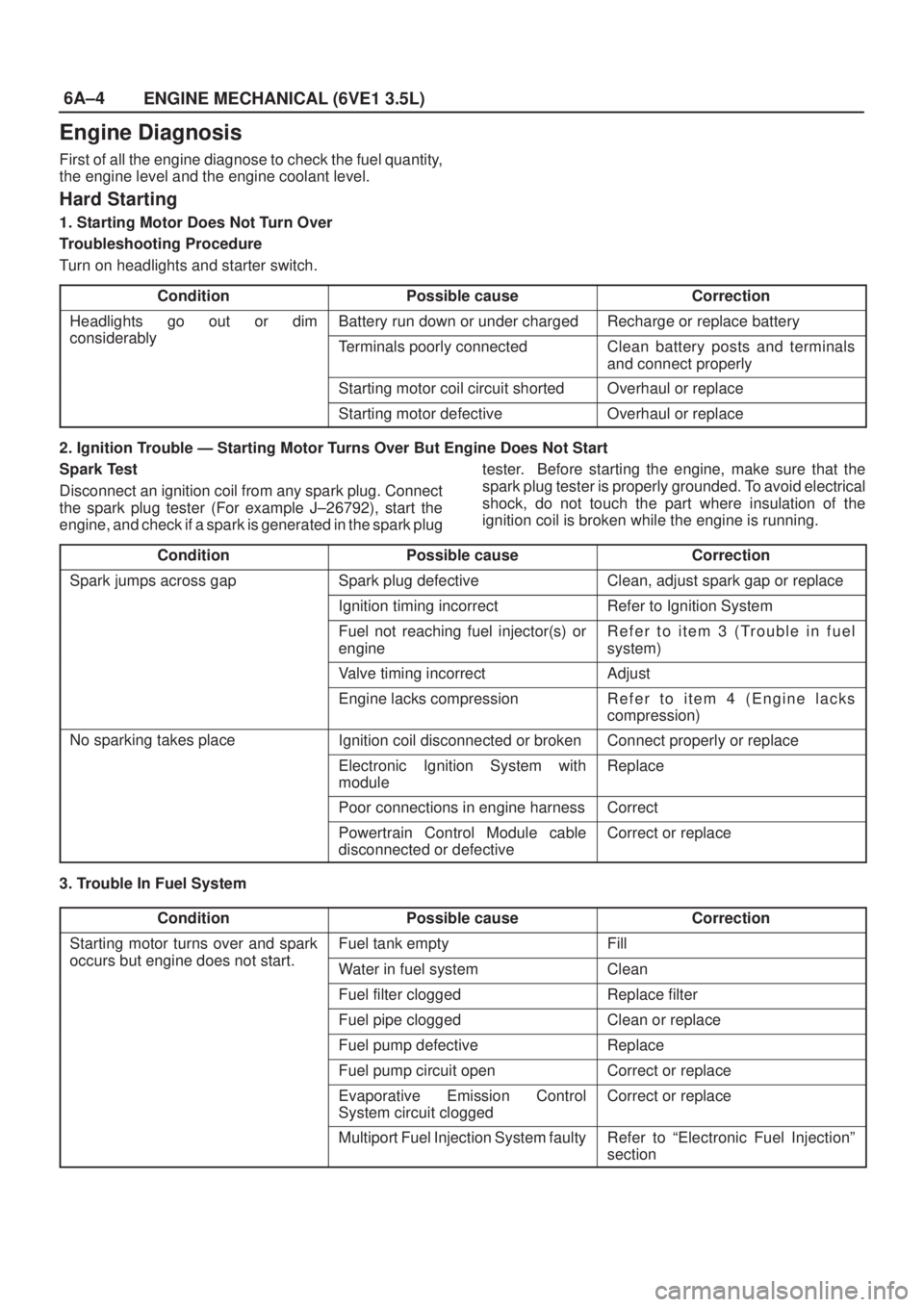
ENGINE MECHANICAL (6VE1 3.5L)
Engine Diagnosis
First of all the engine diagnose to check the fuel quantity,
the engine level and the engine coolant level.
Hard Starting
1. Starting Motor Does Not Turn Over
Troubleshooting Procedure
Turn on headlights and starter switch.
Condition
Possible causeCorrection
Headlights go out or dim
considerably
Battery run down or under chargedRecharge or replace battery
considerablyTerminals poorly connectedClean battery posts and terminals
and connect properly
Starting motor coil circuit shortedOverhaul or replace
Starting motor defectiveOverhaul or replace
2. Ignition Trouble Ð Starting Motor Turns Over But Engine Does Not Start
Spark Test
Disconnect an ignition coil from any spark plug. Connect
the spark plug tester (For example J±26792), start the
engine, and check if a spark is generated in the spark plugtester. Before starting the engine, make sure that the
spark plug tester is properly grounded. To avoid electrical
shock, do not touch the part where insulation of the
ignition coil is broken while the engine is running.
Condition
Possible causeCorrection
Spark jumps across gapSpark plug defectiveClean, adjust spark gap or replace
Ignition timing incorrectRefer to Ignition System
Fuel not reaching fuel injector(s) or
engineRefer to item 3 (Trouble in fuel
system)
Valve timing incorrectAdjust
Engine lacks compressionRefer to item 4 (Engine lacks
compression)
No sparking takes placeIgnition coil disconnected or brokenConnect properly or replace
Electronic Ignition System with
moduleReplace
Poor connections in engine harnessCorrect
Powertrain Control Module cable
disconnected or defectiveCorrect or replace
3. Trouble In Fuel System
Condition
Possible causeCorrection
Starting motor turns over and spark
occurs but engine does not start
Fuel tank emptyFill
occurs but engine does not start.Water in fuel systemClean
Fuel filter cloggedReplace filter
Fuel pipe cloggedClean or replace
Fuel pump defectiveReplace
Fuel pump circuit openCorrect or replace
Evaporative Emission Control
System circuit cloggedCorrect or replace
Multiport Fuel Injection System faultyRefer to ªElectronic Fuel Injectionº
section