DTC CHECK ISUZU KB P190 2007 Workshop Workshop Manual
[x] Cancel search | Manufacturer: ISUZU, Model Year: 2007, Model line: KB P190, Model: ISUZU KB P190 2007Pages: 6020, PDF Size: 70.23 MB
Page 805 of 6020
6 – 20 TROUBLESHOOTING
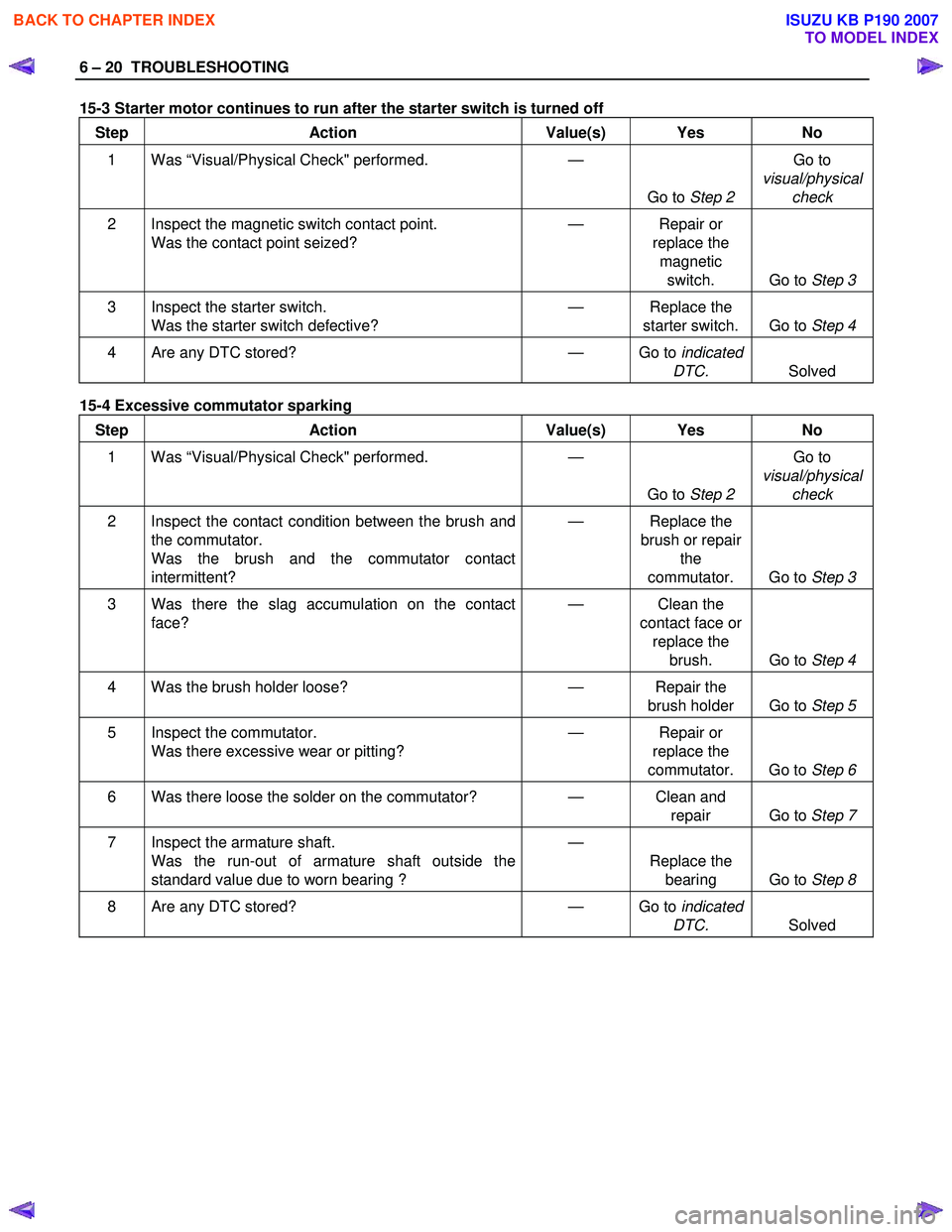
15-3 Starter motor continues to run after the starter switch is turned off
Step Action Value(s) Yes No
1 Was “Visual/Physical Check" performed.
—
Go to Step 2 Go to
visual/physical check
2 Inspect the magnetic switch contact point.
Was the contact point seized? —
Repair or
replace the magnetic switch. Go to Step 3
3 Inspect the starter switch.
Was the starter switch defective? —
Replace the
starter switch. Go to Step 4
4 Are any DTC stored? — Go to indicated
DTC. Solved
15-4 Excessive commutator sparking
Step Action Value(s) Yes No
1 Was “Visual/Physical Check" performed.
—
Go to Step 2 Go to
visual/physical check
2 Inspect the contact condition between the brush and
the commutator.
Was the brush and the commutator contact
intermittent? —
Replace the
brush or repair the
commutator. Go to Step 3
3 Was there the slag accumulation on the contact
face? —
Clean the
contact face or replace the brush. Go to Step 4
4 Was the brush holder loose? — Repair the
brush holder Go to Step 5
5 Inspect the commutator.
Was there excessive wear or pitting? —
Repair or
replace the
commutator. Go to Step 6
6 Was there loose the solder on the commutator? — Clean and
repair Go to Step 7
7 Inspect the armature shaft.
Was the run-out of armature shaft outside the
standard value due to worn bearing ? —
Replace the bearing Go to Step 8
8 Are any DTC stored? — Go to indicated
DTC. Solved
BACK TO CHAPTER INDEX
TO MODEL INDEX
ISUZU KB P190 2007
Page 831 of 6020
6A – 26 ENGINE MECHANICAL
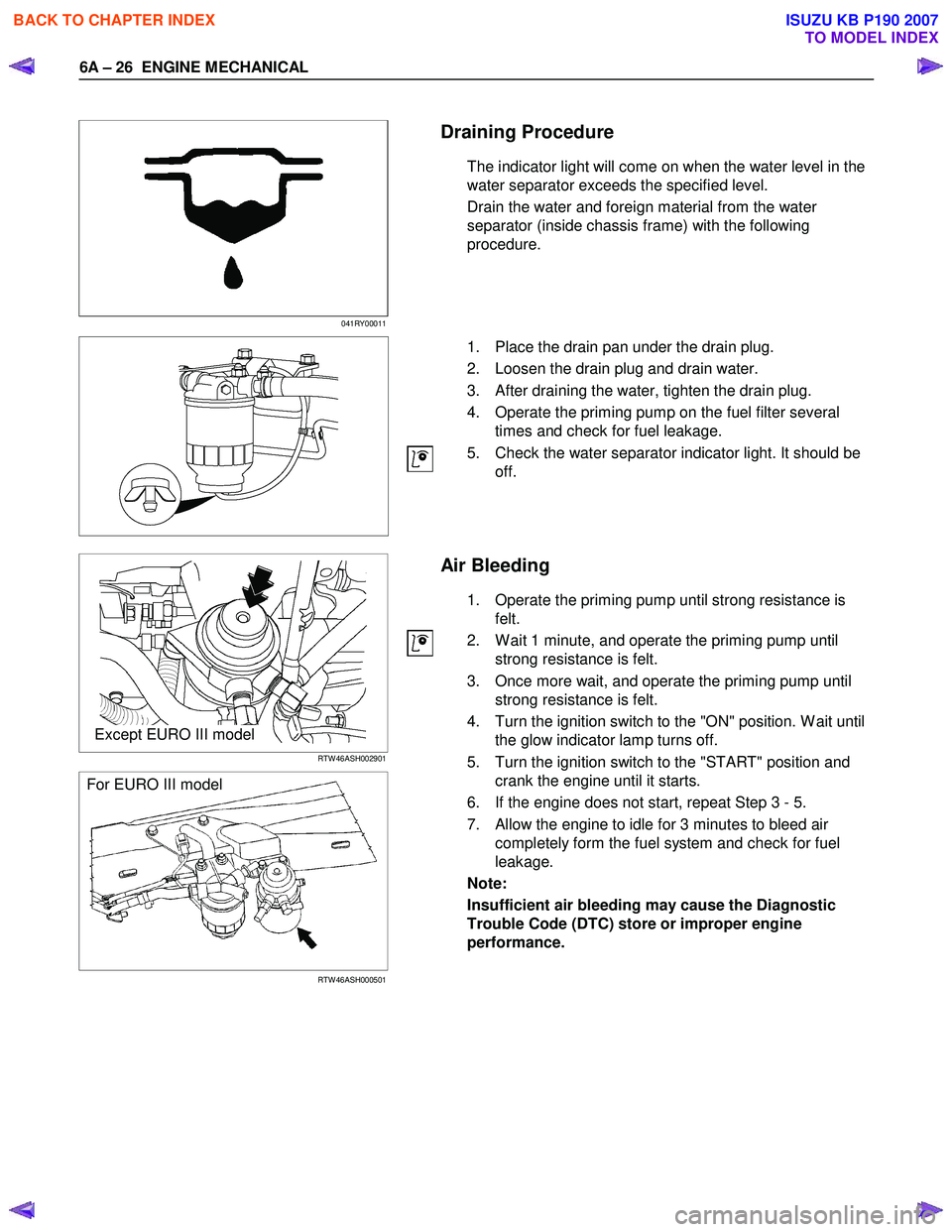
041RY00011
Draining Procedure
The indicator light will come on when the water level in the
water separator exceeds the specified level.
Drain the water and foreign material from the water
separator (inside chassis frame) with the following
procedure.
1. Place the drain pan under the drain plug.
2. Loosen the drain plug and drain water.
3. After draining the water, tighten the drain plug.
4. Operate the priming pump on the fuel filter several times and check for fuel leakage.
5. Check the water separator indicator light. It should be off.
Except EURO III model
RTW 46ASH002901
For EURO III model
RTW 46ASH000501
Air Bleeding
1. Operate the priming pump until strong resistance is felt.
2. W ait 1 minute, and operate the priming pump until strong resistance is felt.
3. Once more wait, and operate the priming pump until strong resistance is felt.
4. Turn the ignition switch to the "ON" position. W ait until the glow indicator lamp turns off.
5. Turn the ignition switch to the "START" position and crank the engine until it starts.
6. If the engine does not start, repeat Step 3 - 5.
7. Allow the engine to idle for 3 minutes to bleed air completely form the fuel system and check for fuel
leakage.
Note:
Insufficient air bleeding may cause the Diagnostic
Trouble Code (DTC) store or improper engine
performance.
BACK TO CHAPTER INDEX
TO MODEL INDEX
ISUZU KB P190 2007
Page 1035 of 6020
Engine Control System (4JH1) 6E-1
SECTION 6E
ENGINE CONTROL SYSTEM (4JH1)
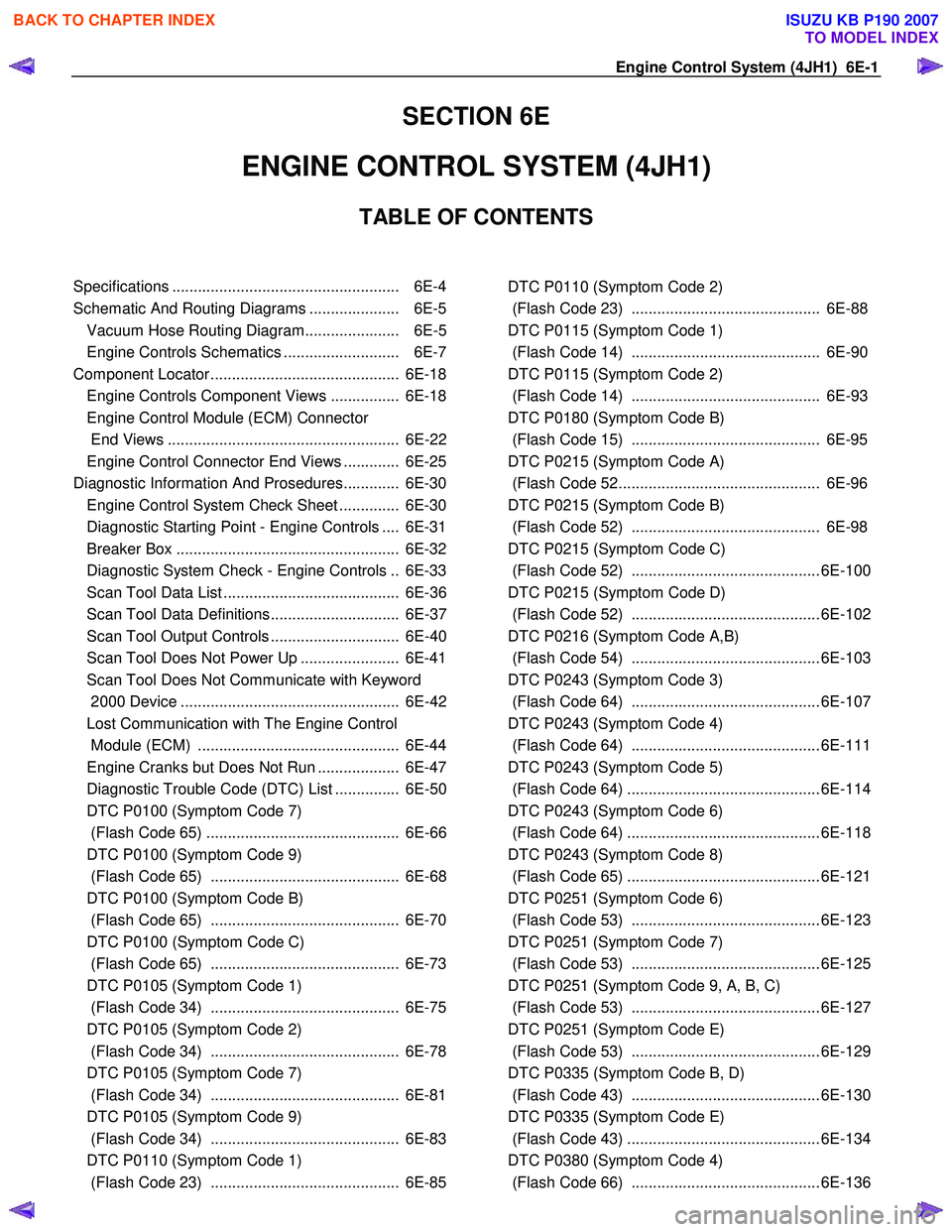
TABLE OF CONTENTS
Specifications ..................................................... 6E-4
Schematic And Routing Diagrams ..................... 6E-5 Vacuum Hose Routing Diagram...................... 6E-5
Engine Controls Schematics ........................... 6E-7
Component Locator ............................................ 6E-18 Engine Controls Component Views ................ 6E-18
Engine Control Module (ECM) Connector
End Views ...................................................... 6E-22
Engine Control Connector End Views ............. 6E-25
Diagnostic Information And Prosedures............. 6E-30 Engine Control System Check Sheet .............. 6E-30
Diagnostic Starting Point - Engine Controls .... 6E-31
Breaker Box .................................................... 6E-32
Diagnostic System Check - Engine Controls .. 6E-33
Scan Tool Data List ......................................... 6E-36
Scan Tool Data Definitions.............................. 6E-37
Scan Tool Output Controls .............................. 6E-40
Scan Tool Does Not Power Up ....................... 6E-41
Scan Tool Does Not Communicate with Keyword
2000 Device ................................................... 6E-42
Lost Communication with The Engine Control
Module (ECM) ............................................... 6E-44
Engine Cranks but Does Not Run ................... 6E-47
Diagnostic Trouble Code (DTC) List ............... 6E-50
DTC P0100 (Symptom Code 7)
(Flash Code 65) ............................................. 6E-66
DTC P0100 (Symptom Code 9)
(Flash Code 65) ............................................ 6E-68
DTC P0100 (Symptom Code B)
(Flash Code 65) ............................................ 6E-70
DTC P0100 (Symptom Code C)
(Flash Code 65) ............................................ 6E-73
DTC P0105 (Symptom Code 1)
(Flash Code 34) ............................................ 6E-75
DTC P0105 (Symptom Code 2)
(Flash Code 34) ............................................ 6E-78
DTC P0105 (Symptom Code 7)
(Flash Code 34) ............................................ 6E-81
DTC P0105 (Symptom Code 9)
(Flash Code 34) ............................................ 6E-83
DTC P0110 (Symptom Code 1)
(Flash Code 23) ............................................ 6E-85
DTC P0110 (Symptom Code 2)
(Flash Code 23) ............................................ 6E-88
DTC P0115 (Symptom Code 1)
(Flash Code 14) ............................................ 6E-90
DTC P0115 (Symptom Code 2)
(Flash Code 14) ............................................ 6E-93
DTC P0180 (Symptom Code B)
(Flash Code 15) ............................................ 6E-95
DTC P0215 (Symptom Code A)
(Flash Code 52............................................... 6E-96
DTC P0215 (Symptom Code B)
(Flash Code 52) ............................................ 6E-98
DTC P0215 (Symptom Code C)
(Flash Code 52) ............................................ 6E-100
DTC P0215 (Symptom Code D)
(Flash Code 52) ............................................ 6E-102
DTC P0216 (Symptom Code A,B)
(Flash Code 54) ............................................ 6E-103
DTC P0243 (Symptom Code 3)
(Flash Code 64) ............................................ 6E-107
DTC P0243 (Symptom Code 4)
(Flash Code 64) ............................................ 6E-111
DTC P0243 (Symptom Code 5)
(Flash Code 64) ............................................. 6E-114
DTC P0243 (Symptom Code 6)
(Flash Code 64) ............................................. 6E-118
DTC P0243 (Symptom Code 8)
(Flash Code 65) ............................................. 6E-121
DTC P0251 (Symptom Code 6)
(Flash Code 53) ............................................ 6E-123
DTC P0251 (Symptom Code 7)
(Flash Code 53) ............................................ 6E-125
DTC P0251 (Symptom Code 9, A, B, C)
(Flash Code 53) ............................................ 6E-127
DTC P0251 (Symptom Code E)
(Flash Code 53) ............................................ 6E-129
DTC P0335 (Symptom Code B, D)
(Flash Code 43) ............................................ 6E-130
DTC P0335 (Symptom Code E)
(Flash Code 43) ............................................. 6E-134
DTC P0380 (Symptom Code 4)
(Flash Code 66) ............................................ 6E-136
BACK TO CHAPTER INDEX
TO MODEL INDEX
ISUZU KB P190 2007
Page 1036 of 6020
6E-2 Engine Control System (4JH1)
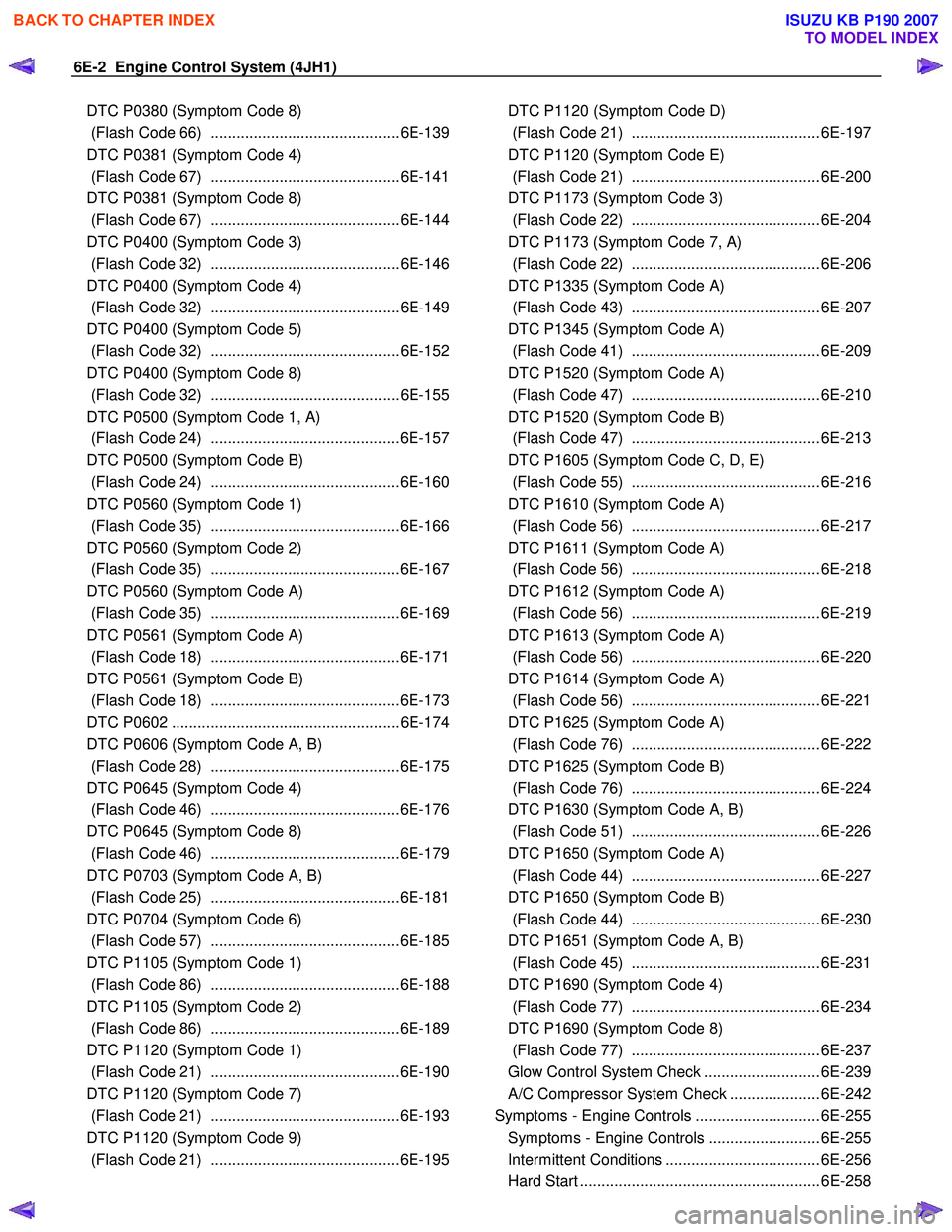
DTC P0380 (Symptom Code 8)
(Flash Code 66) ............................................6E-139
DTC P0381 (Symptom Code 4)
(Flash Code 67) ............................................6E-141
DTC P0381 (Symptom Code 8)
(Flash Code 67) ............................................6E-144
DTC P0400 (Symptom Code 3)
(Flash Code 32) ............................................6E-146
DTC P0400 (Symptom Code 4)
(Flash Code 32) ............................................6E-149
DTC P0400 (Symptom Code 5)
(Flash Code 32) ............................................6E-152
DTC P0400 (Symptom Code 8)
(Flash Code 32) ............................................6E-155
DTC P0500 (Symptom Code 1, A)
(Flash Code 24) ............................................6E-157
DTC P0500 (Symptom Code B)
(Flash Code 24) ............................................6E-160
DTC P0560 (Symptom Code 1)
(Flash Code 35) ............................................6E-166
DTC P0560 (Symptom Code 2)
(Flash Code 35) ............................................6E-167
DTC P0560 (Symptom Code A)
(Flash Code 35) ............................................6E-169
DTC P0561 (Symptom Code A)
(Flash Code 18) ............................................6E-171
DTC P0561 (Symptom Code B)
(Flash Code 18) ............................................6E-173
DTC P0602 .....................................................6E-174
DTC P0606 (Symptom Code A, B)
(Flash Code 28) ............................................6E-175
DTC P0645 (Symptom Code 4)
(Flash Code 46) ............................................6E-176
DTC P0645 (Symptom Code 8)
(Flash Code 46) ............................................6E-179
DTC P0703 (Symptom Code A, B)
(Flash Code 25) ............................................6E-181
DTC P0704 (Symptom Code 6)
(Flash Code 57) ............................................6E-185
DTC P1105 (Symptom Code 1)
(Flash Code 86) ............................................6E-188
DTC P1105 (Symptom Code 2)
(Flash Code 86) ............................................6E-189
DTC P1120 (Symptom Code 1)
(Flash Code 21) ............................................6E-190
DTC P1120 (Symptom Code 7)
(Flash Code 21) ............................................6E-193
DTC P1120 (Symptom Code 9)
(Flash Code 21) ............................................6E-195
DTC P1120 (Symptom Code D)
(Flash Code 21) ............................................ 6E-197
DTC P1120 (Symptom Code E)
(Flash Code 21) ............................................ 6E-200
DTC P1173 (Symptom Code 3)
(Flash Code 22) ............................................ 6E-204
DTC P1173 (Symptom Code 7, A)
(Flash Code 22) ............................................ 6E-206
DTC P1335 (Symptom Code A)
(Flash Code 43) ............................................ 6E-207
DTC P1345 (Symptom Code A)
(Flash Code 41) ............................................ 6E-209
DTC P1520 (Symptom Code A)
(Flash Code 47) ............................................ 6E-210
DTC P1520 (Symptom Code B)
(Flash Code 47) ............................................ 6E-213
DTC P1605 (Symptom Code C, D, E)
(Flash Code 55) ............................................ 6E-216
DTC P1610 (Symptom Code A)
(Flash Code 56) ............................................ 6E-217
DTC P1611 (Symptom Code A)
(Flash Code 56) ............................................ 6E-218
DTC P1612 (Symptom Code A)
(Flash Code 56) ............................................ 6E-219
DTC P1613 (Symptom Code A)
(Flash Code 56) ............................................ 6E-220
DTC P1614 (Symptom Code A)
(Flash Code 56) ............................................ 6E-221
DTC P1625 (Symptom Code A)
(Flash Code 76) ............................................ 6E-222
DTC P1625 (Symptom Code B)
(Flash Code 76) ............................................ 6E-224
DTC P1630 (Symptom Code A, B)
(Flash Code 51) ............................................ 6E-226
DTC P1650 (Symptom Code A)
(Flash Code 44) ............................................ 6E-227
DTC P1650 (Symptom Code B)
(Flash Code 44) ............................................ 6E-230
DTC P1651 (Symptom Code A, B)
(Flash Code 45) ............................................ 6E-231
DTC P1690 (Symptom Code 4)
(Flash Code 77) ............................................ 6E-234
DTC P1690 (Symptom Code 8)
(Flash Code 77) ............................................ 6E-237
Glow Control System Check ........................... 6E-239
A/C Compressor System Check ..................... 6E-242
Symptoms - Engine Controls ............................. 6E-255 Symptoms - Engine Controls .......................... 6E-255
Intermittent Conditions .................................... 6E-256
Hard Start ........................................................ 6E-258
BACK TO CHAPTER INDEX
TO MODEL INDEX
ISUZU KB P190 2007
Page 1064 of 6020
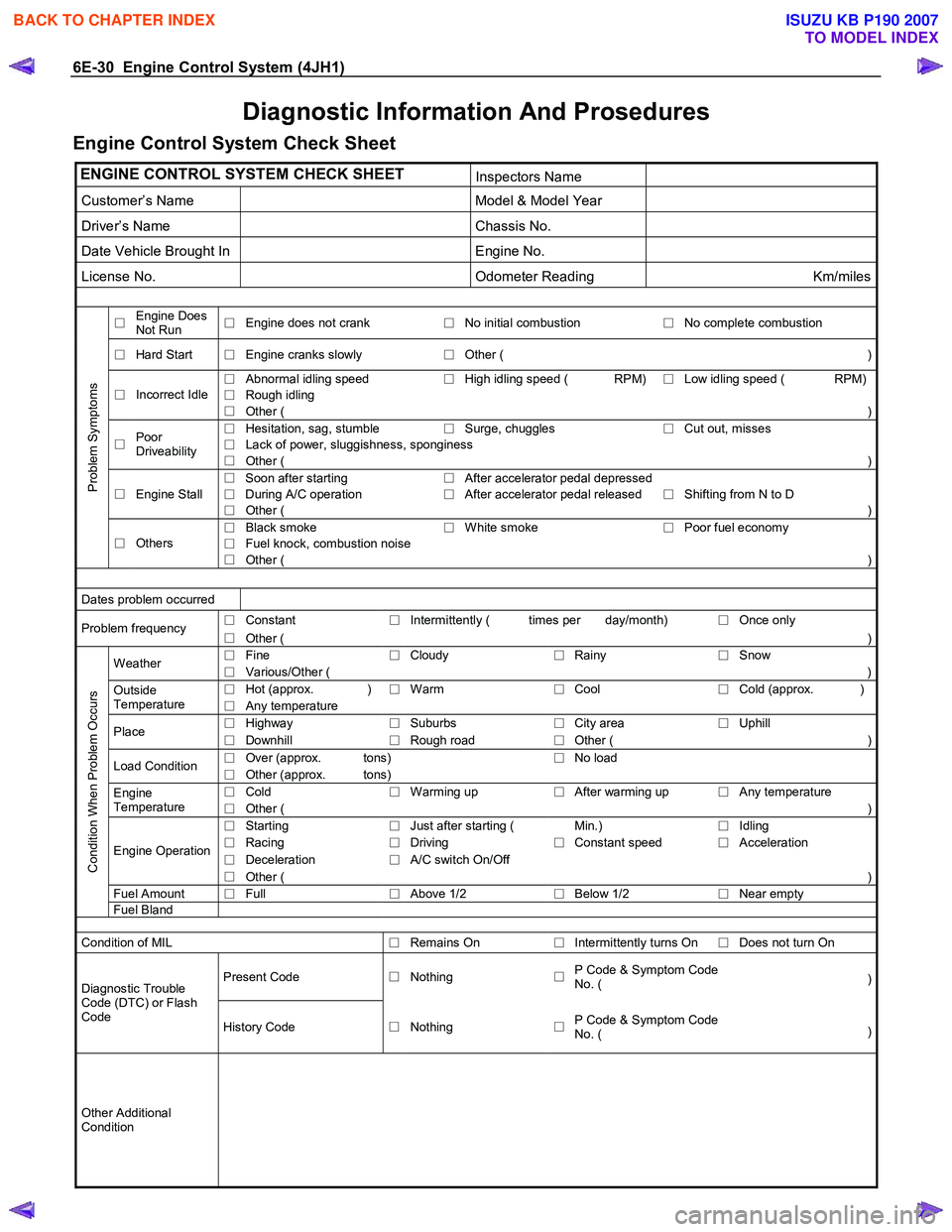
6E-30 Engine Control System (4JH1)
Diagnostic Information And Prosedures
Engine Control System Check Sheet
ENGINE CONTROL SYSTEM CHECK SHEET Inspectors Name
Customer’s Name Model & Model Year
Driver’s Name Chassis No.
Date Vehicle Brought In Engine No.
License No. Odometer Reading Km/miles
□ Engine Does
Not Run □
Engine does not crank
□No initial combustion
□ No complete combustion
□
Hard Start
□ Engine cranks slowly
□Other ( )
□
Abnormal idling speed
□High idling speed ( RPM)
□ Low idling speed ( RPM)
□
Rough idling □
Incorrect Idle
□ Other ( )
□
Hesitation, sag, stumble
□Surge, chuggles
□ Cut out, misses
□
Lack of power, sluggishness, sponginess □
Poor
Driveability □ Other ( )
□ Soon after starting
□After accelerator pedal depressed
Engine Stall
□ During A/C operation
□After accelerator pedal released
□ Shifting from N to D □
□ Other ( )
□
Black smoke
□White smoke
□ Poor fuel economy
□
Fuel knock, combustion noise
Problem Symptoms
□
Others
□ Other ( )
Dates problem occurred
□
Constant
□Intermittently ( times per day/month)
□ Once only Problem frequency
□ Other (
)
□ Fine
□Cloudy
□Rainy
□ Snow Weather
□ Various/Other (
)
□ Hot (approx. )
□Warm
□Cool
□ Cold (approx. )Outside
Temperature □ Any temperature
□
Highway
□Suburbs
□City area
□ Uphill Place
□ Downhill
□Rough road
□Other (
)
□ Over (approx. tons)
□No load
Load Condition
□ Other (approx. tons)
□ Cold
□Warming up
□After warming up
□ Any temperature Engine
Temperature □ Other ( )
□
Starting
□Just after starting ( Min.)
□ Idling
□
Racing
□Driving
□Constant speed
□ Acceleration
□
Deceleration
□A/C switch On/Off Engine Operation
□ Other ( )
Fuel Amount
□ Full
□Above 1/2
□Below 1/2
□ Near empty
Condition When Problem Occurs
Fuel
Bland
Condition of MIL
□Remains On
□Intermittently turns On
□ Does not turn On
Present Code
□Nothing
□P Code & Symptom Code
No. ( )Diagnostic Trouble
Code (DTC) or Flash
Code History Code □Nothing
□P Code & Symptom Code
No. ( )
Other Additional
Condition
BACK TO CHAPTER INDEX
TO MODEL INDEX
ISUZU KB P190 2007
Page 1065 of 6020
Engine Control System (4JH1) 6E-31
Diagnostic Starting Point - Engine Controls
Begin the system diagnosis with Diagnostic System
Check - Engine Controls. The Diagnostic System Check
- Engine Controls will provide the following information:
• The identification of the control modules which
command the system.
• The ability of the control modules to communicate
through the serial data circuit.
• The identification of any stored diagnostic trouble
codes (DTCs) and the their statuses.
The use of the Diagnostic System Check - Engine
Controls will identify the correct procedure fo
r
diagnosing the system and where the procedure is
located.
Important:
Engine Control System Check Sheet must be used to
verify the complaint vehicle, you need to know the
correct (normal) operating behavior of the system and
verify that the customer complaint is a valid failure o
f
the system.
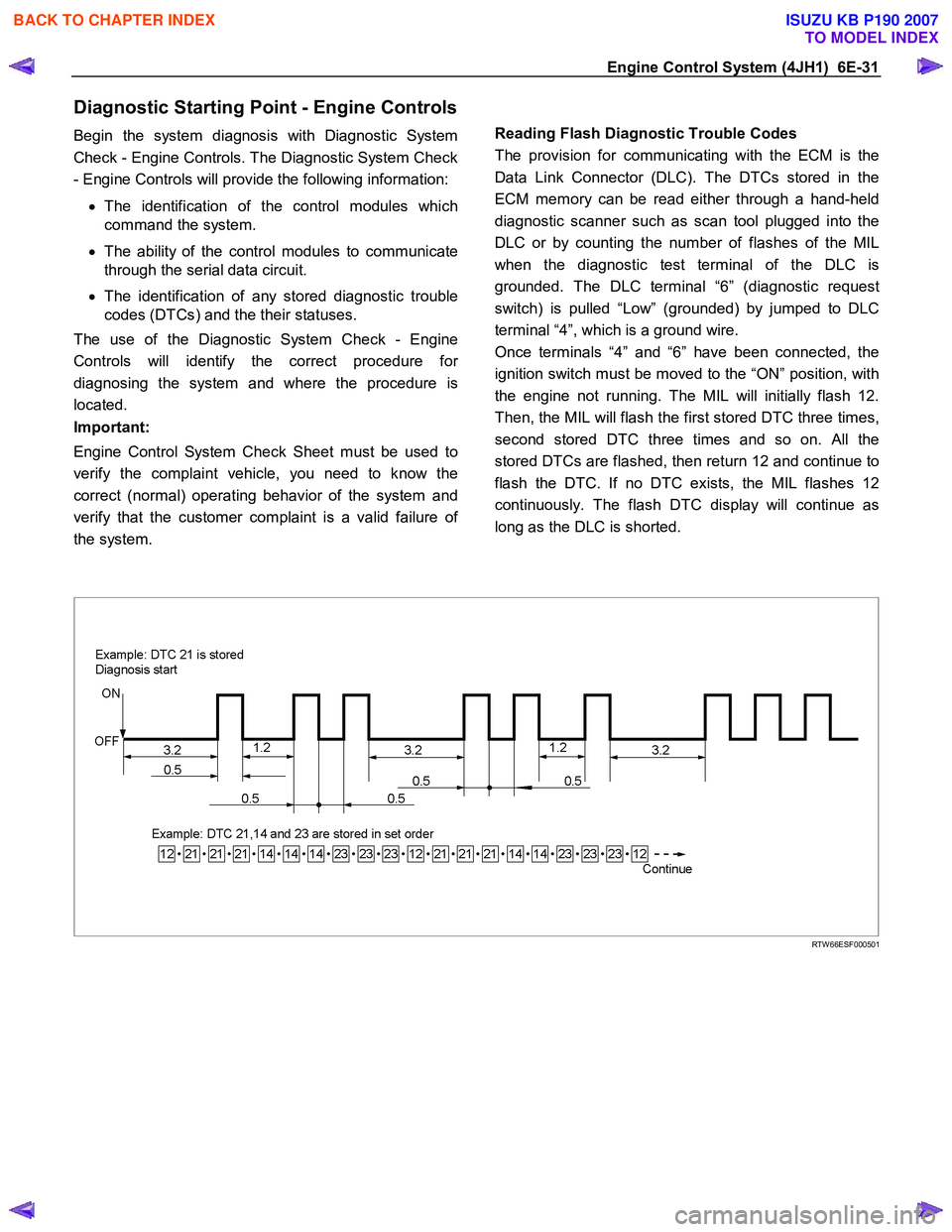
Reading Flash Diagnostic Trouble Codes
The provision for communicating with the ECM is the
Data Link Connector (DLC). The DTCs stored in the
ECM memory can be read either through a hand-held
diagnostic scanner such as scan tool plugged into the
DLC or by counting the number of flashes of the MIL
when the diagnostic test terminal of the DLC is
grounded. The DLC terminal “6” (diagnostic request
switch) is pulled “Low” (grounded) by jumped to DLC
terminal “4”, which is a ground wire.
Once terminals “4” and “6” have been connected, the
ignition switch must be moved to the “ON” position, with
the engine not running. The MIL will initially flash 12.
Then, the MIL will flash the first stored DTC three times,
second stored DTC three times and so on. All the
stored DTCs are flashed, then return 12 and continue to
flash the DTC. If no DTC exists, the MIL flashes 12
continuously. The flash DTC display will continue as
long as the DLC is shorted.
RTW 66ESF000501
BACK TO CHAPTER INDEX
TO MODEL INDEX
ISUZU KB P190 2007
Page 1067 of 6020
Engine Control System (4JH1) 6E-33
Diagnostic System Check - Engine
Controls
Description
The Diagnostic System Check-Engine Controls is an
organized approach to identifying a condition that is
created by a malfunction in the electronic engine control
system. The Diagnostic System Check must be the
starting point for any driveability concern. The
Diagnostic System Check directs the service technician
to the next logical step in order to diagnose the concern.
Understanding and correctly using the diagnostic table
reduces diagnostic time, and prevents the replacement
of good parts.
Test Description
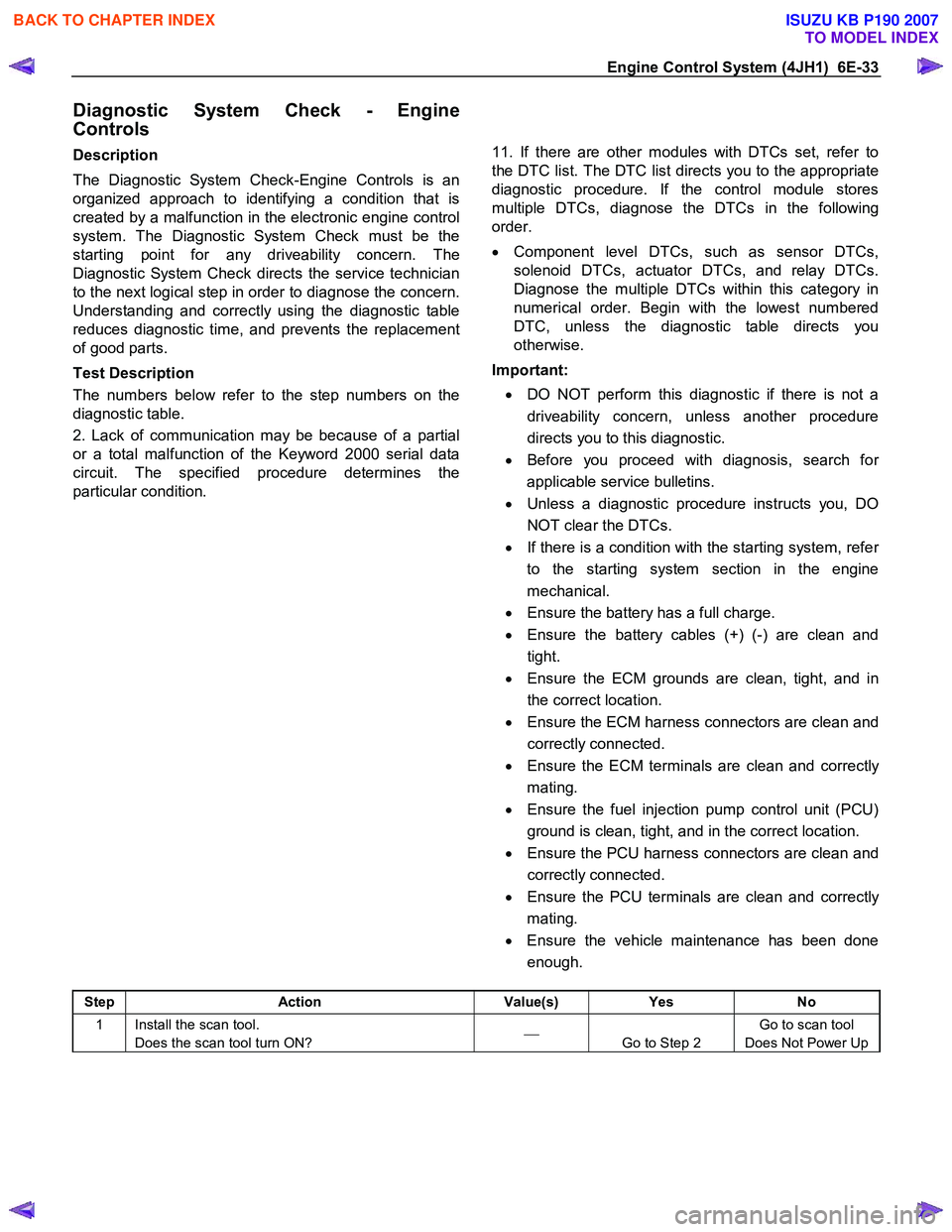
The numbers below refer to the step numbers on the
diagnostic table.
2. Lack of communication may be because of a partial
or a total malfunction of the Keyword 2000 serial data
circuit. The specified procedure determines the
particular condition.
11. If there are other modules with DTCs set, refer to
the DTC list. The DTC list directs you to the appropriate
diagnostic procedure. If the control module stores
multiple DTCs, diagnose the DTCs in the following
order.
• Component level DTCs, such as sensor DTCs,
solenoid DTCs, actuator DTCs, and relay DTCs.
Diagnose the multiple DTCs within this category in
numerical order. Begin with the lowest numbered
DTC, unless the diagnostic table directs you
otherwise.
Important:
• DO NOT perform this diagnostic if there is not a
driveability concern, unless another procedure
directs you to this diagnostic.
• Before you proceed with diagnosis, search fo
r
applicable service bulletins.
• Unless a diagnostic procedure instructs you, DO
NOT clear the DTCs.
• If there is a condition with the starting system, refe
r
to the starting system section in the engine
mechanical.
• Ensure the battery has a full charge.
• Ensure the battery cables (+) (-) are clean and
tight.
• Ensure the ECM grounds are clean, tight, and in
the correct location.
• Ensure the ECM harness connectors are clean and
correctly connected.
• Ensure the ECM terminals are clean and correctl
y
mating.
• Ensure the fuel injection pump control unit (PCU)
ground is clean, tight, and in the correct location.
• Ensure the PCU harness connectors are clean and
correctly connected.
• Ensure the PCU terminals are clean and correctl
y
mating.
• Ensure the vehicle maintenance has been done
enough.
Step Action Value(s) Yes No
1 Install the scan tool.
Does the scan tool turn ON?
Go to Step 2 Go to scan tool
Does Not Power Up
BACK TO CHAPTER INDEX
TO MODEL INDEX
ISUZU KB P190 2007
Page 1068 of 6020
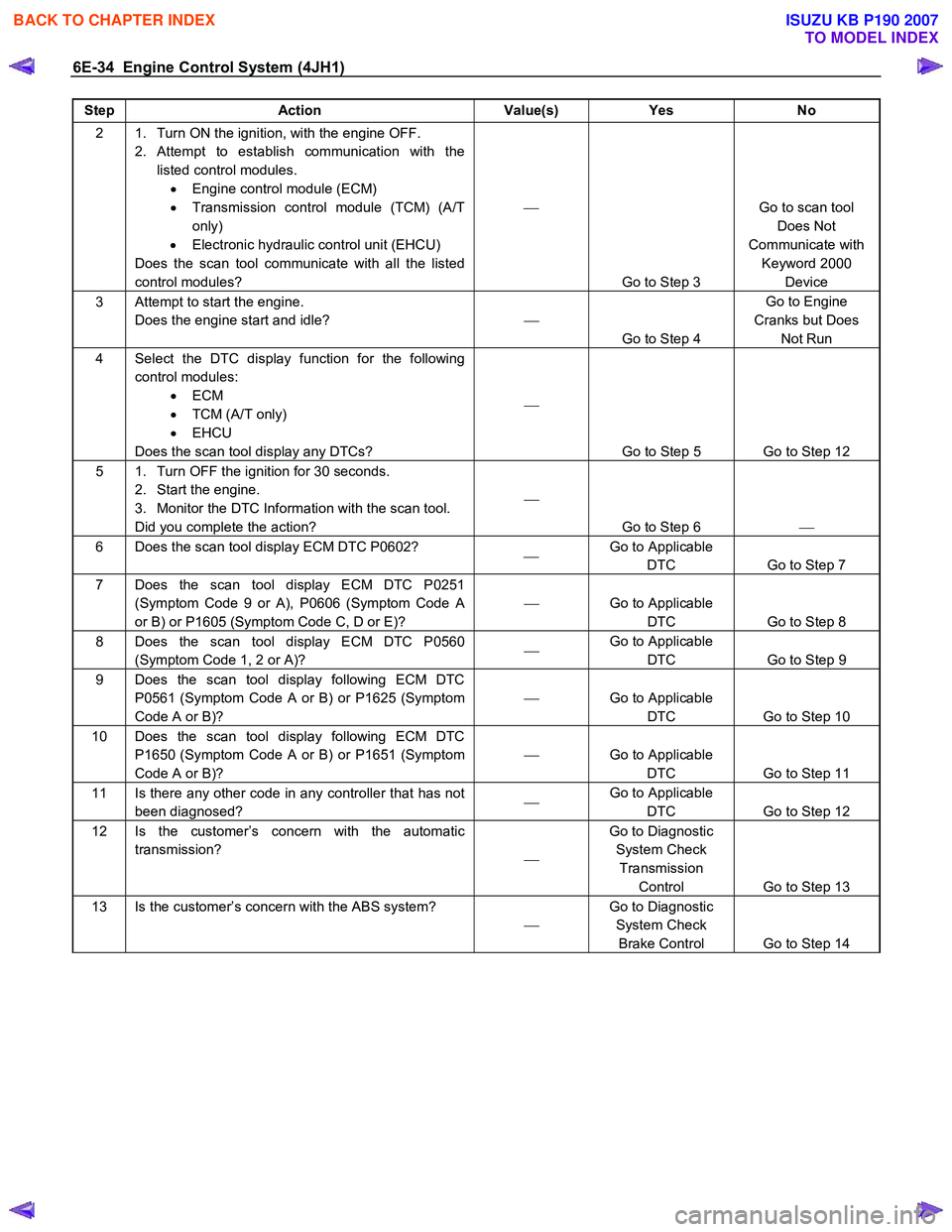
6E-34 Engine Control System (4JH1)
Step Action Value(s) Yes No
2 1. Turn ON the ignition, with the engine OFF.
2. Attempt to establish communication with the listed control modules. • Engine control module (ECM)
• Transmission control module (TCM) (A/T
only)
• Electronic hydraulic control unit (EHCU)
Does the scan tool communicate with all the listed
control modules?
Go to Step 3 Go to scan tool
Does Not
Communicate with Keyword 2000 Device
3 Attempt to start the engine. Does the engine start and idle?
Go to Step 4 Go to Engine
Cranks but Does Not Run
4 Select the DTC display function for the following control modules: • ECM
• TCM (A/T only)
• EHCU
Does the scan tool display any DTCs?
Go to Step 5 Go to Step 12
5 1. Turn OFF the ignition for 30 seconds. 2. Start the engine.
3. Monitor the DTC Information with the scan tool.
Did you complete the action?
Go to Step 6
6 Does the scan tool display ECM DTC P0602?
Go to Applicable
DTC Go to Step 7
7 Does the scan tool display ECM DTC P0251 (Symptom Code 9 or A), P0606 (Symptom Code A
or B) or P1605 (Symptom Code C, D or E)?
Go to Applicable
DTC Go to Step 8
8 Does the scan tool display ECM DTC P0560 (Symptom Code 1, 2 or A)?
Go to Applicable
DTC Go to Step 9
9 Does the scan tool display following ECM DTC
P0561 (Symptom Code A or B) or P1625 (Symptom
Code A or B)?
Go to Applicable
DTC Go to Step 10
10 Does the scan tool display following ECM DTC P1650 (Symptom Code A or B) or P1651 (Symptom
Code A or B)?
Go to Applicable
DTC Go to Step 11
11 Is there any other code in any controller that has not
been diagnosed?
Go to Applicable
DTC Go to Step 12
12 Is the customer’s concern with the automatic
transmission? Go to Diagnostic
System Check Transmission Control Go to Step 13
13 Is the customer’s concern with the ABS system?
Go to Diagnostic
System Check Brake Control Go to Step 14
BACK TO CHAPTER INDEX
TO MODEL INDEX
ISUZU KB P190 2007
Page 1070 of 6020
6E-36 Engine Control System (4JH1)
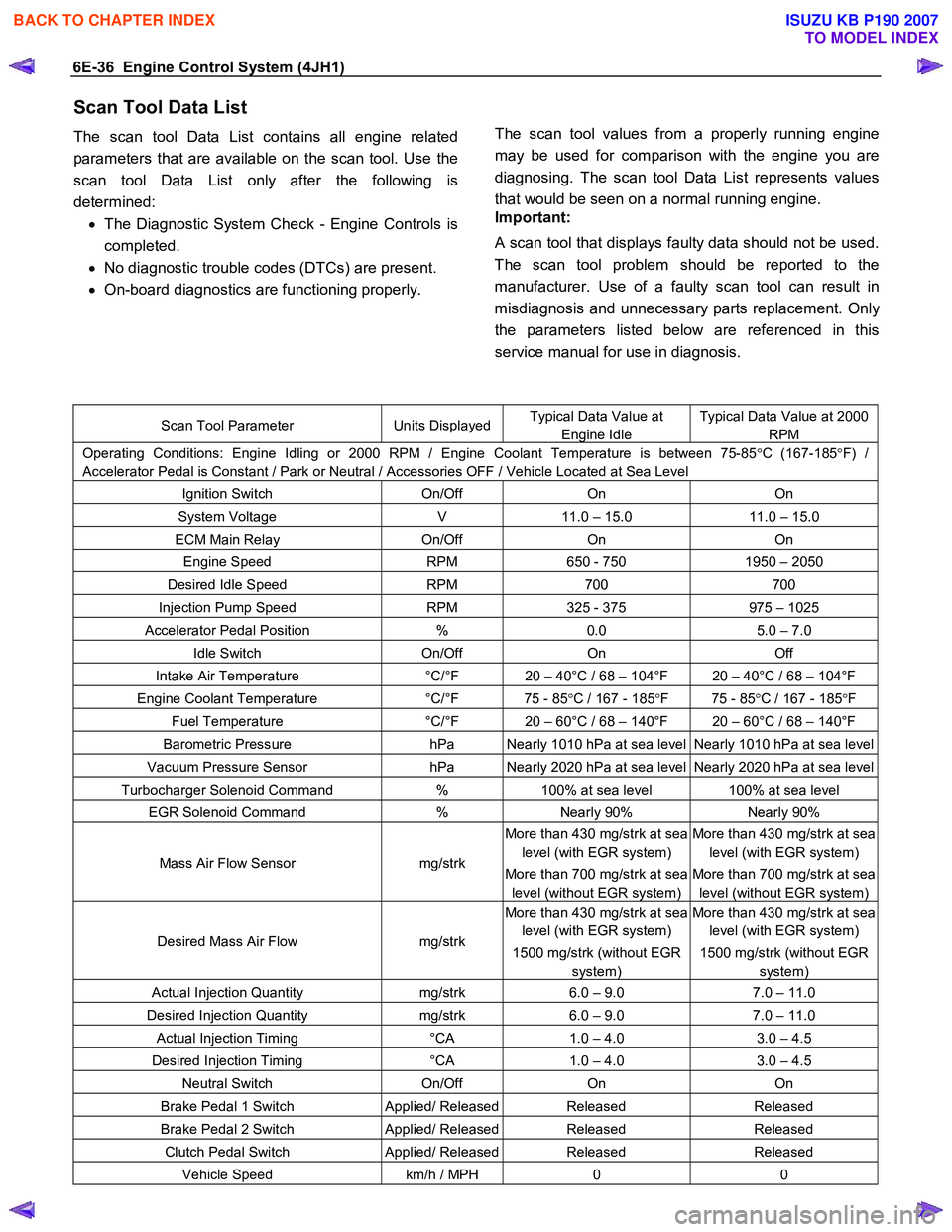
Scan Tool Data List
The scan tool Data List contains all engine related
parameters that are available on the scan tool. Use the
scan tool Data List only after the following is
determined: • The Diagnostic System Check - Engine Controls is
completed.
• No diagnostic trouble codes (DTCs) are present.
• On-board diagnostics are functioning properly.
The scan tool values from a properly running engine
may be used for comparison with the engine you are
diagnosing. The scan tool Data List represents values
that would be seen on a normal running engine.
Important:
A scan tool that displays faulty data should not be used.
The scan tool problem should be reported to the
manufacturer. Use of a faulty scan tool can result in
misdiagnosis and unnecessary parts replacement. Onl
y
the parameters listed below are referenced in this
service manual for use in diagnosis.
Scan Tool Parameter Units DisplayedTypical Data Value at
Engine Idle
Typical Data Value at 2000
RPM
Operating Conditions: Engine Idling or 2000 RPM / Engine Coolant Temperature is between 75-85 °C (167-185 °F) /
Accelerator Pedal is Constant / Park or Neutral / Accessories OFF / Vehicle Located at Sea Level
Ignition Switch On/Off On On
System Voltage V 11.0 – 15.0 11.0 – 15.0
ECM Main Relay On/Off On On
Engine Speed RPM 650 - 750 1950 – 2050
Desired Idle Speed RPM 700 700
Injection Pump Speed RPM 325 - 375 975 – 1025
Accelerator Pedal Position % 0.0 5.0 – 7.0
Idle Switch On/Off On Off
Intake Air Temperature °C/°F 20 – 40°C / 68 – 104°F 20 – 40°C / 68 – 104°F
Engine Coolant Temperature °C/°F 75 - 85 °C / 167 - 185 °F 75 - 85 °C / 167 - 185 °F
Fuel Temperature °C/°F 20 – 60°C / 68 – 140°F 20 – 60°C / 68 – 140°F
Barometric Pressure hPa Nearly 1010 hPa at sea level Nearly 1010 hPa at sea level
Vacuum Pressure Sensor hPa Nearly 2020 hPa at sea level Nearly 2020 hPa at sea level
Turbocharger Solenoid Command % 100% at sea level 100% at sea level
EGR Solenoid Command % Nearly 90% Nearly 90%
Mass Air Flow Sensor mg/strk
More than 430 mg/strk at sea
level (with EGR system)
More than 700 mg/strk at sea
level (without EGR system)
More than 430 mg/strk at sea
level (with EGR system)
More than 700 mg/strk at sea
level (without EGR system)
Desired Mass Air Flow mg/strk
More than 430 mg/strk at sea
level (with EGR system)
1500 mg/strk (without EGR
system)
More than 430 mg/strk at sea
level (with EGR system)
1500 mg/strk (without EGR
system)
Actual Injection Quantity mg/strk 6.0 – 9.0 7.0 – 11.0
Desired Injection Quantity mg/strk 6.0 – 9.0 7.0 – 11.0
Actual Injection Timing °CA 1.0 – 4.0 3.0 – 4.5
Desired Injection Timing °CA 1.0 – 4.0 3.0 – 4.5
Neutral Switch On/Off On On
Brake Pedal 1 Switch Applied/ ReleasedReleased Released
Brake Pedal 2 Switch Applied/ ReleasedReleased Released
Clutch Pedal Switch Applied/ ReleasedReleased Released
Vehicle Speed km/h / MPH 0 0
BACK TO CHAPTER INDEX
TO MODEL INDEX
ISUZU KB P190 2007
Page 1081 of 6020
Engine Control System (4JH1) 6E-47
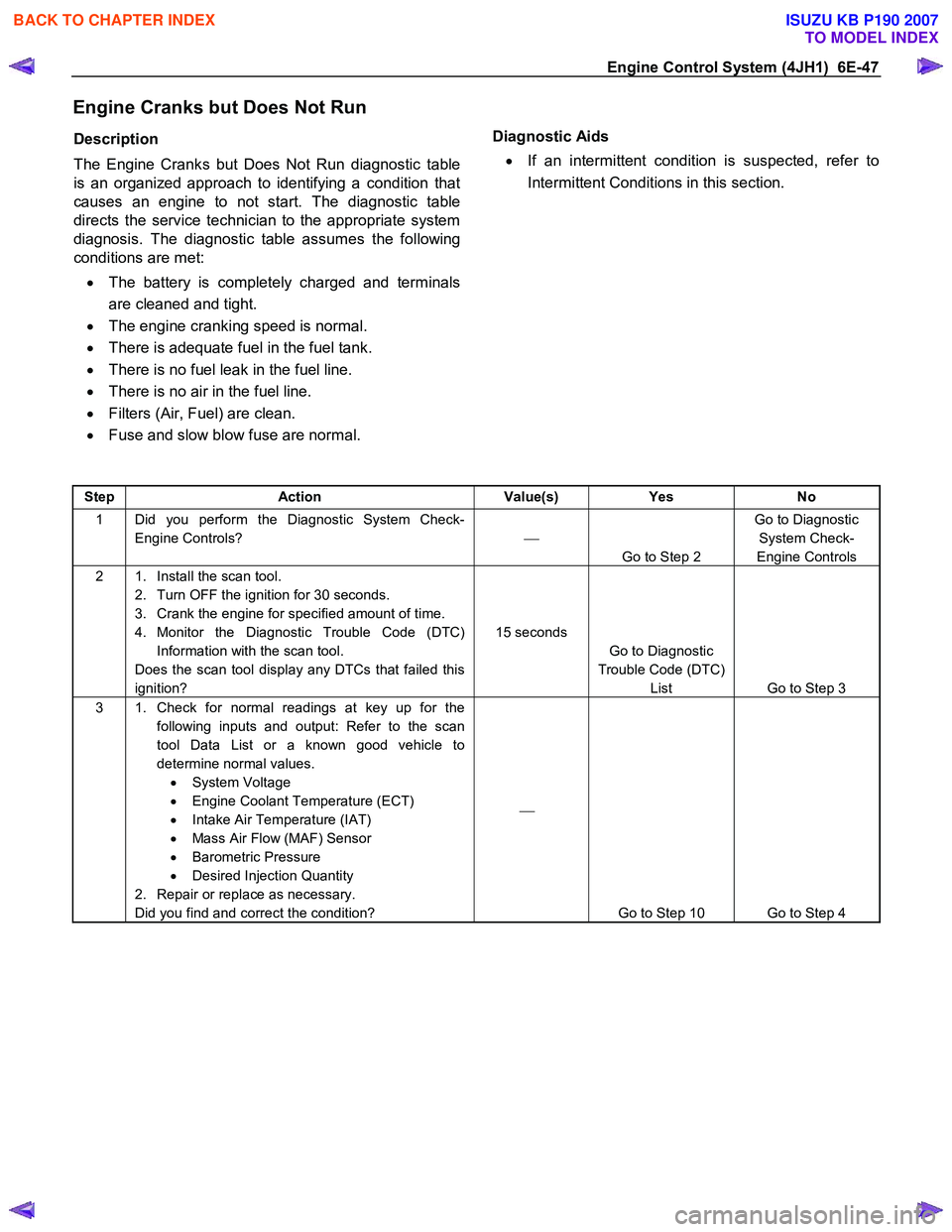
Engine Cranks but Does Not Run
Description
The Engine Cranks but Does Not Run diagnostic table
is an organized approach to identifying a condition that
causes an engine to not start. The diagnostic table
directs the service technician to the appropriate system
diagnosis. The diagnostic table assumes the following
conditions are met:
• The battery is completely charged and terminals
are cleaned and tight.
• The engine cranking speed is normal.
• There is adequate fuel in the fuel tank.
• There is no fuel leak in the fuel line.
• There is no air in the fuel line.
• Filters (Air, Fuel) are clean.
• Fuse and slow blow fuse are normal.
Diagnostic Aids
• If an intermittent condition is suspected, refer to
Intermittent Conditions in this section.
Step Action Value(s) Yes No
1 Did you perform the Diagnostic System Check-
Engine Controls?
Go to Step 2 Go to Diagnostic
System Check-
Engine Controls
2 1. Install the scan tool. 2. Turn OFF the ignition for 30 seconds.
3. Crank the engine for specified amount of time.
4. Monitor the Diagnostic Trouble Code (DTC) Information with the scan tool.
Does the scan tool display any DTCs that failed this
ignition? 15 seconds
Go to Diagnostic
Trouble Code (DTC) List Go to Step 3
3 1. Check for normal readings at key up for the
following inputs and output: Refer to the scan
tool Data List or a known good vehicle to
determine normal values. • System Voltage
• Engine Coolant Temperature (ECT)
• Intake Air Temperature (IAT)
• Mass Air Flow (MAF) Sensor
• Barometric Pressure
• Desired Injection Quantity
2. Repair or replace as necessary.
Did you find and correct the condition?
Go to Step 10 Go to Step 4
BACK TO CHAPTER INDEX
TO MODEL INDEX
ISUZU KB P190 2007