light ISUZU TROOPER 1998 Service Repair Manual
[x] Cancel search | Manufacturer: ISUZU, Model Year: 1998, Model line: TROOPER, Model: ISUZU TROOPER 1998Pages: 3573, PDF Size: 60.36 MB
Page 1529 of 3573
SERVICE INFORMATION 00 Ð 29
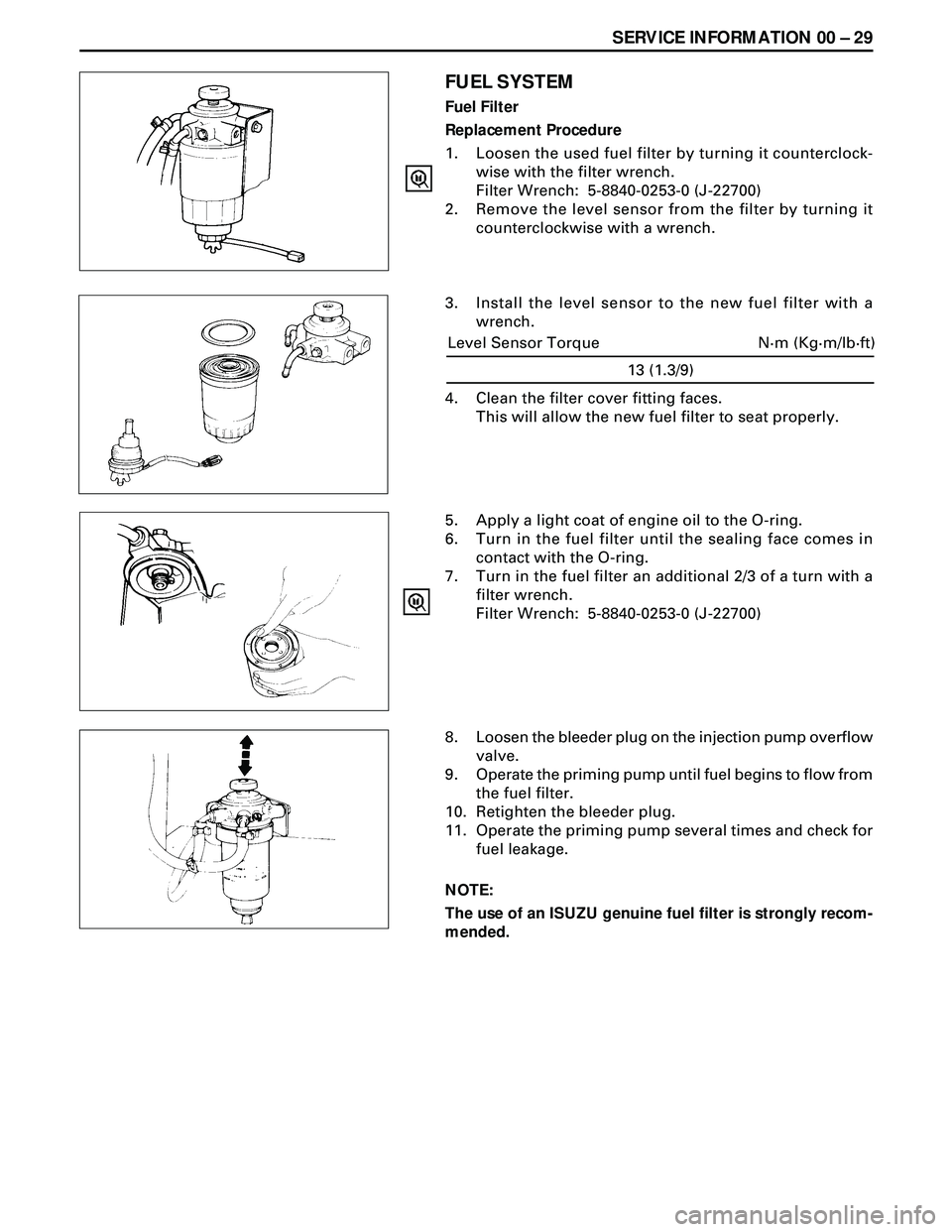
FUEL SYSTEM
Fuel Filter
Replacement Procedure
1. Loosen the used fuel filter by turning it counterclock-
wise with the filter wrench.
Filter Wrench: 5-8840-0253-0 (J-22700)
2. Remove the level sensor from the filter by turning it
counterclockwise with a wrench.
3. Install the level sensor to the new fuel filter with a
wrench.
5. Apply a light coat of engine oil to the O-ring.
6. Turn in the fuel filter until the sealing face comes in
contact with the O-ring.
7. Turn in the fuel filter an additional 2/3 of a turn with a
filter wrench.
Filter Wrench: 5-8840-0253-0 (J-22700)
8. Loosen the bleeder plug on the injection pump overflow
valve.
9. Operate the priming pump until fuel begins to flow from
the fuel filter.
10. Retighten the bleeder plug.
11. Operate the priming pump several times and check for
fuel leakage.
NOTE:
The use of an ISUZU genuine fuel filter is strongly recom-
mended.
13 (1.3/9)
N·m (Kg·m/lb·ft) Level Sensor Torque
4. Clean the filter cover fitting faces.
This will allow the new fuel filter to seat properly.
Page 1530 of 3573
00 Ð 30 SERVICE INFORMATION
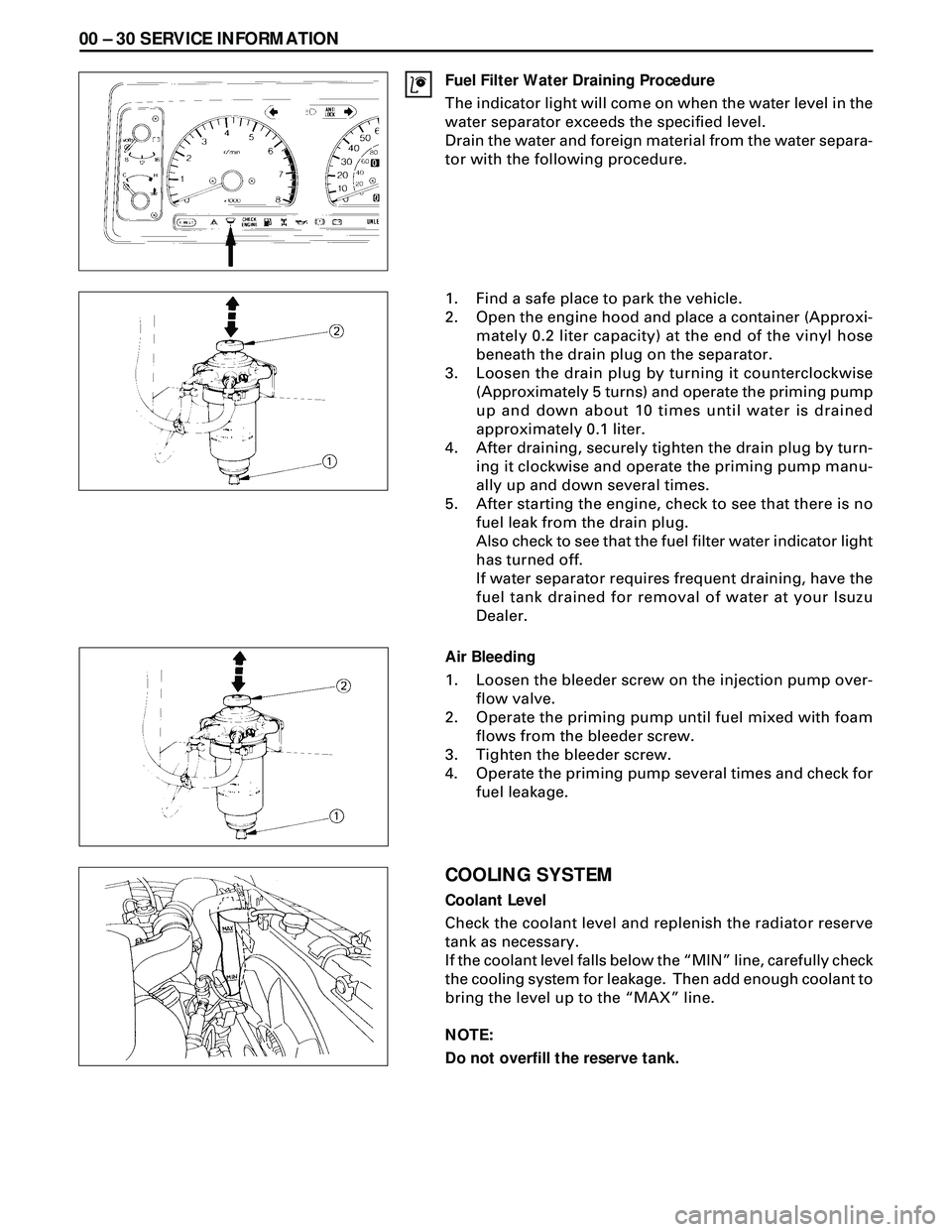
Fuel Filter Water Draining Procedure
The indicator light will come on when the water level in the
water separator exceeds the specified level.
Drain the water and foreign material from the water separa-
tor with the following procedure.
1. Find a safe place to park the vehicle.
2. Open the engine hood and place a container (Approxi-
mately 0.2 liter capacity) at the end of the vinyl hose
beneath the drain plug on the separator.
3. Loosen the drain plug by turning it counterclockwise
(Approximately 5 turns) and operate the priming pump
up and down about 10 times until water is drained
approximately 0.1 liter.
4. After draining, securely tighten the drain plug by turn-
ing it clockwise and operate the priming pump manu-
ally up and down several times.
5. After starting the engine, check to see that there is no
fuel leak from the drain plug.
Also check to see that the fuel filter water indicator light
has turned off.
If water separator requires frequent draining, have the
fuel tank drained for removal of water at your Isuzu
Dealer.
Air Bleeding
1. Loosen the bleeder screw on the injection pump over-
flow valve.
2. Operate the priming pump until fuel mixed with foam
flows from the bleeder screw.
3. Tighten the bleeder screw.
4. Operate the priming pump several times and check for
fuel leakage.
COOLING SYSTEM
Coolant Level
Check the coolant level and replenish the radiator reserve
tank as necessary.
If the coolant level falls below the ÒMINÓ line, carefully check
the cooling system for leakage. Then add enough coolant to
bring the level up to the ÒMAXÓ line.
NOTE:
Do not overfill the reserve tank.
Page 1535 of 3573

SERVICE INFORMATION 00 Ð 35
Adjust the No. 1 or the No. 4 cylinder valve clearances while
their respective cylinders are at TDC on the compression
stroke.
0.4 (0.016)
mm(in) Valve Clearance (At Cold)
4. Loosen each valve clearance adjusting screw as shown
in the ilustration.
5. Insert a feeler gauge of the appropriate thickness be-
tween the rocker arm and the valve stem end.
6. Turn the valve clearance adjusting screw until a slight
drag can be felt on the feeler gauge.
7. Tighten the lock nut securely.
8. Rotate the crankshaft 360°.
9. Realign the crankshaft damper pulley TDC notched line
with the timing pointer.
10. Adjust the clearances for the remaining valves as shown
in the illustration.
INJECTION TIMING ADJUSTMENT
1. Set the No. 1 cylinder to Top Dead Center.
2. Remove injector pump distributor head plug.
3. Cancel Wax CSD with the handle of a screw driver.
4. Fit a dial gauge and set lift to 1 mm.
5. Set crankshaft damper pulley Top Dead Center mark
about 45° before Top Dead Center from the pointer.
6. Set dial gauge in the ÒOÓ position.
Measuring device : 5-8840-0145-0
7. Turn the crankshaft a little rightwise and leftwise and
see it the pointer is stable in the ÒOÓ position.
8. Turn the crankshaft in the normal direction and read the
measuring deviceÕs indication at TDC (4JG2-T) or 1°
ATDC (4JG2-NA).
9. If the injection timing is outside the specified range,
continue with the following steps.
10. Loosen the injection pump fixing nuts and bracket bolts.
11. Adjust the injection pump setting angle.
¥ If injection timing will be advanced, move the injec-
tion pump toward the engine.
¥ If injection timing will be retarded, move the injec-
tion pump away from the engine.
Tighten the pump fixing nut, adjust bolt and pump distribu-
tor head plug to the specified torque.
19(1.9/13)
N·m(Kg·m/lb·ft) Pump Fixing Bolt
0.5 (0.02)
mm(in) Starting Timing
Page 1554 of 3573
6A Ð 4 ENGINE MECHANICAL
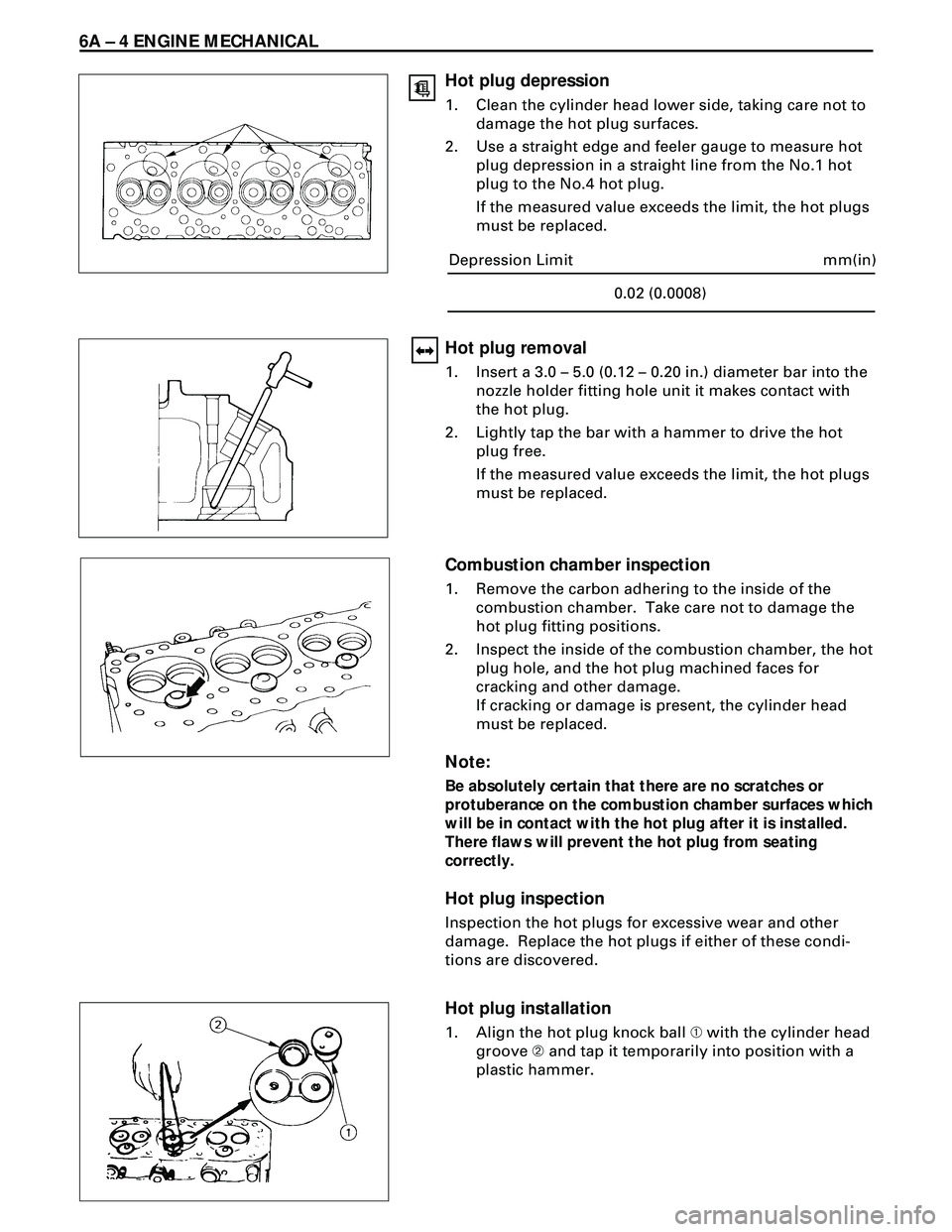
Hot plug depression
1. Clean the cylinder head lower side, taking care not to
damage the hot plug surfaces.
2. Use a straight edge and feeler gauge to measure hot
plug depression in a straight line from the No.1 hot
plug to the No.4 hot plug.
If the measured value exceeds the limit, the hot plugs
must be replaced.
Hot plug removal
1. Insert a 3.0 Ð 5.0 (0.12 Ð 0.20 in.) diameter bar into the
nozzle holder fitting hole unit it makes contact with
the hot plug.
2. Lightly tap the bar with a hammer to drive the hot
plug free.
If the measured value exceeds the limit, the hot plugs
must be replaced.
mm(in)
0.02 (0.0008) Depression Limit
Combustion chamber inspection
1. Remove the carbon adhering to the inside of the
combustion chamber. Take care not to damage the
hot plug fitting positions.
2. Inspect the inside of the combustion chamber, the hot
plug hole, and the hot plug machined faces for
cracking and other damage.
If cracking or damage is present, the cylinder head
must be replaced.
Note:
Be absolutely certain that there are no scratches or
protuberance on the combustion chamber surfaces which
will be in contact with the hot plug after it is installed.
There flaws will prevent the hot plug from seating
correctly.
Hot plug inspection
Inspection the hot plugs for excessive wear and other
damage. Replace the hot plugs if either of these condi-
tions are discovered.
Hot plug installation
1. Align the hot plug knock ball À with the cylinder head
groove Á and tap it temporarily into position with a
plastic hammer.
Page 1555 of 3573
ENGINE MECHANICAL 6A Ð 5
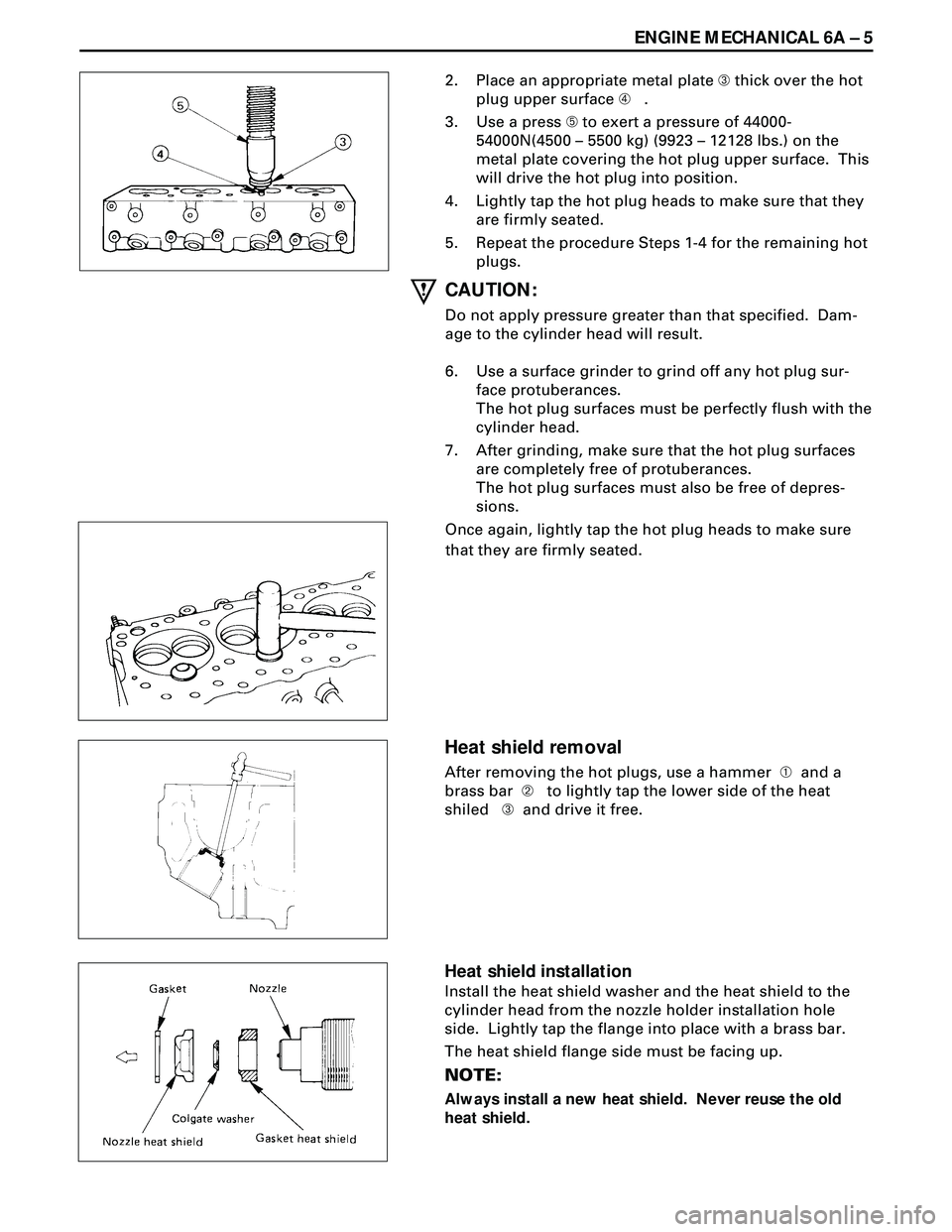
2. Place an appropriate metal plate  thick over the hot
plug upper surface à .
3. Use a press Ä to exert a pressure of 44000-
54000N(4500 Ð 5500 kg) (9923 Ð 12128 lbs.) on the
metal plate covering the hot plug upper surface. This
will drive the hot plug into position.
4. Lightly tap the hot plug heads to make sure that they
are firmly seated.
5. Repeat the procedure Steps 1-4 for the remaining hot
plugs.
CAUTION:
Do not apply pressure greater than that specified. Dam-
age to the cylinder head will result.
6. Use a surface grinder to grind off any hot plug sur-
face protuberances.
The hot plug surfaces must be perfectly flush with the
cylinder head.
7. After grinding, make sure that the hot plug surfaces
are completely free of protuberances.
The hot plug surfaces must also be free of depres-
sions.
Once again, lightly tap the hot plug heads to make sure
that they are firmly seated.
Heat shield removal
After removing the hot plugs, use a hammer À and a
brass bar Á to lightly tap the lower side of the heat
shiled  and drive it free.
Heat shield installation
Install the heat shield washer and the heat shield to the
cylinder head from the nozzle holder installation hole
side. Lightly tap the flange into place with a brass bar.
The heat shield flange side must be facing up.
NOTE:
Always install a new heat shield. Never reuse the old
heat shield.
Page 1563 of 3573
ENGINE MECHANICAL 6A Ð 13
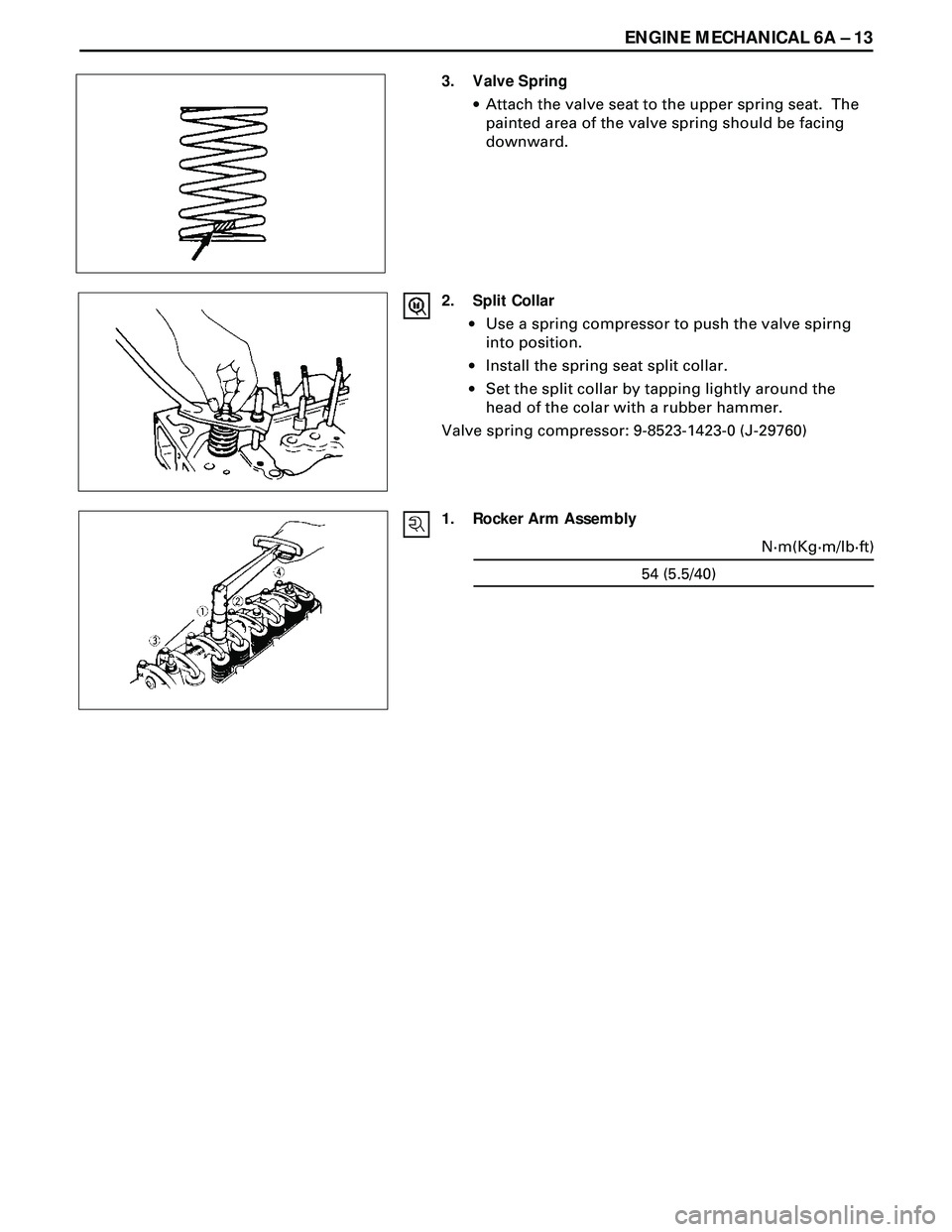
3. Valve Spring
·Attach the valve seat to the upper spring seat. The
painted area of the valve spring should be facing
downward.
2. Split Collar
·Use a spring compressor to push the valve spirng
into position.
·Install the spring seat split collar.
·Set the split collar by tapping lightly around the
head of the colar with a rubber hammer.
Valve spring compressor: 9-8523-1423-0 (J-29760)
1. Rocker Arm Assembly
N·m(Kg·m/lb·ft)
54 (5.5/40)
Page 1570 of 3573
6A Ð 20 ENGINE MECHANICAL
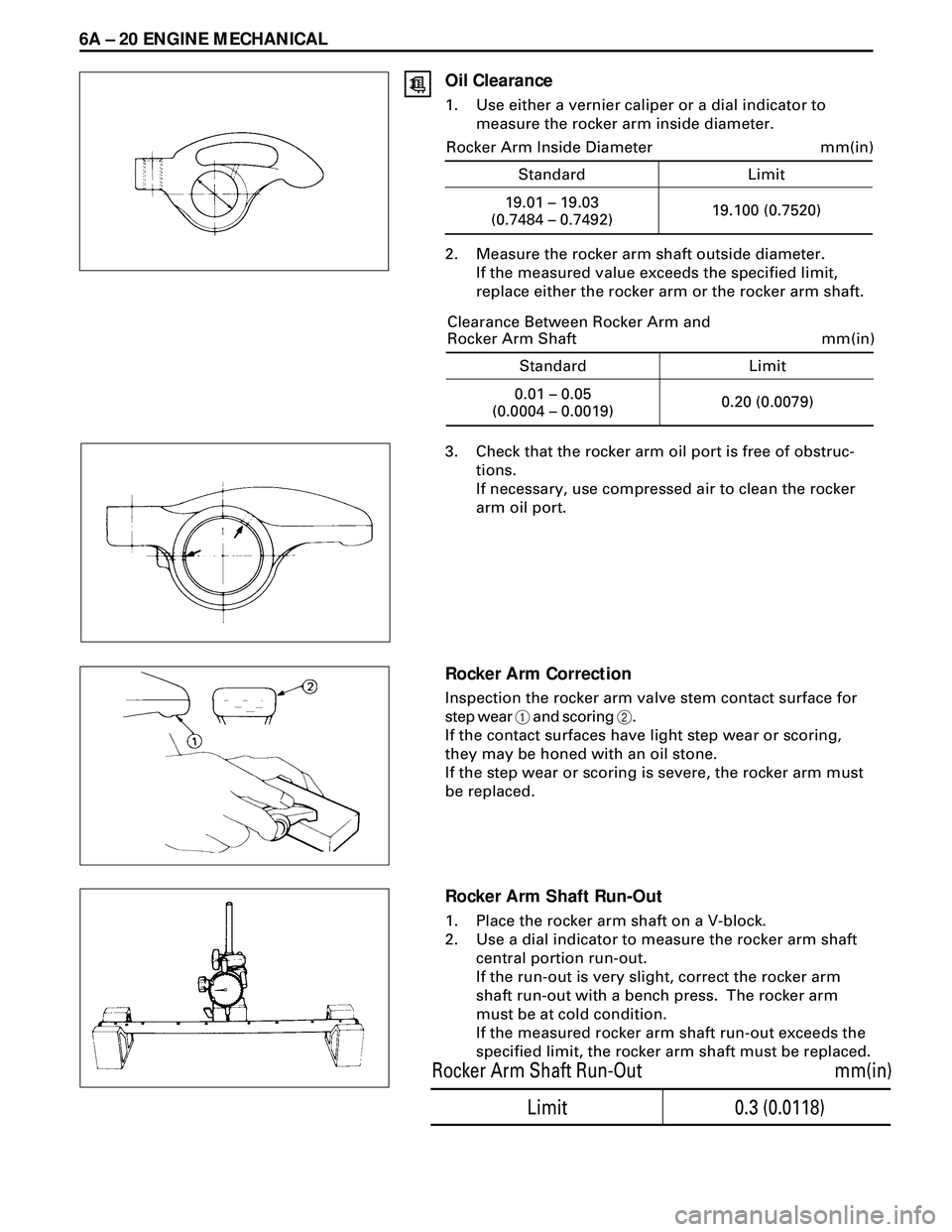
Oil Clearance
1. Use either a vernier caliper or a dial indicator to
measure the rocker arm inside diameter.
2. Measure the rocker arm shaft outside diameter.
If the measured value exceeds the specified limit,
replace either the rocker arm or the rocker arm shaft.
3. Check that the rocker arm oil port is free of obstruc-
tions.
If necessary, use compressed air to clean the rocker
arm oil port.
Rocker Arm Correction
Inspection the rocker arm valve stem contact surface for
step wear 1 and scoring 2.
If the contact surfaces have light step wear or scoring,
they may be honed with an oil stone.
If the step wear or scoring is severe, the rocker arm must
be replaced.
Rocker Arm Shaft Run-Out
1. Place the rocker arm shaft on a V-block.
2. Use a dial indicator to measure the rocker arm shaft
central portion run-out.
If the run-out is very slight, correct the rocker arm
shaft run-out with a bench press. The rocker arm
must be at cold condition.
If the measured rocker arm shaft run-out exceeds the
specified limit, the rocker arm shaft must be replaced.
0.3 (0.0118)
mm(in) Rocker Arm Shaft Run-Out
Limit
Standard Limit
mm(in)
19.01 – 19.03
(0.7484 – 0.7492)19.100 (0.7520) Rocker Arm Inside Diameter
Standard Limit
mm(in)
0.01 – 0.05
(0.0004 – 0.0019)0.20 (0.0079) Clearance Between Rocker Arm and
Rocker Arm Shaft
Page 1571 of 3573
ENGINE MECHANICAL 6A Ð 21
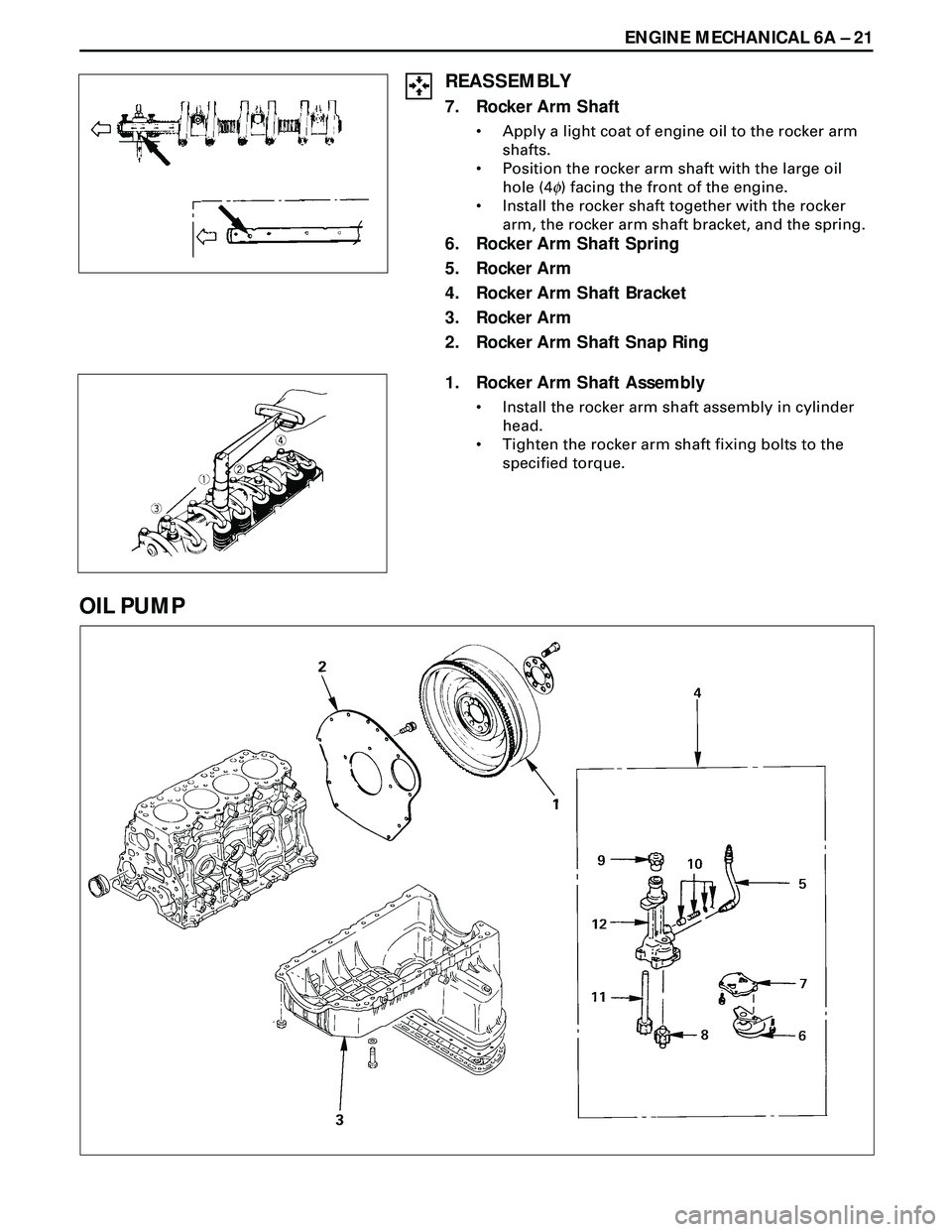
REASSEMBLY
7. Rocker Arm Shaft
¥ Apply a light coat of engine oil to the rocker arm
shafts.
¥ Position the rocker arm shaft with the large oil
hole (4
f) facing the front of the engine.
¥ Install the rocker shaft together with the rocker
arm, the rocker arm shaft bracket, and the spring.
6. Rocker Arm Shaft Spring
5. Rocker Arm
4. Rocker Arm Shaft Bracket
3. Rocker Arm
2. Rocker Arm Shaft Snap Ring
1. Rocker Arm Shaft Assembly
¥ Install the rocker arm shaft assembly in cylinder
head.
¥ Tighten the rocker arm shaft fixing bolts to the
specified torque.
OIL PUMP
Page 1635 of 3573
4JG2-NA/4JG2-TURBO ENGINE 6A2 Ð 33
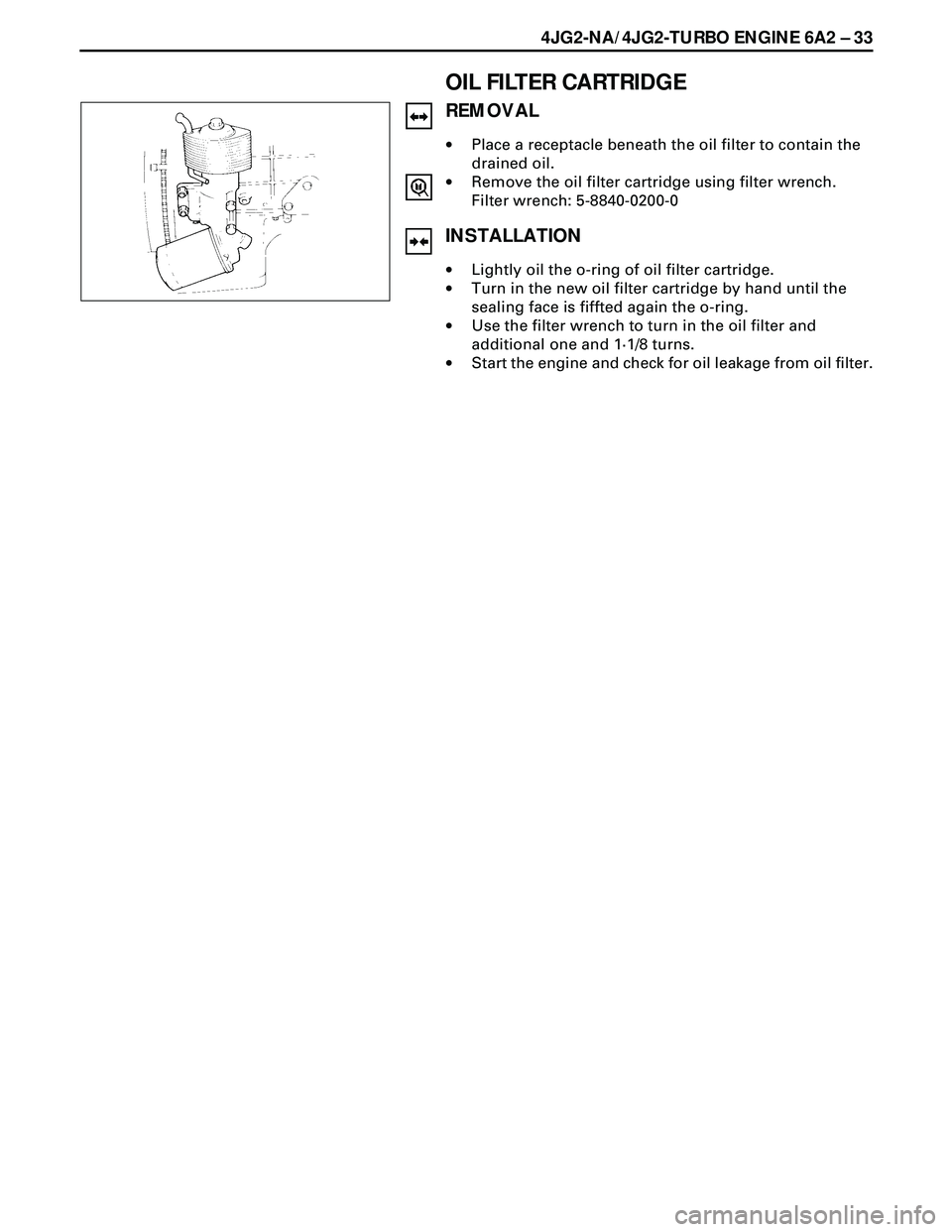
OIL FILTER CARTRIDGE
REMOVAL
·Place a receptacle beneath the oil filter to contain the
drained oil.
·Remove the oil filter cartridge using filter wrench.
Filter wrench: 5-8840-0200-0
INSTALLATION
·Lightly oil the o-ring of oil filter cartridge.
·Turn in the new oil filter cartridge by hand until the
sealing face is fiffted again the o-ring.
·Use the filter wrench to turn in the oil filter and
additional one and 1á1/8 turns.
·Start the engine and check for oil leakage from oil filter.
Page 1670 of 3573
6C Ð 4 FUEL SYSTEM
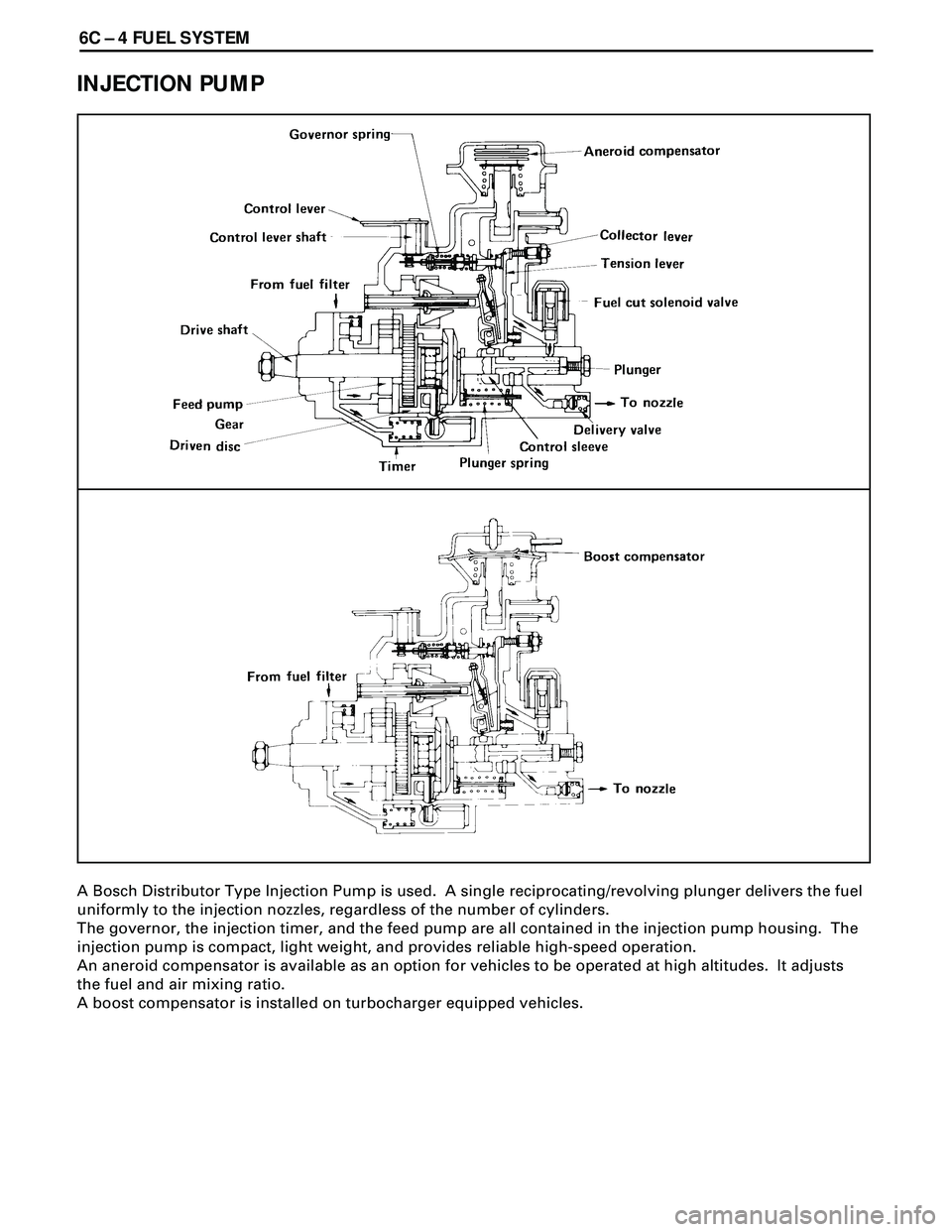
INJECTION PUMP
A Bosch Distributor Type Injection Pump is used. A single reciprocating/revolving plunger delivers the fuel
uniformly to the injection nozzles, regardless of the number of cylinders.
The governor, the injection timer, and the feed pump are all contained in the injection pump housing. The
injection pump is compact, light weight, and provides reliable high-speed operation.
An aneroid compensator is available as an option for vehicles to be operated at high altitudes. It adjusts
the fuel and air mixing ratio.
A boost compensator is installed on turbocharger equipped vehicles.