Pin ISUZU TROOPER 1998 Service Manual Online
[x] Cancel search | Manufacturer: ISUZU, Model Year: 1998, Model line: TROOPER, Model: ISUZU TROOPER 1998Pages: 3573, PDF Size: 60.36 MB
Page 468 of 3573
DIFFERENTIAL (REAR 220mm)
4A2A±1
DRIVELINE/AXLE
DIFFERENTIAL (Rear 220mm)
CONTENTS
Service Precaution 4A2A±1. . . . . . . . . . . . . . . . . . . . . .
General Description 4A2A±2. . . . . . . . . . . . . . . . . . . . .
Diagnosis 4A2A±3. . . . . . . . . . . . . . . . . . . . . . . . . . . . . .
Axle Housing 4A2A±4. . . . . . . . . . . . . . . . . . . . . . . . . . .
Axle Housing and Associated Parts 4A2A±4. . . . . .
Removal 4A2A±4. . . . . . . . . . . . . . . . . . . . . . . . . . . . .
Oil Seal Replacement 4A2A±5. . . . . . . . . . . . . . . . . .
Installation 4A2A±5. . . . . . . . . . . . . . . . . . . . . . . . . . . .
Pinion Oil Seal 4A2A±6. . . . . . . . . . . . . . . . . . . . . . . . . .
Pinion Oil Seal and Associated Parts 4A2A±6. . . . .
Removal 4A2A±6. . . . . . . . . . . . . . . . . . . . . . . . . . . . .
Inspection and Repair 4A2A±7. . . . . . . . . . . . . . . . . .
Installation 4A2A±7. . . . . . . . . . . . . . . . . . . . . . . . . . . .
Differential Assembly 4A2A±8. . . . . . . . . . . . . . . . . . . .
Differential Assembly and Associated Parts 4A2A±8
Removal 4A2A±8. . . . . . . . . . . . . . . . . . . . . . . . . . . . . Installation 4A2A±9. . . . . . . . . . . . . . . . . . . . . . . . . . . .
Disassembled View 4A2A±10. . . . . . . . . . . . . . . . . . . .
Disassembly 4A2A±11. . . . . . . . . . . . . . . . . . . . . . . . . .
Reassembly 4A2A±13. . . . . . . . . . . . . . . . . . . . . . . . . .
Differential Cage Assembly 4A2A±21. . . . . . . . . . . . . . .
Disassembled View 4A2A±21. . . . . . . . . . . . . . . . . . . .
Disassembly 4A2A±21. . . . . . . . . . . . . . . . . . . . . . . . . .
Inspection and Repair 4A2A±22. . . . . . . . . . . . . . . . . .
Reassembly 4A2A±23. . . . . . . . . . . . . . . . . . . . . . . . . .
Limited Slip Differential 4A2A±25. . . . . . . . . . . . . . . . . . .
Disassembled View 4A2A±25. . . . . . . . . . . . . . . . . . . .
Disassembly 4A2A±26. . . . . . . . . . . . . . . . . . . . . . . . . .
Inspection and Repair 4A2A±26. . . . . . . . . . . . . . . . . .
Reassembly 4A2A±28. . . . . . . . . . . . . . . . . . . . . . . . . .
Main Data and Specifications 4A2A±32. . . . . . . . . . .
Special Tools 4A2A±34. . . . . . . . . . . . . . . . . . . . . . . . . .
Service Precaution
WARNING: I F S O E Q U IPPED WITH A
SUPPLEMENTAL RESTRAINT SYSTEM (SRS),
REFER TO THE SRS COMPONENT AND WIRING
LOCATION VIEW IN ORDER TO DETERMINE
WHETHER YOU ARE PERFORMING SERVICE ON OR
NEAR THE SRS COMPONENTS OR THE SRS
WIRING. WHEN YOU ARE REFORMING SERVICE ON
OR NEAR THE SRS COMPONENTS OR THE SRS
WIRING, REFER TO THE SRS SERVICE
INFORMATION. FAILURE TO FOLLOW WARNINGS
COULD RESULT IN POSSIBLE AIR BAG
DEPLOYMENT, PERSONAL INJURY, OR
OTHERWISE UNNEEDED SRS SYSTEM REPAIRS.
CAUTION: Always use the correct fastener in the
proper location. When you replace a fastener, use
ONLY the exact part number for that application.
ISUZU will call out those fasteners that require a
replacement after removal. ISUZU will also call out
the fasteners that require thread lockers or thread
sealant. UNLESS OTHERWISE SPECIFIED , do not
use supplemental coatings (Paints, greases, or other
corrosion inhibitors) on threaded fasteners or
fastener joint interfaces. Generally,such coatings
adversely affect the fastener torque and the joint
clamping force, and may damage the fastener. When
you install fasteners, use the correct tightening
sequence and specification. Following these
instructions can help you avoid damage to parts and
systems.
Page 469 of 3573
4A2A±2
DIFFERENTIAL (REAR 220mm)
General Description
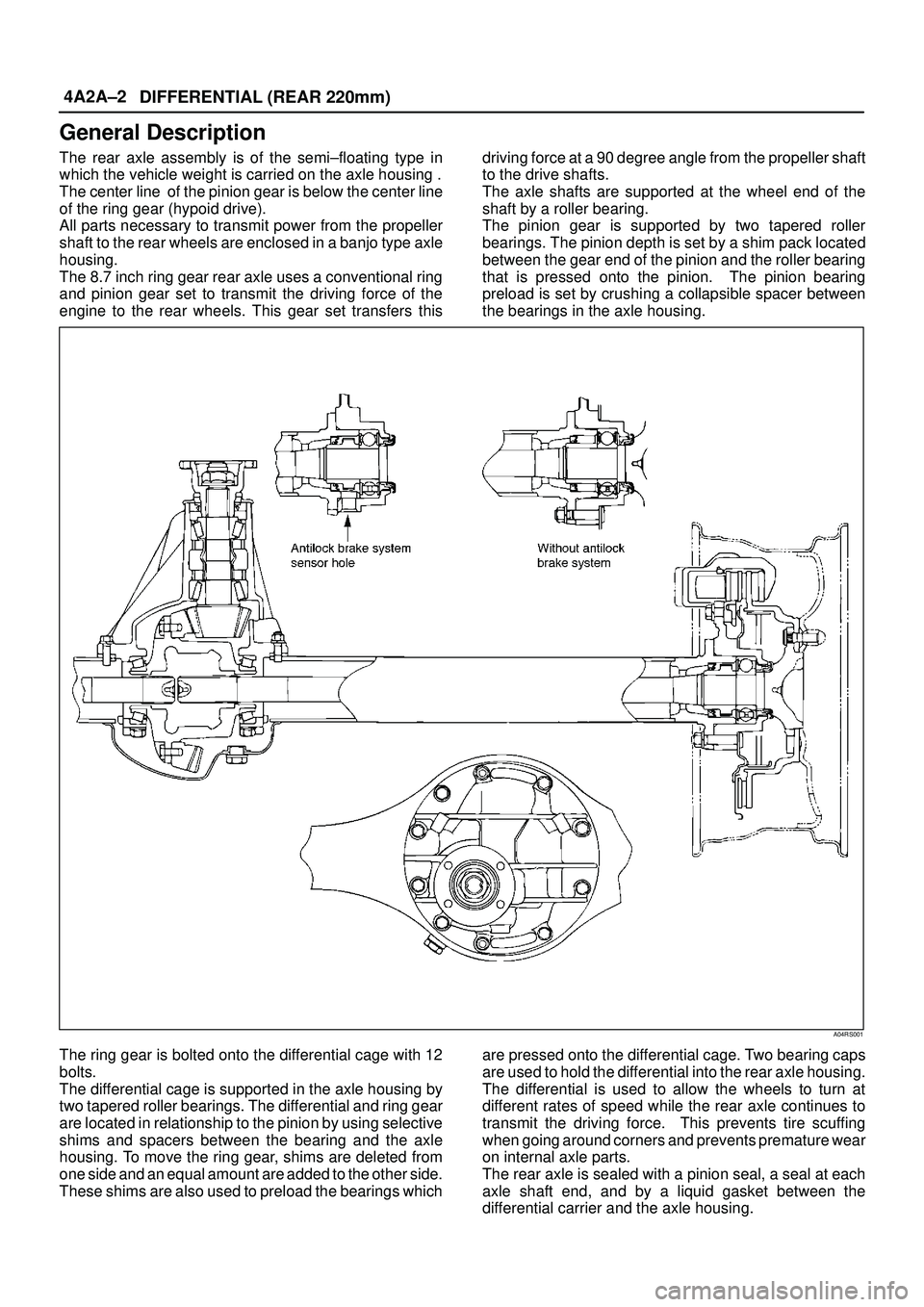
The rear axle assembly is of the semi±floating type in
which the vehicle weight is carried on the axle housing .
The center line of the pinion gear is below the center line
of the ring gear (hypoid drive).
All parts necessary to transmit power from the propeller
shaft to the rear wheels are enclosed in a banjo type axle
housing.
The 8.7 inch ring gear rear axle uses a conventional ring
and pinion gear set to transmit the driving force of the
engine to the rear wheels. This gear set transfers thisdriving force at a 90 degree angle from the propeller shaft
to the drive shafts.
The axle shafts are supported at the wheel end of the
shaft by a roller bearing.
The pinion gear is supported by two tapered roller
bearings. The pinion depth is set by a shim pack located
between the gear end of the pinion and the roller bearing
that is pressed onto the pinion. The pinion bearing
preload is set by crushing a collapsible spacer between
the bearings in the axle housing.
A04RS001
The ring gear is bolted onto the differential cage with 12
bolts.
The differential cage is supported in the axle housing by
two tapered roller bearings. The differential and ring gear
are located in relationship to the pinion by using selective
shims and spacers between the bearing and the axle
housing. To move the ring gear, shims are deleted from
one side and an equal amount are added to the other side.
These shims are also used to preload the bearings whichare pressed onto the differential cage. Two bearing caps
are used to hold the differential into the rear axle housing.
The differential is used to allow the wheels to turn at
different rates of speed while the rear axle continues to
transmit the driving force. This prevents tire scuffing
when going around corners and prevents premature wear
on internal axle parts.
The rear axle is sealed with a pinion seal, a seal at each
axle shaft end, and by a liquid gasket between the
differential carrier and the axle housing.
Page 470 of 3573
DIFFERENTIAL (REAR 220mm)
4A2A±3
Diagnosis
Many noises that seem to come from the rear axle
actually originate from other sources such as tires, road
surface, wheel bearings, engine, transmission, muffler, or
body drumming. Investigate to find the source of the
noise before disassembling the rear axle. Rear axles, like
any other mechanical device, are not absolutely quiet but
should be considered quiet unless some abnormal noise
is present.
To make a systematic check for axle noise, observe the
following:
1. Select a level asphalt road to reduce tire noise and
body drumming.
2. Check rear axle lubricant level to assure correct level,
and then drive the vehicle far enough to thoroughly
warm up the rear axle lubricant.
3. Note the speed at which noise occurs. Stop the
vehicle and put the transmission in neutral. Run the
engine speed slowly up and down to determine if the
noise is caused by exhaust, muffler noise, or other
engine conditions.
4. Tire noise changes with different road surfaces; axle
noises do not. Temporarily inflate all tires to 344 kPa
(3.5kg/cm
2, 50 psi) (for test purposes only). This will
change noise caused by tires but will not affect noise
caused by the rear axle.
Rear axle noise usually stops when coasting at
speeds under 48 km/h (30 mph); however, tire noise
continues with a lower tone. Rear axle noise usually
changes when comparing pull and coast, but tire
noise stays about the same.
Distinguish between tire noise and rear axle noise by
noting if the noise changes with various speeds or
sudden acceleration and deceleration. Exhaust and
axle noise vary under these conditions, while tire
noise remains constant and is more pronounced at
speeds of 32 to 48 km/h (20 to 30 mph). Further check
for tire noise by driving the vehicle over smooth
pavements or dirt roads (not gravel) with the tires at
normal pressure. If the noise is caused by tires, it will
change noticeably with changes in road surface.
5. Loose or rough front wheel bearings will cause noise
which may be confused with rear axle noise; however,
front wheel bearing noise does not change when
comparing drive and coast. Light application of the
brake while holding vehicle speed steady will often
cause wheel bearing noise to diminish. Front wheel
bearings may be checked for noise by jacking up the
wheels and spinning them or by shaking the wheels to
determine if bearings are loose.
6. Rear suspension rubber bushings and spring
insulators dampen out rear axle noise when correctly
installed. Check to see that there is no link or rod
loosened or metal±to±metal contact.
7. Make sure that there is no metal±to±metal contact
between the floor and the frame.
After the noise has been determined to be in the axle, the
type of axle noise should be determined, in order to make
any necessary repairs.
Gear Noise
Gear noise (whine) is audible from 32 to 89 km/h (20 to 55
mph) under four driving conditions.
1. Driving under acceleration or heavy pull.
2. Driving under load or under constant speed.
3. When using enough throttle to keep the vehicle from
driving the engine while the vehicle slows down
gradually (engine still pulls slightly).
4. When coasting with the vehicle in gear and the throttle
closed. The gear noise is usually more noticeable
between 48 and 64 km/h (30 and 40 mph) and 80 and
89 km/h (50 and 55 mph).
Bearing Noise
Bad bearings generally produce a rough growl or grating
sound, rather than the whine typical of gear noise.
Bearing noise frequently ªwow±wowsº at bearing rpm,
indicating a bad pinion or rear axle side bearing. This
noise can be confused with rear wheel bearing noise.
Rear Wheel Bearing Noise
Rear wheel bearing noise continues to be heard while
coasting at low speed with transmission in neutral. Noise
may diminish by gentle braking. Jack up the rear wheels,
spin them by hand and listen for noise at the hubs.
Replace any faulty wheel bearings.
Knock At Low Speeds
Low speed knock can be caused by worn universal joints
or a side gear hub counter bore in the cage that is worn
oversize. Inspect and replace universal joints or cage and
side gears as required.
Backlash Clunk
Excessive clunk on acceleration and deceleration can be
caused by a worn rear axle pinion shaft, a worn cage,
excessive clearance between the axle and the side gear
splines, excessive clearance between the side gear hub
and the counterbore in the cage, worn pinion and side
gear teeth, worn thrust washers, or excessive drive pinion
and ring gear backlash. Remove worn parts and replace
as required. Select close±fitting parts when possible.
Adjust pinion and ring gear backlash.
Page 473 of 3573
4A2A±6
DIFFERENTIAL (REAR 220mm)
11. Install the lateral rod fixing nut to the axle housing.
12. Install the stabilizer linkage mounting nut to the axle
housing.
13. Install the shock absorber fixing nut to the axle
housing.
14. Install brake tube flare nut, Refer to Disk Brakes in
Brake section.15. Install ABS connector and bracket (ABS model only).
16. Connect breather hose.
17. Install parking brake cable, Refer to Parking Brakes in
Brake section.
18. Bleed brakes. Refer to Hydraulic Brakes in Brake
section.
Pinion Oil Seal
Pinion Oil Seal and Associated Parts
425RW054
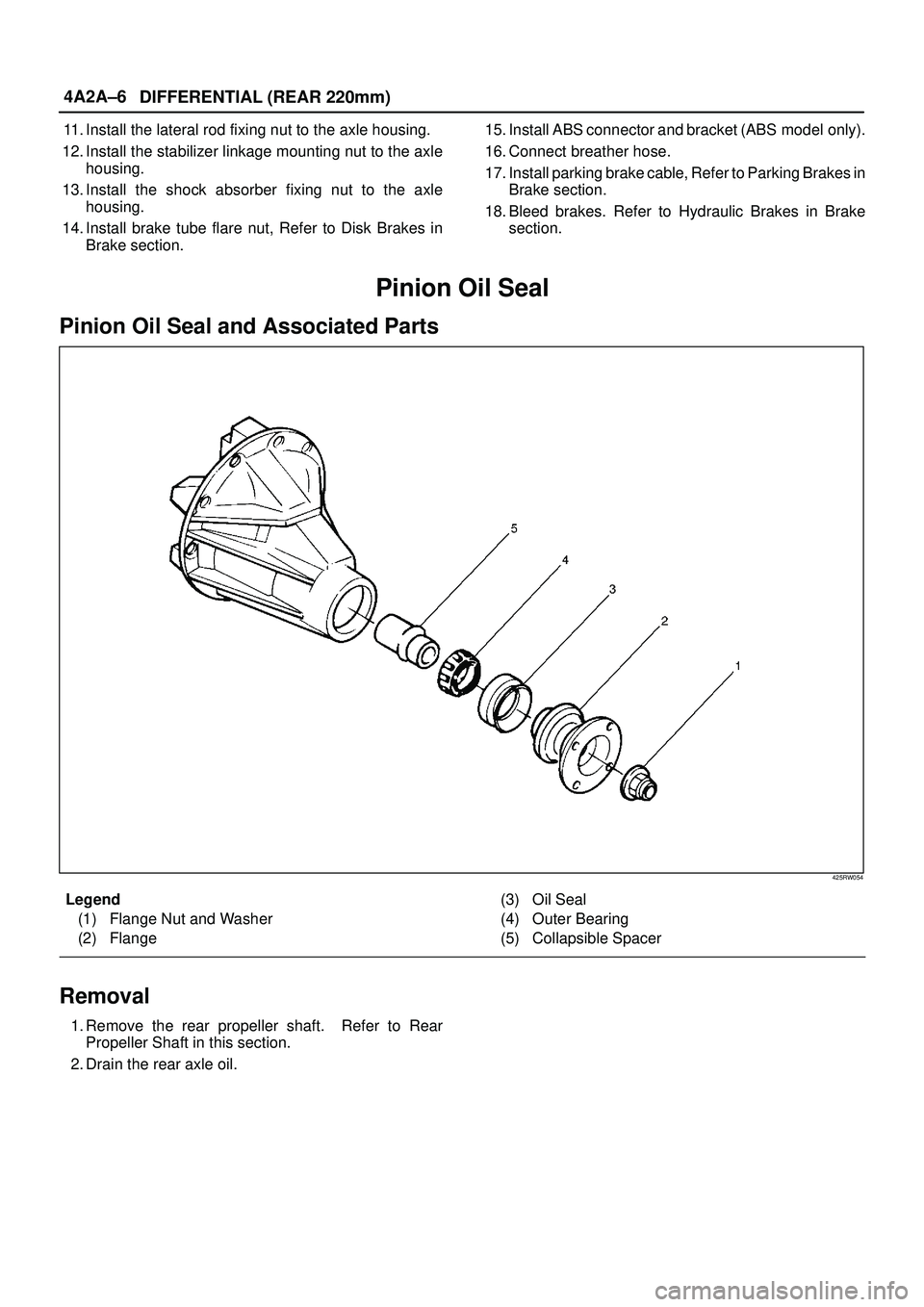
Legend
(1) Flange Nut and Washer
(2) Flange(3) Oil Seal
(4) Outer Bearing
(5) Collapsible Spacer
Removal
1. Remove the rear propeller shaft. Refer to Rear
Propeller Shaft in this section.
2. Drain the rear axle oil.
Page 474 of 3573
DIFFERENTIAL (REAR 220mm)
4A2A±7
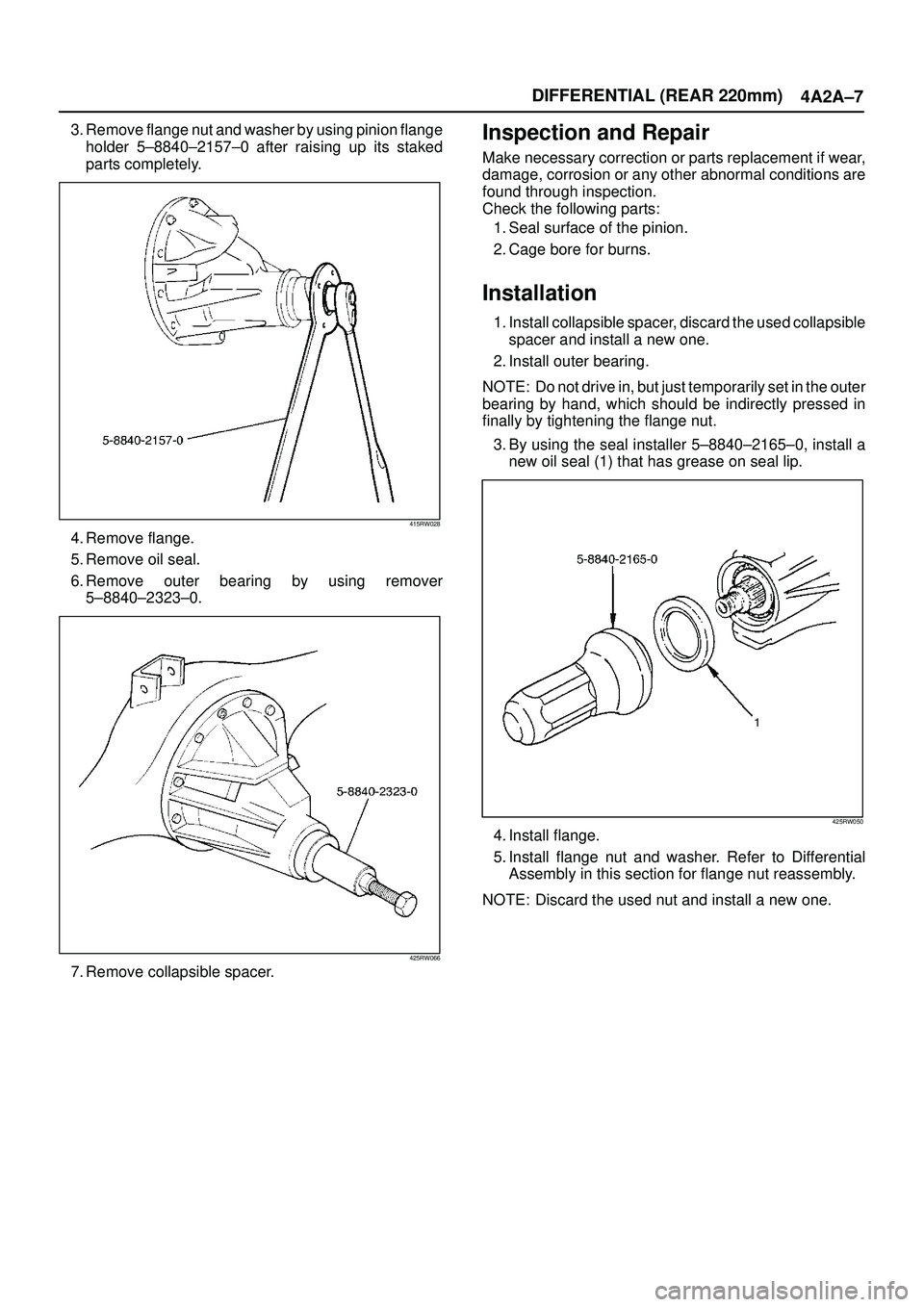
3. Remove flange nut and washer by using pinion flange
holder 5±8840±2157±0 after raising up its staked
parts completely.
415RW028
4. Remove flange.
5. Remove oil seal.
6. Remove outer bearing by using remover
5±8840±2323±0.
425RW066
7. Remove collapsible spacer.
Inspection and Repair
Make necessary correction or parts replacement if wear,
damage, corrosion or any other abnormal conditions are
found through inspection.
Check the following parts:
1. Seal surface of the pinion.
2. Cage bore for burns.
Installation
1. Install collapsible spacer, discard the used collapsible
spacer and install a new one.
2. Install outer bearing.
NOTE: Do not drive in, but just temporarily set in the outer
bearing by hand, which should be indirectly pressed in
finally by tightening the flange nut.
3. By using the seal installer 5±8840±2165±0, install a
new oil seal (1) that has grease on seal lip.
425RW050
4. Install flange.
5. Install flange nut and washer. Refer to Differential
Assembly in this section for flange nut reassembly.
NOTE: Discard the used nut and install a new one.
Page 477 of 3573
4A2A±10
DIFFERENTIAL (REAR 220mm)
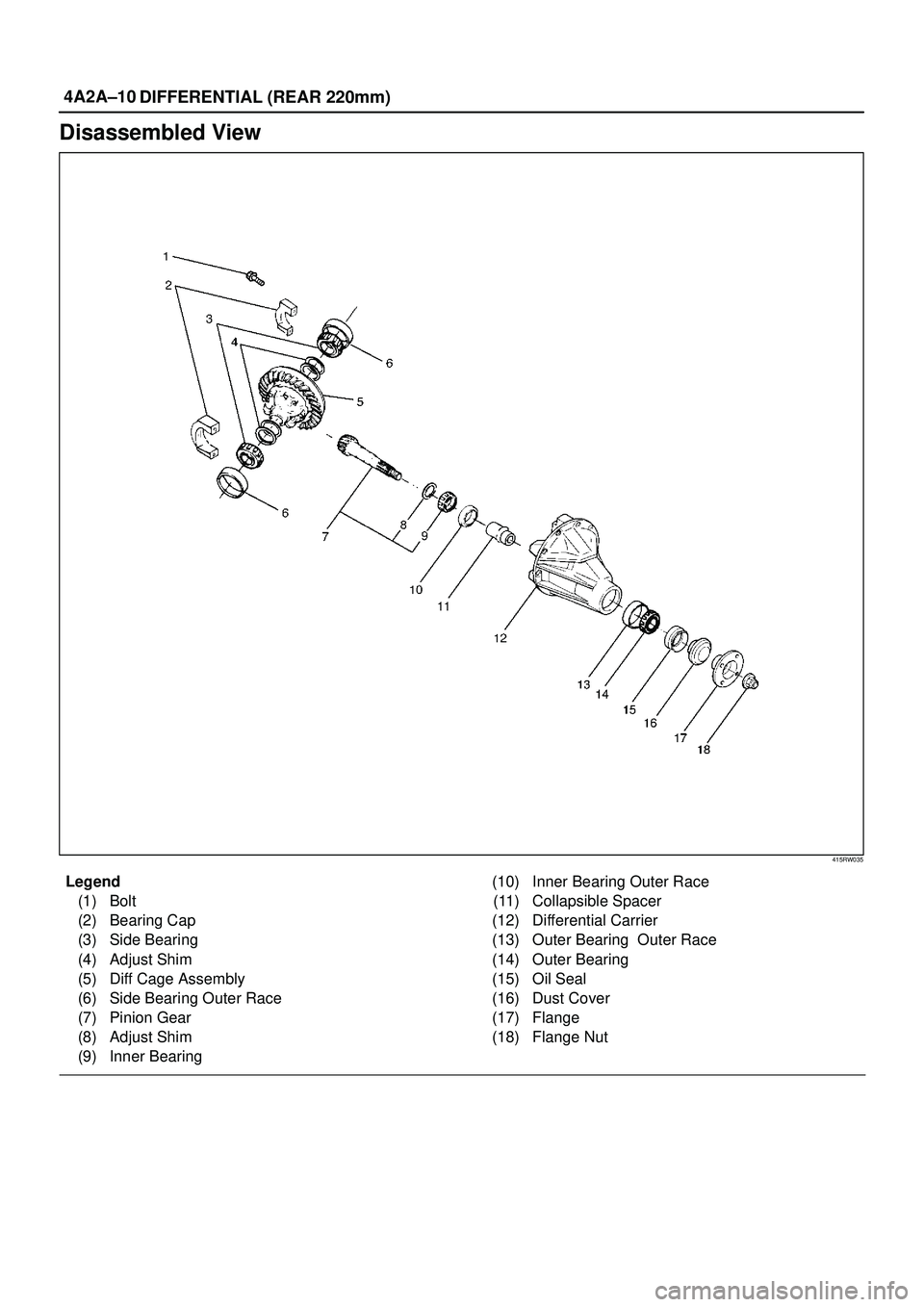
Disassembled View
415RW035
Legend
(1) Bolt
(2) Bearing Cap
(3) Side Bearing
(4) Adjust Shim
(5) Diff Cage Assembly
(6) Side Bearing Outer Race
(7) Pinion Gear
(8) Adjust Shim
(9) Inner Bearing (10) Inner Bearing Outer Race
(11) Collapsible Spacer
(12) Differential Carrier
(13) Outer Bearing Outer Race
(14) Outer Bearing
(15) Oil Seal
(16) Dust Cover
(17) Flange
(18) Flange Nut
Page 479 of 3573
4A2A±12
DIFFERENTIAL (REAR 220mm)
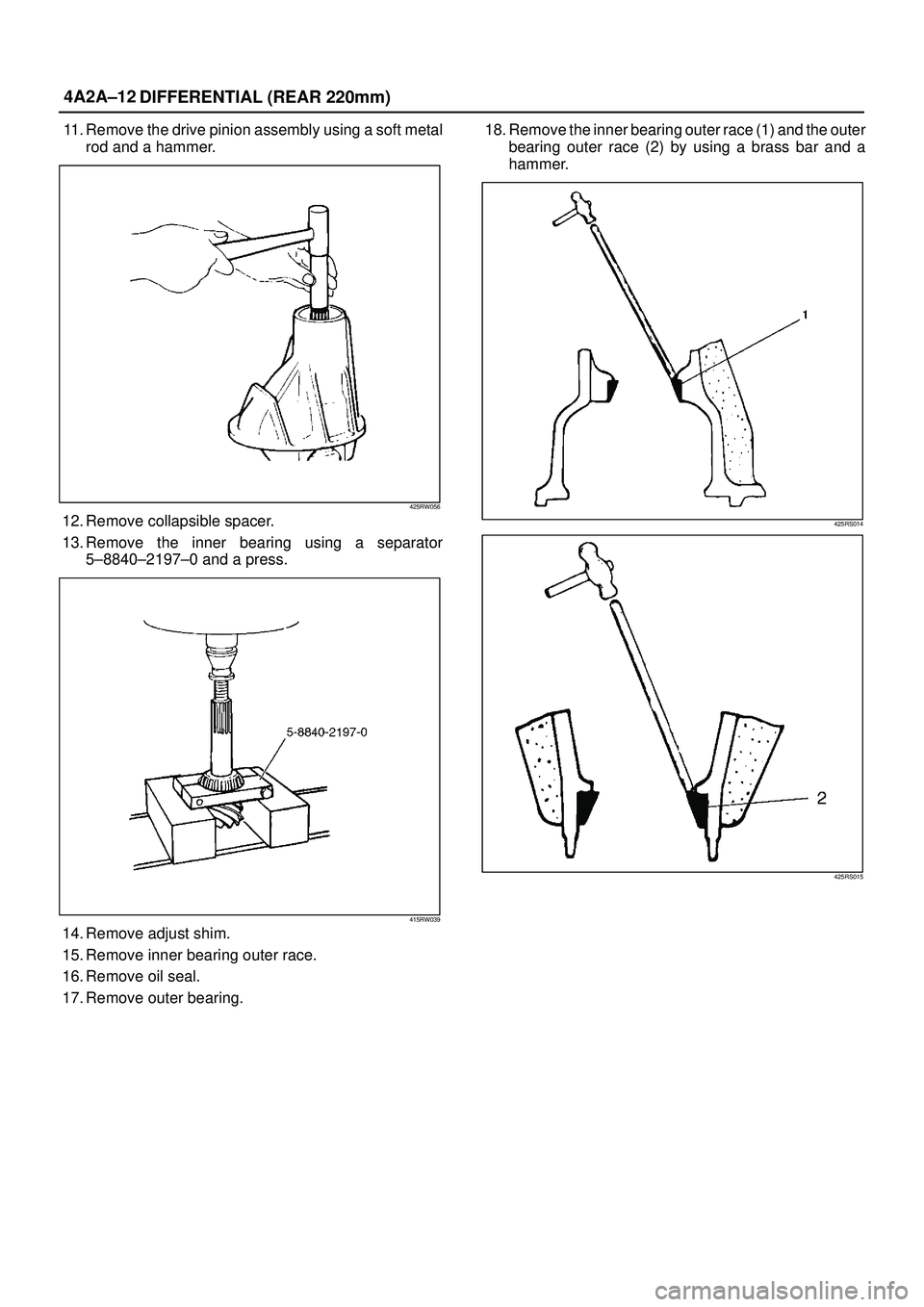
11. Remove the drive pinion assembly using a soft metal
rod and a hammer.
425RW056
12. Remove collapsible spacer.
13. Remove the inner bearing using a separator
5±8840±2197±0 and a press.
415RW039
14. Remove adjust shim.
15. Remove inner bearing outer race.
16. Remove oil seal.
17. Remove outer bearing.18. Remove the inner bearing outer race (1) and the outer
bearing outer race (2) by using a brass bar and a
hammer.
425RS014
425RS015
Page 480 of 3573
DIFFERENTIAL (REAR 220mm)
4A2A±13
Reassembly
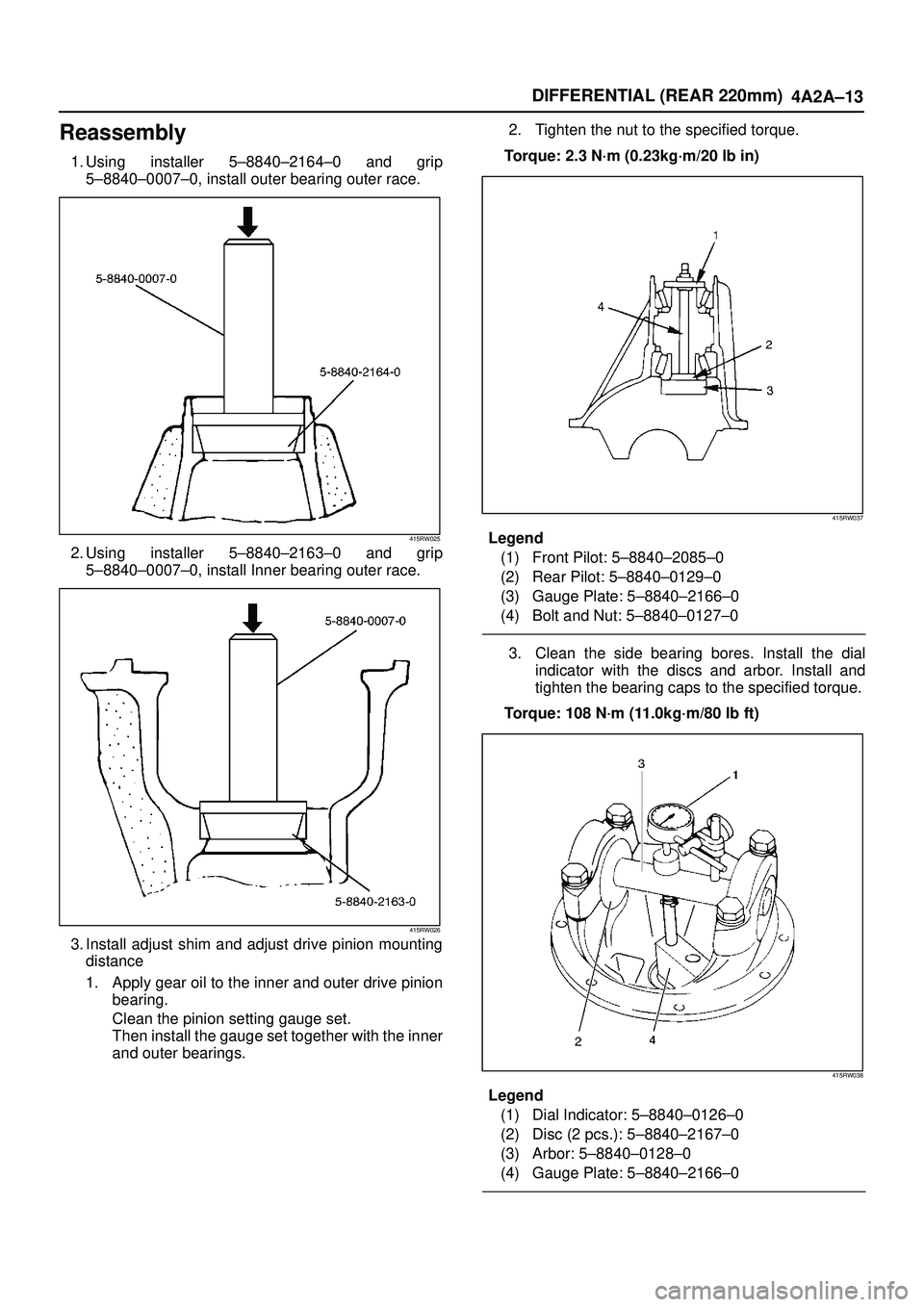
1. Using installer 5±8840±2164±0 and grip
5±8840±0007±0, install outer bearing outer race.
415RW025
2. Using installer 5±8840±2163±0 and grip
5±8840±0007±0, install Inner bearing outer race.
415RW026
3. Install adjust shim and adjust drive pinion mounting
distance
1. Apply gear oil to the inner and outer drive pinion
bearing.
Clean the pinion setting gauge set.
Then install the gauge set together with the inner
and outer bearings.2. Tighten the nut to the specified torque.
Torque: 2.3 N´m (0.23kg´m/20 lb in)
415RW037
Legend
(1) Front Pilot: 5±8840±2085±0
(2) Rear Pilot: 5±8840±0129±0
(3) Gauge Plate: 5±8840±2166±0
(4) Bolt and Nut: 5±8840±0127±0
3. Clean the side bearing bores. Install the dial
indicator with the discs and arbor. Install and
tighten the bearing caps to the specified torque.
Torque: 108 N´m (11.0kg´m/80 lb ft)
415RW038
Legend
(1) Dial Indicator: 5±8840±0126±0
(2) Disc (2 pcs.): 5±8840±2167±0
(3) Arbor: 5±8840±0128±0
(4) Gauge Plate: 5±8840±2166±0
Page 481 of 3573
4A2A±14
DIFFERENTIAL (REAR 220mm)
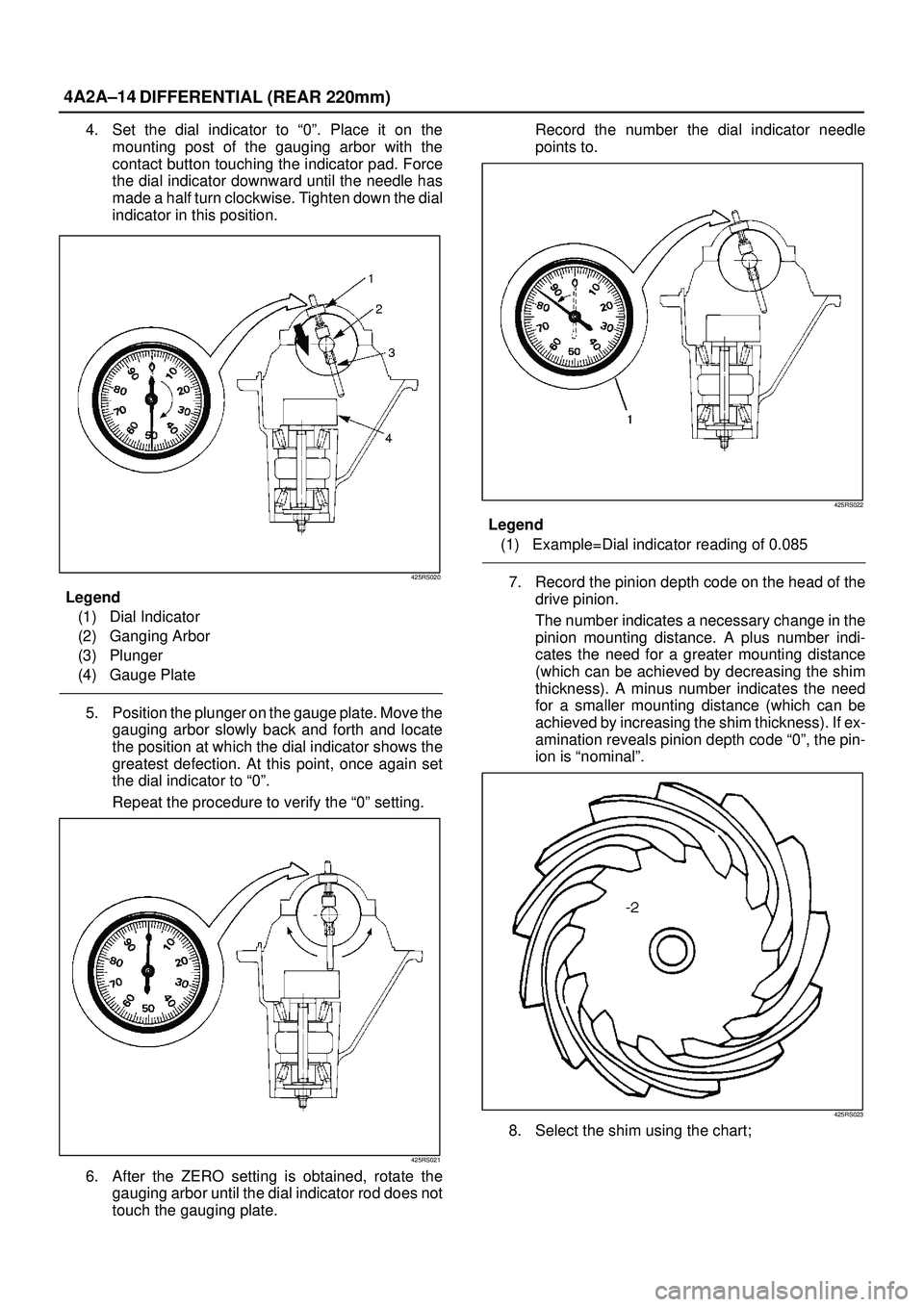
4. Set the dial indicator to ª0º. Place it on the
mounting post of the gauging arbor with the
contact button touching the indicator pad. Force
the dial indicator downward until the needle has
made a half turn clockwise. Tighten down the dial
indicator in this position.
425RS020
Legend
(1) Dial Indicator
(2) Ganging Arbor
(3) Plunger
(4) Gauge Plate
5. Position the plunger on the gauge plate. Move the
gauging arbor slowly back and forth and locate
the position at which the dial indicator shows the
greatest defection. At this point, once again set
the dial indicator to ª0º.
Repeat the procedure to verify the ª0º setting.
425RS021
6. After the ZERO setting is obtained, rotate the
gauging arbor until the dial indicator rod does not
touch the gauging plate.Record the number the dial indicator needle
points to.
425RS022
Legend
(1) Example=Dial indicator reading of 0.085
7. Record the pinion depth code on the head of the
drive pinion.
The number indicates a necessary change in the
pinion mounting distance. A plus number indi-
cates the need for a greater mounting distance
(which can be achieved by decreasing the shim
thickness). A minus number indicates the need
for a smaller mounting distance (which can be
achieved by increasing the shim thickness). If ex-
amination reveals pinion depth code ª0º, the pin-
ion is ªnominalº.
425RS023
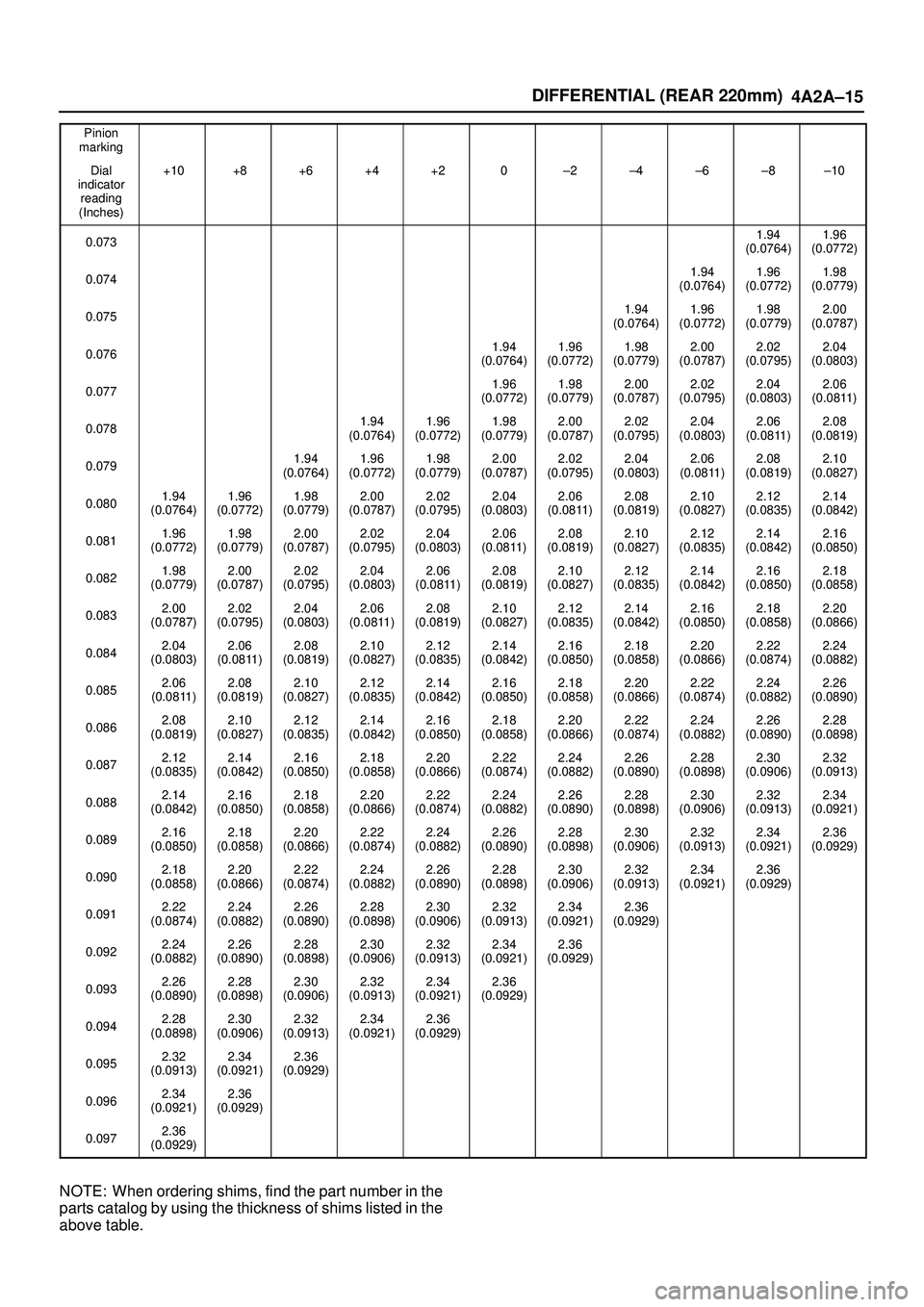
8. Select the shim using the chart;
Page 482 of 3573
DIFFERENTIAL (REAR 220mm)
4A2A±15
Pinion
marking
Dial
indicator
reading
(Inches)+10+8+6+4+20±2±4±6±8±10
0.0731.94
(0.0764)1.96
(0.0772)
0.0741.94
(0.0764)1.96
(0.0772)1.98
(0.0779)
0.0751.94
(0.0764)1.96
(0.0772)1.98
(0.0779)2.00
(0.0787)
0.0761.94
(0.0764)1.96
(0.0772)1.98
(0.0779)2.00
(0.0787)2.02
(0.0795)2.04
(0.0803)
0.0771.96
(0.0772)1.98
(0.0779)2.00
(0.0787)2.02
(0.0795)2.04
(0.0803)2.06
(0.0811)
0.0781.94
(0.0764)1.96
(0.0772)1.98
(0.0779)2.00
(0.0787)2.02
(0.0795)2.04
(0.0803)2.06
(0.0811)2.08
(0.0819)
0.0791.94
(0.0764)1.96
(0.0772)1.98
(0.0779)2.00
(0.0787)2.02
(0.0795)2.04
(0.0803)2.06
(0.0811)2.08
(0.0819)2.10
(0.0827)
0.0801.94
(0.0764)1.96
(0.0772)1.98
(0.0779)2.00
(0.0787)2.02
(0.0795)2.04
(0.0803)2.06
(0.0811)2.08
(0.0819)2.10
(0.0827)2.12
(0.0835)2.14
(0.0842)
0.0811.96
(0.0772)1.98
(0.0779)2.00
(0.0787)2.02
(0.0795)2.04
(0.0803)2.06
(0.0811)2.08
(0.0819)2.10
(0.0827)2.12
(0.0835)2.14
(0.0842)2.16
(0.0850)
0.0821.98
(0.0779)2.00
(0.0787)2.02
(0.0795)2.04
(0.0803)2.06
(0.0811)2.08
(0.0819)2.10
(0.0827)2.12
(0.0835)2.14
(0.0842)2.16
(0.0850)2.18
(0.0858)
0.0832.00
(0.0787)2.02
(0.0795)2.04
(0.0803)2.06
(0.0811)2.08
(0.0819)2.10
(0.0827)2.12
(0.0835)2.14
(0.0842)2.16
(0.0850)2.18
(0.0858)2.20
(0.0866)
0.0842.04
(0.0803)2.06
(0.0811)2.08
(0.0819)2.10
(0.0827)2.12
(0.0835)2.14
(0.0842)2.16
(0.0850)2.18
(0.0858)2.20
(0.0866)2.22
(0.0874)2.24
(0.0882)
0.0852.06
(0.0811)2.08
(0.0819)2.10
(0.0827)2.12
(0.0835)2.14
(0.0842)2.16
(0.0850)2.18
(0.0858)2.20
(0.0866)2.22
(0.0874)2.24
(0.0882)2.26
(0.0890)
0.0862.08
(0.0819)2.10
(0.0827)2.12
(0.0835)2.14
(0.0842)2.16
(0.0850)2.18
(0.0858)2.20
(0.0866)2.22
(0.0874)2.24
(0.0882)2.26
(0.0890)2.28
(0.0898)
0.0872.12
(0.0835)2.14
(0.0842)2.16
(0.0850)2.18
(0.0858)2.20
(0.0866)2.22
(0.0874)2.24
(0.0882)2.26
(0.0890)2.28
(0.0898)2.30
(0.0906)2.32
(0.0913)
0.0882.14
(0.0842)2.16
(0.0850)2.18
(0.0858)2.20
(0.0866)2.22
(0.0874)2.24
(0.0882)2.26
(0.0890)2.28
(0.0898)2.30
(0.0906)2.32
(0.0913)2.34
(0.0921)
0.0892.16
(0.0850)2.18
(0.0858)2.20
(0.0866)2.22
(0.0874)2.24
(0.0882)2.26
(0.0890)2.28
(0.0898)2.30
(0.0906)2.32
(0.0913)2.34
(0.0921)2.36
(0.0929)
0.0902.18
(0.0858)2.20
(0.0866)2.22
(0.0874)2.24
(0.0882)2.26
(0.0890)2.28
(0.0898)2.30
(0.0906)2.32
(0.0913)2.34
(0.0921)2.36
(0.0929)
0.0912.22
(0.0874)2.24
(0.0882)2.26
(0.0890)2.28
(0.0898)2.30
(0.0906)2.32
(0.0913)2.34
(0.0921)2.36
(0.0929)
0.0922.24
(0.0882)2.26
(0.0890)2.28
(0.0898)2.30
(0.0906)2.32
(0.0913)2.34
(0.0921)2.36
(0.0929)
0.0932.26
(0.0890)2.28
(0.0898)2.30
(0.0906)2.32
(0.0913)2.34
(0.0921)2.36
(0.0929)
0.0942.28
(0.0898)2.30
(0.0906)2.32
(0.0913)2.34
(0.0921)2.36
(0.0929)
0.0952.32
(0.0913)2.34
(0.0921)2.36
(0.0929)
0.0962.34
(0.0921)2.36
(0.0929)
0.0972.36
(0.0929)
NOTE: When ordering shims, find the part number in the
parts catalog by using the thickness of shims listed in the
above table.