Pin ISUZU TROOPER 1998 Service Repair Manual
[x] Cancel search | Manufacturer: ISUZU, Model Year: 1998, Model line: TROOPER, Model: ISUZU TROOPER 1998Pages: 3573, PDF Size: 60.36 MB
Page 15 of 3573
GENERAL INFORMATION 0AÐ1
SECTION 0A
GENERAL INFORMATION
CONTENTS
PAGE
General Repair Instructions...............................................0AÐ 2
How To Use This Manual.................................................0AÐ 3
Identification...........................................................0AÐ 6
Lifting Instructions......................................................0AÐ 8
Torque Specifications....................................................0AÐ10
Recommended Liquid Gasket.............................................0AÐ11
Recommended Thread Locking Agents.....................................0AÐ11
Abbreviations Charts....................................................0AÐ12
Service Precaution
WARNING: THIS VEHICLE HAS A SUPPLEMENTAL
RESTRAINT SYSTEM (SRS). REFER TO THE SRS
COMPONENT AND WIRING LOCATION VIEW IN
ORDER TO DETERMINE WHETHER YOU ARE
PERFORMING SERVICE ON OR NEAR THE SRS
COMPONENTS OR THE SRS WIRING. WHEN YOU
ARE PERFORMING SERVICE ON OR NEAR THE
SRS COMPONENTS OR THE SRS WIRING, REFER
TO THE SRS SERVICE INFORMATION. FAILURE
TO FOLLOW WARNINGS COULD RESULT IN
POSSIBLE AIR BAG DEPLOYMENT, PERSONAL
INJURY, OR OTHERWISE UNNEEDED SRS
SYSTEM REPAIRS.CAUTION: Always use the correct fastener in the
proper location. When you replace a fastener, use
ONLY the exact part number for that application.
ISUZU will call out those fasteners that require a
replacement after removal. ISUZU will also call out
the fasteners that require thread lockers or thread
sealant. UNLESS OTHERWISE SPECIFIED, do not
use supplemental coatings (Paints, greases, or
other corrosion inhibitors) on threaded fasteners
or fasteners joint interfaces. Generally, such
coatings adversely affect the fastener torque and
the joint clamping force, and may damage the
fastener. When you install fasteners, use the
correct tightening sequence and specification.
Following these instructions can help you avoid
damage to parts and systems.
Page 16 of 3573
GENERAL REPAIR INSTRUCTIONS
1. Park the vehicle on level ground and chock the
front or rear wheels before lifting the vehicle.
2. Use covers on the vehicle body, seats, and
floor to prevent damage and/or
contaminations.
3. Disconnect the grounding cable from the
battery before performing service operations.
This will prevent cable damage or burning due
to shortcircuiting.
4. Raise the vehicle with a jack set against the
recommended lifting points (see ÒLifting
instructionsÓ in this section).
5. Support the vehicle on chassis stands.
6. Handle brake fluid and antifreeze solution with
great care.
Spilling these liquids on painted surfaces will
damage the paint.
7. The use of the proper tool(s) and special tool(s)
where specified is essential to efficient,
reliable, and safe service operations.
8. Always use genuine ISUZU replacement parts.
9. Discard used cotter pins, gasket, plastic clips,
O-rings, oil seals, lock washers, and self-
locking nuts at disassembly.
Normal function of these parts cannot be
guaranteed if they are reused.
10. Keep the disassembled parts neatly in groups.
This will facilitate smooth and correct
reassembly.11. Keep fixing nuts and bolts separate.
Fixing nuts and bolts vary in hardness and
design according to installation positions.
12. Clean all parts before inspection or
reassembly.
13. Clean the oil ports and other openings with
compressed air to make certain that they are
free of dirt and obstructions.
14. Lubricate the rotating and sliding faces of all
moving parts with oil or grease before
installation.
15. Use the recommended liquid gasket to prevent
leakage.
16. Carefully observe all nut and bolt torque
specifications.
17. When service operation is completed, make a
final check to be sure service has been done
properly and problem has been corrected.
18. When removing or replacing parts that require
refrigerant to be discharged from the air
conditioning system, be sure to use the
following tools to recover and recycle the
Refrigerant-134a (R-134a).
For 134a:
Use the R-134a Refrigerant Recovery/Recovery/
Recycling/Recharging/System (ACR
4) or its
equivalent to prevent the discharge of
refrigerant into the air.
0AÐ2 GENERAL INFORMATION
Page 17 of 3573
GENERAL INFORMATION 0AÐ3
HOW TO USE THIS MANUAL
1. Find the applicable section by referring to the
table of contents on the introduction page of
each manual.
2. In ÒService InformationÓ, an opening section of
each manual, the troubleshooting, maintenance
servicing, service data and/or information on
special tools required for the service operations
described in the next subsequent sections are
arranged and compiled so concisely that you
can see at a first glance.
3. Each section except the Service Information
section is basically arranged in the following
order of headings:
General description
On-vehicle service
Unit repair4. The service operations are in two groups: one is
the ÒOn-vehicle serviceÓ where operations can
be directly performed on the vehicle, and the
other is the ÒUnit repairÓ where the operations
are done on the work bench after removing the
unit from the vehicle.
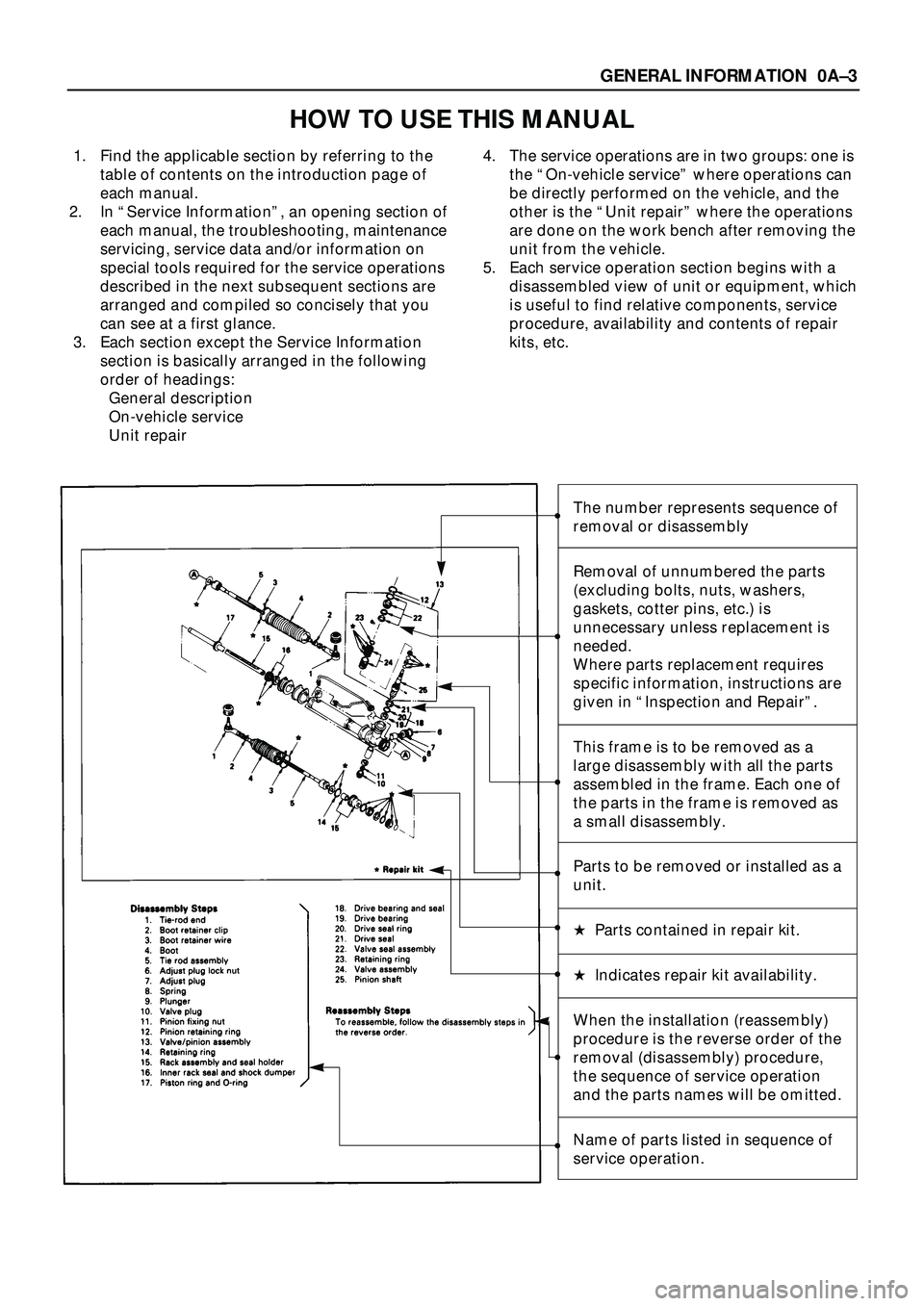
5. Each service operation section begins with a
disassembled view of unit or equipment, which
is useful to find relative components, service
procedure, availability and contents of repair
kits, etc.
The number represents sequence of
removal or disassembly
Removal of unnumbered the parts
(excluding bolts, nuts, washers,
gaskets, cotter pins, etc.) is
unnecessary unless replacement is
needed.
Where parts replacement requires
specific information, instructions are
given in ÒInspection and RepairÓ.
This frame is to be removed as a
large disassembly with all the parts
assembled in the frame. Each one of
the parts in the frame is removed as
a small disassembly.
Parts to be removed or installed as a
unit.
H Parts contained in repair kit.
H Indicates repair kit availability.
When the installation (reassembly)
procedure is the reverse order of the
removal (disassembly) procedure,
the sequence of service operation
and the parts names will be omitted.
Name of parts listed in sequence of
service operation.
Page 18 of 3573
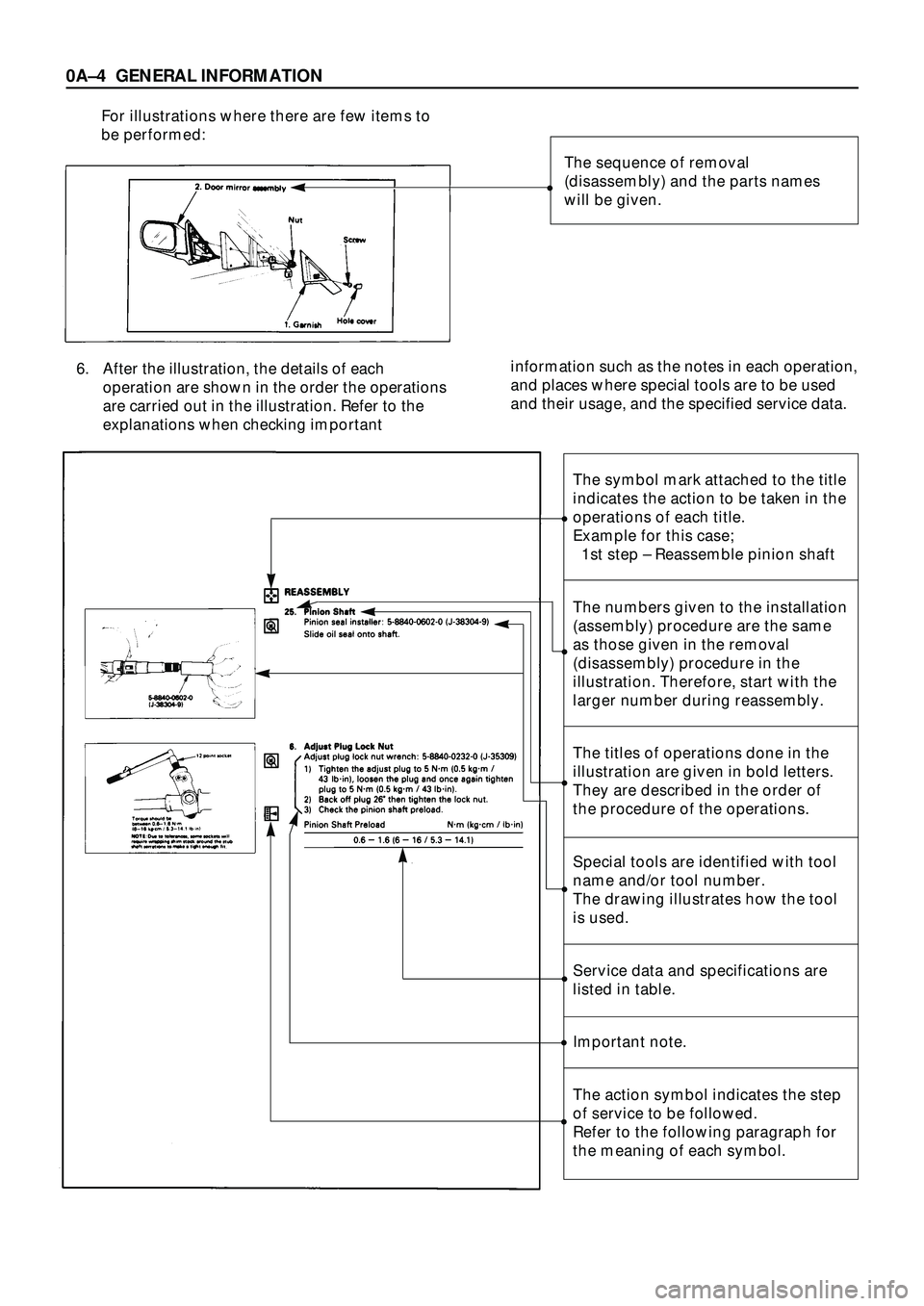
For illustrations where there are few items to
be performed:
The sequence of removal
(disassembly) and the parts names
will be given.
The symbol mark attached to the title
indicates the action to be taken in the
operations of each title.
Example for this case;
1st step Ð Reassemble pinion shaft
The numbers given to the installation
(assembly) procedure are the same
as those given in the removal
(disassembly) procedure in the
illustration. Therefore, start with the
larger number during reassembly.
The titles of operations done in the
illustration are given in bold letters.
They are described in the order of
the procedure of the operations.
Special tools are identified with tool
name and/or tool number.
The drawing illustrates how the tool
is used.
Service data and specifications are
listed in table.
Important note.
The action symbol indicates the step
of service to be followed.
Refer to the following paragraph for
the meaning of each symbol.
information such as the notes in each operation,
and places where special tools are to be used
and their usage, and the specified service data.
0AÐ4 GENERAL INFORMATION
6. After the illustration, the details of each
operation are shown in the order the operations
are carried out in the illustration. Refer to the
explanations when checking important
Page 27 of 3573
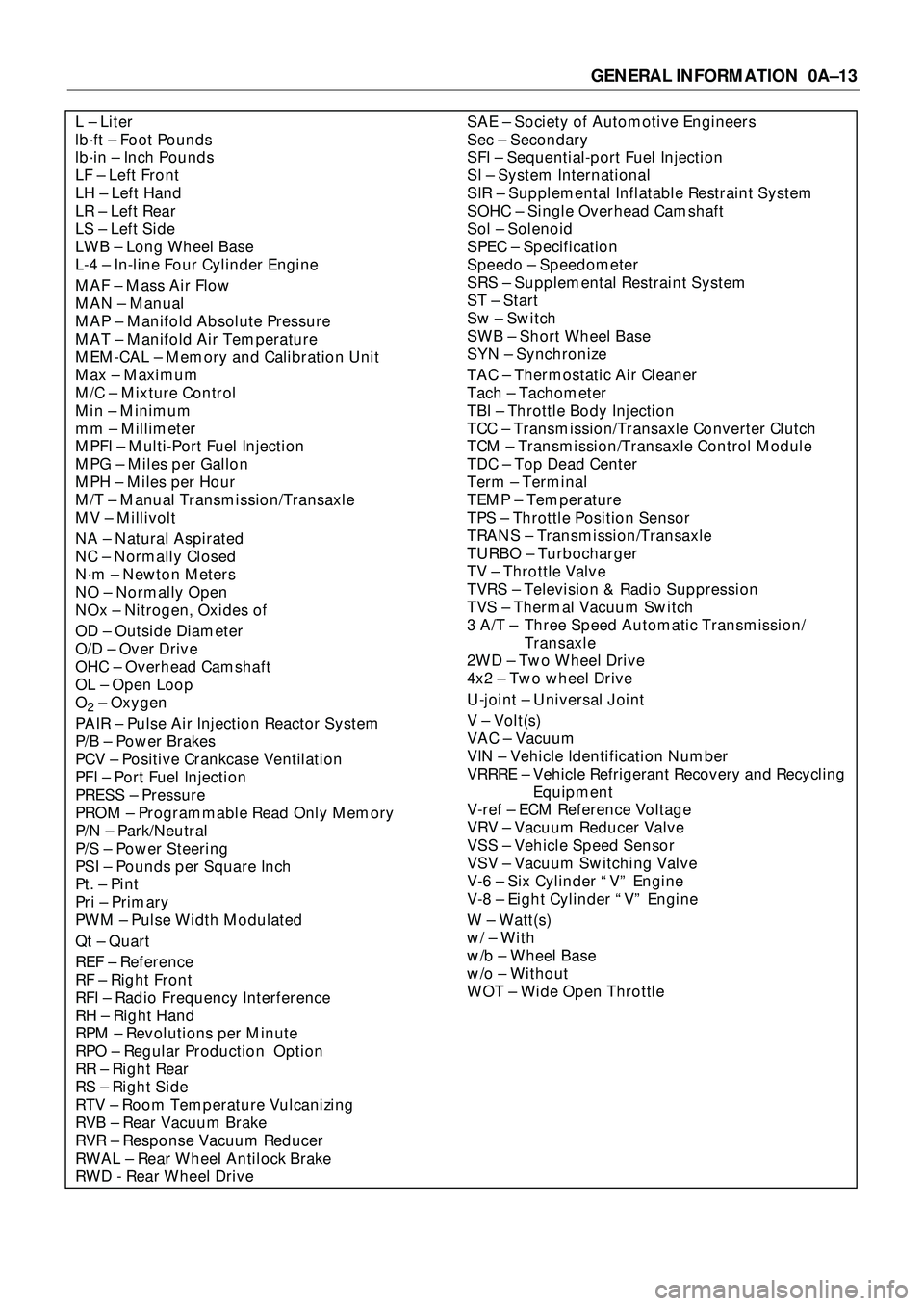
SAE Ð Society of Automotive Engineers
Sec Ð Secondary
SFI Ð Sequential-port Fuel Injection
SI Ð System International
SIR Ð Supplemental Inflatable Restraint System
SOHC Ð Single Overhead Camshaft
Sol Ð Solenoid
SPEC Ð Specification
Speedo Ð Speedometer
SRS Ð Supplemental Restraint System
ST Ð Start
Sw Ð Switch
SWB Ð Short Wheel Base
SYN Ð Synchronize
TAC Ð Thermostatic Air Cleaner
Tach Ð Tachometer
TBI Ð Throttle Body Injection
TCC Ð Transmission/Transaxle Converter Clutch
TCM Ð Transmission/Transaxle Control Module
TDC Ð Top Dead Center
Term Ð Terminal
TEMP Ð Temperature
TPS Ð Throttle Position Sensor
TRANS Ð Transmission/Transaxle
TURBO Ð Turbocharger
TV Ð Throttle Valve
TVRS Ð Television & Radio Suppression
TVS Ð Thermal Vacuum Switch
3 A/T Ð Three Speed Automatic Transmission/
Transaxle
2WD Ð Two Wheel Drive
4x2 Ð Two wheel Drive
U-joint Ð Universal Joint
V Ð Volt(s)
VAC Ð Vacuum
VIN Ð Vehicle Identification Number
VRRRE Ð Vehicle Refrigerant Recovery and Recycling
Equipment
V-ref Ð ECM Reference Voltage
VRV Ð Vacuum Reducer Valve
VSS Ð Vehicle Speed Sensor
VSV Ð Vacuum Switching Valve
V-6 Ð Six Cylinder ÒVÓ Engine
V-8 Ð Eight Cylinder ÒVÓ Engine
W Ð Watt(s)
w/ Ð With
w/b Ð Wheel Base
w/o Ð Without
WOT Ð Wide Open ThrottleL Ð Liter
lbáft Ð Foot Pounds
lbáin Ð Inch Pounds
LF Ð Left Front
LH Ð Left Hand
LR Ð Left Rear
LS Ð Left Side
LWB Ð Long Wheel Base
L-4 Ð In-line Four Cylinder Engine
MAF Ð Mass Air Flow
MAN Ð Manual
MAP Ð Manifold Absolute Pressure
MAT Ð Manifold Air Temperature
MEM-CAL Ð Memory and Calibration Unit
Max Ð Maximum
M/C Ð Mixture Control
Min Ð Minimum
mm Ð Millimeter
MPFI Ð Multi-Port Fuel Injection
MPG Ð Miles per Gallon
MPH Ð Miles per Hour
M/T Ð Manual Transmission/Transaxle
MV Ð Millivolt
NA Ð Natural Aspirated
NC Ð Normally Closed
Nám Ð Newton Meters
NO Ð Normally Open
NOx Ð Nitrogen, Oxides of
OD Ð Outside Diameter
O/D Ð Over Drive
OHC Ð Overhead Camshaft
OL Ð Open Loop
O
2Ð Oxygen
PAIR Ð Pulse Air Injection Reactor System
P/B Ð Power Brakes
PCV Ð Positive Crankcase Ventilation
PFI Ð Port Fuel Injection
PRESS Ð Pressure
PROM Ð Programmable Read Only Memory
P/N Ð Park/Neutral
P/S Ð Power Steering
PSI Ð Pounds per Square Inch
Pt. Ð Pint
Pri Ð Primary
PWM Ð Pulse Width Modulated
Qt Ð Quart
REF Ð Reference
RF Ð Right Front
RFI Ð Radio Frequency Interference
RH Ð Right Hand
RPM Ð Revolutions per Minute
RPO Ð Regular Production Option
RR Ð Right Rear
RS Ð Right Side
RTV Ð Room Temperature Vulcanizing
RVB Ð Rear Vacuum Brake
RVR Ð Response Vacuum Reducer
RWAL Ð Rear Wheel Antilock Brake
RWD - Rear Wheel Drive
GENERAL INFORMATION 0AÐ13
Page 28 of 3573
MAINTENANCE AND LUBRICATION 0BÐ1
SECTION 0B
MAINTENANCE AND LUBRICATION
CONTENTS
PAGE
Maintenance Schedule...................................................0BÐ 2
Recommended Fluids, Lubricants and Fuels.................................0BÐ 7
Oil Viscosity Chart.......................................................0BÐ10
Service Precaution
WARNING: THIS VEHICLE HAS A SUPPLEMENTAL
RESTRAINT SYSTEM (SRS). REFER TO THE SRS
COMPONENT AND WIRING LOCATION VIEW IN
ORDER TO DETERMINE WHETHER YOU ARE
PERFORMING SERVICE ON OR NEAR THE SRS
COMPONENTS OR THE SRS WIRING. WHEN YOU
ARE PERFORMING SERVICE ON OR NEAR THE
SRS COMPONENTS OR THE SRS WIRING, REFER
TO THE SRS SERVICE INFORMATION. FAILURE
TO FOLLOW WARNINGS COULD RESULT IN
POSSIBLE AIR BAG DEPLOYMENT, PERSONAL
INJURY, OR OTHERWISE UNNEEDED SRS
SYSTEM REPAIRS.CAUTION: Always use the correct fastener in the
proper location. When you replace a fastener, use
ONLY the exact part number for that application.
ISUZU will call out those fasteners that require a
replacement after removal. ISUZU will also call out
the fasteners that require thread lockers or thread
sealant. UNLESS OTHERWISE SPECIFIED, do not
use supplemental coatings (Paints, greases, or
other corrosion inhibitors) on threaded fasteners
or fasteners joint interfaces. Generally, such
coatings adversely affect the fastener torque and
the joint clamping force, and may damage the
fastener. When you install fasteners, use the
correct tightening sequence and specification.
Following these instructions can help you avoid
damage to parts and systems.
Page 30 of 3573
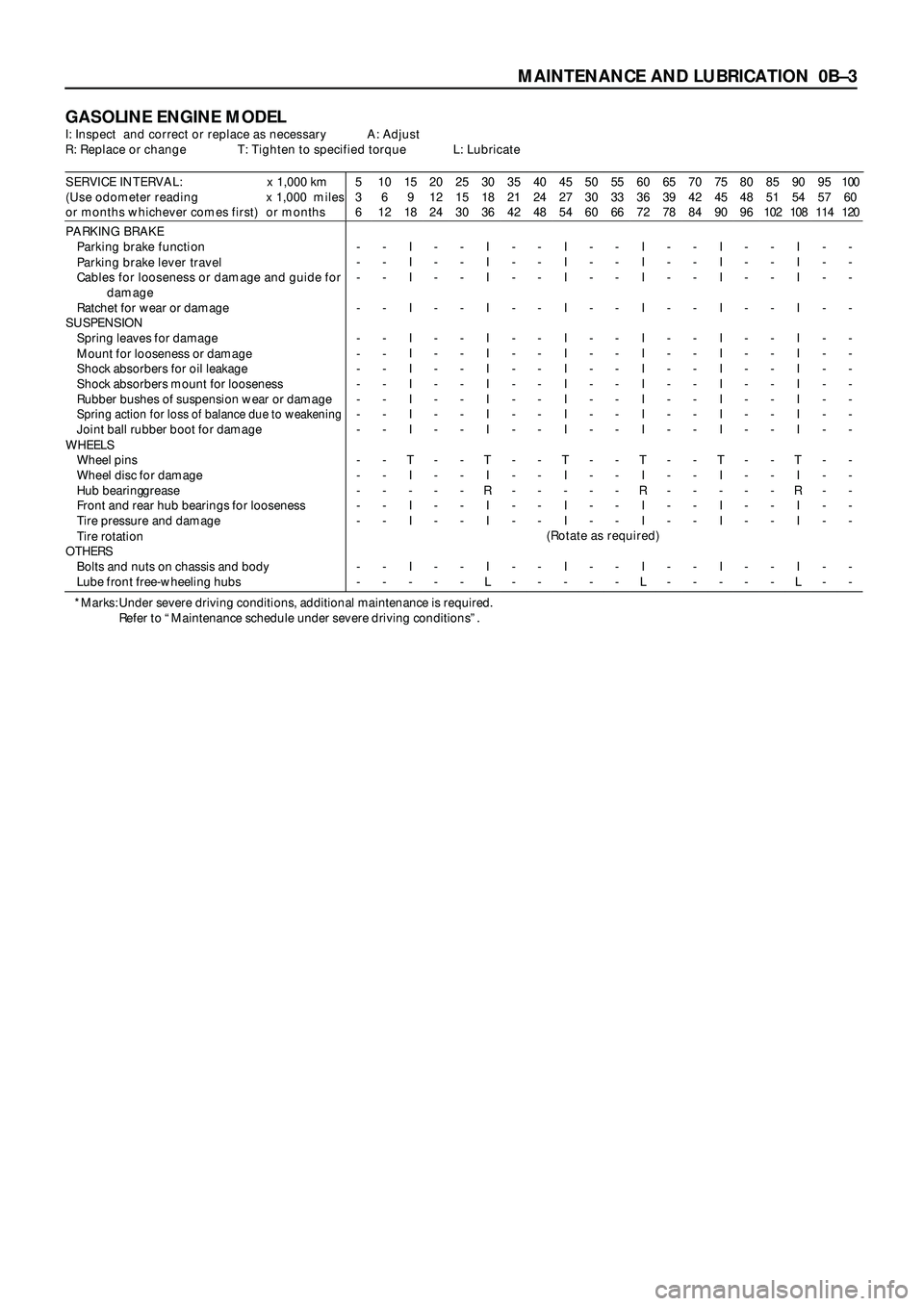
MAINTENANCE AND LUBRICATION 0BÐ3
GASOLINE ENGINE MODELI: Inspect and correct or replace as necessary A: Adjust
R: Replace or change T: Tighten to specified torque L: Lubricate
SERVICE INTERVAL: x 1,000 km
(Use odometer reading x 1,000 miles
or months whichever comes first) or months5
3
610
6
1215
9
1820
12
2425
15
3030
18
3635
21
4240
24
4845
27
5450
30
6055
33
6660
36
7265
39
7870
42
8475
45
9080
48
9685
51
10290
54
10895
57
114100
60
120
PARKING BRAKE
Parking brake function
Parking brake lever travel
Cables for looseness or damage and guide for
damage
Ratchet for wear or damage
SUSPENSION
Spring leaves for damage
Mount for looseness or damage
Shock absorbers for oil leakage
Shock absorbers mount for looseness
Rubber bushes of suspension wear or damage
Spring action for loss of balance due to weakeningJoint ball rubber boot for damage
WHEELS
Wheel pins
Wheel disc for damage
Hub bearing grease
Front and rear hub bearings for looseness
Tire pressure and damage
Tire rotation
OTHERS
Bolts and nuts on chassis and body
Lube front free-wheeling hubs-
-
-
-
-
-
-
-
-
-
-
-
-
-
-
-
-
--
-
-
-
-
-
-
-
-
-
-
-
-
-
-
-
-
-I
I
I
I
I
I
I
I
I
I
I
T
I
-
I
I
I
--
-
-
-
-
-
-
-
-
-
-
-
-
-
-
-
-
--
-
-
-
-
-
-
-
-
-
-
-
-
-
-
-
-
-I
I
I
I
I
I
I
I
I
I
I
T
I
R
I
I
I
L-
-
-
-
-
-
-
-
-
-
-
-
-
-
-
-
-
--
-
-
-
-
-
-
-
-
-
-
-
-
-
-
-
-
-I
I
I
I
I
I
I
I
I
I
I
T
I
-
I
I
I
--
-
-
-
-
-
-
-
-
-
-
-
-
-
-
-
-
--
-
-
-
-
-
-
-
-
-
-
-
-
-
-
-
-
-I
I
I
I
I
I
I
I
I
I
I
T
I
R
I
I
I
L-
-
-
-
-
-
-
-
-
-
-
-
-
-
-
-
-
--
-
-
-
-
-
-
-
-
-
-
-
-
-
-
-
-
-I
I
I
I
I
I
I
I
I
I
I
T
I
-
I
I
I
--
-
-
-
-
-
-
-
-
-
-
-
-
-
-
-
-
--
-
-
-
-
-
-
-
-
-
-
-
-
-
-
-
-
-I
I
I
I
I
I
I
I
I
I
I
T
I
R
I
I
I
L-
-
-
-
-
-
-
-
-
-
-
-
-
-
-
-
-
--
-
-
-
-
-
-
-
-
-
-
-
-
-
-
-
-
-
(Rotate as required)
*Marks: Under severe driving conditions, additional maintenance is required.
Refer to “Maintenance schedule under severe driving conditions”.
Page 32 of 3573
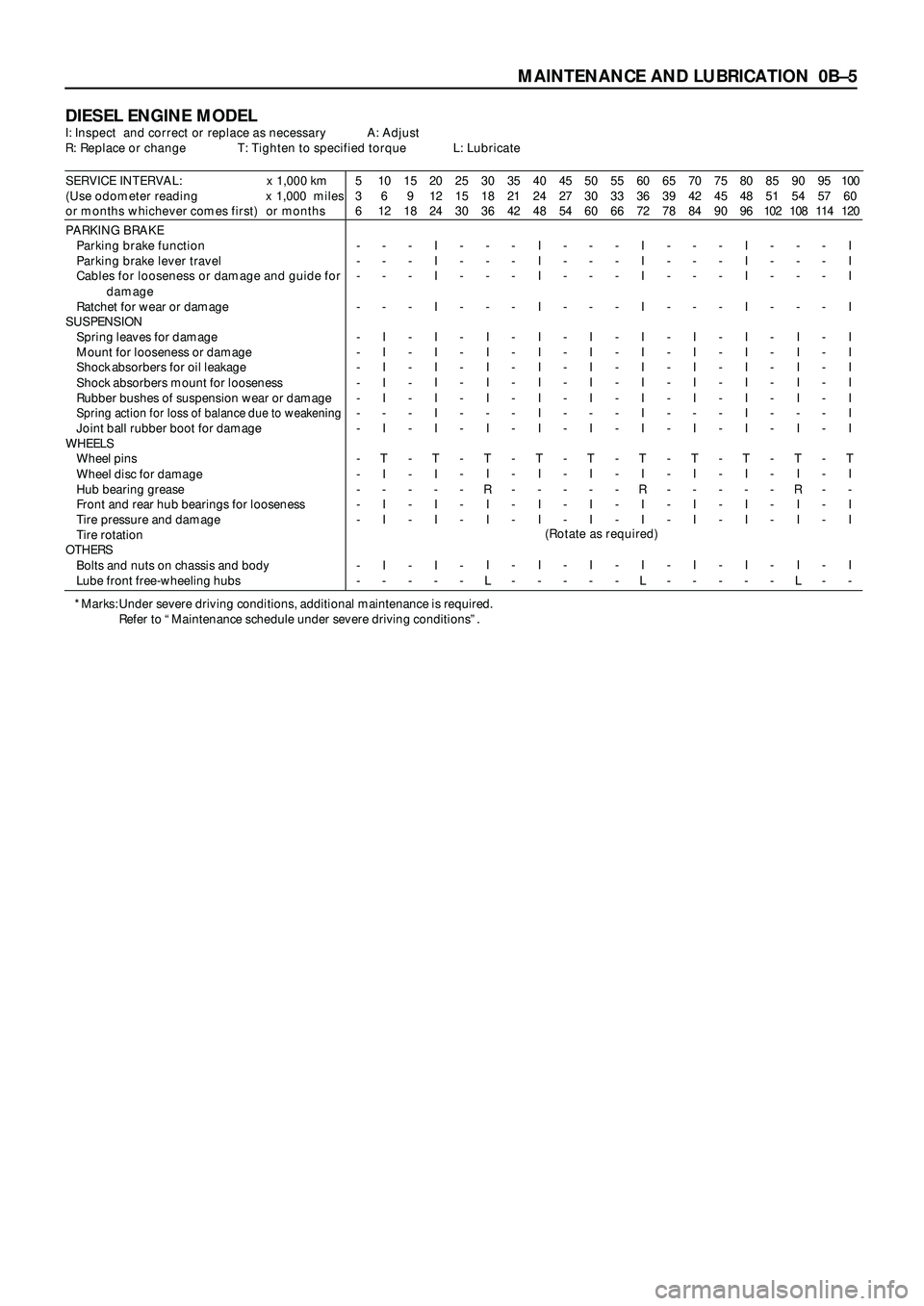
MAINTENANCE AND LUBRICATION 0BÐ5
DIESEL ENGINE MODELI: Inspect and correct or replace as necessary A: Adjust
R: Replace or change T: Tighten to specified torque L: Lubricate
SERVICE INTERVAL: x 1,000 km
(Use odometer reading x 1,000 miles
or months whichever comes first) or months5
3
610
6
1215
9
1820
12
2425
15
3030
18
3635
21
4240
24
4845
27
5450
30
6055
33
6660
36
7265
39
7870
42
8475
45
9080
48
9685
51
10290
54
10895
57
114100
60
120
PARKING BRAKE
Parking brake function
Parking brake lever travel
Cables for looseness or damage and guide for
damage
Ratchet for wear or damage
SUSPENSION
Spring leaves for damage
Mount for looseness or damage
Shock absorbers for oil leakage
Shock absorbers mount for looseness
Rubber bushes of suspension wear or damage
Spring action for loss of balance due to weakeningJoint ball rubber boot for damage
WHEELS
Wheel pins
Wheel disc for damage
Hub bearing grease
Front and rear hub bearings for looseness
Tire pressure and damage
Tire rotation
OTHERS
Bolts and nuts on chassis and body
Lube front free-wheeling hubs-
-
-
-
-
-
-
-
-
-
-
-
-
-
-
-
-
--
-
-
-
I
I
I
I
I
-
I
T
I
-
I
I
I
--
-
-
-
-
-
-
-
-
-
-
-
-
-
-
-
-
-I
I
I
I
I
I
I
I
I
I
I
T
I
-
I
I
I
--
-
-
-
-
-
-
-
-
-
-
-
-
-
-
-
-
--
-
-
-
I
I
I
I
I
-
I
T
I
R
I
I
I
L-
-
-
-
-
-
-
-
-
-
-
-
-
-
-
-
-
-I
I
I
I
I
I
I
I
I
I
I
T
I
-
I
I
I
--
-
-
-
-
-
-
-
-
-
-
-
-
-
-
-
-
--
-
-
-
I
I
I
I
I
-
I
T
I
-
I
I
I
--
-
-
-
-
-
-
-
-
-
-
-
-
-
-
-
-
-I
I
I
I
I
I
I
I
I
I
I
T
I
R
I
I
I
L-
-
-
-
-
-
-
-
-
-
-
-
-
-
-
-
-
--
-
-
-
I
I
I
I
I
-
I
T
I
-
I
I
I
--
-
-
-
-
-
-
-
-
-
-
-
-
-
-
-
-
-I
I
I
I
I
I
I
I
I
I
I
T
I
-
I
I
I
--
-
-
-
-
-
-
-
-
-
-
-
-
-
-
-
-
--
-
-
-
I
I
I
I
I
-
I
T
I
R
I
I
I
L-
-
-
-
-
-
-
-
-
-
-
-
-
-
-
-
-
-I
I
I
I
I
I
I
I
I
I
I
T
I
-
I
I
I
-
(Rotate as required)
*Marks: Under severe driving conditions, additional maintenance is required.
Refer to “Maintenance schedule under severe driving conditions”.
Page 64 of 3573
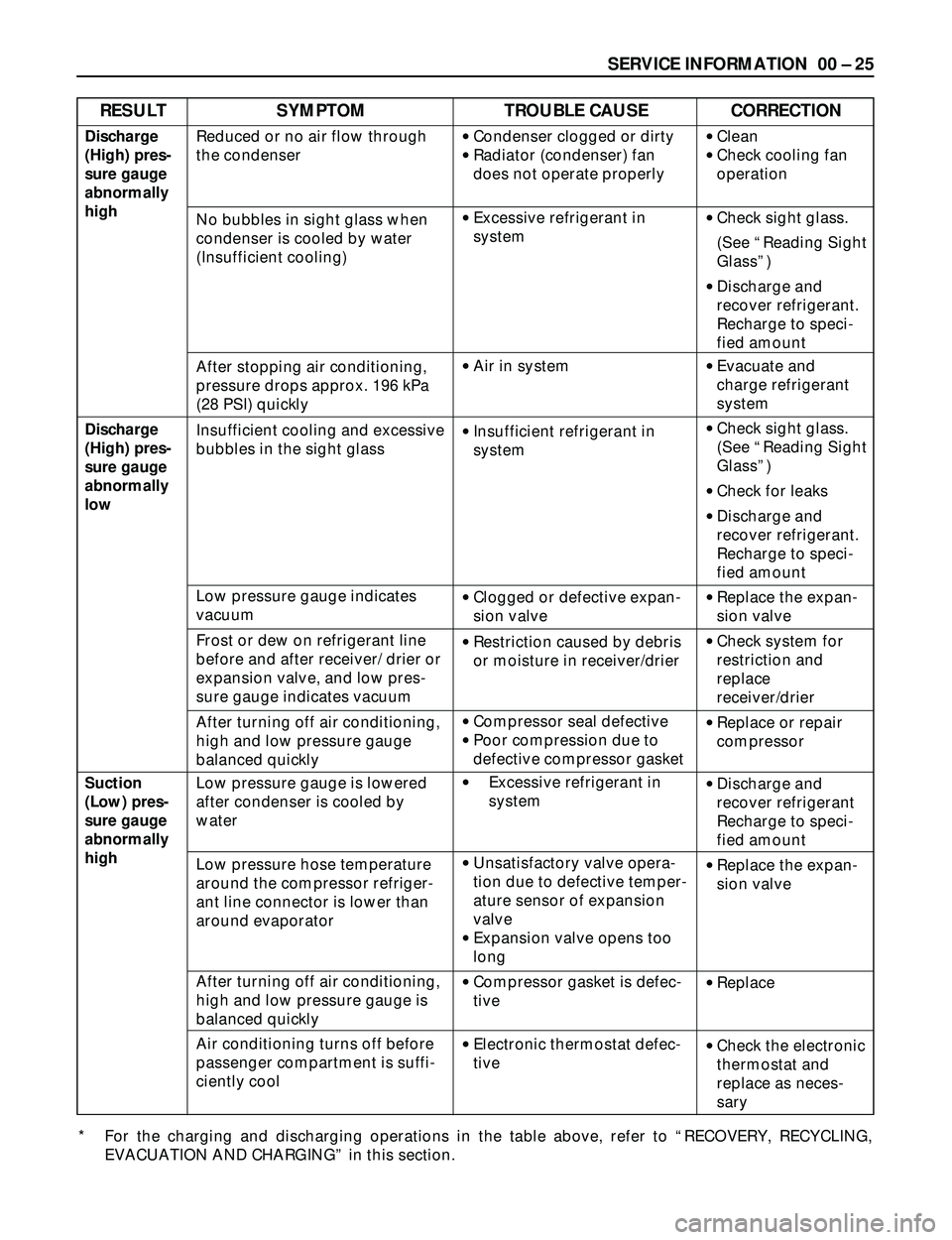
RESULT SYMPTOM TROUBLE CAUSE CORRECTION
SERVICE INFORMATION 00 Ð 25
Reduced or no air flow through
the condenser
No bubbles in sight glass when
condenser is cooled by water
(Insufficient cooling)
After stopping air conditioning,
pressure drops approx. 196 kPa
(28 PSI) quickly
Insufficient cooling and excessive
bubbles in the sight glass
Low pressure gauge indicates
vacuum
Frost or dew on refrigerant line
before and after receiver/ drier or
expansion valve, and low pres-
sure gauge indicates vacuum
After turning off air conditioning,
high and low pressure gauge
balanced quickly
Low pressure gauge is lowered
after condenser is cooled by
water
Low pressure hose temperature
around the compressor refriger-
ant line connector is lower than
around evaporator
After turning off air conditioning,
high and low pressure gauge is
balanced quickly
Air conditioning turns off before
passenger compartment is suffi-
ciently cool·Condenser clogged or dirty
·Radiator (condenser) fan
does not operate properly
·Excessive refrigerant in
system
·Air in system
·Insufficient refrigerant in
system
·Clogged or defective expan-
sion valve
·Restriction caused by debris
or moisture in receiver/drier
·Compressor seal defective
·Poor compression due to
defective compressor gasket
·Excessive refrigerant in
system
·Unsatisfactory valve opera-
tion due to defective temper-
ature sensor of expansion
valve
·Expansion valve opens too
long
·Compressor gasket is defec-
tive
·Electronic thermostat defec-
tive·Clean
·Check cooling fan
operation
·Check sight glass.
(See ÒReading Sight
GlassÓ)
·Discharge and
recover refrigerant.
Recharge to speci-
fied amount
·Evacuate and
charge refrigerant
system
·Check sight glass.
(See ÒReading Sight
GlassÓ)
·Check for leaks
·Discharge and
recover refrigerant.
Recharge to speci-
fied amount
·Replace the expan-
sion valve
·Check system for
restriction and
replace
receiver/drier
·Replace or repair
compressor
·Discharge and
recover refrigerant
Recharge to speci-
fied amount
·Replace the expan-
sion valve
·Replace
·Check the electronic
thermostat and
replace as neces-
saryDischarge
(High) pres-
sure gauge
abnormally
high
Discharge
(High) pres-
sure gauge
abnormally
low
Suction
(Low) pres-
sure gauge
abnormally
high
* For the charging and discharging operations in the table above, refer to ÒRECOVERY, RECYCLING,
EVACUATION AND CHARGINGÓ in this section.
Page 66 of 3573
SERVICE INFORMATION 00 Ð 27
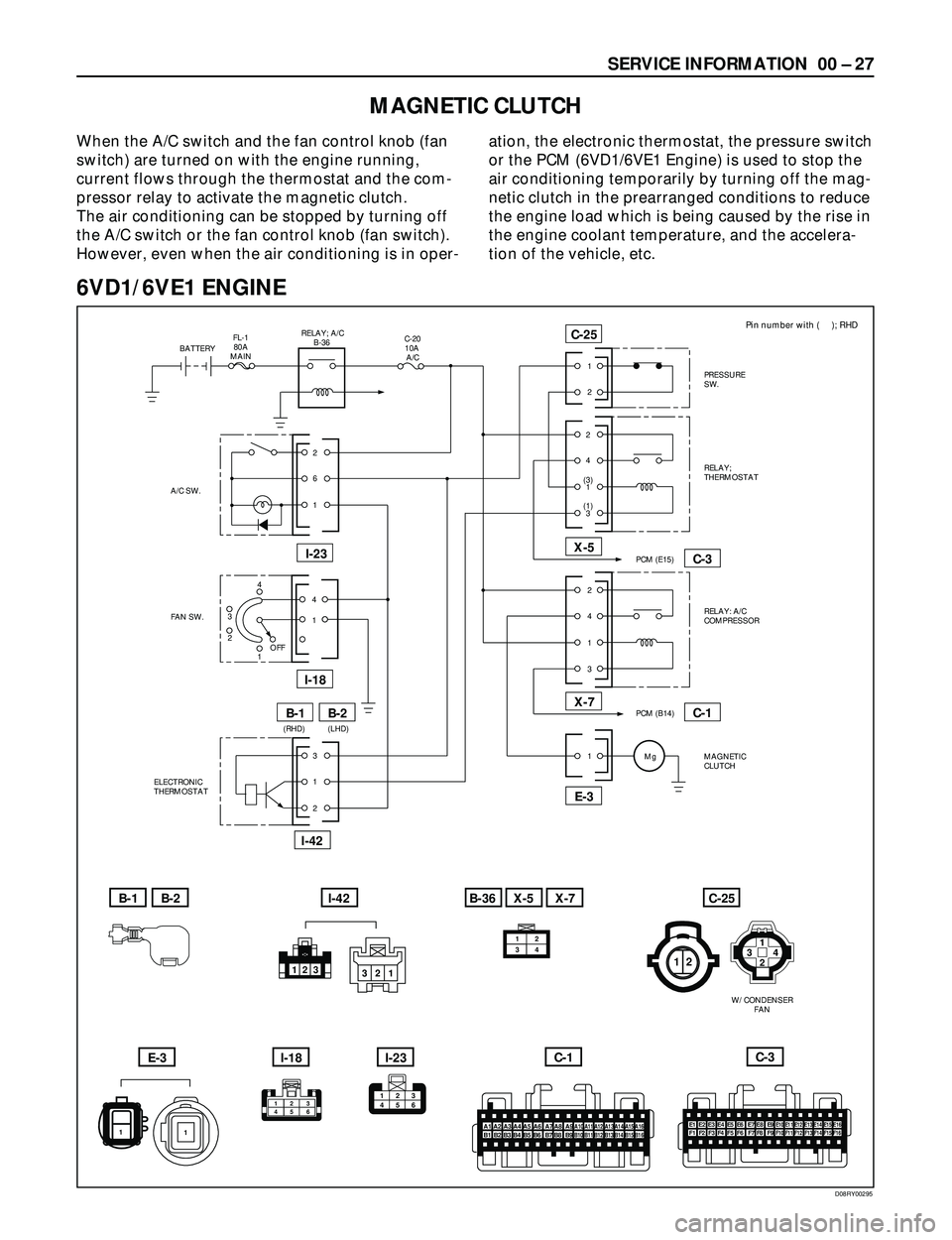
MAGNETIC CLUTCH
When the A/C switch and the fan control knob (fan
switch) are turned on with the engine running,
current flows through the thermostat and the com-
pressor relay to activate the magnetic clutch.
The air conditioning can be stopped by turning off
the A/C switch or the fan control knob (fan switch).
However, even when the air conditioning is in oper-ation, the electronic thermostat, the pressure switch
or the PCM (6VD1/6VE1 Engine) is used to stop the
air conditioning temporarily by turning off the mag-
netic clutch in the prearranged conditions to reduce
the engine load which is being caused by the rise in
the engine coolant temperature, and the accelera-
tion of the vehicle, etc.
123
45 6
RELAY; A/C
B-36C-20
10A
A/C FL-1
80A
MAIN
1
2
B-2
C-25
2
4
X-5
1
3 (3)
(1)
4
13
24
1
A/C SW.
FAN SW.
I-23
PRESSURE
SW.
RELAY;
THERMOSTAT
B-2
X-7 C-25
C-1C-3E-3I-23
BATTERY
X-7
RELAY: A/C
COMPRESSOR
1
E-3
MAGNETIC
CLUTCHMg
OFF
I-18
2
6
1
321123
12
3412
11
213
5 46
I-18
X-5
B-1(LHD) (RHD)
B-1
1
2 34
W/ CONDENSER
FAN
2
4
1
3
C-3PCM (E15)
C-1PCM (B14)
3
1
2
ELECTRONIC
THERMOSTAT
I-42
I-42B-36
Pin number with ( ); RHD
A1 A2 A3 A4 A5 A6 A7 A8 A9A10 A11 A12 A13 A14 A15 A16B1 B2 B3 B4 B5 B6 B7 B8 B9B10 B11 B12 B13 B14 B15 B16E1 E2 E3 E4 E5 E6 E7 E8 E9E10 E11 E12 E13 E14 E15 E16F1 F2 F3 F4 F5 F6 F7 F8 F9F10 F11 F12 F13 F14 F15 F16
6VD1/6VE1 ENGINE
D08RY00295