parking brake ISUZU TROOPER 1998 Service Repair Manual
[x] Cancel search | Manufacturer: ISUZU, Model Year: 1998, Model line: TROOPER, Model: ISUZU TROOPER 1998Pages: 3573, PDF Size: 60.36 MB
Page 8 of 3573
PAGE BACK PAGE NEXT
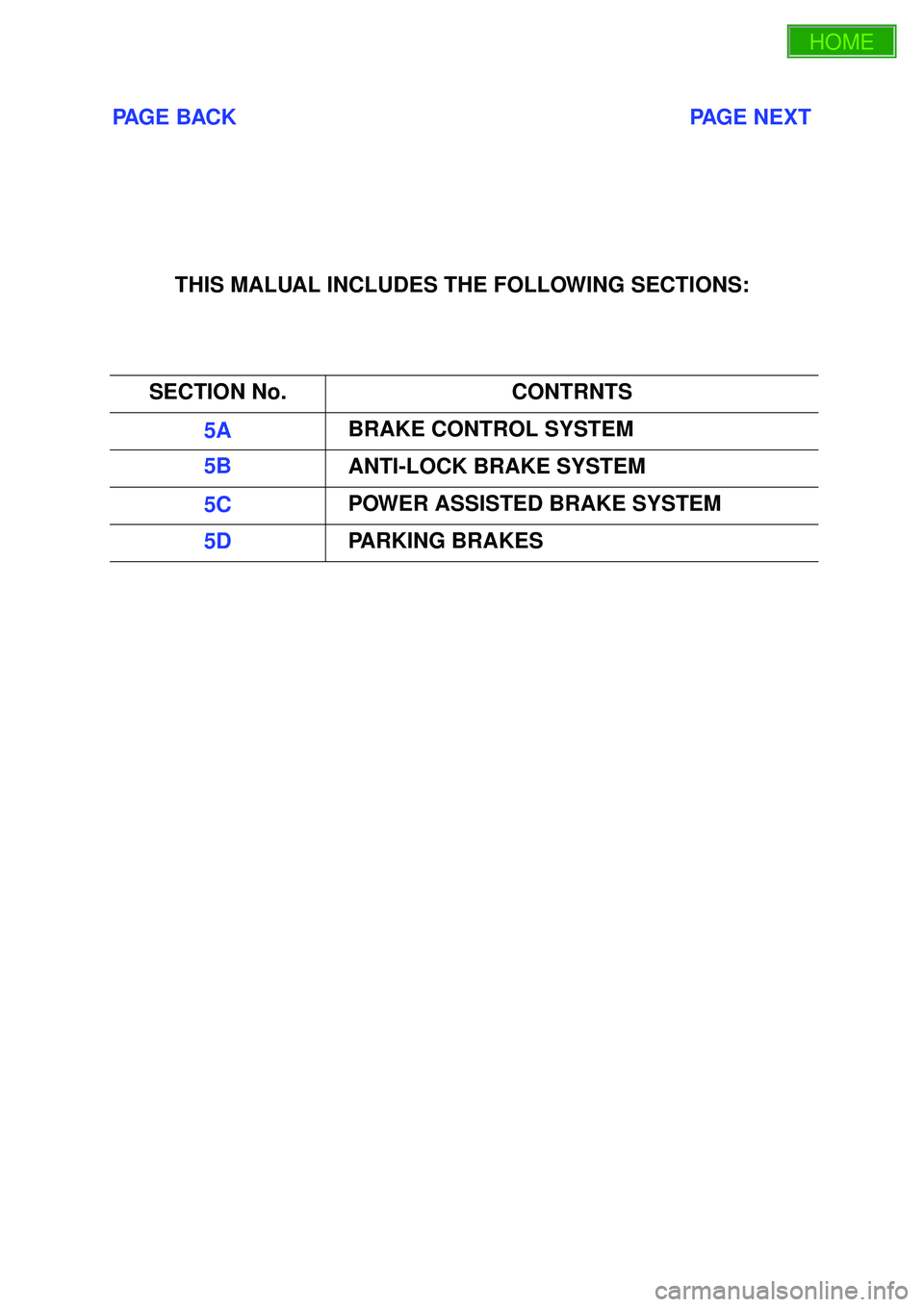
THIS MALUAL INCLUDES THE FOLLOWING SECTIONS:
SECTION No. CONTRNTS
5A BRAKE CONTROL SYSTEM
5B ANTI-LOCK BRAKE SYSTEM
5C POWER ASSISTED BRAKE SYSTEM
5D PARKING BRAKES
Page 30 of 3573
MAINTENANCE AND LUBRICATION 0BÐ3
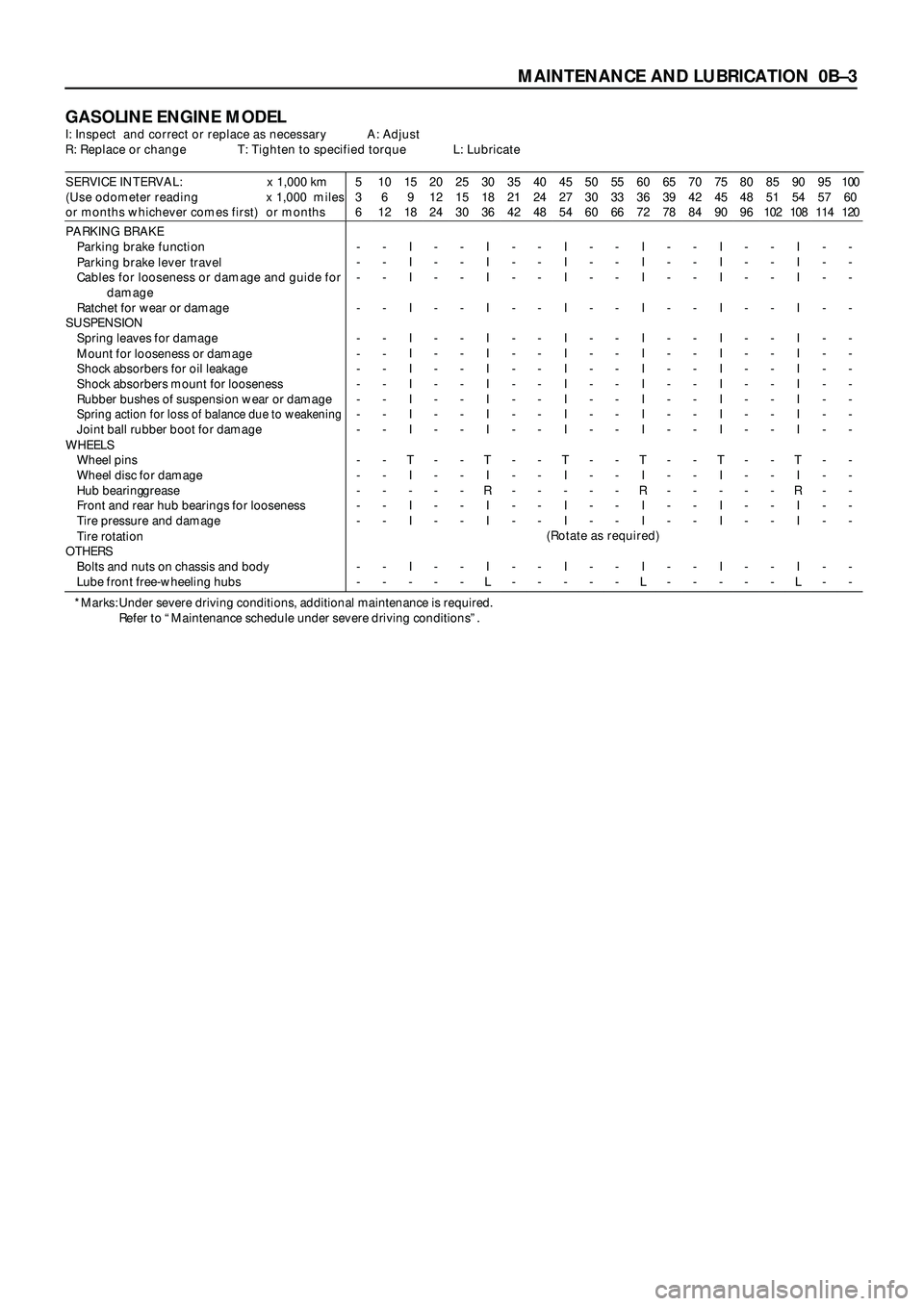
GASOLINE ENGINE MODELI: Inspect and correct or replace as necessary A: Adjust
R: Replace or change T: Tighten to specified torque L: Lubricate
SERVICE INTERVAL: x 1,000 km
(Use odometer reading x 1,000 miles
or months whichever comes first) or months5
3
610
6
1215
9
1820
12
2425
15
3030
18
3635
21
4240
24
4845
27
5450
30
6055
33
6660
36
7265
39
7870
42
8475
45
9080
48
9685
51
10290
54
10895
57
114100
60
120
PARKING BRAKE
Parking brake function
Parking brake lever travel
Cables for looseness or damage and guide for
damage
Ratchet for wear or damage
SUSPENSION
Spring leaves for damage
Mount for looseness or damage
Shock absorbers for oil leakage
Shock absorbers mount for looseness
Rubber bushes of suspension wear or damage
Spring action for loss of balance due to weakeningJoint ball rubber boot for damage
WHEELS
Wheel pins
Wheel disc for damage
Hub bearing grease
Front and rear hub bearings for looseness
Tire pressure and damage
Tire rotation
OTHERS
Bolts and nuts on chassis and body
Lube front free-wheeling hubs-
-
-
-
-
-
-
-
-
-
-
-
-
-
-
-
-
--
-
-
-
-
-
-
-
-
-
-
-
-
-
-
-
-
-I
I
I
I
I
I
I
I
I
I
I
T
I
-
I
I
I
--
-
-
-
-
-
-
-
-
-
-
-
-
-
-
-
-
--
-
-
-
-
-
-
-
-
-
-
-
-
-
-
-
-
-I
I
I
I
I
I
I
I
I
I
I
T
I
R
I
I
I
L-
-
-
-
-
-
-
-
-
-
-
-
-
-
-
-
-
--
-
-
-
-
-
-
-
-
-
-
-
-
-
-
-
-
-I
I
I
I
I
I
I
I
I
I
I
T
I
-
I
I
I
--
-
-
-
-
-
-
-
-
-
-
-
-
-
-
-
-
--
-
-
-
-
-
-
-
-
-
-
-
-
-
-
-
-
-I
I
I
I
I
I
I
I
I
I
I
T
I
R
I
I
I
L-
-
-
-
-
-
-
-
-
-
-
-
-
-
-
-
-
--
-
-
-
-
-
-
-
-
-
-
-
-
-
-
-
-
-I
I
I
I
I
I
I
I
I
I
I
T
I
-
I
I
I
--
-
-
-
-
-
-
-
-
-
-
-
-
-
-
-
-
--
-
-
-
-
-
-
-
-
-
-
-
-
-
-
-
-
-I
I
I
I
I
I
I
I
I
I
I
T
I
R
I
I
I
L-
-
-
-
-
-
-
-
-
-
-
-
-
-
-
-
-
--
-
-
-
-
-
-
-
-
-
-
-
-
-
-
-
-
-
(Rotate as required)
*Marks: Under severe driving conditions, additional maintenance is required.
Refer to “Maintenance schedule under severe driving conditions”.
Page 32 of 3573
MAINTENANCE AND LUBRICATION 0BÐ5
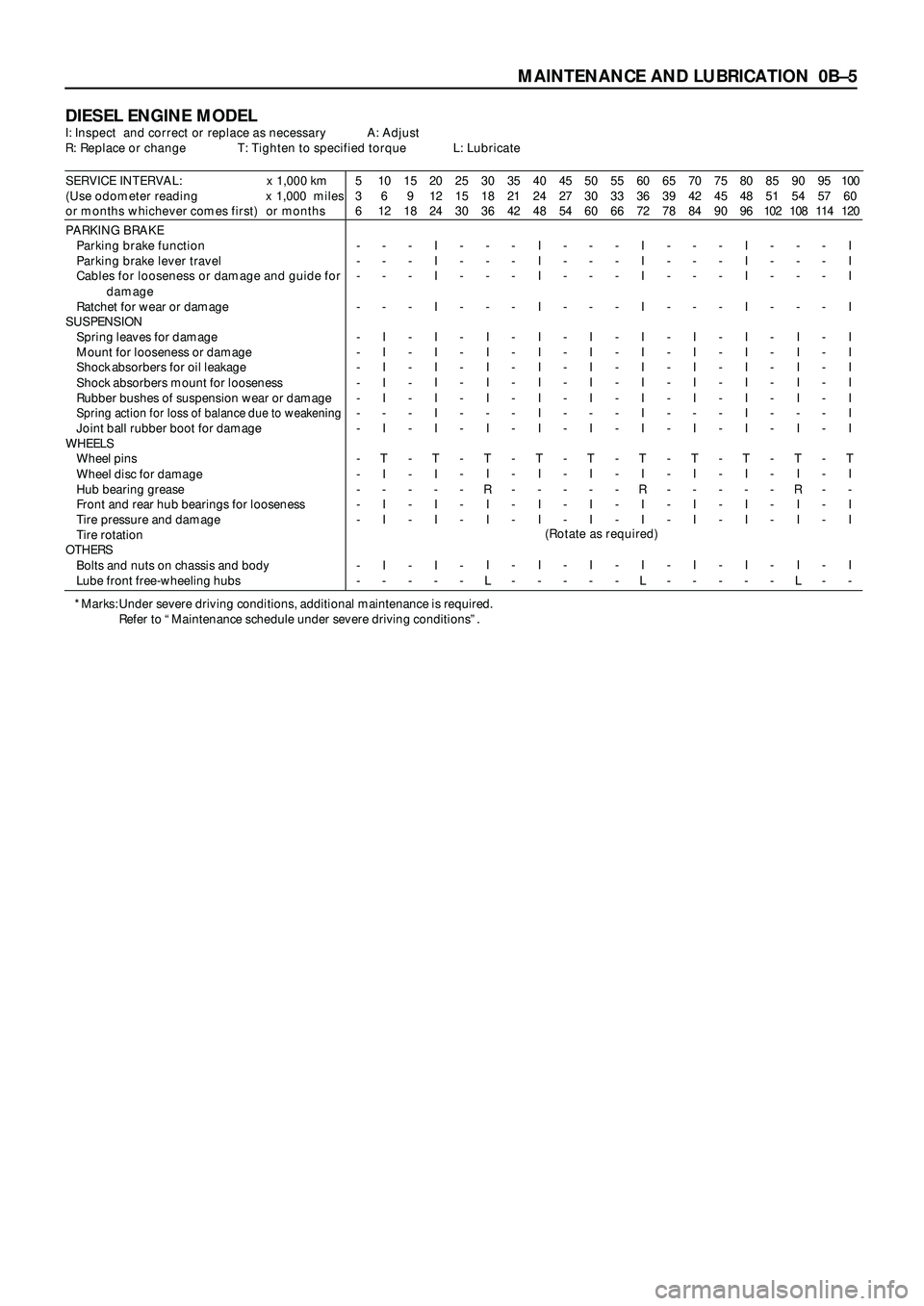
DIESEL ENGINE MODELI: Inspect and correct or replace as necessary A: Adjust
R: Replace or change T: Tighten to specified torque L: Lubricate
SERVICE INTERVAL: x 1,000 km
(Use odometer reading x 1,000 miles
or months whichever comes first) or months5
3
610
6
1215
9
1820
12
2425
15
3030
18
3635
21
4240
24
4845
27
5450
30
6055
33
6660
36
7265
39
7870
42
8475
45
9080
48
9685
51
10290
54
10895
57
114100
60
120
PARKING BRAKE
Parking brake function
Parking brake lever travel
Cables for looseness or damage and guide for
damage
Ratchet for wear or damage
SUSPENSION
Spring leaves for damage
Mount for looseness or damage
Shock absorbers for oil leakage
Shock absorbers mount for looseness
Rubber bushes of suspension wear or damage
Spring action for loss of balance due to weakeningJoint ball rubber boot for damage
WHEELS
Wheel pins
Wheel disc for damage
Hub bearing grease
Front and rear hub bearings for looseness
Tire pressure and damage
Tire rotation
OTHERS
Bolts and nuts on chassis and body
Lube front free-wheeling hubs-
-
-
-
-
-
-
-
-
-
-
-
-
-
-
-
-
--
-
-
-
I
I
I
I
I
-
I
T
I
-
I
I
I
--
-
-
-
-
-
-
-
-
-
-
-
-
-
-
-
-
-I
I
I
I
I
I
I
I
I
I
I
T
I
-
I
I
I
--
-
-
-
-
-
-
-
-
-
-
-
-
-
-
-
-
--
-
-
-
I
I
I
I
I
-
I
T
I
R
I
I
I
L-
-
-
-
-
-
-
-
-
-
-
-
-
-
-
-
-
-I
I
I
I
I
I
I
I
I
I
I
T
I
-
I
I
I
--
-
-
-
-
-
-
-
-
-
-
-
-
-
-
-
-
--
-
-
-
I
I
I
I
I
-
I
T
I
-
I
I
I
--
-
-
-
-
-
-
-
-
-
-
-
-
-
-
-
-
-I
I
I
I
I
I
I
I
I
I
I
T
I
R
I
I
I
L-
-
-
-
-
-
-
-
-
-
-
-
-
-
-
-
-
--
-
-
-
I
I
I
I
I
-
I
T
I
-
I
I
I
--
-
-
-
-
-
-
-
-
-
-
-
-
-
-
-
-
-I
I
I
I
I
I
I
I
I
I
I
T
I
-
I
I
I
--
-
-
-
-
-
-
-
-
-
-
-
-
-
-
-
-
--
-
-
-
I
I
I
I
I
-
I
T
I
R
I
I
I
L-
-
-
-
-
-
-
-
-
-
-
-
-
-
-
-
-
-I
I
I
I
I
I
I
I
I
I
I
T
I
-
I
I
I
-
(Rotate as required)
*Marks: Under severe driving conditions, additional maintenance is required.
Refer to “Maintenance schedule under severe driving conditions”.
Page 289 of 3573
SERVICE INFORMATION 00 – 7
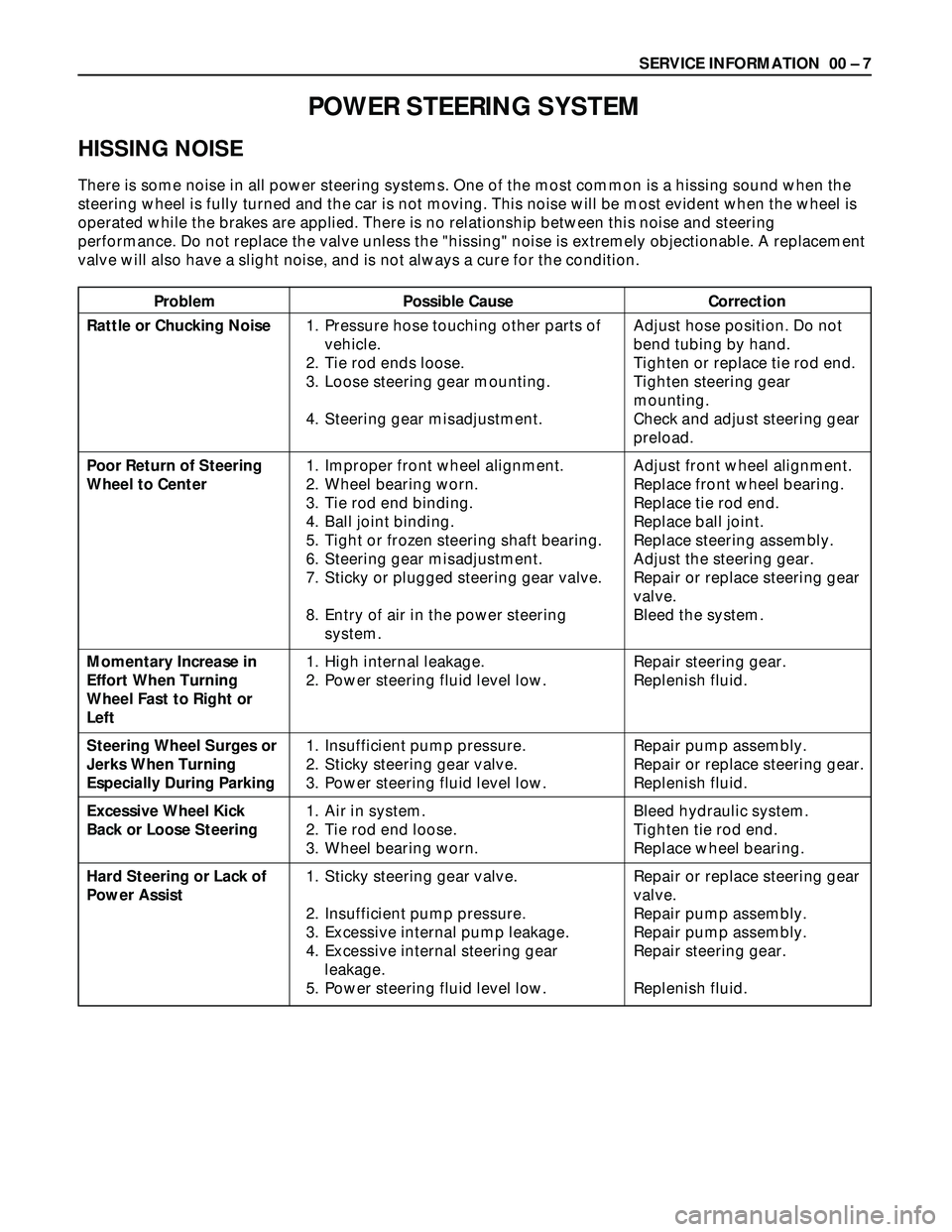
Problem Possible Cause Correction
POWER STEERING SYSTEM
HISSING NOISE
There is some noise in all power steering systems. One of the most common is a hissing sound when the
steering wheel is fully turned and the car is not moving. This noise will be most evident when the wheel is
operated while the brakes are applied. There is no relationship between this noise and steering
performance. Do not replace the valve unless the "hissing" noise is extremely objectionable. A replacement
valve will also have a slight noise, and is not always a cure for the condition.
Rattle or Chucking Noise
Poor Return of Steering
Wheel to Center
Momentary Increase in
Effort When Turning
Wheel Fast to Right or
Left
Steering Wheel Surges or
Jerks When Turning
Especially During Parking
Excessive Wheel Kick
Back or Loose Steering
Hard Steering or Lack of
Power Assist1. Pressure hose touching other parts of
vehicle.
2. Tie rod ends loose.
3. Loose steering gear mounting.
4. Steering gear misadjustment.
1. Improper front wheel alignment.
2. Wheel bearing worn.
3. Tie rod end binding.
4. Ball joint binding.
5. Tight or frozen steering shaft bearing.
6. Steering gear misadjustment.
7. Sticky or plugged steering gear valve.
8. Entry of air in the power steering
system.
1. High internal leakage.
2. Power steering fluid level low.
1. Insufficient pump pressure.
2. Sticky steering gear valve.
3. Power steering fluid level low.
1. Air in system.
2. Tie rod end loose.
3. Wheel bearing worn.
1. Sticky steering gear valve.
2. Insufficient pump pressure.
3. Excessive internal pump leakage.
4. Excessive internal steering gear
leakage.
5. Power steering fluid level low.Adjust hose position. Do not
bend tubing by hand.
Tighten or replace tie rod end.
Tighten steering gear
mounting.
Check and adjust steering gear
preload.
Adjust front wheel alignment.
Replace front wheel bearing.
Replace tie rod end.
Replace ball joint.
Replace steering assembly.
Adjust the steering gear.
Repair or replace steering gear
valve.
Bleed the system.
Repair steering gear.
Replenish fluid.
Repair pump assembly.
Repair or replace steering gear.
Replenish fluid.
Bleed hydraulic system.
Tighten tie rod end.
Replace wheel bearing.
Repair or replace steering gear
valve.
Repair pump assembly.
Repair pump assembly.
Repair steering gear.
Replenish fluid.
Page 307 of 3573
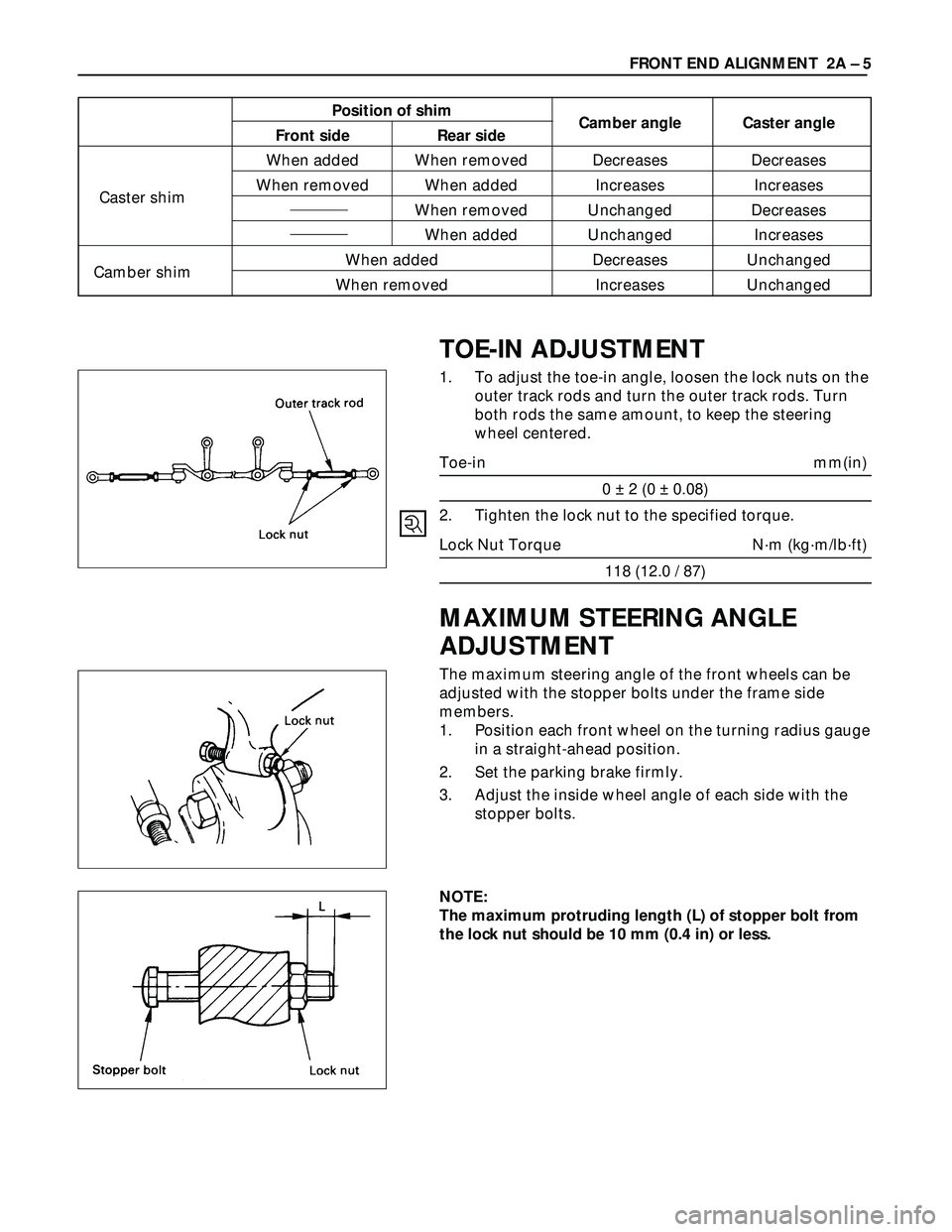
FRONT END ALIGNMENT 2A – 5
Position of shim
Camber angle Caster angle
Front side Rear side
When added When removed Decreases Decreases
When removed When added Increases Increases
Caster shim
When removed Unchanged Decreases
When added Unchanged Increases
When added Decreases Unchanged
Camber shim
When removed Increases Unchanged
TOE-IN ADJUSTMENT
1. To adjust the toe-in angle, loosen the lock nuts on the
outer track rods and turn the outer track rods. Turn
both rods the same amount, to keep the steering
wheel centered.
Toe-in mm(in)
0 ± 2 (0 ± 0.08)
2. Tighten the lock nut to the specified torque.
Lock Nut Torque N·m (kg·m/lb·ft)
118 (12.0 / 87)
MAXIMUM STEERING ANGLE
ADJUSTMENT
The maximum steering angle of the front wheels can be
adjusted with the stopper bolts under the frame side
members.
1. Position each front wheel on the turning radius gauge
in a straight-ahead position.
2. Set the parking brake firmly.
3. Adjust the inside wheel angle of each side with the
stopper bolts.
NOTE:
The maximum protruding length (L) of stopper bolt from
the lock nut should be 10 mm (0.4 in) or less.
Page 418 of 3573
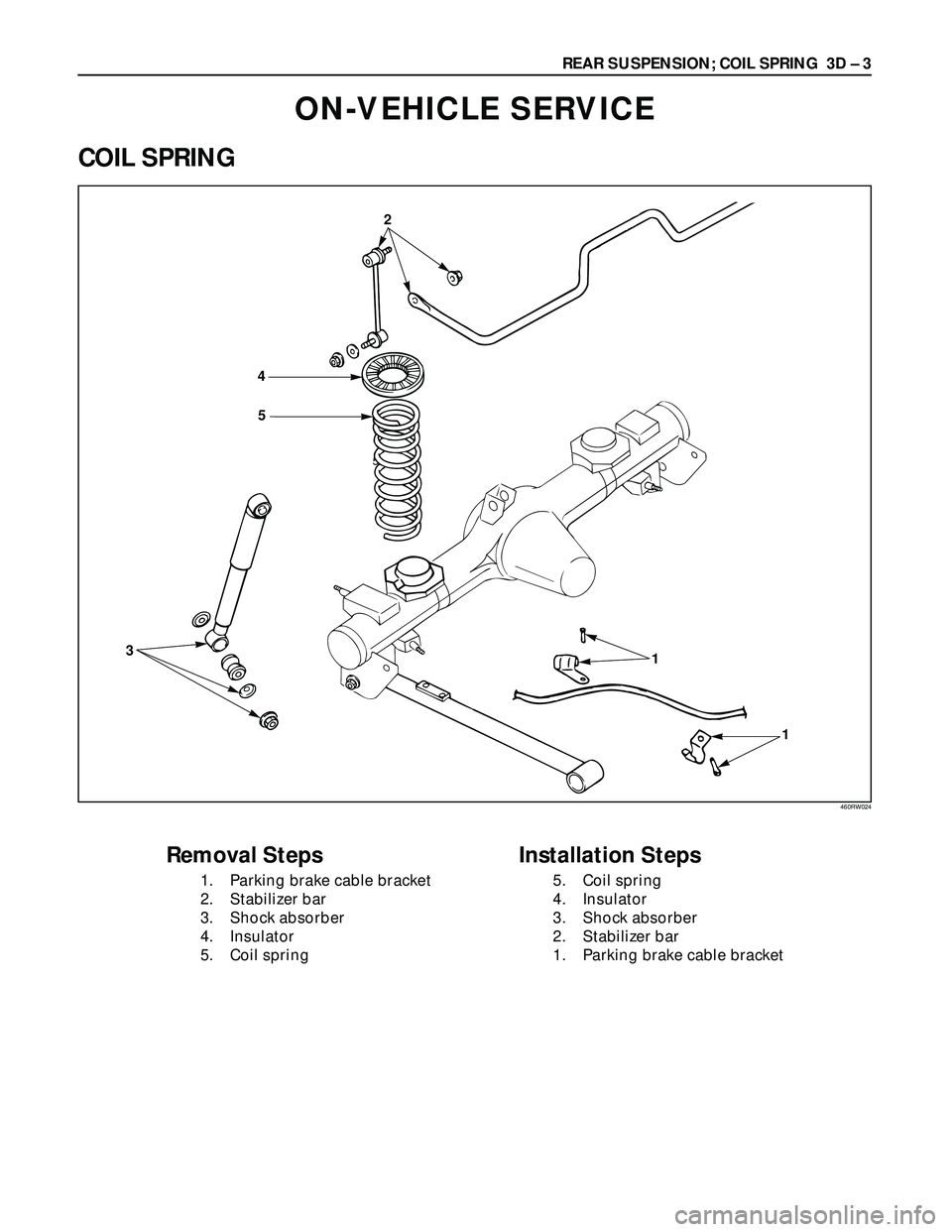
REAR SUSPENSION; COIL SPRING 3D – 3
ON-VEHICLE SERVICE
COIL SPRING
5
2
4
5
31
1
Removal Steps
1. Parking brake cable bracket
2. Stabilizer bar
3. Shock absorber
4. Insulator
5. Coil spring
Installation Steps
5. Coil spring
4. Insulator
3. Shock absorber
2. Stabilizer bar
1. Parking brake cable bracket
460RW024
Page 419 of 3573
3D – 4 REAR SUSPENSION; COIL SPRING
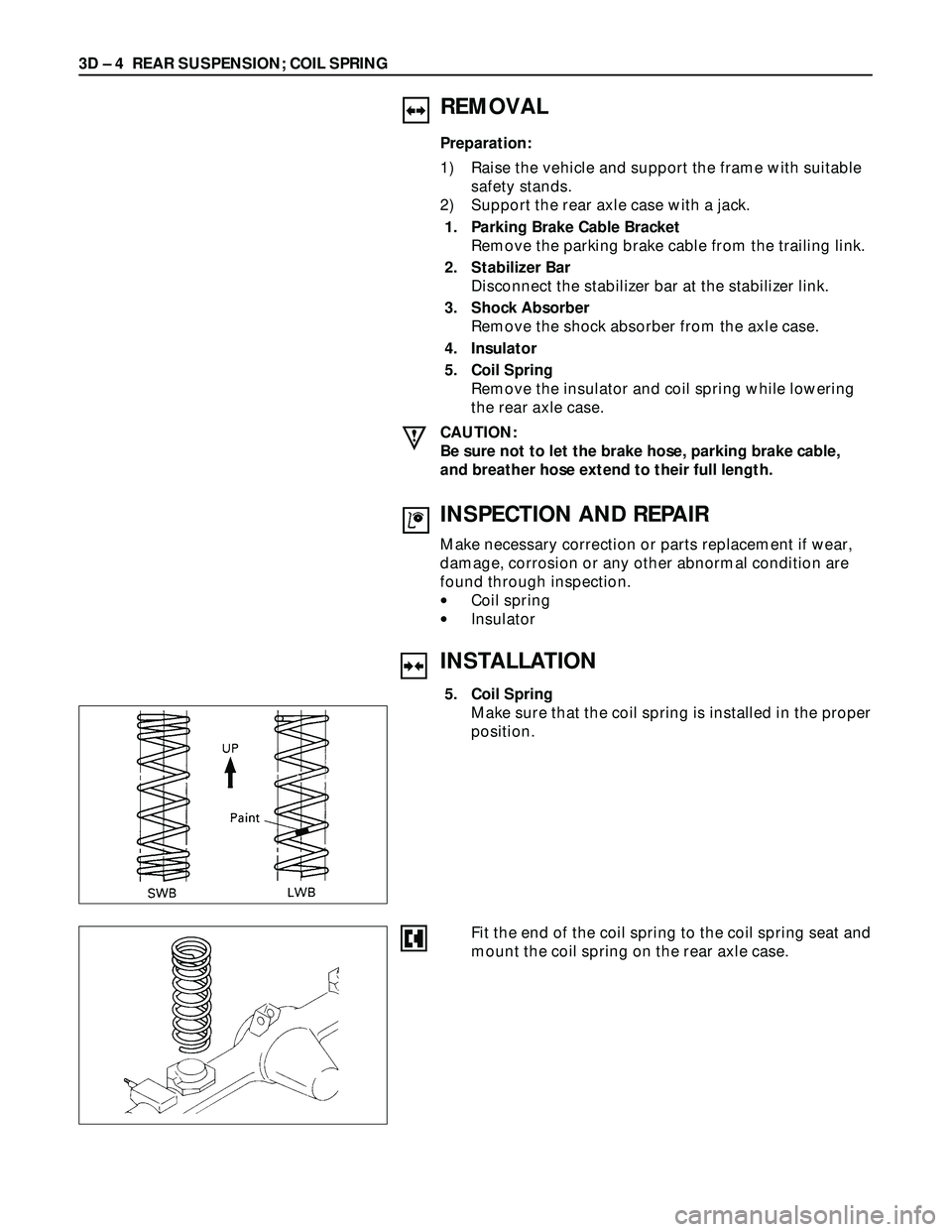
INSTALLATION
5. Coil Spring
Make sure that the coil spring is installed in the proper
position.
REMOVAL
Preparation:
1) Raise the vehicle and support the frame with suitable
safety stands.
2) Support the rear axle case with a jack.
1. Parking Brake Cable Bracket
Remove the parking brake cable from the trailing link.
2. Stabilizer Bar
Disconnect the stabilizer bar at the stabilizer link.
3. Shock Absorber
Remove the shock absorber from the axle case.
4. Insulator
5. Coil Spring
Remove the insulator and coil spring while lowering
the rear axle case.
CAUTION:
Be sure not to let the brake hose, parking brake cable,
and breather hose extend to their full length.
INSPECTION AND REPAIR
Make necessary correction or parts replacement if wear,
damage, corrosion or any other abnormal condition are
found through inspection.
•Coil spring
•Insulator
Fit the end of the coil spring to the coil spring seat and
mount the coil spring on the rear axle case.
Page 420 of 3573
REAR SUSPENSION; COIL SPRING 3D – 5
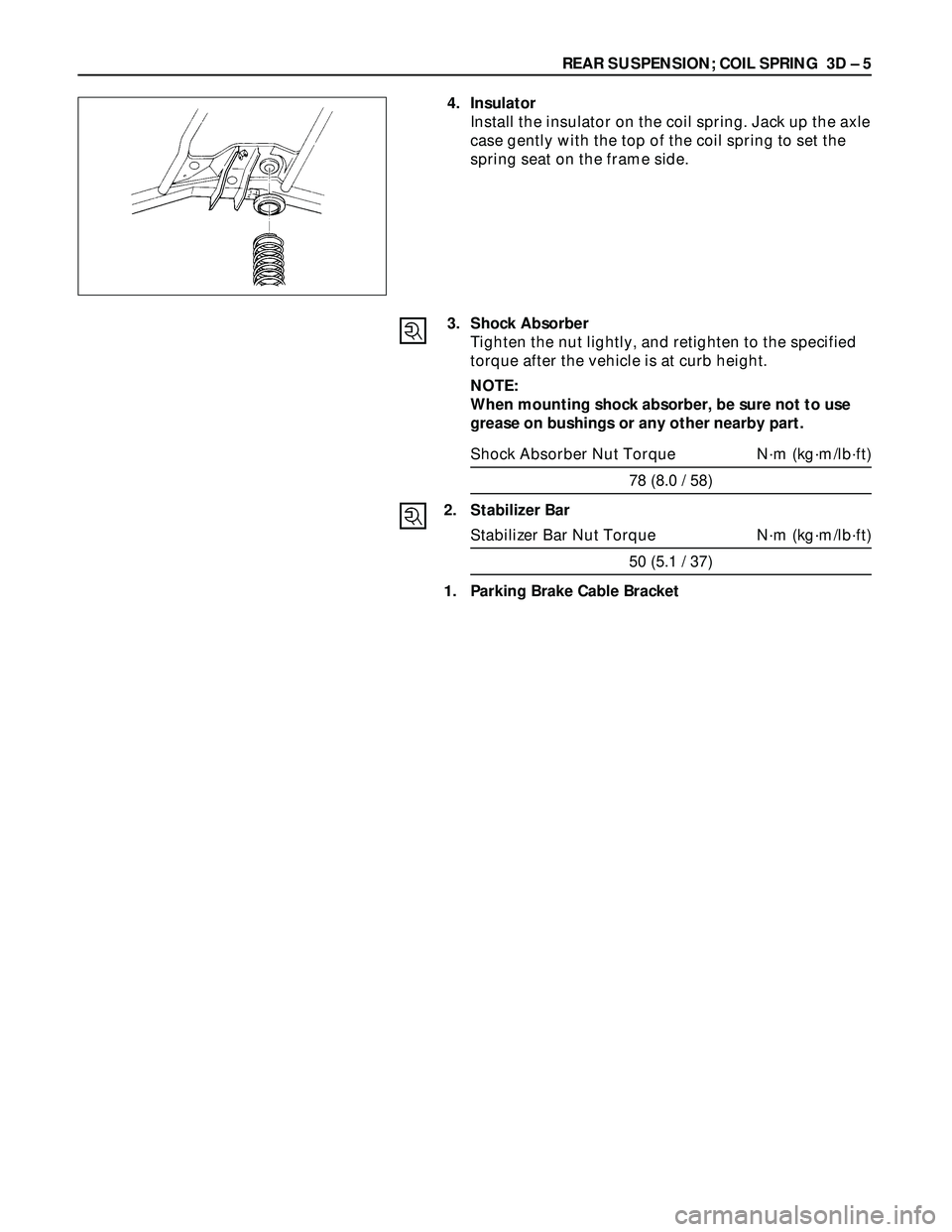
4. Insulator
Install the insulator on the coil spring. Jack up the axle
case gently with the top of the coil spring to set the
spring seat on the frame side.
3. Shock Absorber
Tighten the nut lightly, and retighten to the specified
torque after the vehicle is at curb height.
NOTE:
When mounting shock absorber, be sure not to use
grease on bushings or any other nearby part.
Shock Absorber Nut Torque N·m (kg·m/lb·ft)
78 (8.0 / 58)
2. Stabilizer Bar
Stabilizer Bar Nut Torque N·m (kg·m/lb·ft)
50 (5.1 / 37)
1. Parking Brake Cable Bracket
Page 423 of 3573
3D – 8 REAR SUSPENSION; COIL SPRING
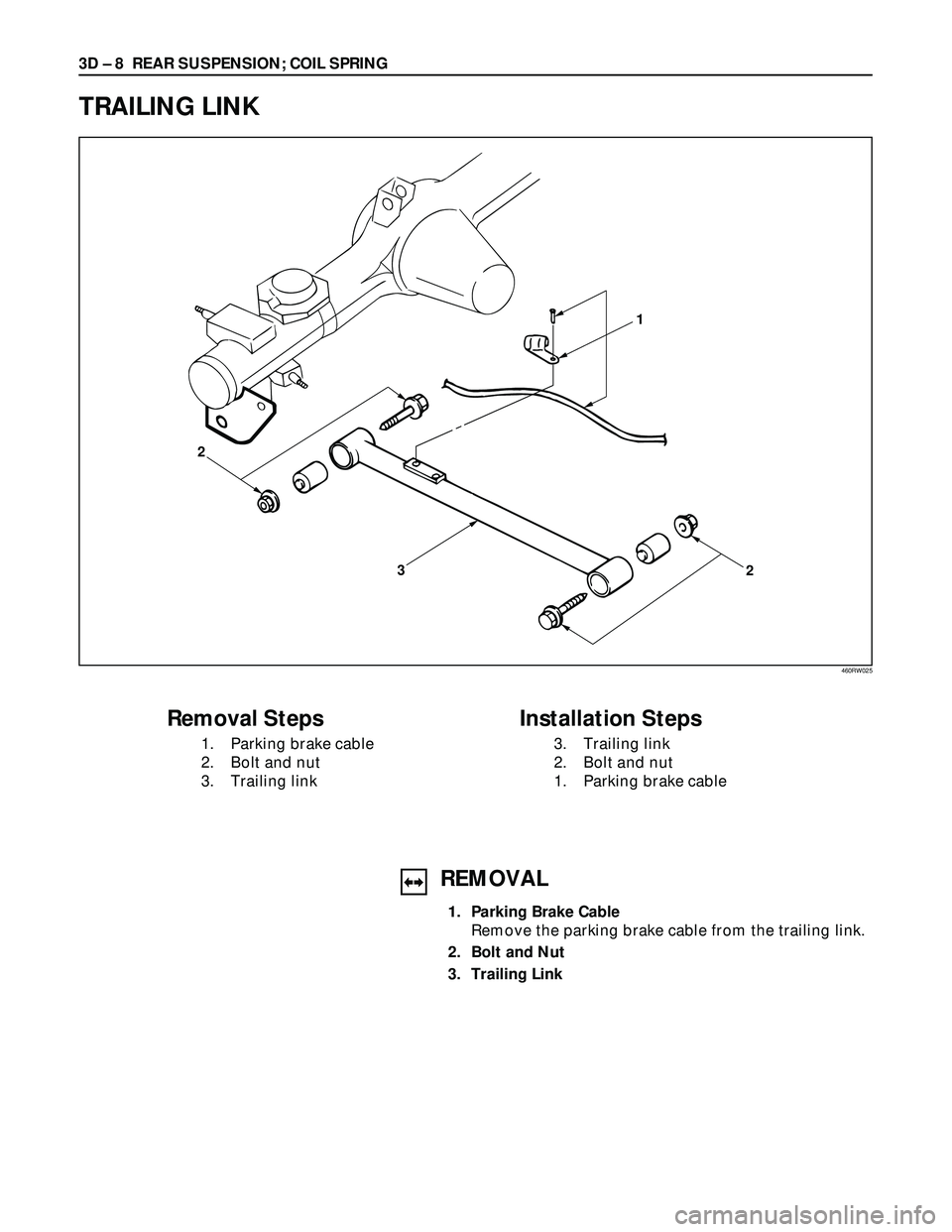
TRAILING LINK
2
3
2 1
Removal Steps
1. Parking brake cable
2. Bolt and nut
3. Trailing link
Installation Steps
3. Trailing link
2. Bolt and nut
1. Parking brake cable
REMOVAL
1. Parking Brake Cable
Remove the parking brake cable from the trailing link.
2. Bolt and Nut
3. Trailing Link
460RW025
Page 424 of 3573
REAR SUSPENSION; COIL SPRING 3D – 9
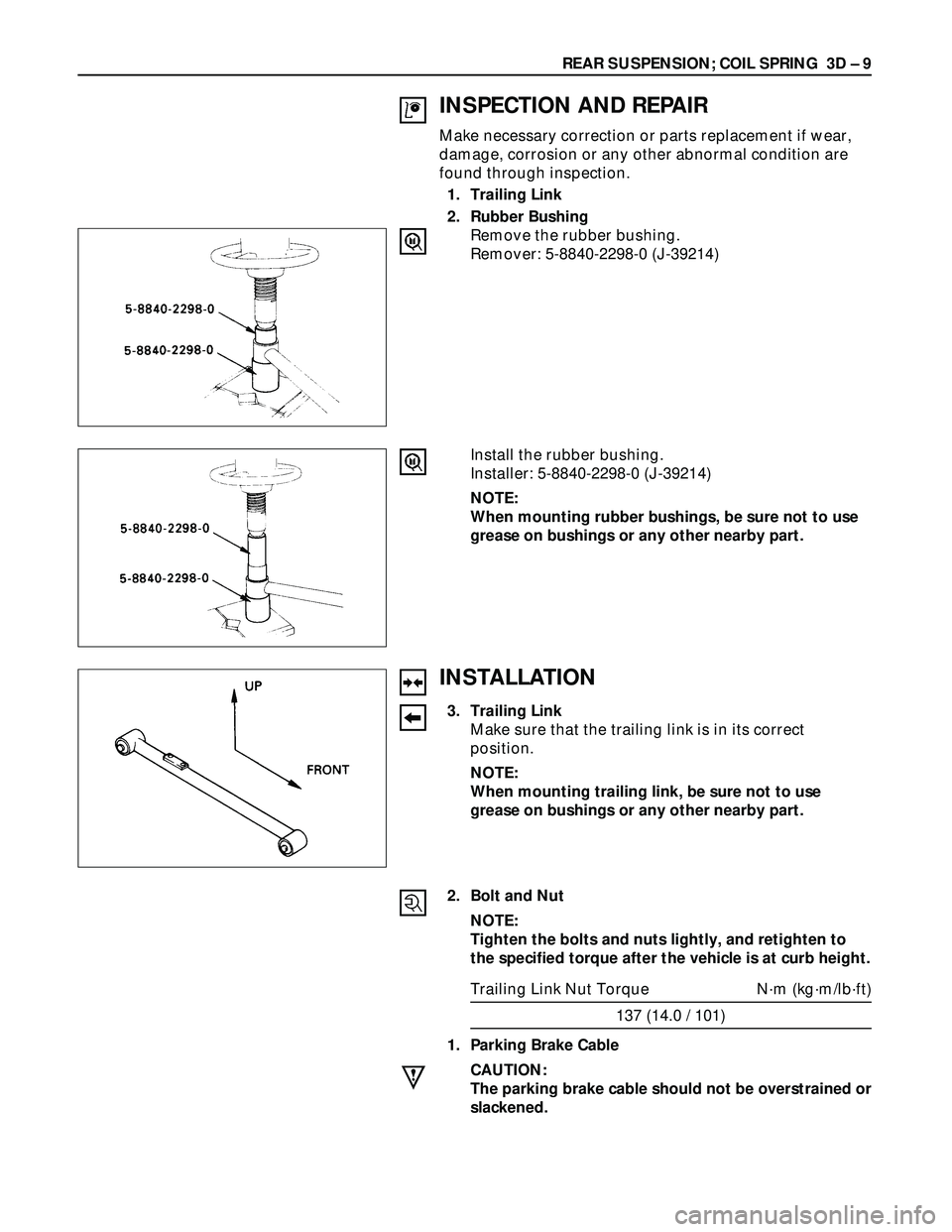
INSPECTION AND REPAIR
Make necessary correction or parts replacement if wear,
damage, corrosion or any other abnormal condition are
found through inspection.
1. Trailing Link
2. Rubber Bushing
Remove the rubber bushing.
Remover: 5-8840-2298-0 (J-39214)
Install the rubber bushing.
Installer: 5-8840-2298-0 (J-39214)
NOTE:
When mounting rubber bushings, be sure not to use
grease on bushings or any other nearby part.
INSTALLATION
3. Trailing Link
Make sure that the trailing link is in its correct
position.
NOTE:
When mounting trailing link, be sure not to use
grease on bushings or any other nearby part.
2. Bolt and Nut
NOTE:
Tighten the bolts and nuts lightly, and retighten to
the specified torque after the vehicle is at curb height.
Trailing Link Nut Torque N·m (kg·m/lb·ft)
137 (14.0 / 101)
1. Parking Brake Cable
CAUTION:
The parking brake cable should not be overstrained or
slackened.