warning light JAGUAR XF 2010 1.G User Guide
[x] Cancel search | Manufacturer: JAGUAR, Model Year: 2010, Model line: XF, Model: JAGUAR XF 2010 1.GPages: 225, PDF Size: 8 MB
Page 79 of 225

R
(FM8) SEMCON JLR OWNER GUIDE VER 1.00 EURO
LANGUAGE: english-en; MARQUE: jaguar; MODEL: XF
Intelligent stop/start
79
Intelligent stop/startECO STOP/START
The Stop/Start system is designed to improve
fuel efficiency and is automatically activated
when the ignition is turned on. If the vehicle is
stopped (e.g. at traffic lights or in traffic), the
engine will turn off ( unless it is required to
support other vehicle systems). When the
brake is released and a drive gear is selected,
the engine will restart automatically.
To activate an automatic engine stop:
• Stop the vehicle from a speed greater than
4 km/h (2.5 mph) and apply sufficient
brake pressure to ensure the vehicle is
stationary.
• Alternatively, whilst stationary, select P
(Park) or N (Neutral).
To activate an automatic engine restart release
the brake pedal with D (Drive) or S (Sport)
selected. The engine will also restart if one of the
following occurs:
•
The accelerator pedal is pressed.
• A shift paddle is used to select a gear.
• R (Reverse) is selected.
• Climate control system demand increases.
• The vehicle’s speed exceeds approximately
1 km/h (0.5 mph).
• Battery charge becomes low.
• Brake vacuum has be en reduced (e.g.
using the brake pedal repeatedly with the
engine off).
• Stop/Start is deactivated.
The following conditions will prevent an
automatic engine stop:
• A shift paddle has been used to select a
gear.
• The external temperature is less than
approximately 0 °C (32 °F).
• The external temperature is more than
approximately 40 °C (104 °F).
• The engine has not reached operating
temperature.
• The driver's door is opened.
• The driver’s seat belt is not fastened.
• The climate control system demand
requires the engine to be running (for
example, in Defrost mode).
• The battery charge is low.
• The bonnet is opened.
• Stop/Start is deactivated.
The warning lamp in the
instrument panel
illuminates when
the engine has been switched off
by the Stop/Start system.
Page 87 of 225
R
(FM8) SEMCON JLR OWNER GUIDE VER 1.00 EURO
LANGUAGE: english-en; MARQUE: jaguar; MODEL: XF
Brakes
87
BrakesIMPORTANT INFORMATION
Do not rest your foot on the brake
pedal whilst the vehicle is in motion.
Never allow the vehicle to coast
(freewheel) with the engine turned off.
The engine must be running to provide
full braking assistance. The brakes
will still function wi th the engine off,
but far more pressure will be required
to operate them.
If the red brake warning lamp
illuminates, safely bring the vehicle to
a stop, as quickly as possible and
seek qualified assistance.
Never place non-approved floor
matting or any other obstructions
under the brake pedal. This restricts
pedal travel and braking efficiency.
Driving through heavy rain or water can have
an adverse effect on braking efficiency. Under
such circumstances, it is recommended that
you lightly apply the brak es intermittently to
dry the brakes.
BRAKE WARNING LAMPS
Note: This warning lamp will also illuminate if
there is a fault with the parking brake. See 88,
ELECTRIC PARKIN G BRAKE (EPB).
ELECTRONIC BRAKE FORCE
DISTRIBUTION (EBD)
EBD balances the distribution of braking forces
between the wheels on the front and rear axles,
to maintain maximum braking under all vehicle
loading conditions.
For example; Under light loads, EBD applies
less braking effort to the rear wheels, to
maintain stability. Conv ersely, it allows full
braking effort to the rear wheels when the
vehicle is heavily laden.
A fault with the EBD system is indicated by the
red brake warning lamp and the message EBD
FAULT . The braking system will still operate,
but without EBD assist ance. Seek qualified
assistance to have the fault rectified.
EMERGENCY BRAKE ASSIST (EBA)
The EBA system measures the rate at which the
brake pressure increases. If the system detects
an emergency braki ng situation, EBA
automatically initiates fu ll braking effect. This
can reduce stopping distances in critical
situations.
A fault with the EBA system is indicated by the
brake warning lamp illuminating and
Emergency Brake Assist Not Available
displaying in the message centre. The braking
system will still func tion, but without EBA
assistance. Seek qualified assistance to have
the fault rectified.
EMERGENCY STOP SIGNAL (ESS)
ESS (Emergency Stop Signal) automatically
activates the hazard warning lights during
emergency braking to warn other road users
and reduce the risk of a collision.
If the parking brake
is released and
this red warning lamp illuminates
while driving and/or the message
Brake Fluid Low is displayed in the
message centre, check the brake
fluid level at the earliest
opportunity and top-up as
required.
If this amber warning lamp
illuminates while driving and/or
ABS Fault is displayed in the
message centre, drive with extra
caution, avoid heavy braking
where possible, and seek qualified
assistance as soon as possible.
Page 89 of 225
R
(FM8) SEMCON JLR OWNER GUIDE VER 1.00 EURO
LANGUAGE: english-en; MARQUE: jaguar; MODEL: XF
Tyre pressure monitoring system
89
Tyre pressure monitoring systemTYRE PRESSURE MONITORING
SYSTEM (TPMS)
The TPM system provides a low
pressure warning and does not
re-inflate your tyres. Tyre pressures
should be checked regularly using an
accurate pressure gauge when cold.
The TPM system can NOT register
damage to a tyre. Regularly check the
condition of your tyres, especially if
the vehicle is driven off-road.
When inflating tyre s, care should be
taken to avoid bending or damaging the
TPM system valves. Always ensure
correct alignment of the inflation head
to the valve stem.
Note: Non-approved accessories may interfere
with the system. If this occurs, TYRE
PRESSURE MONITORI NG SYSTEM FAULT is
displayed in the message centre.
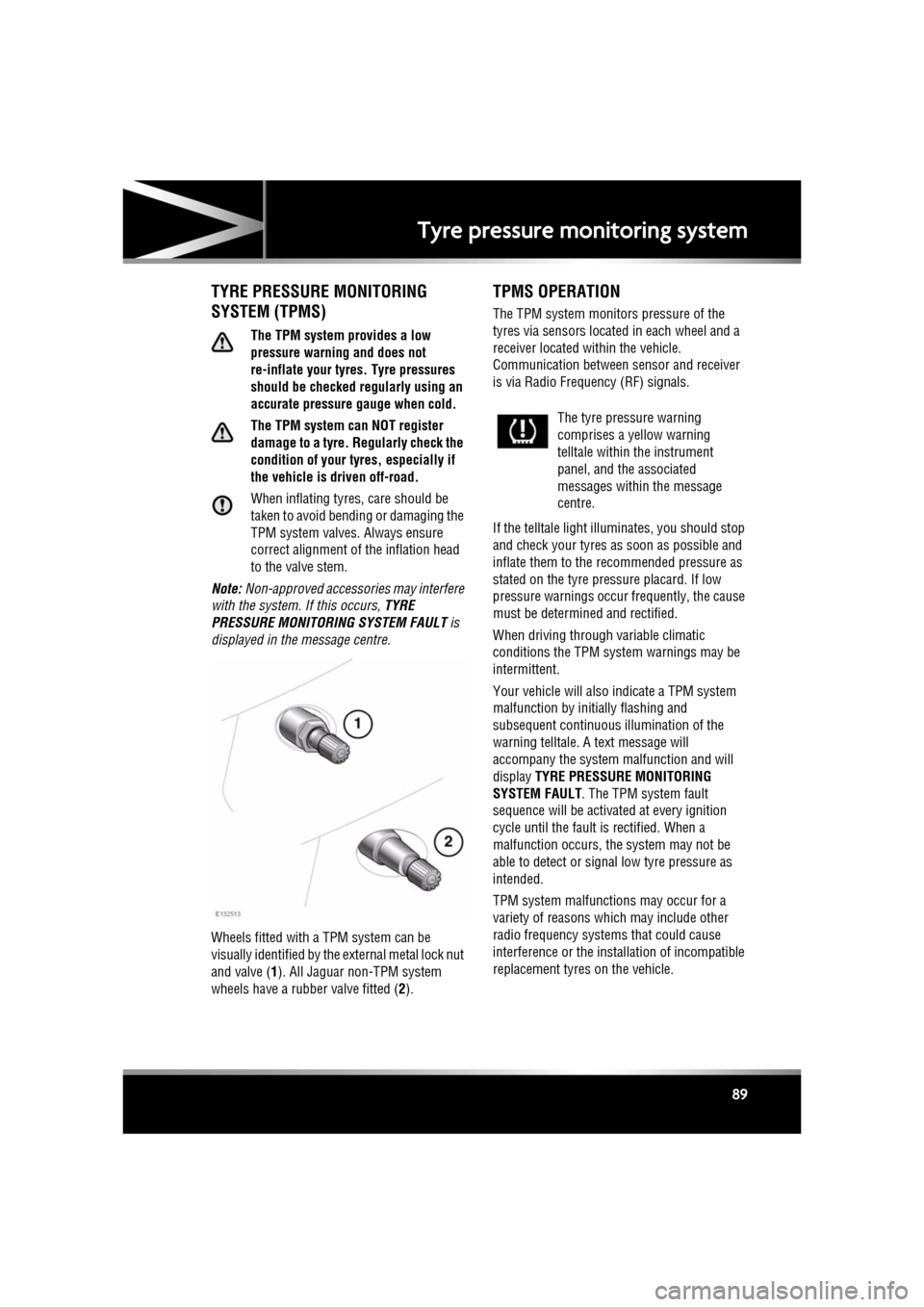
Wheels fitted with a TPM system can be
visually identified by the external metal lock nut
and valve ( 1). All Jaguar n on-TPM system
wheels have a rubber valve fitted (2).
TPMS OPERATION
The TPM system monitors pressure of the
tyres via sensors located in each wheel and a
receiver located within the vehicle.
Communication between sensor and receiver
is via Radio Freque ncy (RF) signals.
If the telltale light illu minates, you should stop
and check your tyres as soon as possible and
inflate them to the recommended pressure as
stated on the tyre pressure placard. If low
pressure warnings occur frequently, the cause
must be determined and rectified.
When driving through variable climatic
conditions the TPM syst em warnings may be
intermittent.
Your vehicle will also indicate a TPM system
malfunction by initially flashing and
subsequent continuous illumination of the
warning telltale. A text message will
accompany the system malfunction and will
display TYRE PRESSURE MONITORING
SYSTEM FAULT . The TPM system fault
sequence will be activated at every ignition
cycle until the fault is rectified. When a
malfunction occurs, the system may not be
able to detect or signal low tyre pressure as
intended.
TPM system malfuncti ons may occur for a
variety of reasons which may include other
radio frequency systems that could cause
interference or the installation of incompatible
replacement tyres on the vehicle.
The tyre pressure warning
comprises a yellow warning
telltale within the instrument
panel, and the associated
messages within the message
centre.
Page 101 of 225
R
(FM8) SEMCON JLR OWNER GUIDE VER 1.00 EURO
LANGUAGE: english-en; MARQUE: jaguar; MODEL: XF
Adaptive cruise control
101
The sensitivity of th e warning can only be
adjusted with ACC disengaged. Adjust as
follows:
• Roll the gap adjustment control
downwards to decrease the sensitivity of
the alert.
• Roll the gap adjustment control upwards to
increase the sensitivity of the alert.
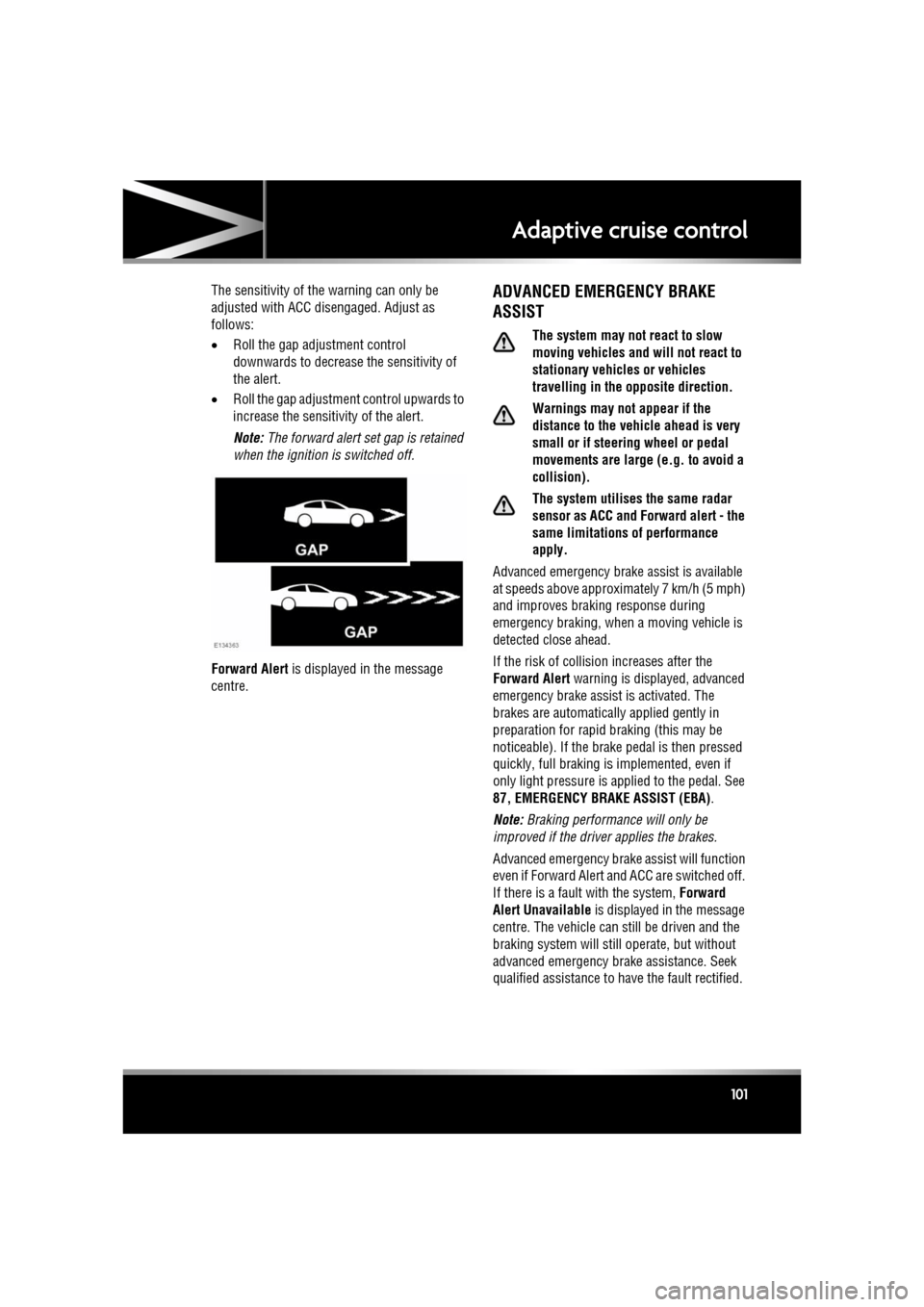
Note: The forward alert set gap is retained
when the ignition is switched off.
Forward Alert is displayed in the message
centre.ADVANCED EMERGENCY BRAKE
ASSIST
The system may not react to slow
moving vehicles and will not react to
stationary vehicles or vehicles
travelling in the opposite direction.
Warnings may not appear if the
distance to the vehicle ahead is very
small or if steering wheel or pedal
movements are large (e.g. to avoid a
collision).
The system utilises the same radar
sensor as ACC and Forward alert - the
same limitations of performance
apply.
Advanced emergency brake assist is available
at speeds above approximately 7 km/h (5 mph)
and improves brakin g response during
emergency braking, when a moving vehicle is
detected close ahead.
If the risk of collision increases after the
Forward Alert warning is displayed, advanced
emergency brake assist is activated. The
brakes are automatically applied gently in
preparation for rapid braking (this may be
noticeable). If the brake pedal is then pressed
quickly, full braking is implemented, even if
only light pressure is ap plied to the pedal. See
87, EMERGENCY BRAKE ASSIST (EBA) .
Note: Braking performance will only be
improved if the driver applies the brakes.
Advanced emergency brake assist will function
even if Forward Alert and ACC are switched off.
If there is a fault with the system, Forward
Alert Unavailable is displayed in the message
centre. The vehicle can st ill be driven and the
braking system will still operate, but without
advanced emergency brake assistance. Seek
qualified assistance to have the fault rectified.
Page 149 of 225
R
(FM8) SEMCON JLR OWNER GUIDE VER 1.00 EURO
LANGUAGE: english-en; MARQUE: jaguar; MODEL: XF
Tyre repair kit
149
USING THE TYRE REPAIR KIT
Avoid skin contact with the sealant
which contains natural rubber latex.
If the tyre inflation pressure does not
reach 1.8 bar (26 psi, 180 kPa) within
seven minutes, the tyre may have
suffered excessive damage. A
temporary repair will not be possible,
and the vehicle should not be driven
until the tyre has been replaced.
Before attempting a tyre repair, ensure
that the vehicle is parked safely, as far
away from passing traffic as possible.
Ensure that the parking brake is applied
and P (Park) is selected.
Do not attempt to remove foreign
objects such as nails, screws, etc. from
the tyre.
Always run the engine when using the
compressor, unless the vehicle is in an
enclosed or poorly ventilated space, as
this may cause asphyxiation.
To prevent overheatin g, do not operate
the compressor continuously for longer
than ten minutes.
Note: All vehicle drivers and occupants should
be made aware that a temporary repair has
been made to a tyre fitt ed to the vehicle. They
should also be made aware of the special
driving conditions im posed when using a
repaired tyre.
REPAIR PROCEDURE
Check the tyre sidewall prior to
inflation. If there are any cracks,
bumps or similar damage, do not
attempt to inflate the tyre. Do not
stand directly besi de the tyre while
the compressor is pumping. Watch the
tyre sidewall. If any cracks, bumps or
similar damage appear, turn off the
compressor and let the air out by
means of the pressure relief valve. Do
not continue to use the tyre.
1. Open the tyre repair kit and peel off the
maximum speed label. Attach the label to
the facia in the driver's field of vision. Take
care not to obstruct an y of the instruments
or warning lights.
2. Uncoil the compressor power cable and
the inflation hose.
3. Unscrew the orange cap from the sealant
bottle receiver and the sealant bottle cap.
4. Screw the sealant bottle into the receiver
(clockwise) until tight.
•Screwing the bottle onto the receiver
will pierce the bottle's seal. Once the
receiver has been fitted, a ratchet
prevents it from being removed.
5. Remove the valve cap from the damaged
tyre.
6. Remove the protective cap from the
inflation hose and connect the inflation
hose to the tyre valve. Ensure that the hose
is screwed on firmly.
7. Ensure that the compressor switch is in the
off ( 0) position.
8. Insert the power cable connector into the
auxiliary power socket.
9. Unless the vehicle is in an enclosed area,
start the engine.
Page 168 of 225
L
(FM8) SEMCON JLR OWNER GUIDE VER 1.00 EURO
LANGUAGE: english-en; MARQUE: jaguar; MODEL: XF
Fluid level checks
168
Fluid level checksCHECKING THE ENGINE OIL LEVEL
Check the engine oil weekly. If any
significant or sudden drop in oil level is
noted, seek qualified assistance.
If the message ENGINE OIL PRESSURE
LOW is displayed, stop the engine as
soon as it is safe to do so and seek
qualified assistance. Do not start the
engine until the cause has been
rectified.
Prior to checking the oil level ensure that the
vehicle is on level ground.
All except V6 petrol engines
Ensure that:
• The engine oil has reached working
temperature (oil is hot).
• The engine has been switched off for ten
minutes, as the syst em will not give an
accurate reading until the oil level has
stabilised.
The oil level can then be checked as follows:
1. Switch on the ignition (do not start the
engine).
2. Ensure Park (P ) is selected.
3. Press the trip button (on the end of the
lighting control stalk) repeatedly until the
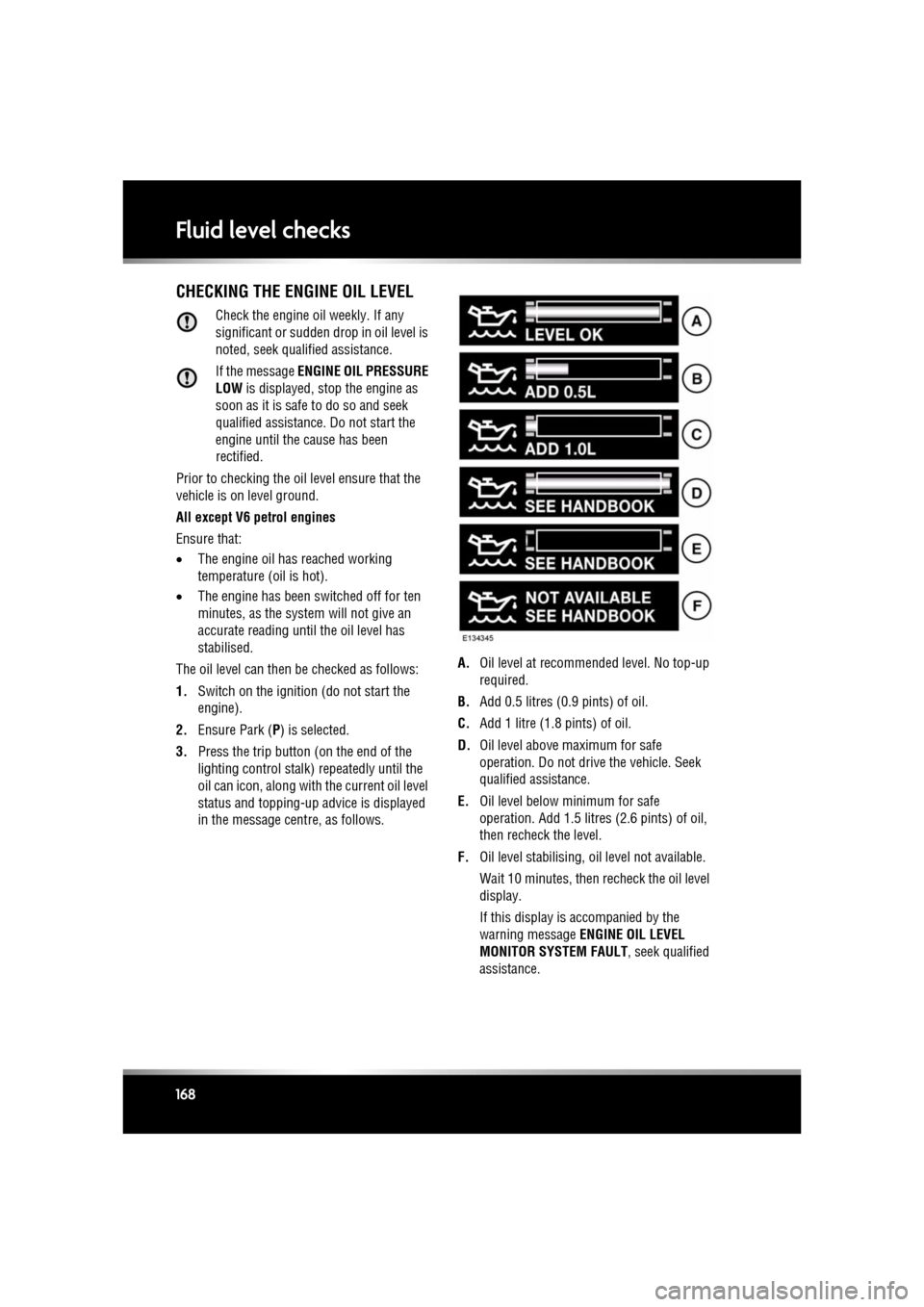
oil can icon, along with the current oil level
status and topping-up ad vice is displayed
in the message centre, as follows. A.
Oil level at recommended level. No top-up
required.
B. Add 0.5 litres (0.9 pints) of oil.
C. Add 1 litre (1.8 pints) of oil.
D. Oil level above maximum for safe
operation. Do not drive the vehicle. Seek
qualified assistance.
E. Oil level below mi nimum for safe
operation. Add 1.5 litres (2.6 pints) of oil,
then recheck the level.
F. Oil level stabilising, oil level not available.
Wait 10 minutes, then recheck the oil level
display.
If this display is accompanied by the
warning message ENGINE OIL LEVEL
MONITOR SYSTEM FAULT , seek qualified
assistance.
Page 194 of 225
L
(FM8) SEMCON JLR OWNER GUIDE VER 1.00 EURO
LANGUAGE: english-en; MARQUE: jaguar; MODEL: XF
Wheel changing
194
Wheel changingWHEEL CHANGING SAFETY
Before raising the vehicl e, or changing a wheel
ensure that you read, and comply with the
following warnings.
Always find a safe place to stop, off
the highway and aw ay from traffic.
Ensure that the vehicle and jack are
both on firm level ground.
Apply the parking brake, and engage
Park (P).
Switch on the hazard warning lamps.
Ensure that the front wheels are in the
straight ahead position, and engage
the steering lock.
Disconnect trailer/ca ravan from the
vehicle.
Ensure that all passengers, and
animals, are out of the vehicle and in
a safe place away from the highway.
Place a warning triangle at a suitable
distance behind the v ehicle, facing
towards oncoming traffic.
When one rear wheel is lifted off the
ground the selection P (Park) position
will not prevent the vehicle from
moving and possibly slipping off the
jack as the park brake only operates
on the rear wheels. Use the wheel
chock when jacking the vehicle.
Always chock the wheel diagonally
opposite the wheel to be changed,
using the wheel chock supplied in the
tool kit. Chock the front of a front
wheel, or the rear of a rear wheel.
If jacking the vehicle on a slight slope
is unavoidable, place chocks on the
downhill side of the two opposite
wheels. An additional chock will be
needed. Never place anything between the jack
and the ground, or the jack and the
vehicle.
Do not attempt to raise the vehicle
unless the jack head is fully engaged
in the jacking point. Only jack the
vehicle using the approved jacking
points.
Remove the spare wheel prior to
jacking the vehicle, to avoid
destabilising the vehicle when raised.
Take care when lifting the spare
wheel, and removing the punctured
wheel. The wheels are heavy, and can
cause injuries if not handled correctly.
Do not start or run the engine while the
vehicle is support
ed only by a jack.
Do not get under a vehicle that is
supported by a jack.
Never work or allow any person to
place any part of their body beneath
the vehicle with the jack as the only
means of support - use vehicle
support stands.
Take care when loosening the wheel
nuts. The wheel brace may slip off if
not properly attached, and the wheel
nuts may release suddenly. Either
unexpected movement may cause an
injury.
After use, the tool kit should be
returned to the under floor storage
area and correctly stowed.
Always ensure replacement tyres
have the correct rating and
specifications (e.g. load index, size,
speed rating) for your vehicle.
Page 196 of 225
L
(FM8) SEMCON JLR OWNER GUIDE VER 1.00 EURO
LANGUAGE: english-en; MARQUE: jaguar; MODEL: XF
Wheel changing
196
TEMPORARY USE SPARE WHEEL
Observe the following warnings before using
the wheel:
Always adhere to the instructions
given on the temporary use spare
wheel warning label. Failure to
comply can be dangerous.
When a temporary use spare wheel is
fitted, drive with caution and replace
with the specified wheel and tyre as
soon as possible.
Do not fit more than one temporary
use spare wheel and ty re assembly at
one time.
The temporary use spare wheel must
be inflated to 4.2 bar (60 psi, 420 kPa)
and cannot be repaired.
Temporary use spare wheel,
maximum speed is 80 km/h (50 mph).
DSC must be on when the temporary
use spare wheel is in use.
LOCKING WHEEL NUTS
Note: A code number is stam ped on the side of
the locking nut. Ensure the number is recorded
on the Security Card supplied with the
literature pack. Quot e this number if a
replacement is require d. Do not keep the
Security Card in the vehicle.
TIGHTENING THE WHEEL NUTS
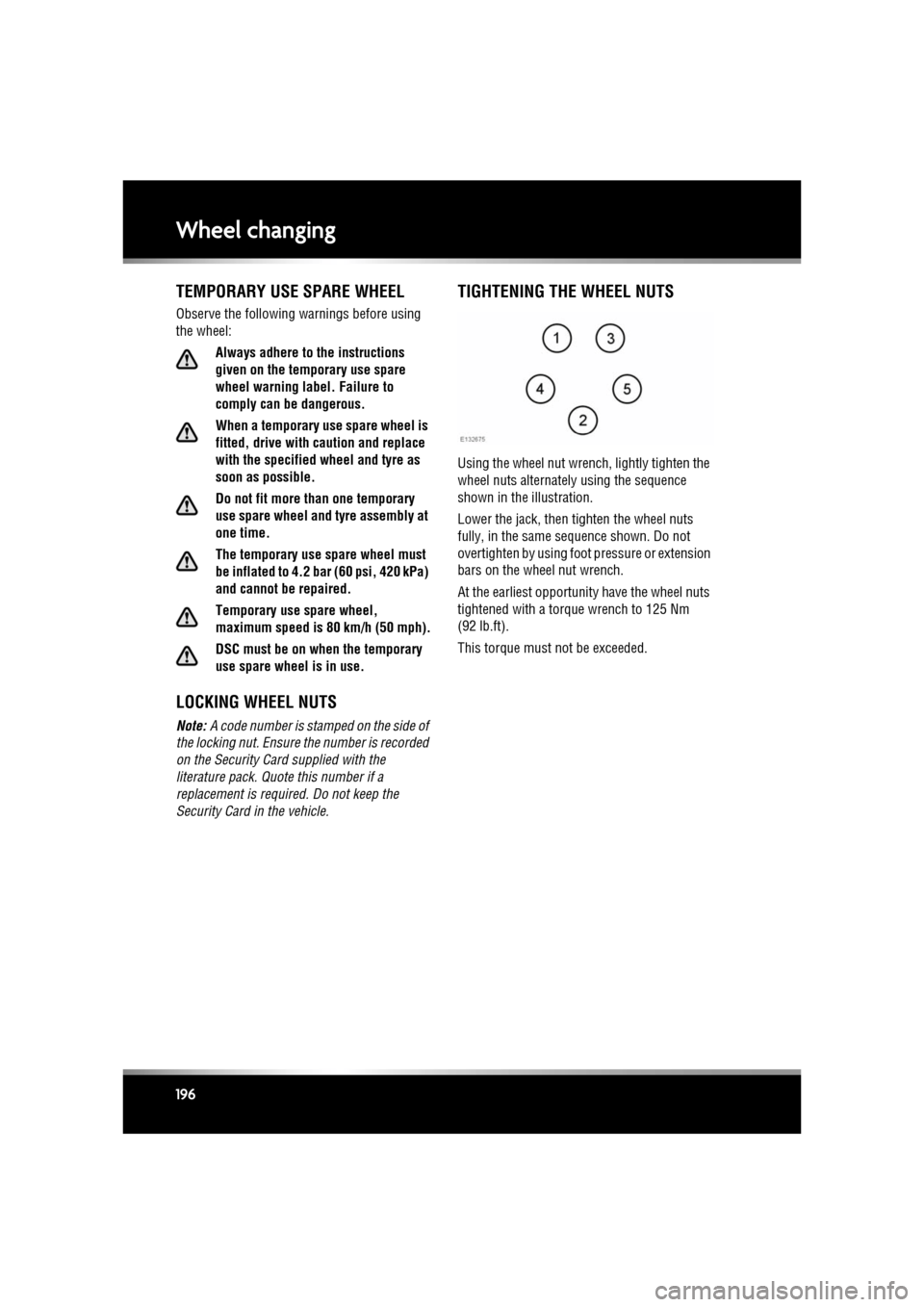
Using the wheel nut wrench, lightly tighten the
wheel nuts alternately using the sequence
shown in the illustration.
Lower the jack, then tighten the wheel nuts
fully, in the same se quence shown. Do not
overtighten by using foot pressure or extension
bars on the wheel nut wrench.
At the earliest opportunity have the wheel nuts
tightened with a torque wrench to 125 Nm
(92 lb.ft).
This torque must not be exceeded.
Page 205 of 225

R
english-en (10, 18, 21 & 25)
Index
205
A
ABS (Anti-lock braking system)warning lamp . . . . . . . . . . . . . . . . . . . . . 52
ACC (Adaptive cruise control) . . . . . . . . . . 96 ASL (Active speed limiter) . . . . . . . . . . 103
ASL (Automatic speed limiter)
setting . . . . . . . . . . . . . . . . . . . . . . . 103
suspending . . . . . . . . . . . . . . . . . . . 103
automatic switch-off . . . . . . . . . . . . . . . 98
driving hints . . . . . . . . . . . . . . . . . . . . . 99
fault . . . . . . . . . . . . . . . . . . . . . . . . . . . 100
follow mode. . . . . . . . . . . . . . . . . . . . . . 97
gap change . . . . . . . . . . . . . . . . . . . . . . 98
low speed switch-off . . . . . . . . . . . . . . . 98
malfunction . . . . . . . . . . . . . . . . . . . . . 100
override . . . . . . . . . . . . . . . . . . . . . . . . . 98
resume follow mode . . . . . . . . . . . . . . . 99
resume set speed . . . . . . . . . . . . . . . . . 99
warning lamp . . . . . . . . . . . . . . . . . . . . . 53
ACC (adaptive cruise control)
operating . . . . . . . . . . . . . . . . . . . . . . . . 96
Active differential control. . . . . . . . . . . . . . 85
Active head restraints
airbags. . . . . . . . . . . . . . . . . . . . . . . . . . 32
Adaptive dynamics . . . . . . . . . . . . . . . . . . 84
Adaptive front light ing system (AFS)
warning lamp . . . . . . . . . . . . . . . . . . . . . 53
AFS (Adaptive front lighting system) . . . . . 37
After a collision
pedestrian protection system . . . . . . . 198
Age degradation (tyres) . . . . . . . . . . . . . . 186
Air conditioning
air quality sensor . . . . . . . . . . . . . . . . . . 65
auto . . . . . . . . . . . . . . . . . . . . . . . . . . . . 65
Air quality sensor . . . . . . . . . . . . . . . . . . . 65
Airbags active head restraints. . . . . . . . . . . . . . . 32
deployment . . . . . . . . . . . . . . . . . . . 33, 34
module covers . . . . . . . . . . . . . . . . . . . 167
service information . . . . . . . . . . . . . . . . 35
SRS (Supplementary re straint system) 158
warning lamps . . . . . . . . . . . . . . . . . 34, 53
Alarm. . . . . . . . . . . . . . . . . . . . . . . . . 10, 158 automatic relocking and arming . . . . . . . 11
battery backed sounder. . . . . . . . . . . . . . 11
deactivating. . . . . . . . . . . . . . . . . . . . . . . 11
passive arming . . . . . . . . . . . . . . . . . . . . 11
perimeter . . . . . . . . . . . . . . . . . . . . . . . . 11
sensor fault . . . . . . . . . . . . . . . . . . . . . . . 11
tilt sensor . . . . . . . . . . . . . . . . . . . . . . . . 11
Anchor points (ISOFIX). . . . . . . . . . . . . . . . 30
Anchor points (luggage) . . . . . . . . . . . . . . . 68
Antifreeze level check . . . . . . . . . . . . . . . . 170
Anti-theft system . . . . . . . . . . . . . . . . . . . 158
Anti-trap mechanism
sunroof . . . . . . . . . . . . . . . . . . . . . . . . . . 43
Anti-trap protection windows . . . . . . . . . . . . . . . . . . . . . . . . . 43
Approach lamps . . . . . . . . . . . . . . . . . . . . . 37
Arduous driving conditions. . . . . . . . . . . . 159
ASL (Automatic speed limiter) . . . . . . . . . 103 gap change . . . . . . . . . . . . . . . . . . . . . . . 98
resuming. . . . . . . . . . . . . . . . . . . . . . . . 103
setting . . . . . . . . . . . . . . . . . . . . . . . . . . 103
suspending . . . . . . . . . . . . . . . . . . . . . . 103
warning lamp . . . . . . . . . . . . . . . . . 53, 103
Audible warnings . . . . . . . . . . . . . . . . . . . . 55
Audio Settings. . . . . . . . . . . . . . . . . . . . . . . . . 105
Audio system . . . . . . . . . . . . . . . . . . . . . . 166
Audio/video CD controls . . . . . . . . . . . . . . . . . . . . . . . 120
controls. . . . . . . . . . . . . . . . . . . . . . . . . 104
DAB reception . . . . . . . . . . . . . . . . . . . . . . 112
loading CDs . . . . . . . . . . . . . . . . . . . . . 119
loading DVDs . . . . . . . . . . . . . . . . . . . . 125
MP3 . . . . . . . . . . . . . . . . . . . . . . . . . . . 119
portable media connections. . . . . . . . . . . . . . . . . . . . 113
controls . . . . . . . . . . . . . . . . . . . . . . . 115
pairing . . . . . . . . . . . . . . . . . . . . 117, 118
play . . . . . . . . . . . . . . . . . . . . . . . . . . 117
television
controls . . . . . . . . . . . . . . . . . . . . . . . 122
Page 208 of 225

L
english-en (10, 18, 21 & 25)
Index
208
Daily checks . . . . . . . . . . . . . . . . . . . . . . 158
Data recording . . . . . . . . . . . . . . . . . . . . . 199
Daylight running lamps . . . . . . . . . . . . . . . 37
Dealer locations (Jaguar). . . . . . . . . . . . . 141
Declarations of conformity . . . . . . . . . . . 202navigation system . . . . . . . . . . . . . . . . 146
Derv sulphur content . . . . . . . . . . . . . . . . . . 153
Deselecting valet mode . . . . . . . . . . . . . . . 62
Destination entry . . . . . . . . . . . . . . . . . . . 138 postcode . . . . . . . . . . . . . . . . . . . . . . . 140
search area . . . . . . . . . . . . . . . . . . . . . 138
town . . . . . . . . . . . . . . . . . . . . . . . . . . 141
Detection beam issues . . . . . . . . . . . . . . . 99
Dialling a number . . . . . . . . . . . . . . . . . . 132
Diesel engine . . . . . . . . . . . . . . . . . . . . . 153, 154starting . . . . . . . . . . . . . . . . . . . . . . . 74
switching off . . . . . . . . . . . . . . . . . . . 75
filler flap. . . . . . . . . . . . . . . . . . . . 154, 155
fuel consumption . . . . . . . . . . . . . . . . . 157
misfuel device . . . . . . . . . . . . . . . . . . . 155
specification . . . . . . . . . . . . . . . . . . . . 156
sulphur content . . . . . . . . . . . . . . . . . . 153
water in fuel . . . . . . . . . . . . . . . . . . . . . 153
Diesel particulate filter (DPF) . . . . . . . . . . 159
Differential control . . . . . . . . . . . . . . . . . . . 85
Dimensions . . . . . . . . . . . . . . . . . . . . . . . 178
Direction indicators . . . . . . . . . . . . . . . . . . 36 warning lamp . . . . . . . . . . . . . . . . . . . . . 54
Disability modifications . . . . . . . . . . . . . . 158
Door mirrors BSM (Blind spot monitor)
sensor blockage . . . . . . . . . . . . . . . . . 47
system fault . . . . . . . . . . . . . . . . . . . . 47
Door transceiver
entry gate. . . . . . . . . . . . . . . . . . . . . . . . 50
garage door opener . . . . . . . . . . . . . . . . 48
programming. . . . . . . . . . . . . . . . . . . . . 48
programming a single button . . . . . . . . 49
rolling code device programming . . . . . 49
Double locking. . . . . . . . . . . . . . . . . . . . . . . 9
DPF (Diesel particulate filter) . . . . . . . . . . 159 Drive away locking . . . . . . . . . . . . . . . . . . . . 7
Drive control
operation. . . . . . . . . . . . . . . . . . . . . . . . . 86
Driver controls . . . . . . . . . . . . . . . . . . . . . 226
Driver information module information messages. . . . . . . . . . . . . . . 56
trip computer . . . . . . . . . . . . . . . . . . . . . 56
warning lamps . . . . . . . . . . . . . . . . . . . . 51
warning messages . . . . . . . . . . . . . . . . . 56
Driving ACC (Adaptive cruise c ontrol) . . . . . . 96, 99
override . . . . . . . . . . . . . . . . . . . . . . . . 98
adaptive cruise control automatic switch off . . . . . . . . . . . . . . 98
arduous conditions . . . . . . . . . . . . . . . . 159
ASL (Automatic speed limiter) . . . . . . . 103 setting . . . . . . . . . . . . . . . . . . . . . . . . 103
before starting. . . . . . . . . . . . . . . . . . . . 198
BSM (Blind spot monitor) sensor blockage . . . . . . . . . . . . . . . . . 47
controls. . . . . . . . . . . . . . . . . . . . . . . . . 226
cruise control automatic switch off . . . . . . . . . . . . . . 95
change speed . . . . . . . . . . . . . . . . . . . 94
set speed . . . . . . . . . . . . . . . . . . . . . . . 94
daily checks . . . . . . . . . . . . . . . . . . . . . 158
DSC warning lamp
active. . . . . . . . . . . . . . . . . . . . . . . . . . 53
off . . . . . . . . . . . . . . . . . . . . . . . . . . . . 53
dynamic mode . . . . . . . . . . . . . . . . . . . . 83
EBA (Emergency brake assist) . . . . . . . . 87
EBD (Electronic brake force distribution) 87
forward alert . . . . . . . . . . . . . . . . . . . . . 100
mirror dip when reversing. . . . . . . . . . . . 45
sitting correctly . . . . . . . . . . . . . . . . . . . . 15
wipers
rain sensor . . . . . . . . . . . . . . . . . . . . . 40
DSC (Dynamic st ability control)
switching between DSC and tracDSC . . . 84
switching off . . . . . . . . . . . . . . . . . . . . . . 84
switching on . . . . . . . . . . . . . . . . . . . . . . 84