Pin JAGUAR XF 2011 1.G Owner's Guide
[x] Cancel search | Manufacturer: JAGUAR, Model Year: 2011, Model line: XF, Model: JAGUAR XF 2011 1.GPages: 225, PDF Size: 7.32 MB
Page 185 of 225
R
(FM8) SEMCON JLR OWNER GUIDE VER 1.00 EURO
LANGUAGE: english-en; MARQUE: jaguar; MODEL: XF
Tyres
185
TyresTYRE CARE
Do not drive the vehi cle if a tyre is
damaged, excessively worn, or
incorrectly inflated.
Avoid contaminating the tyres with
vehicle fluids as they may cause
damage to the tyre.
Avoid spinning the wheels. The forces
released can damage the structure of
the tyre and cause it to fail.
If wheel spin is unavoidable due to a
loss of traction (in deep snow, for
example), do not exceed 50 km/h (30
mph).
Do not exceed the maximum pressure
stated on the sidewall of the tyre.
TYRE PRESSURES
Never drive your vehicle if the tyre
pressures are incorrect.
Pressure checks should only be
carried out when the tyres are cold,
and the vehicle has been stationary
for more than three hours. A hot tyre at
or below recommended cold inflation
pressure is dangerously
under-inflated.
If the vehicle has been parked in
strong sunlight, or used in high
ambient temperatures, do not reduce
the tyre pressures. Move the vehicle
into the shade and allow the tyres to
cool before re-checking the
pressures.
CHECKING THE TYRE PRESSURES
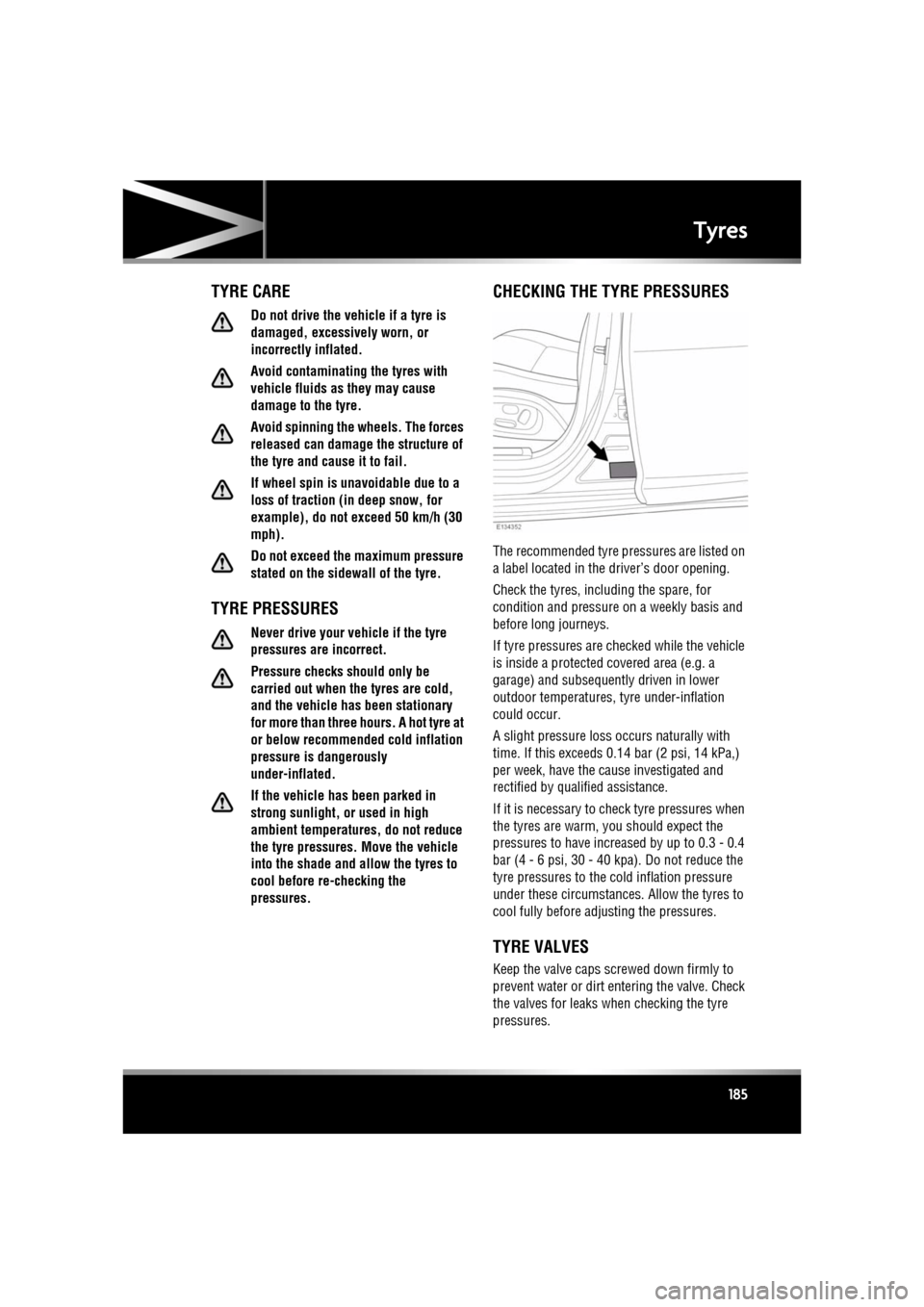
The recommended tyre pressures are listed on
a label located in the driver’s door opening.
Check the tyres, including the spare, for
condition and pressure on a weekly basis and
before long journeys.
If tyre pressures are checked while the vehicle
is inside a protected covered area (e.g. a
garage) and subsequent ly driven in lower
outdoor temperatures, tyre under-inflation
could occur.
A slight pressure loss occurs naturally with
time. If this exceeds 0. 14 bar (2 psi, 14 kPa,)
per week, have the cause investigated and
rectified by qualified assistance.
If it is necessary to check tyre pressures when
the tyres are warm, you should expect the
pressures to have increased by up to 0.3 - 0.4
bar (4 - 6 psi, 30 - 40 kpa). Do not reduce the
tyre pressures to the cold inflation pressure
under these circumstances. Allow the tyres to
cool fully before ad justing the pressures.
TYRE VALVES
Keep the valve caps screwed down firmly to
prevent water or dirt entering the valve. Check
the valves for leaks when checking the tyre
pressures.
Page 187 of 225
R
(FM8) SEMCON JLR OWNER GUIDE VER 1.00 EURO
LANGUAGE: english-en; MARQUE: jaguar; MODEL: XF
Tyres
187
APPROVED WINTER TYRE SIZES
Front :
• Dunlop Wintersport M3 - 235/55R17 99H,
245/45R18 96V, 245/45R18 100V,
245/40R19 98V.
• W240 Pirelli Sotto Zero - 245/45R18 100V,
245/40R19 98V, 255/35R20 97V.
Rear:
• Dunlop Wintersport M3 - 235/55R17 99H,
245/45R18 96V, 245/45R18 100V,
245/40R19 98V.
• W240 Pirelli Sotto Zero - 245/45R18 100V,
245/40R19 98V, 285/30R20 97V.
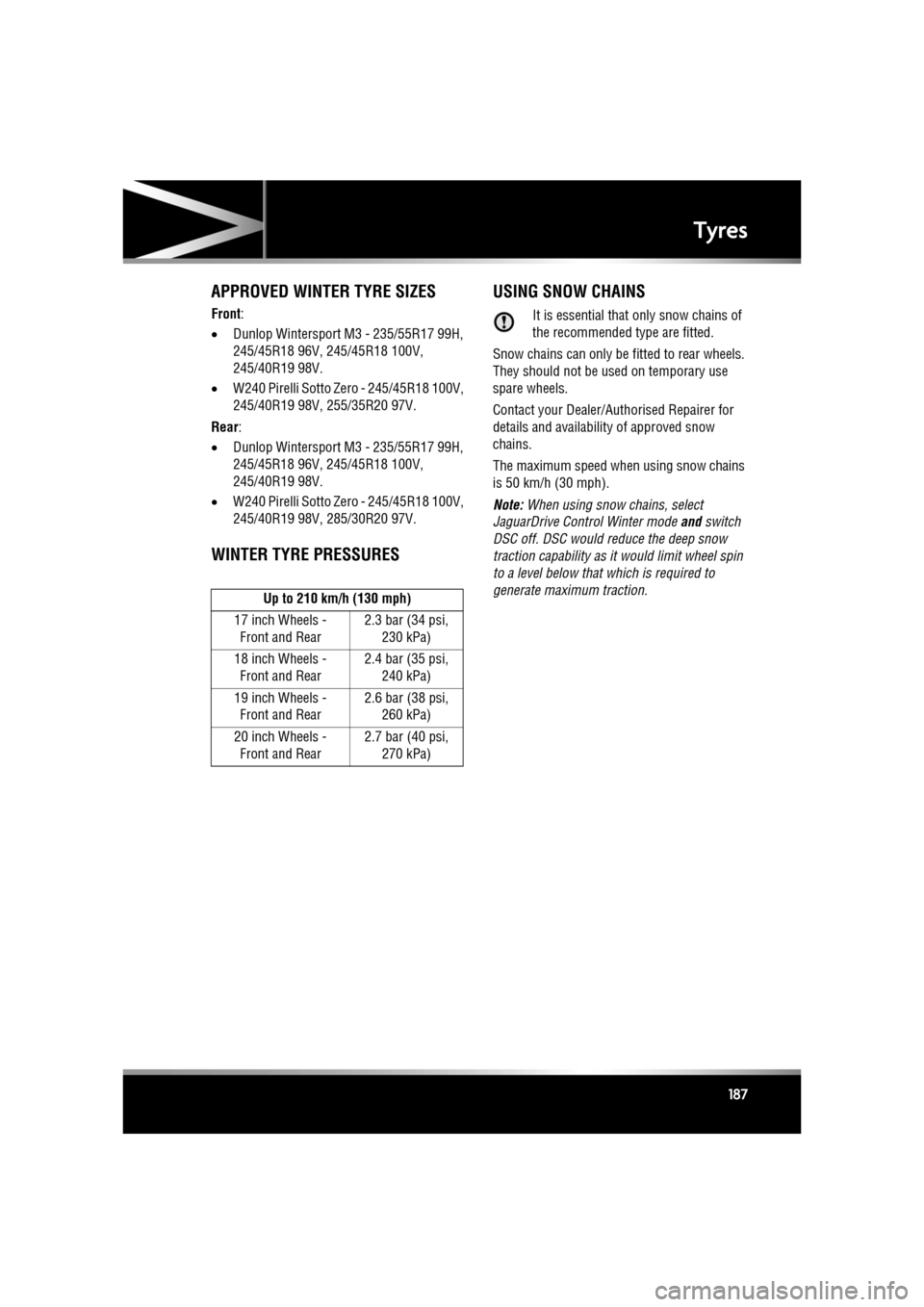
WINTER TYRE PRESSURES USING SNOW CHAINS
It is essential that
only snow chains of
the recommended type are fitted.
Snow chains can only be fitted to rear wheels.
They should not be used on temporary use
spare wheels.
Contact your Dealer/Authorised Repairer for
details and availabilit y of approved snow
chains.
The maximum speed when using snow chains
is 50 km/h (30 mph).
Note: When using snow chains, select
JaguarDrive Contro l Winter mode and switch
DSC off. DSC would reduce the deep snow
traction capability as it would limit wheel spin
to a level below that which is required to
generate maximum traction.
Up to 210 km/h (130 mph)
17 inch Wheels - Front and Rear 2.3 bar (34 psi,
230 kPa)
18 inch Wheels - Front and Rear 2.4 bar (35 psi,
240 kPa)
19 inch Wheels - Front and Rear 2.6 bar (38 psi,
260 kPa)
20 inch Wheels - Front and Rear 2.7 bar (40 psi,
270 kPa)
Page 194 of 225
L
(FM8) SEMCON JLR OWNER GUIDE VER 1.00 EURO
LANGUAGE: english-en; MARQUE: jaguar; MODEL: XF
Wheel changing
194
Wheel changingWHEEL CHANGING SAFETY
Before raising the vehicl e, or changing a wheel
ensure that you read, and comply with the
following warnings.
Always find a safe place to stop, off
the highway and aw ay from traffic.
Ensure that the vehicle and jack are
both on firm level ground.
Apply the parking brake, and engage
Park (P).
Switch on the hazard warning lamps.
Ensure that the front wheels are in the
straight ahead position, and engage
the steering lock.
Disconnect trailer/ca ravan from the
vehicle.
Ensure that all passengers, and
animals, are out of the vehicle and in
a safe place away from the highway.
Place a warning triangle at a suitable
distance behind the v ehicle, facing
towards oncoming traffic.
When one rear wheel is lifted off the
ground the selection P (Park) position
will not prevent the vehicle from
moving and possibly slipping off the
jack as the park brake only operates
on the rear wheels. Use the wheel
chock when jacking the vehicle.
Always chock the wheel diagonally
opposite the wheel to be changed,
using the wheel chock supplied in the
tool kit. Chock the front of a front
wheel, or the rear of a rear wheel.
If jacking the vehicle on a slight slope
is unavoidable, place chocks on the
downhill side of the two opposite
wheels. An additional chock will be
needed. Never place anything between the jack
and the ground, or the jack and the
vehicle.
Do not attempt to raise the vehicle
unless the jack head is fully engaged
in the jacking point. Only jack the
vehicle using the approved jacking
points.
Remove the spare wheel prior to
jacking the vehicle, to avoid
destabilising the vehicle when raised.
Take care when lifting the spare
wheel, and removing the punctured
wheel. The wheels are heavy, and can
cause injuries if not handled correctly.
Do not start or run the engine while the
vehicle is support
ed only by a jack.
Do not get under a vehicle that is
supported by a jack.
Never work or allow any person to
place any part of their body beneath
the vehicle with the jack as the only
means of support - use vehicle
support stands.
Take care when loosening the wheel
nuts. The wheel brace may slip off if
not properly attached, and the wheel
nuts may release suddenly. Either
unexpected movement may cause an
injury.
After use, the tool kit should be
returned to the under floor storage
area and correctly stowed.
Always ensure replacement tyres
have the correct rating and
specifications (e.g. load index, size,
speed rating) for your vehicle.