Electrical JAGUAR XFR 2010 1.G Workshop Manual
[x] Cancel search | Manufacturer: JAGUAR, Model Year: 2010, Model line: XFR, Model: JAGUAR XFR 2010 1.GPages: 3039, PDF Size: 58.49 MB
Page 453 of 3039
3 Using manufacturer approved diagnostic system run On Demand Self Test (0x0202). Is the DTC C1D1911 set?
Yes
Replace Tire Pressure Monitoring System Control Module.
No
Investigate possible cause of intermittent failure.
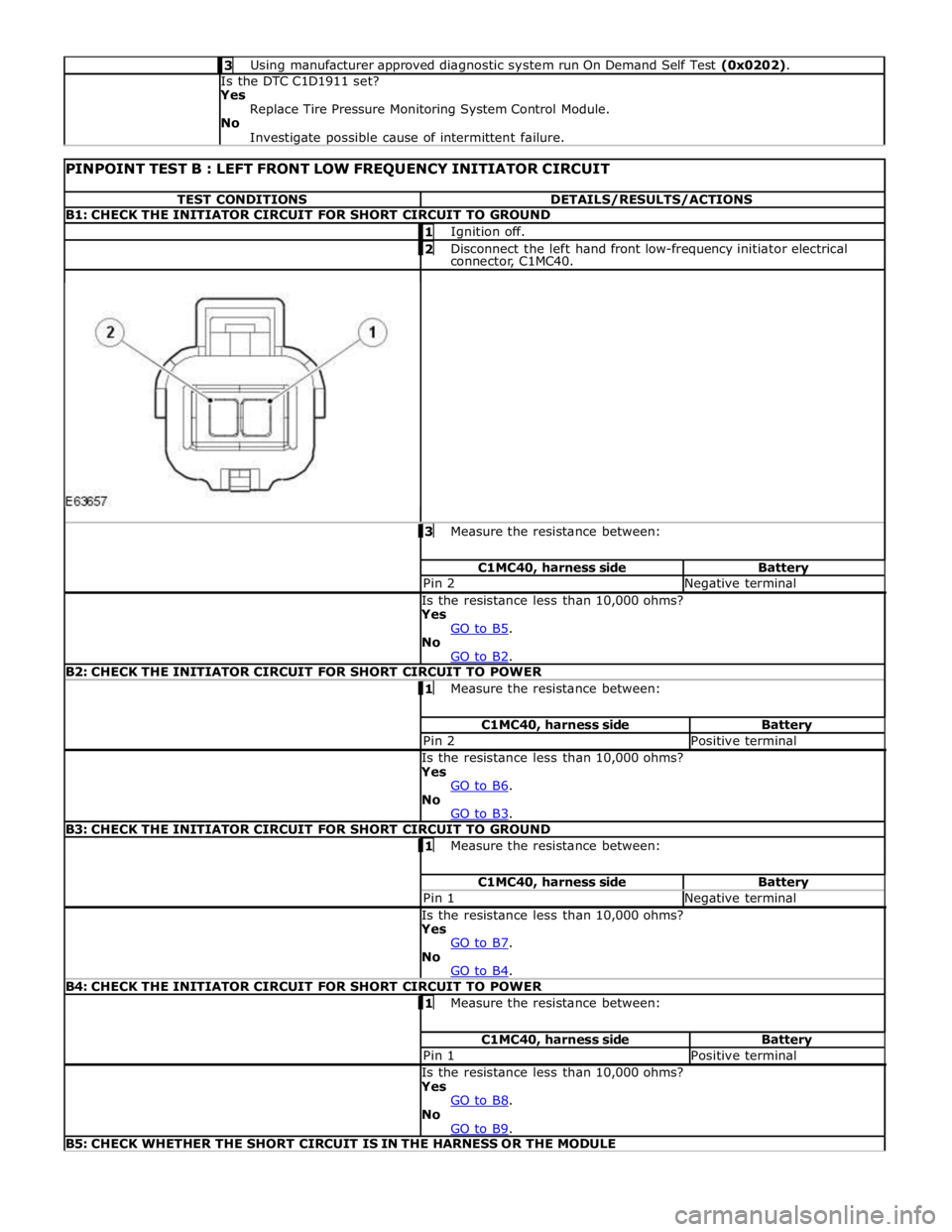
PINPOINT TEST B : LEFT FRONT LOW FREQUENCY INITIATOR CIRCUIT TEST CONDITIONS DETAILS/RESULTS/ACTIONS B1: CHECK THE INITIATOR CIRCUIT FOR SHORT CIRCUIT TO GROUND 1 Ignition off. 2 Disconnect the left hand front low-frequency initiator electrical connector, C1MC40. 3 Measure the resistance between: C1MC40, harness side Battery Pin 2 Negative terminal Is the resistance less than 10,000 ohms?
Yes
GO to B5. No
GO to B2. B2: CHECK THE INITIATOR CIRCUIT FOR SHORT CIRCUIT TO POWER 1 Measure the resistance between: C1MC40, harness side Battery Pin 2 Positive terminal Is the resistance less than 10,000 ohms?
Yes
GO to B6. No
GO to B3. B3: CHECK THE INITIATOR CIRCUIT FOR SHORT CIRCUIT TO GROUND 1 Measure the resistance between: C1MC40, harness side Battery Pin 1 Negative terminal Is the resistance less than 10,000 ohms?
Yes
GO to B7. No
GO to B4. B4: CHECK THE INITIATOR CIRCUIT FOR SHORT CIRCUIT TO POWER 1 Measure the resistance between: C1MC40, harness side Battery Pin 1 Positive terminal Is the resistance less than 10,000 ohms?
Yes
GO to B8. No
GO to B9. B5: CHECK WHETHER THE SHORT CIRCUIT IS IN THE HARNESS OR THE MODULE
Page 456 of 3039
B10: CHECK THE INITIATOR CIRCUIT FOR HIGH RESISTANCE 1 Measure the resistance between: C3MC39A, harness side C1MC40, harness side Pin 13 Pin 1 Is the resistance greater than 5 ohms?
Yes
REPAIR the high resistance circuit. This circuit contains
intermediate connector, C13-B. For additional information, refer to
the wiring diagram. Clear the DTC and run an On Demand Self Test
(ODST) using the manufacturer approved diagnostic system to
confirm rectification.
No
INSTALL a new left hand front low-frequency initiator. REFER to:
Tire Pressure Monitoring System (TPMS) Front Antenna (204-04 Wheels and Tires, Removal and Installation).
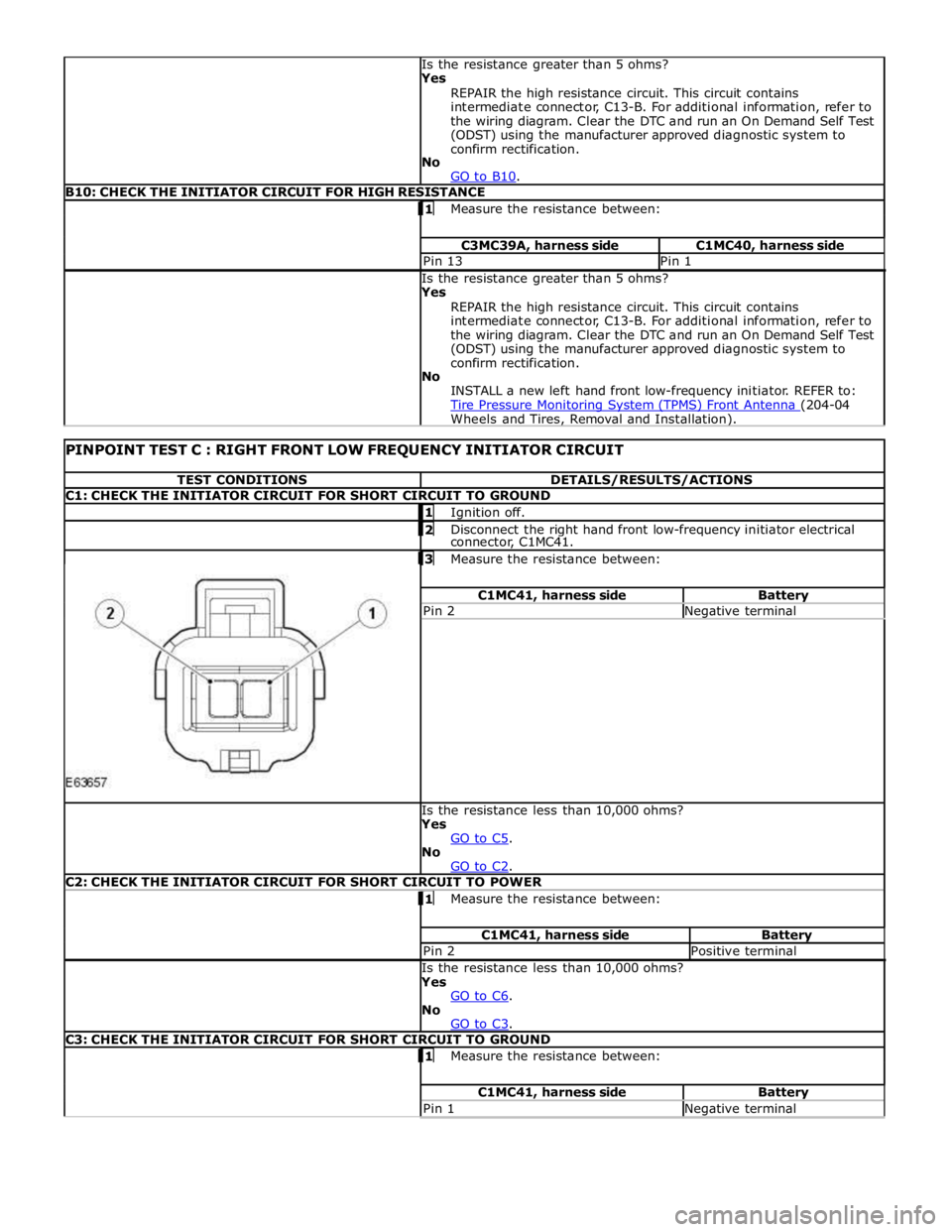
PINPOINT TEST C : RIGHT FRONT LOW FREQUENCY INITIATOR CIRCUIT TEST CONDITIONS DETAILS/RESULTS/ACTIONS C1: CHECK THE INITIATOR CIRCUIT FOR SHORT CIRCUIT TO GROUND 1 Ignition off. 2 Disconnect the right hand front low-frequency initiator electrical connector, C1MC41.
3 Measure the resistance between: C1MC41, harness side Battery Pin 2 Negative terminal Is the resistance less than 10,000 ohms?
Yes
GO to C5. No
GO to C2. C2: CHECK THE INITIATOR CIRCUIT FOR SHORT CIRCUIT TO POWER 1 Measure the resistance between: C1MC41, harness side Battery Pin 2 Positive terminal Is the resistance less than 10,000 ohms?
Yes
GO to C6. No
GO to C3. C3: CHECK THE INITIATOR CIRCUIT FOR SHORT CIRCUIT TO GROUND 1 Measure the resistance between: C1MC41, harness side Battery Pin 1 Negative terminal
Page 459 of 3039
C10: CHECK THE INITIATOR CIRCUIT FOR HIGH RESISTANCE 1 Measure the resistance between: C3MC39A, harness side C1MC41, harness side Pin 15 Pin 1 Is the resistance greater than 5 ohms?
Yes
REPAIR the high resistance circuit. This circuit contains
intermediate connector, C13-B. For additional information, refer to
the wiring diagram. Clear the DTC and run an On Demand Self Test
(ODST) using the manufacturer approved diagnostic system to
confirm rectification.
No
INSTALL a new right hand front low-frequency initiator. REFER to:
Tire Pressure Monitoring System (TPMS) Front Antenna (204-04 Wheels and Tires, Removal and Installation).
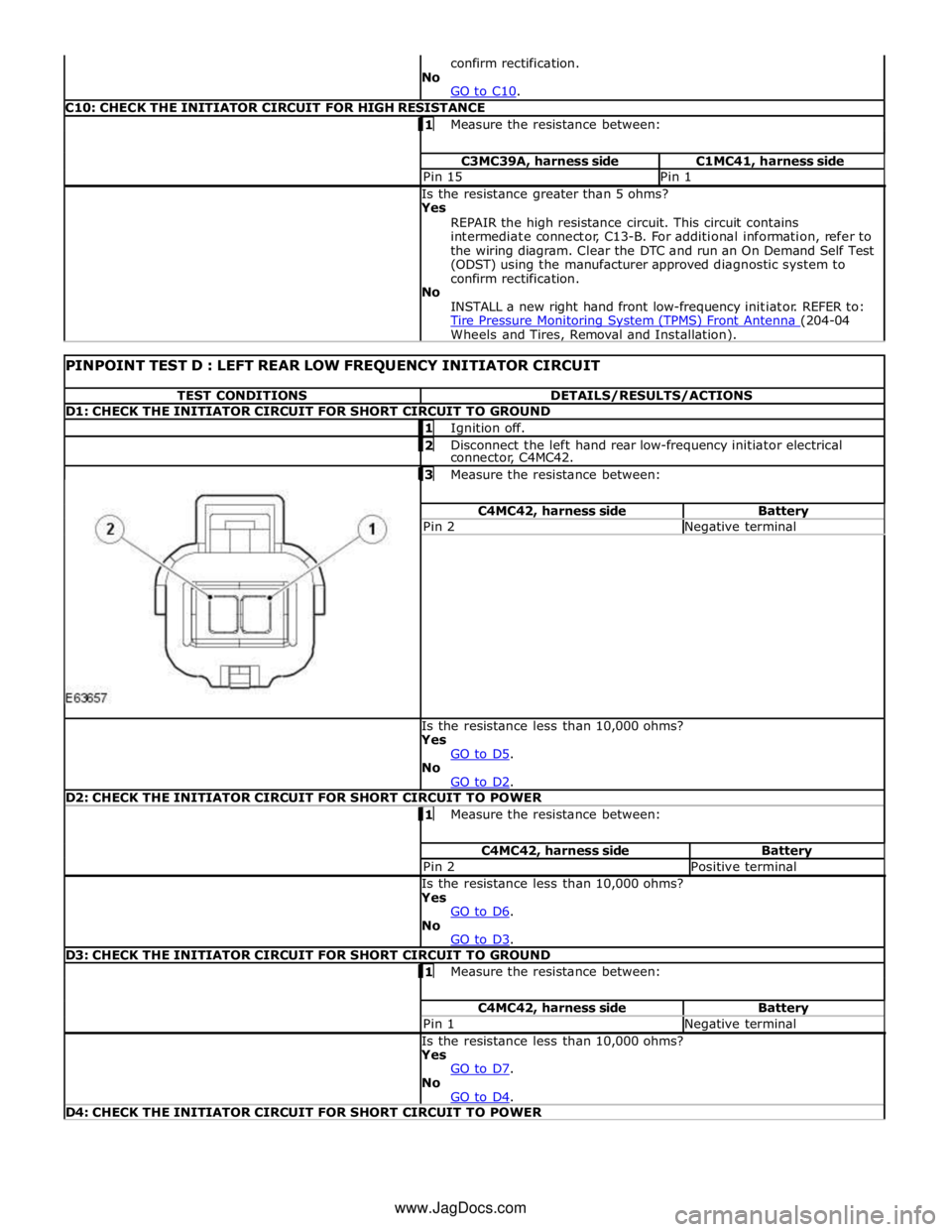
PINPOINT TEST D : LEFT REAR LOW FREQUENCY INITIATOR CIRCUIT TEST CONDITIONS DETAILS/RESULTS/ACTIONS D1: CHECK THE INITIATOR CIRCUIT FOR SHORT CIRCUIT TO GROUND 1 Ignition off. 2 Disconnect the left hand rear low-frequency initiator electrical connector, C4MC42.
3 Measure the resistance between: C4MC42, harness side Battery Pin 2 Negative terminal Is the resistance less than 10,000 ohms?
Yes
GO to D5. No
GO to D2. D2: CHECK THE INITIATOR CIRCUIT FOR SHORT CIRCUIT TO POWER 1 Measure the resistance between: C4MC42, harness side Battery Pin 2 Positive terminal Is the resistance less than 10,000 ohms?
Yes
GO to D6. No
GO to D3. D3: CHECK THE INITIATOR CIRCUIT FOR SHORT CIRCUIT TO GROUND 1 Measure the resistance between: C4MC42, harness side Battery Pin 1 Negative terminal Is the resistance less than 10,000 ohms?
Yes
GO to D7. No
GO to D4. D4: CHECK THE INITIATOR CIRCUIT FOR SHORT CIRCUIT TO POWER www.JagDocs.com
Page 462 of 3039
Measure the resistance between: C3MC39A, harness side C4MC42, harness side Pin 5 Pin 1 Is the resistance greater than 5 ohms?
Yes
REPAIR the high resistance circuit. This circuit contains
intermediate connector, C44-W. For additional information, refer to
the wiring diagram. Clear the DTC and run an On Demand Self Test
(ODST) using the manufacturer approved diagnostic system to
confirm rectification.
No
INSTALL a new rear left hand low-frequency initiator. REFER to:
Tire Pressure Monitoring System (TPMS) Rear Antenna (204-04 Wheels and Tires, Removal and Installation).
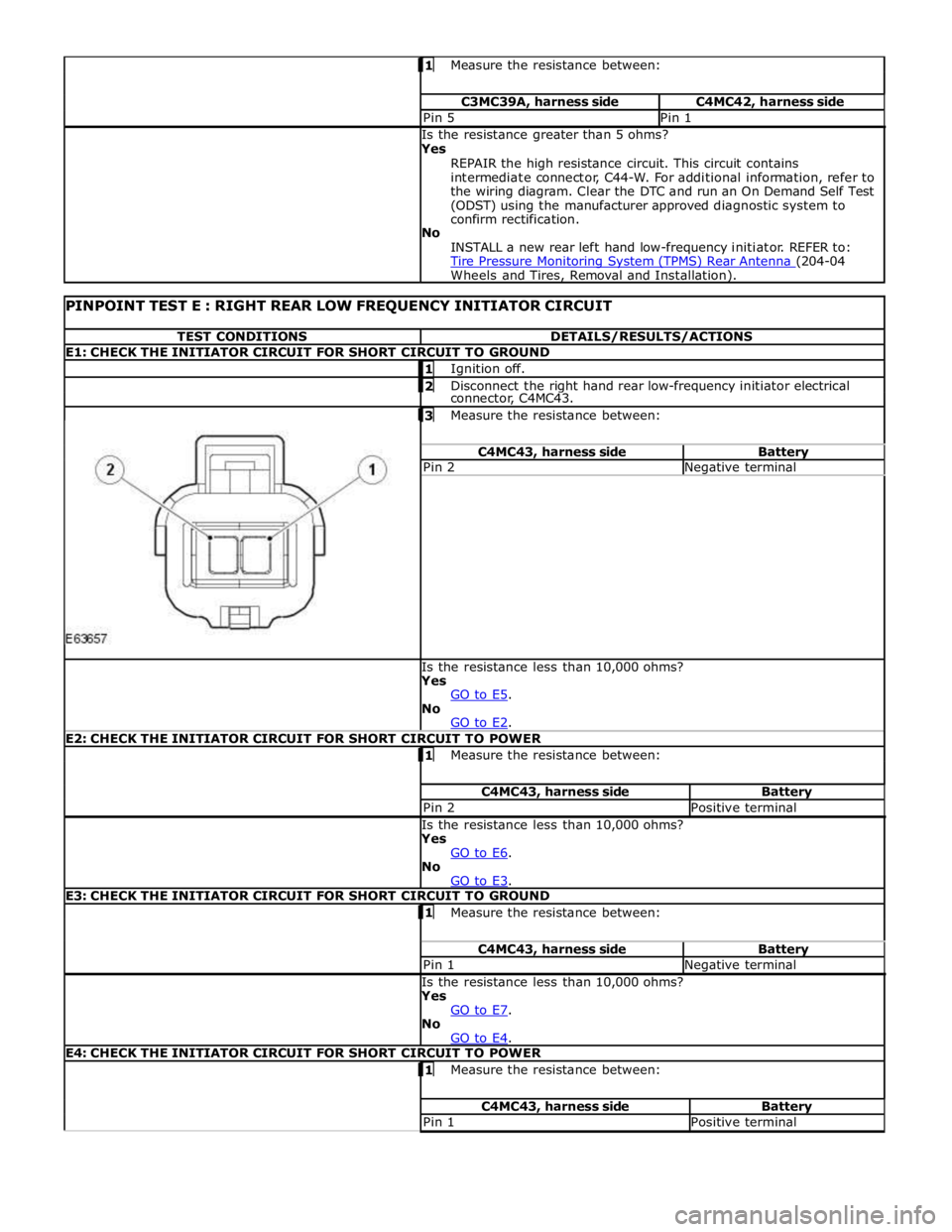
PINPOINT TEST E : RIGHT REAR LOW FREQUENCY INITIATOR CIRCUIT TEST CONDITIONS DETAILS/RESULTS/ACTIONS E1: CHECK THE INITIATOR CIRCUIT FOR SHORT CIRCUIT TO GROUND 1 Ignition off. 2 Disconnect the right hand rear low-frequency initiator electrical connector, C4MC43.
3 Measure the resistance between: C4MC43, harness side Battery Pin 2 Negative terminal Is the resistance less than 10,000 ohms?
Yes
GO to E5. No
GO to E2. E2: CHECK THE INITIATOR CIRCUIT FOR SHORT CIRCUIT TO POWER 1 Measure the resistance between: C4MC43, harness side Battery Pin 2 Positive terminal Is the resistance less than 10,000 ohms?
Yes
GO to E6. No
GO to E3. E3: CHECK THE INITIATOR CIRCUIT FOR SHORT CIRCUIT TO GROUND 1 Measure the resistance between: C4MC43, harness side Battery Pin 1 Negative terminal Is the resistance less than 10,000 ohms?
Yes
GO to E7. No
GO to E4. E4: CHECK THE INITIATOR CIRCUIT FOR SHORT CIRCUIT TO POWER 1 Measure the resistance between: C4MC43, harness side Battery Pin 1 Positive terminal
Page 467 of 3039
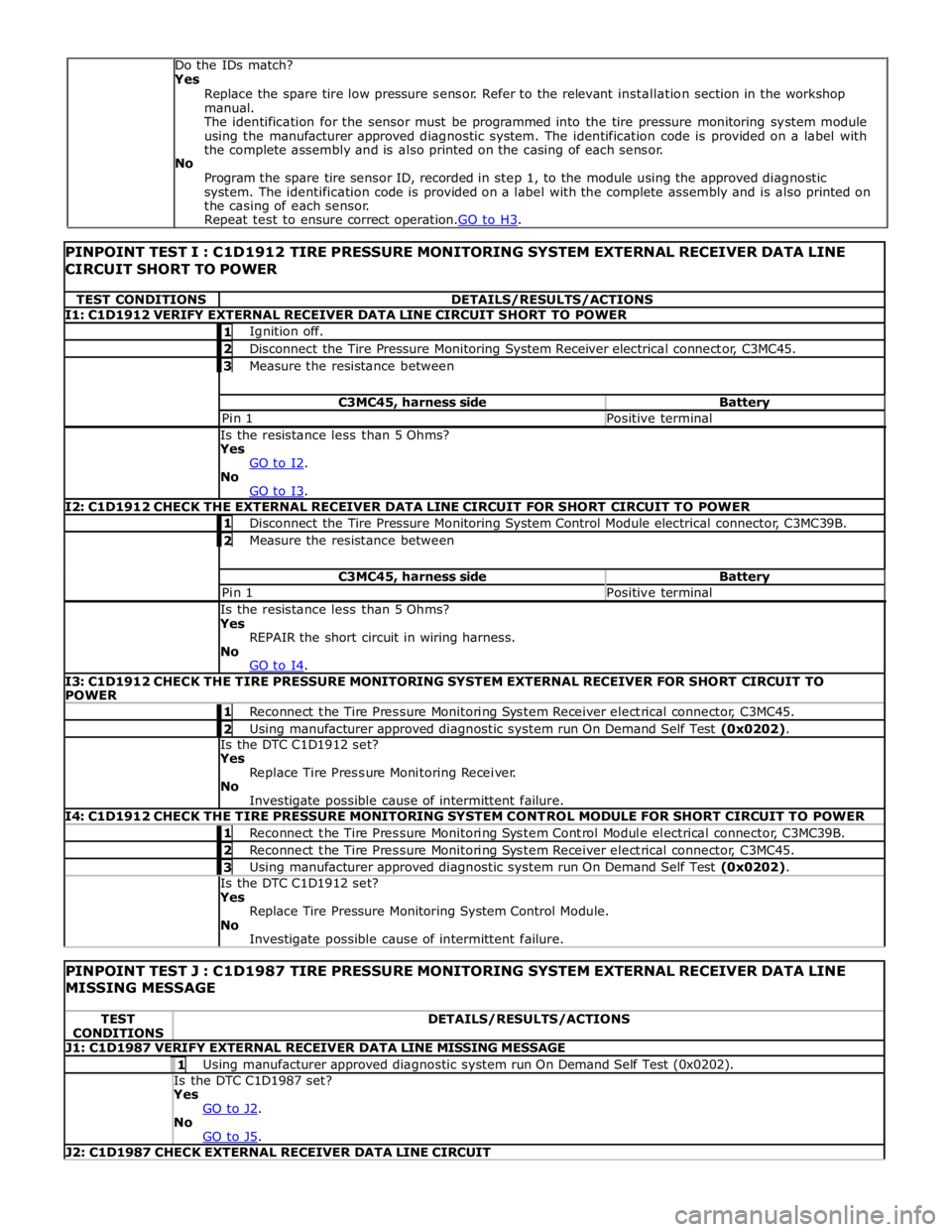
TEST CONDITIONS DETAILS/RESULTS/ACTIONS I1: C1D1912 VERIFY EXTERNAL RECEIVER DATA LINE CIRCUIT SHORT TO POWER 1 Ignition off. 2 Disconnect the Tire Pressure Monitoring System Receiver electrical connector, C3MC45. 3 Measure the resistance between C3MC45, harness side Battery Pin 1 Positive terminal Is the resistance less than 5 Ohms?
Yes
GO to I2. No
GO to I3. I2: C1D1912 CHECK THE EXTERNAL RECEIVER DATA LINE CIRCUIT FOR SHORT CIRCUIT TO POWER 1 Disconnect the Tire Pressure Monitoring System Control Module electrical connector, C3MC39B. 2 Measure the resistance between C3MC45, harness side Battery Pin 1 Positive terminal Is the resistance less than 5 Ohms?
Yes
REPAIR the short circuit in wiring harness.
No
GO to I4. I3: C1D1912 CHECK THE TIRE PRESSURE MONITORING SYSTEM EXTERNAL RECEIVER FOR SHORT CIRCUIT TO
POWER 1 Reconnect the Tire Pressure Monitoring System Receiver electrical connector, C3MC45. 2 Using manufacturer approved diagnostic system run On Demand Self Test (0x0202). Is the DTC C1D1912 set?
Yes
Replace Tire Pressure Monitoring Receiver.
No
Investigate possible cause of intermittent failure. I4: C1D1912 CHECK THE TIRE PRESSURE MONITORING SYSTEM CONTROL MODULE FOR SHORT CIRCUIT TO POWER 1 Reconnect the Tire Pressure Monitoring System Control Module electrical connector, C3MC39B. 2 Reconnect the Tire Pressure Monitoring System Receiver electrical connector, C3MC45. 3 Using manufacturer approved diagnostic system run On Demand Self Test (0x0202). Is the DTC C1D1912 set?
Yes
Replace Tire Pressure Monitoring System Control Module.
No
Investigate possible cause of intermittent failure.
PINPOINT TEST J : C1D1987 TIRE PRESSURE MONITORING SYSTEM EXTERNAL RECEIVER DATA LINE
MISSING MESSAGE TEST
CONDITIONS DETAILS/RESULTS/ACTIONS J1: C1D1987 VERIFY EXTERNAL RECEIVER DATA LINE MISSING MESSAGE 1 Using manufacturer approved diagnostic system run On Demand Self Test (0x0202). Is the DTC C1D1987 set? Yes
GO to J2. No
GO to J5. J2: C1D1987 CHECK EXTERNAL RECEIVER DATA LINE CIRCUIT Do the IDs match?
Yes
Replace the spare tire low pressure sensor. Refer to the relevant installation section in the workshop
manual.
The identification for the sensor must be programmed into the tire pressure monitoring system module
using the manufacturer approved diagnostic system. The identification code is provided on a label with
the complete assembly and is also printed on the casing of each sensor.
No
Program the spare tire sensor ID, recorded in step 1, to the module using the approved diagnostic
system. The identification code is provided on a label with the complete assembly and is also printed on
the casing of each sensor.
Repeat test to ensure correct operation.GO to H3.
Page 468 of 3039
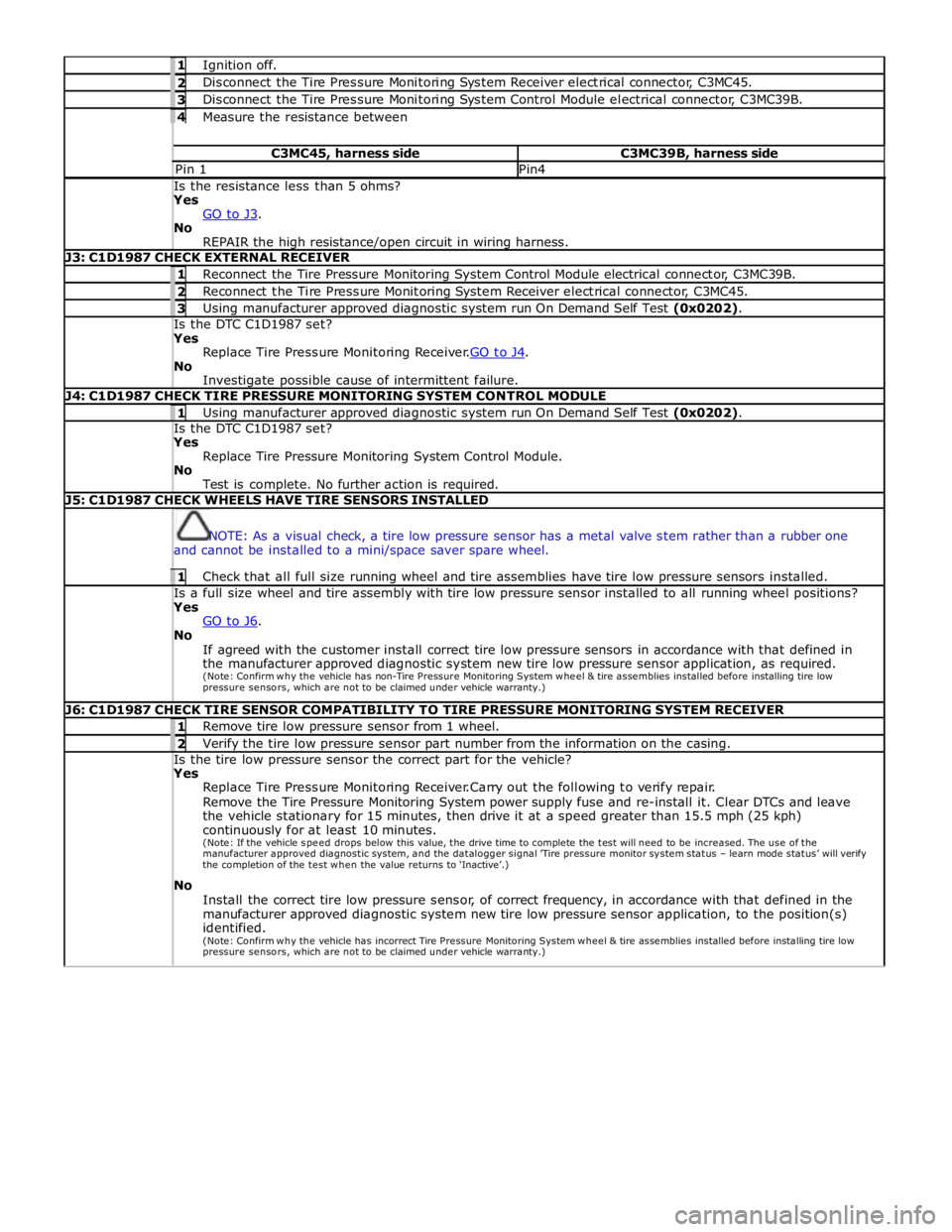
1 Ignition off. 2 Disconnect the Tire Pressure Monitoring System Receiver electrical connector, C3MC45. 3 Disconnect the Tire Pressure Monitoring System Control Module electrical connector, C3MC39B. 4 Measure the resistance between C3MC45, harness side C3MC39B, harness side Pin 1 Pin4 Is the resistance less than 5 ohms? Yes
GO to J3. No
REPAIR the high resistance/open circuit in wiring harness. J3: C1D1987 CHECK EXTERNAL RECEIVER 1 Reconnect the Tire Pressure Monitoring System Control Module electrical connector, C3MC39B. 2 Reconnect the Tire Pressure Monitoring System Receiver electrical connector, C3MC45. 3 Using manufacturer approved diagnostic system run On Demand Self Test (0x0202). Is the DTC C1D1987 set? Yes
Replace Tire Pressure Monitoring Receiver.GO to J4. No
Investigate possible cause of intermittent failure. J4: C1D1987 CHECK TIRE PRESSURE MONITORING SYSTEM CONTROL MODULE 1 Using manufacturer approved diagnostic system run On Demand Self Test (0x0202). Is the DTC C1D1987 set? Yes
Replace Tire Pressure Monitoring System Control Module.
No
Test is complete. No further action is required. J5: C1D1987 CHECK WHEELS HAVE TIRE SENSORS INSTALLED
NOTE: As a visual check, a tire low pressure sensor has a metal valve stem rather than a rubber one
and cannot be installed to a mini/space saver spare wheel. 1 Check that all full size running wheel and tire assemblies have tire low pressure sensors installed. Is a full size wheel and tire assembly with tire low pressure sensor installed to all running wheel positions? Yes
GO to J6. No
If agreed with the customer install correct tire low pressure sensors in accordance with that defined in
the manufacturer approved diagnostic system new tire low pressure sensor application, as required.
(Note: Confirm why the vehicle has non-Tire Pressure Monitoring System w he e l & tire assemblies installed before installing tire low
pressure sensors, which are not to be claimed under vehicle warranty.) J6: C1D1987 CHECK TIRE SENSOR COMPATIBILITY TO TIRE PRESSURE MONITORING SYSTEM RECEIVER 1 Remove tire low pressure sensor from 1 wheel. 2 Verify the tire low pressure sensor part number from the information on the casing. Is the tire low pressure sensor the correct part for the vehicle? Yes
Replace Tire Pressure Monitoring Receiver.Carry out the following to verify repair.
Remove the Tire Pressure Monitoring System power supply fuse and re-install it. Clear DTCs and leave
the vehicle stationary for 15 minutes, then drive it at a speed greater than 15.5 mph (25 kph)
continuously for at least 10 minutes.
(Note: If the vehicle spe e d drops below this value, the drive time to complete the test will need to be increased. The use of the manufacturer approved diagnostic system, and the datalogger signal ’Tire pressure monitor system status – learn mode status’ will verify the completion of the test w he n the value returns to ‘Inactive’.)
No
Install the correct tire low pressure sensor, of correct frequency, in accordance with that defined in the
manufacturer approved diagnostic system new tire low pressure sensor application, to the position(s)
identified.
(Note: Confirm why the vehicle has incorrect Tire Pressure Monitoring System w he e l & tire assemblies installed before installing tire low
pressure sensors, which are not to be claimed under vehicle warranty.)
Page 484 of 3039
each damper to the appropriate level to maintain a flat and level body.
Roll Rate Control – Uses CAN inputs. Predicts vehicle roll rate due to driver steering inputs 100 times a second and increases damping to reduce roll rate.
Pitch Rate Control – Uses CAN inputs. Predicts vehicle pitch rate due to driver throttle and braking inputs 100 times a second and increases damping to reduce pitch rate.
Bump Rebound Control – Uses suspension height sensor and CAN inputs. Monitors the position of the wheel 500 times a second and increases the damping rate as the damper approaches the end of its travel.
Wheel Hop Control – Uses suspension height sensor and CAN inputs. Monitors the position of the wheel 500 times a second and detects when the wheel is at its natural frequency and increases the dampingto reduce vertical wheel
motion.
Under normal road conditions when the vehicle is stationary with the engine running, the dampers are set to the firm condition
to reduce power consumption.
The adaptive damping module receives its power supply via a relay and fuse in the CJB. The relay remains energized for a period of time after the ignition is off. This allows the adaptive damping module to record and store any DTC (diagnostic
trouble code) relating to adaptive dynamics system faults.
DAMPERS Component Description
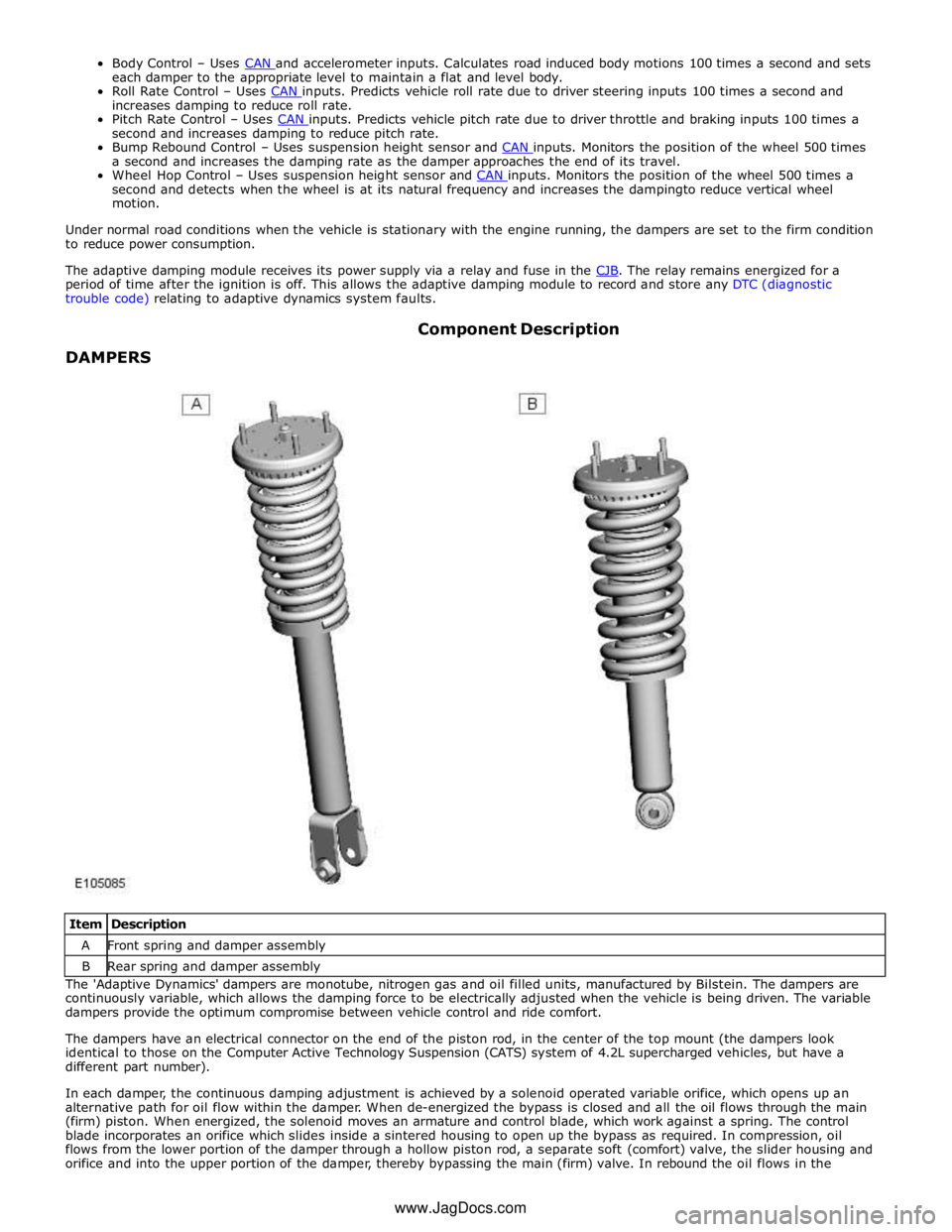
Item Description A Front spring and damper assembly B Rear spring and damper assembly The 'Adaptive Dynamics' dampers are monotube, nitrogen gas and oil filled units, manufactured by Bilstein. The dampers are
continuously variable, which allows the damping force to be electrically adjusted when the vehicle is being driven. The variable
dampers provide the optimum compromise between vehicle control and ride comfort.
The dampers have an electrical connector on the end of the piston rod, in the center of the top mount (the dampers look
identical to those on the Computer Active Technology Suspension (CATS) system of 4.2L supercharged vehicles, but have a
different part number).
In each damper, the continuous damping adjustment is achieved by a solenoid operated variable orifice, which opens up an
alternative path for oil flow within the damper. When de-energized the bypass is closed and all the oil flows through the main
(firm) piston. When energized, the solenoid moves an armature and control blade, which work against a spring. The control
blade incorporates an orifice which slides inside a sintered housing to open up the bypass as required. In compression, oil
flows from the lower portion of the damper through a hollow piston rod, a separate soft (comfort) valve, the slider housing and
orifice and into the upper portion of the damper, thereby bypassing the main (firm) valve. In rebound the oil flows in the www.JagDocs.com
Page 487 of 3039
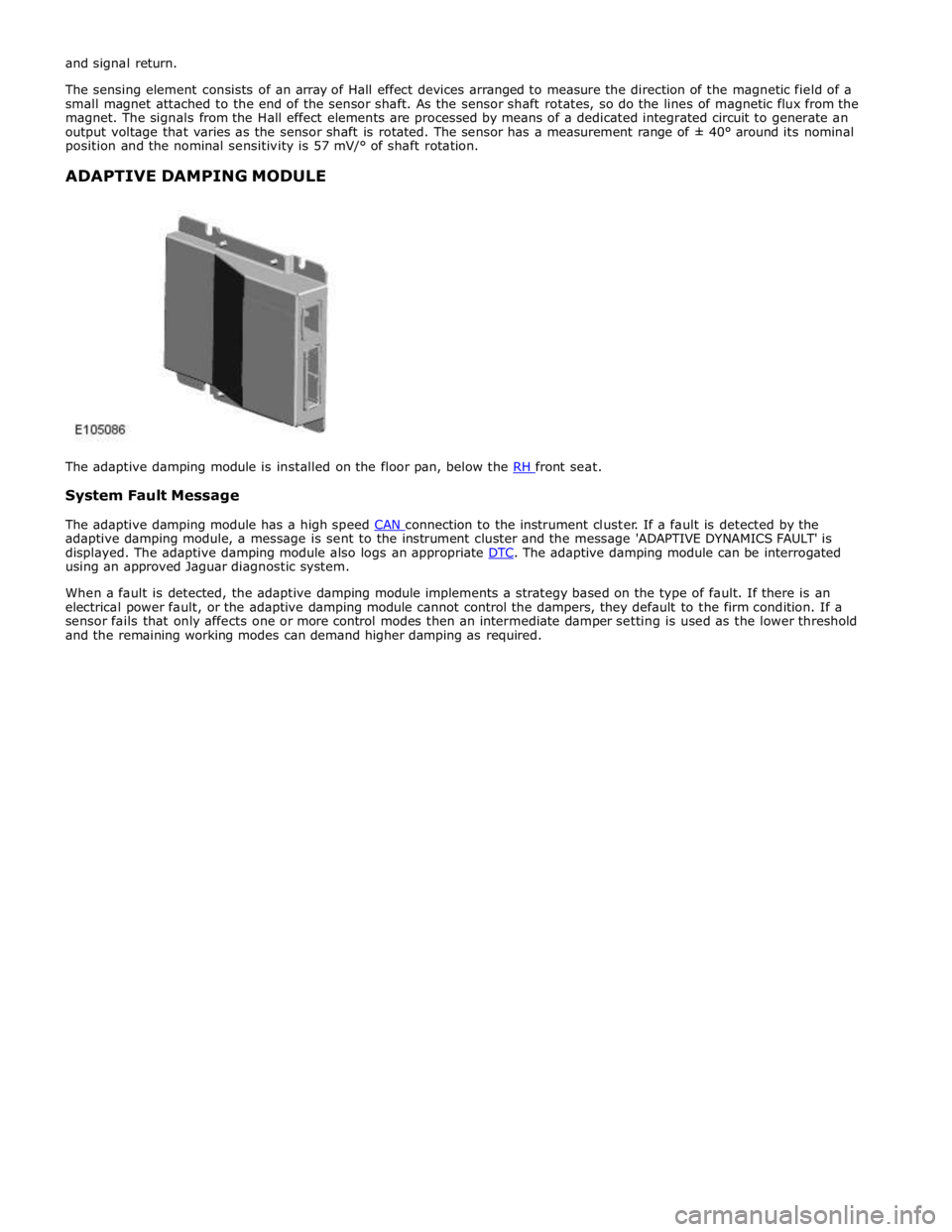
System Fault Message
The adaptive damping module has a high speed CAN connection to the instrument cluster. If a fault is detected by the adaptive damping module, a message is sent to the instrument cluster and the message 'ADAPTIVE DYNAMICS FAULT' is
displayed. The adaptive damping module also logs an appropriate DTC. The adaptive damping module can be interrogated using an approved Jaguar diagnostic system.
When a fault is detected, the adaptive damping module implements a strategy based on the type of fault. If there is an
electrical power fault, or the adaptive damping module cannot control the dampers, they default to the firm condition. If a
sensor fails that only affects one or more control modes then an intermediate damper setting is used as the lower threshold
and the remaining working modes can demand higher damping as required.
Page 488 of 3039

Vehicle Dynamic Suspension - Vehicle Dynamic Suspension
Diagnosis and Testing
Principle of Operation Published: 09-Jul-2014
For a detailed description of the adaptive damping system operation, refer to the relevant Description and Operation section of
the workshop manual. REFER to: (204-05 Vehicle Dynamic Suspension)
Vehicle Dynamic Suspension - V8 5.0L Petrol/V8 S/C 5.0L Petrol (Description and Operation),
Inspection and Verification
1. Verify the customer concern.
2. Visually inspect for obvious signs of damage and system integrity.
Visual Inspection
Mechanical Electrical
Coil spring(s)
Shock absorber(s)
Accelerometer(s) installation
Height sensor(s) installation
Fuse(s)
Wiring harness/electrical connectors
Accelerometer(s)
Adaptive Damping Control Module
Height sensor(s)
3. If an obvious cause for an observed or reported concern is found, correct the cause (if possible) before proceeding to
the next step.
4. If the cause is not visually evident, check the system for any logged Diagnostic Trouble Codes (DTCs) and refer to the
DTC index.
DTC Index
For a list of Diagnostic Trouble Codes (DTCs) that could be logged on this vehicle, please refer to Section 100-00.
REFER to: Diagnostic Trouble Code (DTC) Index - DTC: Adaptive Damping Module (SUMB) (100-00 General Information, Description and Operation).
Page 538 of 3039
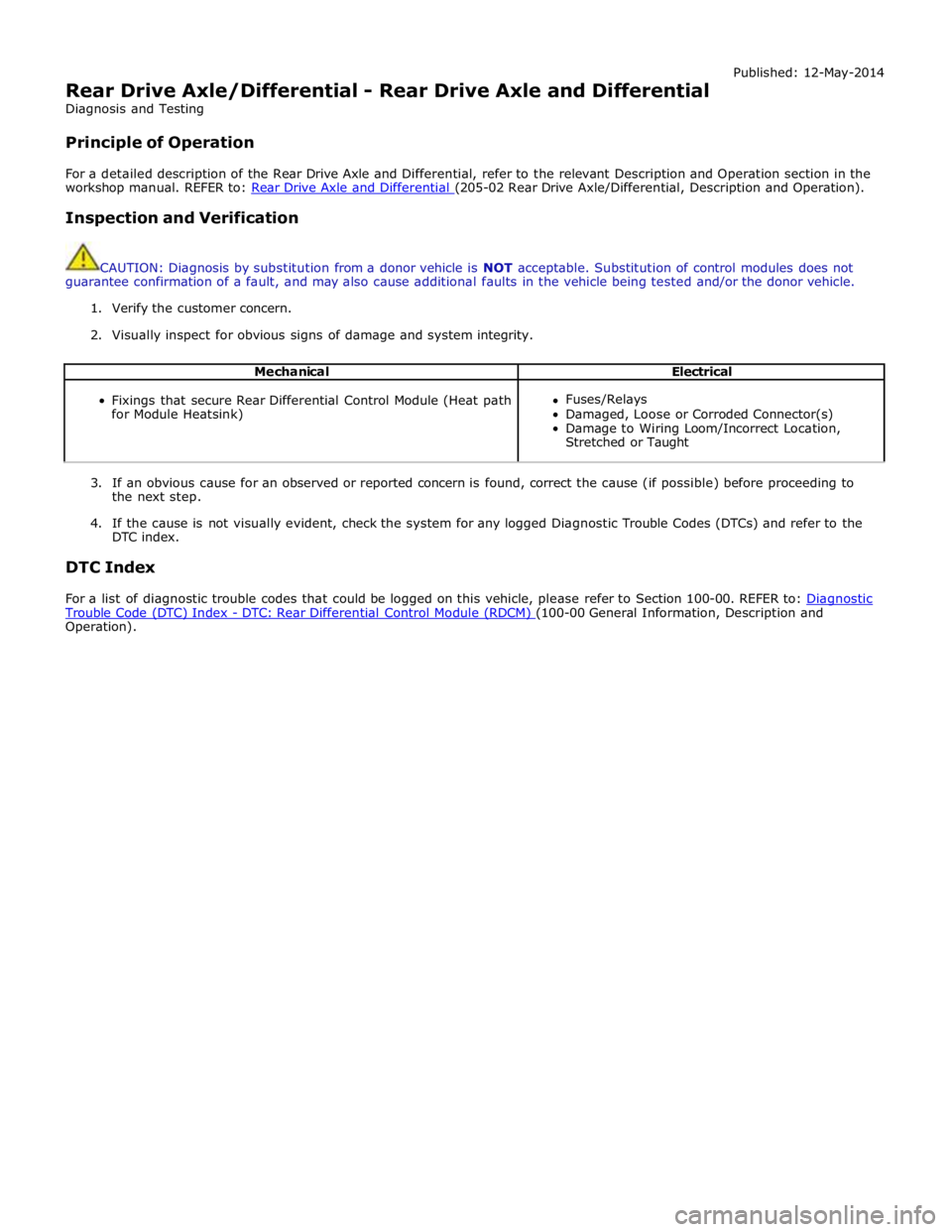
Rear Drive Axle/Differential - Rear Drive Axle and Differential
Diagnosis and Testing
Principle of Operation Published: 12-May-2014
For a detailed description of the Rear Drive Axle and Differential, refer to the relevant Description and Operation section in the
workshop manual. REFER to: Rear Drive Axle and Differential (205-02 Rear Drive Axle/Differential, Description and Operation).
Inspection and Verification
CAUTION: Diagnosis by substitution from a donor vehicle is NOT acceptable. Substitution of control modules does not
guarantee confirmation of a fault, and may also cause additional faults in the vehicle being tested and/or the donor vehicle.
1. Verify the customer concern.
2. Visually inspect for obvious signs of damage and system integrity.
Mechanical Electrical
Fixings that secure Rear Differential Control Module (Heat path
for Module Heatsink)
Fuses/Relays
Damaged, Loose or Corroded Connector(s)
Damage to Wiring Loom/Incorrect Location,
Stretched or Taught
3. If an obvious cause for an observed or reported concern is found, correct the cause (if possible) before proceeding to
the next step.
4. If the cause is not visually evident, check the system for any logged Diagnostic Trouble Codes (DTCs) and refer to the
DTC index.
DTC Index
For a list of diagnostic trouble codes that could be logged on this vehicle, please refer to Section 100-00. REFER to: Diagnostic Trouble Code (DTC) Index - DTC: Rear Differential Control Module (RDCM) (100-00 General Information, Description and Operation).