tire pressure JAGUAR XFR 2010 1.G User Guide
[x] Cancel search | Manufacturer: JAGUAR, Model Year: 2010, Model line: XFR, Model: JAGUAR XFR 2010 1.GPages: 3039, PDF Size: 58.49 MB
Page 306 of 3039
Suspension System - General Information -
Vehicle Ride Height Published: 27-Aug-2013
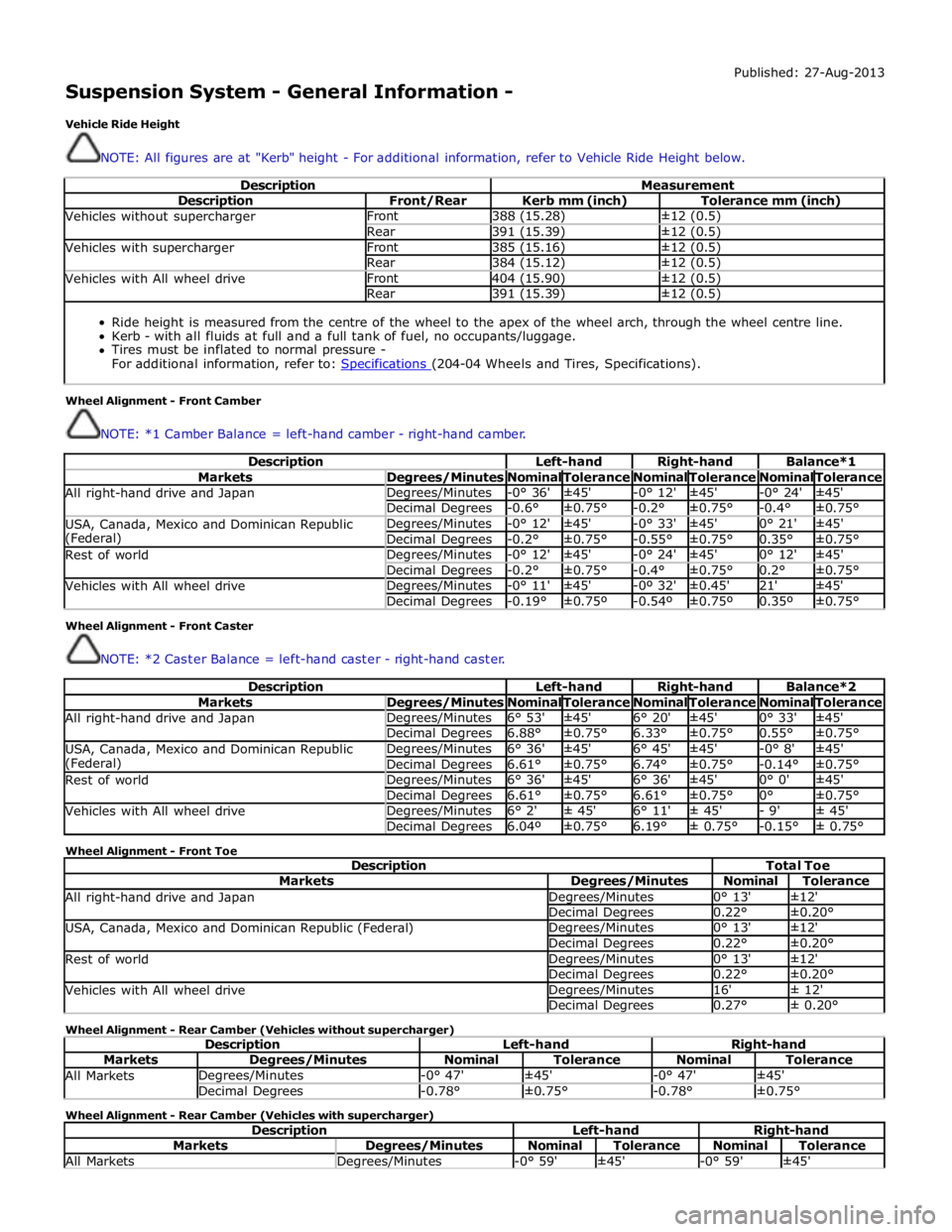
NOTE: All figures are at "Kerb" height - For additional information, refer to Vehicle Ride Height below.
Description Measurement Description Front/Rear Kerb mm (inch) Tolerance mm (inch) Vehicles without supercharger Front 388 (15.28) ±12 (0.5) Rear 391 (15.39) ±12 (0.5) Vehicles with supercharger Front 385 (15.16) ±12 (0.5) Rear 384 (15.12) ±12 (0.5) Vehicles with All wheel drive Front 404 (15.90) ±12 (0.5) Rear 391 (15.39) ±12 (0.5)
Ride height is measured from the centre of the wheel to the apex of the wheel arch, through the wheel centre line.
Kerb - with all fluids at full and a full tank of fuel, no occupants/luggage.
Tires must be inflated to normal pressure -
For additional information, refer to: Specifications (204-04 Wheels and Tires, Specifications). Wheel Alignment - Front Camber
NOTE: *1 Camber Balance = left-hand camber - right-hand camber.
Description Left-hand Right-hand Balance*1 Markets Degrees/Minutes Nominal Tolerance Nominal Tolerance Nominal Tolerance All right-hand drive and Japan Degrees/Minutes -0° 36' ±45' -0° 12' ±45' -0° 24' ±45' Decimal Degrees -0.6° ±0.75° -0.2° ±0.75° -0.4° ±0.75° USA, Canada, Mexico and Dominican Republic
(Federal) Degrees/Minutes -0° 12' ±45' -0° 33' ±45' 0° 21' ±45' Decimal Degrees -0.2° ±0.75° -0.55° ±0.75° 0.35° ±0.75° Rest of world Degrees/Minutes -0° 12' ±45' -0° 24' ±45' 0° 12' ±45' Decimal Degrees -0.2° ±0.75° -0.4° ±0.75° 0.2° ±0.75° Vehicles with All wheel drive Degrees/Minutes -0° 11' ±45' -0º 32' ±0.45' 21' ±45' Decimal Degrees -0.19° ±0.75º -0.54º ±0.75º 0.35º ±0.75° Wheel Alignment - Front Caster
NOTE: *2 Caster Balance = left-hand caster - right-hand caster.
Description Left-hand Right-hand Balance*2 Markets Degrees/Minutes Nominal Tolerance Nominal Tolerance Nominal Tolerance All right-hand drive and Japan Degrees/Minutes 6° 53' ±45' 6° 20' ±45' 0° 33' ±45' Decimal Degrees 6.88° ±0.75° 6.33° ±0.75° 0.55° ±0.75° USA, Canada, Mexico and Dominican Republic
(Federal) Degrees/Minutes 6° 36' ±45' 6° 45' ±45' -0° 8' ±45' Decimal Degrees 6.61° ±0.75° 6.74° ±0.75° -0.14° ±0.75° Rest of world Degrees/Minutes 6° 36' ±45' 6° 36' ±45' 0° 0' ±45' Decimal Degrees 6.61° ±0.75° 6.61° ±0.75° 0° ±0.75° Vehicles with All wheel drive Degrees/Minutes 6° 2' ± 45' 6° 11' ± 45' - 9' ± 45' Decimal Degrees 6.04º ±0.75° 6.19° ± 0.75° -0.15° ± 0.75° Wheel Alignment - Front Toe
Description Total Toe Markets Degrees/Minutes Nominal Tolerance All right-hand drive and Japan Degrees/Minutes 0° 13' ±12' Decimal Degrees 0.22° ±0.20° USA, Canada, Mexico and Dominican Republic (Federal) Degrees/Minutes 0° 13' ±12' Decimal Degrees 0.22° ±0.20° Rest of world Degrees/Minutes 0° 13' ±12' Decimal Degrees 0.22° ±0.20° Vehicles with All wheel drive Degrees/Minutes 16' ± 12' Decimal Degrees 0.27° ± 0.20° Wheel Alignment - Rear Camber (Vehicles without supercharger)
Description Left-hand Right-hand Markets Degrees/Minutes Nominal Tolerance Nominal Tolerance All Markets Degrees/Minutes -0° 47' ±45' -0° 47' ±45' Decimal Degrees -0.78° ±0.75° -0.78° ±0.75° Wheel Alignment - Rear Camber (Vehicles with supercharger)
Description Left-hand Right-hand Markets Degrees/Minutes Nominal Tolerance Nominal Tolerance All Markets Degrees/Minutes -0° 59' ±45' -0° 59' ±45'
Page 308 of 3039
Front Suspension (204-01 Front Suspension, Description and Operation), Front Suspension (204-01 Front Suspension, Description and Operation), Rear Suspension (204-02 Rear Suspension, Description and Operation), Rear Suspension (204-02 Rear Suspension, Description and Operation), Rear Suspension (204-02 Rear Suspension, Description and Operation).
Inspection and Verification
1. Verify the customer concern by carrying out a road test on a smooth road. If any vibrations are apparent, refer to
section 100-04 Noise, Vibration and Harshness.
2. Visually inspect for obvious signs of damage and system integrity.
3. If an obvious cause for an observed or reported condition is found, correct the cause (if possible) before proceeding to
the next step.
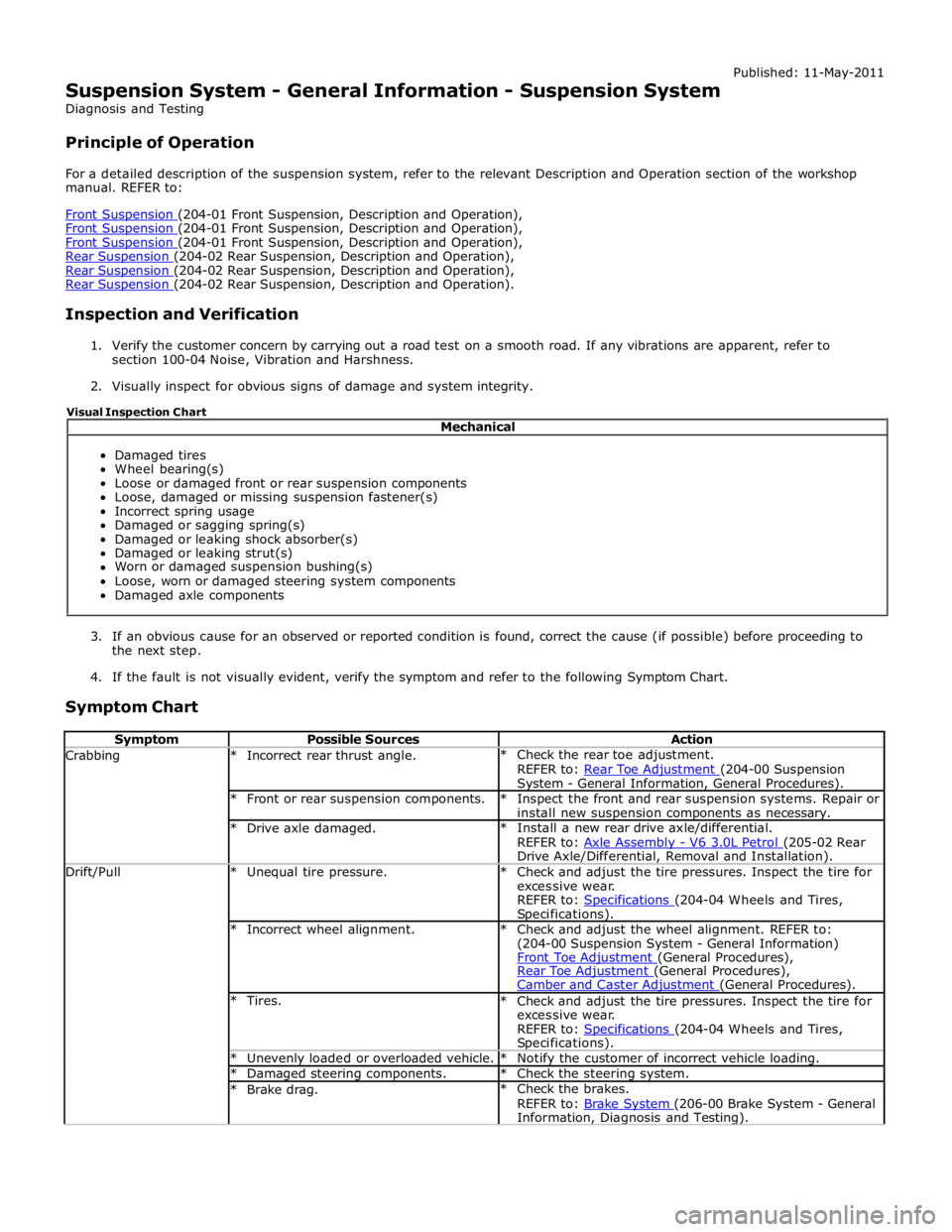
4. If the fault is not visually evident, verify the symptom and refer to the following Symptom Chart.
Symptom Chart
Symptom Possible Sources Action Crabbing * Incorrect rear thrust angle. * Check the rear toe adjustment.
REFER to: Rear Toe Adjustment (204-00 Suspension System - General Information, General Procedures). * Front or rear suspension components.
* Inspect the front and rear suspension systems. Repair or
install new suspension components as necessary. * Drive axle damaged. * Install a new rear drive axle/differential.
REFER to: Axle Assembly - V6 3.0L Petrol (205-02 Rear Drive Axle/Differential, Removal and Installation). Drift/Pull * Unequal tire pressure.
* Check and adjust the tire pressures. Inspect the tire for
excessive wear.
REFER to: Specifications (204-04 Wheels and Tires, Specifications). * Incorrect wheel alignment.
* Check and adjust the wheel alignment. REFER to:
(204-00 Suspension System - General Information)
Front Toe Adjustment (General Procedures), Rear Toe Adjustment (General Procedures), Camber and Caster Adjustment (General Procedures). * Tires.
* Check and adjust the tire pressures. Inspect the tire for
excessive wear.
REFER to: Specifications (204-04 Wheels and Tires, Specifications). * Unevenly loaded or overloaded vehicle. * Notify the customer of incorrect vehicle loading. * Damaged steering components. * Check the steering system. * Brake drag. * Check the brakes.
REFER to: Brake System (206-00 Brake System - General Information, Diagnosis and Testing). Mechanical
Damaged tires
Wheel bearing(s)
Loose or damaged front or rear suspension components
Loose, damaged or missing suspension fastener(s)
Incorrect spring usage
Damaged or sagging spring(s)
Damaged or leaking shock absorber(s)
Damaged or leaking strut(s)
Worn or damaged suspension bushing(s)
Loose, worn or damaged steering system components
Damaged axle components Visual Inspection Chart
Page 309 of 3039
Removal and Installation),
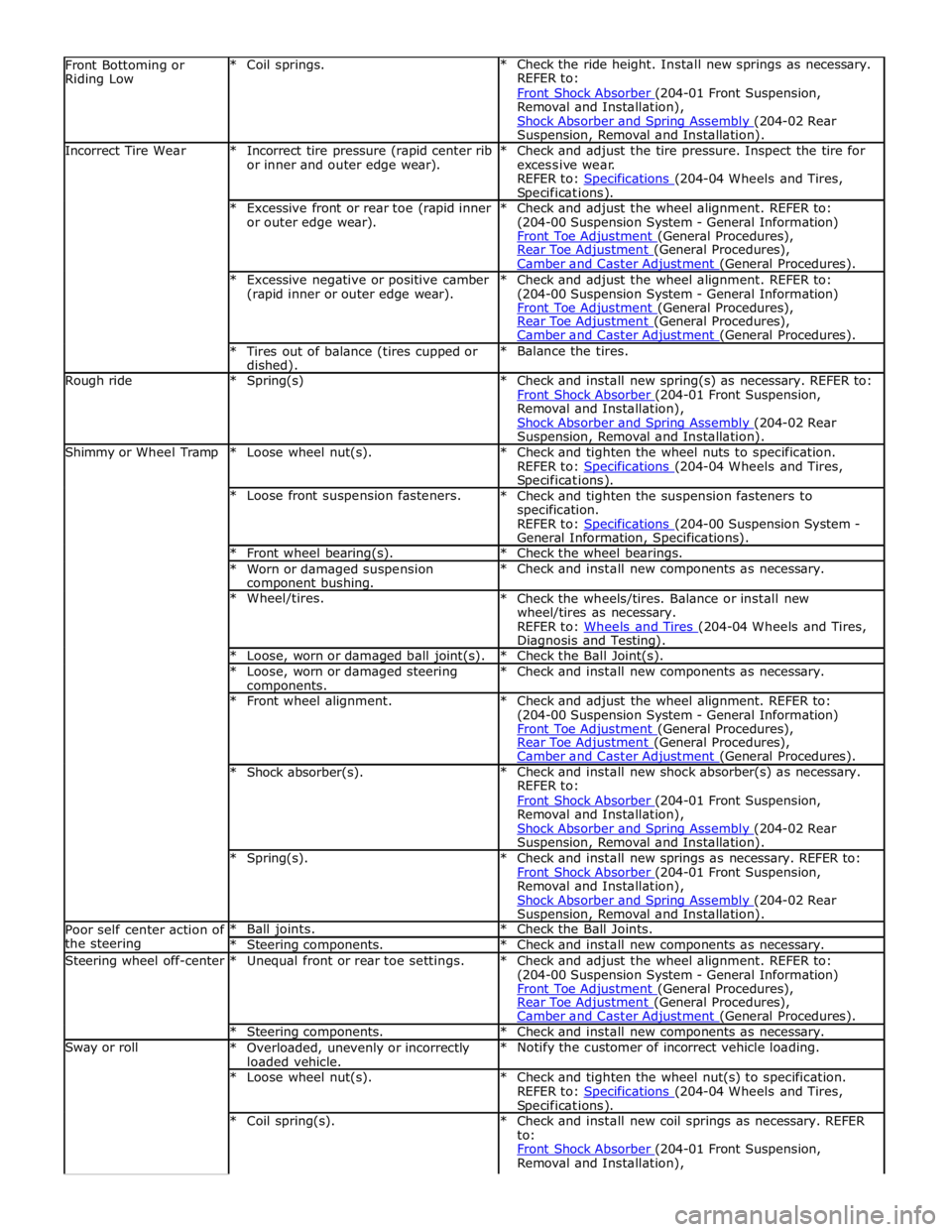
Shock Absorber and Spring Assembly (204-02 Rear Suspension, Removal and Installation). Incorrect Tire Wear
* Incorrect tire pressure (rapid center rib
or inner and outer edge wear). * Check and adjust the tire pressure. Inspect the tire for
excessive wear.
REFER to: Specifications (204-04 Wheels and Tires, Specifications). * Excessive front or rear toe (rapid inner
or outer edge wear). * Check and adjust the wheel alignment. REFER to:
(204-00 Suspension System - General Information)
Front Toe Adjustment (General Procedures), Rear Toe Adjustment (General Procedures), Camber and Caster Adjustment (General Procedures). * Excessive negative or positive camber
(rapid inner or outer edge wear). * Check and adjust the wheel alignment. REFER to:
(204-00 Suspension System - General Information)
Front Toe Adjustment (General Procedures), Rear Toe Adjustment (General Procedures), Camber and Caster Adjustment (General Procedures). * Tires out of balance (tires cupped or dished). * Balance the tires. Rough ride * Spring(s)
* Check and install new spring(s) as necessary. REFER to:
Front Shock Absorber (204-01 Front Suspension, Removal and Installation),
Shock Absorber and Spring Assembly (204-02 Rear Suspension, Removal and Installation). Shimmy or Wheel Tramp * Loose wheel nut(s).
* Check and tighten the wheel nuts to specification.
REFER to: Specifications (204-04 Wheels and Tires, Specifications). * Loose front suspension fasteners.
* Check and tighten the suspension fasteners to
specification.
REFER to: Specifications (204-00 Suspension System - General Information, Specifications). * Front wheel bearing(s). * Check the wheel bearings. * Worn or damaged suspension component bushing. * Check and install new components as necessary. * Wheel/tires.
* Check the wheels/tires. Balance or install new
wheel/tires as necessary.
REFER to: Wheels and Tires (204-04 Wheels and Tires, Diagnosis and Testing). * Loose, worn or damaged ball joint(s). * Check the Ball Joint(s). * Loose, worn or damaged steering components. * Check and install new components as necessary. * Front wheel alignment.
* Check and adjust the wheel alignment. REFER to:
(204-00 Suspension System - General Information)
Front Toe Adjustment (General Procedures), Rear Toe Adjustment (General Procedures), Camber and Caster Adjustment (General Procedures). * Shock absorber(s). * Check and install new shock absorber(s) as necessary.
REFER to:
Front Shock Absorber (204-01 Front Suspension, Removal and Installation),
Shock Absorber and Spring Assembly (204-02 Rear Suspension, Removal and Installation). * Spring(s).
* Check and install new springs as necessary. REFER to:
Front Shock Absorber (204-01 Front Suspension, Removal and Installation),
Shock Absorber and Spring Assembly (204-02 Rear Suspension, Removal and Installation). Poor self center action of
the steering * Ball joints. * Check the Ball Joints. * Steering components. * Check and install new components as necessary. Steering wheel off-center * Unequal front or rear toe settings.
* Check and adjust the wheel alignment. REFER to:
(204-00 Suspension System - General Information)
Front Toe Adjustment (General Procedures), Rear Toe Adjustment (General Procedures), Camber and Caster Adjustment (General Procedures). * Steering components. * Check and install new components as necessary. Sway or roll
* Overloaded, unevenly or incorrectly
loaded vehicle. * Notify the customer of incorrect vehicle loading. * Loose wheel nut(s).
* Check and tighten the wheel nut(s) to specification.
REFER to: Specifications (204-04 Wheels and Tires, Specifications). * Coil spring(s).
* Check and install new coil springs as necessary. REFER
to:
Front Shock Absorber (204-01 Front Suspension, Removal and Installation),
Page 317 of 3039
Published: 16-Oct-2013
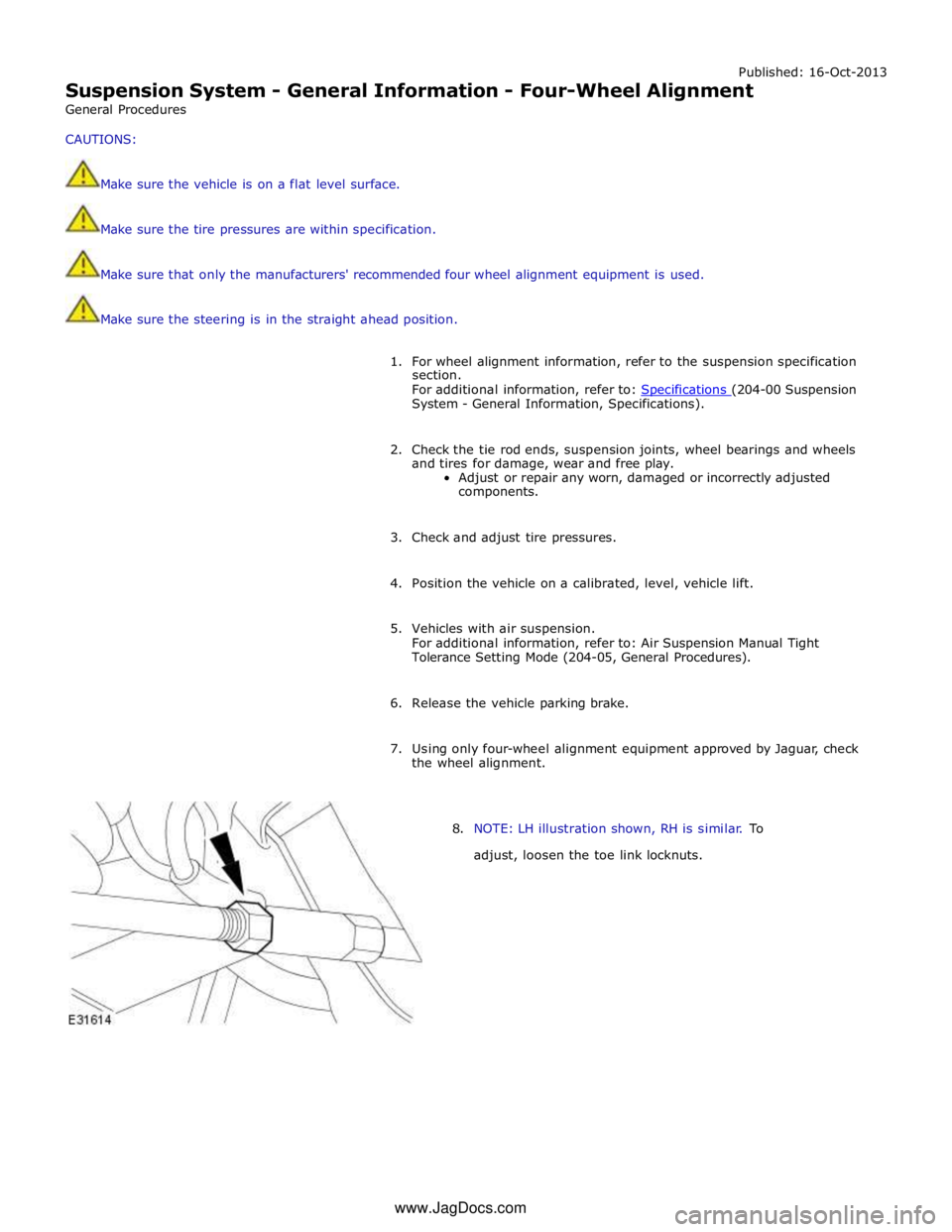
Suspension System - General Information - Four-Wheel Alignment
General Procedures
CAUTIONS:
Make sure the vehicle is on a flat level surface.
Make sure the tire pressures are within specification.
Make sure that only the manufacturers' recommended four wheel alignment equipment is used.
Make sure the steering is in the straight ahead position.
1. For wheel alignment information, refer to the suspension specification
section.
For additional information, refer to: Specifications (204-00 Suspension System - General Information, Specifications).
2. Check the tie rod ends, suspension joints, wheel bearings and wheels
and tires for damage, wear and free play.
Adjust or repair any worn, damaged or incorrectly adjusted
components.
3. Check and adjust tire pressures.
4. Position the vehicle on a calibrated, level, vehicle lift.
5. Vehicles with air suspension.
For additional information, refer to: Air Suspension Manual Tight
Tolerance Setting Mode (204-05, General Procedures).
6. Release the vehicle parking brake.
7. Using only four-wheel alignment equipment approved by Jaguar, check
the wheel alignment.
8. NOTE: LH illustration shown, RH is similar. To
adjust, loosen the toe link locknuts. www.JagDocs.com
Page 321 of 3039
Published: 16-Oct-2013
Suspension System - General Information - Front Toe Adjustment
General Procedures
CAUTIONS:
Make sure the vehicle is on a flat level surface.
Make sure the tire pressures are within specification.
Make sure that only the manufacturers' recommended four wheel alignment equipment is used.
Make sure the steering is in the straight ahead position.
1. For wheel alignment information, refer to the suspension specification
section.
For additional information, refer to: Specifications (204-00 Suspension System - General Information, Specifications).
2. Check the tie rod ends, suspension joints, wheel bearings and wheels
and tires for damage, wear and free play.
Adjust or repair any worn, damaged or incorrectly adjusted
components.
3. Check and adjust tire pressures.
4. Position the vehicle on a 4 post lift.
5. Release the vehicle parking brake.
6. Vehicles with air suspension.
For additional information, refer to: Air Suspension Manual Tight
Tolerance Setting Mode (204-05, General Procedures).
7. For additional information, refer to: Air Suspension Manual Tight
Tolerance Setting Mode (204-05, General Procedures).
8. Using only four-wheel alignment equipment approved by Jaguar, check
the wheel alignment.
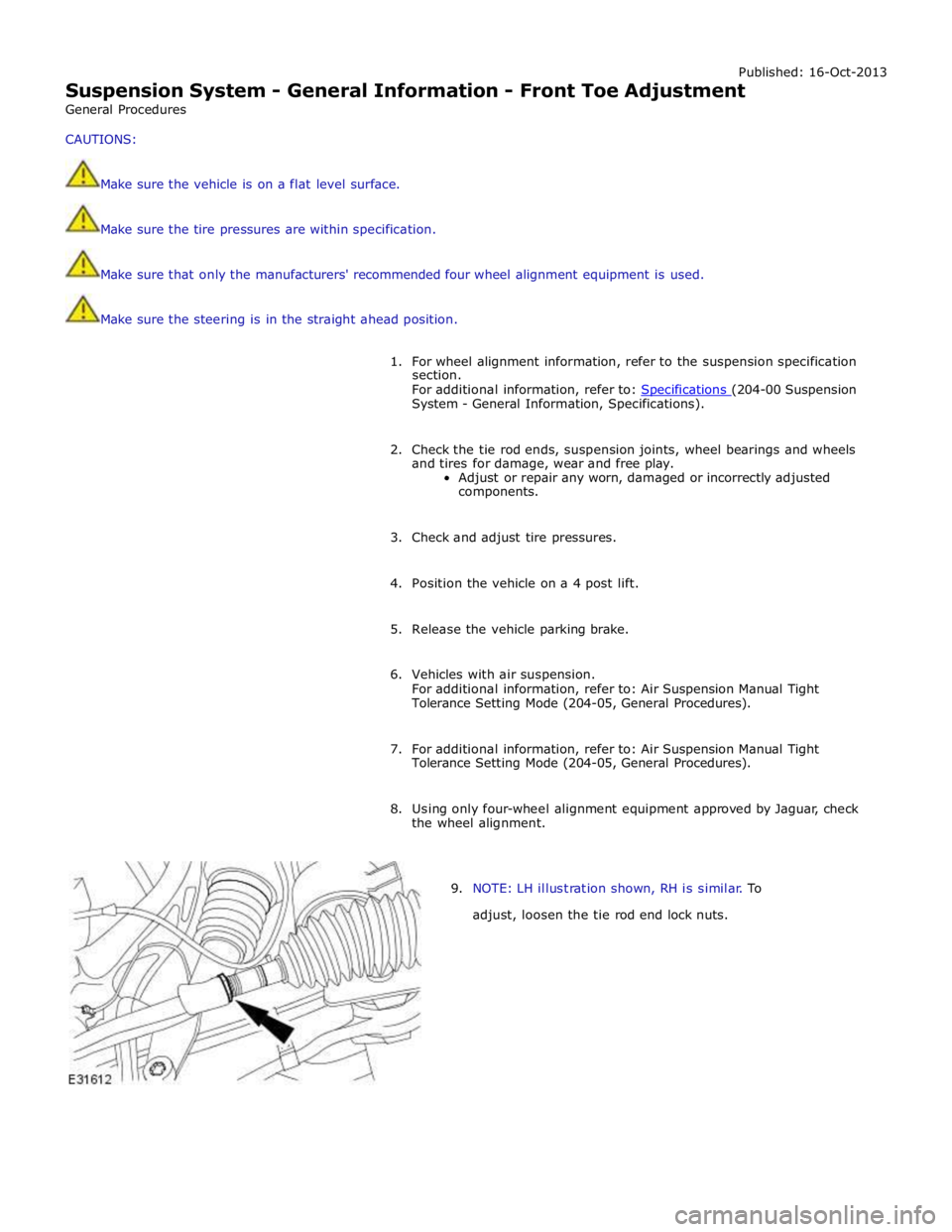
9. NOTE: LH illustration shown, RH is similar. To
adjust, loosen the tie rod end lock nuts.
Page 437 of 3039
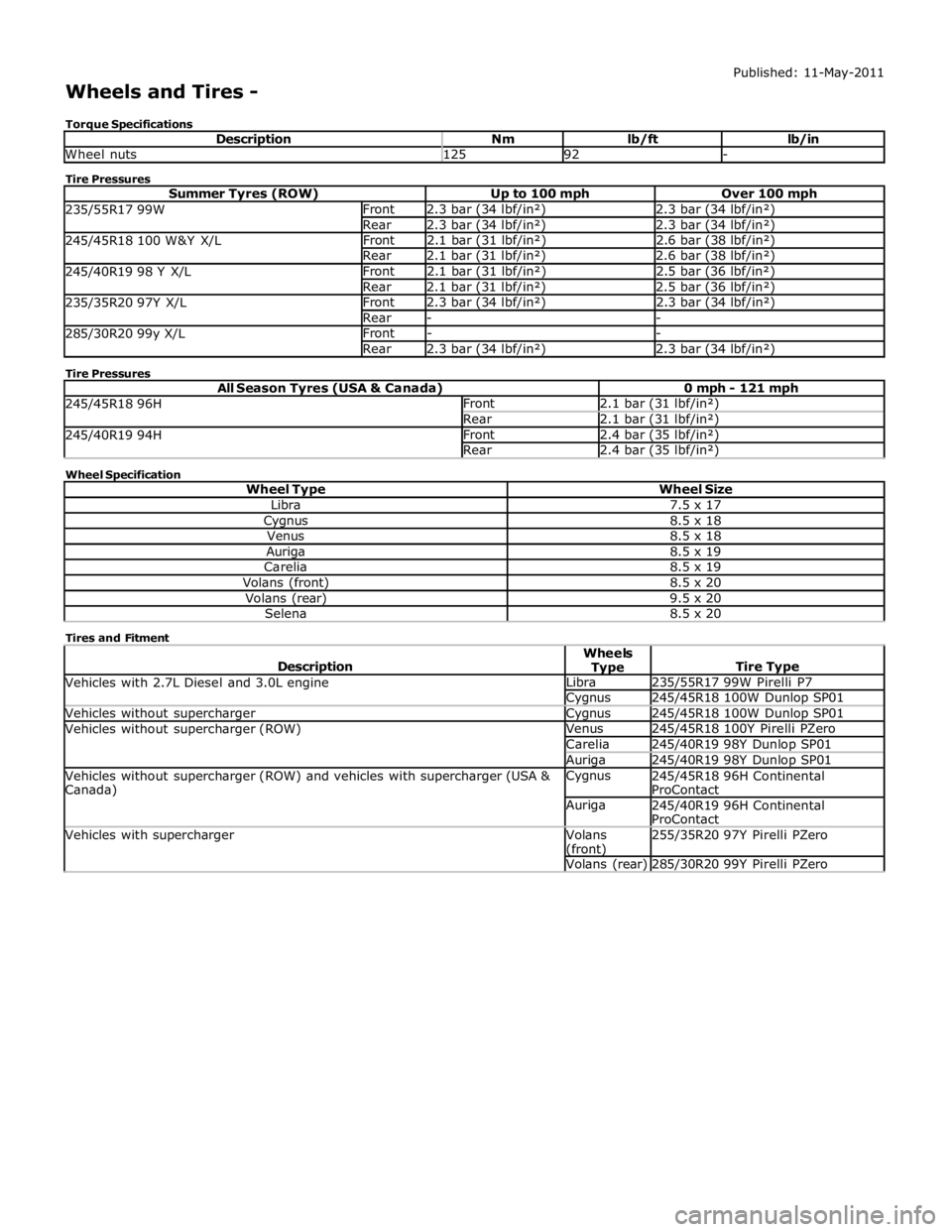
Wheel nuts 125 92 - Tire Pressures
Summer Tyres (ROW) Up to 100 mph Over 100 mph 235/55R17 99W Front 2.3 bar (34 lbf/in²) 2.3 bar (34 lbf/in²) Rear 2.3 bar (34 lbf/in²) 2.3 bar (34 lbf/in²) 245/45R18 100 W&Y X/L Front 2.1 bar (31 lbf/in²) 2.6 bar (38 lbf/in²) Rear 2.1 bar (31 lbf/in²) 2.6 bar (38 lbf/in²) 245/40R19 98 Y X/L Front 2.1 bar (31 lbf/in²) 2.5 bar (36 lbf/in²) Rear 2.1 bar (31 lbf/in²) 2.5 bar (36 lbf/in²) 235/35R20 97Y X/L Front 2.3 bar (34 lbf/in²) 2.3 bar (34 lbf/in²) Rear - - 285/30R20 99y X/L Front - - Rear 2.3 bar (34 lbf/in²) 2.3 bar (34 lbf/in²) Tire Pressures
All Season Tyres (USA & Canada) 0 mph - 121 mph 245/45R18 96H Front 2.1 bar (31 lbf/in²) Rear 2.1 bar (31 lbf/in²) 245/40R19 94H Front 2.4 bar (35 lbf/in²) Rear 2.4 bar (35 lbf/in²) Wheel Specification
Wheel Type Wheel Size Libra 7.5 x 17 Cygnus 8.5 x 18 Venus 8.5 x 18 Auriga 8.5 x 19 Carelia 8.5 x 19 Volans (front) 8.5 x 20 Volans (rear) 9.5 x 20 Selena 8.5 x 20 Tires and Fitment
Description Wheels Type
Tire Type Vehicles with 2.7L Diesel and 3.0L engine Libra 235/55R17 99W Pirelli P7 Cygnus 245/45R18 100W Dunlop SP01 Vehicles without supercharger Cygnus 245/45R18 100W Dunlop SP01 Vehicles without supercharger (ROW) Venus 245/45R18 100Y Pirelli PZero Carelia 245/40R19 98Y Dunlop SP01 Auriga 245/40R19 98Y Dunlop SP01 Vehicles without supercharger (ROW) and vehicles with supercharger (USA &
Canada) Cygnus
245/45R18 96H Continental
ProContact Auriga
245/40R19 96H Continental
ProContact Vehicles with supercharger
Volans (front) 255/35R20 97Y Pirelli PZero Volans (rear) 285/30R20 99Y Pirelli PZero
Page 438 of 3039

1 Tire pressure sensor 2 Tire pressure monitoring system module 3 Tire pressure receiver 4 Tire pressure monitoring system initiator
Page 439 of 3039
Wheels and Tires - Wheels and Tires - Overview
Description and Operation
OVERVIEW Published: 25-May-2012
A number of alloy wheel designs are available ranging from 17 to 20 inch in diameter. A Tire Pressure Monitoring System
(TPMS) is used to monitor the air pressure in each tire and inform the driver if the pressure falls below predetermined
thresholds.
All wheels are of cast construction in aluminum alloy with the choice of wheel design dependant on the vehicle trim level and
engine derivative.
On normally aspirated petrol models and all diesel models a 4J X 18 inch temporary spare wheel is supplied as standard,
supercharged petrol models are supplied with a 4Jx19 inch temporary spare wheel. In some major European markets an Instant
Mobility System is offered as an alternative to the spare wheel. The Instant Mobility System is capable of providing a
temporary repair and tire inflation to a puncture of up to 6mm in diameter in the tread area of the tire. A puncture in the tire
wall cannot be repaired using the system.
The vehicle jack and accessories are stored in the spare wheel-well in the luggage compartment.
Tire Changing
WARNINGS:
Tires must be inflated to the recommended pressures when the tires are cold (ambient temperature) only. Refer to label
on the 'B' pillar for recommended tire pressures. If the tires have been subjected to use or exposed to direct sunlight, move
the vehicle into a shaded position and allow the tires to cool before checking or adjusting the pressures.
Valve stem seal, washer nut, valve core and cap should be replaced at every tire change. Valve stem seal, washer and
nut must be replaced if the valve retention nut is loosened. Sensor units and nuts must be fitted using correct torque figures
and associated profile. Damage to the vehicle and consequently injury to the vehicle's occupants may result if these
instructions are not adhered to.
NOTE: The TPMS valve should be serviced using the suitable service kit, each time the tyre is dismounted, to ensure an
air tight seal. Attention should be made to the detail of fitting this kit.
Vehicles fitted with TPMS can be visually identified by an external metal locknut and valve of the tire pressure sensor on the
road wheels. Vehicles without TPMS will have rubber tire valve.
www.JagDocs.com
Page 440 of 3039
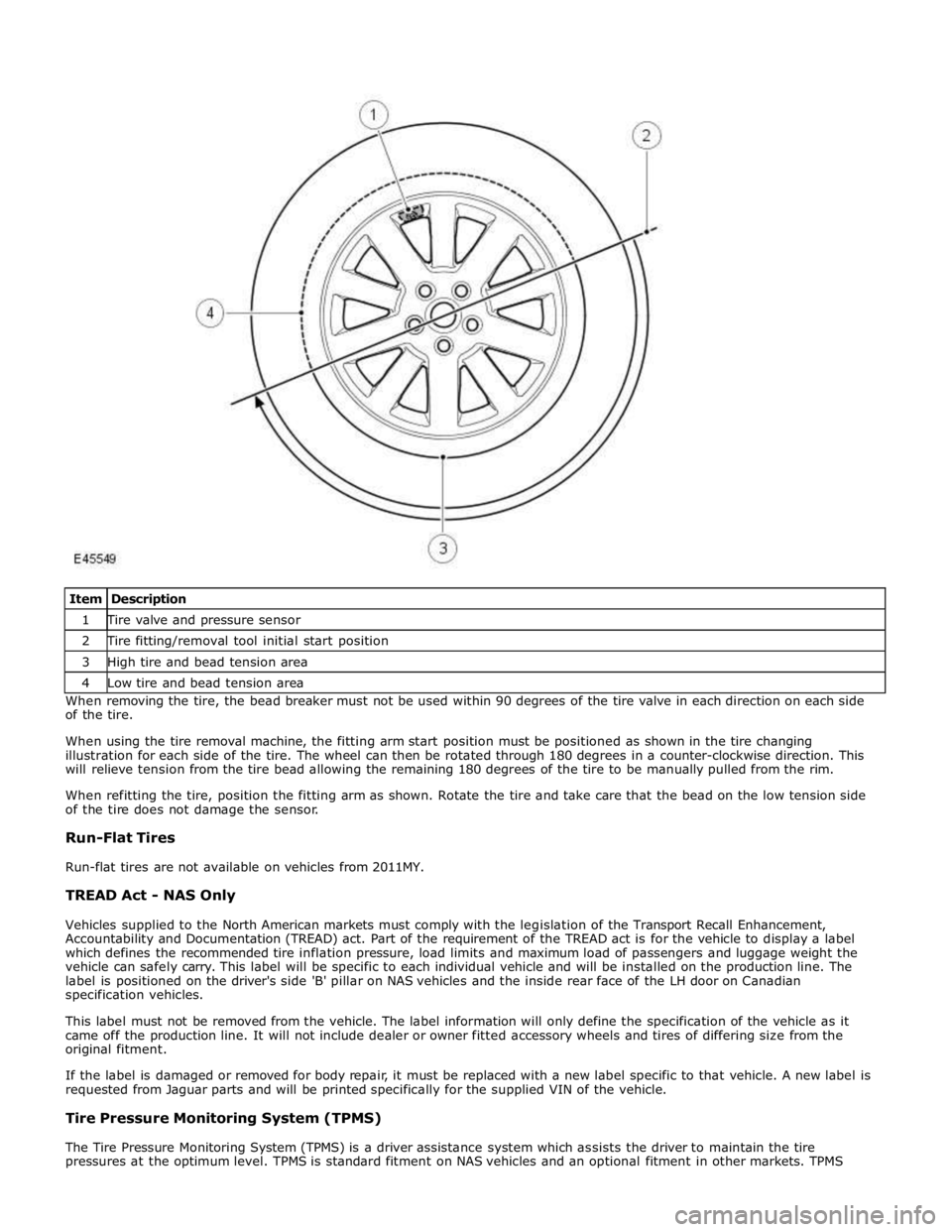
1 Tire valve and pressure sensor 2 Tire fitting/removal tool initial start position 3 High tire and bead tension area 4 Low tire and bead tension area When removing the tire, the bead breaker must not be used within 90 degrees of the tire valve in each direction on each side
of the tire.
When using the tire removal machine, the fitting arm start position must be positioned as shown in the tire changing
illustration for each side of the tire. The wheel can then be rotated through 180 degrees in a counter-clockwise direction. This
will relieve tension from the tire bead allowing the remaining 180 degrees of the tire to be manually pulled from the rim.
When refitting the tire, position the fitting arm as shown. Rotate the tire and take care that the bead on the low tension side
of the tire does not damage the sensor.
Run-Flat Tires
Run-flat tires are not available on vehicles from 2011MY.
TREAD Act - NAS Only
Vehicles supplied to the North American markets must comply with the legislation of the Transport Recall Enhancement,
Accountability and Documentation (TREAD) act. Part of the requirement of the TREAD act is for the vehicle to display a label
which defines the recommended tire inflation pressure, load limits and maximum load of passengers and luggage weight the
vehicle can safely carry. This label will be specific to each individual vehicle and will be installed on the production line. The
label is positioned on the driver's side 'B' pillar on NAS vehicles and the inside rear face of the LH door on Canadian
specification vehicles.
This label must not be removed from the vehicle. The label information will only define the specification of the vehicle as it
came off the production line. It will not include dealer or owner fitted accessory wheels and tires of differing size from the
original fitment.
If the label is damaged or removed for body repair, it must be replaced with a new label specific to that vehicle. A new label is
requested from Jaguar parts and will be printed specifically for the supplied VIN of the vehicle.
Tire Pressure Monitoring System (TPMS)
The Tire Pressure Monitoring System (TPMS) is a driver assistance system which assists the driver to maintain the tire
pressures at the optimum level. TPMS is standard fitment on NAS vehicles and an optional fitment in other markets. TPMS
Page 441 of 3039
provides the following benefits:
Maintain optimal fuel consumption.
Maintain ride and handling characteristics.
Reduce the risk of rapid tire deflation - which may be caused by under inflated tires.
Comply with legislation requirements in relevant markets.
CAUTION: TPMS is not intended as a replacement for regular tire pressure and tire condition checks and should be
considered as additional to good tire maintenance practices.
The TPMS measures the pressure in each of the vehicle's tires and issues warnings to the driver if any of the pressures deviate
from defined tolerances. The space saver spare wheel is not monitored.
NOTE: TPMS is not designed to warn the driver of a tire 'blow-out', as due to the short duration of a 'blow-out', it is not
possible to give the driver sufficient warning that such an event is occurring. The design of the TPMS is to assist the driver in
keeping the tires at the correct pressure, which will assist to reduce the likelihood of a tire 'blow-out' occurring.