roof JAGUAR XFR 2010 1.G Service Manual
[x] Cancel search | Manufacturer: JAGUAR, Model Year: 2010, Model line: XFR, Model: JAGUAR XFR 2010 1.GPages: 3039, PDF Size: 58.49 MB
Page 2573 of 3039
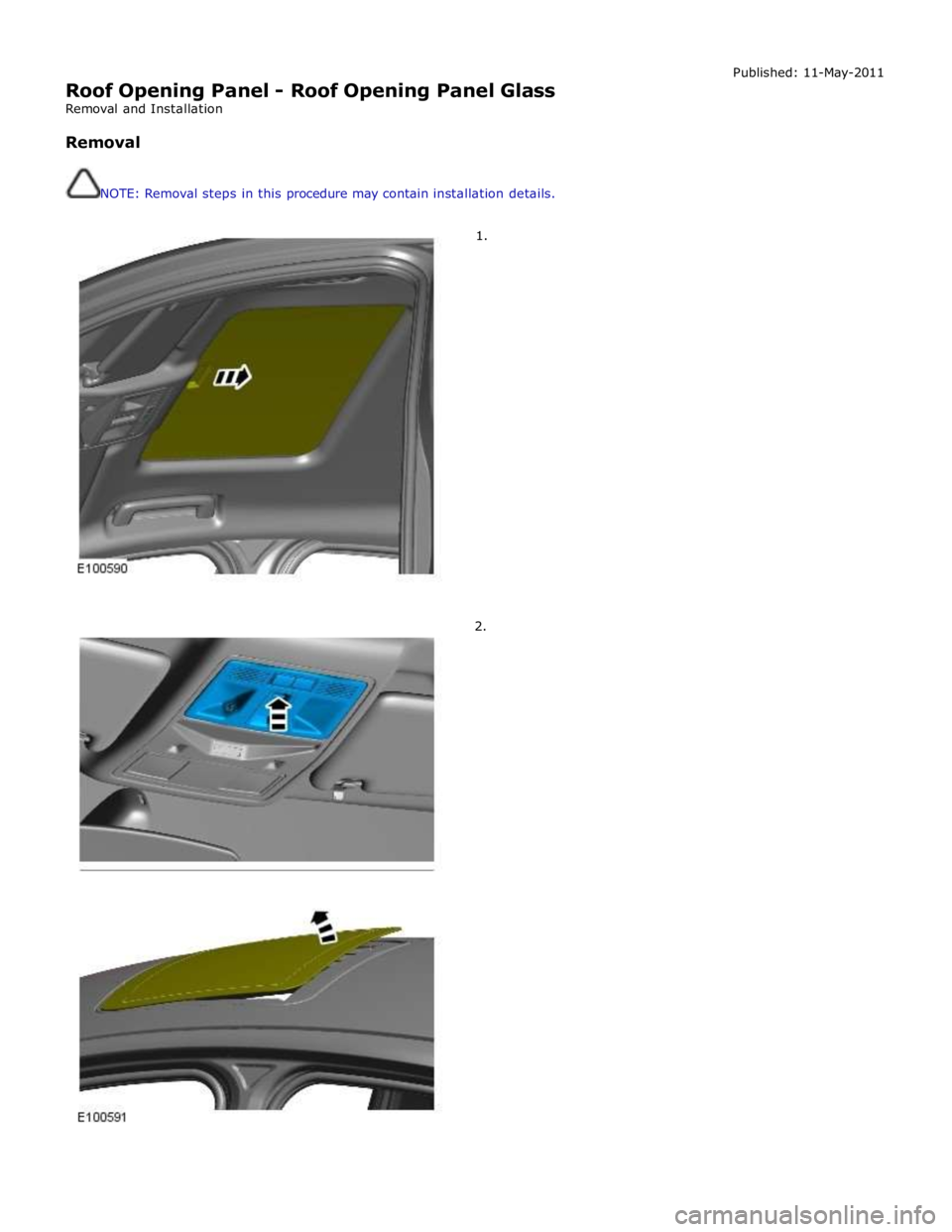
Roof Opening Panel - Roof Opening Panel Glass
Removal and Installation
Removal
NOTE: Removal steps in this procedure may contain installation details.
1.
2. Published: 11-May-2011
Page 2575 of 3039
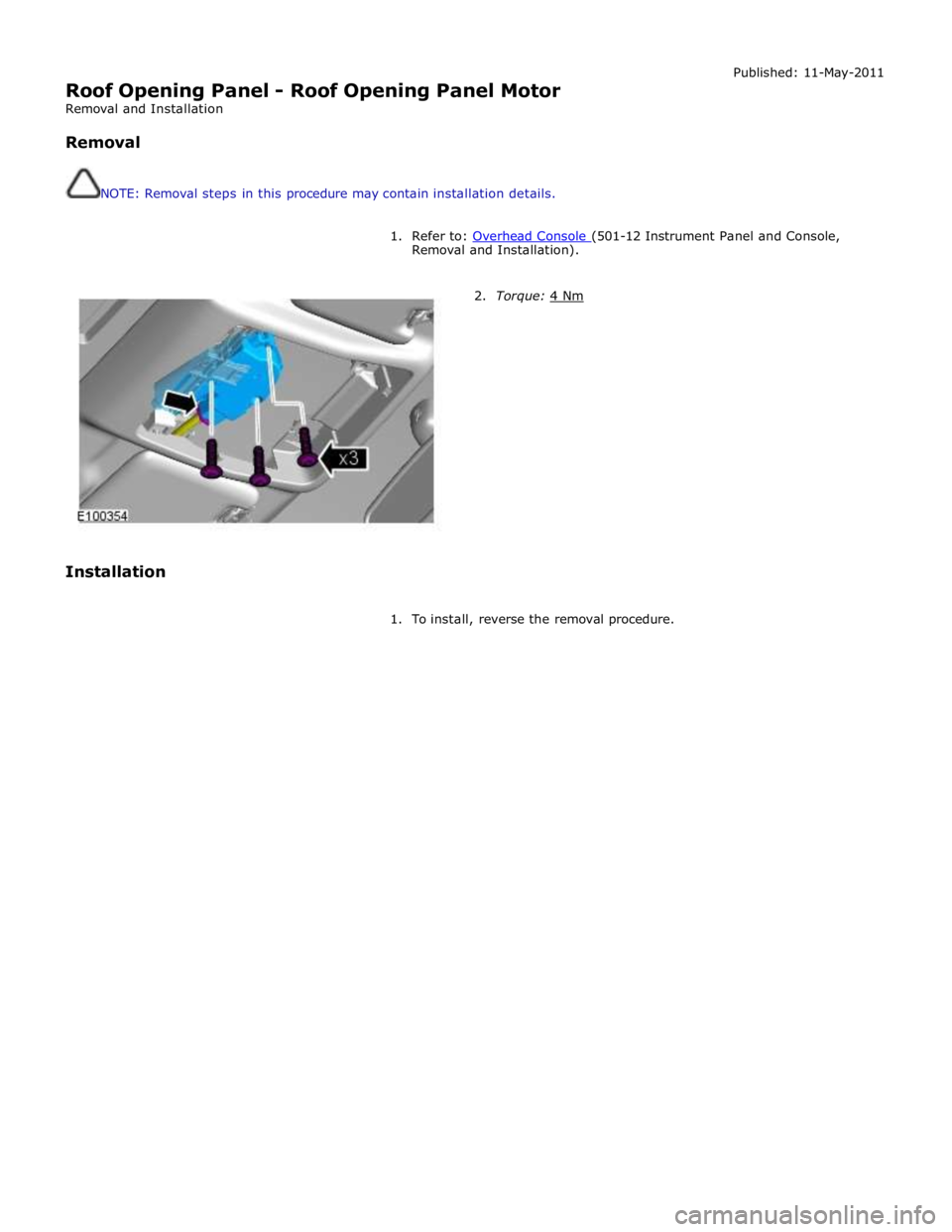
Roof Opening Panel - Roof Opening Panel Motor
Removal and Installation
Removal
NOTE: Removal steps in this procedure may contain installation details. Published: 11-May-2011
1. Refer to: Overhead Console (501-12 Instrument Panel and Console, Removal and Installation).
Installation
2. Torque: 4 Nm
1. To install, reverse the removal procedure.
Page 2576 of 3039
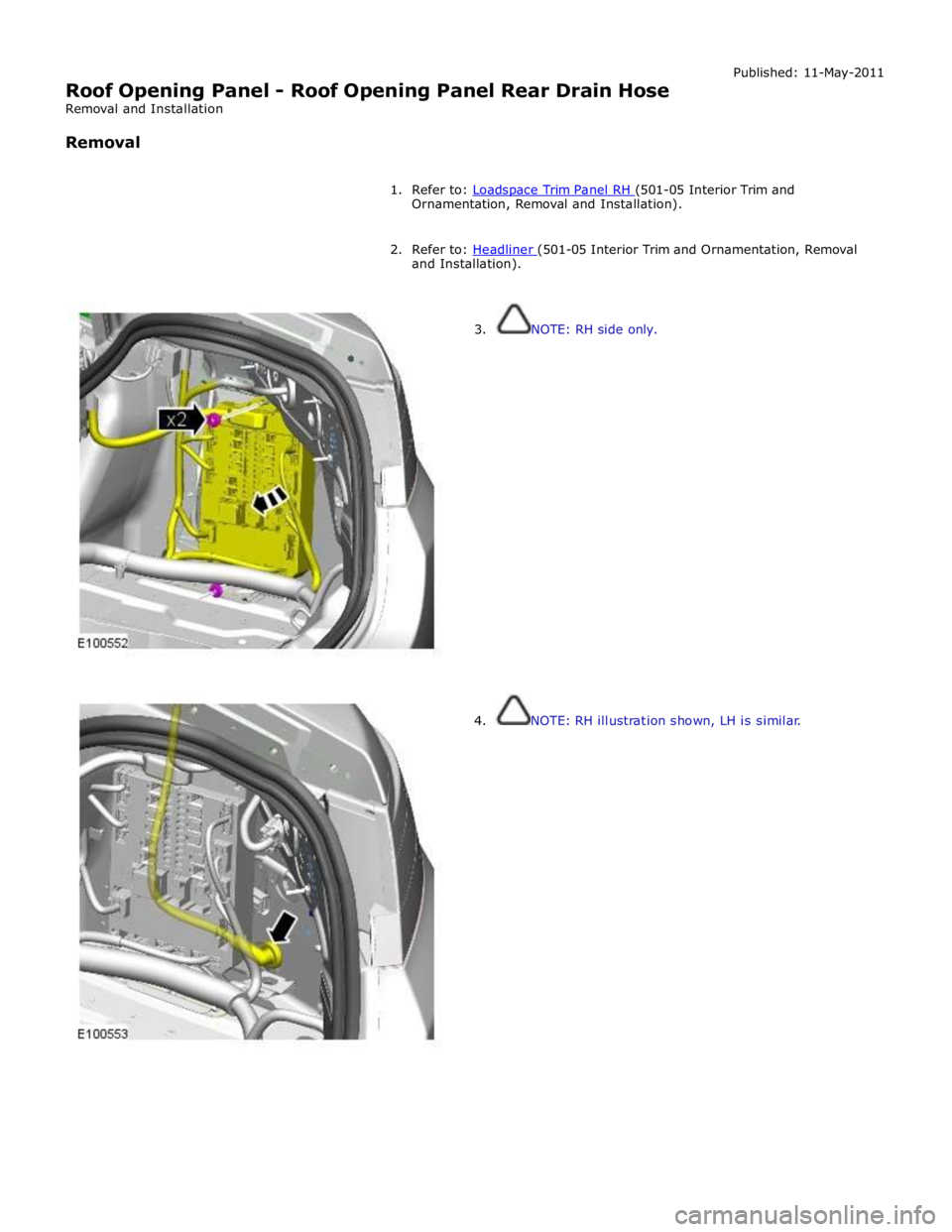
Roof Opening Panel - Roof Opening Panel Rear Drain Hose
Removal and Installation
Removal Published: 11-May-2011
1. Refer to: Loadspace Trim Panel RH (501-05 Interior Trim and Ornamentation, Removal and Installation).
2. Refer to: Headliner (501-05 Interior Trim and Ornamentation, Removal and Installation).
3. NOTE: RH side only.
4. NOTE: RH illustration shown, LH is similar.
Page 2676 of 3039
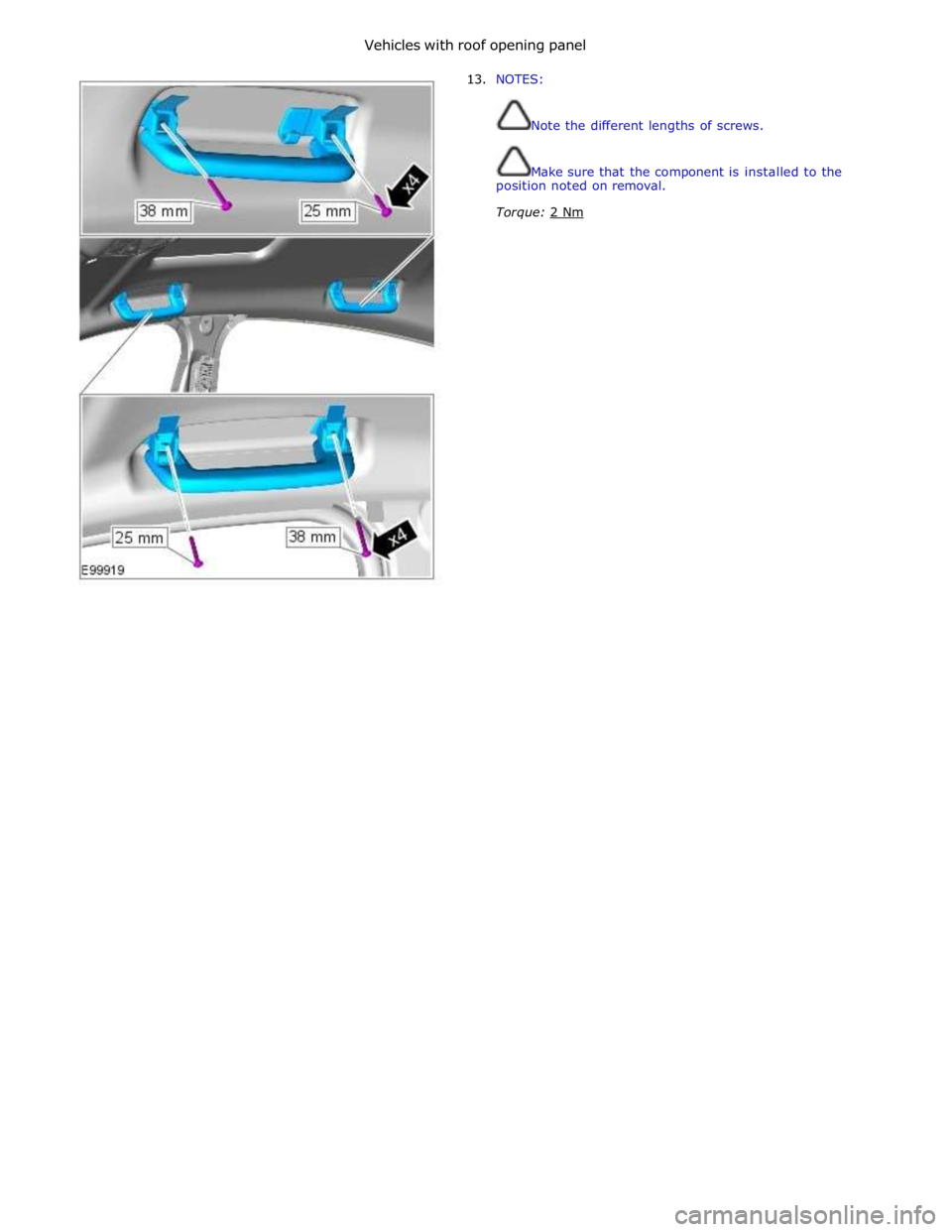
Vehicles with roof opening panel
13. NOTES:
Note the different lengths of screws.
Make sure that the component is installed to the
position noted on removal.
Torque: 2 Nm
Page 2677 of 3039
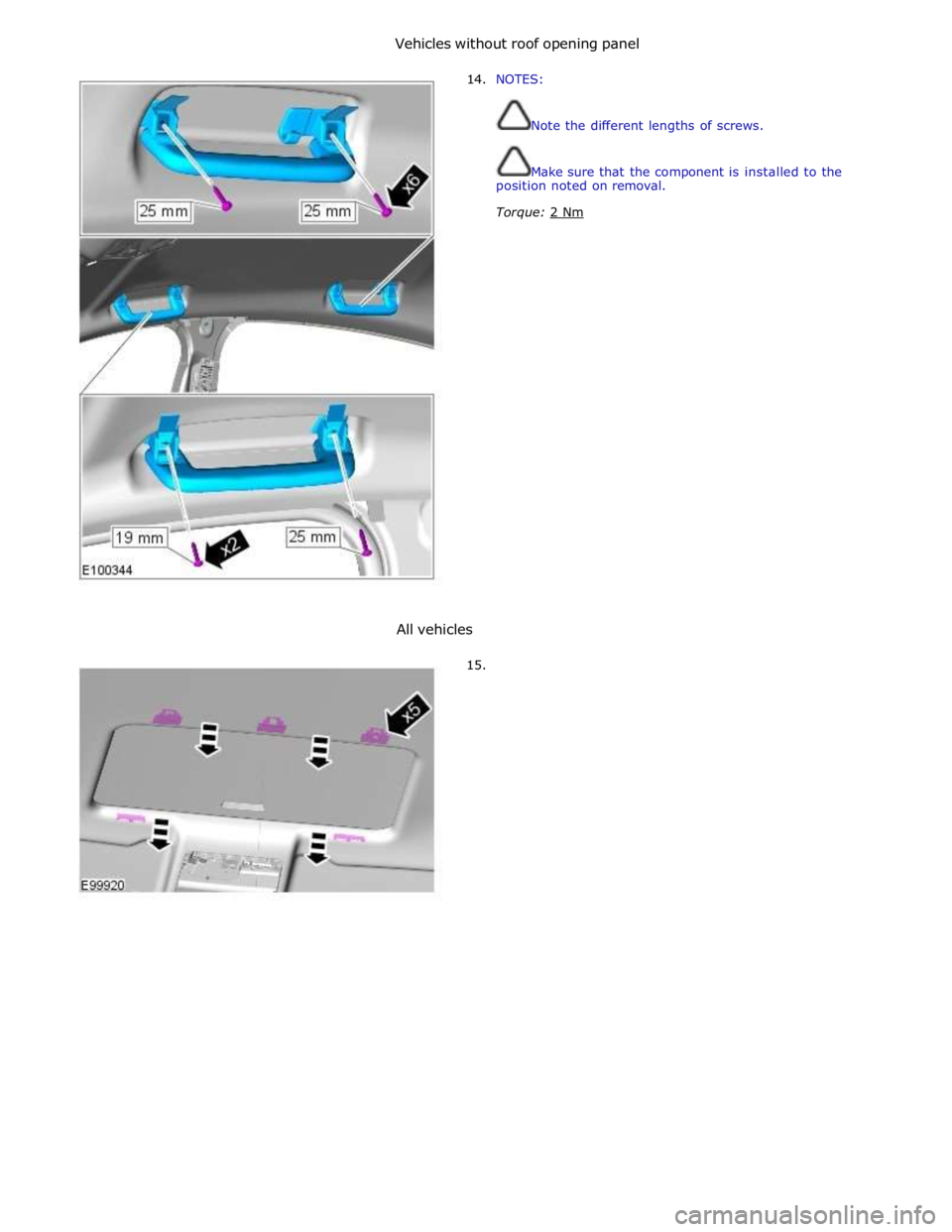
Vehicles without roof opening panel
14. NOTES:
Note the different lengths of screws.
Make sure that the component is installed to the
position noted on removal.
Torque: 2 Nm
All vehicles
15.
Page 2698 of 3039
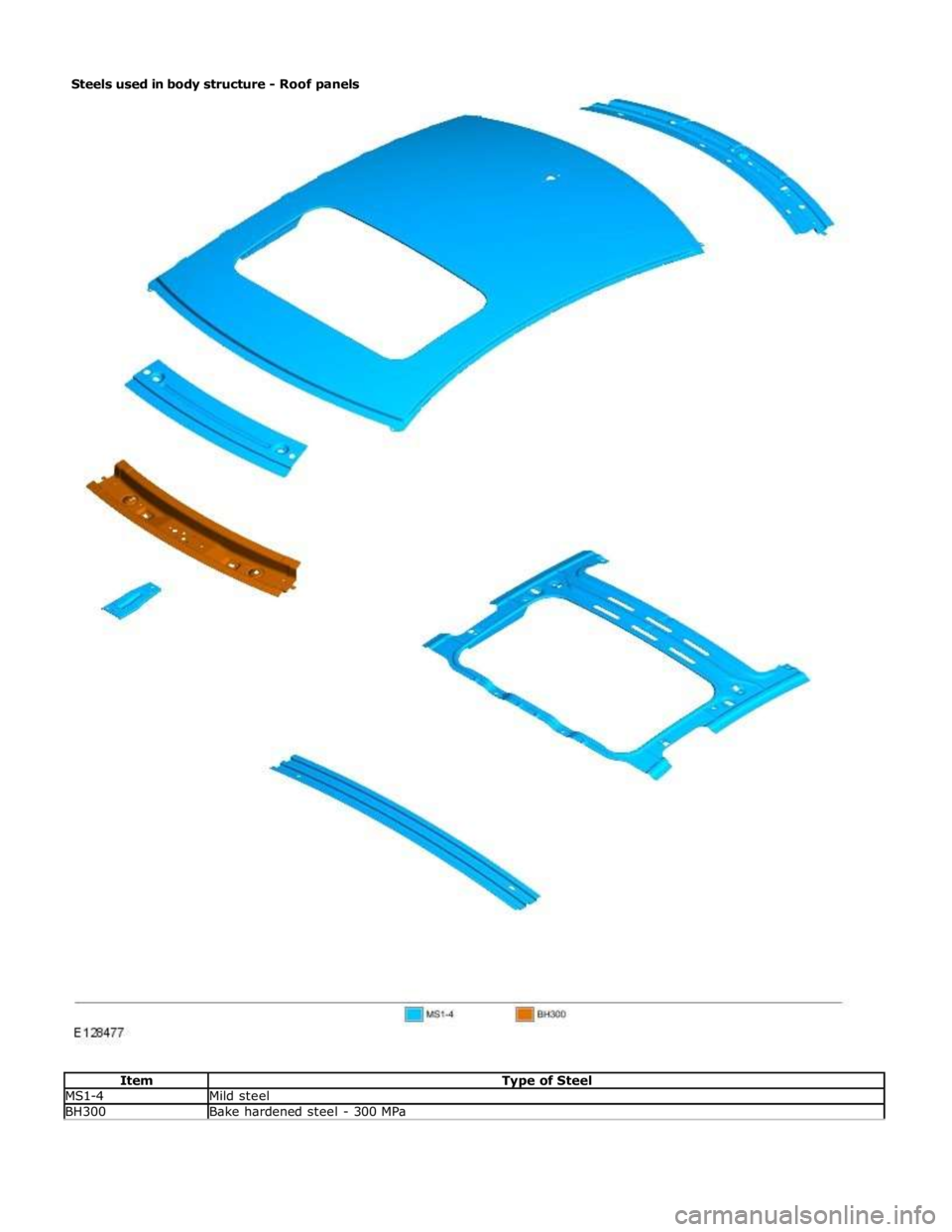
Steels used in body structure - Roof panels
Item Type of Steel MS1-4 Mild steel BH300 Bake hardened steel - 300 MPa
Page 2704 of 3039
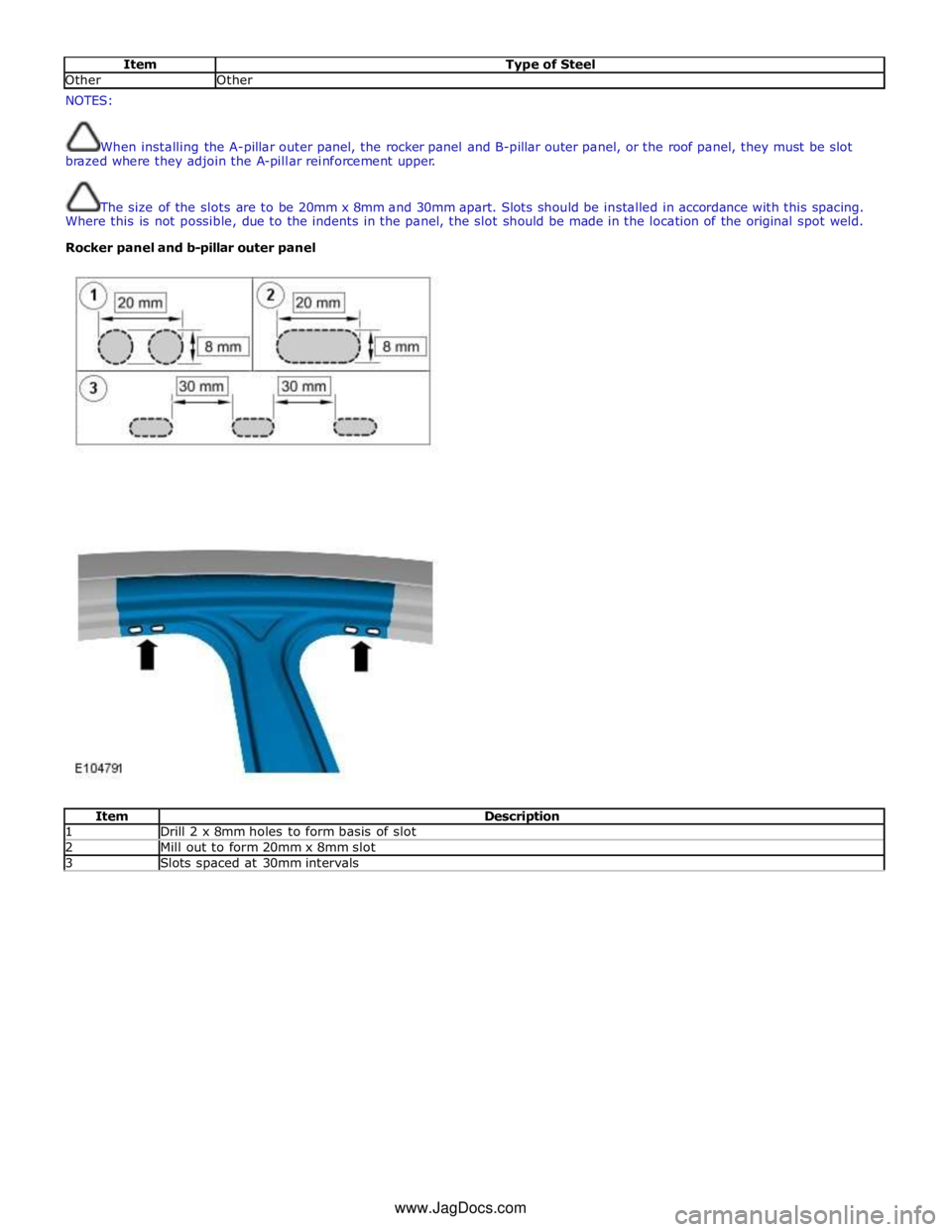
Item Type of Steel Other Other NOTES:
When installing the A-pillar outer panel, the rocker panel and B-pillar outer panel, or the roof panel, they must be slot
brazed where they adjoin the A-pillar reinforcement upper.
The size of the slots are to be 20mm x 8mm and 30mm apart. Slots should be installed in accordance with this spacing.
Where this is not possible, due to the indents in the panel, the slot should be made in the location of the original spot weld.
Rocker panel and b-pillar outer panel
Item Description 1 Drill 2 x 8mm holes to form basis of slot 2 Mill out to form 20mm x 8mm slot 3 Slots spaced at 30mm intervals www.JagDocs.com
Page 2706 of 3039
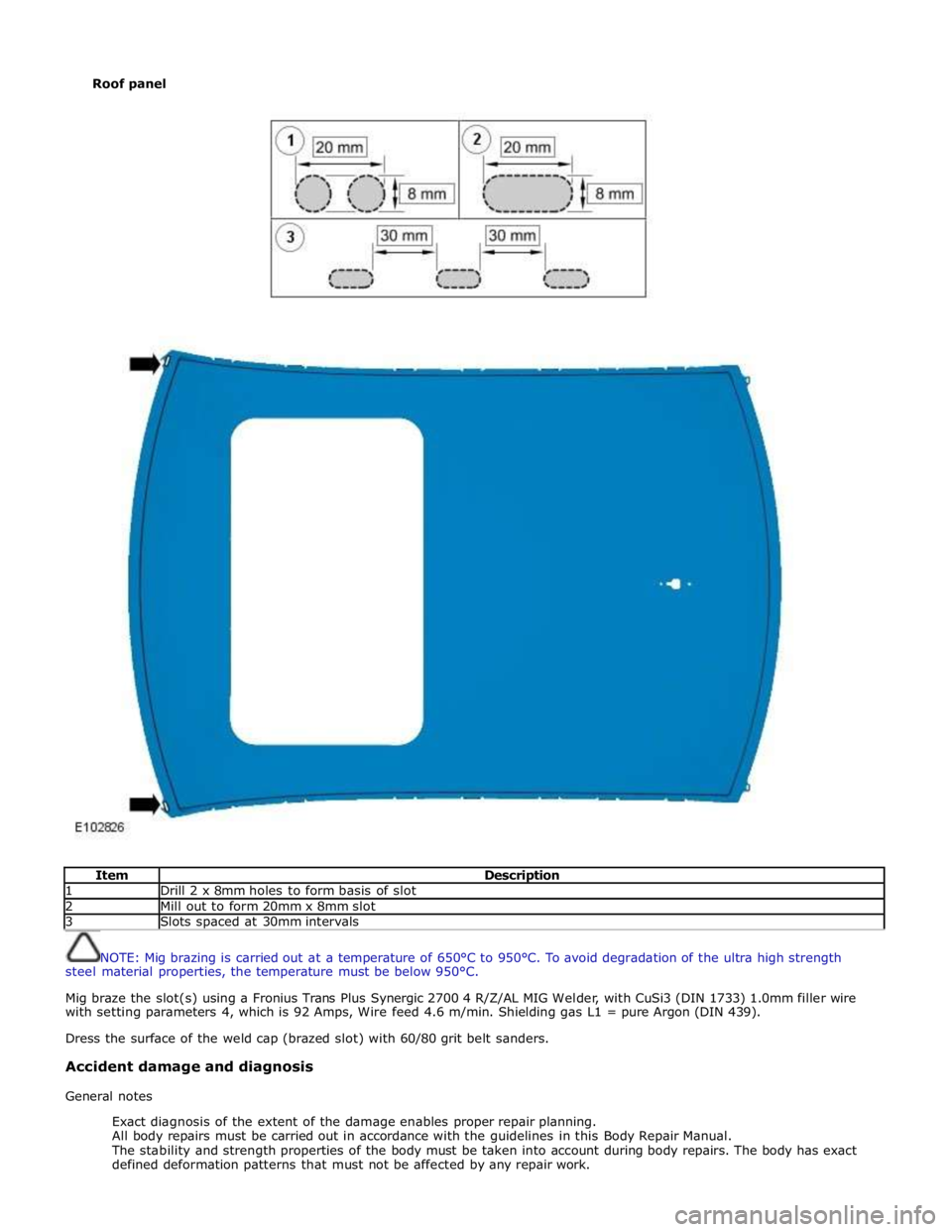
Item Description 1 Drill 2 x 8mm holes to form basis of slot 2 Mill out to form 20mm x 8mm slot 3 Slots spaced at 30mm intervals
NOTE: Mig brazing is carried out at a temperature of 650°C to 950°C. To avoid degradation of the ultra high strength
steel material properties, the temperature must be below 950°C.
Mig braze the slot(s) using a Fronius Trans Plus Synergic 2700 4 R/Z/AL MIG Welder, with CuSi3 (DIN 1733) 1.0mm filler wire
with setting parameters 4, which is 92 Amps, Wire feed 4.6 m/min. Shielding gas L1 = pure Argon (DIN 439).
Dress the surface of the weld cap (brazed slot) with 60/80 grit belt sanders.
Accident damage and diagnosis
General notes
Exact diagnosis of the extent of the damage enables proper repair planning.
All body repairs must be carried out in accordance with the guidelines in this Body Repair Manual.
The stability and strength properties of the body must be taken into account during body repairs. The body has exact
defined deformation patterns that must not be affected by any repair work. Roof panel
Page 2707 of 3039
For instance, the crumple zones absorb the bulk of the impact energy. If any unprofessional repair techniques or
methods are used in these areas then this can pose a fundamental threat to vehicle safety.
Hidden damage
As well as looking at external indicators like flaked off paint, it is vital to check for hidden body damage or deformation
that is not visible from the outside. Large attached parts like bumpers and inner fenders often need to be removed to
allow accurate assessment of damage to underlying body parts.
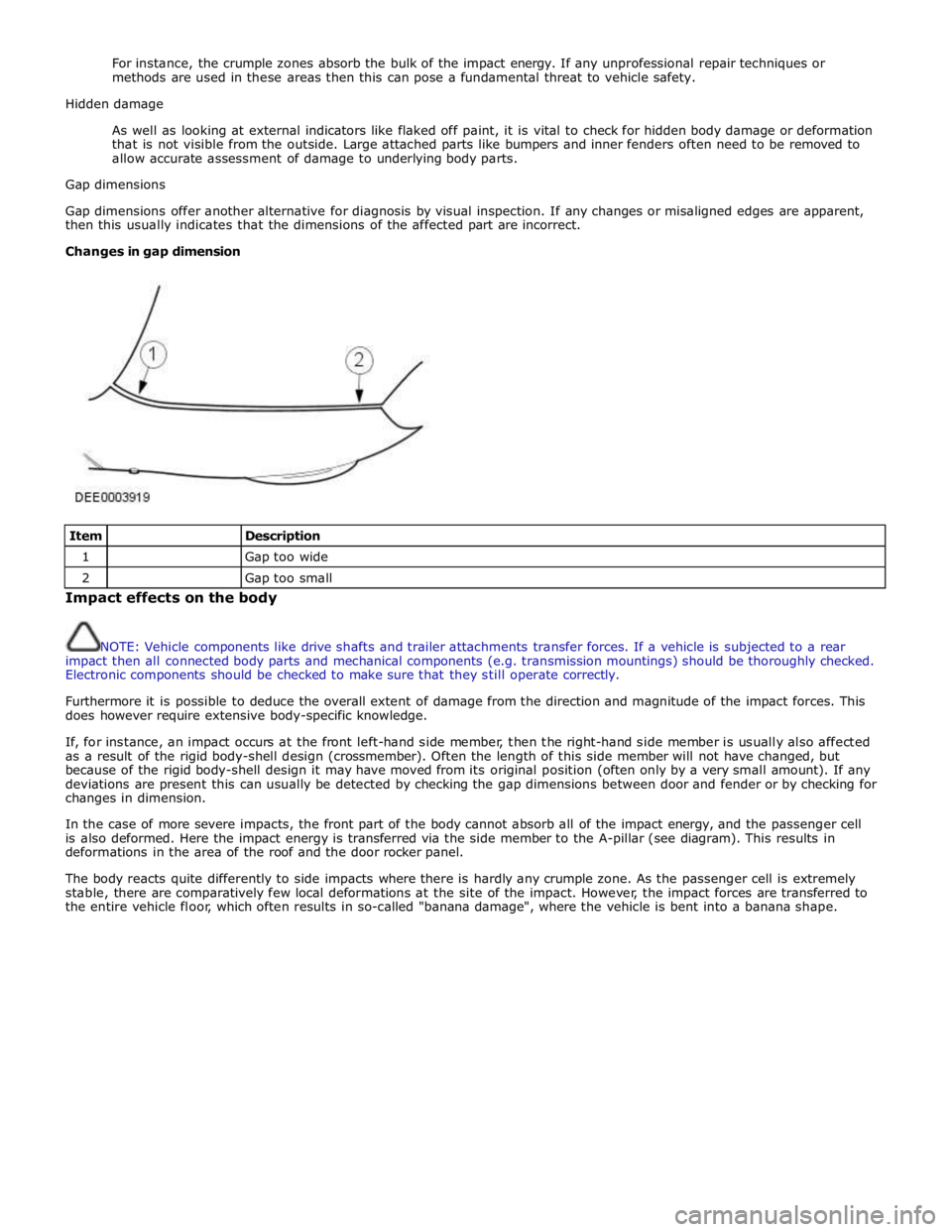
Gap dimensions
Gap dimensions offer another alternative for diagnosis by visual inspection. If any changes or misaligned edges are apparent,
then this usually indicates that the dimensions of the affected part are incorrect.
Changes in gap dimension
Item
Description 1
Gap too wide 2
Gap too small Impact effects on the body
NOTE: Vehicle components like drive shafts and trailer attachments transfer forces. If a vehicle is subjected to a rear
impact then all connected body parts and mechanical components (e.g. transmission mountings) should be thoroughly checked.
Electronic components should be checked to make sure that they still operate correctly.
Furthermore it is possible to deduce the overall extent of damage from the direction and magnitude of the impact forces. This
does however require extensive body-specific knowledge.
If, for instance, an impact occurs at the front left-hand side member, then the right-hand side member is usually also affected
as a result of the rigid body-shell design (crossmember). Often the length of this side member will not have changed, but
because of the rigid body-shell design it may have moved from its original position (often only by a very small amount). If any
deviations are present this can usually be detected by checking the gap dimensions between door and fender or by checking for
changes in dimension.
In the case of more severe impacts, the front part of the body cannot absorb all of the impact energy, and the passenger cell
is also deformed. Here the impact energy is transferred via the side member to the A-pillar (see diagram). This results in
deformations in the area of the roof and the door rocker panel.
The body reacts quite differently to side impacts where there is hardly any crumple zone. As the passenger cell is extremely
stable, there are comparatively few local deformations at the site of the impact. However, the impact forces are transferred to
the entire vehicle floor, which often results in so-called "banana damage", where the vehicle is bent into a banana shape.
Page 2708 of 3039
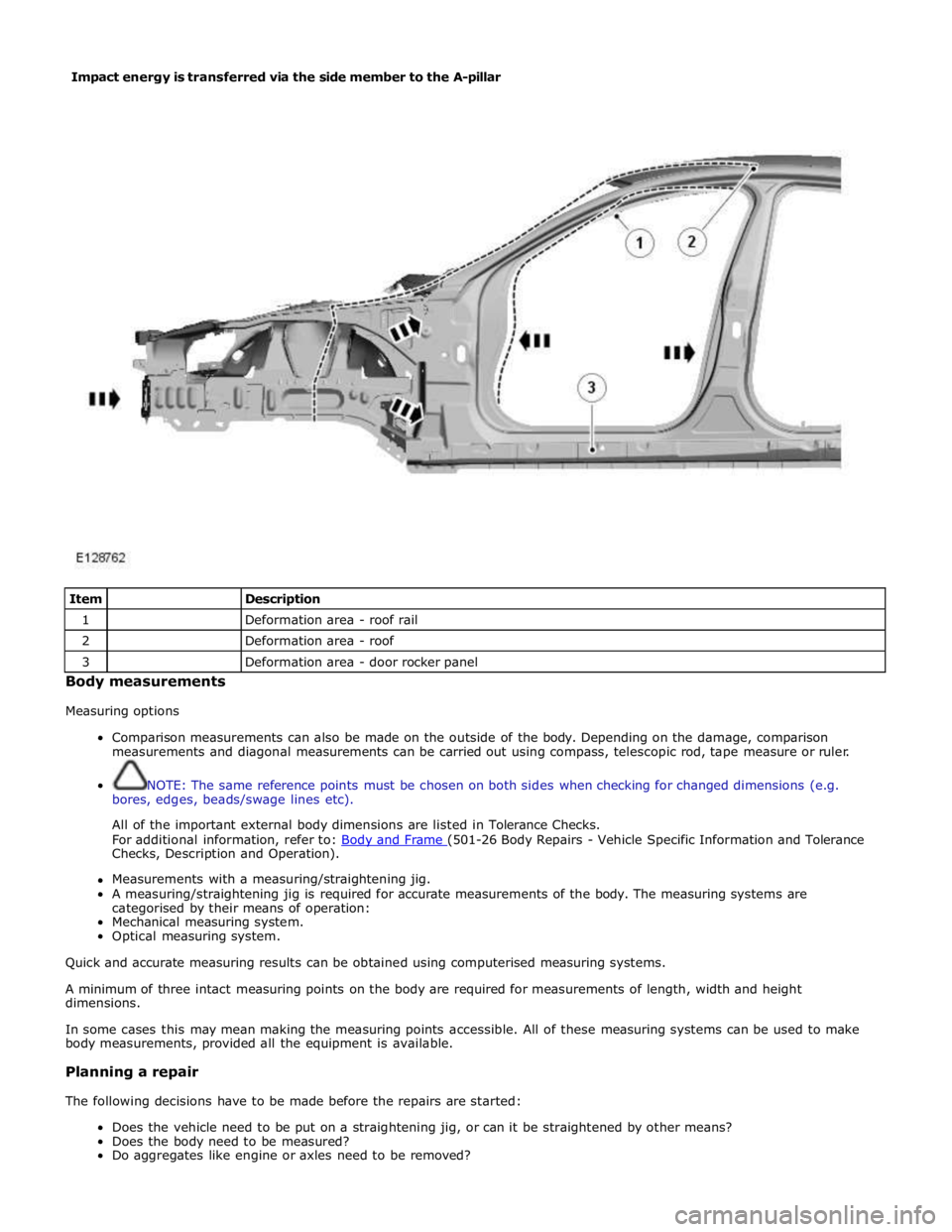
Item
Description 1
Deformation area - roof rail 2
Deformation area - roof 3
Deformation area - door rocker panel Body measurements
Measuring options
Comparison measurements can also be made on the outside of the body. Depending on the damage, comparison
measurements and diagonal measurements can be carried out using compass, telescopic rod, tape measure or ruler.
NOTE: The same reference points must be chosen on both sides when checking for changed dimensions (e.g.
bores, edges, beads/swage lines etc).
All of the important external body dimensions are listed in Tolerance Checks.
For additional information, refer to: Body and Frame (501-26 Body Repairs - Vehicle Specific Information and Tolerance Checks, Description and Operation).
Measurements with a measuring/straightening jig.
A measuring/straightening jig is required for accurate measurements of the body. The measuring systems are
categorised by their means of operation:
Mechanical measuring system.
Optical measuring system.
Quick and accurate measuring results can be obtained using computerised measuring systems.
A minimum of three intact measuring points on the body are required for measurements of length, width and height
dimensions.
In some cases this may mean making the measuring points accessible. All of these measuring systems can be used to make
body measurements, provided all the equipment is available.
Planning a repair
The following decisions have to be made before the repairs are started:
Does the vehicle need to be put on a straightening jig, or can it be straightened by other means?
Does the body need to be measured?
Do aggregates like engine or axles need to be removed? Impact energy is transferred via the side member to the A-pillar