bearing JAGUAR XFR 2010 1.G Workshop Manual
[x] Cancel search | Manufacturer: JAGUAR, Model Year: 2010, Model line: XFR, Model: JAGUAR XFR 2010 1.GPages: 3039, PDF Size: 58.49 MB
Page 4 of 3039

Four-Wheel Alignment
Front Toe Adjustment (57.65.01)
Rear Toe Adjustment (57.65.08)
Front Wheel Bearing and Wheel Hub Runout Check
Rear Wheel Bearing and Wheel Hub Runout Check204-01: Front SuspensionSpecificationDescription and OperationComponent Location
Overview
System Operation and Component DescriptionDiagnosis and TestingFront SuspensionRemoval and InstallationFront Shock Absorber (60.30.04)
Front Lower Arm (60.35.53)
Rear Lower Arm (60.35.54)
Rear Lower Arm Bushing (60.40.12)
Shock Absorber Bushing (60.30.16) (60.30.23)
Front Stabilizer Bar - V8 5.0L Petrol/V8 S/C 5.0L Petrol
Front Stabilizer Bar Link (60.10.02)
Stabilizer Bar Link Bushing (60.10.03)
Upper Arm LH (60.35.41)
Upper Arm RH (60.35.42)
Front Wheel Bearing and Wheel Hub - TDV6 3.0L Diesel /V8 5.0L Petrol/V8 S/C 5.0L Petrol
Wheel Knuckle (60.25.23)
Front Lower Arm Bushing204-02: Rear SuspensionSpecificationDescription and OperationComponent Location
Overview
System Operation and Component DescriptionDiagnosis and TestingRear SuspensionRemoval and InstallationLower Arm (64.35.43)
Shock Absorber and Spring Assembly
Shock Absorber Lower Bushing (64.30.39)
Rear Stabilizer Bar (64.35.08)
Rear Wheel Bearing
Upper Arm
Page 10 of 3039

211-05: Steering Column Switches
Description and OperationComponent Location
Overview
System Operation and Component DescriptionDiagnosis and TestingSteering Column SwitchesRemoval and InstallationHazard Flasher Switch
Steering Column Multifunction Switch LH
Steering Column Multifunction Switch RH
Steering Column Lock Actuator3: Powertrain
303: Engine
303-00: Engine System - General Information
Diagnosis and TestingEngine - 5.0LGeneral ProceduresBearing Inspection
Camshaft Bearing Journal Diameter
Camshaft End Play
Camshaft Lobe Lift
Camshaft Surface Inspection
Connecting Rod Cleaning
Connecting Rod Large End Bore
Crankshaft End Play
Cylinder Bore Out-of-Round
Exhaust Manifold Cleaning and Inspection
Leakage Test Using Smoke Test Equipment
Piston Inspection
Piston Pin Diameter
Piston Pin to Bore Diameter
Piston Ring End Gap
Piston Ring-to-Groove Clearance
Valve Spring Free Length
Valve Stem Diameter
Cylinder Head Distortion
Cylinder Compression Test - V8 S/C 5.0L Petrol303-01D: Engine - V8 S/C 5.0L PetrolSpecificationDescription and OperationComponent Location
Page 51 of 3039
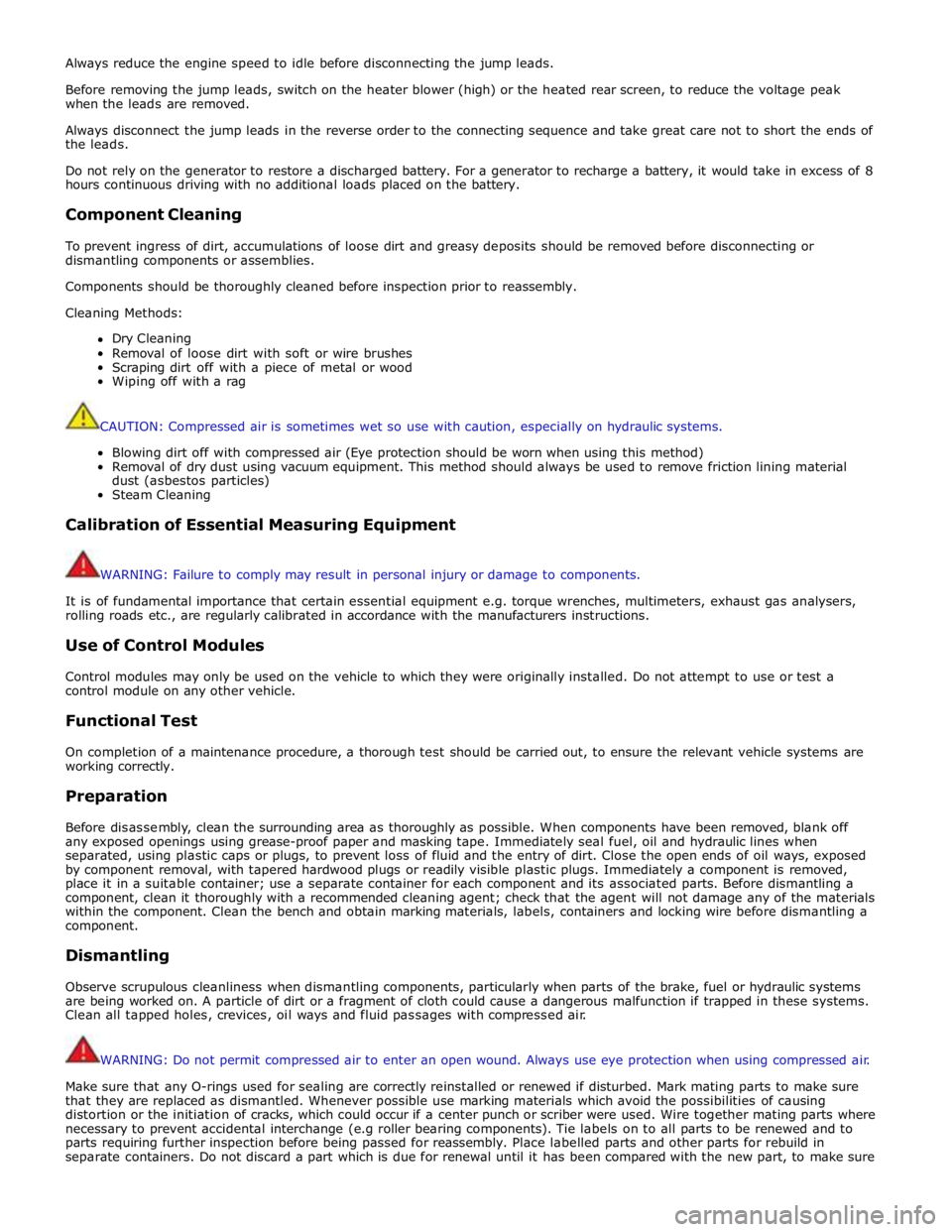
Always reduce the engine speed to idle before disconnecting the jump leads.
Before removing the jump leads, switch on the heater blower (high) or the heated rear screen, to reduce the voltage peak
when the leads are removed.
Always disconnect the jump leads in the reverse order to the connecting sequence and take great care not to short the ends of
the leads.
Do not rely on the generator to restore a discharged battery. For a generator to recharge a battery, it would take in excess of 8
hours continuous driving with no additional loads placed on the battery.
Component Cleaning
To prevent ingress of dirt, accumulations of loose dirt and greasy deposits should be removed before disconnecting or
dismantling components or assemblies.
Components should be thoroughly cleaned before inspection prior to reassembly.
Cleaning Methods:
Dry Cleaning
Removal of loose dirt with soft or wire brushes
Scraping dirt off with a piece of metal or wood
Wiping off with a rag
CAUTION: Compressed air is sometimes wet so use with caution, especially on hydraulic systems.
Blowing dirt off with compressed air (Eye protection should be worn when using this method)
Removal of dry dust using vacuum equipment. This method should always be used to remove friction lining material
dust (asbestos particles)
Steam Cleaning
Calibration of Essential Measuring Equipment
WARNING: Failure to comply may result in personal injury or damage to components.
It is of fundamental importance that certain essential equipment e.g. torque wrenches, multimeters, exhaust gas analysers,
rolling roads etc., are regularly calibrated in accordance with the manufacturers instructions.
Use of Control Modules
Control modules may only be used on the vehicle to which they were originally installed. Do not attempt to use or test a
control module on any other vehicle.
Functional Test
On completion of a maintenance procedure, a thorough test should be carried out, to ensure the relevant vehicle systems are
working correctly.
Preparation
Before disassembly, clean the surrounding area as thoroughly as possible. When components have been removed, blank off
any exposed openings using grease-proof paper and masking tape. Immediately seal fuel, oil and hydraulic lines when
separated, using plastic caps or plugs, to prevent loss of fluid and the entry of dirt. Close the open ends of oil ways, exposed
by component removal, with tapered hardwood plugs or readily visible plastic plugs. Immediately a component is removed,
place it in a suitable container; use a separate container for each component and its associated parts. Before dismantling a
component, clean it thoroughly with a recommended cleaning agent; check that the agent will not damage any of the materials
within the component. Clean the bench and obtain marking materials, labels, containers and locking wire before dismantling a
component.
Dismantling
Observe scrupulous cleanliness when dismantling components, particularly when parts of the brake, fuel or hydraulic systems
are being worked on. A particle of dirt or a fragment of cloth could cause a dangerous malfunction if trapped in these systems.
Clean all tapped holes, crevices, oil ways and fluid passages with compressed air.
WARNING: Do not permit compressed air to enter an open wound. Always use eye protection when using compressed air.
Make sure that any O-rings used for sealing are correctly reinstalled or renewed if disturbed. Mark mating parts to make sure
that they are replaced as dismantled. Whenever possible use marking materials which avoid the possibilities of causing
distortion or the initiation of cracks, which could occur if a center punch or scriber were used. Wire together mating parts where
necessary to prevent accidental interchange (e.g roller bearing components). Tie labels on to all parts to be renewed and to
parts requiring further inspection before being passed for reassembly. Place labelled parts and other parts for rebuild in
separate containers. Do not discard a part which is due for renewal until it has been compared with the new part, to make sure
Page 121 of 3039
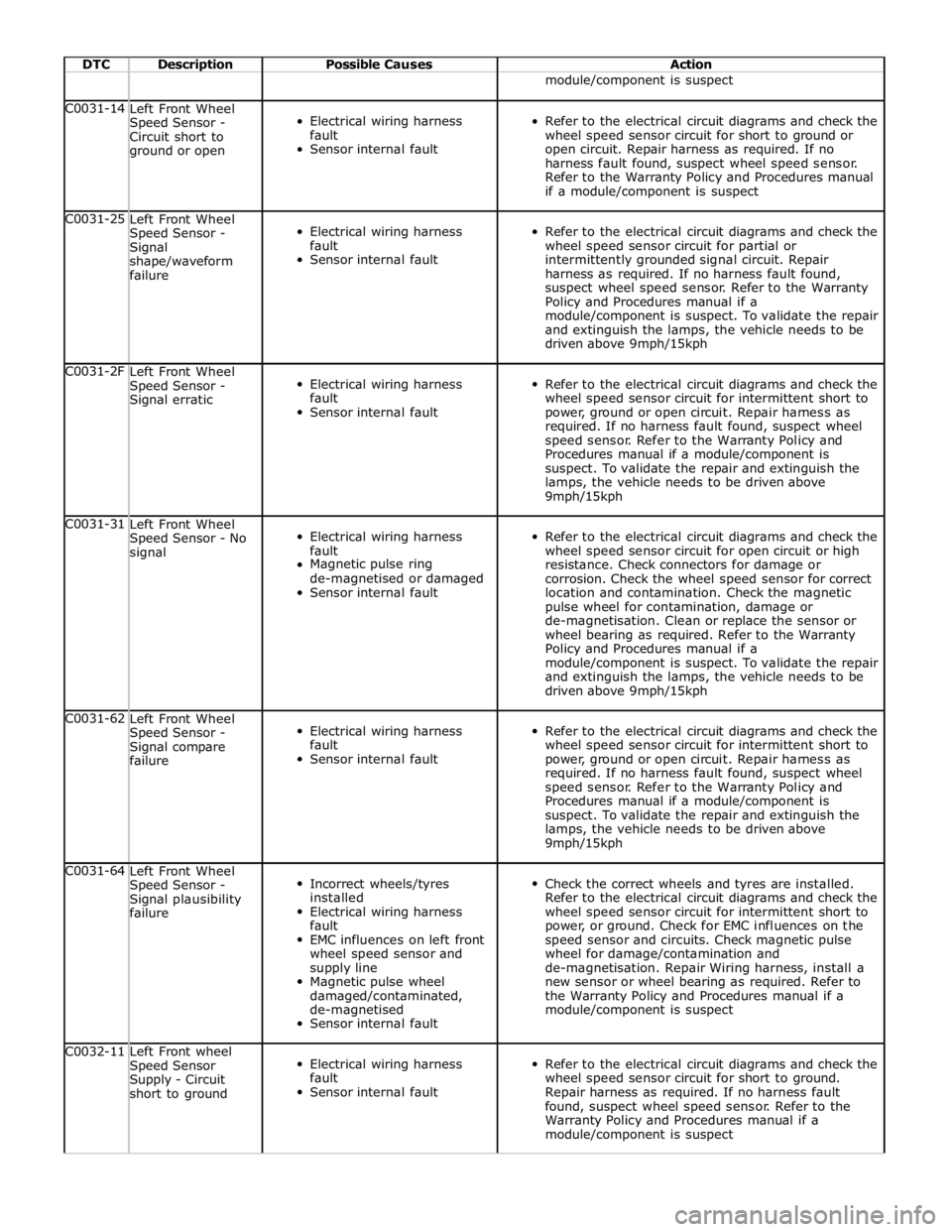
DTC Description Possible Causes Action module/component is suspect C0031-14
Left Front Wheel
Speed Sensor -
Circuit short to
ground or open
Electrical wiring harness
fault
Sensor internal fault
Refer to the electrical circuit diagrams and check the
wheel speed sensor circuit for short to ground or
open circuit. Repair harness as required. If no
harness fault found, suspect wheel speed sensor.
Refer to the Warranty Policy and Procedures manual
if a module/component is suspect C0031-25
Left Front Wheel
Speed Sensor -
Signal
shape/waveform
failure
Electrical wiring harness
fault
Sensor internal fault
Refer to the electrical circuit diagrams and check the
wheel speed sensor circuit for partial or
intermittently grounded signal circuit. Repair
harness as required. If no harness fault found,
suspect wheel speed sensor. Refer to the Warranty
Policy and Procedures manual if a
module/component is suspect. To validate the repair
and extinguish the lamps, the vehicle needs to be
driven above 9mph/15kph C0031-2F
Left Front Wheel
Speed Sensor -
Signal erratic
Electrical wiring harness
fault
Sensor internal fault
Refer to the electrical circuit diagrams and check the
wheel speed sensor circuit for intermittent short to
power, ground or open circuit. Repair harness as
required. If no harness fault found, suspect wheel
speed sensor. Refer to the Warranty Policy and
Procedures manual if a module/component is
suspect. To validate the repair and extinguish the
lamps, the vehicle needs to be driven above
9mph/15kph C0031-31
Left Front Wheel
Speed Sensor - No
signal
Electrical wiring harness
fault
Magnetic pulse ring
de-magnetised or damaged
Sensor internal fault
Refer to the electrical circuit diagrams and check the
wheel speed sensor circuit for open circuit or high
resistance. Check connectors for damage or
corrosion. Check the wheel speed sensor for correct
location and contamination. Check the magnetic
pulse wheel for contamination, damage or
de-magnetisation. Clean or replace the sensor or
wheel bearing as required. Refer to the Warranty
Policy and Procedures manual if a
module/component is suspect. To validate the repair
and extinguish the lamps, the vehicle needs to be
driven above 9mph/15kph C0031-62
Left Front Wheel
Speed Sensor -
Signal compare
failure
Electrical wiring harness
fault
Sensor internal fault
Refer to the electrical circuit diagrams and check the
wheel speed sensor circuit for intermittent short to
power, ground or open circuit. Repair harness as
required. If no harness fault found, suspect wheel
speed sensor. Refer to the Warranty Policy and
Procedures manual if a module/component is
suspect. To validate the repair and extinguish the
lamps, the vehicle needs to be driven above
9mph/15kph C0031-64
Left Front Wheel
Speed Sensor -
Signal plausibility
failure
Incorrect wheels/tyres
installed
Electrical wiring harness
fault
EMC influences on left front
wheel speed sensor and
supply line
Magnetic pulse wheel
damaged/contaminated,
de-magnetised
Sensor internal fault
Check the correct wheels and tyres are installed.
Refer to the electrical circuit diagrams and check the
wheel speed sensor circuit for intermittent short to
power, or ground. Check for EMC influences on the
speed sensor and circuits. Check magnetic pulse
wheel for damage/contamination and
de-magnetisation. Repair Wiring harness, install a
new sensor or wheel bearing as required. Refer to
the Warranty Policy and Procedures manual if a
module/component is suspect C0032-11
Left Front wheel
Speed Sensor
Supply - Circuit
short to ground
Electrical wiring harness
fault
Sensor internal fault
Refer to the electrical circuit diagrams and check the
wheel speed sensor circuit for short to ground.
Repair harness as required. If no harness fault
found, suspect wheel speed sensor. Refer to the
Warranty Policy and Procedures manual if a
module/component is suspect
Page 122 of 3039
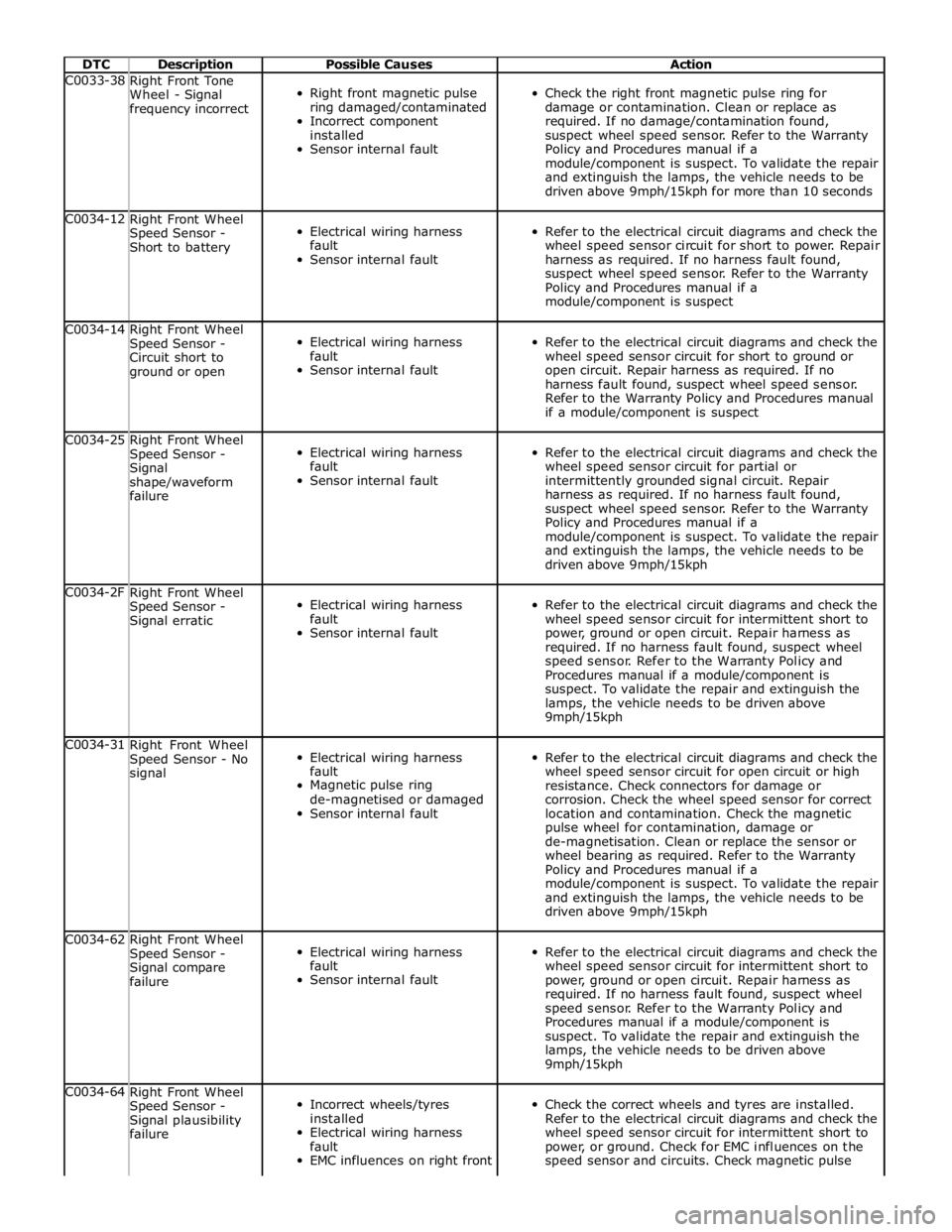
DTC Description Possible Causes Action C0033-38
Right Front Tone
Wheel - Signal
frequency incorrect
Right front magnetic pulse
ring damaged/contaminated
Incorrect component
installed
Sensor internal fault
Check the right front magnetic pulse ring for
damage or contamination. Clean or replace as
required. If no damage/contamination found,
suspect wheel speed sensor. Refer to the Warranty
Policy and Procedures manual if a
module/component is suspect. To validate the repair
and extinguish the lamps, the vehicle needs to be
driven above 9mph/15kph for more than 10 seconds C0034-12
Right Front Wheel
Speed Sensor -
Short to battery
Electrical wiring harness
fault
Sensor internal fault
Refer to the electrical circuit diagrams and check the
wheel speed sensor circuit for short to power. Repair
harness as required. If no harness fault found,
suspect wheel speed sensor. Refer to the Warranty
Policy and Procedures manual if a
module/component is suspect C0034-14
Right Front Wheel
Speed Sensor -
Circuit short to
ground or open
Electrical wiring harness
fault
Sensor internal fault
Refer to the electrical circuit diagrams and check the
wheel speed sensor circuit for short to ground or
open circuit. Repair harness as required. If no
harness fault found, suspect wheel speed sensor.
Refer to the Warranty Policy and Procedures manual
if a module/component is suspect C0034-25
Right Front Wheel
Speed Sensor -
Signal
shape/waveform
failure
Electrical wiring harness
fault
Sensor internal fault
Refer to the electrical circuit diagrams and check the
wheel speed sensor circuit for partial or
intermittently grounded signal circuit. Repair
harness as required. If no harness fault found,
suspect wheel speed sensor. Refer to the Warranty
Policy and Procedures manual if a
module/component is suspect. To validate the repair
and extinguish the lamps, the vehicle needs to be
driven above 9mph/15kph C0034-2F
Right Front Wheel
Speed Sensor -
Signal erratic
Electrical wiring harness
fault
Sensor internal fault
Refer to the electrical circuit diagrams and check the
wheel speed sensor circuit for intermittent short to
power, ground or open circuit. Repair harness as
required. If no harness fault found, suspect wheel
speed sensor. Refer to the Warranty Policy and
Procedures manual if a module/component is
suspect. To validate the repair and extinguish the
lamps, the vehicle needs to be driven above
9mph/15kph C0034-31
Right Front Wheel
Speed Sensor - No
signal
Electrical wiring harness
fault
Magnetic pulse ring
de-magnetised or damaged
Sensor internal fault
Refer to the electrical circuit diagrams and check the
wheel speed sensor circuit for open circuit or high
resistance. Check connectors for damage or
corrosion. Check the wheel speed sensor for correct
location and contamination. Check the magnetic
pulse wheel for contamination, damage or
de-magnetisation. Clean or replace the sensor or
wheel bearing as required. Refer to the Warranty
Policy and Procedures manual if a
module/component is suspect. To validate the repair
and extinguish the lamps, the vehicle needs to be
driven above 9mph/15kph C0034-62
Right Front Wheel
Speed Sensor -
Signal compare
failure
Electrical wiring harness
fault
Sensor internal fault
Refer to the electrical circuit diagrams and check the
wheel speed sensor circuit for intermittent short to
power, ground or open circuit. Repair harness as
required. If no harness fault found, suspect wheel
speed sensor. Refer to the Warranty Policy and
Procedures manual if a module/component is
suspect. To validate the repair and extinguish the
lamps, the vehicle needs to be driven above
9mph/15kph C0034-64
Right Front Wheel
Speed Sensor -
Signal plausibility
failure
Incorrect wheels/tyres
installed
Electrical wiring harness
fault
EMC influences on right front
Check the correct wheels and tyres are installed.
Refer to the electrical circuit diagrams and check the
wheel speed sensor circuit for intermittent short to
power, or ground. Check for EMC influences on the
speed sensor and circuits. Check magnetic pulse
Page 123 of 3039
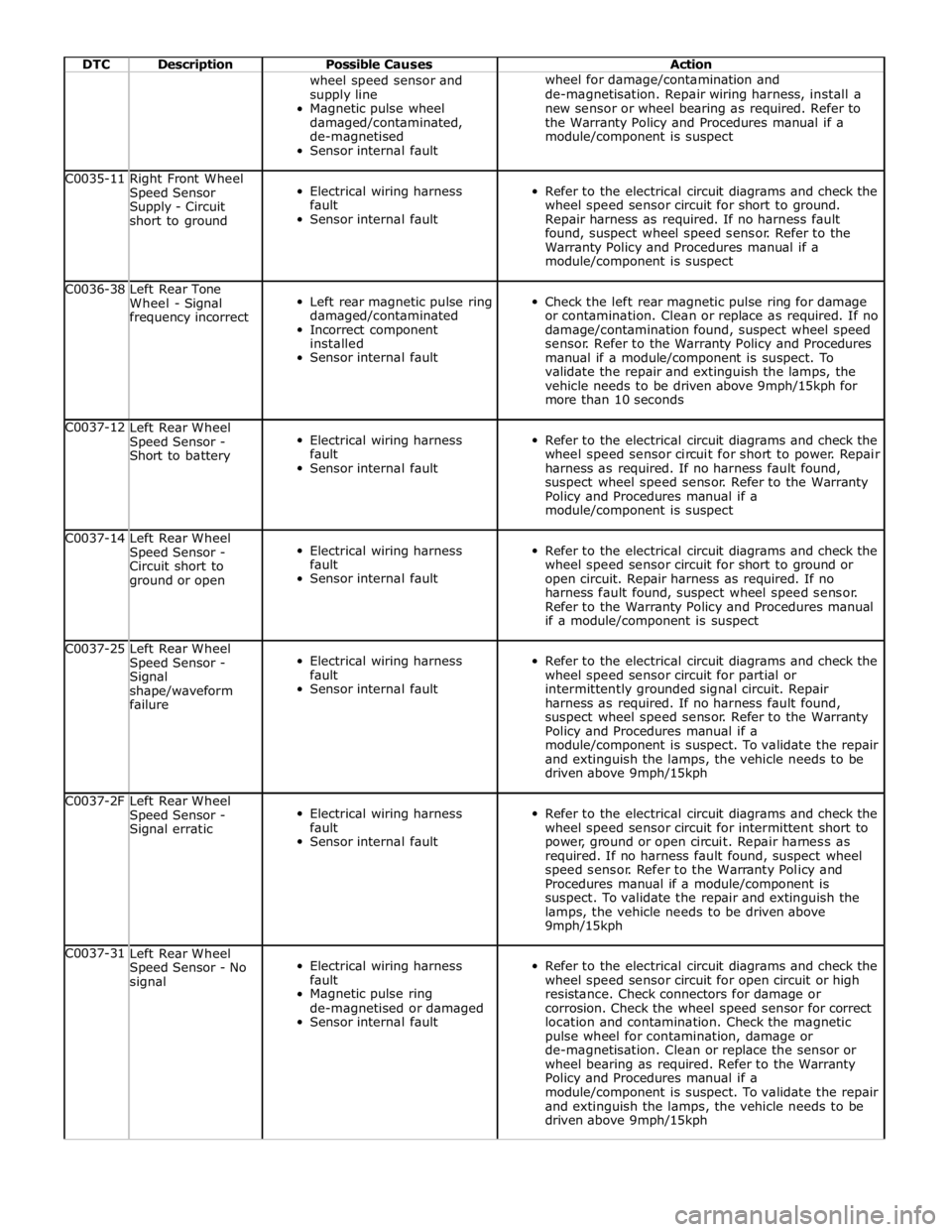
DTC Description Possible Causes Action wheel speed sensor and
supply line
Magnetic pulse wheel
damaged/contaminated,
de-magnetised
Sensor internal fault wheel for damage/contamination and
de-magnetisation. Repair wiring harness, install a
new sensor or wheel bearing as required. Refer to
the Warranty Policy and Procedures manual if a
module/component is suspect C0035-11
Right Front Wheel
Speed Sensor
Supply - Circuit
short to ground
Electrical wiring harness
fault
Sensor internal fault
Refer to the electrical circuit diagrams and check the
wheel speed sensor circuit for short to ground.
Repair harness as required. If no harness fault
found, suspect wheel speed sensor. Refer to the
Warranty Policy and Procedures manual if a
module/component is suspect C0036-38
Left Rear Tone
Wheel - Signal
frequency incorrect
Left rear magnetic pulse ring
damaged/contaminated
Incorrect component
installed
Sensor internal fault
Check the left rear magnetic pulse ring for damage
or contamination. Clean or replace as required. If no
damage/contamination found, suspect wheel speed
sensor. Refer to the Warranty Policy and Procedures
manual if a module/component is suspect. To
validate the repair and extinguish the lamps, the
vehicle needs to be driven above 9mph/15kph for
more than 10 seconds C0037-12
Left Rear Wheel
Speed Sensor -
Short to battery
Electrical wiring harness
fault
Sensor internal fault
Refer to the electrical circuit diagrams and check the
wheel speed sensor circuit for short to power. Repair
harness as required. If no harness fault found,
suspect wheel speed sensor. Refer to the Warranty
Policy and Procedures manual if a
module/component is suspect C0037-14
Left Rear Wheel
Speed Sensor -
Circuit short to
ground or open
Electrical wiring harness
fault
Sensor internal fault
Refer to the electrical circuit diagrams and check the
wheel speed sensor circuit for short to ground or
open circuit. Repair harness as required. If no
harness fault found, suspect wheel speed sensor.
Refer to the Warranty Policy and Procedures manual
if a module/component is suspect C0037-25
Left Rear Wheel
Speed Sensor -
Signal
shape/waveform
failure
Electrical wiring harness
fault
Sensor internal fault
Refer to the electrical circuit diagrams and check the
wheel speed sensor circuit for partial or
intermittently grounded signal circuit. Repair
harness as required. If no harness fault found,
suspect wheel speed sensor. Refer to the Warranty
Policy and Procedures manual if a
module/component is suspect. To validate the repair
and extinguish the lamps, the vehicle needs to be
driven above 9mph/15kph C0037-2F
Left Rear Wheel
Speed Sensor -
Signal erratic
Electrical wiring harness
fault
Sensor internal fault
Refer to the electrical circuit diagrams and check the
wheel speed sensor circuit for intermittent short to
power, ground or open circuit. Repair harness as
required. If no harness fault found, suspect wheel
speed sensor. Refer to the Warranty Policy and
Procedures manual if a module/component is
suspect. To validate the repair and extinguish the
lamps, the vehicle needs to be driven above
9mph/15kph C0037-31
Left Rear Wheel
Speed Sensor - No
signal
Electrical wiring harness
fault
Magnetic pulse ring
de-magnetised or damaged
Sensor internal fault
Refer to the electrical circuit diagrams and check the
wheel speed sensor circuit for open circuit or high
resistance. Check connectors for damage or
corrosion. Check the wheel speed sensor for correct
location and contamination. Check the magnetic
pulse wheel for contamination, damage or
de-magnetisation. Clean or replace the sensor or
wheel bearing as required. Refer to the Warranty
Policy and Procedures manual if a
module/component is suspect. To validate the repair
and extinguish the lamps, the vehicle needs to be
driven above 9mph/15kph
Page 124 of 3039
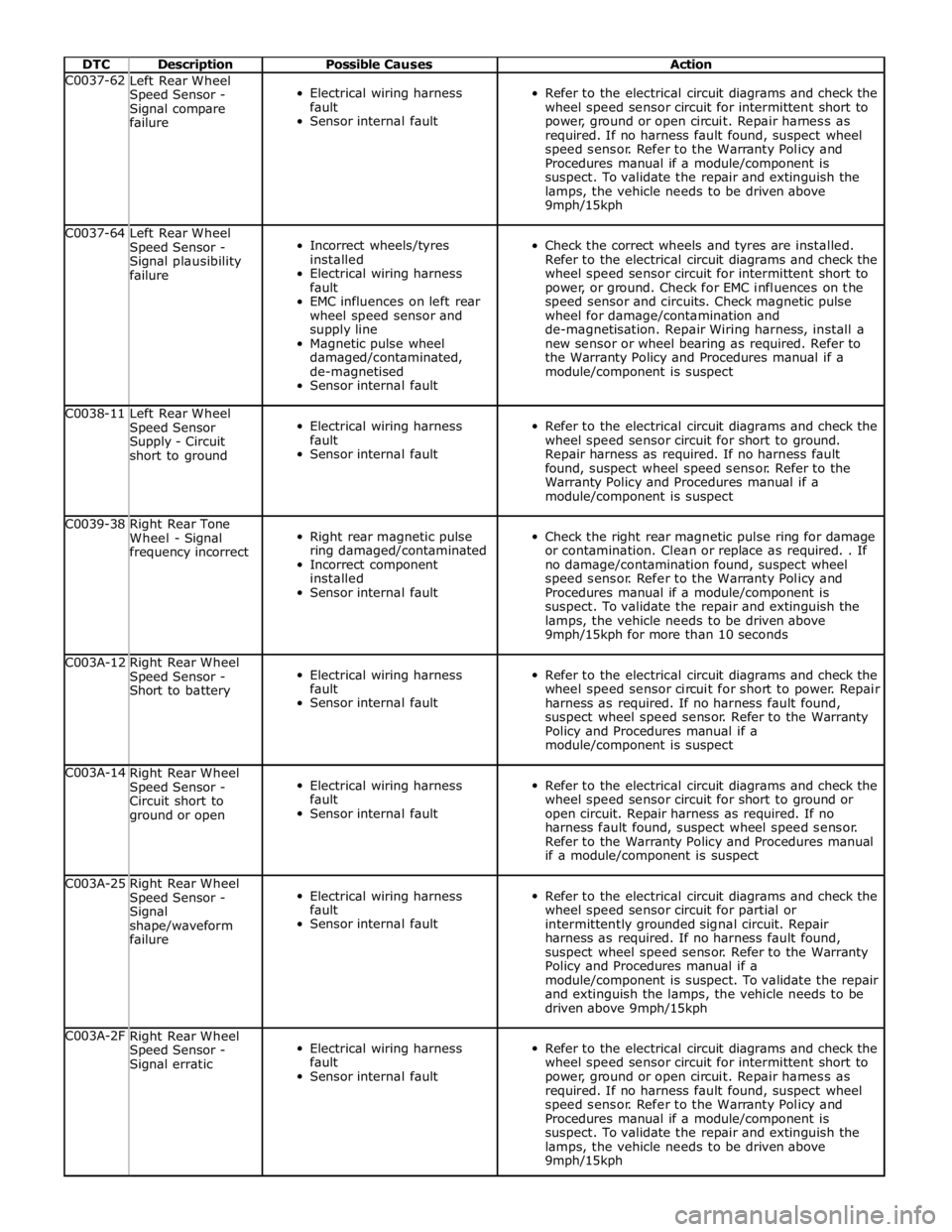
DTC Description Possible Causes Action C0037-62
Left Rear Wheel
Speed Sensor -
Signal compare
failure
Electrical wiring harness
fault
Sensor internal fault
Refer to the electrical circuit diagrams and check the
wheel speed sensor circuit for intermittent short to
power, ground or open circuit. Repair harness as
required. If no harness fault found, suspect wheel
speed sensor. Refer to the Warranty Policy and
Procedures manual if a module/component is
suspect. To validate the repair and extinguish the
lamps, the vehicle needs to be driven above
9mph/15kph C0037-64
Left Rear Wheel
Speed Sensor -
Signal plausibility
failure
Incorrect wheels/tyres
installed
Electrical wiring harness
fault
EMC influences on left rear
wheel speed sensor and
supply line
Magnetic pulse wheel
damaged/contaminated,
de-magnetised
Sensor internal fault
Check the correct wheels and tyres are installed.
Refer to the electrical circuit diagrams and check the
wheel speed sensor circuit for intermittent short to
power, or ground. Check for EMC influences on the
speed sensor and circuits. Check magnetic pulse
wheel for damage/contamination and
de-magnetisation. Repair Wiring harness, install a
new sensor or wheel bearing as required. Refer to
the Warranty Policy and Procedures manual if a
module/component is suspect C0038-11
Left Rear Wheel
Speed Sensor
Supply - Circuit
short to ground
Electrical wiring harness
fault
Sensor internal fault
Refer to the electrical circuit diagrams and check the
wheel speed sensor circuit for short to ground.
Repair harness as required. If no harness fault
found, suspect wheel speed sensor. Refer to the
Warranty Policy and Procedures manual if a
module/component is suspect C0039-38
Right Rear Tone
Wheel - Signal
frequency incorrect
Right rear magnetic pulse
ring damaged/contaminated
Incorrect component
installed
Sensor internal fault
Check the right rear magnetic pulse ring for damage
or contamination. Clean or replace as required. . If
no damage/contamination found, suspect wheel
speed sensor. Refer to the Warranty Policy and
Procedures manual if a module/component is
suspect. To validate the repair and extinguish the
lamps, the vehicle needs to be driven above
9mph/15kph for more than 10 seconds C003A-12
Right Rear Wheel
Speed Sensor -
Short to battery
Electrical wiring harness
fault
Sensor internal fault
Refer to the electrical circuit diagrams and check the
wheel speed sensor circuit for short to power. Repair
harness as required. If no harness fault found,
suspect wheel speed sensor. Refer to the Warranty
Policy and Procedures manual if a
module/component is suspect C003A-14
Right Rear Wheel
Speed Sensor -
Circuit short to
ground or open
Electrical wiring harness
fault
Sensor internal fault
Refer to the electrical circuit diagrams and check the
wheel speed sensor circuit for short to ground or
open circuit. Repair harness as required. If no
harness fault found, suspect wheel speed sensor.
Refer to the Warranty Policy and Procedures manual
if a module/component is suspect C003A-25
Right Rear Wheel
Speed Sensor -
Signal
shape/waveform
failure
Electrical wiring harness
fault
Sensor internal fault
Refer to the electrical circuit diagrams and check the
wheel speed sensor circuit for partial or
intermittently grounded signal circuit. Repair
harness as required. If no harness fault found,
suspect wheel speed sensor. Refer to the Warranty
Policy and Procedures manual if a
module/component is suspect. To validate the repair
and extinguish the lamps, the vehicle needs to be
driven above 9mph/15kph C003A-2F
Right Rear Wheel
Speed Sensor -
Signal erratic
Electrical wiring harness
fault
Sensor internal fault
Refer to the electrical circuit diagrams and check the
wheel speed sensor circuit for intermittent short to
power, ground or open circuit. Repair harness as
required. If no harness fault found, suspect wheel
speed sensor. Refer to the Warranty Policy and
Procedures manual if a module/component is
suspect. To validate the repair and extinguish the
lamps, the vehicle needs to be driven above
9mph/15kph
Page 299 of 3039
Published: 16-Sep-2013
Noise, Vibration and Harshness - Noise, Vibration and Harshness (NVH)
Diagnosis and Testing
Principle of Operation
For a detailed description of Noise, Vibration and Harshness issues, refer to the Description and Operation section of the
workshop manual.
REFER to: Noise, Vibration and Harshness (NVH) (100-04 Noise, Vibration and Harshness, Description and Operation).
Inspection and Verification
1. Verify the customer's concerns by operating the vehicle to duplicate the condition.
2. Visually inspect the vehicle to determine any obvious cause(s) of the concern(s).
3. If the inspection reveals obvious causes that can be readily identified, repair as necessary.
4. If the concern(s) remains after the inspection, determine the symptom(s) and refer to the Symptom Chart.
How To Use This Diagnostic Procedure Section
Noise, vibration and harshness (NVH) concerns have become more important as vehicles have become more sensitive to
these vibrations. This section is designed as an aid to identifying these situations
The section provides diagnostic procedures based on symptoms. If the condition occurs at high speed, for instance, the
most likely place to start is under High Speed Shake
The road test procedure will tell how to sort the conditions into categories and how to tell a vibration from a shake
A series of Road Test Quick Checks is provided to make sure that a cause is either pinpointed or eliminated
Name the condition, proceed to the appropriate section and locate the correct diagnosis. When the condition is
identified, the job is partly done
Follow the diagnostic procedure as outlined
Quick Checks are described within the step, while more involved tests and adjustments are outlined in General
Procedures
Always follow each step exactly and make notes to recall important findings later
Customer Interview
The road test and customer interview (if available) provide information that will help identify the concerns and will provide
direction to the correct starting point for diagnosis.
Identify the Condition
NVH problems usually occur in a number of areas:
tires
engine accessories
suspension
driveline
air leakage (wind noise)
squeaks and rattles
heating ventilation and air conditioning (HVAC)
electrical (e.g. motor noise)
transmission
engine
It is important, therefore, that an NVH concern be isolated into its specific area(s) as soon as possible. The easiest and
quickest way to do this is to carry out the Road Test as outlined.
Noise Diagnostic Procedure
Non-Axle Noise
The five most important sources of non-axle noise are exhaust, tires, roof racks, trim and mouldings, and transmission.
Therefore, make sure that none of the following conditions are the cause of the noise before proceeding with a driveline tear
down and diagnosis.
Under certain conditions, the pitch of the exhaust may sound very much like gear noise. At other times, it can be
mistaken for a wheel bearing rumble
Tires, especially snow tires, can have a high pitched tread whine or roar, similar to gear noise. Radial tires, to some
degree, have this characteristic. Also, any non-standard tire with an unusual tread construction may emit a roar or
whine type noise
Trim and mouldings can also cause whistling or a whining noise
Clunk may be a metallic noise heard when the automatic transmission is engaged in reverse or drive, or it may occur
when the throttle is applied or released. It is caused by backlash somewhere in the driveline
Bearing rumble sounds like marbles being tumbled. This condition is usually caused by a damaged wheel bearing
Page 300 of 3039
Noise Conditions
Gear noise is typically a howling or whining due to gear damage or incorrect bearing preload. It can occur at various
speeds and driving conditions, or it can be continuous
Chuckle is a particular rattling noise that sounds like a stick against the spokes of a spinning bicycle wheel. It occurs
while decelerating from approximately 64 km/h (40 miles/h) and can usually be heard all the way to a stop. The
frequency varies with vehicle speed
Knock is very similar to chuckle, though it may be louder and occurs on acceleration or deceleration. The tear down will
disclose what has to be corrected
Check and rule out tires, exhaust and trim items before disassembling the transmission to diagnose and correct gear noise.
The noises described under Road Test usually have specific causes that can be diagnosed by observation as the unit is
disassembled. The initial clues are the type of noise heard on the road test and the driving conditions.
Vibration Conditions
wear. NOTE: New Constant Velocity (CV) joints should not be installed unless disassembly and inspection revealed unusual
Clicking, popping or grinding noises may be caused by the following:
Cut or damaged CV joint boots resulting in inadequate or contaminated lubricant in the outboard or inboard CV joint
bearing housings
Loose CV joint boot clamps
Another component contacting the rear drive half shaft
Worn, damaged or incorrectly installed wheel bearing, suspension or brake component
Vibration at highway speeds may be caused by the following:
Out-of-balance front or rear wheels
Out-of-round tires
Driveline imbalance
Driveline run-out (alignment)
NOTE: Rear drive half shafts are not balanced and are not likely to contribute to rotational vibration disturbance.
Shudder or vibration during acceleration (including from rest) may be caused by the following:
Driveline alignment
Excessively worn or damaged outboard or inboard CV joint bearing housing
Excessively high CV joint operating angles caused by incorrect ride height. Check ride height, verify correct spring rate
and check items under Inoperative Conditions
Excessively worn driveshaft components
Leakage Conditions
1. Inspect the CV joint boots for evidence of cracks, tears or splits.
2. Inspect the underbody for any indication of grease splatter in the vicinity of the rear drive half shaft, outboard and
inboard CV joint boot locations, which is an indication of CV joint boot or CV joint boot clamp damage.
3. Inspect the inboard CV joint bearing housing seal for leakage.
Inoperative Conditions
If a CV joint or rear drive half shaft pull-out occurs, check the following:
suspension components for correct location, damage or wear
bushings for wear
subframe for damage
bent or worn components
- Stabilizer bar link
- Left-hand rear suspension lower arm and bushing
- Right-hand rear suspension lower arm and bushing
- Rear wheel hub and rear drive half shaft
Road Test
A gear-driven unit will produce a certain amount of noise. Some noise is acceptable and may be audible at certain speeds or
under various driving conditions as on a newly paved blacktop road. The slight noise is in no way detrimental and must be
considered normal.
The road test and customer interview (if available) provide information needed to identify the condition and give direction to
the correct starting point for diagnosis.
1. Make notes throughout the diagnosis routine. Make sure to write down even the smallest piece of information, because
Page 301 of 3039
it may turn out to be the most important.
2. Do not touch anything until a road test and a thorough visual inspection of the vehicle have been carried out. Leave the
tire pressures and vehicle load just where they were when the condition was first observed. Adjusting tire pressures,
vehicle load or making other adjustments may reduce the conditions intensity to a point where it cannot be identified
clearly. It may also inject something new into the system, preventing correct diagnosis.
3. Make a visual inspection as part of the preliminary diagnosis routine, writing down anything that does not look right.
Note tire pressures, but do not adjust them yet. Note leaking fluids, loose nuts and bolts, or bright spots where
components may be rubbing against each other. Check the luggage compartment for unusual loads.
4. Road test the vehicle and define the condition by reproducing it several times during the road test.
5. Carry out the Road Test Quick Checks as soon as the condition is reproduced. This will identify the correct diagnostic
procedure. Carry out the Road Test Quick Checks more than once to verify they are providing a valid result. Remember,
the Road Test Quick Checks may not tell where the concern is, but they will tell where it is not.
Road Test Quick Checks
1. 24-80 km/h (15-50 miles/h): With light acceleration, a moaning noise is heard and possibly a vibration is felt in the
front floor pan. It is usually worse at a particular engine speed and at a particular throttle setting during acceleration at
that speed. It may also produce a moaning sound, depending on what component is causing it. Refer to Tip-In Moan in
the Symptom Chart.
2. Acceleration/deceleration: With slow acceleration and deceleration, a shake is sometimes noticed in the steering
wheel/column, seats, front floor pan, front door trim panel or front end sheet metal. It is a low frequency vibration
(around 9-15 cycles per second). It may or may not be increased by applying brakes lightly. Refer to Idle Boom/Shake
/Vibration in the Symptom Chart.
3. High speed: A vibration is felt in the front floor pan or seats with no visible shake, but with an accompanying sound or
rumble, buzz, hum, drone or booming noise. Coast with the clutch pedal depressed or shift control selector lever in
neutral and engine idling. If vibration is still evident, it may be related to wheels, tires, front brake discs, wheel hubs
or front wheel bearings. Refer to High Speed Shake in the Symptom Chart.
4. Engine rpm sensitive: A vibration is felt whenever the engine reaches a particular rpm. It will disappear in neutral
coasts. The vibration can be duplicated by operating the engine at the problem rpm while the vehicle is stationary. It
can be caused by any component, from the accessory drive belt to the torque converter which turns at engine speed
when the vehicle is stopped. Refer to High Speed Shake in the Symptom Chart.
5. Noise/vibration while turning: Clicking, popping, or grinding noises may be due to a worn, damaged, or incorrectly
installed front wheel bearing, rear drive half shaft or CV joint.
6. Noise/vibration that is road speed relative: This noise/vibration can be diagnosed independent of engine speed or gear
selected (engine speed varies but torque and road speed remain constant). The cause may be a rear drive
axle/differential whine.
Road Conditions
An experienced technician will always establish a route that will be used for all NVH diagnosis road tests. The road selected
should be reasonably smooth, level and free of undulations (unless a particular condition needs to be identified). A smooth
asphalt road that allows driving over a range of speeds is best. Gravel or bumpy roads are unsuitable because of the additional
road noise produced. Once the route is established and consistently used, the road noise variable is eliminated from the test
results.
NOTE: Some concerns may be apparent only on smooth asphalt roads.
If a customer complains of a noise or vibration on a particular road and only on a particular road, the source of the concern
may be the road surface. If possible, try to test the vehicle on the same type of road.
Vehicle Preparation
Carry out a thorough visual inspection of the vehicle before carrying out the road test. Note anything which is unusual. Do not
repair or adjust any condition until the road test is carried out, unless the vehicle is inoperative or the condition could pose a
hazard to the technician.
After verifying the condition has been corrected, make sure all components removed have been installed.
Lift Test
After a road test, it is sometimes useful to do a similar test on a lift.
When carrying out the high-speed shake diagnosis or engine accessory vibration diagnosis on a lift, observe the following
precautions:
WARNING: If only one drive wheel is allowed to rotate, speed must be limited to 55 km/h (35 miles/h) indicated on the
speedometer since actual wheel speed will be twice that indicated on the speedometer. Speed exceeding 55 km/h (35 miles/h)
or allowing the drive wheel to hang unsupported could result in tire disintegration, differential failure, constant velocity joint