Valve JAGUAR XJ 1994 2.G AJ16 Engine Manual
[x] Cancel search | Manufacturer: JAGUAR, Model Year: 1994, Model line: XJ, Model: JAGUAR XJ 1994 2.GPages: 73, PDF Size: 2.06 MB
Page 2 of 73

AJ16 Engine Service Manual
CON TENTS
Section SRO Page
Foreword ........................................................................\
.. iii
I ................ Service Tools & Equipment ........................................................... iv
I1 ................ Torque Tightening Specifications ....................................................... vii
111 ............... Service Materials .................................................................... xii
1V ............... Service Data ...................................................................... xiii
1 ................ General Description .................................................................. 1
1.1 .............. Construction ........................................................................\
1
1.2 .............. Cylinder Head Design ................................................................ 7
1.3 .............. Crankcase Breather ................................................................... 7
1.4 .............. Lubrication System ................................................................... 1
1.5 .............. Cooling System ...................................................................... 2
1.6
.............. Supercharger ........................................................................\
2
2 ................ Service Procedures ................................................................... 2
2.1 .............. SPSloint ControlSystem .............................................................. 2
2.2 .............. Sealants ........................................................................\
.... 2
3 ................ Fault Diagnosis ...................................................................... 3
3.1
.............. Introduction ........................................................................\
. 3
3.2
.............. Diagnostic Procedures ................................................................ 3
4
................ Service Operations ................................................................... 7
4.1 .............. Camshaft, Renew .............................................. 12.13.01 ............. 7
4.2 .............. Camshaft Cover Gasket. Renew .................................. 12.29.39 ............. 9
4.3
.............. Valve Clearance, Checkand Adjust ............................... 12.29.48 ............ 10
4.4 .............. Cylinder Head Gasket, Renew ................................... 12.29.01 ............ 13
4.5
.............. Cylinder Head, Overhaul ........................................ 12.29.19 ............ 16
4.6
.............. Cylinder Head Casting, Renew ................................... 12.29.15 ............ 19
4.7
.............. Piston and Connecting Rod, Engine Set, Renew ..................... 12.17.10 ............ 20
4.8
.............. Connecting Rod Bearing, Engine Set, Renew ....................... 12.17.16 ............ 22
4.9
.............. Main Bearing, Engineset, Renew ................................. 12.21.39 ............ 23
4.10 ............. Crankshaft, Renew ............................................. 12.21.33 ............ 24
4.11
............. Crankshaft Damper/Pulley Assembly, Renew ...................... 12.21.09 ............ 26
4.12
............. Crankshaft End-float, Check andAdjust ........................... 12.21.26 ............ 27
4.13
............. Crankshaft Front Oil Seal, Renew ................................. 12.21.14 ............ 28
4.14
............. Crankshaft Rear Oil Seal, Renew ................................. 72.21.20 ............ 29
4.15
............. Engine Flywheel, Renew ........................................ 12.53.07 ............ 30
4.16
............. Engine Drive-plate, Renew ..................................... 12.53.13 ............ 31
4.17 ............. Engine Rear/ Transmission Adapter Plate, Renew ................... 12.53.03 ............ 32
4.18
............. Engine Assembly, Overhaul ...................................... 12.4 7 . 05 ............ 33
4.19
............. liming Chain, Gear and Tensioner, Engine Set, Renew ............... 12.65.13 ............ 37
4.20
............. Timing Chain Damper, Vehicle Set, Renew ......................... 12.65.48 ............ 40
4.21
............. liming Chain Tensioner, Upper, Renew ............................ 12.65.29 ............ 41
4.22
............. Timing Chain Tensioner, Lower, Renew ............................ 12.65.30 ............ 42
4.23
............. Timing Sprocket, Intermediate, Renew ............................ 12.65.26 ............ 43
4.24
............. Auxiliary Shaft, Renew ......................................... 12.10.30 ............ 44
4.25
............. Auxiliary Shaft Rear Seal. Renew ................................. 12.10.32 ............ 45
0
i Issue 1 August 1994
Page 3 of 73
AJ16 Engine Service Manual
Section Title SRO Page
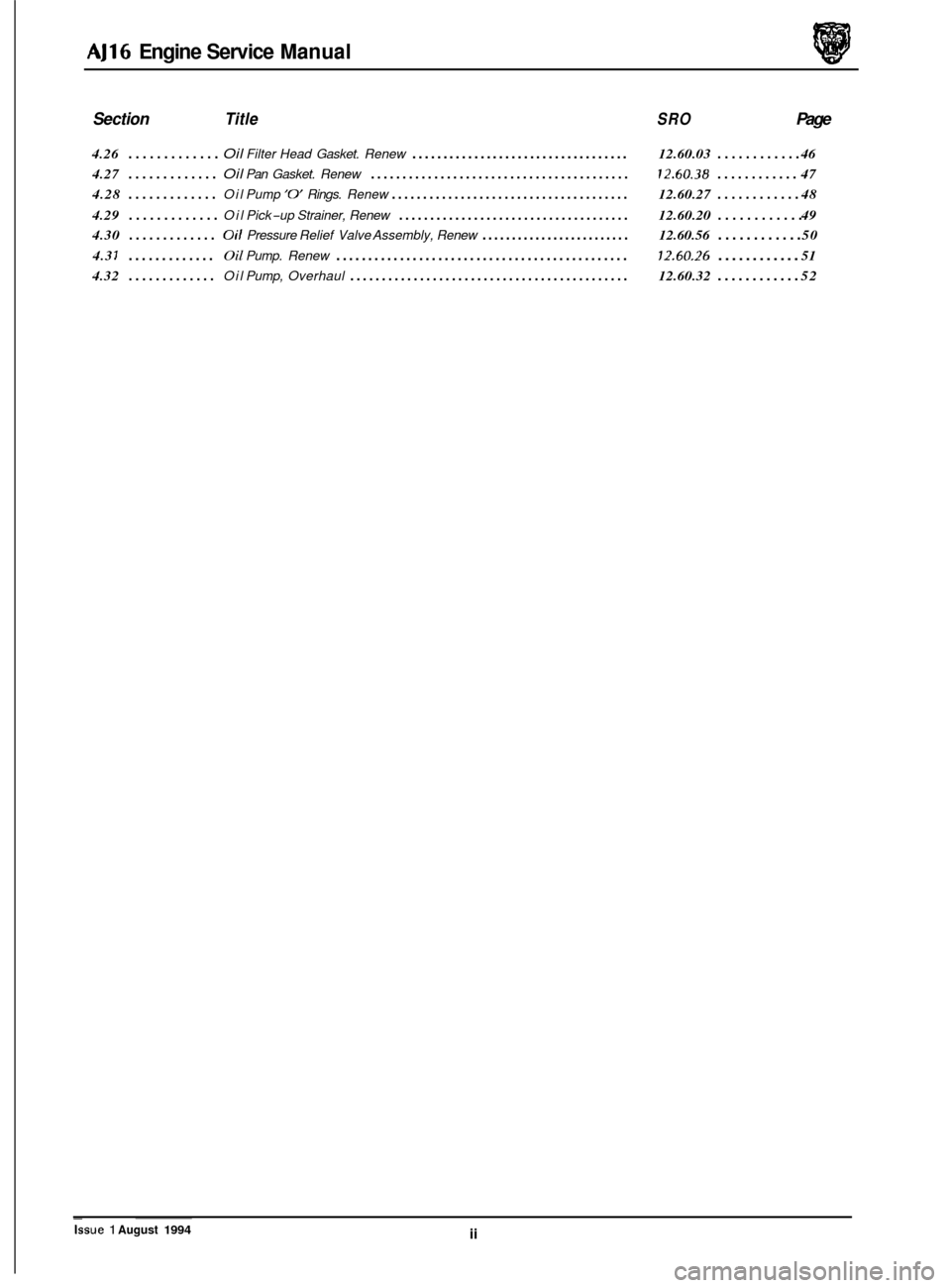
4.26 ............. Oil Filter Head Gasket. Renew ................................... 12.60.03 ............ 46
4.27
............. Oil Pan Gasket. Renew ......................................... 12.60.38 ............ 47
4.28
............. Oil Pump '0' Rings. Renew ...................................... 12.60.27 ............ 48
4.29
............. Oil Pick-up Strainer, Renew ..................................... 12.60.20 ............ 49
4.30
............. Oil Pressure Relief Valve Assembly, Renew ......................... 12.60.56 ............ 50
4.3
1 ............. Oil Pump. Renew .............................................. 12.60.26 ............ 51
4.32
............. Oil Pump, Overhaul ............................................ 12.60.32 ............ 52 ~
Issue 1 August 1994 ii
Page 6 of 73
AJ16 Engine Service Manual
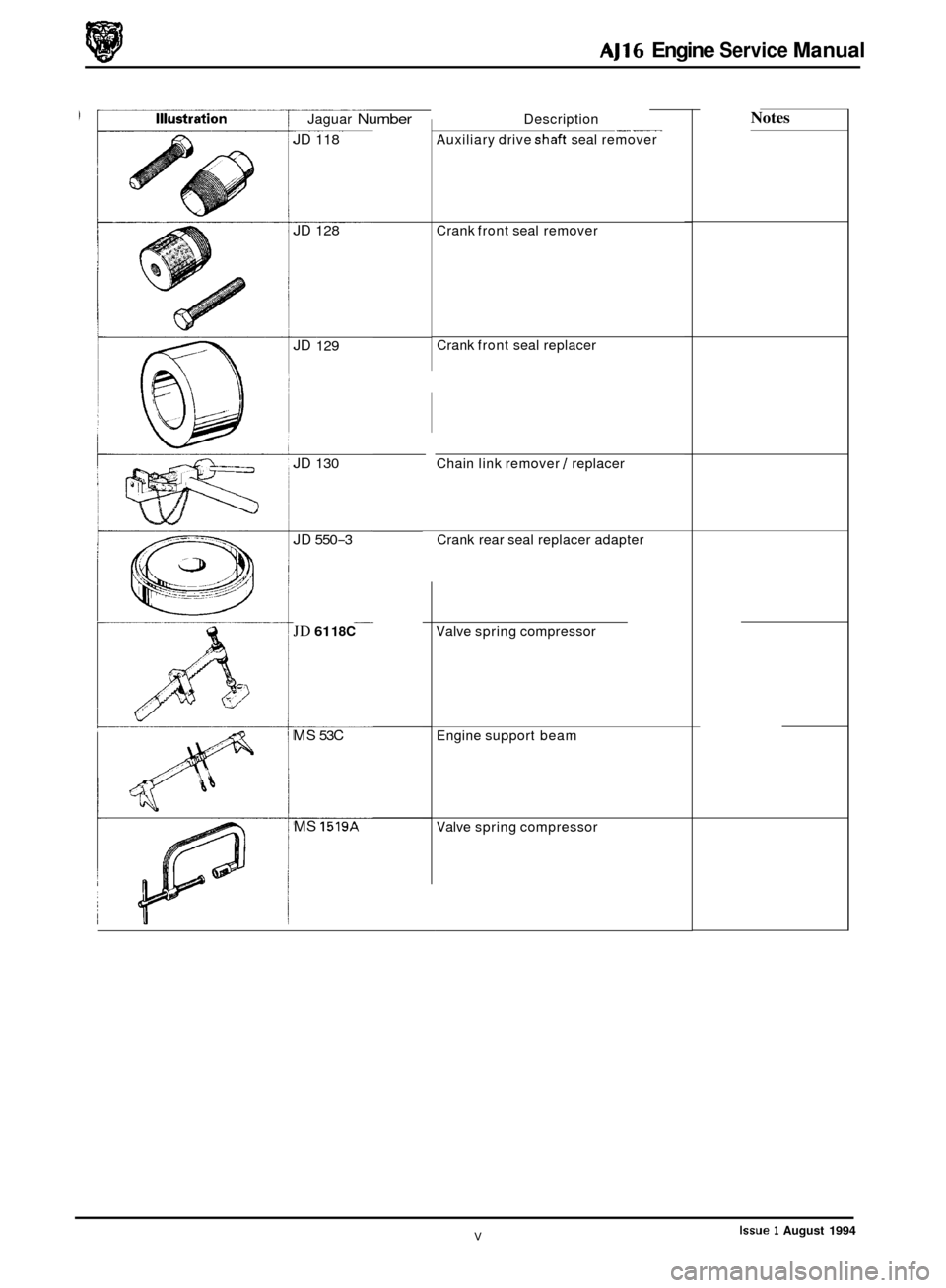
Jaguar Number ~~
JD
118
JD 128
JD
129
JD 130
JD 550
-3
JD 61 18C
MS 53C
MS 1519A
__ ~ Description
Auxiliary drive
shaft seal remover
Crank front seal remover
Crank front seal replacer
Chain link remover
/ replacer
Crank rear seal replacer adapter
Valve spring compressor
Engine support beam
Valve spring compressor
Notes
Issue 1 August 1994 V
Page 11 of 73
AJ16 Engine Service Manual
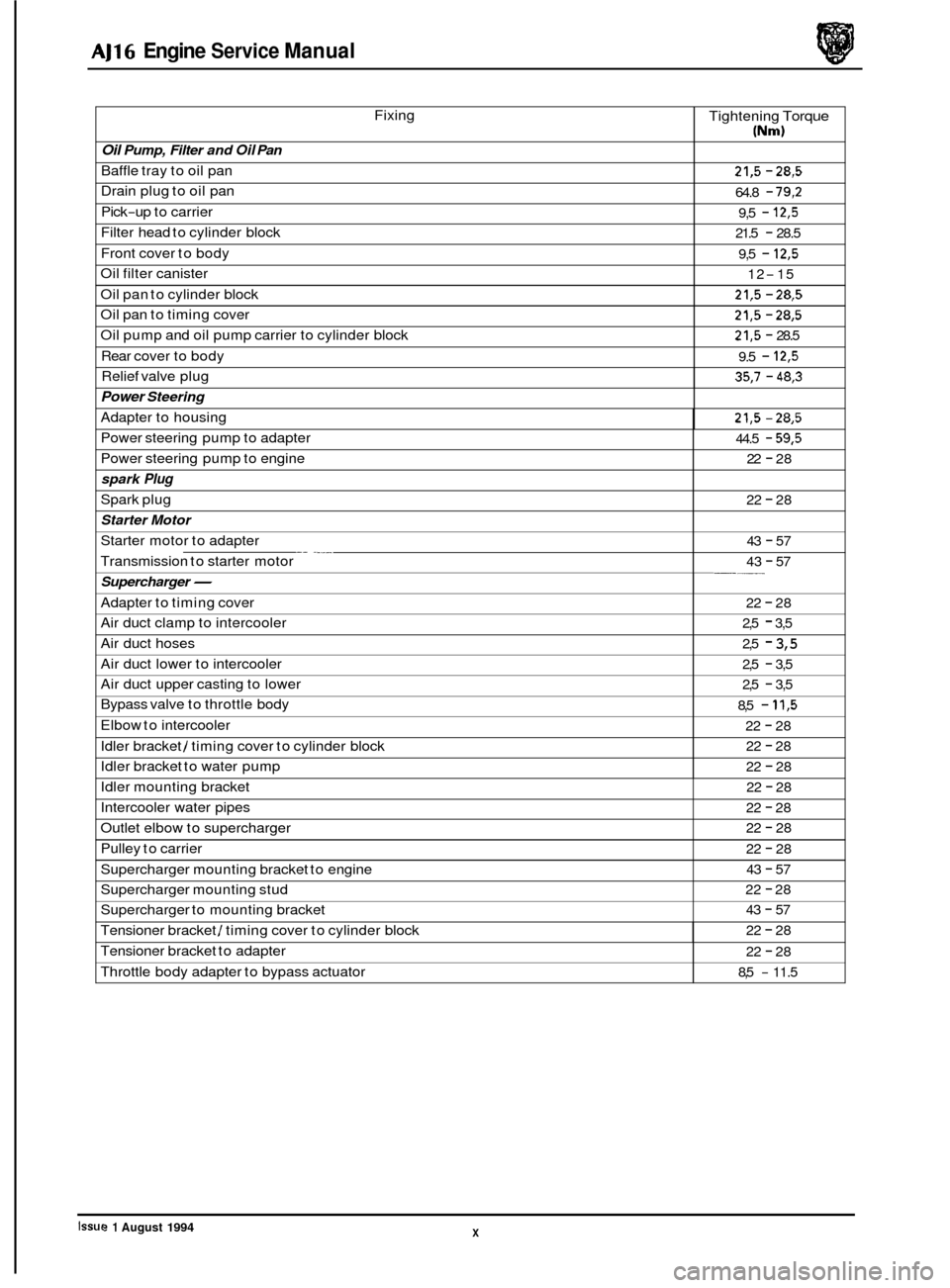
0 Fixing
Oil Pump, Filter and Oil Pan
Baffle tray to oil pan
Drain plug to oil pan
Pick
-up to carrier
Filter head to cylinder block
Front cover to body
Oil filter canister
Oil pan to cylinder block
Oil pan to timing cover
Oil pump and oil pump carrier to cylinder block
Rear cover to body
Relief valve plug Tightening
Torque
(Nm)
21,5 - 28,5
64.8 - 79,2
9,5 - 12,5
21.5 - 28.5
9,5
- 12,5
12-15
21,5 - 28,5
21,5 - 28,5
21,5 - 28.5
9.5
- 12,5
35,7 - 48,3
Power Steering
Adapter to housing 21,5 - 28,5
Power steering pump to adapter
Power steering pump to engine
spark Plug
Starter Motor
Starter motor to adapter
Transmission to starter motor
Supercharger-
Spark plug
--
44.5 - 59,5
22 - 28
22
- 28
43
- 57
43
- 57 -___
Adapter to timing cover
Air duct clamp to intercooler
Air duct hoses
Air duct lower to intercooler 22 - 28
2,5
- 3,5
2,5
- 3,5
2,5 - 3,5
Air duct upper casting to lower
Bypass valve to throttle body
Elbow to intercooler
Idler bracket
/ timing cover to cylinder block
Idler bracket to water pump
X Issue 1 August 1994
2,5 - 3,5
8,5
- 11,5
22 - 28
22
- 28
22
- 28
Idler mounting bracket
Intercooler water pipes
Outlet elbow to supercharger
Pulley to carrier
Supercharger mounting bracket to engine
Supercharger mounting stud 22 - 28
22
- 28
22
- 28
22
- 28
43
- 57
22
- 28
Supercharger to mounting bracket 43 - 57
Tensioner bracket / timing cover to cylinder block 22 - 28
Tensioner bracket to adapter
Throttle body adapter to bypass actuator 22 - 28
8,5
- 11.5
Page 16 of 73

AJ16 Engine Service Manual
Item
Type
Length
Outside diameter
Inside diameter
Material ~
Application
Specification
Chamfer locking
3,2
liter: 68,37 to 68,50 mm
4,O liter: 77,12 to 77,25 mm
23,807 to 23,812 mm
14,30 to 14.81 mm
Cast iron
'iston pin
2amshaft
dalve
Number of journals
Nominal
lift
Permissible end float
4djustment of valve clearance 7
9,95 mm
0.13 mm
rlalve Guide
Valve
stem diameter
Valve clearance
Jalve seat Intake
and exhaust: 6,947 to 6,960
mm
Intake and exhaust: 0,30 to 0,36 mm
Jalve seat insert outside diameter Outside
diameter
rappet
lalve spring Standard
- no
groove: 10,993 to
11,005 mm
1st oversize - 1 groove: 11,043 to
11,055
mm (production only)
2nd oversize
- 2 grooves: 1 1,143 to
11,155 mm
:amshaft sprocket
:rankshaft sprocket Diametrical
clearance
Free length
Number
of teeth
ntermediate sprocket
0,02 to 0,05 mm
43,5 mm
30
xv Issue 1 August 1994
Page 17 of 73
AJ16 Engine Service Manual
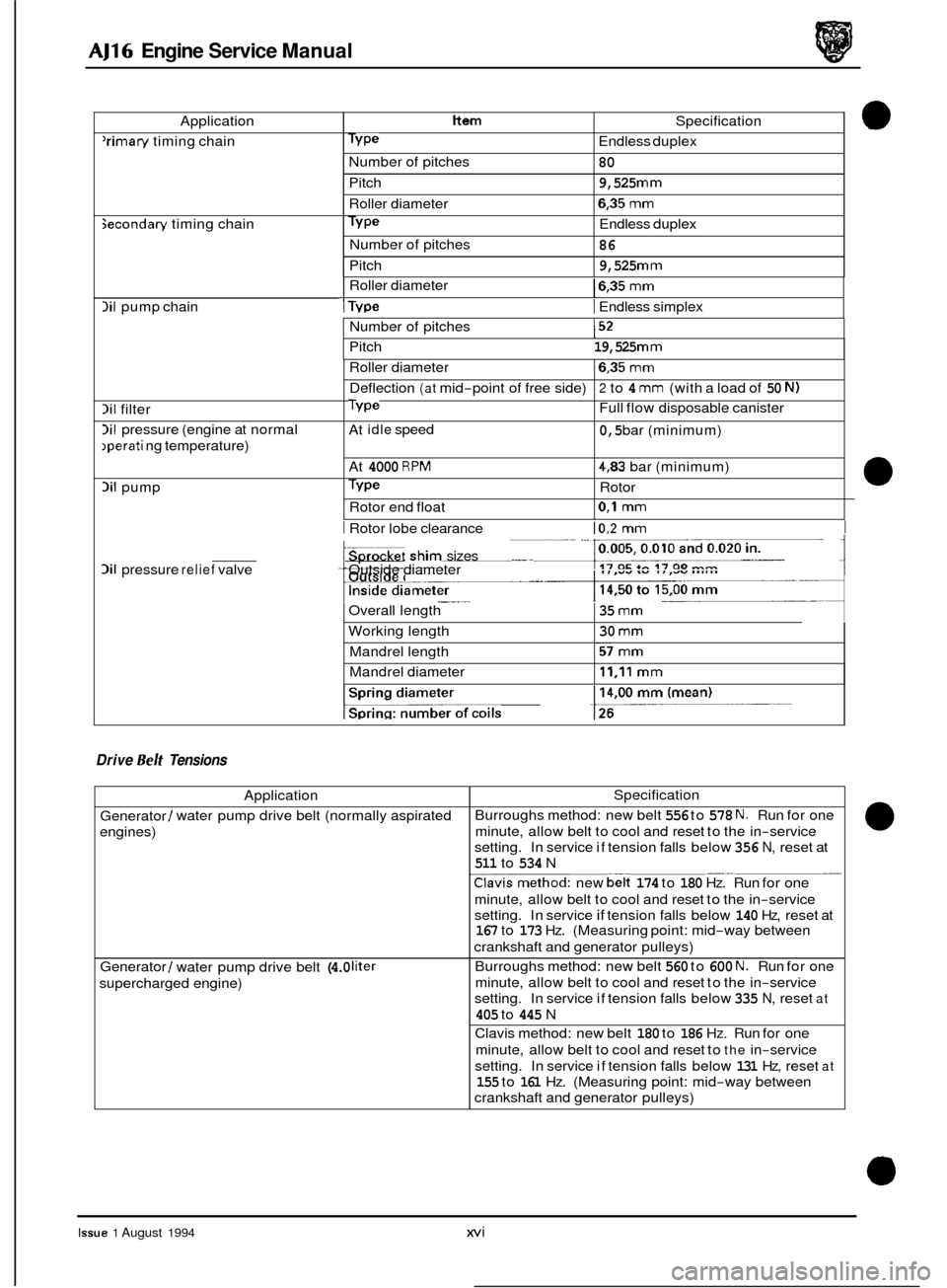
0 Application Item
'rimary timing chain Type
Pitch
Roller diameter
secondan/ timing chain Type
Number of pitches
Pitch
Number of
pitches Specification
Endless duplex
80
9,525
mm
6,35 mm
Endless duplex
86
9,525
mm
lil pump chain
lil filter
lil pressure (engine at normal
,perati ng temperature)
Si1 pump
I Roller diameter 16,35 mm
I Type I Endless simplex
Roller diameter
6,35 mm
Deflection (at mid-point of free side) 2 to 4 mm (with a load of 50 N)
Type Full flow disposable canister
At
idle speed 0,5 bar (minimum)
At
4000 RPM 4,83 bar (minimum)
Type Rotor
Rotor end float
0,l mm
Number of pitches I52
Pitch 19,525 mm
___ Overall length
Working length Mandrel length
Mandrel diameter 35 mm
30 mm
57 mm
11,ll mm
Si1 pressure relief valve
Application
Generator
/ water pump drive belt (normally aspirated
engines)
Generator
/ water pump drive belt (4.0 liter
supercharged engine)
I Rotor lobe clearance 10,2 mm I
Specification
Burroughs method: new belt
556 to 578 N. Run for one
minute, allow belt to cool and reset to the in
-service
setting. In service if tension falls below
356 N, reset at
511 to 534 N
.Clavismethod: new belt 174 to 180 Hz. Run for one
minute, allow belt to cool and reset to the in
-service
setting. In service
if tension falls below 140 Hz, reset at 167 to 173 Hz. (Measuring point: mid-way between
crankshaft and generator pulleys)
Burroughs method: new belt
560 to 600 N. Run for one
minute, allow belt to cool and reset to the in
-service
setting. In service if tension falls below
335 N, reset at
405 to 445 N
Clavis method: new belt
180 to 186 Hz. Run for one
minute, allow belt to cool and reset to
the in-service
setting. In service if tension falls below
131 Hz, reset at
155 to 161 Hz. (Measuring point: mid-way between
crankshaft and generator pulleys)
__ ___
.- ...
pket she sizes ___ Outside diameter
1
1
Drive Belt Tensions
0
Issue 1 August 1994 xvi
Page 20 of 73
AJ16 Engine Service Manual
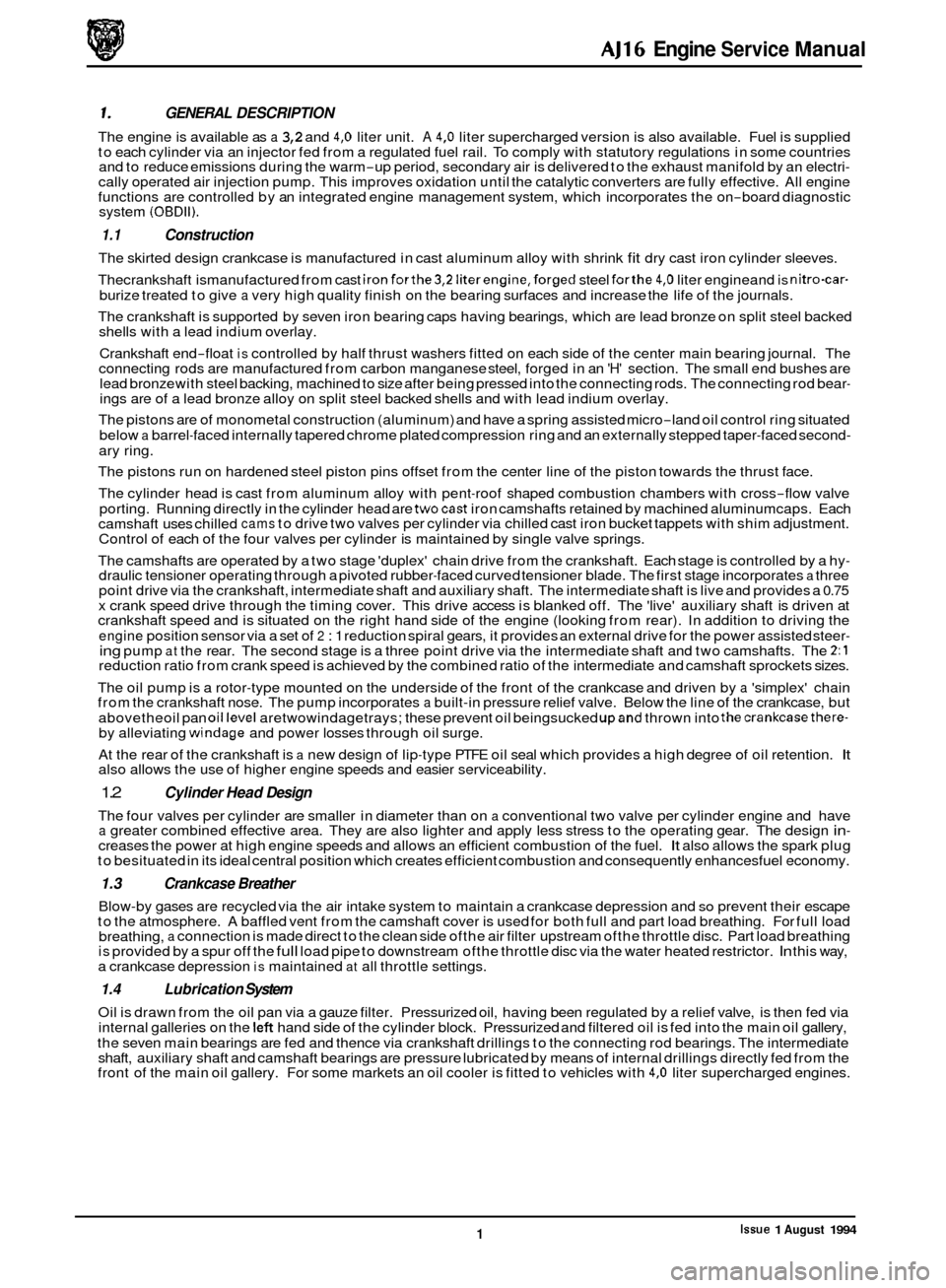
0 GENERAL DESCRIPTION - The engine is available as a 3,2 and 4,O liter unit. A 4,O liter supercharged version is also available. Fuel is supplied
to each cylinder via an injector fed from a regulated fuel rail. To comply with statutory regulations in some countries
and to reduce emissions during the warm
-up period, secondary air is delivered to the exhaust manifold by an electri- cally operated air injection pump. This improves oxidation until the catalytic converters are fully effective. All engine
functions are controlled by an integrated engine management system, which incorporates the on-board diagnostic
system (OBDII).
1.1 Construction
The skirted design crankcase is manufactured in cast aluminum alloy with shrink fit dry cast iron cylinder sleeves.
Thecrankshaft ismanufactured from cast
ironforthe3,2 literengine,forged steel forthe 4,O liter engineand is nitro-car-
burize treated to give a very high quality finish on the bearing surfaces and increase the life of the journals.
The crankshaft is supported by seven iron bearing caps having bearings, which are lead bronze on split steel backed
shells with a lead indium overlay.
Crankshaft end
-float is controlled by half thrust washers fitted on each side of the center main bearing journal. The
connecting rods are manufactured from carbon manganese steel, forged in an 'H' section. The small end bushes are
lead bronze with steel backing, machined to size after being pressed into the connecting rods. The connecting rod bear- ings are of a lead bronze alloy on split steel backed shells and with lead indium overlay.
The pistons are of monometal construction (aluminum) and have a spring assisted micro
-land oil control ring situated
below a barrel-faced internally tapered chrome plated compression ring and an externally stepped taper-faced second-
ary ring.
The cylinder head is cast from aluminum alloy with pent
-roof shaped combustion chambers with cross-flow valve
porting. Running directly in the cylinder head are
twocast iron camshafts retained by machined aluminumcaps. Each
camshaft uses chilled cams to drive two valves per cylinder via chilled cast iron bucket tappets with shim adjustment.
Control of each of the four valves per cylinder is maintained by single valve springs.
The camshafts are operated by a two stage 'duplex' chain drive from the crankshaft. Each stage is controlled by a hy
- draulic tensioner operating through a pivoted rubber-faced curved tensioner blade. The first stage incorporates a three
point drive via the crankshaft, intermediate shaft and auxiliary shaft. The intermediate shaft is live and provides a 0.75 x crank speed drive through the timing cover. This drive access is blanked off. The 'live' auxiliary shaft is driven at
crankshaft speed and is situated on the right hand side of the engine (looking from rear). In addition to driving the
engine position sensor via a set of 2 : 1 reduction spiral gears, it provides an external drive for the power assisted steer- ing pump at the rear. The second stage is a three point drive via the intermediate shaft and two camshafts. The 2:l reduction ratio from crank speed is achieved by the combined ratio of the intermediate and camshaft sprockets sizes.
The oil pump is a rotor
-type mounted on the underside of the front of the crankcase and driven by a 'simplex' chain
from the crankshaft nose. The pump incorporates a built-in pressure relief valve. Below the line of the crankcase, but
abovetheoil pan
oillevel aretwowindagetrays; these prevent oil beingsucked upand thrown into thecrankcasethere- by alleviating windage and power losses through oil surge.
At the rear of the crankshaft is
a new design of lip-type PTFE oil seal which provides a high degree of oil retention. It also allows the use of higher engine speeds and easier serviceability.
1.2 Cylinder Head Design
The four valves per cylinder are smaller in diameter than on a conventional two valve per cylinder engine and have a greater combined effective area. They are also lighter and apply less stress to the operating gear. The design in- creases the power at high engine speeds and allows an efficient combustion of the fuel. It also allows the spark plug
to besituated in its ideal central position which creates efficient combustion and consequently enhancesfuel economy.
1.3 Crankcase Breather
Blow-by gases are recycled via the air intake system to maintain a crankcase depression and so prevent their escape
to the atmosphere. A baffled vent from the camshaft cover is used for both full and part load breathing. For full load
breathing,
a connection is made direct to the clean side ofthe air filter upstream ofthe throttle disc. Part load breathing is provided by a spur off the full load pipe to downstream ofthe throttle disc via the water heated restrictor. In this way,
a crankcase depression is maintained at all throttle settings.
1.4 Lubrication System
Oil is drawn from the oil pan via a gauze filter. Pressurized oil, having been regulated by a relief valve, is then fed via
internal galleries on the left hand side of the cylinder block. Pressurized and filtered oil is fed into the main oil gallery,
the seven main bearings are fed and thence via crankshaft drillings to the connecting rod bearings. The intermediate
shaft, auxiliary shaft and camshaft bearings are pressure lubricated by means of internal drillings directly fed from the
front of the main oil gallery. For some markets an oil cooler is fitted to vehicles with
4,O liter supercharged engines.
The pistons run on hardened steel piston pins offset from the center line of the piston towards the thrust face.
Issue 1 August 1994 1
Page 21 of 73
AJ16 Engine Service Manual
1.5 Coohg System
The engine is liquid cooled by a mixture of water and anti-freeze circulating around the coolant passages. The coolant
pump is mounted on the left hand side of the cylinder block and is driven from the crankshaft nose by a three point
belt drive (which includes the generator). The pump is a fully assembled bolt
-on unit. The coolant is fed into the cylin- der block at two places via an external delivery pipe. The coolant is drawn from the cylinder head via a self-contained
thermostat housing back to the radiator or recirculated according to the thermostat position.
7.6 Supercharger
The supercharger optionally available on the 4,O liter engine is a Roots blower type which gives better engine efficiency
at part throttle conditions and responsive off
-boost performance. The principal changes to the engine for the super- charged version are to the piston, valve timing, intake manifold and the additional drive to the supercharger. A lower
compression ratio
of 8.5:l is used which provides the optimum balance between high speed performance and fuel
economy.
The engine heat exchanger of the intercooler system is incorporated into the intake manifold. The blower incorporates
an air by
-pass system which improves efficiency under part throttle conditions. The by-pass valve is controlled by a vacuum actuator referenced to the intake manifold pressure.
2. SERVICE PROCEDURES
2.1 SPS )oint Control System
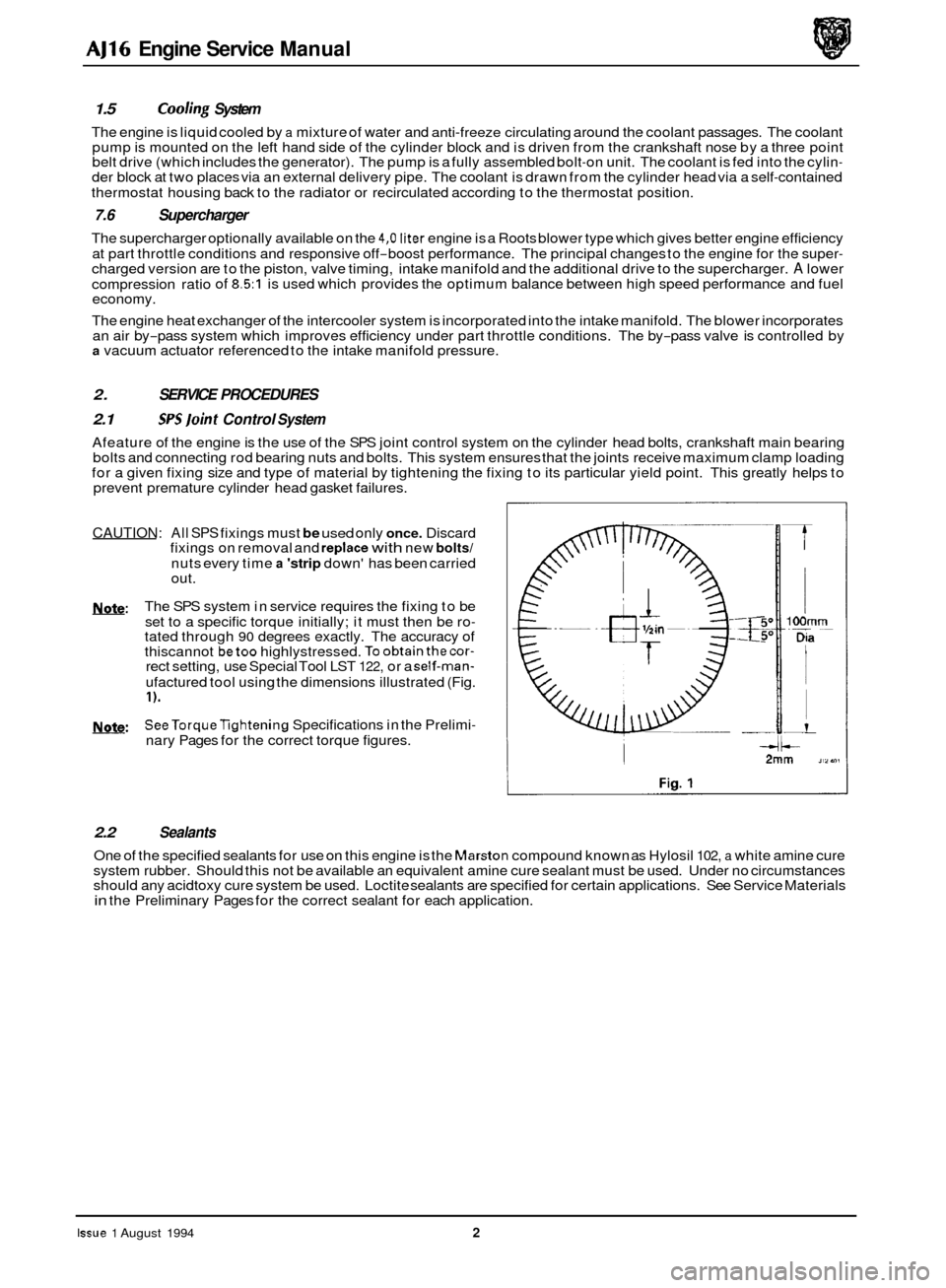
Afeature of the engine is the use of the SPS joint control system on the cylinder head bolts, crankshaft main bearing
bolts and connecting rod bearing nuts and bolts. This system ensures that the joints receive maximum clamp loading
for a given fixing size and type of material by tightening the fixing to its particular yield point. This greatly helps to
prevent premature cylinder head gasket failures.
0
CAUTION: All SPS fixings must be used only once. Discard
fixings on removal and replace with new bolts/
nuts every time a 'strip down' has been carried
out.
The SPS system in service requires the fixing to be
set to a specific torque initially; it must then be ro
- tated through 90 degrees exactly. The accuracy of
thiscannot betoo highlystressed. Toobtainthecor- rect setting, use Special Tool LST 122, or a self-man-
ufactured tool using the dimensions illustrated (Fig.
I).
SeeTorqueTightening Specifications in the Prelimi-
nary Pages for the correct torque figures.
b:
w:
2.2 Sealants
One of the specified sealants for use on this engine is the Marston compound known as Hylosil 102, a white amine cure
system rubber. Should this not be available an equivalent amine cure sealant must be used. Under no circumstances
should any acidtoxy cure system be used. Loctite sealants are specified for certain applications. See Service Materials
in the Preliminary Pages for the correct sealant for each application.
Issue 1 August 1994 2
Page 22 of 73
AJ16 Engine Service Manual
FAULT DIAGNOSIS
3.1 Introduction
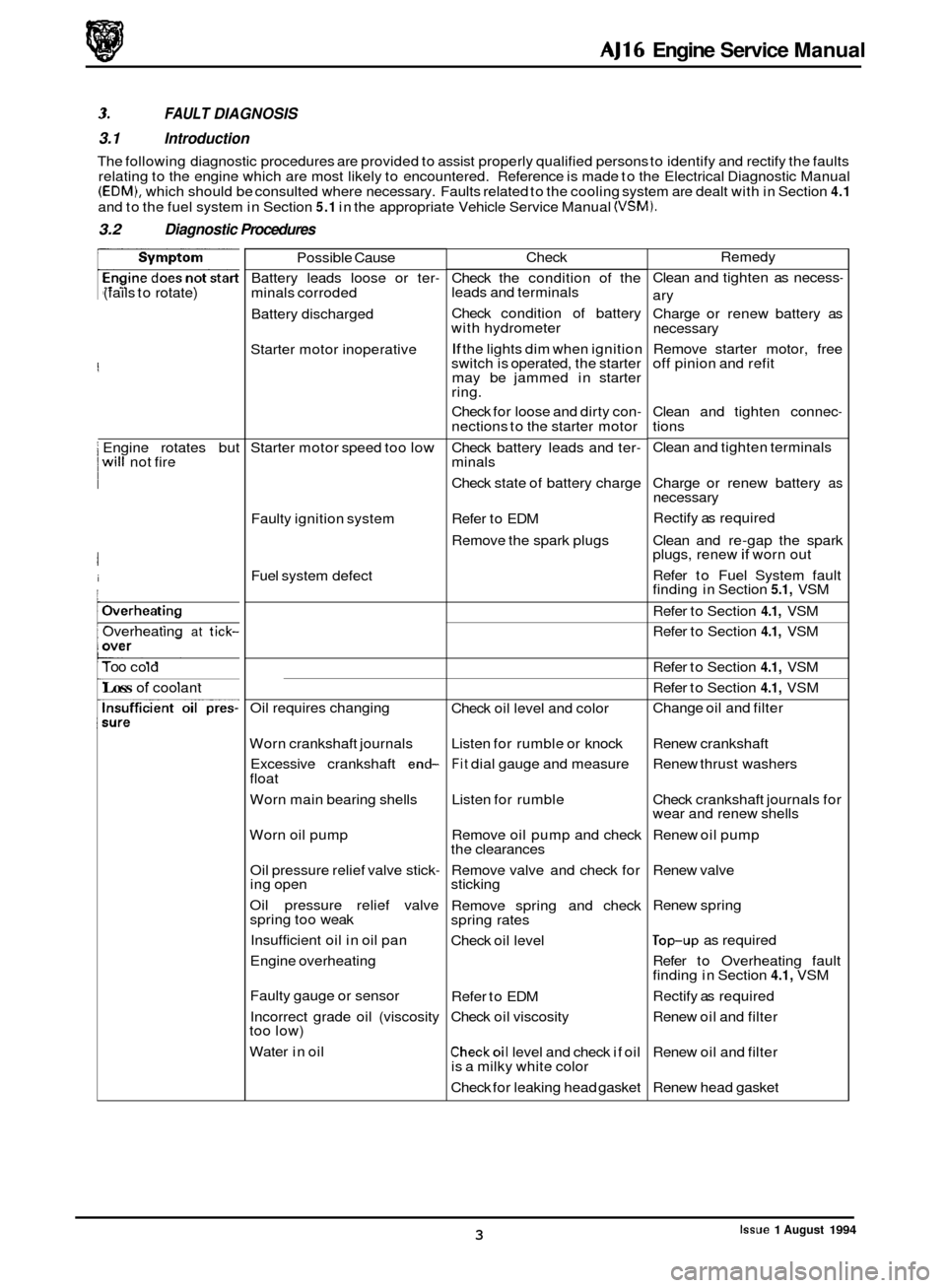
The following diagnostic procedures are provided to assist properly qualified persons to identify and rectify the faults
relating to the engine which are most likely to encountered. Reference is made to the Electrical Diagnostic Manual
(EDM), which should be consulted where necessary. Faults related to the cooling system are dealt with in Section 4.1
and to the fuel system in Section 5.1 in the appropriate Vehicle Service Manual (VSM).
3.2 Diagnostic Procedures
(fails to rotate)
I Engine rotates but 0 I will not fire
I
i
/Overheating
Overheating at tick-
Too cold
Loss of coolant Possible
Cause
Battery leads loose or ter
- minals corroded
Battery discharged
Starter motor inoperative
Starter motor speed too
low
Faulty ignition system
Fuel system defect
Oil requires changing
Worn crankshaft journals
Excessive crankshaft
end- float
Worn main bearing shells
Worn oil pump Oil pressure relief valve stick
- ing open
Oil pressure relief valve
spring too weak
Insufficient oil in oil pan
Engine overheating
Faulty gauge or sensor
Incorrect grade oil (viscosity
too low)
Water in oil Check
Check the condition of the
leads and terminals
Check condition of battery
with hydrometer
If the lights dim when ignition
switch is operated, the starter
may be jammed in starter
ring.
Check for loose and dirty con
- nections to the starter motor
Check battery leads and ter
- minals
Check state of battery charge
Refer to EDM
Remove the spark plugs
Check oil level and color
Listen for rumble or knock
Fit dial gauge and measure
Listen for rumble
Remove oil pump and check
the clearances
Remove valve and check for
sticking
Remove spring and check
spring rates
Check oil level
Refer to EDM
Check oil viscosity
Checkoil level and check if oil
is a milky white color
Check for leaking head gasket Remedy
Clean and tighten as necess
-
ary
Charge or renew battery as
necessary
Remove starter motor, free
off pinion and refit
Clean and tighten connec
- tions
Clean and tighten terminals
Charge or renew battery
as necessary
Rectify as required
Clean and re
-gap the spark
plugs, renew if worn out
Refer to Fuel System fault
finding in Section
5.1, VSM
Refer to Section
4.1, VSM
Refer to Section
4.1, VSM
Refer to Section
4.1, VSM
Refer to Section
4.1, VSM
Change oil and filter
Renew crankshaft
Renew thrust washers
Check crankshaft journals for
wear and renew shells
Renew oil pump
Renew valve
Renew spring
lop-up as required
Refer to Overheating fault
finding in Section
4.1, VSM
Rectify as required
Renew oil and filter
Renew oil and filter
Renew head gasket
Issue 1 August 1994 3
Page 23 of 73
AJ16 Engine Service Manual
Symptom Possible Cause ~~
nsufficient
oil pres- ure (continued)
lil pressure too high
3urning oil
.osing oil (leaking)
Excessive noise
'rom valve gear Cracked
oil pump housing
Blocked oil pick
-up pipe
strainer
Oil pump pipe
'0' rings
Main oil gallery seals leaking
or gallery blocked
Relief valve stuck shut
Wrong pressure relief valve
Incorrect grade engine oil
(viscosity too high)
Gauge or sensor fault
Engine temperature too low
Worn cylinder bores
Worn valve guides
Worn intake valve seals
Worn piston rings
Cylinder head gasket leaking
Incorrect grade of engine oil
Worn front oil seal
Worn rear oil seal
Leaking gaskets
Cylinder block cracked
Excessive valve clearance
Broken valve
spring(s)
Broken valve guide
Broken valve seat insert
Lack of lubrication
Valve clash
Worn
camshaft(s)
Worn camshaft drive chains i tensioners
Check
Remove oil pan and visually
check
Remove oil pan and visually
check
Removeoil
panand pipesand check Eliminate other possible
causes
Remove valve and check for
sticking
Remove spring and check the
rate
Check oil viscosity
Refer to EDM
Check wear with
a compara- tor
Insert valve in guide and
check side movement
Remove seals and check for
splits or wear
Measure rings in bore
Check for blue smoke from
exhaust
Check oil viscosity
Wipe clean, run engine and
visually check
Wipe bell housing clean, run
engine and visually inspect
for cleanliness
Visual check
Visual check
Check valve clearances
Remove valves and check
springs
Remove valves and check
guides
Remove valves and check in
- serts
Check oil pressure gauge re
- ading
Check valve timing
Check valve clearances and
for lack
of lubrication
Remove front timing cover
and check for wear
Remedy
Renew the pump
Remove oil pick
-up pipe and
clean strainer
Fit new '0' rings
Fit new '0 rings or clear oil
gallery
Clean or renew the valve
Renew spring
Renew oil and filter
Rectify as required
RefertoToo Cold fault finding
in Section 4.1, VSM
Rebore cylinders as necess
-
ary
Renew valve guides as
necessary
Renew in sets
Renew rings in sets and re
- bore as necessary
Renew head gasket
Renew oil and filter
Renew seal
Renew seal
Renew gasket Renew cylinder block
Adjust valve clearances
Renew as necessary
Renew as necessary
Renew as necessary
Refer to Insufficient Oil Pres
- sure fault finding
Adjust valve timing
Adjust valve clearances.
Refer to Insufficient Oil Pres
- sure fault finding
Renew as
necessaw
0
0
0 ~~~
Issue 1 August 1994 4