lock JAGUAR XJ 1994 2.G ZF Automatic Transmission Manual
[x] Cancel search | Manufacturer: JAGUAR, Model Year: 1994, Model line: XJ, Model: JAGUAR XJ 1994 2.GPages: 74, PDF Size: 2.66 MB
Page 28 of 74
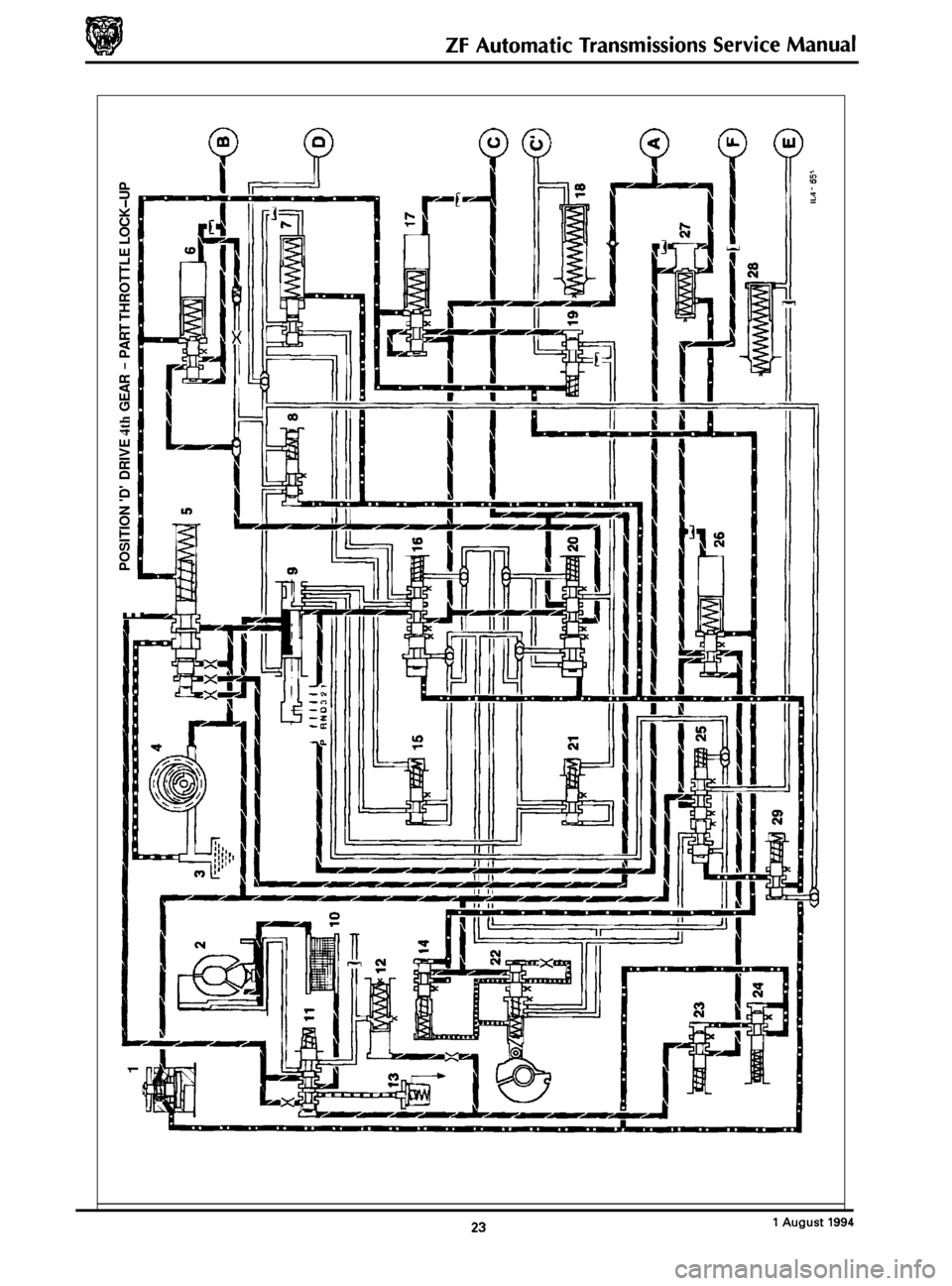
1 E POSITION 'D' DRIVE 4th GEAR - PART THROTTLE LOCK-UP
IL4 - 851
Page 39 of 74
ZF Automatic Transmissions Service Manual
Problem Possible Cause
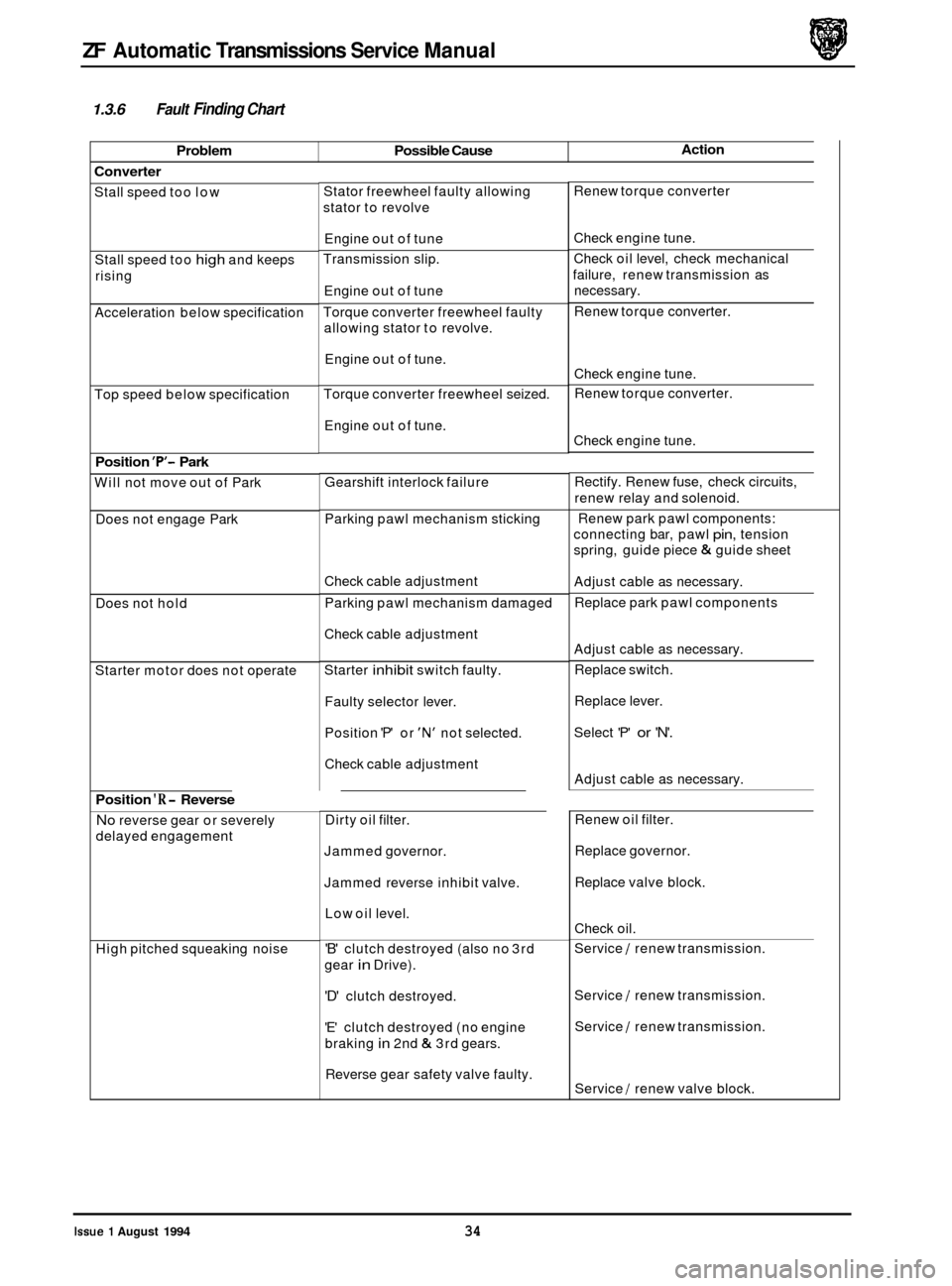
1.3.6 Fault Finding Chart
Action
Converter
Stall speed too low
Stall speed too
high and keeps
rising
Acceleration below specification
Top speed below specification
Position 'P'- Park
Will not move out of Park
Does not engage Park
Does not hold
Starter motor does not operate
Position 'R- Reverse
No reverse gear or severely
delayed engagement
High pitched squeaking noise Stator freewheel
faulty allowing
stator to revolve
Engine out of tune
Transmission slip.
Engine out of tune
Torque converter freewheel faulty
allowing stator to revolve.
Engine out of tune.
Torque converter freewheel seized.
Engine out of tune.
Gearshift interlock failure
Parking pawl mechanism sticking
Check cable adjustment
Parking pawl mechanism damaged
Check cable adjustment
Starter
inhibit switch faulty.
Faulty selector lever.
Position
'P' or 'N' not selected.
Check cable adjustment
Dirty oil filter.
Jammed governor.
Jammed reverse inhibit valve.
Low oil level.
'B' clutch destroyed (also no 3rd
gear
in Drive).
'D' clutch destroyed.
'E' clutch destroyed (no engine
braking
in 2nd & 3rd gears.
Reverse gear safety valve faulty. Renew
torque converter
Check engine tune.
Check oil level, check mechanical
failure, renew transmission as
necessary.
Renew torque converter.
Check engine tune.
Renew torque converter.
Check engine tune.
Rectify. Renew fuse, check circuits,
renew relay and solenoid.
Renew park pawl components:
connecting bar, pawl
pin, tension
spring, guide piece
& guide sheet
Adjust cable as necessary.
Replace park pawl components
Adjust cable as necessary.
Replace switch.
Replace lever.
Select 'P'
or 'N'.
Adjust cable as necessary.
Renew oil filter.
Replace governor.
Replace valve block.
Check oil.
Service
/ renew transmission.
Service
/ renew transmission.
Service
/ renew transmission.
Service
/ renew valve block.
Issue 1 August 1994 34
Page 40 of 74
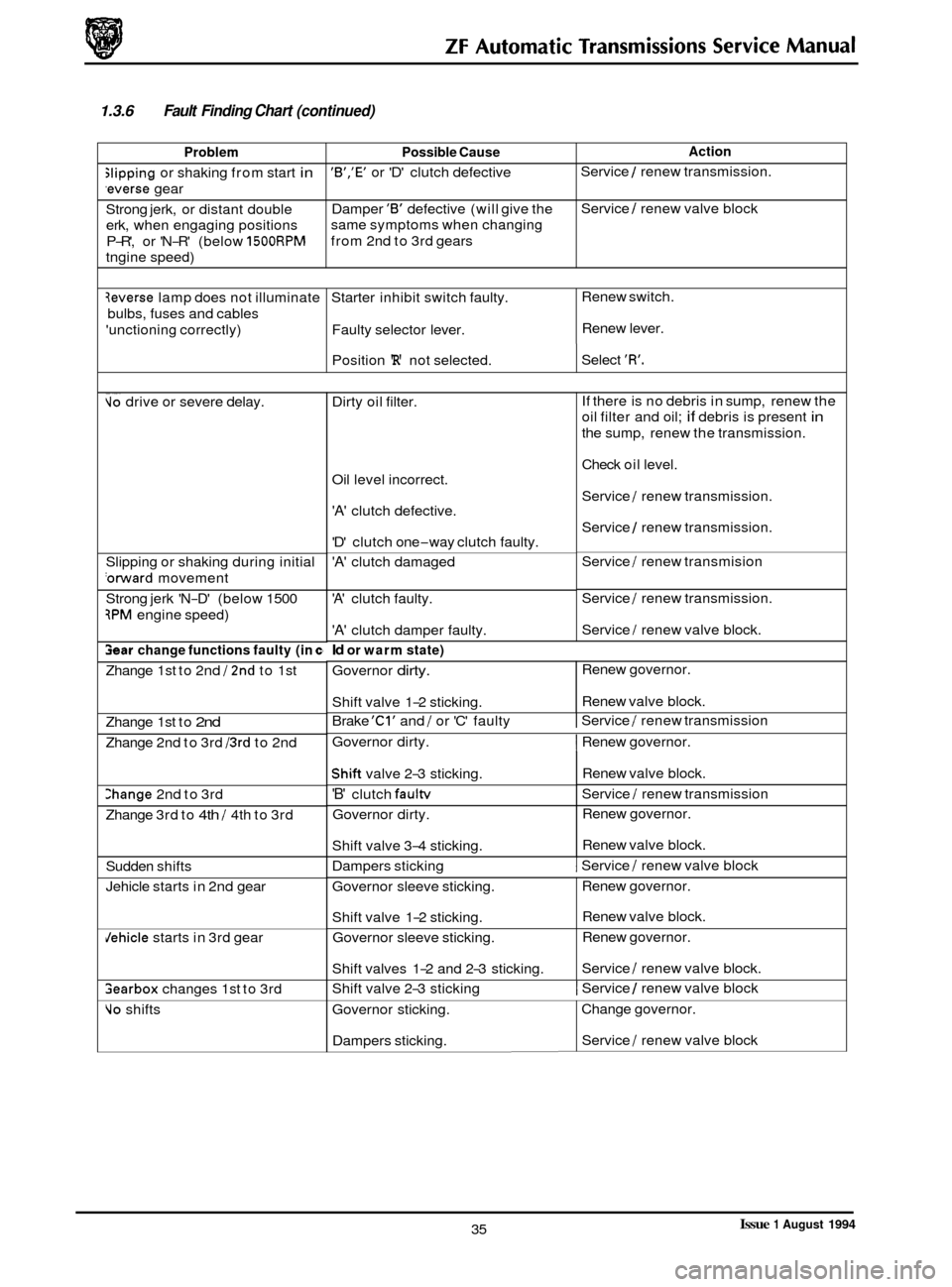
1.3.6 Fault Finding Chart (continued)
Problem Possible Cause
slipping or shaking from start in
'everse gear
Strong jerk, or distant double
erk, when engaging positions
P
-R', or 'N-R' (below 1500RPM
tngine speed)
'B','E or 'D' clutch defective
Damper
'6' defective (will give the
same symptoms when changing
from 2nd to 3rd gears
Action
Service 1 renew transmission.
Service
1 renew valve block
qeverse lamp does not illuminate Starter inhibit switch faulty.
bulbs, fuses and cables
'unctioning correctly) Faulty selector lever.
io drive or severe delay. Renew
switch.
Renew lever.
Slipping or shaking during initial Position
'R' not
selected.
'orward movement
Strong jerk 'N
-D' (below 1500
3PM engine speed) Select
'R'.
Sear change functions
faulty (in c'
Zhange 1st to 2nd 12nd to 1st Governor dirty.
Shift valve 1-2 sticking.
Zhange 1st to
2nd
Renew governor.
Renew valve block.
Zhange 2nd to 3rd
13rd to 2nd
Governor dirty.
Shift valve 3
-4 sticking.
:hange 2nd to 3rd
Zhange 3rd to
4th I 4th to 3rd Renew
governor.
Renew valve block.
Sudden shifts
Jehicle starts in 2nd gear Governor sleeve sticking.
Shift valve 1
-2 sticking.
Governor sleeve sticking.
Shift valves 1
-2 and 2-3 sticking.
Jehicle starts in 3rd gear Renew
governor.
Renew valve block.
Renew governor.
Service
I renew valve block.
Searbox changes 1st to 3rd
Uo shifts Dirty
oil filter.
Oil level incorrect.
'A' clutch defective.
'D' clutch one
-way clutch faulty.
'A' clutch damaged
'A' clutch faulty.
'A' clutch damper faulty.
Id or warm state)
If there is no debris in sump, renew the
oil filter and oil;
if debris is present in
the sump, renew the transmission.
Check oil level.
Service
I renew transmission.
Service
1 renew transmission.
Service
I renew transmision
Service
1 renew transmission.
Service
/ renew valve block.
Brake
'Cl' and 1 or 'C' faulty I Service / renew transmission
Governor dirty.
I Renew governor.
Shift valve 2-3 sticking.
'B' clutch faultv
Renew valve block.
Service
I renew transmission
Dampers sticking
I Service I renew valve block
Shift valve 2
-3 sticking I Service 1 renew valve block
Governor sticking.
Dampers sticking. Change
governor.
Service
I renew valve block
Issue 1 August 1994 35
Page 41 of 74

ZF Automatic Transmissions Service Manual
Problem Possible Cause
1.3.6 Fault Finding Chart (continued)
Action
No changes at light throttle
setting
Change points incorrect at full
throttle setting
No changes at 'kick-down' - 1st
to 2nd 12nd to 1st
No changes at 'kick-down' - 2nd
to 3rd
13rd to 2nd Dirty
governor.
Shift valves sticking.
'Kick
-down' cable setting incorrect
'Kick
-down' cable setting incorrect
'Kick
-down' cable setting incorrect Renew
governor.
Service
1 renew valve block.
Adjust setting
Adjust setting
Adjust setting
Service
1 renew valve block.
Service
1 renew valve block.
Poor changes
Harsh changes at low throttle Throttle
valve ('kickdown') cable
, setting incorrect
I Defective damper.
Modulation pressure too high.
'Kick
-down' cable setting incorrect. I
j Clutch plates damaged.
!
Soft changes at full throttle and
'kick
-down' Defective damper.
'Kick-down' cable setting incorrect.
I
Adjust setting
Service
/ renew valve block.
Service
1 renew valve block.
Adjust setting
,
Service / renew transmission.
Service
/ renew valve block.
Adjust setting.
Adjust setting.
Harsh changes
at full throttle and
'kick
-down' Modulation
pressure too low.
Clutch plates damaged.
Incorrect modulation pressure.
'Kick
-down' cable setting incorrect.
Defective damper.
Manual change 3rd to 2nd faulty
No engine braking
36 Issue 1 August 1994
Locking valve '2' sticking. Service 1 renew valve
block I governor.
Service
/ renew valve block / governor.
Service
1 renew transmission
Governor faulty.
Brake 'C' or 'E' damaged
Page 42 of 74
ZF Automatic Transmissions Service Manual
Problem Possible Cause
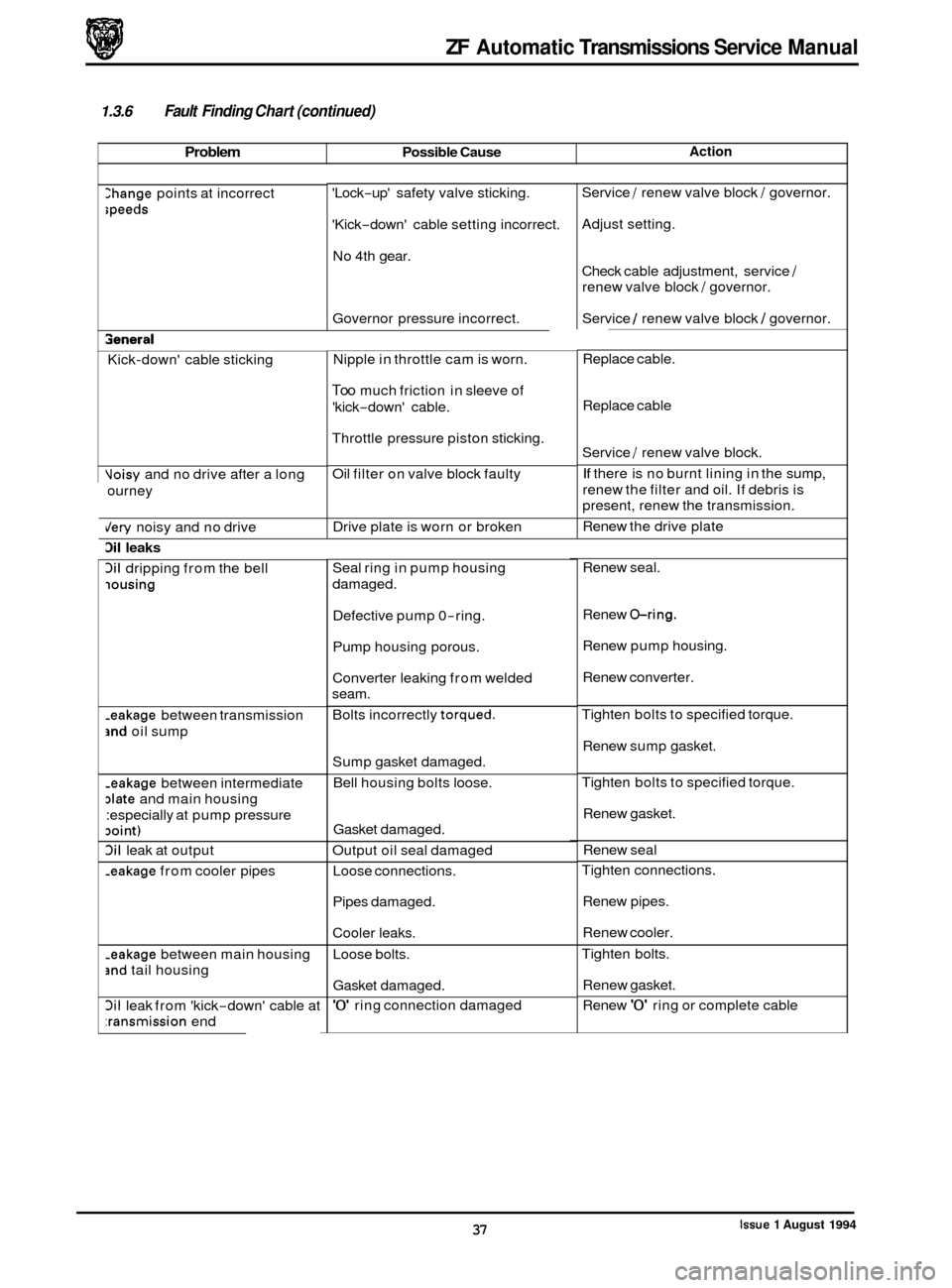
1.3.6 Fault Finding Chart (continued)
Action
>hange points at incorrect
;peeds
3eneral
Kick-down' cable sticking
Voisy and no drive after a long
ourney
dery noisy and no drive
3il leaks
3il dripping from the bell
iousing
-eakage between transmission
and oil sump
-eakage between intermediate
date and main housing
:especially at pump pressure
Doint)
3il leak at output
-eakage from cooler pipes
-eakage between main housing
jnd tail housing
3il leak from 'kick-down' cable at
:ransmission end 'Lock
-up'
safety valve sticking.
'Kick
-down' cable setting incorrect.
No 4th gear.
Governor pressure incorrect.
Nipple in throttle cam is worn.
Too much friction in sleeve of
'kick
-down' cable.
Throttle pressure piston sticking.
Oil filter on valve block faulty
Drive plate is worn or broken
Seal ring in pump housing
damaged.
Defective pump 0
-ring.
Pump housing porous.
Converter leaking from welded
seam.
Bolts incorrectly
torqued.
Sump gasket damaged.
Bell housing bolts loose.
Gasket damaged.
Output oil seal damaged
Loose connections.
Pipes damaged.
Cooler leaks.
Loose bolts.
Gasket damaged.
'0' ring connection damaged Service
/ renew valve
block / governor.
Adjust setting.
Check cable adjustment, service
/
renew valve block / governor.
Service
1 renew valve block I governor.
Replace cable.
Replace cable
Service
/ renew valve block.
If there is no burnt lining in the sump,
renew the filter and oil. If debris is
present, renew the transmission.
Renew the drive plate
Renew seal.
Renew
@ring.
Renew pump housing.
Renew converter.
Tighten bolts to specified torque.
Renew sump gasket.
Tighten bolts to specified torque.
Renew gasket.
Renew seal
Tighten connections.
Renew pipes.
Renew cooler.
Tighten bolts.
Renew gasket.
Renew
'0' ring or complete cable
issue 1 August 1994 37
Page 43 of 74
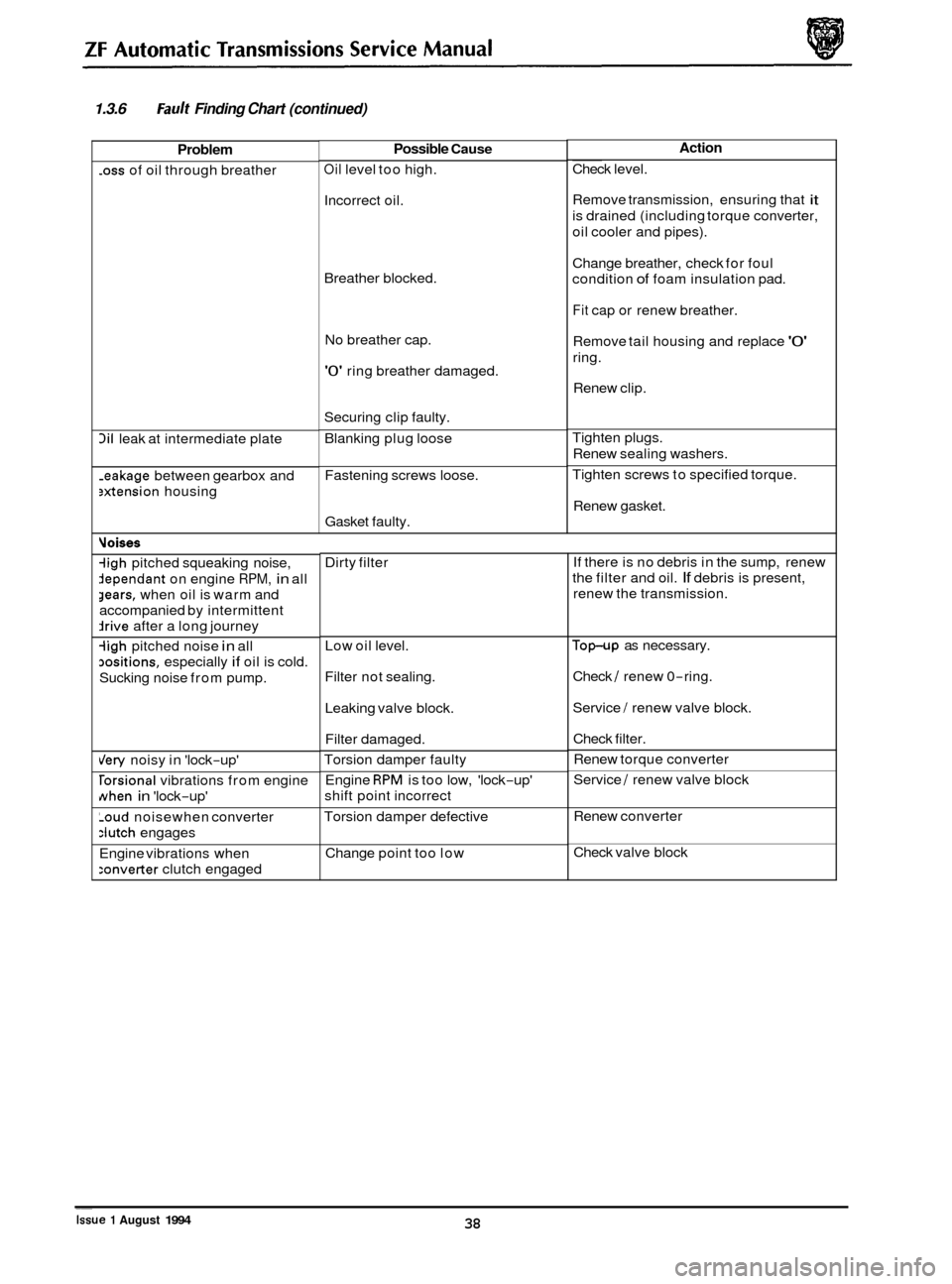
1.3.6 Fault Finding Chart (continued)
Problem
.oss of oil through breather
3il leak at intermediate plate
-eakage between gearbox and
2xtension housing
Uoises
iigh pitched squeaking noise,
jependant on engine RPM, in all
jears, when oil is warm and
accompanied by intermittent
hive after a long journey
iigh pitched noise in all
Dositions, especially if oil is cold.
Sucking noise from pump.
dery noisy in 'lock-up'
rorsional vibrations from engine
Nhen in 'lock-up'
-oud noisewhen converter
:lutch engages
Engine vibrations when
:onverter clutch engaged
Possible Cause
Oil level too high.
Incorrect oil.
Breather blocked.
No breather cap.
'0' ring breather damaged.
Securing clip faulty.
Blanking plug loose
Fastening screws loose.
Gasket faulty.
Dirty filter
Low oil level.
Filter not sealing.
Leaking valve block.
Filter damaged.
Torsion damper faulty
Engine
RPM is too low, 'lock-up'
shift point incorrect
Torsion damper defective
Change point too low
Action ___ Check level.
Remove transmission, ensuring that
it
is drained (including torque converter,
oil cooler and pipes).
Change breather, check for foul
condition
of foam insulation pad.
Fit cap or renew breather.
Remove tail housing and replace
'0'
ring.
Renew clip.
Tighten plugs. Renew sealing washers.
Tighten screws to specified torque.
Renew gasket.
If there is no debris in the sump, renew
the filter and oil.
If debris is present,
renew the transmission.
Top-up as necessary.
Check
I renew 0-ring.
Service
/ renew valve block.
Check filter.
Renew torque converter
Service
I renew valve block
Renew converter
Check valve block ~~
Issue 1 August 1994 38
Page 44 of 74
ZF Automatic Transmissions Service Manual
2.1
electronic-hydraulic transmission control unit.
ZF 4 HP 24 E TRANSMISSION, GENERAL DESCRIPTION
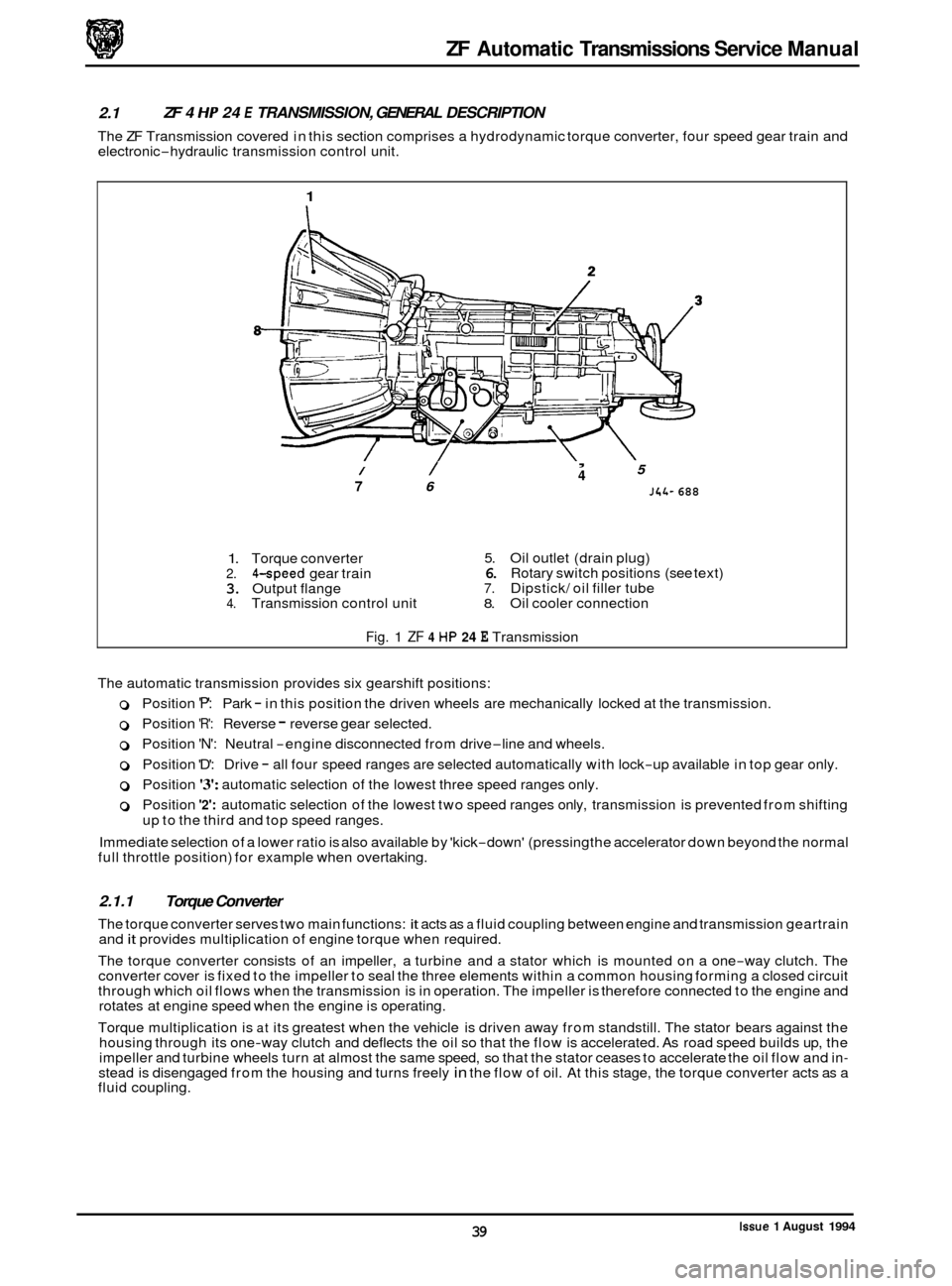
The ZF Transmission covered in this section comprises a hydrodynamic torque converter, four speed gear train and
1
/ /
7 6
, 5 4
J4L- 688
1. Torque converter 5. Oil outlet (drain plug)
2. 4-speed gear train 6. Rotary switch positions (see text)
3. Output flange 7. Dipstick/ oil filler tube 4. Transmission control unit 8. Oil cooler connection
Fig. 1 ZF 4 HP 24 E Transmission
The automatic transmission provides six gearshift positions:
0 Position 'P': Park - in this position the driven wheels are mechanically locked at the transmission.
0 Position 'R': Reverse - reverse gear selected.
0 Position 'N': Neutral -engine disconnected from drive-line and wheels.
0 Position 'D': Drive - all four speed ranges are selected automatically with lock-up available in top gear only.
0 Position '3': automatic selection of the lowest three speed ranges only.
0 Position '2': automatic selection of the lowest two speed ranges only, transmission is prevented from shifting
up to the third and top speed ranges.
Immediate selection of a lower ratio is also available by 'kick
-down' (pressing the accelerator down beyond the normal
full throttle position) for example when overtaking.
2.1.1 Torque Converter
The torque converter serves two main functions: it acts as a fluid coupling between engine and transmission geartrain
and it provides multiplication of engine torque when required.
The torque converter consists of an impeller, a turbine and a stator which is mounted on a one
-way clutch. The
converter cover is fixed to the impeller to seal the three elements within a common housing forming a closed circuit
through which oil flows when the transmission is in operation. The impeller is therefore connected to the engine and
rotates at engine speed when the engine is operating.
Torque multiplication is
at its greatest when the vehicle is driven away from standstill. The stator bears against the
housing through its one-way clutch and deflects the oil so that the flow is accelerated. As road speed builds up, the
impeller and turbine wheels turn at almost the same speed, so that the stator ceases to accelerate the oil flow and in- stead is disengaged from the housing and turns freely in the flow of oil. At this stage, the torque converter acts as a
fluid coupling.
Issue 1 August 1994 39
Page 45 of 74
ZF Automatic Transmissions Service Manual
The torque converter acts in all four forward gears and in reverse. The converter lock-up clutch closes in 4th gear at
a point depending on road speed and accelerator position; engine power is then transmitted
by purely mechanical
means.
A low
-loss oil pump in the front of the transmission housing supplies the converter, the automatic gear shift and the
lubrication circuit; oil is drawn from a sump in the bottom of the gear train housing through a filter. The pump drive
gear is keyed to the converter impeller hub and therefore turns when the engine is running, thereby pressurizing the
oil.
2.1.2 Four-speed Epicyclic Gear Train
The torque converter drives a mechanical epicyclic gear train providing four forward ratios and reverse. Individual ra-
tios are obtained by coupling together the various parts of the gear train by means of solenoid-operated, hydraulically
actuated multi-disc clutches and brakes; built in freewheels permit gear shifts without any interruption of the power
flow.
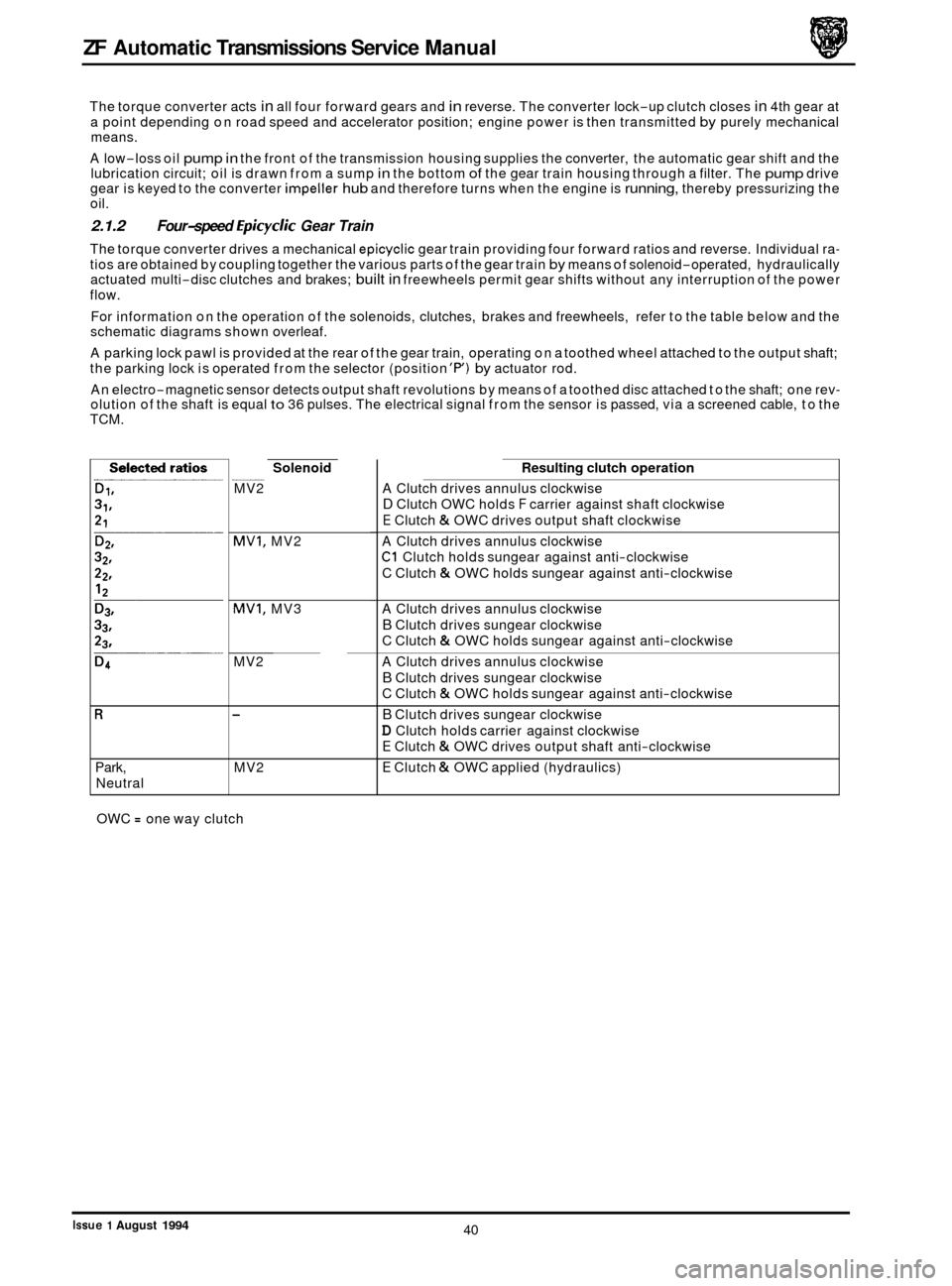
For information on the operation of the solenoids, clutches, brakes and freewheels, refer to the table below and the
schematic diagrams shown overleaf.
A parking lock pawl is provided at the rear of the gear train, operating on a toothed wheel attached to the output shaft;
the parking lock is operated from the selector (position
'P) by actuator rod.
An electro
-magnetic sensor detects output shaft revolutions by means of a toothed disc attached to the shaft; one rev- olution of the shaft is equal to 36 pulses. The electrical signal from the sensor is passed, via a screened cable, to the
TCM.
R
Park,
Neutral
Solenoid ~
MV2
MVI, MV2
MVI, MV3
MV2
-
MV2
OWC
= one way clutch
Resulting clutch operation
A Clutch drives annulus clockwise
D Clutch OWC holds F carrier against shaft clockwise
E Clutch & OWC drives output shaft clockwise
A Clutch drives annulus clockwise
C1 Clutch holds sungear against anti-clockwise
C Clutch
& OWC holds sungear against anti-clockwise
A Clutch drives annulus clockwise
B Clutch drives sungear clockwise
C Clutch
& OWC holds sungear against anti-clockwise
A Clutch drives annulus clockwise
B Clutch drives sungear clockwise
C Clutch
& OWC holds sungear against anti-clockwise
B Clutch drives sungear clockwise
D Clutch holds carrier against clockwise
E Clutch & OWC drives output shaft anti-clockwise
E Clutch & OWC applied (hydraulics)
40
Issue 1 August 1994
Page 46 of 74
ZF Automatic Transmissions Service Manual
2.1.3 Operation Of Gear Train Clutches
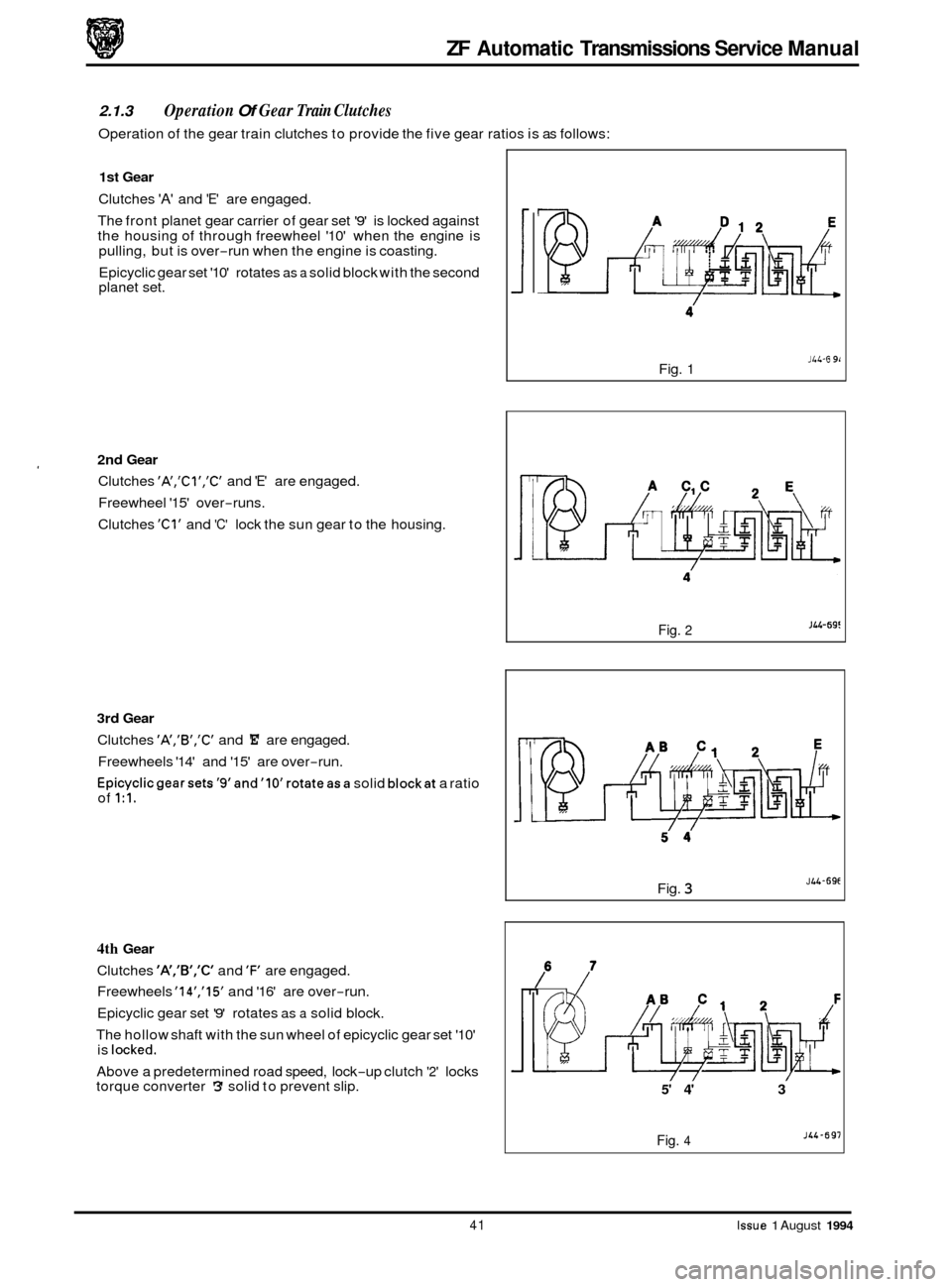
Operation of the gear train clutches to provide the five gear ratios is as follows:
1st Gear
Clutches 'A' and 'E' are engaged.
The front planet gear carrier of gear set
'9' is locked against
the housing of through freewheel '10' when the engine is
pulling, but is over
-run when the engine is coasting.
Epicyclic gear set
'10' rotates as a solid block with the second
planet set.
2nd Gear
Freewheel '15' over-runs.
Clutches
'Cl' and 'C' lock the sun gear to the housing.
* Clutches 'A','Cl','C' and 'E' are engaged.
3rd Gear
Clutches 'A','B','C' and 'E' are engaged.
Freewheels '14' and '15' are over
-run.
Epicyclicgearsets'9'and'lO'rotateasa solid blockat a ratio
of 1:l.
4th Gear
Clutches 'A','B','C' and 'F' are engaged.
Freewheels
'14','15' and '16' are over-run.
Epicyclic gear set
'9' rotates as a solid block.
The hollow shaft with the sun wheel of epicyclic gear set '10'
is
locked.
Above a predetermined road speed, lock-up clutch '2' locks
torque converter '3' solid to prevent slip.
I
J4L-G 9 1 Fig. 1
JLL-69: Fig. 2
J 4L-69E Fig. 3
5' 4' 3
JLL-697 Fig. 4
41 Issue 1 August 1994
Page 47 of 74
ZF Automatic Transmissions Service Manual
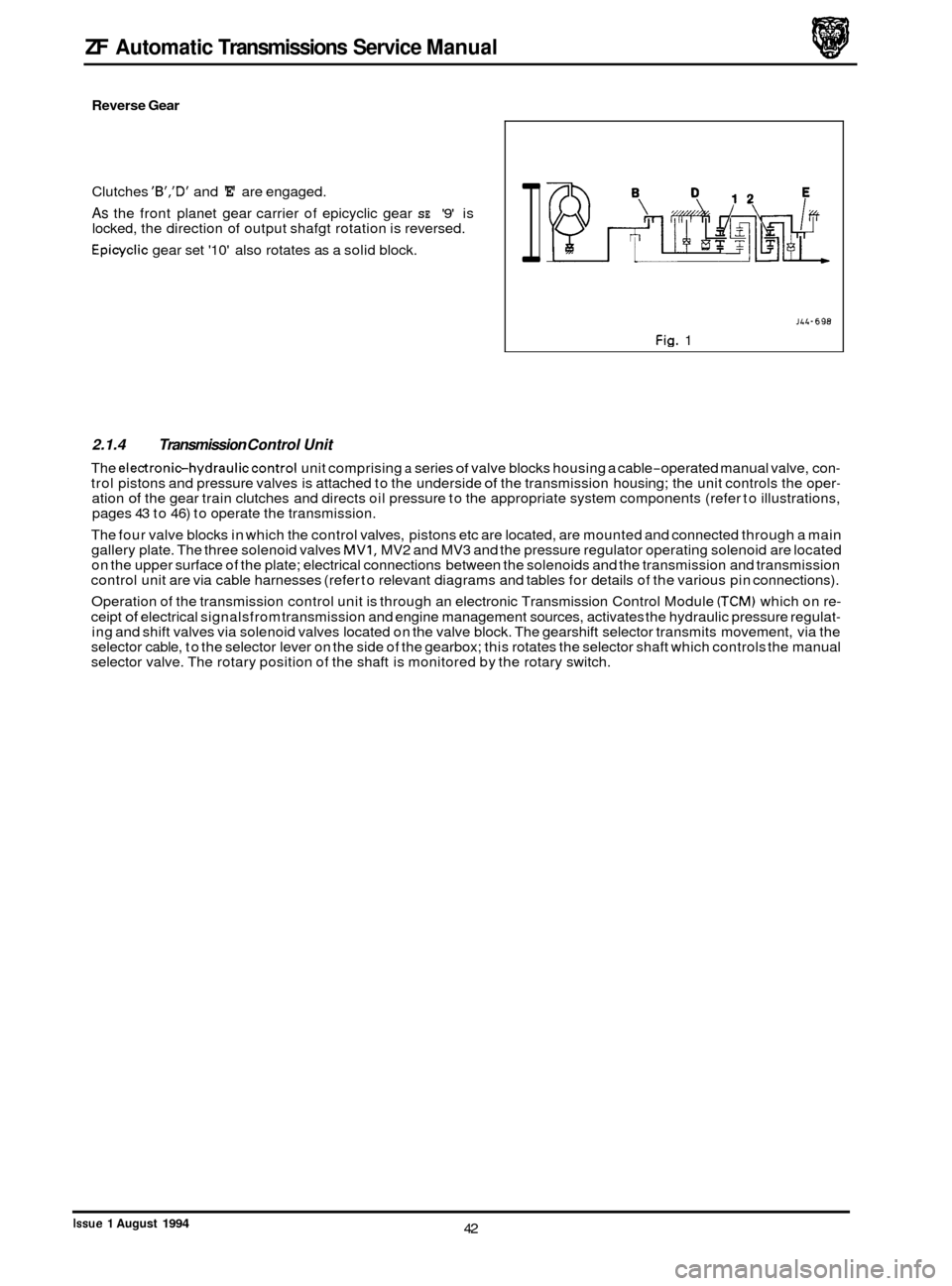
Reverse Gear
Clutches 'B','D' and 'E' are engaged.
As the front planet gear carrier of epicyclic gear SE '9' is
locked, the direction of output shafgt rotation is reversed.
Epicyclic gear set '10' also rotates as a solid block. I
~~~-698
Fig. 1
2.1.4 Transmission Control Unit
The electronichydrauliccontrol unit comprising a series of valve blocks housing a cable-operated manual valve, con- trol pistons and pressure valves is attached to the underside of the transmission housing; the unit controls the oper- ation of the gear train clutches and directs oil pressure to the appropriate system components (refer to illustrations,
pages 43 to 46) to operate the transmission.
The four valve blocks in which the control valves, pistons etc are located, are mounted and connected through a main
gallery plate. The three solenoid valves
MVI, MV2 and MV3 and the pressure regulator operating solenoid are located
on the upper surface of the plate; electrical connections between the solenoids and the transmission and transmission
control unit are via cable harnesses (refer to relevant diagrams and tables for details of the various pin connections).
Operation of the transmission control unit is through an electronic Transmission Control Module
(TCM) which on re-
ceipt of electrical signalsfrom transmission and engine management sources, activates the hydraulic pressure regulat- ing and shift valves via solenoid valves located on the valve block. The gearshift selector transmits movement, via the
selector cable, to the selector lever on the side of the gearbox; this rotates the selector shaft which controls the manual
selector valve. The rotary position of the shaft is monitored by the rotary switch.
42 Issue 1 August 1994