check engine JAGUAR XJ 2004 X350 / 3.G User Guide
[x] Cancel search | Manufacturer: JAGUAR, Model Year: 2004, Model line: XJ, Model: JAGUAR XJ 2004 X350 / 3.GPages: 227, PDF Size: 4.22 MB
Page 136 of 227
On the Road 4 - 65
Fuel capacity
Avoid the risk of running out of fuel and never intentionally
drive the car when the fuel gauge indicates that the tank is
empty. When refuelling your vehicle after the fuel gauge reads
empty, you may not be able to add the fuel quantity shown
below to the tank as there will be a small reserve remaining in
the tank.Fuel Economy
The following tips not only lead to greater fuel economy but also
reduce air pollution causing less environmental damage:
• Try to avoid using the car for short journeys – this will lead
to greater fuel economy and reduce wear on the engine.
• Plan ahead – choose uncongested routes, combine car trips and share cars where possible.
• Drive off as soon as possible after starting a cold engine – do not leave the engine idling until it has warmed up.
• Drive smoothly and efficiently – harsh acceleration and heavy braking have a significant effect on fuel
consumption – driving more smoothly saves fuel.
• Slow down – driving at high speeds significantly increases fuel consumption.
• Switch off – sitting stationary is zero miles per gallon, switch
off the engine when it is safe to do so.
• Unnecessary weight – do not carry unnecessary weight and remove roof-racks when not in use.
• Regular servicing keeps the engine at best efficiency.
• Ensure that tyres are inflated to the correct pressure for the journey.
• Use air conditioning and all vehicle electrical devices sparingly – all increase fuel consumption.
• Check your fuel consumption – it will help you get the most from your car and any significant change in consumption
may indicate a vehicle fault.
Normally
Aspirated
Supercharged
Tank capacity 22.4 US gallons
85 litres 22.3 US gallons
84.5 litres
Fill capacity (when fuel
gauge indicates empty) 20.9 US gallons
79 litres20.3 US gallons
77 litres
Reserve capacity (when fuel
gauge indicates empty) 1.5 US gallons
5.8 litres2.0 US gallons
7.5 litres
Page 154 of 227
Roadside Emergency 6 - 3
6 Roadside Emergency
Inertia Switch
In the event of an accident, the inertia switch may trip
(depending on the severity an d type of impact), isolating
operation of the fuel pump. Once the switch has tripped it must
be reset before attempting to restart the engine.
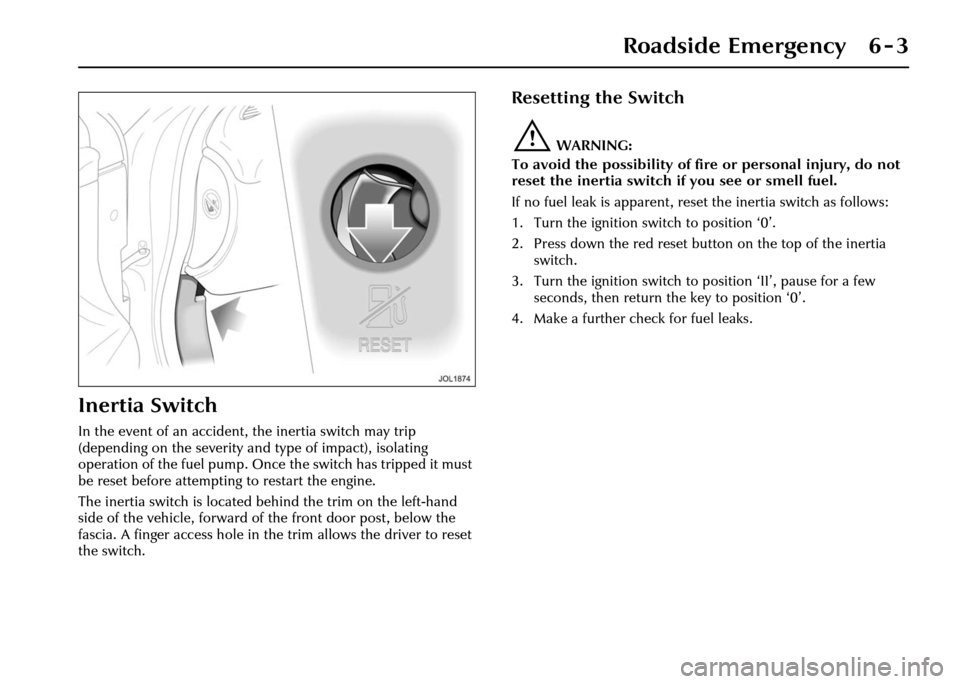
The inertia switch is located behind the trim on the left-hand
side of the vehicle, forward of the front door post, below the
fascia. A finger access hole in the trim allows the driver to reset
the switch.
Resetting the Switch
!WARNING:
To avoid the possibility of fire or personal injury, do not
reset the inertia switch if you see or smell fuel.
If no fuel leak is apparent, reset the inertia switch as follows:
1. Turn the ignition switch to position ‘0’.
2. Press down the red reset butt on on the top of the inertia
switch.
3. Turn the ignition switch to position ‘II’, pause for a few seconds, then return the key to position ‘0’.
4. Make a further check for fuel leaks.
Page 184 of 227
Maintenance
Regular Checks . . . . . . . . . . . . . . . . . . . . . . . . . . 7 - 3
Hood Release . . . . . . . . . . . . . . . . . . . . . . . . . . . 7 - 4
Checking and Top Up . . . . . . . . . . . . . . . . . . . . . 7 - 6
Check Engine Oil Level . . . . . . . . . . . . . . . . . . . . 7 - 6
Check Power Steering Fluid Level . . . . . . . . . . . . 7 - 8
Check Brake Fluid Reservoir . . . . . . . . . . . . . . . . 7 - 9
Check Windscreen/Headlight Washer Reservoir. . . . . . . . . . . . . . . . . . . . . . . . . . . 7 - 10
Check Coolant Level . . . . . . . . . . . . . . . . . . . . . 7 - 11
Capacities . . . . . . . . . . . . . . . . . . . . . . . . . . . . . 7 - 12
Battery . . . . . . . . . . . . . . . . . . . . . . . . . . . . . . . 7 - 13
Battery Warning Signs. . . . . . . . . . . . . . . . . . . . 7 - 14
Check/Top Up Battery Electrolyte . . . . . . . . . . . 7 - 15
Windscreen Wipers . . . . . . . . . . . . . . . . . . . . . 7 - 17
Tyres . . . . . . . . . . . . . . . . . . . . . . . . . . . . . . . . 7 - 18
Tyre Pressures . . . . . . . . . . . . . . . . . . . . . . . . . 7 - 18
Vehicle Care . . . . . . . . . . . . . . . . . . . . . . . . . . . 7 - 22
Interior Care . . . . . . . . . . . . . . . . . . . . . . . . . . . 7 - 22
Exterior Care . . . . . . . . . . . . . . . . . . . . . . . . . . 7 - 23
Electrical Accessories . . . . . . . . . . . . . . . . . . . . 7 - 25
Page 186 of 227
Maintenance 7 - 3
7 Maintenance
Regular Checks
In the interests of safety and reliability,
it is advisable to carry out the following
checks at the recommended intervals,
and always before starting on a long
journey.
Daily
Check that there is sufficient fuel for the
journey intended, particularly at night
and before joining motorways.
Weekly
Tyres– Check the tyres, including the
spare, for condition and pressure.
Tyre pressures are explained on page 8 - 8
and shown on a label inside the fuel filler
flap.
Lights – Check that all exterior lights and
direction indicators function correctly
and that the lenses are clean.
Engine oil – With the vehicle standing
on level ground, check the oil level and
top up if necessary with oil of the correct
grade.
Engine coolant – With the engine cold,
check the level of the coolant in the
coolant reservoir header tank. Any loss of
fluid must be checked by a Jaguar
Retailer. Brake fluid
– Check the level of the fluid
in the brake fluid reservoir. Top up if
necessary with new, unused Jaguar
approved brake fluid.
The reservoir is initially nearly full,
but the level will drop as the brake pads
wear. If the level appears unusually low,
location of the fluid leakage must be
checked by a Jaguar Retailer.
Power steering fluid – With the engine
cold, check the level of the fluid in the
power steering fluid reservoir. Top up if
necessary with fluid of the correct
specification. Any loss of fluid should be
checked by a Jaguar Retailer.
Windscreen washer fluid – Top up
with windscreen washer fluid and clean
soft water. Check the operation of the
washers. It is recommended that you
use Jaguar Windscreen Washer Fluid to
keep the glass clean and also to prevent
the fluid from freezing during cold
weather.
Monthly
Wiper blades – Check the quality of the
wipe. If smearing or juddering is evident,
clean the windscreen and wiper blades.
Used Engine Oil
!WARNING:
Prolonged and repeated contact may
cause serious skin disorders,
including dermatitis and cancer.
Always use a hand cream to protect the
skin from oil contamination.
Avoid contact with the skin as far as
possible and wash thoroughly after any
contact. Keep oils out of reach of
children.
PROTECT THE ENVIRONMENT: It is
illegal to pollute drai ns, watercourses and
soil. Use authorised waste collection
facilities, including civic amenity sites and
garages providing fa cilities for the
disposal of used oi l, oil filters and
batteries. If in doubt, contact your Local
Authority for advice on disposal.
Page 187 of 227
7 - 4 Maintenance
Hood Release
!WARNING:
Take care to keep away from rotating components if the
engine is running when you open the hood.
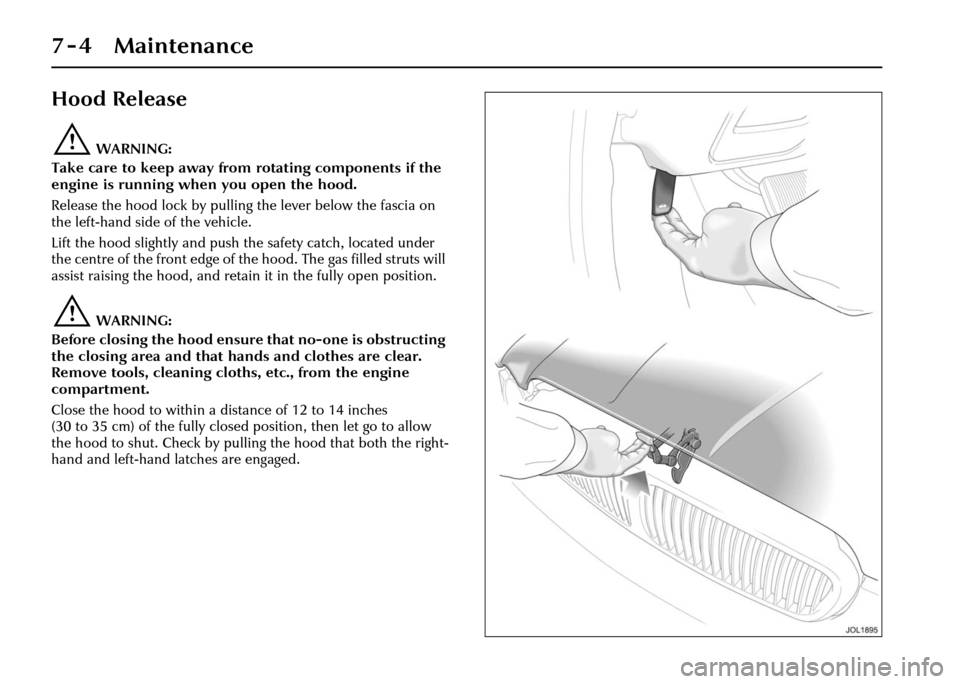
Release the hood lock by pullin g the lever below the fascia on
the left-hand side of the vehicle.
Lift the hood slightly and push the safety catch, located under
the centre of the front edge of th e hood. The gas filled struts will
assist raising the hood, and retain it in the fully open position.
!WARNING:
Before closing the hood ensure that no-one is obstructing
the closing area and that hands and clothes are clear.
Remove tools, cleaning cloths, etc., from the engine
compartment.
Close the hood to within a distance of 12 to 14 inches
(30 to 35 cm) of the fully closed position, then let go to allow
the hood to shut. Check by pulling the hood that both the right-
hand and left-hand latches are engaged.
Page 189 of 227
7 - 6 Maintenance
Checking and Top Up
Check Engine Oil Level
Check the oil level regularly with the vehicle on flat, level
ground.
Refer to page 7 - 5 for dipstick and oil filler locations.
It is preferable to check the oil level after the vehicle has been
standing, that is, with th e engine completely cold.
If the engine has been started do not check the oil level until the
engine has reached normal operating temperature. Stop the
engine and wait for a minimum of 5 minutes to allow the oil to
drain back into the sump.
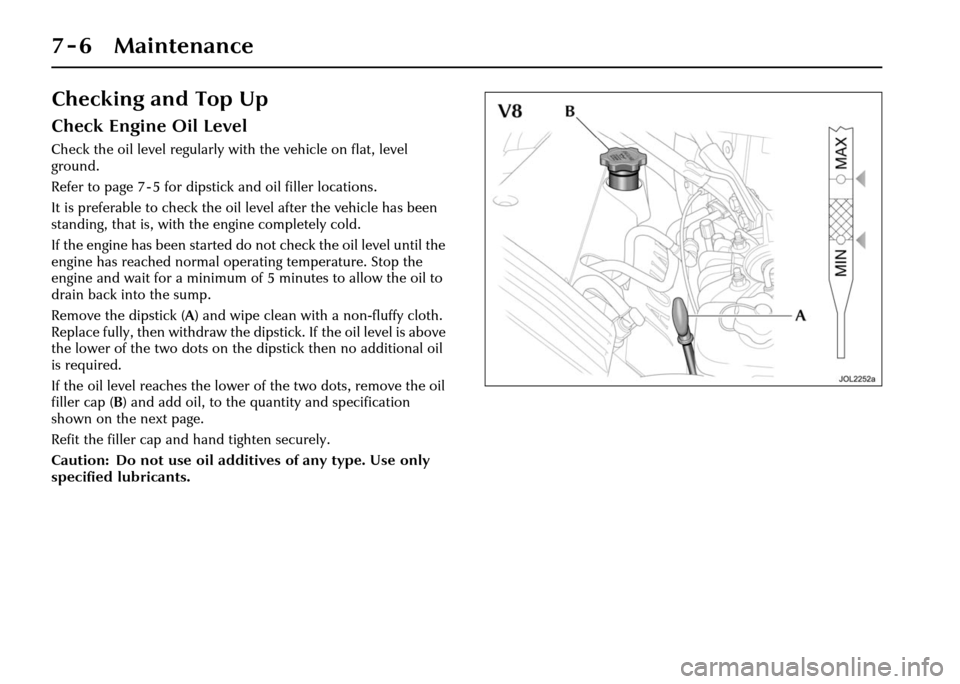
Remove the dipstick ( A) and wipe clean with a non-fluffy cloth.
Replace fully, then wi thdraw the dipstick. If the oil level is above
the lower of the two dots on the dipstick then no additional oil
is required.
If the oil level reaches the lower of the two dots, remove the oil
filler cap ( B) and add oil, to the quantity and specification
shown on the next page.
Refit the filler cap and hand tighten securely.
Caution: Do not use oil additives of any type. Use only
specified lubricants.
Page 191 of 227
7 - 8 Maintenance
Check Power Steering Fluid
Level
Caution: It is imperative that the
power steering system does not
become contaminated in any way.
Always dispense fluid from a fresh
sealed container and clean the area
around the reservoir neck both
before and after topping up.
Never return drained fluid to the
system.Refer to page 7 - 5 for power steering fluid
reservoir location.
Check the fluid level when the engine is
‘COLD’ and the vehicle is on a flat, level
surface.
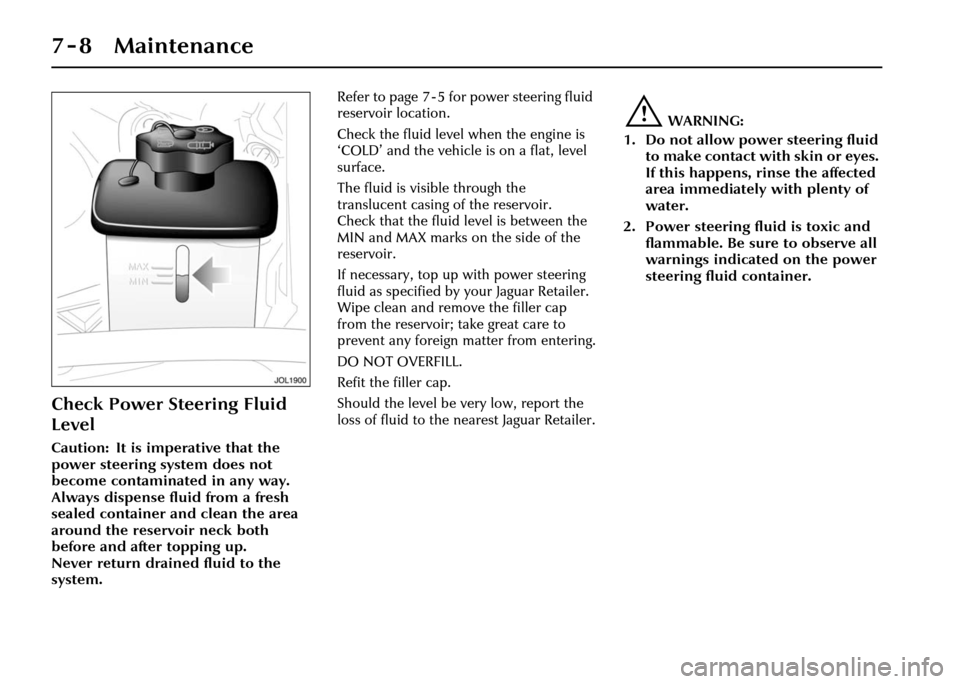
The fluid is visible through the
translucent casing of the reservoir.
Check that the fluid level is between the
MIN and MAX marks on the side of the
reservoir.
If necessary, top up with power steering
fluid as specified by your Jaguar Retailer.
Wipe clean and remove the filler cap
from the reservoir;
take great care to
prevent any foreign matter from entering.
DO NOT OVERFILL.
Refit the filler cap.
Should the level be ve ry low, report the
loss of fluid to the nearest Jaguar Retailer.
!WARNING:
1. Do not allow power steering fluid to make contact with skin or eyes.
If this happens, rinse the affected
area immediately with plenty of
water.
2. Power steering fluid is toxic and flammable. Be sure to observe all
warnings indicated on the power
steering fluid container.
Page 194 of 227
Maintenance 7 - 11
Check Coolant Level
Refer to page 7 - 5 for coolant header tank
location.
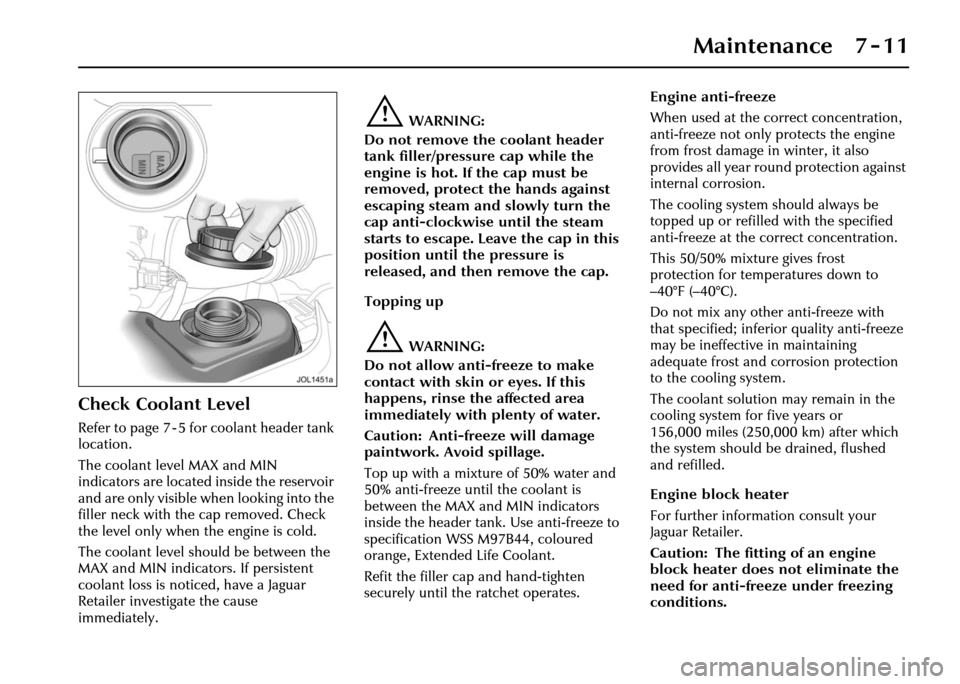
The coolant level MAX and MIN
indicators are located inside the reservoir
and are only visible when looking into the
filler neck with the cap removed. Check
the level only when the engine is cold.
The coolant level shou ld be between the
MAX and MIN indicators. If persistent
coolant loss is noticed, have a Jaguar
Retailer investigate the cause
immediately.
!WARNING:
Do not remove the coolant header
tank filler/pressure cap while the
engine is hot. If the cap must be
removed, protect the hands against
escaping steam and slowly turn the
cap anti-clockwise until the steam
starts to escape. Leave the cap in this
position until the pressure is
released, and then remove the cap.
Topping up
!WARNING:
Do not allow anti-freeze to make
contact with skin or eyes. If this
happens, rinse the affected area
immediately with plenty of water.
Caution: Anti-freeze will damage
paintwork. Avoid spillage.
Top up with a mixture of 50% water and
50% anti-freeze until the coolant is
between the MAX and MIN indicators
inside the header tank. Use anti-freeze to
specification WSS M97B44, coloured
orange, Extended Life Coolant.
Refit the filler cap and hand-tighten
securely until the ratchet operates. Engine anti-freeze
When used at the correct concentration,
anti-freeze not only protects the engine
from frost damage in winter, it also
provides all year round protection against
internal corrosion.
The cooling system should always be
topped up or refilled with the specified
anti-freeze at the correct concentration.
This 50/50% mixture gives frost
protection for temperatures down to
–40°F (–40°C).
Do not mix any other anti-freeze with
that specified; inferior quality anti-freeze
may be ineffective in maintaining
adequate frost and corrosion protection
to the cooling system.
The coolant solution
may remain in the
cooling system for five years or
156,000 miles (250,000 km) after which
the system should be drained, flushed
and refilled.
Engine block heater
For further information consult your
Jaguar Retailer.
Caution: The fitting of an engine
block heater does not eliminate the
need for anti-freeze under freezing
conditions.
Page 195 of 227
7-12 Maintenance
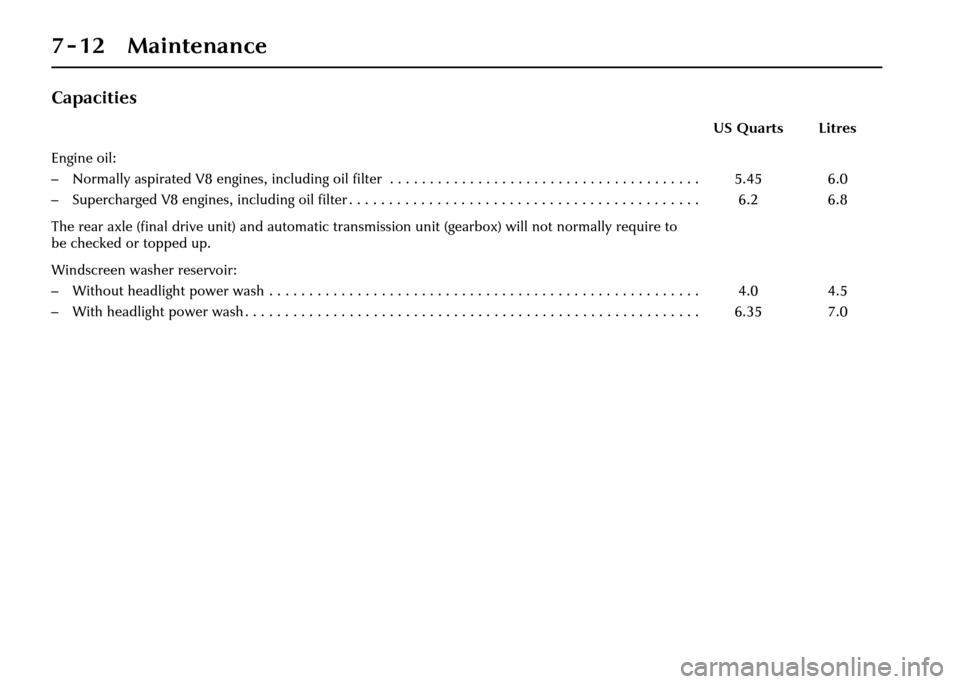
Capacities
US Quarts Litres
Engine oil:
– Normally aspirated V8 engines, including oil filter . . . . . . . . . . . . . . . . . . . . . . . . . . . . . . . . . . . . . . .
– Supercharged V8 engines, including oil filter . . . . . . . . . . . . . . . . . . . . . . . . . . . . . . . . . . . . . . . . . . . . 5.45
6.2 6.0
6.8
The rear axle (final drive unit) and automatic transmission unit (gearbox) will not normally require to
be checked or topped up.
Windscreen washer reservoir:
– Without headlight power wash . . . . . . . . . . . . . . . . . . . . . . . . . . . . . . . . . . . . . . . . . . . . . . . . . . . . . .
– With headlight power wash . . . . . . . . . . . . . . . . . . . . . . . . . . . . . . . . . . . . . . . . . . . . . . . . . . . . . . . . . 4.0
6.35 4.5
7.0
Page 196 of 227
Maintenance 7 - 13
Battery
A low maintenance battery specifically
designed for use with this vehicle is fitted
below the luggage compartment floor.
!WARNING:
California Proposition 65:
Battery posts, terminals and related
accessories, contain lead and lead
compounds. Wash hands after
handling.
!WARNING:
1. The cell plugs and vent pipe must
be in place at all times when the
battery is in the vehicle. Failure to
fit, or incorrect fitting of these
items is potentially hazardous.
2. To avoid injury do not use an open flame or cause an electric spark
when checking the battery.
Hydrogen gas generated by the
battery is flammable and may
explode. 3. Do not connect any 12 volt
equipment (for example a 12 volt
lead lamp) directly to the battery
terminals. Use the accessory
sockets to temporarily connect
Jaguar approved accessories.
4. Do not let battery acid electrolyte come into contact with skin or
eyes. If you get any in your eyes or
on your skin, immediately rinse
with cold water and consult a
doctor.
Caution:
1. Switch off the ignition before disconnecting battery terminals.
Always disconnect the earth
terminal first and reconnect last.
2. Do not let battery acid come into contact with painted surfaces or
fabric.
The exterior of the battery should be
occasionally wiped clean to remove any
dirt or grease.
If a new battery is to be fitted, it must be
the same type as the original.
The use of unapproved batteries is not
recommended and coul d invalidate the
vehicle warranty. Note:
The service life of the battery is
dependent on its condition of charge.
It must always be sufficiently charged for
the battery to last an optimum length of
time.
We recommend that the battery charge is
checked frequently if the vehicle is used
mostly for short distance trips, or if it is
not used for long periods of time.
Battery/ignition isolator switches
Non-approved battery isolator switches,
which disconnect the power supply to all
electrical circuits, are not recommended.
Generator
To prevent damage to the generator,
do not run the engine while the battery
or any of the charging circuit cables are
disconnected.
The generator has polarity-sensitive
components that may be irreparably
damaged if subjected to incorrect
polarity. Ensure that the battery earth
lead is always connected to the battery
negative terminal.