light JAGUAR XJ 2004 X350 / 3.G Manual Online
[x] Cancel search | Manufacturer: JAGUAR, Model Year: 2004, Model line: XJ, Model: JAGUAR XJ 2004 X350 / 3.GPages: 227, PDF Size: 4.22 MB
Page 180 of 227
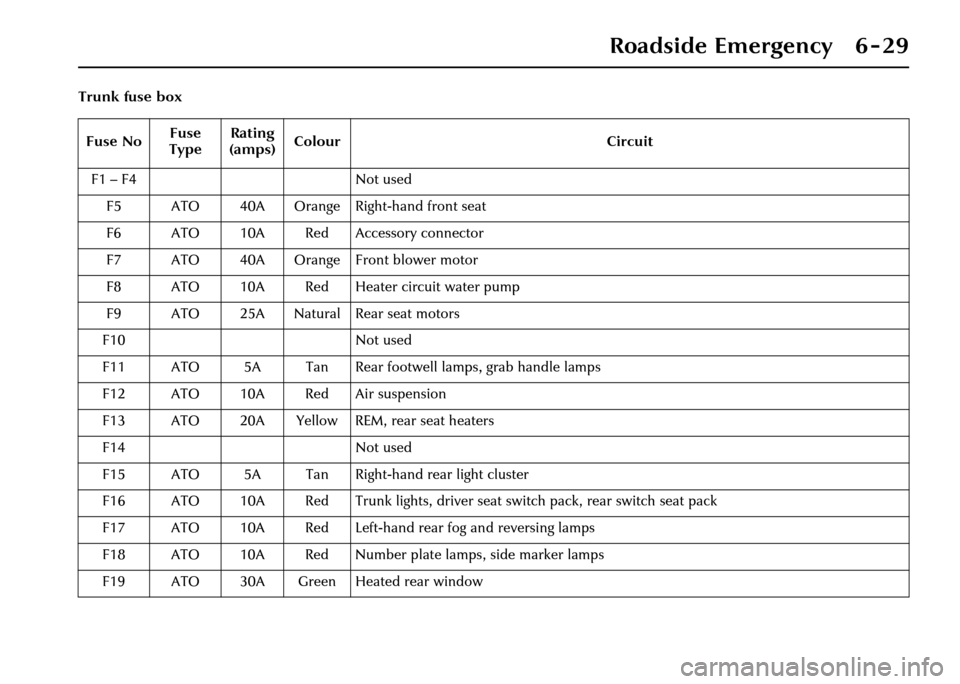
Roadside Emergency 6 - 29
Trunk fuse boxFuse No Fuse
Type Rating
(amps) Colour
Circuit
F1 – F4 Not used
F5 ATO 40A Orange Right-hand front seat
F6 ATO 10A Red Accessory connector
F7 ATO 40A Orange Front blower motor
F8 ATO 10A Red Heater circuit water pump
F9 ATO 25A Natural Rear seat motors
F10 Not used
F11 ATO 5A Tan Rear footwell lamps, grab handle lamps
F12 ATO 10A Red Air suspension
F13 ATO 20A Yellow REM, rear seat heaters
F14 Not used
F15 ATO 5A Tan Right-hand rear light cluster
F16 ATO 10A Red Trunk lights, driver seat switch pack, rear switch seat pack
F17 ATO 10A Red Left-hand rear fog and reversing lamps
F18 ATO 10A Red Number plate lamps, side marker lamps
F19 ATO 30A Green Heated rear window
Page 182 of 227
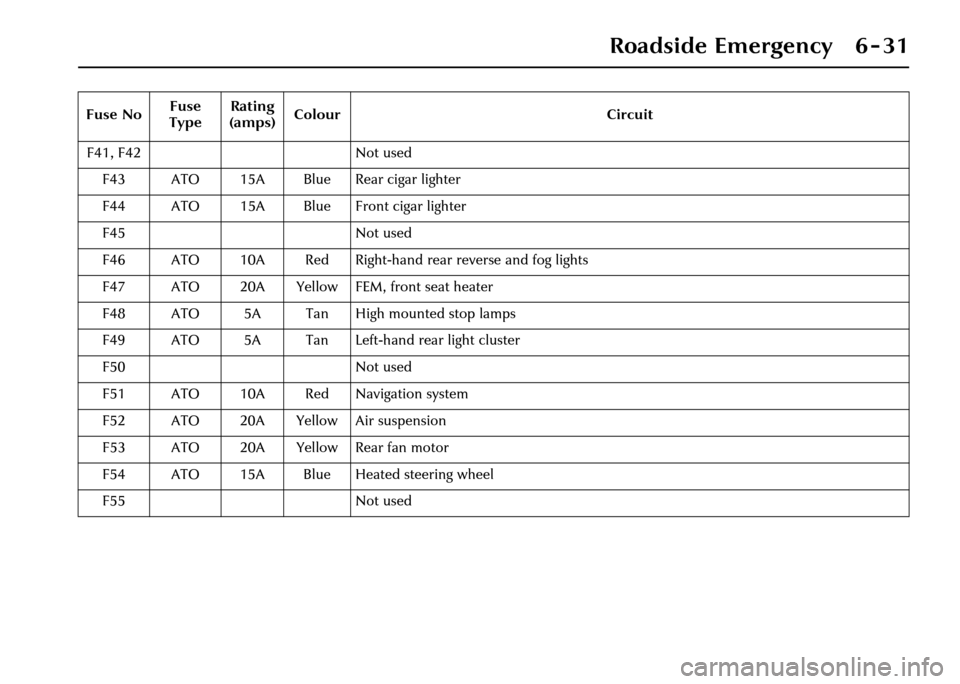
Roadside Emergency 6 - 31
F41, F42Not used
F43 ATO 15A Blue Rear cigar lighter
F44 ATO 15A Blue Front cigar lighter
F45 Not used
F46 ATO 10A Red Right-hand rear reverse and fog lights
F47 ATO 20A Yellow FEM, front seat heater
F48 ATO 5A Tan High mounted stop lamps
F49 ATO 5A Tan Left-hand rear light cluster
F50 Not used
F51 ATO 10A Red Navigation system
F52 ATO 20A Yellow Air suspension
F53 ATO 20A Yellow Rear fan motor
F54 ATO 15A Blue Heated steering wheel
F55 Not used
Fuse No
Fuse
Type Rating
(amps) Colour
Circuit
Page 184 of 227
Maintenance
Regular Checks . . . . . . . . . . . . . . . . . . . . . . . . . . 7 - 3
Hood Release . . . . . . . . . . . . . . . . . . . . . . . . . . . 7 - 4
Checking and Top Up . . . . . . . . . . . . . . . . . . . . . 7 - 6
Check Engine Oil Level . . . . . . . . . . . . . . . . . . . . 7 - 6
Check Power Steering Fluid Level . . . . . . . . . . . . 7 - 8
Check Brake Fluid Reservoir . . . . . . . . . . . . . . . . 7 - 9
Check Windscreen/Headlight Washer Reservoir. . . . . . . . . . . . . . . . . . . . . . . . . . . 7 - 10
Check Coolant Level . . . . . . . . . . . . . . . . . . . . . 7 - 11
Capacities . . . . . . . . . . . . . . . . . . . . . . . . . . . . . 7 - 12
Battery . . . . . . . . . . . . . . . . . . . . . . . . . . . . . . . 7 - 13
Battery Warning Signs. . . . . . . . . . . . . . . . . . . . 7 - 14
Check/Top Up Battery Electrolyte . . . . . . . . . . . 7 - 15
Windscreen Wipers . . . . . . . . . . . . . . . . . . . . . 7 - 17
Tyres . . . . . . . . . . . . . . . . . . . . . . . . . . . . . . . . 7 - 18
Tyre Pressures . . . . . . . . . . . . . . . . . . . . . . . . . 7 - 18
Vehicle Care . . . . . . . . . . . . . . . . . . . . . . . . . . . 7 - 22
Interior Care . . . . . . . . . . . . . . . . . . . . . . . . . . . 7 - 22
Exterior Care . . . . . . . . . . . . . . . . . . . . . . . . . . 7 - 23
Electrical Accessories . . . . . . . . . . . . . . . . . . . . 7 - 25
Page 186 of 227
Maintenance 7 - 3
7 Maintenance
Regular Checks
In the interests of safety and reliability,
it is advisable to carry out the following
checks at the recommended intervals,
and always before starting on a long
journey.
Daily
Check that there is sufficient fuel for the
journey intended, particularly at night
and before joining motorways.
Weekly
Tyres– Check the tyres, including the
spare, for condition and pressure.
Tyre pressures are explained on page 8 - 8
and shown on a label inside the fuel filler
flap.
Lights – Check that all exterior lights and
direction indicators function correctly
and that the lenses are clean.
Engine oil – With the vehicle standing
on level ground, check the oil level and
top up if necessary with oil of the correct
grade.
Engine coolant – With the engine cold,
check the level of the coolant in the
coolant reservoir header tank. Any loss of
fluid must be checked by a Jaguar
Retailer. Brake fluid
– Check the level of the fluid
in the brake fluid reservoir. Top up if
necessary with new, unused Jaguar
approved brake fluid.
The reservoir is initially nearly full,
but the level will drop as the brake pads
wear. If the level appears unusually low,
location of the fluid leakage must be
checked by a Jaguar Retailer.
Power steering fluid – With the engine
cold, check the level of the fluid in the
power steering fluid reservoir. Top up if
necessary with fluid of the correct
specification. Any loss of fluid should be
checked by a Jaguar Retailer.
Windscreen washer fluid – Top up
with windscreen washer fluid and clean
soft water. Check the operation of the
washers. It is recommended that you
use Jaguar Windscreen Washer Fluid to
keep the glass clean and also to prevent
the fluid from freezing during cold
weather.
Monthly
Wiper blades – Check the quality of the
wipe. If smearing or juddering is evident,
clean the windscreen and wiper blades.
Used Engine Oil
!WARNING:
Prolonged and repeated contact may
cause serious skin disorders,
including dermatitis and cancer.
Always use a hand cream to protect the
skin from oil contamination.
Avoid contact with the skin as far as
possible and wash thoroughly after any
contact. Keep oils out of reach of
children.
PROTECT THE ENVIRONMENT: It is
illegal to pollute drai ns, watercourses and
soil. Use authorised waste collection
facilities, including civic amenity sites and
garages providing fa cilities for the
disposal of used oi l, oil filters and
batteries. If in doubt, contact your Local
Authority for advice on disposal.
Page 187 of 227
7 - 4 Maintenance
Hood Release
!WARNING:
Take care to keep away from rotating components if the
engine is running when you open the hood.
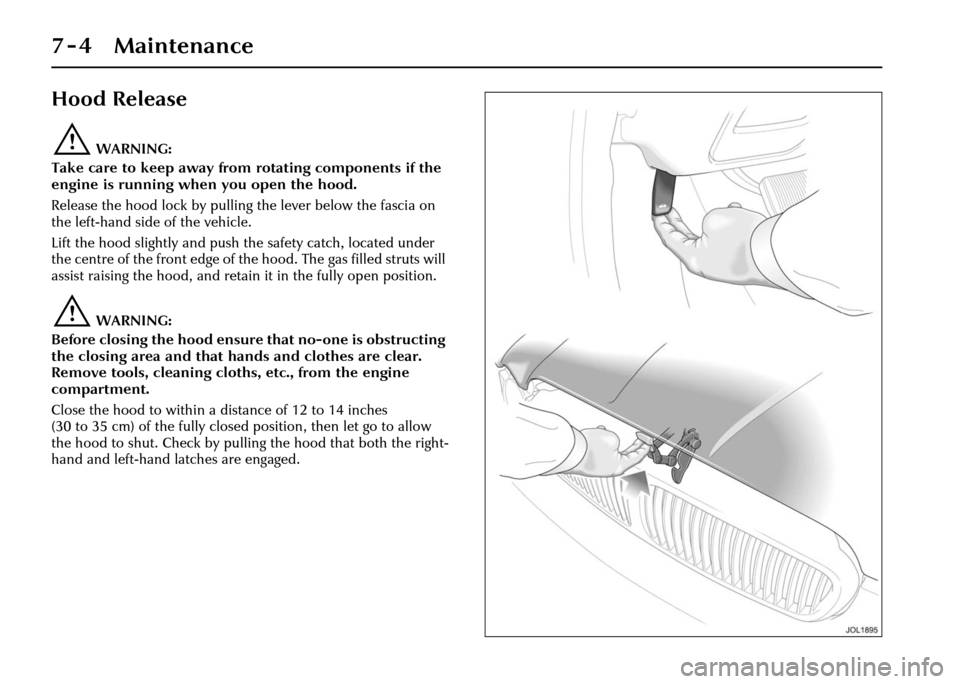
Release the hood lock by pullin g the lever below the fascia on
the left-hand side of the vehicle.
Lift the hood slightly and push the safety catch, located under
the centre of the front edge of th e hood. The gas filled struts will
assist raising the hood, and retain it in the fully open position.
!WARNING:
Before closing the hood ensure that no-one is obstructing
the closing area and that hands and clothes are clear.
Remove tools, cleaning cloths, etc., from the engine
compartment.
Close the hood to within a distance of 12 to 14 inches
(30 to 35 cm) of the fully closed position, then let go to allow
the hood to shut. Check by pulling the hood that both the right-
hand and left-hand latches are engaged.
Page 193 of 227
7-10 Maintenance
Check Windscreen/Headlight
Washer Reservoir
Refer to page 7 - 5 for windscreen washer
reservoir location.
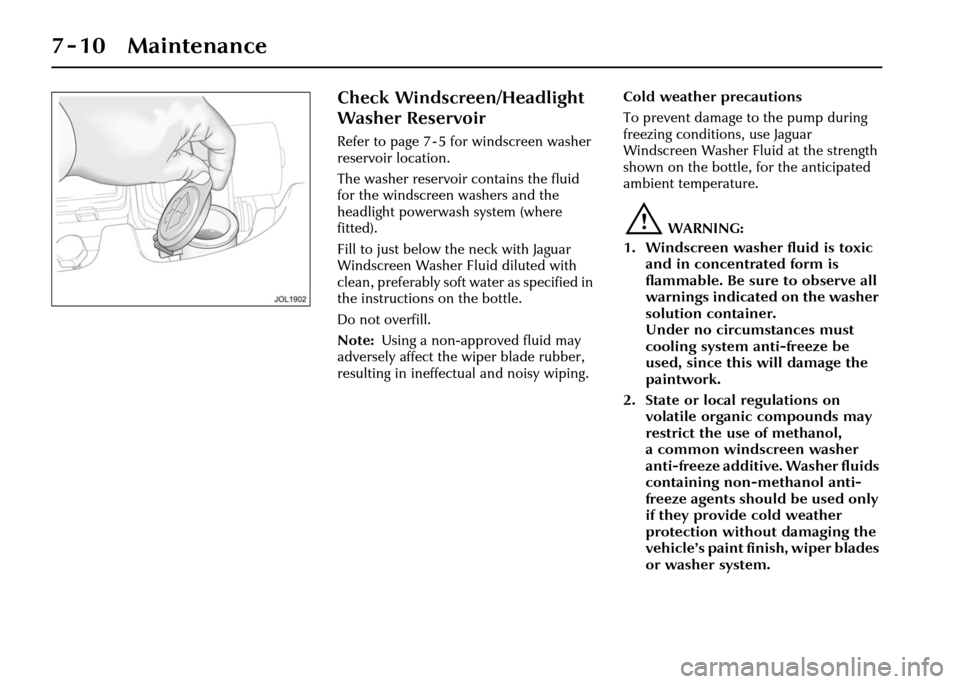
The washer reservoir contains the fluid
for the windscreen washers and the
headlight powerwash system (where
fitted).
Fill to just below th e neck with Jaguar
Windscreen Washer Fl uid diluted with
clean, preferably soft water as specified in
the instructions on the bottle.
Do not overfill.
Note: Using a non-approved fluid may
adversely affect the wiper blade rubber,
resulting in ineffectual and noisy wiping. Cold weather precautions
To prevent damage to the pump during
freezing conditions, use Jaguar
Windscreen Washer Fluid at the strength
shown on the bottle, for the anticipated
ambient temperature.
!WARNING:
1. Windscreen washer fluid is toxic and in concentrated form is
flammable. Be sure to observe all
warnings indicated on the washer
solution container.
Under no circumstances must
cooling system anti-freeze be
used, since this will damage the
paintwork.
2. State or local regulations on volatile organic compounds may
restrict the use of methanol,
a common windscreen washer
anti-freeze additive. Washer fluids
containing non-methanol anti-
freeze agents should be used only
if they provide cold weather
protection without damaging the
vehicle’s paint finish, wiper blades
or washer system.
Page 195 of 227
7-12 Maintenance
Capacities
US Quarts Litres
Engine oil:
– Normally aspirated V8 engines, including oil filter . . . . . . . . . . . . . . . . . . . . . . . . . . . . . . . . . . . . . . .
– Supercharged V8 engines, including oil filter . . . . . . . . . . . . . . . . . . . . . . . . . . . . . . . . . . . . . . . . . . . . 5.45
6.2 6.0
6.8
The rear axle (final drive unit) and automatic transmission unit (gearbox) will not normally require to
be checked or topped up.
Windscreen washer reservoir:
– Without headlight power wash . . . . . . . . . . . . . . . . . . . . . . . . . . . . . . . . . . . . . . . . . . . . . . . . . . . . . .
– With headlight power wash . . . . . . . . . . . . . . . . . . . . . . . . . . . . . . . . . . . . . . . . . . . . . . . . . . . . . . . . . 4.0
6.35 4.5
7.0
Page 198 of 227
Maintenance 7 - 15
Check/Top Up Battery
Electrolyte
In normal climates this must be carried
out at least once a year. In hot weather/
climates the electrolyte level must be
checked at least every three months.
Fold the luggage compartment floor panel
forwards (see page 6 - 4).
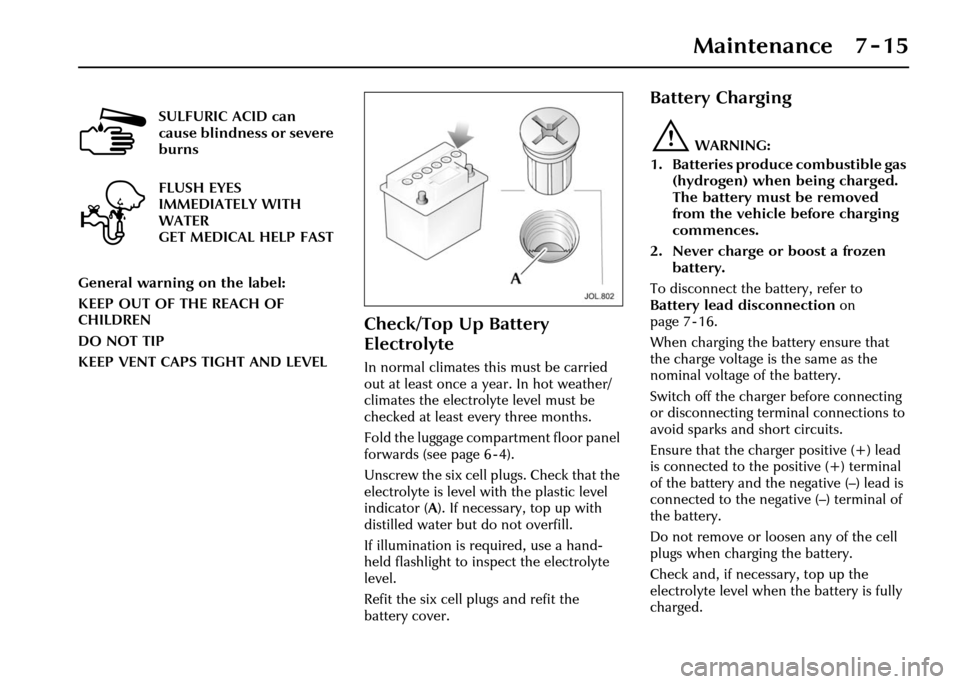
Unscrew the six cell plugs. Check that the
electrolyte is level wi th the plastic level
indicator ( A). If necessary, top up with
distilled water but do not overfill.
If illumination is required, use a hand-
held flashlight to in spect the electrolyte
level.
Refit the six cell plugs and refit the
battery cover.
Battery Charging
!WARNING:
1. Batteries produce combustible gas (hydrogen) when being charged.
The battery must be removed
from the vehicle before charging
commences.
2. Never charge or boost a frozen battery.
To disconnect the battery, refer to
Battery lead disconnection on
page 7 - 16.
When charging the battery ensure that
the charge voltage is the same as the
nominal voltage of the battery.
Switch off the charge r before connecting
or disconnecting terminal connections to
avoid sparks and short circuits.
Ensure that the charger positive (+) lead
is connected to the positive (+) terminal
of the battery and the negative (–) lead is
connected to the nega tive (–) terminal of
the battery.
Do not remove or loosen any of the cell
plugs when charging the battery.
Check and, if necessary, top up the
electrolyte level when the battery is fully
charged.
SULFURIC ACID can
cause blindness or severe
burns
FLUSH EYES
IMMEDIATELY WITH
WATER
GET MEDICAL HELP FAST
General warning on the label:
KEEP OUT OF THE REACH OF
CHILDREN
DO NOT TIP
KEEP VENT CAPS TIGHT AND LEVEL
Page 199 of 227
7-16 Maintenance
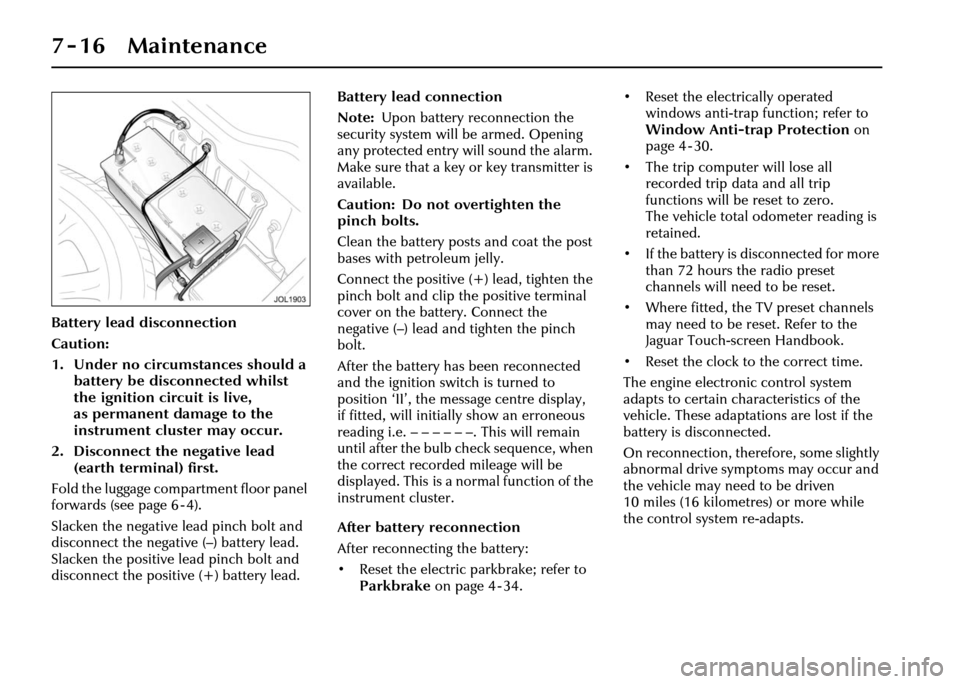
Battery lead disconnection
Caution:
1. Under no circumstances should a battery be discon nected whilst
the ignition circuit is live,
as permanent damage to the
instrument cluster may occur.
2. Disconnect the negative lead (earth terminal) first.
Fold the luggage compartment floor panel
forwards (see page 6 - 4).
Slacken the negative lead pinch bolt and
disconnect the negative (–) battery lead.
Slacken the positive lead pinch bolt and
disconnect the positive (+) battery lead. Battery lead connection
Note:
Upon battery reconnection the
security system will be armed. Opening
any protected entry will sound the alarm.
Make sure that a key or key transmitter is
available.
Caution: Do not overtighten the
pinch bolts.
Clean the battery posts and coat the post
bases with petroleum jelly.
Connect the positive (+) lead, tighten the
pinch bolt and clip the positive terminal
cover on the battery. Connect the
negative (–) lead and tighten the pinch
bolt.
After the battery ha s been reconnected
and the ignition swit ch is turned to
position ‘II’, the message centre display,
if fitted, will initially show an erroneous
reading i.e.––––––. Thiswill remain
until after the bulb check sequence, when
the correct recorded mileage will be
displayed. This is a normal function of the
instrument cluster.
After battery reconnection
After reconnecting the battery:
• Reset the electric parkbrake; refer to Parkbrake on page 4 - 34. • Reset the electrically operated
windows anti-trap function; refer to
Window Anti-trap Protection on
page 4 - 30.
• The trip computer will lose all recorded trip data and all trip
functions will be reset to zero.
The vehicle total odometer reading is
retained.
• If the battery is disconnected for more than 72 hours the radio preset
channels will need to be reset.
• Where fitted, the TV preset channels may need to be reset. Refer to the
Jaguar Touch-screen Handbook.
• Reset the clock to the correct time.
The engine electronic control system
adapts to certain characteristics of the
vehicle. These adaptations are lost if the
battery is disconnected.
On reconnection, therefore, some slightly
abnormal drive symptoms may occur and
the vehicle may need to be driven
10 miles (16 kilometres) or more while
the control system re-adapts.
Page 200 of 227
Maintenance 7 - 17
Windscreen Wipers
Use Jaguar Screen Clean Paste to remove
contamination from the windscreen to
ensure effective wiping or if smearing or
juddering becomes evident. A more
aggressive cleaning agent may be
required to remove stubborn
contamination. Contact a Jaguar Retailer
for advice.
To ensure that the windscreen remains
smear-free, the washer system should be
operated whenever the wipers are used,
even when it is raining.
Windscreen Wiper Blades –
Inspect and Clean
Lift the wiper blades clear of the
windscreen and wipe the blades with a
clean, soft cloth moistened with water to
which a mild liquid detergent has been
added.
Windscreen Washers
The windscreen washer jets are mounted
on the wiper arms.
Note:The windscreen washer jets and
headlight washer jets are not adjustable.