light JAGUAR XJ 2004 X350 / 3.G Repair Manual
[x] Cancel search | Manufacturer: JAGUAR, Model Year: 2004, Model line: XJ, Model: JAGUAR XJ 2004 X350 / 3.GPages: 227, PDF Size: 4.22 MB
Page 130 of 227
On the Road 4 - 59
General Driving
Information
!WARNING:
Ensure the parkbrake is on and the
automatic gear selector is in
position ‘P’ or ‘N’ before attempting
to start the engine.
Before driving off, check the gauges and
warning lights and messages. Take special
note of any warning light that is on.
Seat belts are provided for your safety
and it is unwise, and in certain countries
illegal, to commence any journey,
however short, without wearing them.
Warming Up
Do not operate the en gine at high speed
when first started but allow time for the
engine to warm up and the oil to
circulate.
Engine Braking On Downhill
Gradients
When driving on mountain roads with
long downhill gradients it is advisable to
select a low gear.
Running-in
Apart from a few precautionary
recommendations, there are no strict
‘running-in’ procedures for this vehicle.
By observing the following advisory notes
you will ensure maximum engine,
transmission and brake life for your
vehicle:
1. Allow the engine to warm up thoroughly before operating at engine
speeds over 3500 rev/min.
2. Vary the speed frequently.
3. From 940 miles (1500 kilometres) onwards, gradually increase
performance of the vehicle up to the
permitted maximum speed, where
road conditions permit. Running-in for brakes
To ensure that the brake pads can
‘bed-in’ evenly and reach their optimum
wear and performance condition, usually
within 300 miles (480 kilometres),
the following points are recommended.
1. Where possible, avoid heavy braking
or rough usage of the brakes as this
can result in damage being caused to
the brake pads and discs.
2. Avoid prolonged use of the brakes, for example, when descending severe
gradients.
3. Frequent light application of the brakes is desirable. This helps to fully
‘bed-in’ the brake pads before the
normal running-in period is
completed and the vehicle is operated
at high speeds, when maximum brake
efficiency will be required.
The above equally applies when new
discs or pads have been fitted.
Page 131 of 227
4-60 On the Road
Use of Headlamps In Daylight
When visibility is poor the headlamps
with dipped beam setting should be
switched on so that the vehicle may be
seen more easily by other road users.
The instrument illumination dimmer
control adjusts the brightness of the panel
lighting.
Engine Oil Consumption
A certain amount of oil consumption is
normal. The rate of consumption will
depend on the following:
• The quality and viscosity of the oil.
• The amount of oxidation and dilution of the oil.
• Climatic conditions.
• The speed at which the engine is being operated.
• Road conditions.
Drivers should expect above normal
consumption when the engine is new,
and after running-in if high speeds are
sustained.
Winter Driving
Freeing a frozen door lock
Caution: Do not ap ply a proprietary
lock de-icer through the keyhole.
Should the lock beco me frozen, warm the
end of the key before use.
Windscreen wiper blades
Before driving away, clear any ice from
the windscreen and check that the wiper
blades are free. Switching on the heated
screen will accelerate this process.
The heated wiper park, if fitted, will come
on automatically.
Frost precautions
The correct concentration of coolant
must be maintained at all times when
‘topping up’ or ‘refilling’ the cooling
system.
Parking the Vehicle
When leaving the vehicle, remember the
following:
• Whenever the vehicle is being parked, apply the parkbrake and move the
gear selector to Park ‘P’.
• Do not leave children or pets in the vehicle unattended.
• Do not leave luggage or valuables on view. Always take your valuables with
you or lock them in the luggage
compartment.
• Remove the ignition key and spare keys, even when the vehicle is in your
garage.
• When the vehicle is unoccupied, close
all windows and lock all doors
securely.
• Park the vehicle where it can be seen. At night, park in a well-lit area.
• Ensure that the keys and the key transmitters are removed from the
vehicle before locking the doors,
and that all doors, the luggage
compartment and the hood are
closed.
Page 132 of 227
On the Road 4 - 61
Touring
Foreign travel
Before planning foreign travel, check with
a motoring organisation to ensure that
your vehicle will comply with legal
requirements of the countries you intend
to visit.
International motoring organisations are
helpful for all aspects of long distance
touring advice.
In some countries it is a legal requirement
to carry spare vehicle bulbs.
First aid kit
A first aid kit is compulsory equipment in
certain countries. Your Jaguar Retailer
can supply a first aid kit.Petroleum spirit in containers
Some countries forbid the carrying of
petrol in containers, as do most ferry and
hovercraft operators.
Cellular radio telephones
Ask your motoring organisation about the
use of cellular radio telephones before
travelling abroad, as some countries
exercise controls on the importation and
use of such equipment.
Roof-rack
Only the Jaguar approved roof-rack
should be used.
The maximum load, including the weight
of the rack, must not exceed the load
rating indicated on th
e roof-rack bars and
must be deducted from the vehicle
maximum luggage load.
Loads on the roof-rack may affect vehicle
handling, especially in crosswinds or
when cornering. Jaguar warning triangle
A warning triangle to give traffic
advanced notice of a disabled vehicle is
compulsory in many countries.
A triangle, designed to international
standards is fitted as standard equipment
in certain countries. The warning triangle
with its stand legs folded flat, is mounted
on the inside of the luggage compartment
lid.
In an emergency, remove the triangle and
unfold its stand legs. Place the triangle in
the road in accordance with local traffic
regulations to give oncoming traffic
warning of an im
mobilised vehicle.
Hazard warning lights must be used with
the warning triangle.
Page 134 of 227
On the Road 4 - 63
Fuel and Refuelling
Before refuelling, switch off the ignition
and remove the key.
Note:Do not leave the ignition key in the
vehicle; vehicles have been stolen from
garage service/filling stations whilst the
driver is absent from the vehicle. It is
recommended that the vehicle is locked,
if left unattended.
Caution: No additives of any kind
(fuel or oil) must be put into the fuel
tank. Additives could reduce engine
life or affect exhaust emissions.
!WARNING:
1. Fuel vapour is highly flammable and in confined spaces is
explosive and toxic. In the event
of inadvertent spillage, and before
refuelling, always switch OFF the
engine. Do not use exposed flame
or light. Do not smoke. Do not
inhale fumes.
2. Do not fill the tank so that fuel is visible in the fuel filler intake
tube. This could cause spillage
and danger from exposed fuel.
Fuel Tank Filling
Caution: Your vehicle is fitted with
catalytic converters and must only be
filled with ‘Unleaded Fuel’.
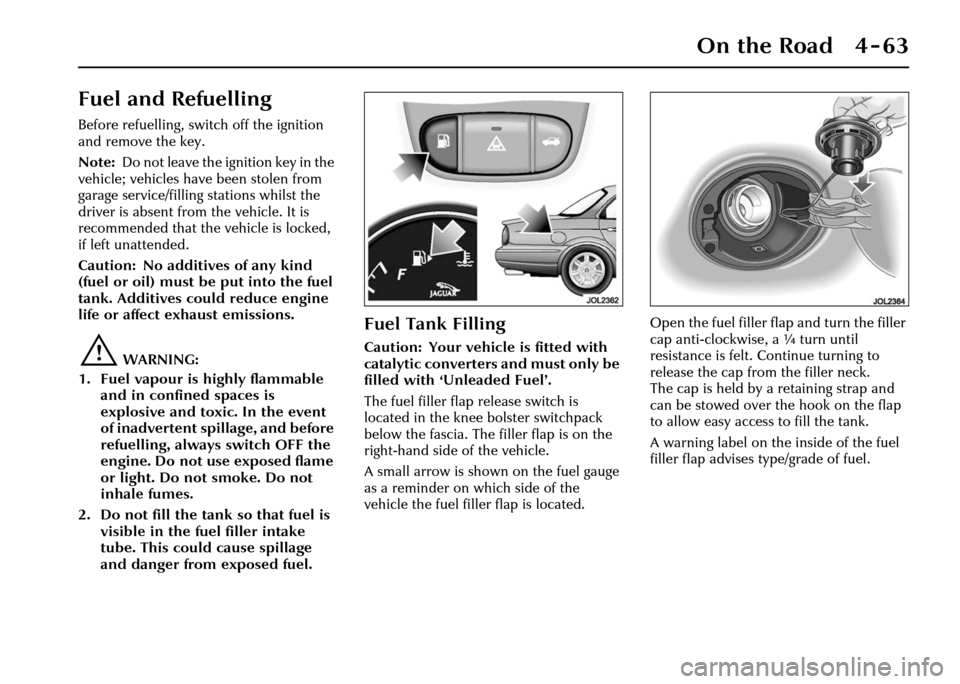
The fuel filler flap release switch is
located in the knee bolster switchpack
below the fascia. The fi ller flap is on the
right-hand side of the vehicle.
A small arrow is shown on the fuel gauge
as a reminder on which side of the
vehicle the fuel filler flap is located. Open the fuel filler flap and turn the filler
cap anti-clockwise, a ¼ turn until
resistance is felt. Continue turning to
release the cap from the filler neck.
The cap is held by a retaining strap and
can be stowed over the hook on the flap
to allow easy access to fill the tank.
A warning label on the inside of the fuel
filler flap advises type/grade of fuel.
Page 137 of 227
4-66 On the Road
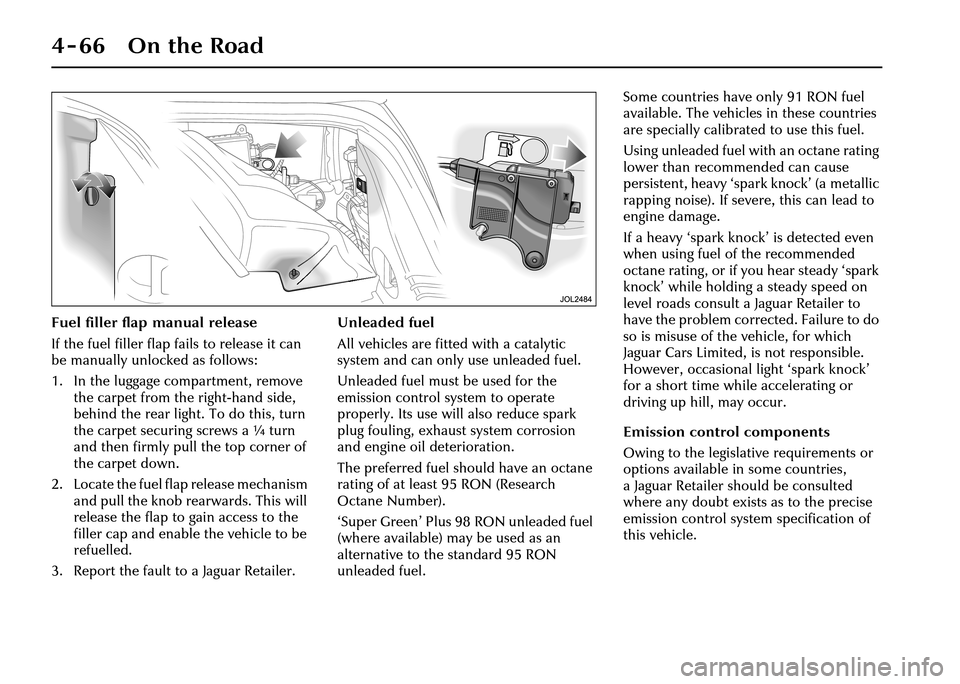
Fuel filler flap manual release
If the fuel filler flap fails to release it can
be manually unlocked as follows:
1. In the luggage compartment, remove
the carpet from the right-hand side,
behind the rear light. To do this, turn
the carpet securing screws a ¼ turn
and then firmly pull the top corner of
the carpet down.
2. Locate the fuel flap release mechanism and pull the knob rearwards. This will
release the flap to gain access to the
filler cap and enable the vehicle to be
refuelled.
3. Report the fault to a Jaguar Retailer. Unleaded fuel
All vehicles are fitted with a catalytic
system and can only use unleaded fuel.
Unleaded fuel must be used for the
emission control system to operate
properly. Its use will also reduce spark
plug fouling, exhaust system corrosion
and engine oil deterioration.
The preferred fuel should have an octane
rating of at least 95 RON (Research
Octane Number).
‘Super Green’ Plus 98 RON unleaded fuel
(where available) may be used as an
alternative to the standard 95 RON
unleaded fuel. Some countries have only 91 RON fuel
available. The vehicles in these countries
are specially calibrated to use this fuel.
Using unleaded fuel with an octane rating
lower than recomm
ended can cause
persistent, heavy ‘spark knock’ (a metallic
rapping noise). If severe, this can lead to
engine damage.
If a heavy ‘spark knock’ is detected even
when using fuel of the recommended
octane rating, or if you hear steady ‘spark
knock’ while holding a steady speed on
level roads consult a Jaguar Retailer to
have the problem corrected. Failure to do
so is misuse of the vehicle, for which
Jaguar Cars Limited, is not responsible.
However, occasional light ‘spark knock’
for a short time while accelerating or
driving up hill, may occur.
Emission control components
Owing to the legislative requirements or
options available in some countries,
a Jaguar Retailer should be consulted
where any doubt exists as to the precise
emission control system specification of
this vehicle.
Page 142 of 227
Climate Control 5 - 3
5 Climate Control
Introduction
The cabin is supplied with filtered air
from a fully automatic electronic climate
control system with manual overrides.
Two systems are available:
• A two zone system which allows the front occupants to set individual
temperatures for the left and right
sides of the interior.
• A four zone system which allows front and rear occupants to set individual
temperatures, i.e. two front zones and
two rear zones.
Occupant controls
The main climate control panel is located
in the centre console above the radio and
audio controls. There are two types of
control panel for either two or four zone
systems:
• A dedicated control panel with LCD (liquid crystal display) screen
(see page 5 - 6).
• A multi-function touch control and display unit shared with navigation
and other systems. Where this control
unit is fitted, refer to the Jaguar
Touch-screen Handbook for the
detailed operating instructions. Where the four zone climate control
system is fitted, an additional control/
display panel for rear passenger use is
located at the rear of the centre console,
between the front seats.
Voice control
The climate control system may also be
operated by spoken commands if the
optional voice activation system is fitted.
For full information on the use of this
system refer to the JaguarVoice
Handbook.
Recommended Operation
Automatic climate control
Automatic climate control provides
efficient regulation of the vehicle
environment without constant
adjustments from the occupant.
Sensors inside the vehicle monitor
temperature, humidity and direct
sunlight. In response, the electronic
control system automatically adjusts the
heat input, blower speed, air intake and
airflow distribution so as to maintain the
selected temperature(s) and reduce
misting.
Automatic operation provides optimum
comfort under most driving conditions. It is recommended that automatic
control (AUTO) is selected as the
normal operating mode.
Use of air conditioning
Air conditioning is an integral part of the
climate control system, providing cooled
and dehumidified
air for occupant
comfort; the dry airflow is also effective
in preventing misting of the windows.
While the air conditioner can be
manually switched off, it is recommended
that it is used in all climatic conditions
throughout the year, preferably in AUTO
mode.
Close all windows and the sunroof when
the air conditioning is on to ensure
satisfactory operation.
Use of air recirculation
The air conditioner/heater system is
supplied with fresh air via an intake flap.
Closing the flap causes the air inside the
vehicle to be recirculated. This helps to
prevent unpleasant odours from being
drawn into the vehicle and also to
improve the performance of the air
conditioner in very hot conditions.
However, the use of recirculated air will
cause screen misting after a short period
and should only be used as necessary.
Page 145 of 227
5 - 6 Climate Control
Front Climate Controls
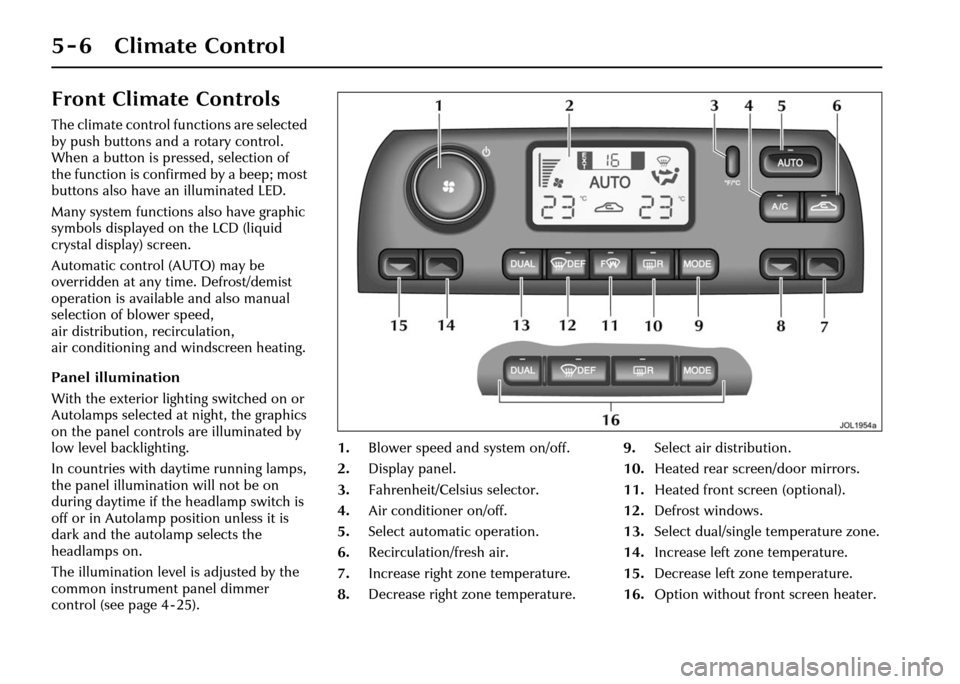
The climate control functions are selected
by push buttons and a rotary control.
When a button is pressed, selection of
the function is confirmed by a beep; most
buttons also have an illuminated LED.
Many system functions also have graphic
symbols displayed on the LCD (liquid
crystal display) screen.
Automatic control (AUTO) may be
overridden at any time. Defrost/demist
operation is available and also manual
selection of blower speed,
air distribution, recirculation,
air conditioning and windscreen heating.
Panel illumination
With the exterior lighting switched on or
Autolamps selected at night, the graphics
on the panel controls are illuminated by
low level backlighting.
In countries with daytime runnin g lamps,
the panel illumination will not be on
during daytime if the headlamp switch is
off or in Autolamp position unless it is
dark and the autolamp selects the
headlamps on.
The illumination level is adjusted by the
common instrument panel dimmer
control (see page 4 - 25). 1.
Blower speed and system on/off.
2. Display panel.
3. Fahrenheit/Celsius selector.
4. Air conditioner on/off.
5. Select automatic operation.
6. Recirculation/fresh air.
7. Increase right zone temperature.
8. Decrease right zone temperature. 9.
Select air distribution.
10. Heated rear screen/door mirrors.
11. Heated front screen (optional).
12. Defrost windows.
13. Select dual/single temperature zone.
14. Increase left zone temperature.
15. Decrease left zone temperature.
16. Option without fron t screen heater.
Page 147 of 227
5 - 8 Climate Control
Windscreen Defrost/Demist
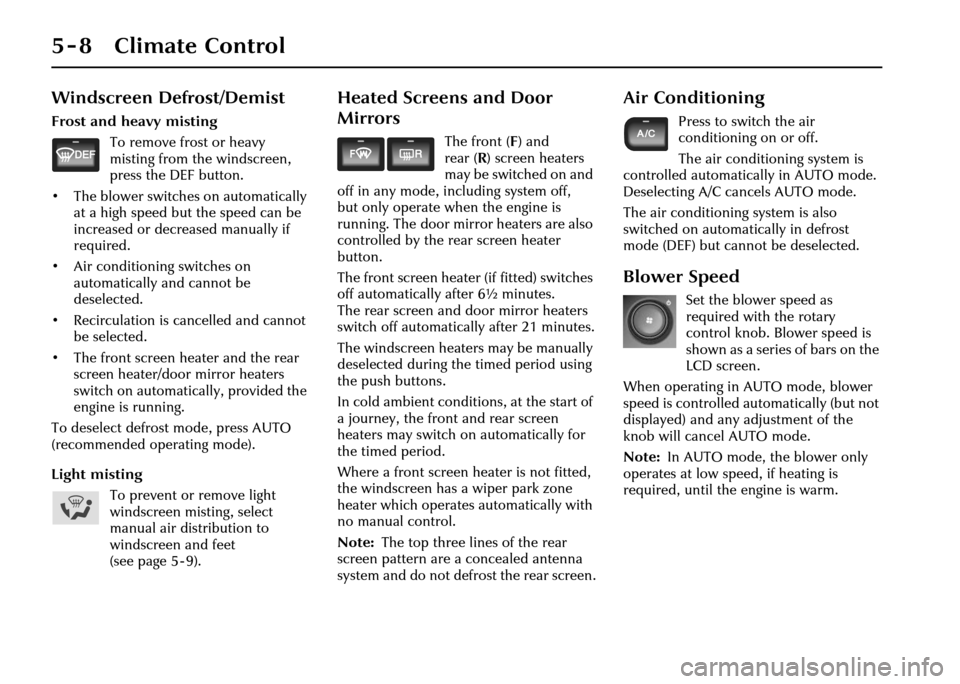
Frost and heavy mistingTo remove frost or heavy
misting from the windscreen,
press the DEF button.
• The blower switches on automatically at a high speed but the speed can be
increased or decrea sed manually if
required.
• Air conditioning switches on automatically and cannot be
deselected.
• Recirculation is ca ncelled and cannot
be selected.
• The front screen heater and the rear screen heater/door mirror heaters
switch on automatically, provided the
engine is running.
To deselect defrost mode, press AUTO
(recommended operating mode).
Light misting To prevent or remove light
windscreen misting, select
manual air distribution to
windscreen and feet
(see page 5 - 9).
Heated Screens and Door
Mirrors
The front ( F) and
rear ( R) screen heaters
may be switched on and
off in any mode, including system off,
but only operate when the engine is
running. The door mirror heaters are also
controlled by the rear screen heater
button.
The front screen heater (if fitted) switches
off automatically after 6½ minutes.
The rear screen and door mirror heaters
switch off automatica lly after 21 minutes.
The windscreen heaters may be manually
deselected during the timed period using
the push buttons.
In cold ambient conditions, at the start of
a journey, the front and rear screen
heaters may switch on automatically for
the timed period.
Where a front screen he ater is not fitted,
the windscreen has a wiper park zone
heater which operates automatically with
no manual control.
Note: The top three lines of the rear
screen pattern are a concealed antenna
system and do not defrost the rear screen.
Air Conditioning
Press to switch the air
conditioning on or off.
The air conditioning system is
controlled automatically in AUTO mode.
Deselecting A/C cancels AUTO mode.
The air conditioning system is also
switched on automatically in defrost
mode (DEF) but cann ot be deselected.
Blower Speed
Set the blower speed as
required with the rotary
control knob. Blower speed is
shown as a series of bars on the
LCD screen.
When operating in AUTO mode, blower
speed is controlled automatically (but not
displayed) and any adjustment of the
knob will cancel AUTO mode.
Note: In AUTO mode, the blower only
operates at low speed, if heating is
required, until the engine is warm.
Page 148 of 227
Climate Control 5 - 9
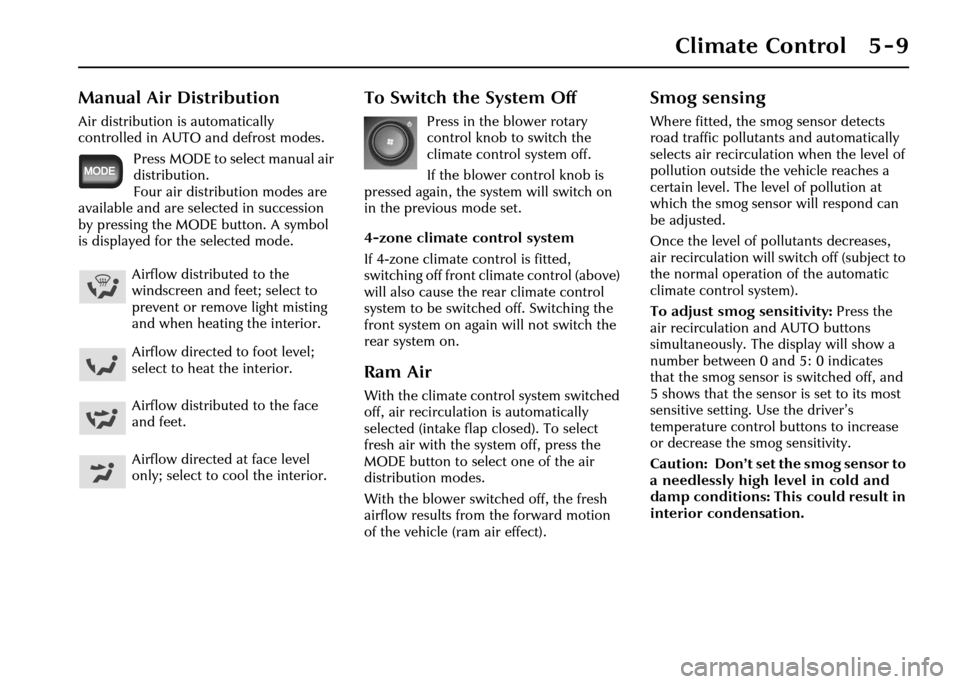
Manual Air Distribution
Air distribution is automatically
controlled in AUTO and defrost modes.Press MODE to select manual air
distribution.
Four air distribution modes are
available and are selected in succession
by pressing the MODE button. A symbol
is displayed for the selected mode.
To Switch the System Off
Press in the blower rotary
control knob to switch the
climate control system off.
If the blower control knob is
pressed again, the system will switch on
in the previous mode set.
4-zone climate control system
If 4-zone climate control is fitted,
switching off front climate control (above)
will also cause the rear climate control
system to be switched off. Switching the
front system on again will not switch the
rear system on.
Ram Air
With the climate control system switched
off, air recirculation is automatically
selected (intake flap closed). To select
fresh air with the system off, press the
MODE button to select one of the air
distribution modes.
With the blower switched off, the fresh
airflow results from the forward motion
of the vehicle (ram air effect).
Smog sensing
Where fitted, the smog sensor detects
road traffic pollutants and automatically
selects air recirculation when the level of
pollution outside the vehicle reaches a
certain level. The level of pollution at
which the smog sensor will respond can
be adjusted.
Once the level of pollutants decreases,
air recirculation will switch off (subject to
the normal operation of the automatic
climate control system).
To adjust smog sensitivity: Press the
air recirculation and AUTO buttons
simultaneously. The display will show a
number between 0 and 5: 0 indicates
that the smog sensor is switched off, and
5 shows that the sensor is set to its most
sensitive setting. Use the driver’s
temperature control bu ttons to increase
or decrease the smog sensitivity.
Caution: Don’t set the smog sensor to
a needlessly high level in cold and
damp conditions: This could result in
interior condensation.
Airflow distributed to the
windscreen and feet; select to
prevent or remove light misting
and when heating the interior.
Airflow directed to foot level;
select to heat the interior.
Airflow distributed to the face
and feet.
Airflow directed at face level
only; select to cool the interior.
Page 157 of 227
6 - 6 Roadside Emergency
Wheel Changing and
Jacking
Be prepared for a flat tyre. Know where
equipment is stowed and read the wheel
changing and jacking instructions
carefully. Keep the jack screw threads
clean and greased to ensure it is always
ready for an emergency.
Park off the road, clear of all traffic and
on as level, solid ground as possible.
Switch on hazard warning lights and,
where legally required, display the
warning triangle.
!WARNING:
It can be dangerous to change a
wheel when the vehicle is on a slope
or soft, uneven ground.
Temporary-use Spare Wheel
Note: Maintenance information for the
temporary-use spare wheel is the same as
given for normal tyres.
Observe the following warnings before
using the wheel:
!WARNING:
1. Please note th e temporary-use
spare wheel warning label on the
wheel. Adhere to instructions on
the label. Failure to comply can be
dangerous.
2. When a temporary spare wheel is fitted, drive with caution and
replace with the specified wheel
and tyre as soon as possible.
3. Do not fit more than one temporary-use spare wheel and
tyre assembly at a time.
4. The temporary-use spare wheel must be inflated to the correct
pressure.
5. Temporary-use spare wheel maximum speed is 80 km/h
(50 mph).