Power steering JAGUAR XJ6 1994 2.G User Guide
[x] Cancel search | Manufacturer: JAGUAR, Model Year: 1994, Model line: XJ6, Model: JAGUAR XJ6 1994 2.GPages: 521, PDF Size: 17.35 MB
Page 205 of 521
@ Steering
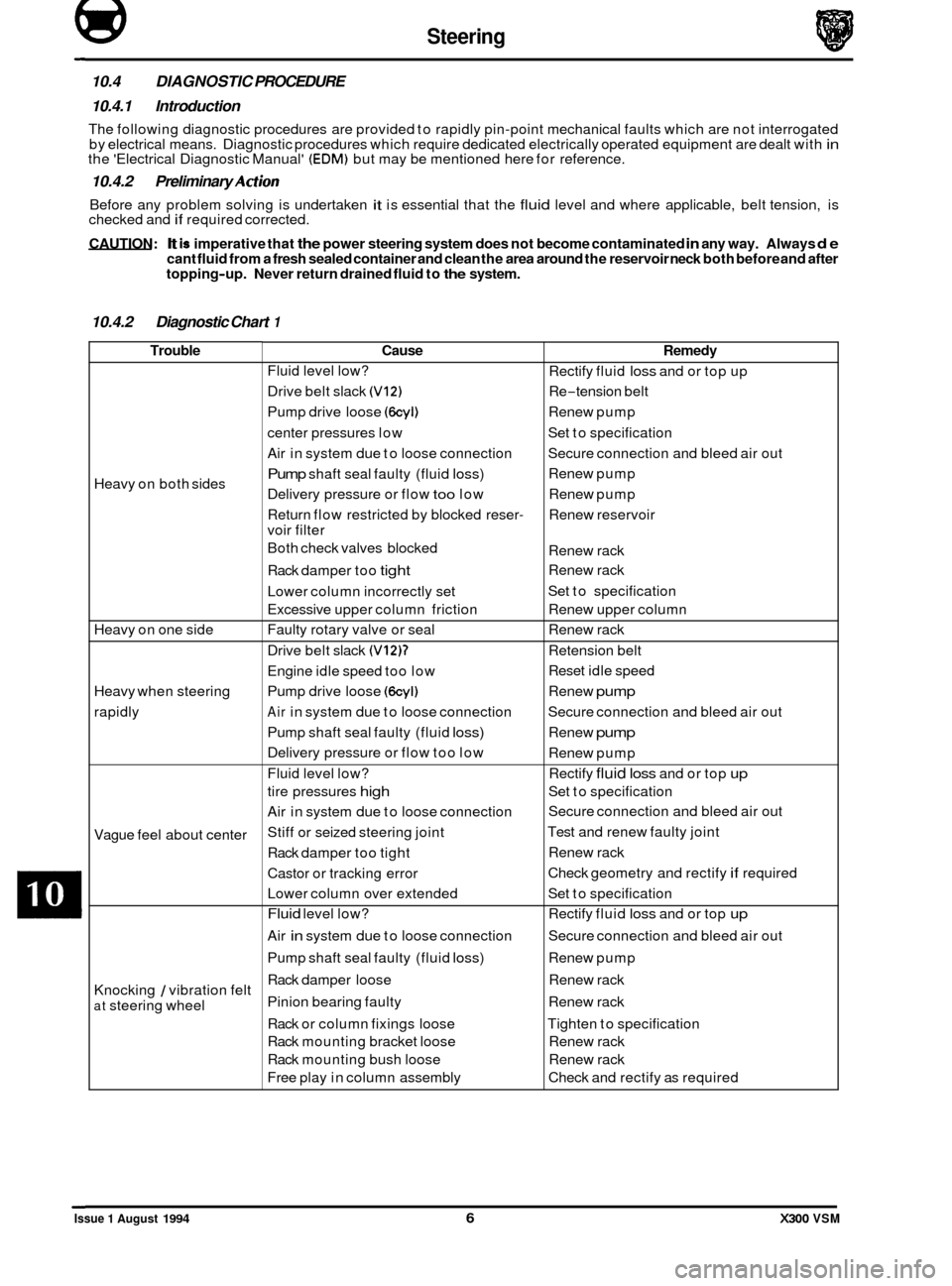
Cause
Fluid level low?
Drive belt slack
(V12)
Pump drive loose (6cyl)
center pressures low
Air in system due to loose connection
Pump shaft seal faulty (fluid loss)
Delivery pressure or flow too low
Return flow restricted by blocked reser
-
voir filter
Both check valves blocked
Rack damper too
tight
Lower column incorrectly set
Excessive upper column friction
Faulty rotary valve or seal
Drive belt slack
(VI217
Engine idle speed too low
Pump drive loose
(6cyl)
Air in system due to loose connection
Pump shaft seal faulty (fluid
loss)
Delivery pressure or flow too low
Fluid level low?
tire pressures
high
Air in system due to loose connection
Stiff or seized steering joint
Rack damper too tight
Castor or tracking error
Lower column over extended
Fluid level low?
Air
in system due to loose connection
Pump shaft seal faulty (fluid
loss)
Rack damper loose
Pinion bearing faulty
Rack or column fixings loose
Rack mounting bracket loose
Rack mounting bush loose
Free play in column assembly
10.4 DIAGNOSTIC PROCEDURE
10.4.1 Introduction
The following diagnostic procedures are provided to rapidly pin-point mechanical faults which are not interrogated
by electrical means. Diagnostic procedures which require dedicated electrically operated equipment are dealt with in the 'Electrical Diagnostic Manual' (EDM) but may be mentioned here for reference.
10.4.2 Preliminary Action
Before any problem solving is undertaken it is essential that the fluid level and where applicable, belt tension, is
checked and if required corrected.
CAUTION: It is imperative that the power steering system does not become contaminated in any way. Always de cant fluid from a fresh sealed container and clean the area around the reservoir neck both before and after
topping-up. Never return drained fluid to the system.
10.4.2 Diagnostic Chart 1
Remedy
Rectify fluid loss and or top up
Re
-tension belt
Renew pump
Set to specification
Secure connection and bleed air out
Renew pump
Renew pump
Renew reservoir
Renew rack
Renew rack
Set to specification
Renew upper column
Renew rack
Retension belt
Reset idle speed
Renew
pump
Secure connection and bleed air out
Renew
pump
Renew pump
Rectify
fluid loss and or top up
Set to specification
Secure connection and bleed air out
Test and renew faulty joint
Renew rack
Check geometry and rectify
if required
Set to specification
Rectify fluid
loss and or top up
Secure connection and bleed air out
Renew pump
Renew rack
Renew rack
Tighten to specification
Renew rack
Renew rack
Check and rectify as required
Trouble
Heavy on both sides
Heavy on one side
Heavy when steering
rapidly
Vague feel about center
Knocking
1 vibration felt
at steering wheel
0
0
0
0
Issue 1 August 1994 6 X300 VSM
Page 219 of 521
Suspension Systems
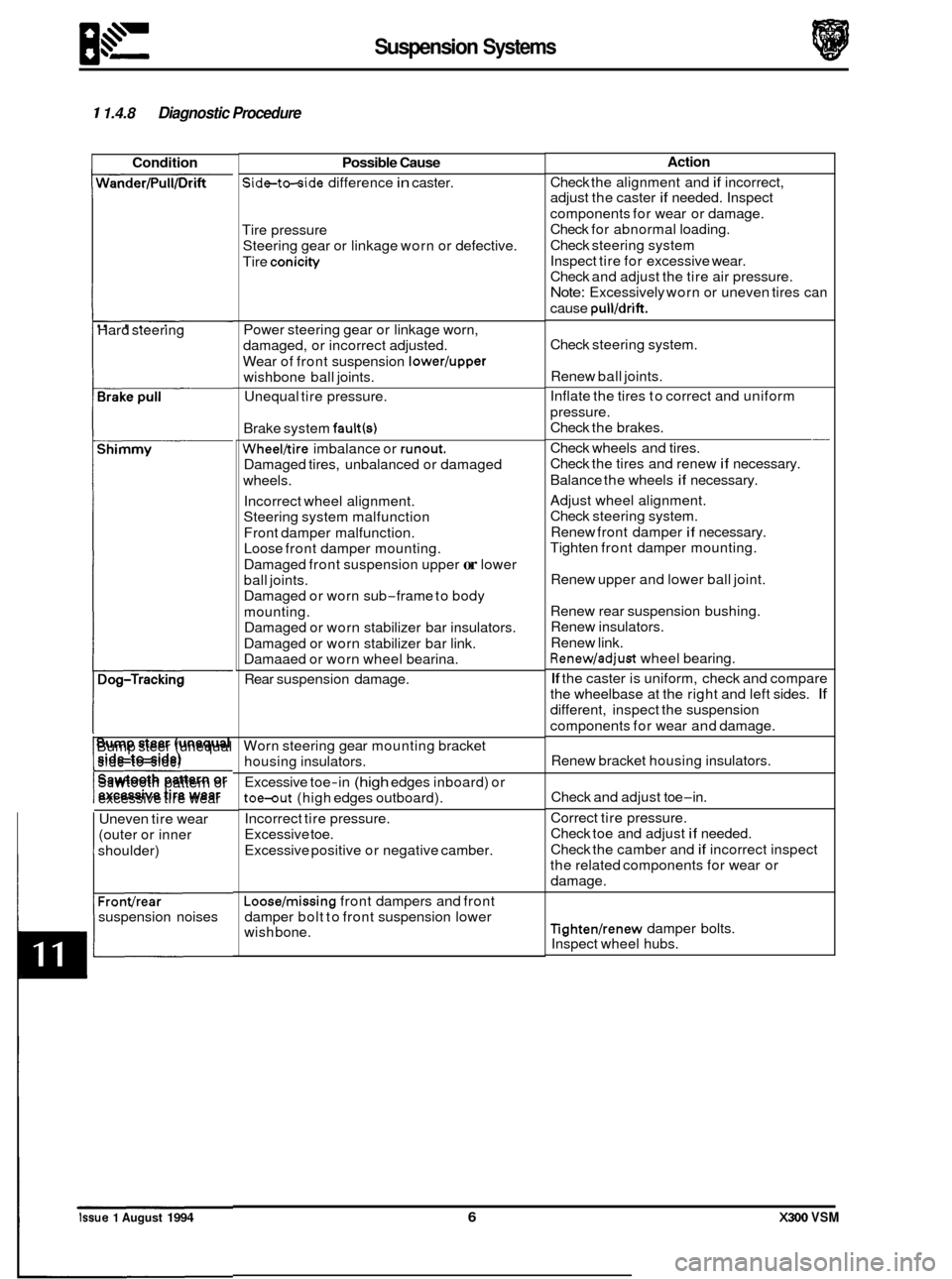
1 1.4.8 Diagnostic Procedure
Condition
Hard steering
Shimmy
I----
Bump steer (unequal
side-to-side)
Sawtooth pattern or
t excessive tire wear
Uneven tire wear
(outer or inner
shoulder)
Fronvrear
suspension noises
Possible Cause
Side-to-side difference in caster.
Tire pressure Steering gear or linkage worn or defective.
Tire
conicity
Power steering gear or linkage worn,
damaged, or incorrect adjusted.
Wear of front suspension
lower/upper
wishbone ball joints.
Unequal tire pressure.
Brake system
fault(s)
Wheel/tire imbalance or runout.
Damaged tires, unbalanced or damaged
wheels.
Incorrect wheel alignment.
Steering system malfunction
Front damper malfunction.
Loose front damper mounting.
Damaged front suspension upper
or lower
ball joints.
Damaged or worn sub
-frame to body
mounting. Damaged or worn stabilizer bar insulators.
Damaged or worn stabilizer bar link.
Damaaed or worn wheel bearina.
Rear suspension damage.
Worn steering gear mounting bracket
housing insulators.
Excessive toe
-in (high edges inboard) or
toe-out (high edges outboard).
Incorrect tire pressure.
Excessive toe.
Excessive positive or negative camber.
Loose/missing front dampers and front
damper bolt to front suspension lower
wish bone.
Action
Check the alignment and if incorrect,
adjust the caster
if needed. Inspect
components for wear or damage.
Check for abnormal loading.
Check steering system
Inspect tire for excessive wear.
Check and adjust the tire air pressure.
Note: Excessively worn or uneven tires can
cause
pull/drift.
Check steering system.
Renew ball joints.
Inflate the tires to correct and uniform
pressure.
Check the brakes.
Check wheels and tires.
Check the tires and renew
if necessary.
Balance the wheels
if necessary.
Adjust wheel alignment.
Check steering system.
Renew front damper
if necessary.
Tighten front damper mounting.
-
Renew upper and lower ball joint.
Renew rear suspension bushing.
Renew insulators.
Renew link.
Renew/adjust wheel bearing.
If the caster is uniform, check and compare
the wheelbase at the right and left sides.
If
different, inspect the suspension
components for wear and damage.
Renew bracket housing insulators.
Check and adjust toe
-in.
Correct tire pressure.
Check toe and adjust
if needed.
Check the camber and
if incorrect inspect
the related components for wear or
damage.
Tighten/renew damper bolts.
Inspect wheel hubs.
0
0
0
lssue 1 August 1994 6 X300 VSM
Page 303 of 521
Body Components & Trim a
13.8 SEATING AND SEAT BELTS
13.8.1 Seating, Description
The front seats are available in a range of materials consisting of sculptured fabric / leather, leather, sports cloth / leather, embossed leather / leather and autolux. Both seats are available as 'manual', ie manually adjustable with elec- tric rise and fall, manual height adjustment headrests, 'power', ie 12-way electric adjustment, 'power with memory', ie memory controlled, 12-way electric adjustment of seat, steering column and exterior rear view mirrors and 'heated',
ie with integral heating.
Front seats are based on a non
-handed, one-piece frame which includes cushion and squab frames and seat adjuster
mechanisms. The seat switchpacks (powerseats) are fitted to the outboard side of driver and passenger seats; on 'man- ual'seats, the seat height adjustment switch is similarly located. Seat control modules SCMs are contained within the
seat assemblies. The seats are secured through four mounting points to the vehicle floor.
Rear seats are of the bench type with
full width removable cushion and individual seat squabs.
Electrical components installed on the heel board below the rear passenger seat are protected
by two covers secured
by two locating brackets on the floor and by two latches on the cover. The latches are released by pushing down on
the two recesses in the top edge of the cover.
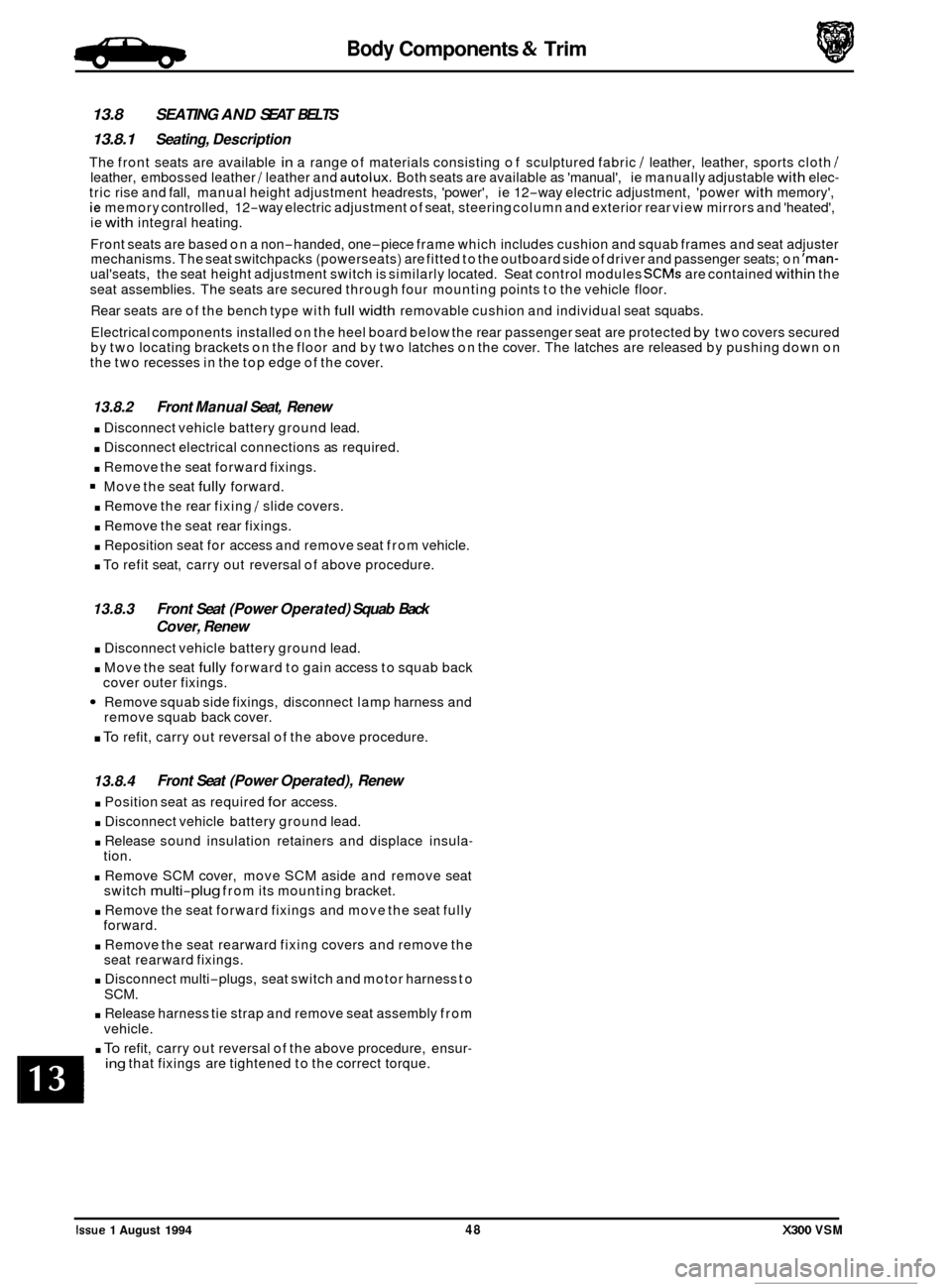
13.8.2 Front Manual Seat, Renew
. Disconnect vehicle battery ground lead.
. Disconnect electrical connections as required.
. Remove the seat forward fixings.
Move the seat fully forward.
. Remove the rear fixing / slide covers.
. Remove the seat rear fixings.
. Reposition seat for access and remove seat from vehicle.
. To refit seat, carry out reversal of above procedure.
13.8.3
. Disconnect vehicle battery ground lead.
. Move the seat fully forward to gain access to squab back
Remove squab side fixings, disconnect lamp harness and
. To refit, carry out reversal of the above procedure.
Front Seat (Power Operated) Squab Back
Cover, Renew
cover outer fixings.
remove squab back cover.
13.8.4
. Position seat as required for access.
. Disconnect vehicle battery ground lead.
. Release sound insulation retainers and displace insula-
. Remove SCM cover, move SCM aside and remove seat
. Remove the seat forward fixings and move the seat fully
. Remove the seat rearward fixing covers and remove the
. Disconnect multi-plugs, seat switch and motor harness to
. Release harness tie strap and remove seat assembly from
Front Seat (Power Operated), Renew
tion.
switch
multi-plug from its mounting bracket.
forward. seat rearward fixings.
SCM.
vehicle.
. To refit, carry out reversal of the above procedure, ensur- ing that fixings are tightened to the correct torque.
Issue 1 August 1994 48 X300 VSM
0
0
0
Page 345 of 521
rl Electrical
15.1.6 Fire Hazard Infonnath
Thermal decomposition or combustion may produce dense smoke and other dangerous fumes which in fire situations
form
a highly toxic explosive.
In the event of fire the surrounding area must be evacuated and
all personnel kept well upwind of the area.
Full fire fighting protective gear and
a self contained breathing apparatus operating in the positive pressure mode must
be worn for combating fire. Material near fires must be cooled with water spray to prevent ignition.
Fires should be allowed to burn themselves
out if not threatening to life or property. If fire is threatening to life or prop- erty use copious quantities of water to extinguish.
15.1.7 Ventilath
Local exhaust ventilation designed by a professional engineer should be provided if vapours, fumes, or dusts are gen- erated whilst working with airbag module.
The latest issue of the manual for recommended practices on 'Industrial Ventilation' is available from the
ACGIH Com- mittee on Industrial Ventilation, PO Box 16153, Lansing, MI 48910, USA.
The need for local exhaust ventilation should be evaluated by a professional industrial hygienist.
15.1.8 Respiratory Precauth
To prevent the inhalation of dangerous fumes and dusts, an approved mask should be worn.
15.1.9 Eye Protection
Chemical protective goggles are recommended where there is a possibility of eye contact with the propellant.
Safety glasses with side shields are recommended for
all other operations.
15.1. I0 Protective Clothing
Approved protective gloves, overalls and shoes / boots should be worn.
15.1.1 1 Handling and Storage Precautions
Do not store airbag module near live electrical equipment or circuitry. Store in a dry environment at ambient tempera-
tures.
Good housekeeping and engineering practices should be employed to prevent the generation and accumulation of
dusts. Store in compliance with
all local state and federal regulations.
15.1.12 Driver And Passenger Airbag Modules Assembly / Removal / Service Instructions
Before starting work, ensure ignition switch is in 'IocK position, key is removed and negative terminal cable
is disconnected from the battery.
As the airbag is equipped with a back up power source and due to the risk of airbag being inadvertently
deployed, wait one minute or longer before starting work.
0 Disconnecting the battery cancels the memory for clock, radio, seats, mirrors, steering column and any other
components using battery power. Reset memory after work is completed.
0 Never use airbags from other vehicles, always use new parts.
0 After work is completed, reconnect battery and perform warning light check see diagnostic manual.
0 Never use electrical probes to check voltage or electrical resistance.
0 Disconnect the airbag before carrying out any work on, or in the vicinity of module, or when using electric weld- ing equipment.
0 Always ensure that battery negative has been disconnected for one minute or longer before commencing any
removal procedure.
EB
Issue 1 August 1994 4 X300 VSM
Page 357 of 521
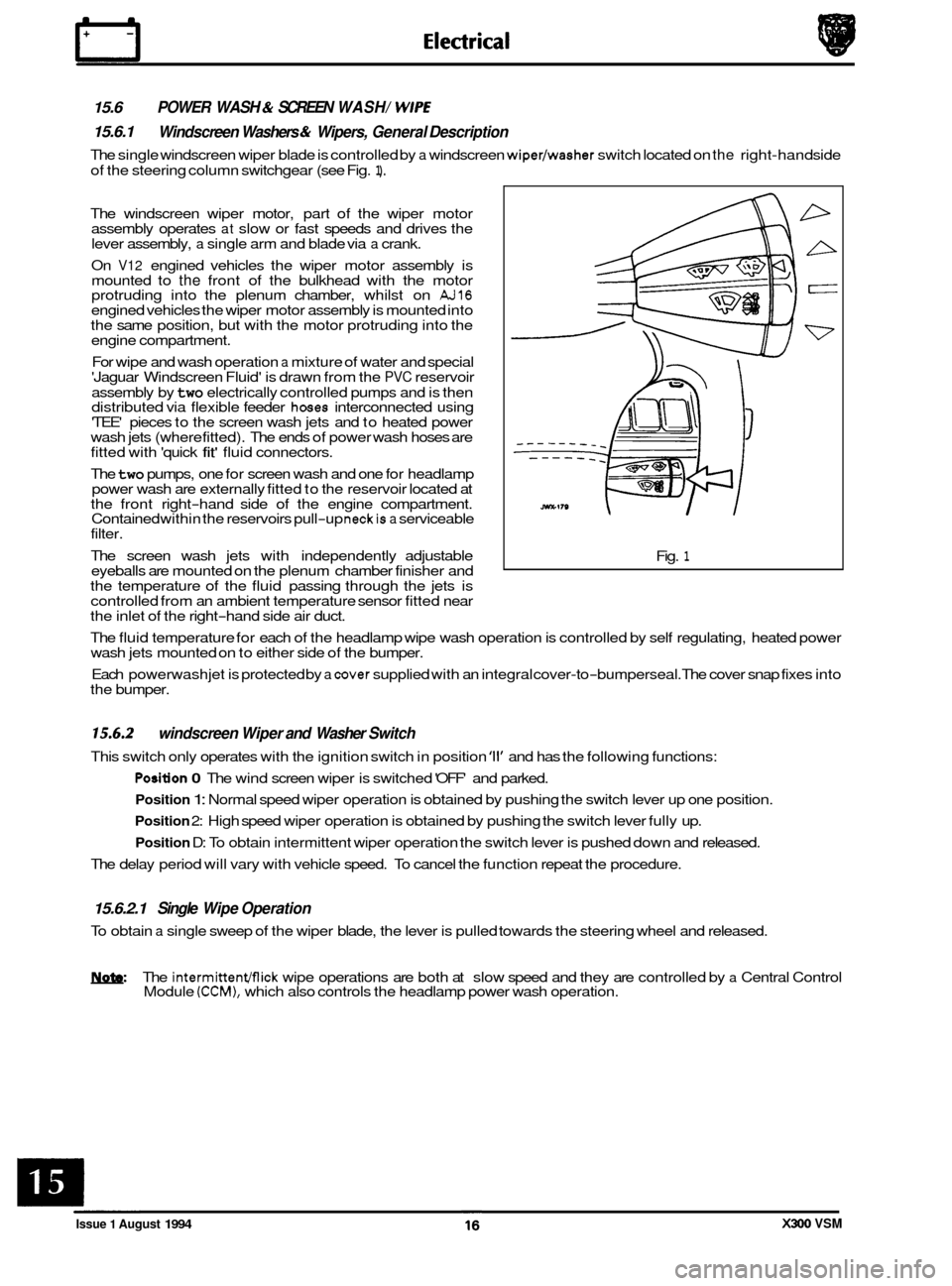
15.6
15.6.1
The single windscreen wiper blade is controlled by a windscreen wiper/washer switch located on the right-hand side
of the steering column switchgear (see Fig.
1).
POWER WASH & SCREEN WASH/ WlPE
Windscreen Washers & Wipers, General Description
The windscreen wiper motor, part of the wiper motor
assembly operates at slow or fast speeds and drives the
lever assembly, a single arm and blade via a crank.
On
V12 engined vehicles the wiper motor assembly is
mounted to the front of the bulkhead with the motor
protruding into the plenum chamber, whilst on AJ16 engined vehicles the wiper motor assembly is mounted into
the same position, but with the motor protruding into the
engine compartment.
For wipe and wash operation
a mixture of water and special
'Jaguar Windscreen Fluid' is drawn from the PVC reservoir
assembly by
two electrically controlled pumps and is then
distributed via flexible feeder hoses interconnected using
'TEE' pieces to the screen wash jets and to heated power
wash jets (where fitted). The ends of power wash hoses are
fitted with 'quick
fit' fluid connectors.
The
two pumps, one for screen wash and one for headlamp
power wash are externally fitted to the reservoir located at
the front right
-hand side of the engine compartment.
Contained within the reservoirs pull-up neckis a serviceable
filter.
The screen wash jets with independently adjustable
eyeballs are mounted on the plenum chamber finisher and
the temperature of the fluid passing through the jets is
controlled from an ambient temperature sensor fitted near
the inlet of the right
-hand side air duct. Fig.
1
The
fluid temperature for each of the headlamp wipe wash operation is controlled by self regulating, heated power
wash jets mounted on to either side of the bumper.
Each powerwash jet is protected by
a cover supplied with an integral cover-to-bumperseal. The cover snap fixes into
the bumper.
15.6.2
This switch only operates with the ignition switch in position '11' and has the following functions:
windscreen Wiper and Washer Switch
Position 0 The wind screen wiper is switched 'OFF' and parked.
Position 1: Normal speed wiper operation is obtained by pushing the switch lever up one position.
Position 2: High speed wiper operation is obtained by pushing the switch lever fully up.
Position D: To obtain intermittent wiper operation the switch lever is pushed down and released.
The delay period will vary with vehicle speed. To cancel the function repeat the procedure.
15.6.2.1 Single Wipe Operation
To obtain a single sweep of the wiper blade, the lever is pulled towards the steering wheel and released.
W The intermittenmick wipe operations are both at slow speed and they are controlled by a Central Control
Module (CCM), which also controls the headlamp power wash operation.
Issue 1 August 1994 X300 VSM
Page 380 of 521
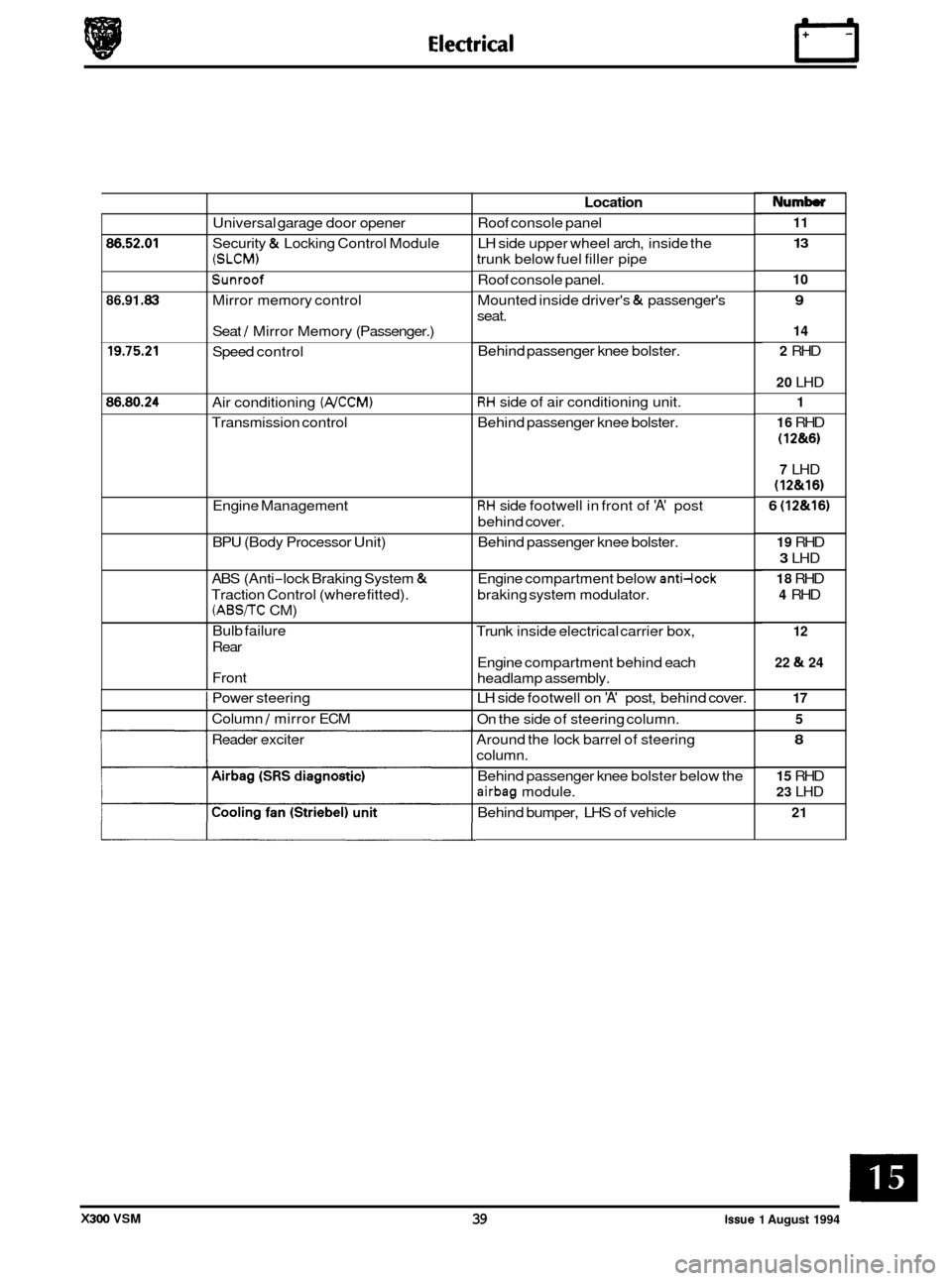
86.52.01
86.91 -83
19.75.21
86.80.24
Universal garage door opener
Security
& Locking Control Module
(SLCM)
Sunroof
Mirror memory control
Seat
/ Mirror Memory (Passenger.)
Speed control
Air conditioning
(NCCM)
Transmission control
Engine Management
BPU (Body Processor Unit)
ABS (Anti
-lock Braking System &
Traction Control (where fitted).
(ABS/TC CM)
Bulb failure
Rear
Front
I Power steering
I Column / mirror ECM
Reader exciter
Location
Roof console panel
LH side upper wheel arch, inside the
trunk below fuel filler pipe
Roof console panel.
Mounted inside driver's
& passenger's
seat.
Behind passenger knee bolster.
RH side of air conditioning unit.
Behind passenger knee bolster.
RH side footwell in front of 'A' post
behind cover.
Behind passenger knee bolster.
Engine compartment below
anti-lock
braking system modulator.
Trunk inside electrical carrier box,
Engine compartment behind each
headlamp assembly.
LH side footwell on
'A' post, behind cover.
On the side of steering column.
Around the lock barrel of steering
column.
Behind passenger knee bolster below the
airbag module.
Behind bumper, LHS of vehicle
Numb
11
13
10
9
14
2
RHD
20 LHD
1
16
RHD
(1 2&6)
7 LHD
(12&16)
6 (12&16)
19 RHD
3 LHD
18 RHD
4 RHD
12
22
& 24
17 5
8
15 RHD
23 LHD
21
X300 VSM 39 issue 1 August 1994
Page 387 of 521
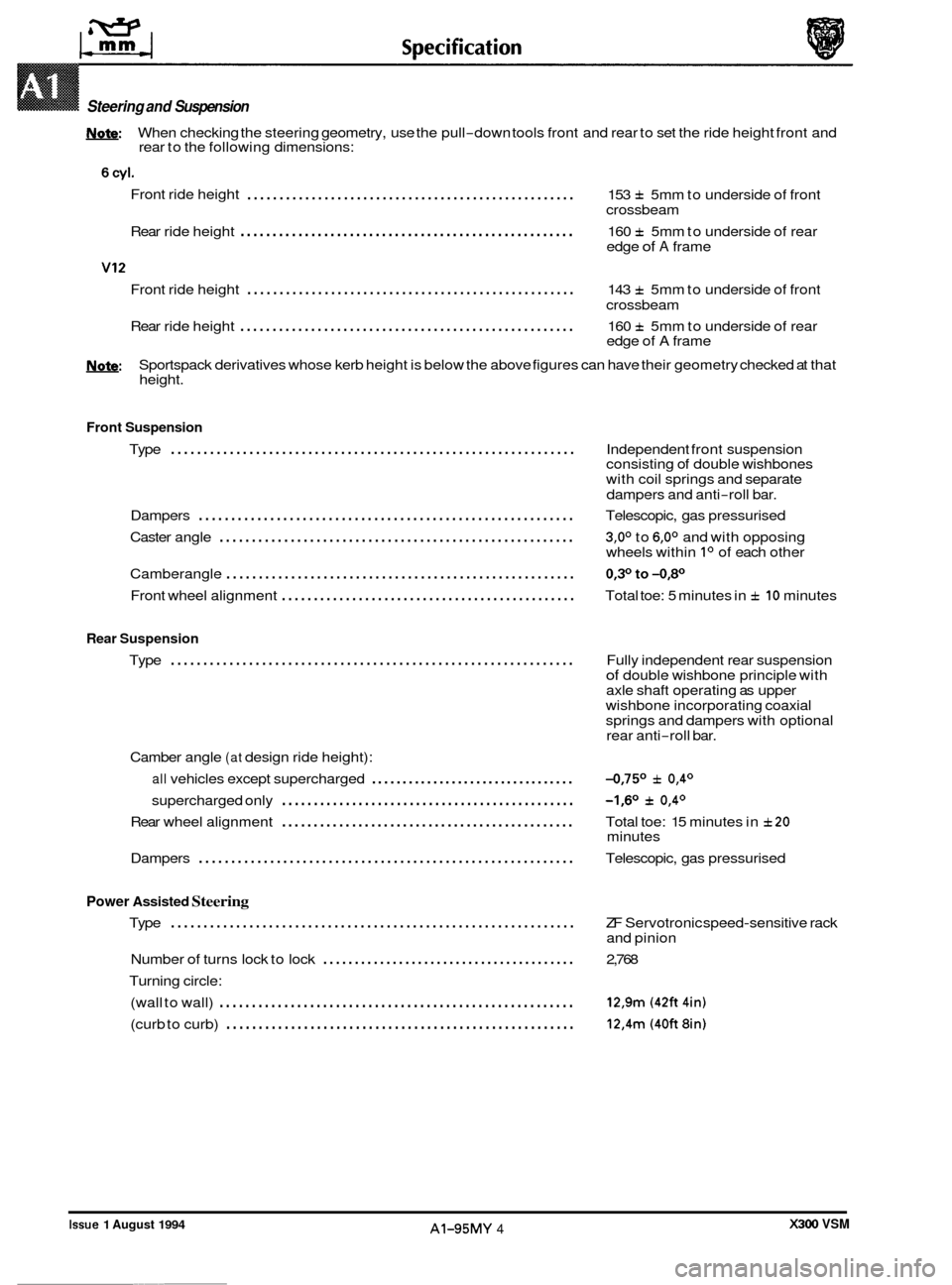
Steering and Suspension
W: When checking the steering geometry, use the pull-down tools front and rear to set the ride height front and
rear to the following dimensions:
Front ride height
................................................... 153 f 5mm to underside of front
crossbeam
Rear ride height
.................................................... 160 f 5mm to underside of rear
edge of A frame
Front ride height
................................................... 143 f 5mm to underside of front
crossbeam
Rear ride height
.................................................... 160 f 5mm to underside of rear
edge of A frame
U: Sportspack derivatives whose kerb height is below the above figures can have their geometry checked at that
height.
Front Suspension
..............................................................
0
Type Independent front suspension
consisting of double wishbones
with coil springs and separate
dampers and anti
-roll bar.
Dampers
.......................................................... Telescopic, gas pressurised
Caster angle
....................................................... 3,0° to 6,0° and with opposing
wheels within Io of each other
Camberangle
...................................................... 0,3°to-0,80
Front wheel alignment .............................................. Total toe: 5 minutes in f 10 minutes
Rear Suspension
Type .............................................................. Fully independent rear suspension of double wishbone principle with
axle shaft operating as upper
wishbone incorporating coaxial
springs and dampers with optional
rear anti
-roll bar.
Camber angle
(at design ride height):
all vehicles except supercharged ................................. -0,75O f 0,4O
supercharged only -1,6O f 0,4O ..............................................
0 Rear wheel alignment .............................................. Total toe: 15 minutes in f20
Dampers .......................................................... Telescopic, gas pressurised
minutes
Power Assisted Steering
Type .............................................................. ZF
Servotronic speed-sensitive rack
and pinion
Number
of turns lock to lock ........................................ 2,768
Turning circle: (wall to wall)
....................................................... 12,9m (42ft 4in)
(curb to curb) ...................................................... 12,4m (40ft 8in)
0
X300 VSM Issue 1 August 1994 AI-95MY 4 ~~~~
Page 390 of 521
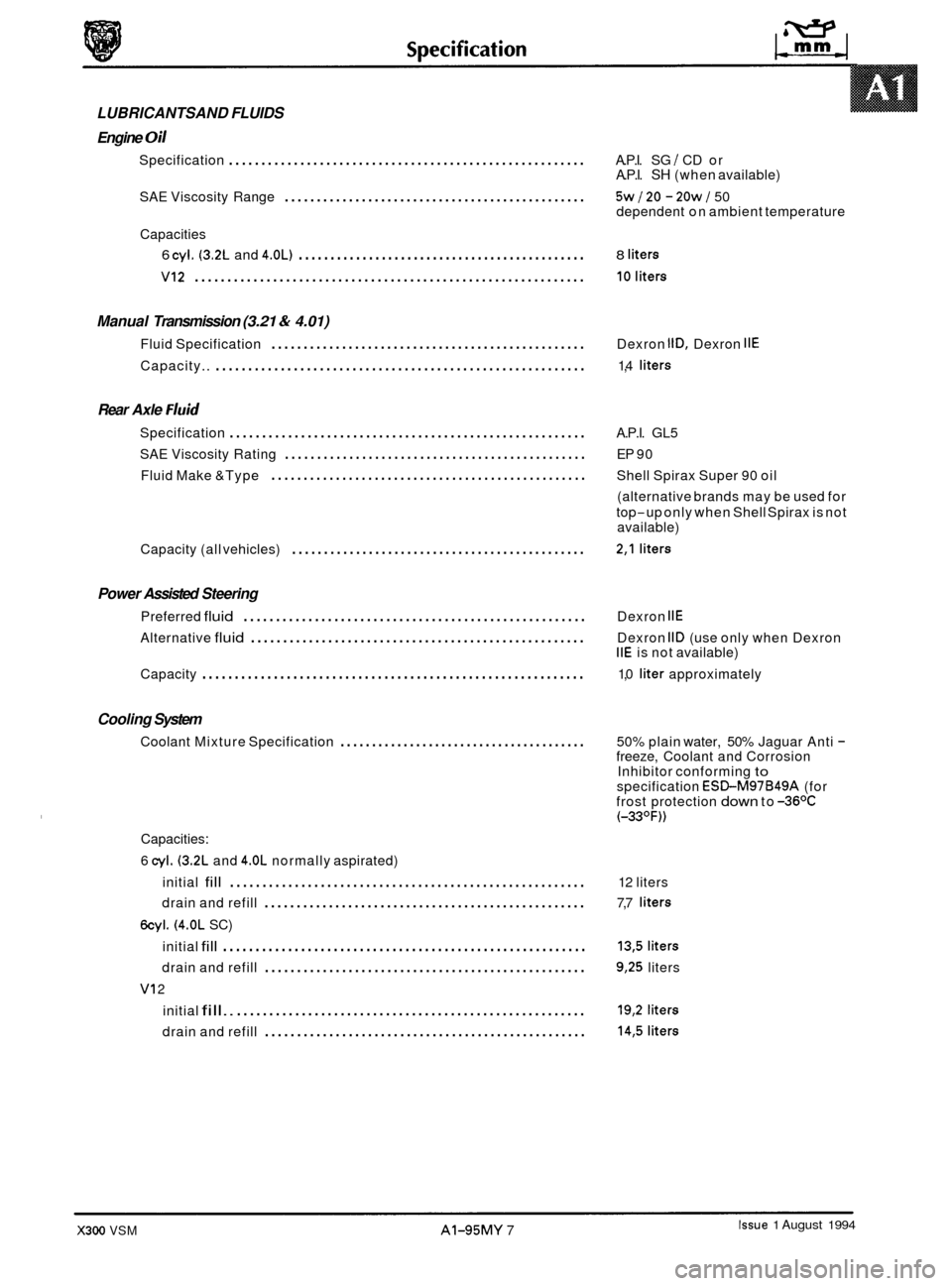
0 LUBRICANTSAND FLUIDS
Engine
Oil
Specification ....................................................... A.P.I. SG I CD or
A.P.I. SH (when available)
SAE Viscosity Range
............................................... 5w 120 - 20w J 50
dependent on ambient temperature
6 cyi. (3.2L and 4.0L) ............................................. 8 liters
VI2 ............................................................ 10liters
Capacities
Manual Transmission (3.21 & 4.01)
Fluid Specification ................................................. Dexron IlD, Dexron IIE
Capacity.. ......................................................... 1,4 liters
Rear Axle Fluid
Specification ....................................................... A.P.I. GL5
Fluid Make &Type
................................................. Shell Spirax Super 90 oil
SAE
Viscosity Rating
............................................... EP 90
(alternative brands may be used for
top
-up only when Shell Spirax is not
available)
0
Capacity (all vehicles) .............................................. 2,l liters
Power Assisted Steering
Preferred fluid ..................................................... Dexron IIE
Alternative fluid .................................................... Dexron IID (use only when Dexron IIE is not available)
Capacity
........................................................... 1,0 liter approximately
Cooling System
Coolant Mixture Specification ....................................... 50% plain water, 50% Jaguar Anti - freeze, Coolant and Corrosion
Inhibitor conforming to specification ESBM97B49A (for
frost protection down to -36OC (-33OF))
Capacities:
6
cyl. (3.2L and 4.OL normally aspirated)
initial
fill ....................................................... 12 liters
drain and refill
.................................................. 7,7 liters
6cyl. (4.0L SC)
initial
fill ........................................................ 13,5 liters
drain and refill .................................................. 9,25 liters
initial
fill.. ...................................................... 19,2 liters
drain and refill .................................................. 14,5 liters
VI 2
Issue 1 August 1994 X300 VSM AI-95MY 7
Page 399 of 521
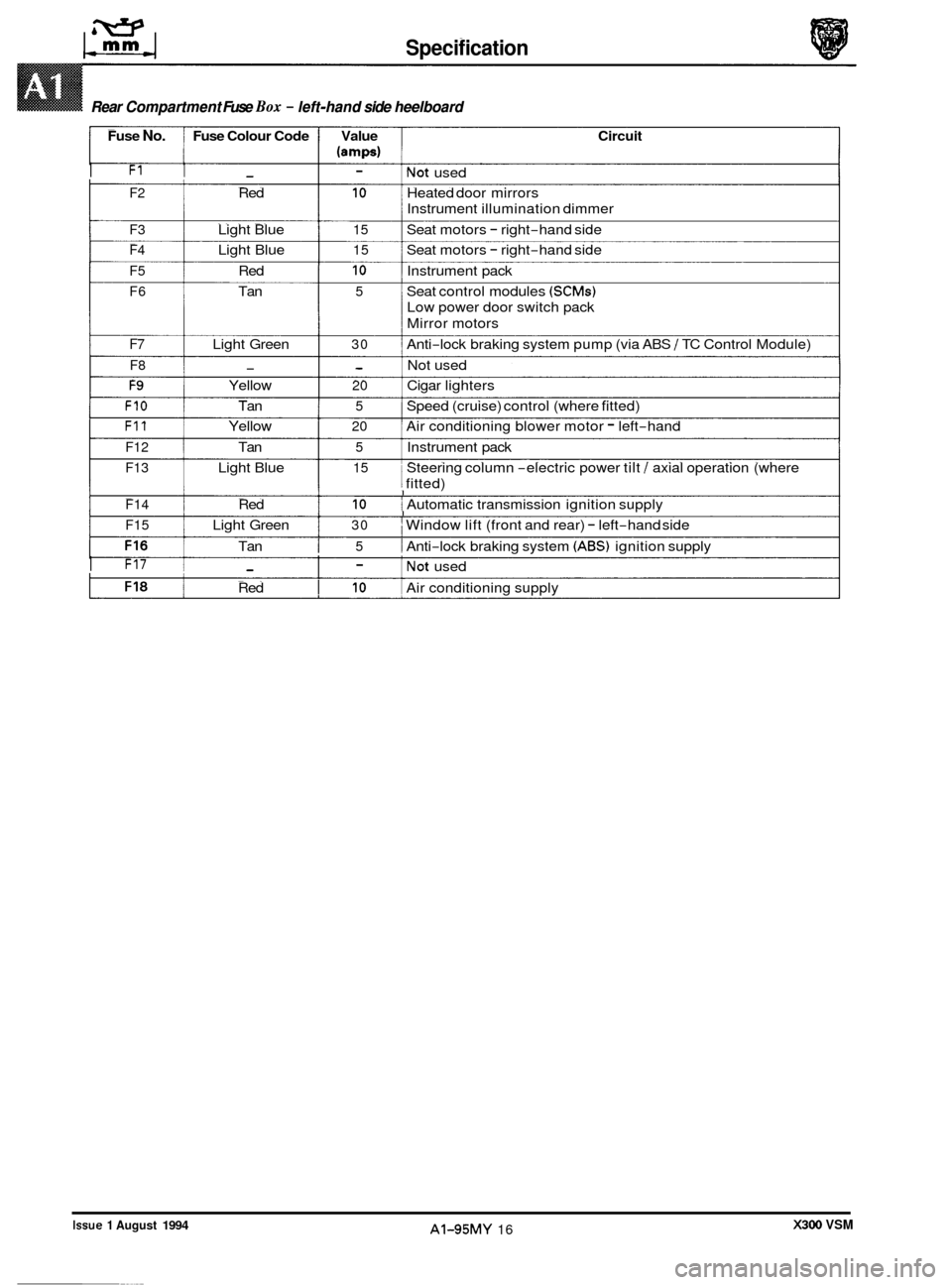
Specification
Rear Compartment Fuse Box - left-hand side heelboard
Fuse No. Fuse Colour Code Value Circuit
(amps)
I F1 I - I - lNot used
F2 Red 10 Heated door mirrors
F3 Light Blue 15 Seat motors - right-hand side
F4 Light Blue 15 Seat motors - right-hand side
F5 Red 10 Instrument pack
F6 Tan 5 Seat control modules (SCMs)
Low power door switch pack
Mirror motors
Instrument
illumination dimmer
F7 Light Green 30 Anti-lock braking system pump (via ABS / TC Control Module)
F8 - - Not used
F9 Yellow 20 Cigar lighters
FIO Tan 5 Speed (cruise) control (where fitted)
F11 Yellow 20 Air conditioning blower motor - left-hand
F12 Tan 5 Instrument pack
F13 Light Blue 15 Steering column -electric power tilt / axial operation (where
j fitted) 1 I I F14 Red 10 i Automatic transmission ignition supply I I I F15 Light Green 30 I Window lift (front and rear) - left-hand side
Tan
I 5 1 Anti-lock braking system (ABS) ignition supply
I F17 1 - I - lNot used
Red
I 10 I Air conditioning supply
Rear Compartment Fuse Box - left-hand side heelboard ~~
X300 VSM Issue 1 August 1994 AI-95MY 16
0
0
0
Page 400 of 521
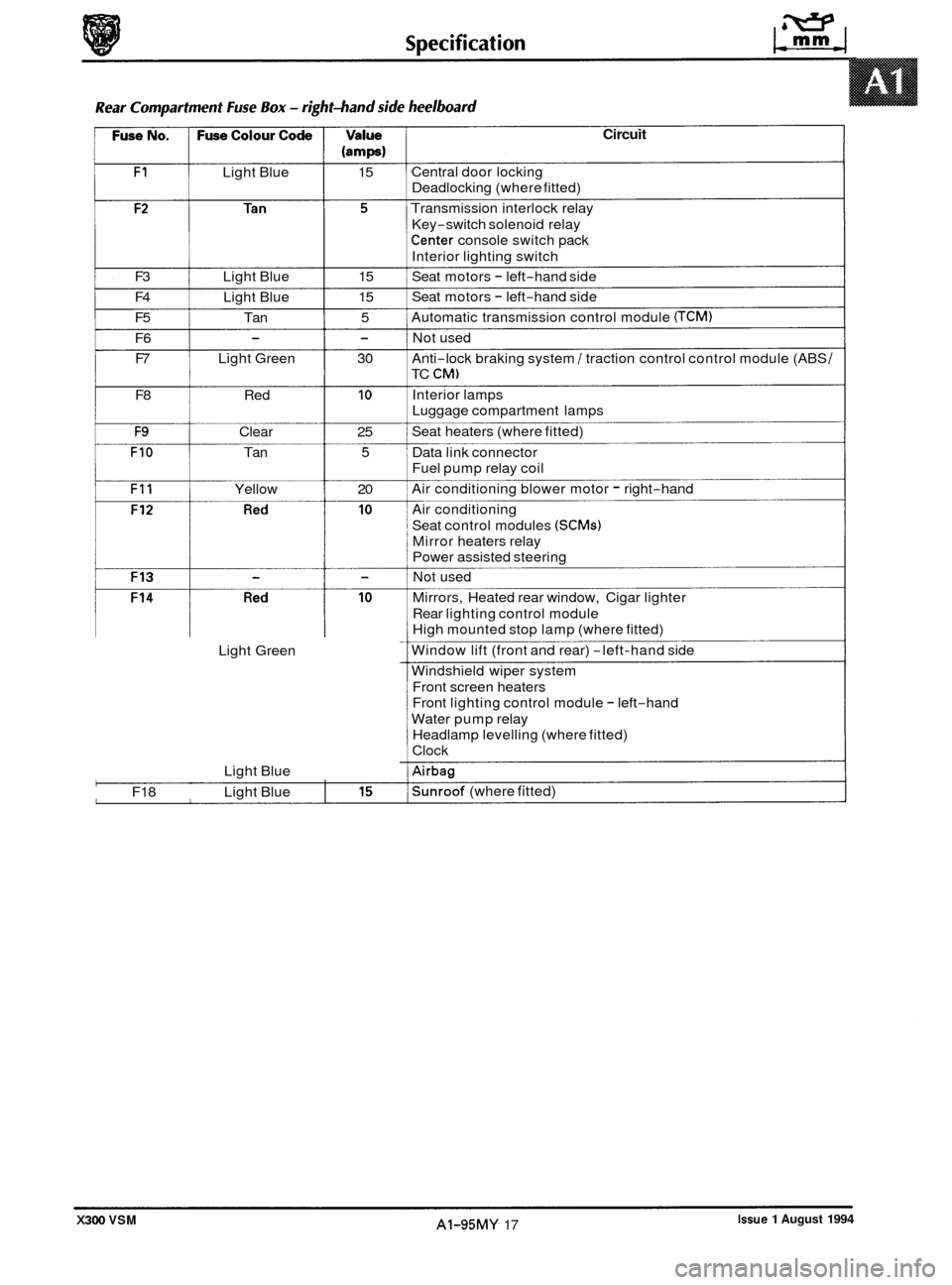
(amps)
F1 Light Blue 15
F3 Light Blue 15
F4 Light Blue 15
F5 Tan 5
F6 F7 Light Green 30
- -
F8 Red 10
F9 Clear 25
FIO Tan 5
F11 Yellow 20 0
Light Green
Light Blue
F18 Light Blue
0'
I
Circuit
Central door locking
Deadlocking (where fitted)
Transmission interlock relay
Key
-switch solenoid relay
Center console switch pack
Interior lighting switch
Seat motors
- left-hand side
Seat motors
- left-hand side
Automatic transmission control module
(TCM)
Not used
Anti
-lock braking system / traction control control module (ABS /
TC CM)
Interior lamps
Luggage compartment lamps
Seat heaters (where fitted)
Data link connector
Fuel pump relay coil
Air conditioning blower motor
- right-hand
Air conditioning
Seat control modules
(SCMs)
Mirror heaters relay
Power assisted steering
Not used
Mirrors, Heated rear window, Cigar lighter
Rear lighting control module
High mounted stop lamp (where fitted)
Window lift (front and rear)
-left-hand side
Windshield wiper system Front screen heaters
Front lighting control module
- left-hand
Water pump relay
Headlamp levelling (where fitted)
Clock
Airbag
Sunroof (where fitted)
Issue 1 August 1994 AI-95MY 17 X300 VSM